What is Zulu Beadwork (KwaZulu-Natal)?
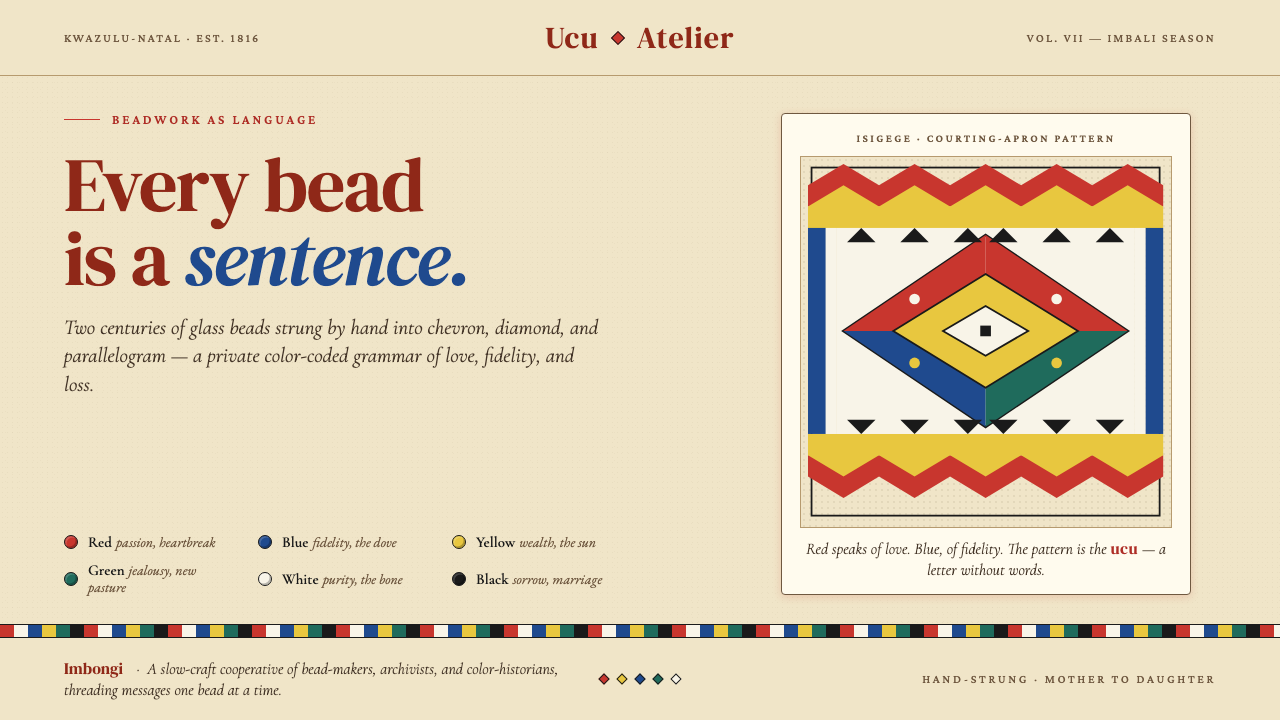
Every bead is a sentence — for two centuries Zulu women of KwaZulu-Natal have strung saturated glass primaries into chevron and diamond grids that function as a living written language.
Zulu Beadwork (KwaZulu-Natal) in brief
Zulu beadwork is southern Africa's most elaborately coded social-messaging textile. Produced by Zulu women of KwaZulu-Natal province, it encodes romantic intention, marital status, clan affiliation, and emotional states through the deliberate combination of color and geometric pattern. Unlike purely decorative craft traditions, every finished piece is a legible text: a ucu love-letter bead panel delivered to a suitor, an isigege courting apron worn at ceremonies, or a wide-band ingqosha necklace communicating the maker's social standing.
The visual system rests on a color grammar that assigns specific meanings to each of the six canonical hues. Red signals passion or heartbreak depending on context; white stands for purity, spiritual energy, and ancestral bone; blue represents fidelity and the constancy of sky and water; black marks sorrow, marriage, and the darkness before renewal; yellow carries wealth, fertility, and the warmth of sunlight; green speaks of jealousy, new grass, and growing things. A single beaded panel can carry multiple simultaneous messages by varying which colors appear in which zones and which geometric patterns they fill.
Visually, the aesthetic is instantly legible: dense saturated color set against a cream or natural ground, organized into bilaterally symmetric geometric fields — chevrons, triangles, diamonds, parallelograms, and stepped rectangles. The palette is pure and flat; there is no blending, no shading, no tonal modulation. Each colored bead is a discrete unit, and the pattern emerges from the disciplined accumulation of those units row by row. The resulting surfaces have a quality that recalls both mosaic and pixel grid — dense, precise, and luminous.

Where does Zulu Beadwork (KwaZulu-Natal) come from?
The roots of Zulu beadwork reach back to a pre-glass era when beads were carved from shell, bone, ostrich eggshell, and wood. The arrival of small glass seed beads via Indian Ocean trade networks in the eighteenth century transformed both the medium and the expressive range available to makers. Glass beads, manufactured in Bohemia and Venice and distributed through Indian and Portuguese trading posts along the eastern African coast, offered a new range of saturated, durable colors that organic materials could not match. By the early nineteenth century, glass beadwork had become the prestige form of the tradition, and the color grammar that defines Zulu beadwork today was being established.
The reign of King Shaka kaSenzangakhona, who consolidated the Zulu kingdom between 1816 and 1828, is a crucial historical reference point. Shaka standardized aspects of military dress and ceremonial attire, including the role of beadwork in marking rank and regiment. His court became a center where beadwork conventions were codified, and the bilateral symmetry and geometric discipline that characterize the tradition may have been reinforced during this period of centralized cultural authority. After Shaka's assassination in 1828, the kingdom fragmented, but the beadwork tradition continued and deepened, with regional and clan variations emerging across what is now KwaZulu-Natal province.
Colonial contact in the nineteenth century brought contradictory pressures. Christian missionaries discouraged what they viewed as sexually communicative dress, particularly the sparse courting garments that beadwork panels were designed to accompany. At the same time, European traders expanded the range of available glass bead colors, which paradoxically enriched the visual vocabulary of the tradition. By the late nineteenth century, ethnographers and colonial administrators were documenting the color grammar — recording which colors meant what — though their interpretations were often partial and filtered through outsider assumptions.
The twentieth century brought urbanization, apartheid displacement, and sustained scholarly attention. Anthropologists Eleanor Preston-Whyte and Jean Morris conducted foundational fieldwork in KwaZulu-Natal through the 1970s and 1980s, producing systematic documentation of the color-meaning system and the social contexts in which different beaded objects were exchanged. Their work established the academic framework through which the tradition is understood internationally. In the twenty-first century, the tradition has engaged with global craft and luxury markets: contemporary designer Laduma Ngxokolo has drawn on Xhosa and broader southern African beadwork geometry in his MaXhosa brand, demonstrating the ongoing vitality of the broader southern African beadwork lineage in high fashion.
What defines the Zulu Beadwork (KwaZulu-Natal) look?
Color as Language
The six canonical colors — red, white, blue, black, yellow, and green — are not decorative choices but semantic units. Each carries a primary meaning (red: passion; white: purity; blue: fidelity; black: sorrow; yellow: wealth; green: jealousy) that can shift depending on the pattern zone in which it appears and the object type it decorates. The color system is culturally shared and socially enforced: a misspelled love letter bead panel was as legible — and as consequential — as a misspelled written note.
Bilateral Symmetry
All Zulu beadwork panels and objects are organized around a central vertical axis: the left half mirrors the right half exactly. This symmetry is not merely aesthetic — it reflects a cosmological sense of balance and completeness. In practical terms, the bilateral structure means that a maker must plan the entire composition before stringing the first bead, since every decision on one side commits an identical decision on the other. The discipline this demands is one reason the tradition is taught from childhood, with younger girls learning foundational patterns under the guidance of mothers and grandmothers.
Geometric Vocabulary
The formal vocabulary is strictly geometric: chevrons (V-shapes running in parallel bands), diamonds, triangles (both pointing up and pointing down), parallelograms, and stepped or terraced rectangles. These forms are not chosen arbitrarily — each carries conventional meanings within the message system, and their interaction with color creates compound meaning. A red chevron communicates differently from a white chevron; a diamond in the center of a panel carries different weight than the same form repeated at the border. Representational forms — animals, plants, human figures — are almost entirely absent.
Flat Saturated Ground
The background of most Zulu beadwork panels is a cream, white, or natural-fiber ground against which the saturated primary and secondary colors read with maximum clarity. The contrast between the muted, organic ground and the intense bead colors is fundamental to the visual system's legibility. Where white beads are used as a pattern element rather than as ground, they carry their full semantic weight — purity, bone, the spiritual realm — rather than serving as neutral background.
Tactile and Acoustic Presence
Beadwork is not only seen — it is heard and felt. Dense bead panels worn as aprons, necklaces, or headbands produce a characteristic rustling and clicking sound during movement, particularly in ceremonial dance contexts. The weight and texture of a well-made beaded object communicate quality through touch as well as sight. This multisensory dimension means that the tradition exists in time and space rather than purely on a two-dimensional plane — a quality that distinguishes it from most visual design traditions and that any digital application must acknowledge as an irreducible original character.
Purposive Object Types
Different beaded objects serve distinct social functions, and the grammar of color and pattern is calibrated accordingly. The ucu is a small rectangular panel — a love letter — passed privately from a young woman to her suitor and read according to the color code. The isigege is a courting apron worn publicly at ceremonies, communicating the wearer's romantic availability and intentions. The ingqosha is a wide necklace worn by married women to signal their status. Each object type has its own conventional dimensions, pattern structure, and color expectations, so that form and message are inseparable in the tradition.
Intergenerational Transmission
The technical and semantic knowledge of Zulu beadwork is transmitted from mother to daughter and from older women to younger girls within the community. Learning begins with simple foundational patterns and progresses to the complex bilateral compositions of fully legible message objects. This means the tradition is inseparable from its social structure: the beadwork encodes community knowledge, and the act of learning it reproduces that community. Contemporary pressures — urban migration, formal schooling, synthetic fabrics — have disrupted transmission in many families, making the sustained documentation work of researchers and cultural institutions especially significant.

Who shaped Zulu Beadwork (KwaZulu-Natal)?
Shaka, who ruled the Zulu kingdom from approximately 1816 until his assassination in 1828, is the tradition's most significant political patron. By standardizing ceremonial and military dress — including the role of beadwork in marking regiment and rank — he elevated beadwork from regional craft to a state-level visual system. His centralized court provided the conditions under which pattern conventions could be formalized and disseminated across the kingdom. The bilateral symmetry and chromatic discipline that define the classic Zulu beadwork aesthetic are thought by many scholars to have been consolidated, if not originated, during his reign.
Preston-Whyte was a University of Natal anthropologist who conducted sustained fieldwork among Zulu communities from the 1970s through the 1980s. Her research produced the most rigorous published documentation of the Zulu color-meaning system available in English, establishing which colors signify which meanings in which social contexts and how those meanings shift across different regions of KwaZulu-Natal. Her work, often conducted in collaboration with Jean Morris, provided the scholarly foundation that allowed the tradition to be studied and appreciated internationally without collapsing its complexity into a single simplified grammar.
Morris collaborated with Preston-Whyte on the landmark documentation of Zulu beadwork and co-authored the definitive reference works on southern African beadwork traditions that emerged from their joint fieldwork. Her contribution extended beyond data collection to interpretation: she was among the first scholars to argue systematically that Zulu beadwork should be understood as a true writing system — a medium capable of encoding specific propositional content — rather than simply as decorative textile art. This reframing had lasting consequences for how the tradition is taught, exhibited, and valued.
Ngxokolo is a South African fashion designer who founded the MaXhosa brand in 2012 after studying at the Tshwane University of Technology and later at the Royal College of Art. Drawing on Xhosa initiation dress and the broader southern African beadwork geometric tradition — including Zulu chevron and diamond structures — he has brought the visual language of indigenous beadwork into international luxury fashion. His work has been shown at New York Fashion Week and acquired by the Victoria and Albert Museum, demonstrating that the geometric precision and chromatic boldness of the southern African beadwork tradition carry significant aesthetic authority in global contemporary design.
How do you use Zulu Beadwork (KwaZulu-Natal) today?
Applying Zulu beadwork aesthetics to contemporary design requires understanding what the visual system is fundamentally doing: organizing saturated color into strict bilateral geometry against a muted ground, where every color carries weight and every pattern unit contributes to a compound message. The transfer works best when designers adopt the underlying principles — chromatic hierarchy, geometric discipline, symmetric composition — rather than simply quoting surface patterns.
For presentation slides, the Zulu beadwork palette excels on cover pages and section dividers. A cover built in this aesthetic leads with a wide bilateral chevron band in one or two saturated primaries centered on a cream or off-white field, with the title set in bold, clean type below. The geometry should fill the horizontal band generously — small, timid beadwork-inspired borders read as decoration rather than as the structural element the tradition intends. Content slides work best when they adopt the chromatic logic strictly: choose one primary as the accent throughout, use the cream ground as the default background, and reserve black or white for type. Data slides benefit from bar and line charts built in the primary palette, where each color encodes a category meaning rather than simply differentiating one series from another.
For web interfaces, the aesthetic is well-suited to landing pages, feature sections, and pricing tiers where strong visual hierarchy and cultural distinctiveness are desired. The approach: use a cream or warm off-white as the page ground, build section headers with wide geometric band dividers drawn from the chevron vocabulary, and assign one saturated primary to each pricing tier or feature category — letting the color carry semantic weight the way it does in the source tradition. Navigation and body type should remain dark and restrained to let the beadwork-derived color fields read with full intensity. Avoid applying the style to contexts requiring soft gradients, photographic overlays, or organic shapes, as these are incompatible with the aesthetic's fundamental logic.
For editorial and marketing work, the tradition's poster-like boldness translates well into high-contrast cover pages, event graphics, and brand identity systems for organizations with a connection to African heritage, craft, or community. A marketing page in this aesthetic alternates cream-ground and primary-color-ground sections, using the color transitions as structural chapter breaks. Pull quotes and callouts can borrow the diamond or chevron shape as a containing frame. The bilateral symmetry of the source tradition works especially well in social media square formats, where a centered chevron composition reads as confident and culturally specific rather than generic.
A common mistake when applying this aesthetic is reducing it to surface decoration — adding a narrow beadwork border to an otherwise unrelated layout, or scattering isolated chevron motifs as accents. This approach captures none of the tradition's structural logic and reads as superficial cultural quotation. Equally problematic is treating the saturated palette as license to use all six canonical colors simultaneously at full intensity; authentic Zulu beadwork reads as a system because each color is assigned a role, not deployed indiscriminately. For digital applications, choose two or three colors from the canonical palette, assign each a consistent semantic function throughout the piece, and let the cream ground do its work as the structural foil.

Zulu Beadwork (KwaZulu-Natal) — FAQ
Is Zulu beadwork a universal southern African tradition, or specific to one group?
Beadwork traditions exist across many southern African peoples — Ndebele, Xhosa, Sotho, Tsonga, and others all have distinct beadwork practices with their own color systems and pattern vocabularies. Zulu beadwork from KwaZulu-Natal is one of the most extensively documented and internationally recognized of these traditions, but it should not be treated as a generic stand-in for all southern African beadwork. The Ndebele tradition, for instance, uses a bolder palette with strong emphasis on white grounds and black outlines, while Xhosa beadwork has its own distinct chromatic conventions. Conflating them misrepresents each tradition and obscures the genuine diversity of the broader cultural landscape.
Can the color meanings be used as design metaphors in a Western commercial context?
The color meanings — red for passion, white for purity, black for sorrow — overlap partially with Western color symbolism, making them broadly legible in international contexts. However, the more specific meanings (black for marriage, green for jealousy) diverge from Western conventions and should not be assumed to transfer without explanation. More importantly, the color-meaning system is culturally embedded: applying it as a decorative metaphor without acknowledging its origin risks reducing a sophisticated communication system to a visual trend. The most successful contemporary applications either engage explicitly with the tradition's provenance or use its geometric structures without claiming the semantic layer.
How does the Zulu beadwork aesthetic differ from other bold geometric styles like Memphis or Op Art?
All three are visually bold and geometrically structured, but their underlying logics are fundamentally different. Memphis (1980s Italian design) is deliberately ironic and eclectic — its geometric patterns are playful provocations against good taste, with no semantic layer. Op Art is perceptual and psychological — its patterns are engineered to exploit visual illusions and have no representational or communicative intent. Zulu beadwork is communicative first and aesthetic second: the geometry and color are carriers of specific social meaning, not ends in themselves. This means Zulu beadwork is much more constrained in its formal choices than Memphis or Op Art, because every formal decision is also a semantic decision. The surface similarity is real; the purpose is entirely different.
Does the tradition work on dark backgrounds, or is the cream ground essential?
The cream or natural ground is not arbitrary — it provides the tonal contrast that allows saturated primaries to read at full intensity without competing with each other. On a dark or black ground, the warm primaries (red and yellow) tend to advance aggressively while the cooler colors (blue and green) recede, disrupting the visual balance that the bilateral symmetry is designed to maintain. That said, a dark-ground variant is possible if the palette is adjusted accordingly: reducing the number of active colors to two, increasing the proportion of white or near-white beads to provide internal light, and ensuring the geometric structure remains as tight and bilateral as the classic light-ground version. The goal is to preserve the legibility of the pattern system, not to replicate the surface appearance of historical objects.
What is the biggest risk of misrepresentation when using this style?
The greatest risk is treating Zulu beadwork as a purely decorative source — borrowing the chevron shapes and saturated palette while ignoring the fact that the original system is a social communication technology with specific grammar and cultural stakes. This produces work that looks superficially bold and culturally distinctive but is disconnected from the principles that give the tradition its coherence. A secondary risk is homogenizing southern African visual traditions into a single generic aesthetic, stripping away the distinctions between Zulu, Ndebele, Xhosa, and other beadwork traditions that practitioners themselves regard as fundamental. The most responsible approach is to engage with the specific tradition named, acknowledge its origin explicitly in contexts where provenance matters, and apply its structural principles — bilateral symmetry, geometric discipline, chromatic hierarchy — rather than treating it as a pattern library.
Related design styles
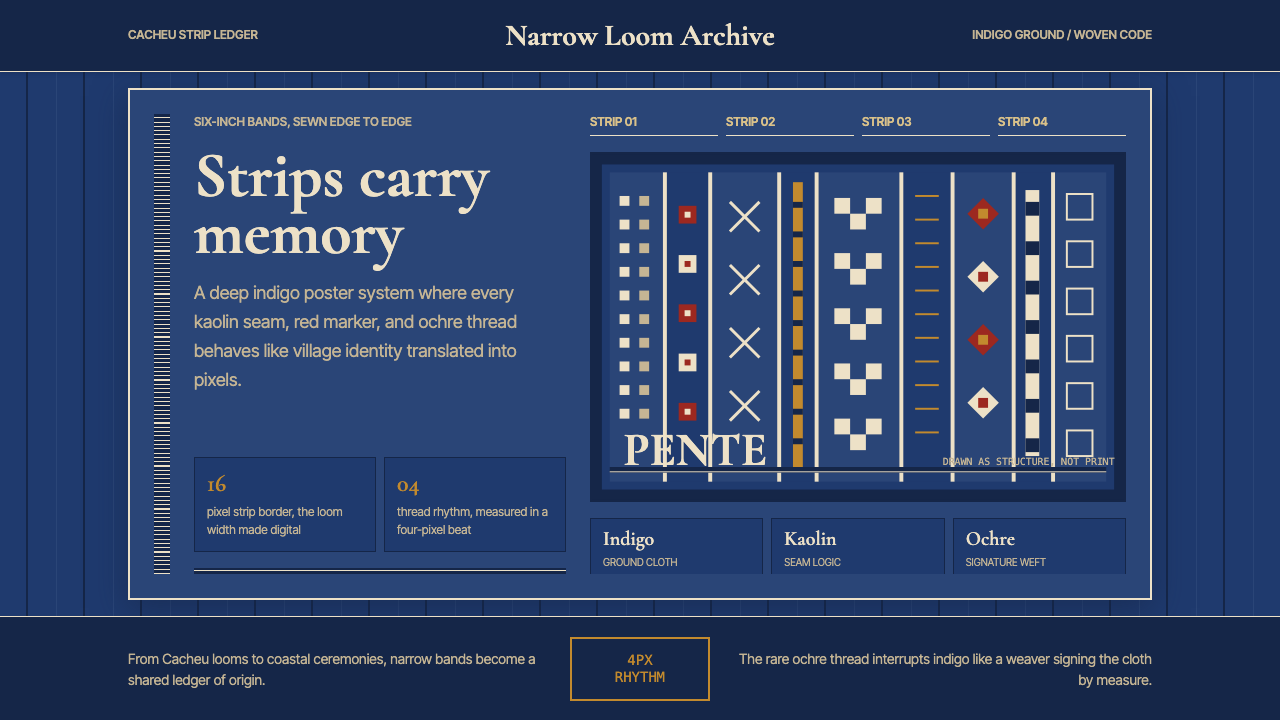 Bissau-Guinean Pano de PenteIndigo remembers. Narrow bands and kaolin seams turn weave grammar into pixel…
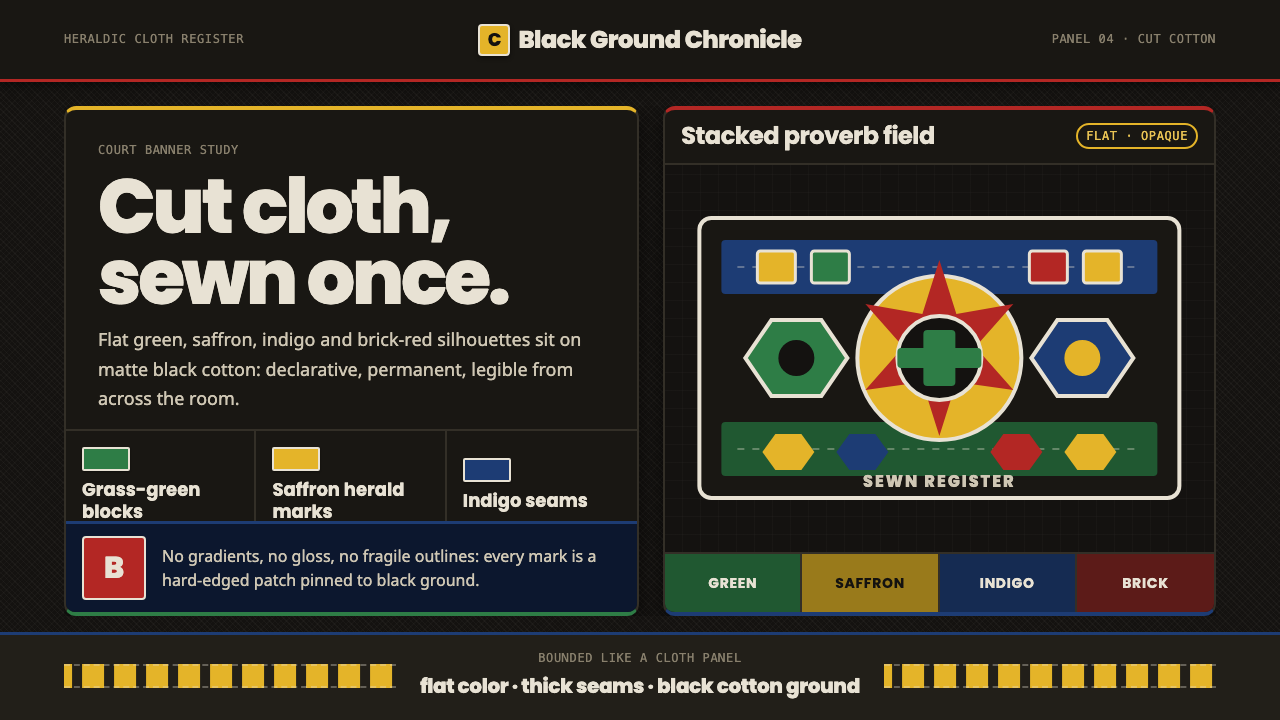 Fon Applique Banner AbomeyRoyal cloth speaks plainly. Flat saffron, green and indigo silhouettes on bla…
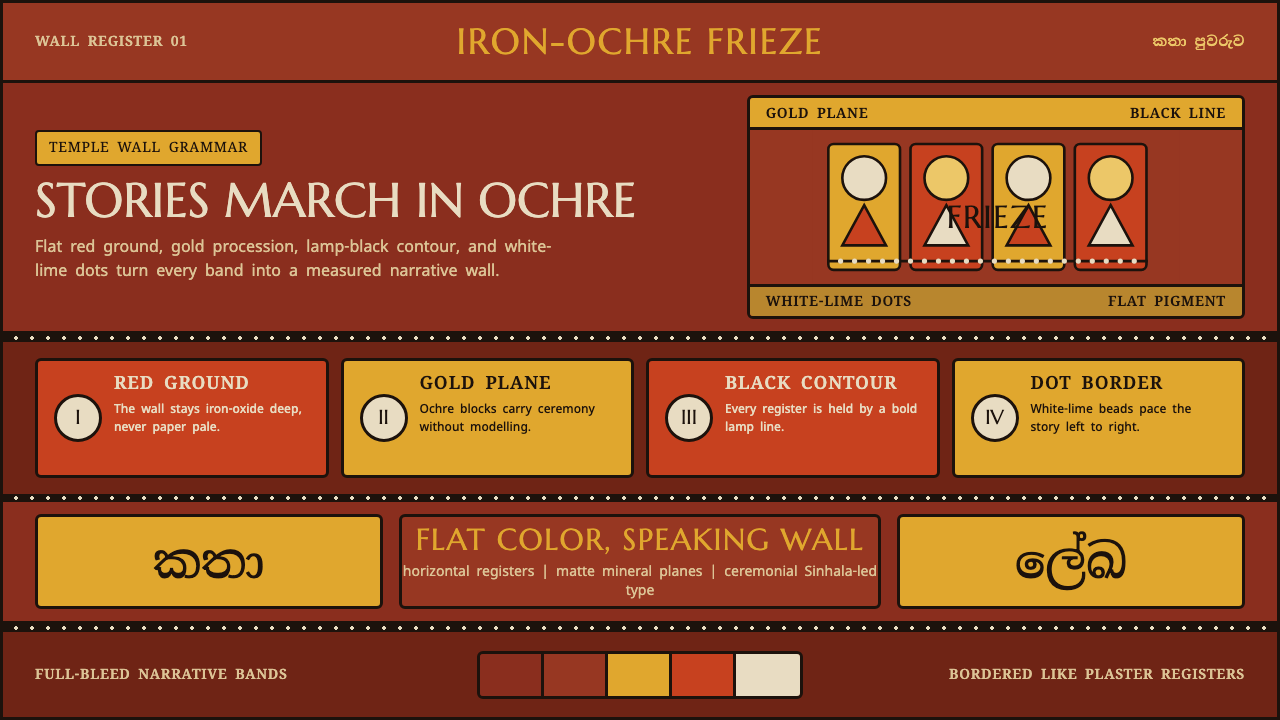 Kandyan Temple Mural FriezeTemple-wall gravity. Red ochre, gold planes, black contours, white-dot regist…
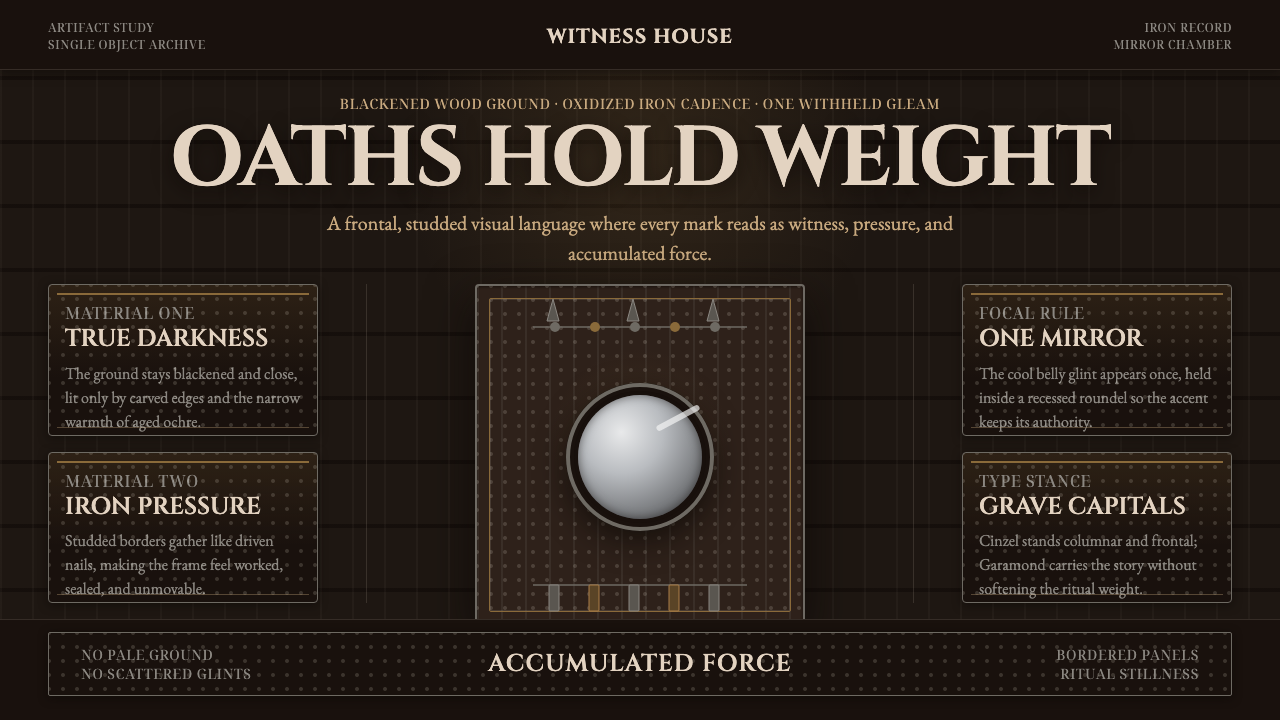 Kongo Nkisi Nkondi FigurePower accumulates in darkness. Black wood, iron studs, and one mirror glint h…
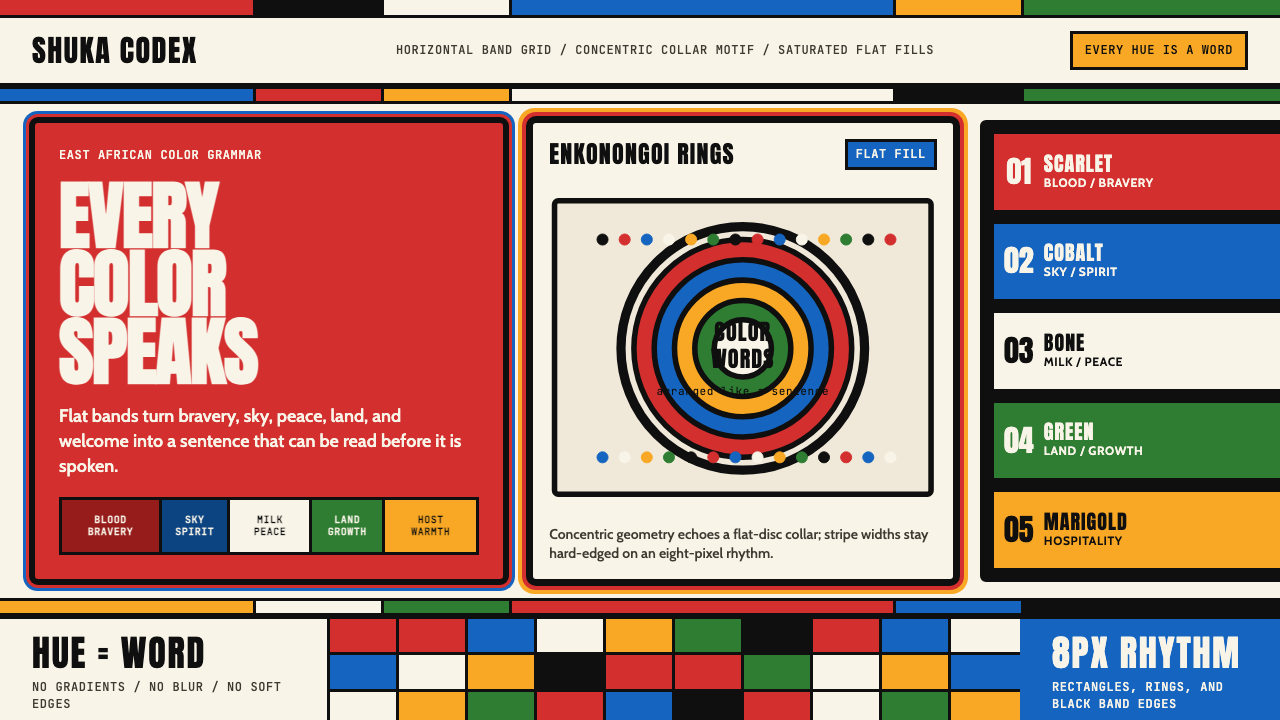 Maasai Shuka & BeadworkColor becomes language. Scarlet bands, cobalt panels, and concentric bead rin…
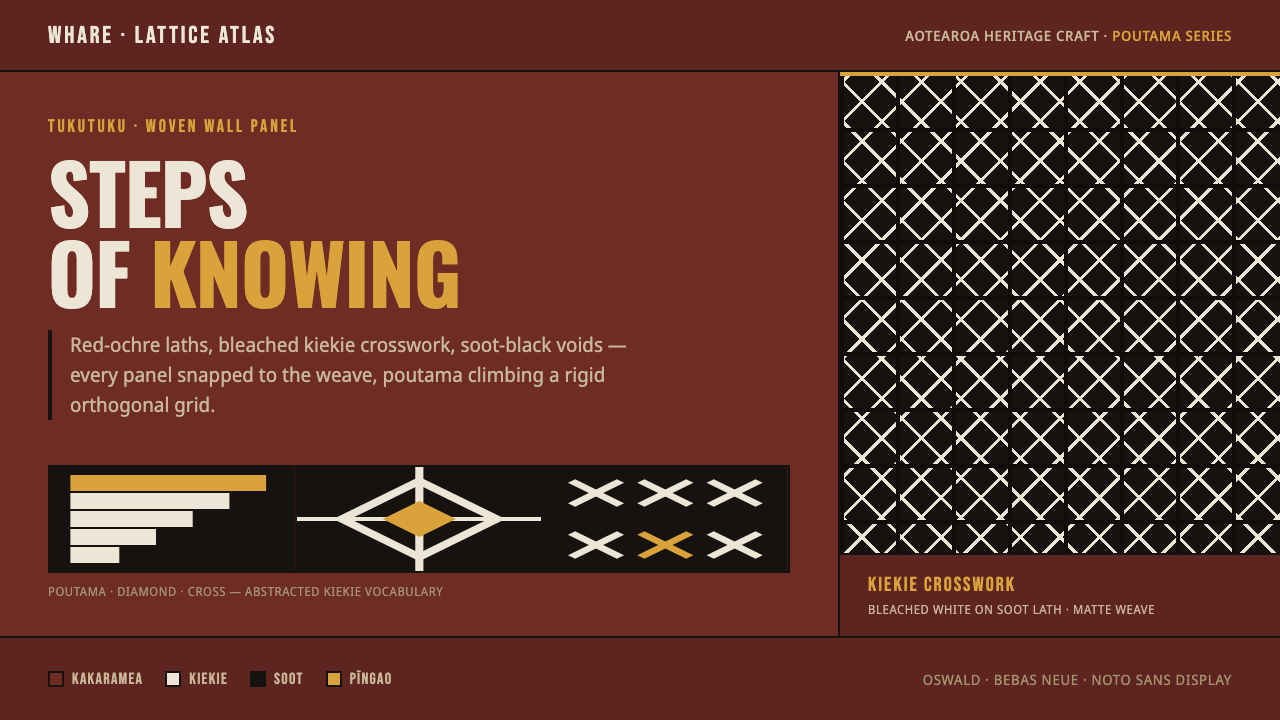 Māori Tukutuku PanelTukutuku weave, rendered strict. Bleached kiekie crosswork laces poutama step…