What is Bulgarian Shevitsa Folk Embroidery?
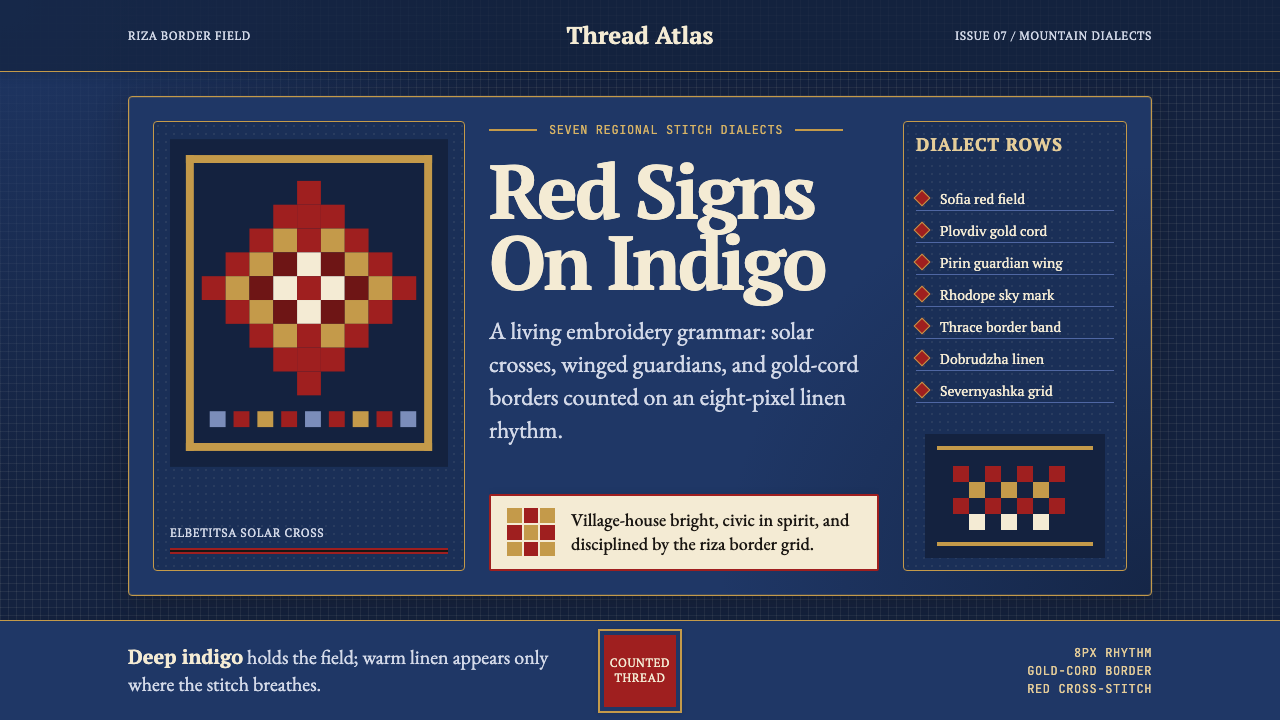
Shevitsa is Bulgaria's embroidered sign-language — a geometry of solar crosses and winged guardians stitched in deep indigo and shevitsa red that has carried pre-Christian meaning for more than a millennium.
Bulgarian Shevitsa Folk Embroidery in brief
Bulgarian shevitsa embroidery is a regional textile tradition in which symbolic geometric motifs — primarily crosses, diamond grids, and angular vegetal forms — are worked in counted cross-stitch onto white linen garments, most commonly the riza (embroidered shirt) and the apron. The tradition is not decorative in the casual sense; every motif belongs to a vocabulary of pre-Christian protective and cosmological signs whose meanings were transmitted orally alongside their stitching patterns across generations of rural women.
The visual system is built on absolute contrast. Deep indigo — the colour of the protective border woven into the riza itself — provides the field against which shevitsa red emerges as the dominant stitch colour. Gold-cord accents outline the major compositional bands, echoing the gold embroidery reserved for festive and ceremonial garments. The combination is not subtle: it is deliberately bright, even confrontational, because embroidered garments were meant to be seen and read from a distance at village fairs and religious festivals.
Bulgaria recognizes seven distinct regional embroidery dialects — Sofia, Plovdiv, Pirin, Rhodope, Thrace, Dobrudzha, and Severnyashka — each with its own compositional grammar, characteristic motif set, and colour emphasis. The motifs share a deep grammar across all dialects: the elbetitsa (eight-pointed solar cross), the kanatitsa (winged form, a guardian sign), and the bogovitsa (sky-mother figure) recur throughout the tradition and constitute its cosmological core.
Where does Bulgarian Shevitsa Folk Embroidery come from?
The roots of shevitsa extend into the pre-Slavic and early medieval Balkans, where solar signs, diamond grids, and serpentine borders appear on ceramics, stone carvings, and woven textiles dating to the first millennium. When the Bulgarian state was consolidated in the seventh and eighth centuries, and again after the conversion to Christianity in 864, the older protective signs did not disappear — they migrated into textile form, where they persisted precisely because embroidery was a domestic and feminine practice outside the direct gaze of ecclesiastical authority.
The tradition reached its most elaborate and codified form during the Bulgarian National Revival (Vazrazhdane), the cultural efflorescence of the eighteenth and nineteenth centuries in which Bulgarian identity was consciously articulated against Ottoman cultural dominance. The riza became a garment of ethnic and civic statement, not merely a practical shirt: the density of embroidery, the quality of linen, and the exactness of regional motifs all signaled origin, status, and affiliation. Skilled embroiderers became locally celebrated figures, and regional workshops developed recognizable house styles.
The Plovdiv Ethnographic Museum and the network of regional ethnographic collections became the institutional memory of the tradition through the twentieth century, documenting the seven dialects, cataloguing motif names and meanings, and training new generations of embroiderers in the canonical forms. Figures such as Maria Vesselinova, Elena Pavlova, and Anna Velkova contributed to this documentary and pedagogical work, ensuring that the vocabulary of signs survived the transition from a living folk practice to a carefully preserved heritage.
A significant contemporary development came after the 2013 anti-corruption protests in Bulgaria, when activists began incorporating shevitsa patterns onto protest flags and banners — the elbetitsa solar cross and the red-on-indigo palette appearing in street demonstrations as markers of distinctly Bulgarian civic identity. This revival reconnected ancient protective signs to contemporary political expression, giving the tradition a new public role and introducing it to a generation for whom folk embroidery had been museum material rather than living culture.
What defines the Bulgarian Shevitsa Folk Embroidery look?
Colour Field
The foundational colour is a deep, saturated indigo — the colour historically associated with the protective woven border (riza) of Bulgarian linen shirts. This dark ground is not a neutral backdrop; it is charged with protective symbolism, creating the sense that motifs are emerging from depth rather than applied to a surface. Against this field, the dominant stitch colour is a warm, assertive red — neither crimson nor brick but the specific red known simply as 'shevitsa red', clear and fully saturated. Gold-cord lines provide a third voice: they outline compositional zones and accent the edges of major motif bands without filling large areas.
Counted Cross-Stitch Geometry
The defining technical constraint of shevitsa is counted cross-stitch on a regular linen grid: every mark is a diagonal crossing of two threads, every placement is a discrete integer position on the fabric. This constraint makes curvilinear forms impossible and enforces an angular, pixelated geometry on all motifs. Curves become stepped diagonals; circles become octagonal approximations; natural forms — leaves, birds, human figures — are reduced to their most angular, geometric reading. The result is a visual language that feels simultaneously archaic and strikingly digital, as if drawn on a very coarse grid.
Solar and Cosmic Motifs
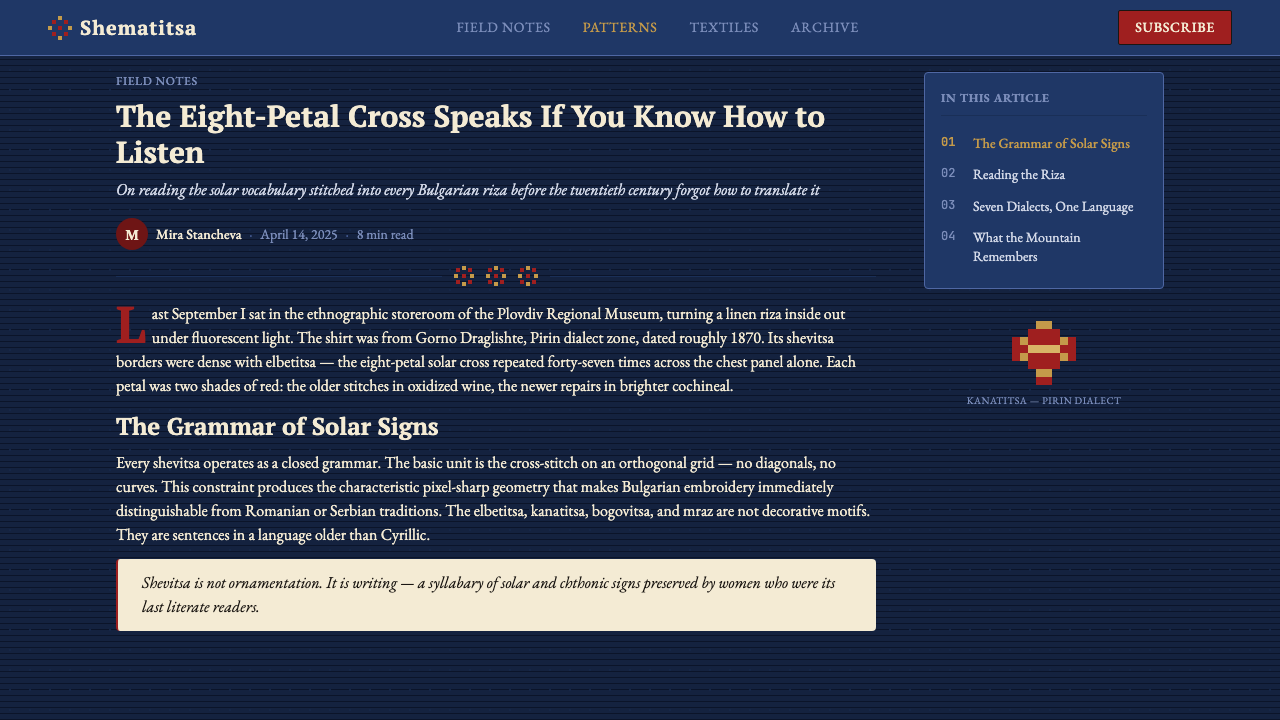
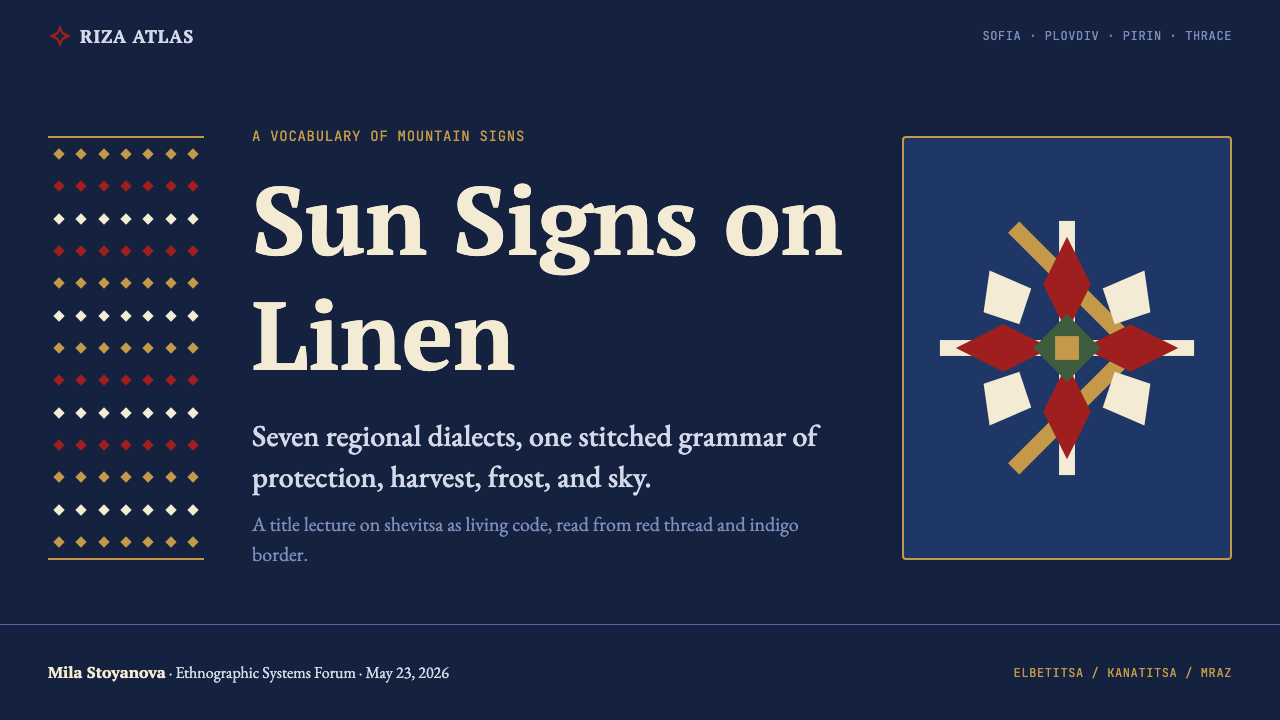
The cosmological motifs are the semantic core of the tradition. The elbetitsa — an eight-pointed star-cross formed by two overlapping squares rotated forty-five degrees — is the solar sign, associated with light, protection, and cyclical renewal. The kanatitsa is a bilaterally symmetrical winged form, read as a guardian or angelic figure, and appears frequently at compositional borders. The bogovitsa, the sky-mother, is a more elaborate figure whose arms and attributes vary by region. These signs function not as decoration but as text: a garment covered in elbetitsas was a garment that made a specific cosmological claim about its wearer's relationship to protective forces.
Compositional Banding
Shevitsa composition is organized in horizontal bands — rows of repeated motifs that wrap around the collar, cuffs, hem, and centre-front opening of the riza. These bands are not merely decorative borders; they demarcate the apertures of the garment, which in pre-Christian protective logic are the points where harmful influences might enter the body. The width, density, and motif content of each band signals the garment's ceremonial register: everyday shirts carry narrow, simpler bands; festival and wedding garments carry wide, densely worked bands of the most complex motifs. Between major bands, narrow geometric filler rows — zigzags, stepped diamonds, running-cross rows — provide visual rhythm and separation.
Regional Dialect Variation
Within the shared deep grammar of the tradition, the seven regional dialects differ substantially in colour emphasis, motif preference, and compositional density. The Thrace dialect, for example, tends toward lighter backgrounds and more elaborate figurative motifs; the Rhodope dialect is characteristically darker and more densely worked, with a preference for the elbetitsa and angular geometric filling. The Sofia and Plovdiv dialects are considered the most canonical and are most frequently cited in contemporary revival work. These dialect differences mean that a knowledgeable reader can identify a garment's regional origin purely from its stitching, in the same way that a trained linguist identifies regional accent.
Symmetry and Repetition
Individual shevitsa motifs are almost always bilaterally symmetrical along both vertical and horizontal axes. This double symmetry is not merely aesthetic; it is a property of protective signs in the pre-Christian Balkan tradition, where symmetry was understood as completeness — a sign without a mirror image was considered incomplete and therefore ineffective as a protective device. At the compositional level, bands repeat their motifs at regular intervals, creating a rhythm that reads as both meditative and insistent. The same cross appears forty times across a hem, each instance identical to the last, so that the overall effect is of a woven text rather than a drawn image.
Textile as Text
Perhaps the most distinctive conceptual property of shevitsa is that it functions as a communicative system, not simply a visual one. The tradition holds that specific combinations of motifs in specific positions on a garment carried specific meanings — about the wearer's status, protective wishes, the occasion, and the regional community of origin. This textual dimension means that for those who could read it, a shevitsa garment was an embroidered statement, not merely an embroidered object. Contemporary revival work grapples with this duality: the visual vocabulary can be transferred to new media, but the semantic grammar is largely inaccessible to modern audiences without scholarly mediation.

Who shaped Bulgarian Shevitsa Folk Embroidery?
Vesselinova was a central figure in the twentieth-century documentation and systematization of Bulgarian folk embroidery. Her research into regional dialect differences, motif naming conventions, and the surviving oral transmission of stitch meanings contributed foundational reference material that subsequent embroiderers, museum cataloguers, and designers have relied upon. Her work helped transform what had been an embodied, orally transmitted practice into a documented system capable of being taught and revived outside its original rural context.
Pavlova contributed significantly to the pedagogical revival of shevitsa in the late twentieth century, working to develop teaching materials and workshop programmes that could transmit the counted cross-stitch techniques and motif grammar to learners who had not grown up in the embroidery tradition. Her work was part of a broader institutional effort to prevent the tradition from becoming purely archival — to keep it in the hands and knowledge of living practitioners rather than exclusively in museum collections.
Velkova's contribution lay particularly in the area of motif interpretation and the reconstruction of pre-Christian symbolic meanings that had become partially obscured as the tradition was absorbed into a Christian cultural framework over centuries. Her scholarly work drew on comparative Balkan ethnography and linguistic analysis to reconstruct the probable meanings of signs such as the bogovitsa and the kanatitsa, providing the intellectual grounding that contemporary designers and cultural workers use when they engage seriously with the tradition rather than merely borrowing its surface appearance.
The Plovdiv Ethnographic Museum holds one of the most significant collections of Bulgarian folk embroidery, with particular strength in the Plovdiv and Thrace regional dialects. The museum has served as an anchor institution for the study and preservation of shevitsa for more than a century, and its curatorial and research staff have been instrumental in producing the detailed documentation — measured drawings of motifs, recorded interviews with village embroiderers, photographic archives of complete garments — that makes serious revival work possible.
Not an individual but a collective actor: the civic protesters who appeared on the streets of Sofia and other Bulgarian cities in 2013 in demonstrations against government corruption. It was in this context that shevitsa motifs — particularly the elbetitsa solar cross on the national flag's white stripe — migrated from folk-heritage museums into active political symbolism. The protesters' adoption of traditional embroidery patterns as protest imagery gave the visual system a new contemporary relevance and introduced it to a generation of young Bulgarians who subsequently became interested in the tradition as a form of cultural and civic identity expression.
How do you use Bulgarian Shevitsa Folk Embroidery today?
Shevitsa is a high-intention style: its visual weight, symbolic density, and cultural specificity make it unsuitable for generic or mass-market contexts but extremely powerful in projects where those qualities are assets — cultural institutions, heritage brands, events with a Balkan or specifically Bulgarian dimension, and any project where the combination of geometric precision and deep historical resonance is the intended message.
For presentation slides, shevitsa works most effectively as a full-commitment cover treatment: a deep indigo background carrying a central elbetitsa cross or kanatitsa form in shevitsa red, with gold-cord-weight lines framing the compositional bands and title type set in a face that respects Cyrillic letterform traditions. Content slides are better served by a restrained extraction — the banding principle applied as a header and footer device, with the indigo and red palette reduced to accent use against white or near-white fields. Resist the temptation to embroider every slide: the system's power comes from density at key moments and restraint elsewhere.
For web and product interfaces, the shevitsa vocabulary is best used selectively as structural accent rather than pervasive background. An indigo-and-red palette with gold-weight borders applied to navigation bands, section dividers, or call-to-action elements carries the visual language without overwhelming the interface's functional requirements. Card components can use a narrow elbetitsa or geometric border pattern along their top or side edges — a suggestion of the riza's embroidered borders — without filling their entire surface with the dense cross-stitch field.
For editorial and marketing contexts — cultural event posters, heritage brand campaigns, magazine feature layouts — shevitsa justifies a more immersive commitment. A full-bleed indigo field with shevitsa red motif rows running horizontally across the composition reads as both poster-bold and culturally specific. The banding structure translates naturally to editorial layouts, with heavy geometric rules replacing the embroidered bands as section markers. In marketing contexts, the visual system works best when paired with copy that acknowledges rather than ignores the cultural source — the style carries enough specificity that unexplained adoption can read as appropriation rather than reference.
The most common mistake when applying shevitsa is treating it as a pattern library rather than a sign system. Selecting individual motifs for their visual appeal without regard to their symbolic meaning or compositional position produces results that look decorative but feel arbitrary — the visual weight is present but the internal logic is absent. A second common error is diluting the palette: introducing tertiaries, muting the red toward dusty rose, or lightening the indigo toward a mid-tone blue all break the contrast that the tradition depends on for its visual authority. Shevitsa read from across a field; if it reads only at arm's length, it has been misapplied.
Bulgarian Shevitsa Folk Embroidery — FAQ
What does 'shevitsa' actually mean?
The word shevitsa derives from the Bulgarian verb 'sheya' — to stitch or sew — and translates roughly as 'stitching' or 'embroidery work'. It is the generic term for Bulgarian folk embroidery in general but has come to be used most specifically for the counted cross-stitch tradition worked in the canonical indigo, red, and gold palette. Regional practitioners sometimes use dialect-specific terms for their local embroidery tradition, but shevitsa is the nationally recognized term used in ethnographic and museum contexts.
Is shevitsa only for women's garments?
Historically, the most elaborate embroidery appeared on women's garments — the riza (shirt), apron, and headdress — because these were the garments through which women performed protective and ceremonial functions for their households. Men's garments were embroidered, but typically with narrower, simpler bands. The embroidery itself was exclusively the work of women and girls, who would begin learning to stitch their own trousseau garments in childhood. In contemporary practice, shevitsa motifs are applied without gender restriction to garments, accessories, and non-textile surfaces, though the historical gender asymmetry of the tradition is part of its documented meaning.
How does shevitsa differ from other Balkan embroidery traditions?
The broader Balkan region has many embroidery traditions — Serbian vezenje, Greek cross-stitch, Romanian cusatura, Macedonian needlework — and they share family resemblances in technique and some motifs, given their common geographic and historical context. What distinguishes Bulgarian shevitsa specifically is the formalization of the seven regional dialect system (which makes it unusually well-documented among folk embroidery traditions), the centrality of the pre-Christian solar signs (particularly the elbetitsa) as named, semantically loaded motifs rather than purely decorative patterns, and the specific three-colour palette of deep indigo, shevitsa red, and gold cord that has become the identifying signature of the tradition in its canonical form.
Can the shevitsa visual system be used without the cultural context?
It can be used, and frequently is, but the work reads differently depending on whether the cultural context is acknowledged or erased. The motifs and palette are visually powerful independently of their symbolic meaning — the elbetitsa cross is geometrically compelling, and the indigo-red-gold combination is visually striking in any context. However, designers who apply shevitsa elements while acknowledging the tradition produce work that can carry depth and specificity; those who strip the context to borrow only the visual vocabulary produce work that may look similar but lacks the internal logic that makes the original tradition coherent. In culturally sensitive or international contexts, the distinction matters — particularly given the tradition's contemporary role as an active marker of Bulgarian civic identity after 2013.
Is shevitsa considered a dark or light style?
The canonical shevitsa palette is dark: deep indigo as the foundational field is what the style is built on, and the shevitsa red and gold appear against that depth rather than against a light ground. This makes the style inherently suited to dark-mode interfaces and dark-background compositions without any adaptation. A light inversion — shevitsa red and gold motifs on white or cream — exists as a secondary variant in some regional dialects and in contemporary revival work, but it lacks the protective visual depth that the dark ground provides and tends to read as lighter in cultural resonance as well as in value. When working with this style, committing to the dark ground is committing to the tradition's visual logic.
Related design styles
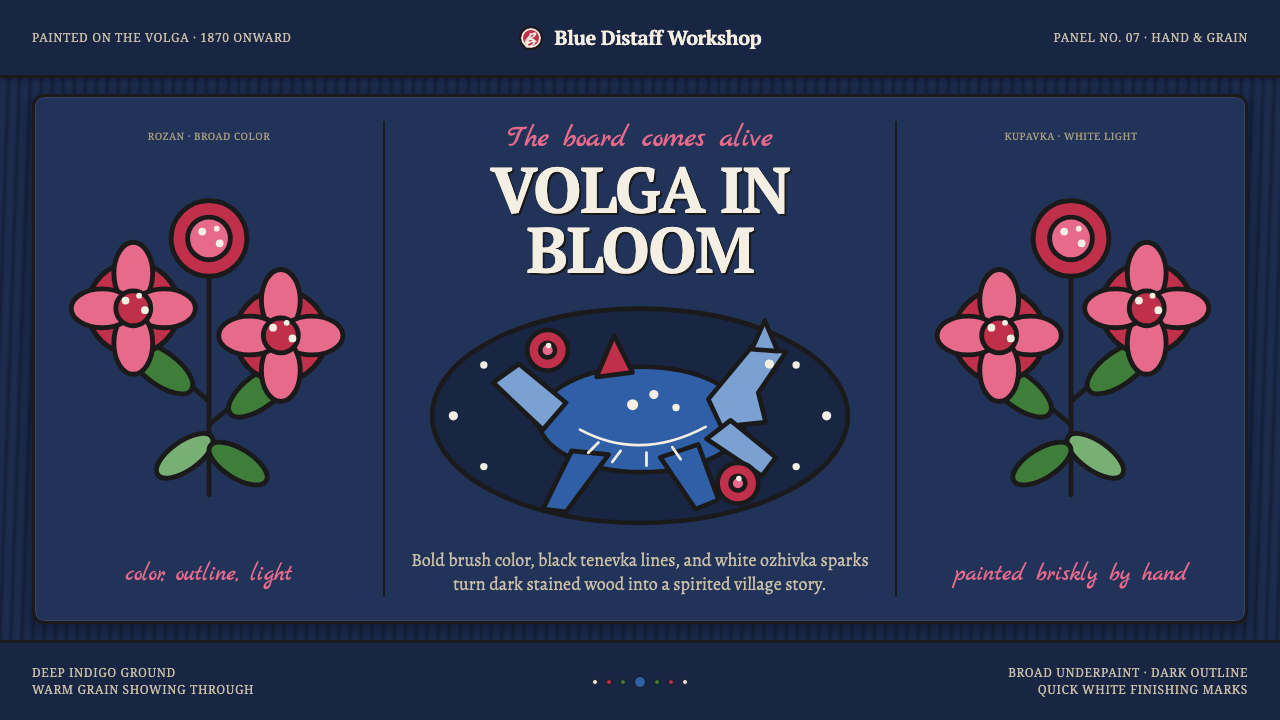 Gorodets Folk Panel PaintingFolk color moves at a gallop. Blue forms, red roses and white dots spark on i…
 Ukrainian Pysanka Wax-Resist EggIndigo preserves ritual geometry. Wax-white lines hold red-gold stars and whe…
 Bissau-Guinean Pano de PenteIndigo remembers. Narrow bands and kaolin seams turn weave grammar into pixel…
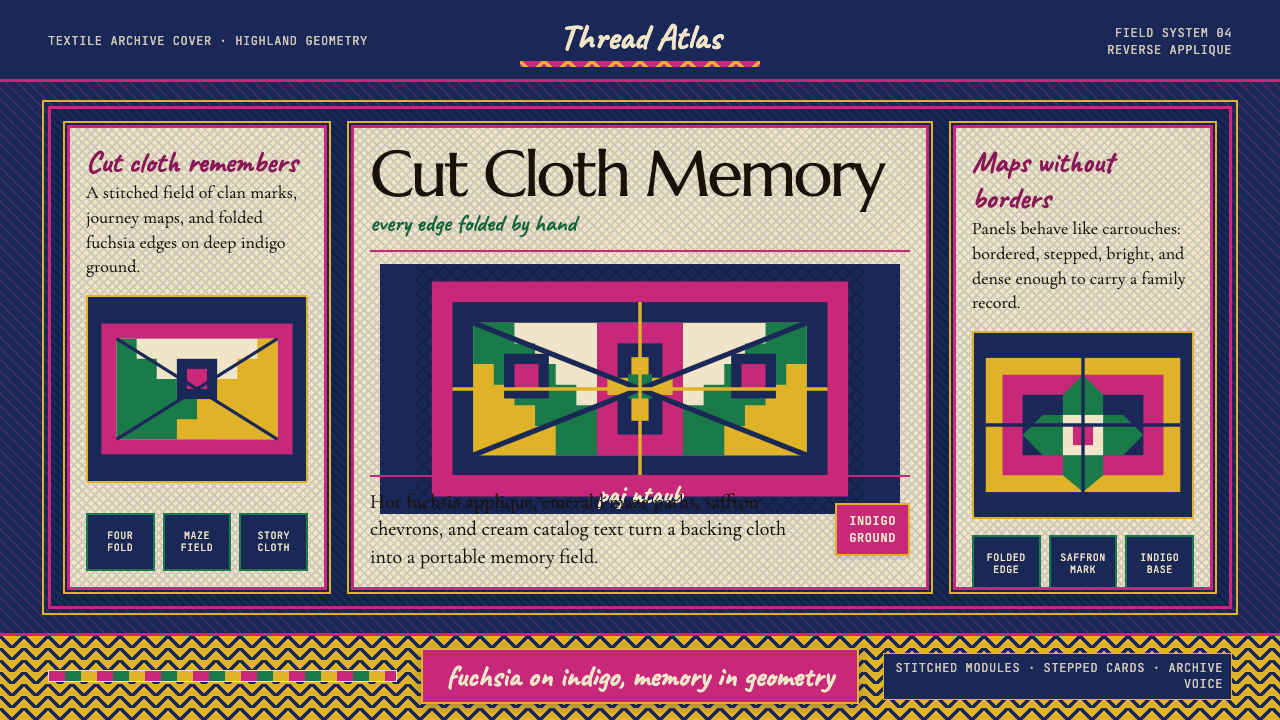 Hmong Paj Ntaub (Flower Cloth)Memory is geometric. Fuchsia applique on indigo forms stepped maze panels.
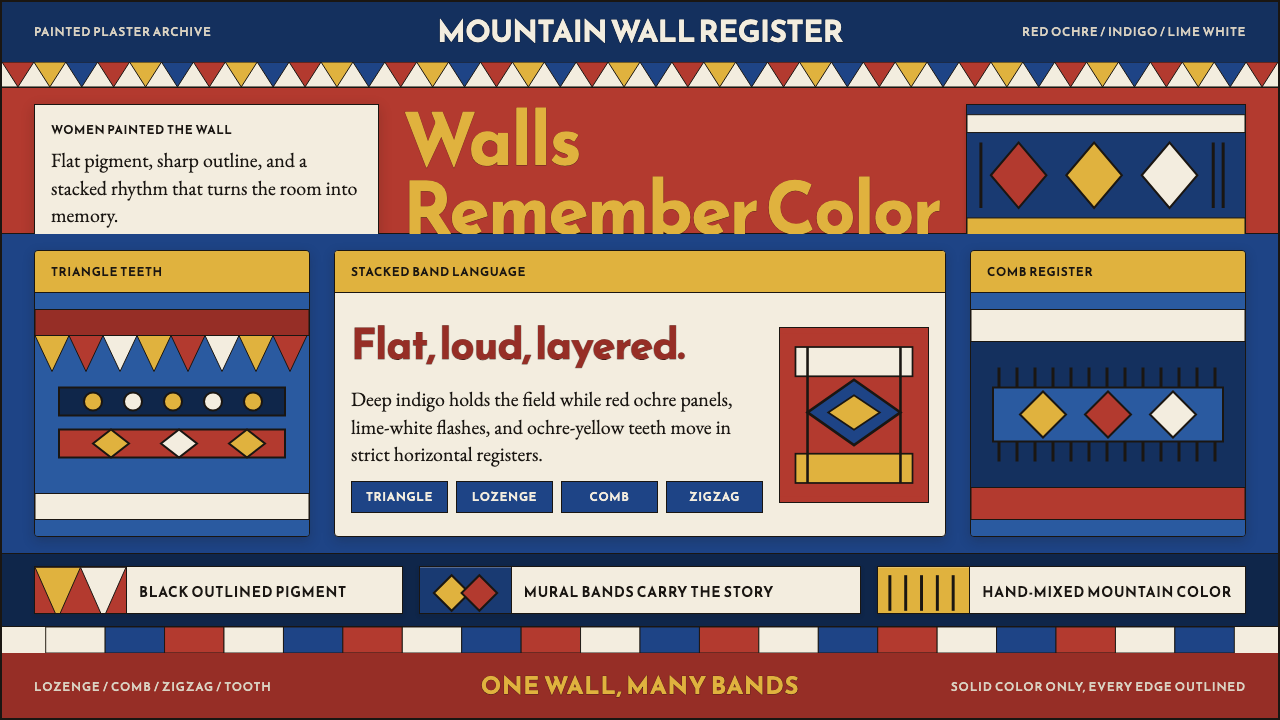 Saudi Asiri Qatt Wall PaintingPainted walls speak loudly. Indigo bands, red triangles, ochre teeth, black o…
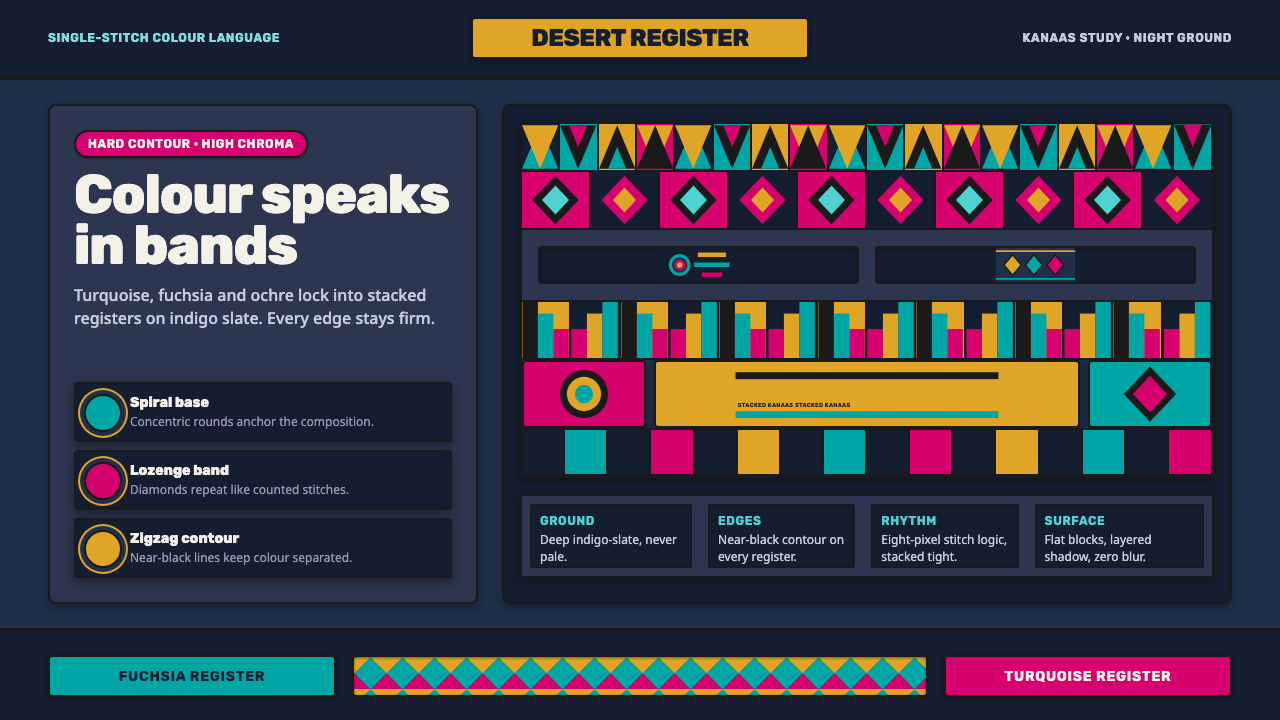 Wayuu Mochila CrochetColour speaks in bands. Turquoise, fuchsia and ochre stack on indigo-slate.