What is Bissau-Guinean Pano de Pente?
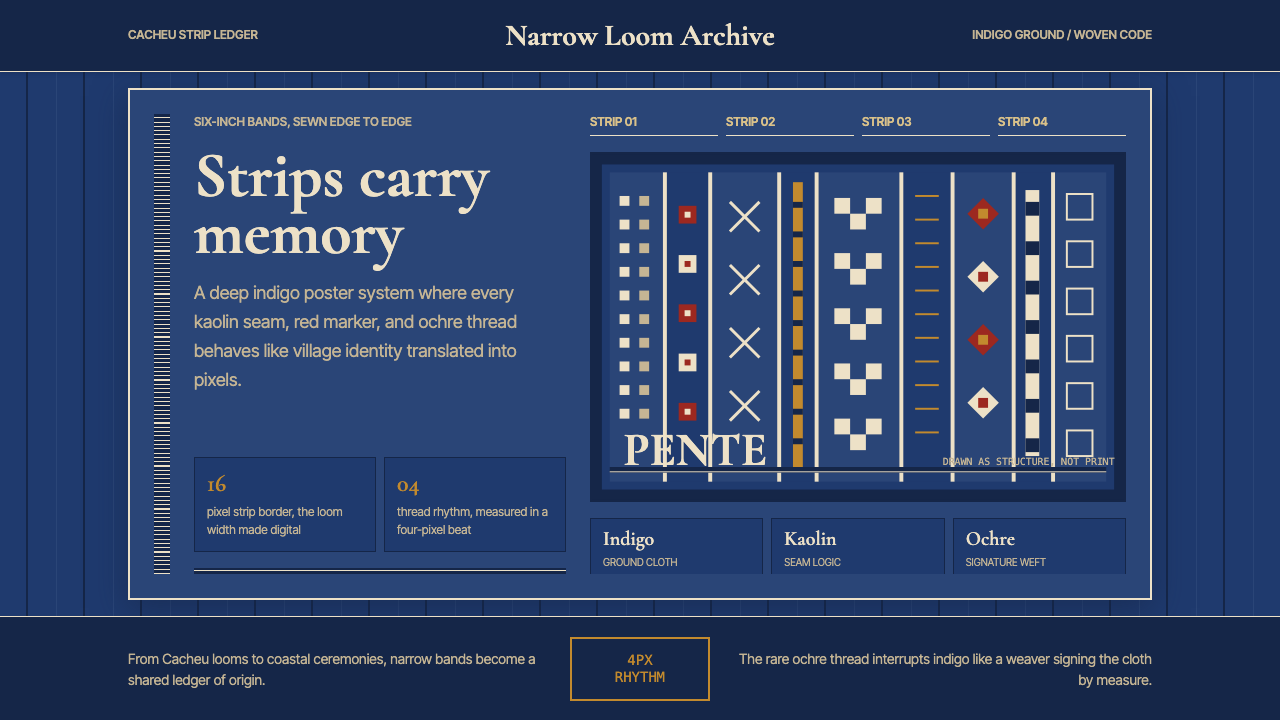
Six-inch strips of handwoven cotton, saturated in Atlantic indigo and stitched edge-to-edge, carry the oldest pixel logic in West Africa.
Bissau-Guinean Pano de Pente in brief
Pano de pente — literally cloth of the comb, named for the reed comb of the narrow-strip treadle loom — is the signature handwoven textile of Guinea-Bissau. Woven primarily by Manjaco and Pepel artisans along the country's coastal regions, each cloth is assembled from a series of narrow bands, each band carrying its own geometric drawdown: a precise interlocking of warp and weft that encodes village identity, weaver lineage, and ceremonial function into the fabric's very structure.
What makes pano de pente visually distinctive is the interplay between the deep, saturated indigo ground and the brilliant white or cream stripes produced by undyed cotton. The vertical rhythm of the assembled strips creates a system of alternating dark and light columns, punctuated by fine horizontal seam lines where band meets band. These seam lines are not disguised — they are embraced as a structural feature, giving the finished cloth a grid-like character that feels simultaneously ancient and startlingly contemporary.
As a design language, pano de pente operates through constraint. The narrow loom limits the width of each band, imposing a module. The binary logic of the weave — thread up or thread down — limits the geometry to hard-edged figures. The two-tone palette of indigo and undyed cotton limits the color. Yet within these constraints, Manjaco and Pepel weavers have produced an astonishing range of surface patterns, each distinct enough to identify a weaver's hand, yet coherent enough to read as a unified system when strips are joined. It is, in the most literal sense, a modular grid system realized in textile.
Where does Bissau-Guinean Pano de Pente come from?
Strip-weaving in Guinea-Bissau predates Portuguese contact, with evidence of narrow-loom textile production along the coast reaching back to at least the fifteenth century. The term pano de pente appears in Portuguese colonial records from the sixteenth and seventeenth centuries, when these cloths served as a primary unit of exchange in the Atlantic trading economy. Panos circulated as currency alongside cowrie shells, iron bars, and European cloth — valued not merely as material but as encoded social objects whose patterns and assembly could communicate status, origin, and intent.
The geography of production shaped the aesthetic. The Cacheu River region, the Biombo peninsula, and the Bijagos island archipelago each developed recognizable weaving traditions, with local variations in stripe proportion, geometric vocabulary, and the density of pattern bands. Weaving was and remains a male-dominated practice among the Manjaco, organized through age-grade associations that transmitted both technical skill and pattern knowledge across generations. A young weaver began with simple striped compositions and advanced over years toward the complex interlocked figures that signified mastery.
The Atlantic trade intensified production and spread demand. European merchants and African trading partners both sought pano de pente, and Guinean weavers responded by increasing output while preserving the core structural logic of the tradition. Indigo — either locally sourced from the plant Lonchocarpus cyanescens or acquired through trade — provided the deep blue ground that became the cloth's signature. The dyeing and weaving were separate specialized crafts, and the quality of the indigo saturation was as much a mark of excellence as the complexity of the woven pattern.
In the twentieth century, pano de pente navigated colonial disruption and post-independence economic pressure. The cloth retained its ceremonial importance — present at funerals, initiations, and marriage ceremonies — even as machine-made substitutes flooded the market. The 2010s brought a new wave of attention from the global fashion industry, with designers such as Sarah Diouf incorporating the textile's visual grammar into contemporary garments, and scholars such as Lisa Aronson and Eric Robertson producing detailed documentation of the tradition's technical and social dimensions. Today the cloth occupies a dual role: living craft with active ceremonial function, and recognized source material for contemporary design practice worldwide.
What defines the Bissau-Guinean Pano de Pente look?
Indigo Ground
The dominant tone is a deep, saturated blue-black produced by repeated immersion in indigo vat dye — a color that deepens with successive dyings and softens with age toward a rich, complex navy. This indigo ground is not uniform; slight tonal variation from selvage to center gives the cloth a living, breathing quality distinct from flat dyed yardage. The depth of the indigo signals quality: the most valued panos were dyed until the color reached near-black intensity.
Vertical Strip Rhythm
The assembled cloth reads as a series of vertical columns, each column the width of one woven band. Within each band, the geometric pattern runs in horizontal registers — rows of interlocked figures — while the band itself reads as a vertical module in the larger composition. Where adjacent bands carry different patterns, the seam between them creates a strong vertical accent. The overall effect is a grid whose columns are decorated internally but whose vertical structure governs the whole.
Weft-Structure Geometry
The patterns within each band are generated entirely by the weave structure — by which threads float over the surface and which sink below it. This constrains the geometry to forms that can be built from a regular grid of thread crossings: diamonds, zigzags, stepped triangles, interlocking rectangles, and cruciform motifs. The resulting shapes have crisp, hard edges and a pixelated quality that reads simultaneously as textile and as digital bitmap. No curved forms appear; every shape is an aggregate of rectangular thread crossings.
Two-Tone Palette
The canonical pano de pente palette is binary: deep indigo and undyed cotton white or cream. Occasionally a third tone — a lighter, partially dyed thread — introduces a mid-value accent, but the logic of the cloth is fundamentally two-tone. This constraint is not a limitation so much as a discipline: with only two values, every pattern decision becomes legible at a glance. The contrast between the dark ground and the bright weft-structure figures is what makes the geometric system readable across distance.
Seam as Structure
When individual bands are joined edge-to-edge to form the full cloth, the seam line between them remains visible — a thin white or cream thread that divides the surface into its constituent modules. Rather than being a flaw to hide, this seam is a structural declaration: it announces the modular logic of the textile. In design translations, this quality manifests as visible grid lines, column dividers, or repeating vertical accents that acknowledge the underlying structure rather than papering over it.
Encoded Identity
No two weavers' panos are identical. Each band's drawdown — the precise sequence of thread lifts — encodes information readable by others trained in the tradition: which village, which lineage, sometimes which specific weaver. This encoding is not decorative symbolism layered on top of a functional textile; it is intrinsic to the weave structure itself. The design language is also a record-keeping system. This quality — information embedded in pattern rather than added to it — is what distinguishes authentic pano de pente from surface-pattern imitations.
Ceremonial Weight
Pano de pente was never a casual textile. Its primary social contexts — funerals, initiations, marriages, and diplomatic exchange — gave it a gravitas that shaped how it was perceived and used. The cloth is associated with transition, with the crossing of thresholds. This ceremonial weight is legible in the deliberateness of its visual system: nothing is arbitrary, nothing is merely decorative. Every pattern decision is justified by precedent and social meaning. This quality of intentional seriousness — restraint used not as minimalism but as respect — is one of the most transportable properties of the style.
Who shaped Bissau-Guinean Pano de Pente?
Carlos Cardoso was a Guinean journalist and intellectual who, before his assassination in 2000, played a formative role in documenting Guinea-Bissau's material and cultural heritage. His work contributed to the broader awareness of pano de pente as a national and diasporic cultural marker, positioning the textile not merely as craft but as a political and social text. His legacy continues to shape how Guinean cultural practitioners engage with traditional forms.
Sarah Diouf is a Senegalese-born designer and founder of the fashion label Tongoro, which brought West African textile traditions — including the visual grammar of strip-woven cloth — into contemporary luxury fashion. Her work with pano de pente aesthetics on the international stage helped establish the textile's geometric vocabulary as viable source material for high-end design. Diouf's approach has been influential in demonstrating that African textile traditions can be referenced without pastiche: the structure, not the surface decoration, is what translates.
Lisa Aronson is an art historian specializing in West African textiles whose scholarly work provided some of the most detailed technical and contextual documentation of pano de pente available in English. Her research traced the trade routes, weaving communities, and social functions of Guinean strip cloth, establishing the textile's complexity as a system of encoded meaning rather than mere surface pattern. Her documentation has been foundational for designers and researchers seeking to work seriously with this tradition.
Eric Robertson's field research and documentation of Manjaco weaving practices contributed substantially to the preservation of technical knowledge about the treadle loom systems and drawdown sequences used in pano de pente production. His work bridges ethnographic documentation and design history, treating the weave structure itself — not just the finished cloth — as the primary artifact worth recording. This approach has made his documentation particularly useful for design practice, since it reveals the generative logic rather than just the output.
How do you use Bissau-Guinean Pano de Pente today?
Pano de pente translates into contemporary design practice most cleanly when the designer engages with its underlying logic — the modular column, the binary palette, the weft-structure geometry — rather than sampling its surface patterns. A design built around these principles will feel grounded and coherent; one that simply pastes a scanned pano texture onto a layout will feel decorative and hollow.
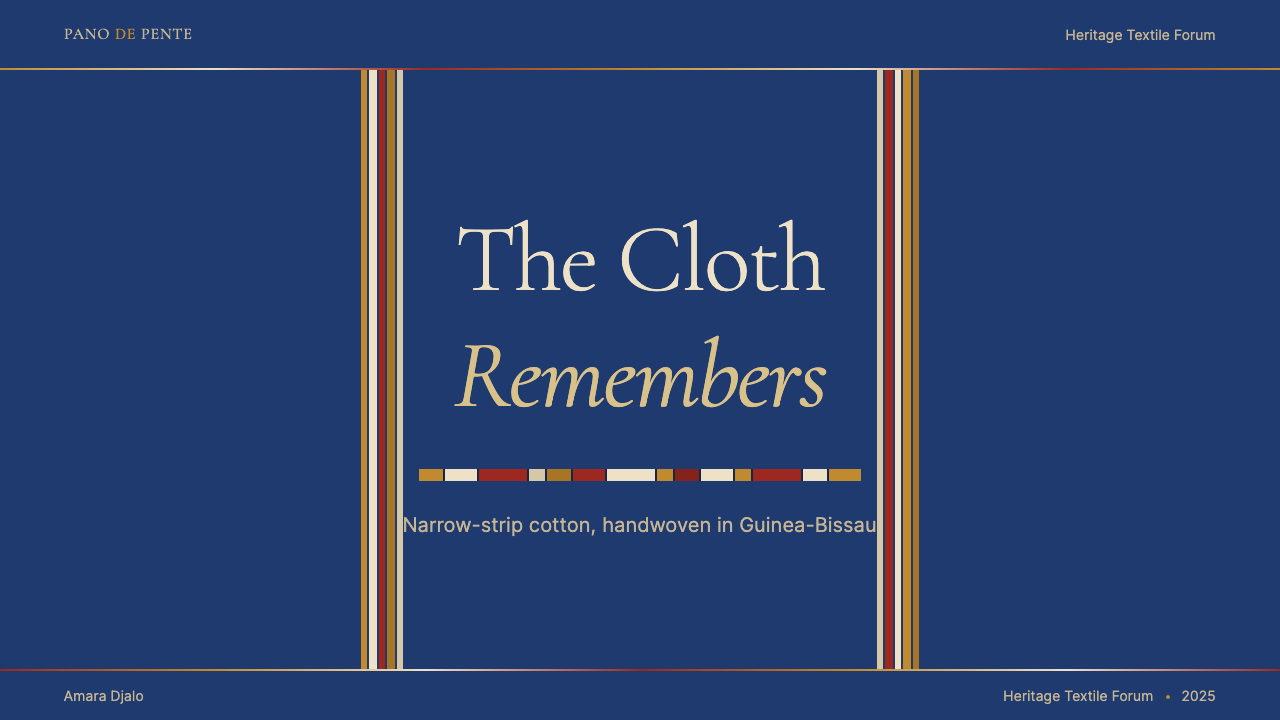
For presentation slides, the system works especially well on cover pages where bold vertical structure is needed. A cover organized as a series of alternating dark and light columns — with type aligned to one of the column intervals — draws directly on pano's strip logic without literal imitation. Content slides benefit from a strict two-tone approach: one deep indigo-equivalent tone for backgrounds and emphasized elements, undyed white or cream for text fields and secondary areas. Data visualizations can adopt the weft-structure principle: bar charts built from stacked rectangular units, with pattern differentiation achieved through alternating fills rather than hue changes.
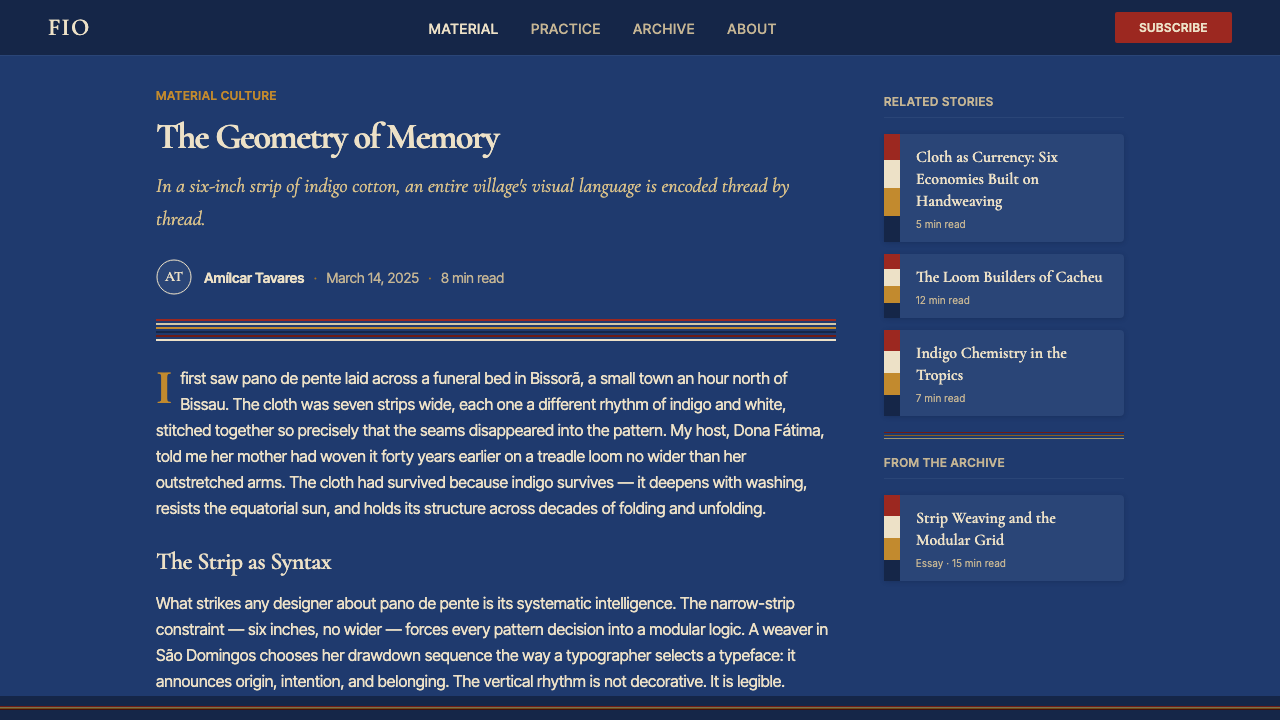
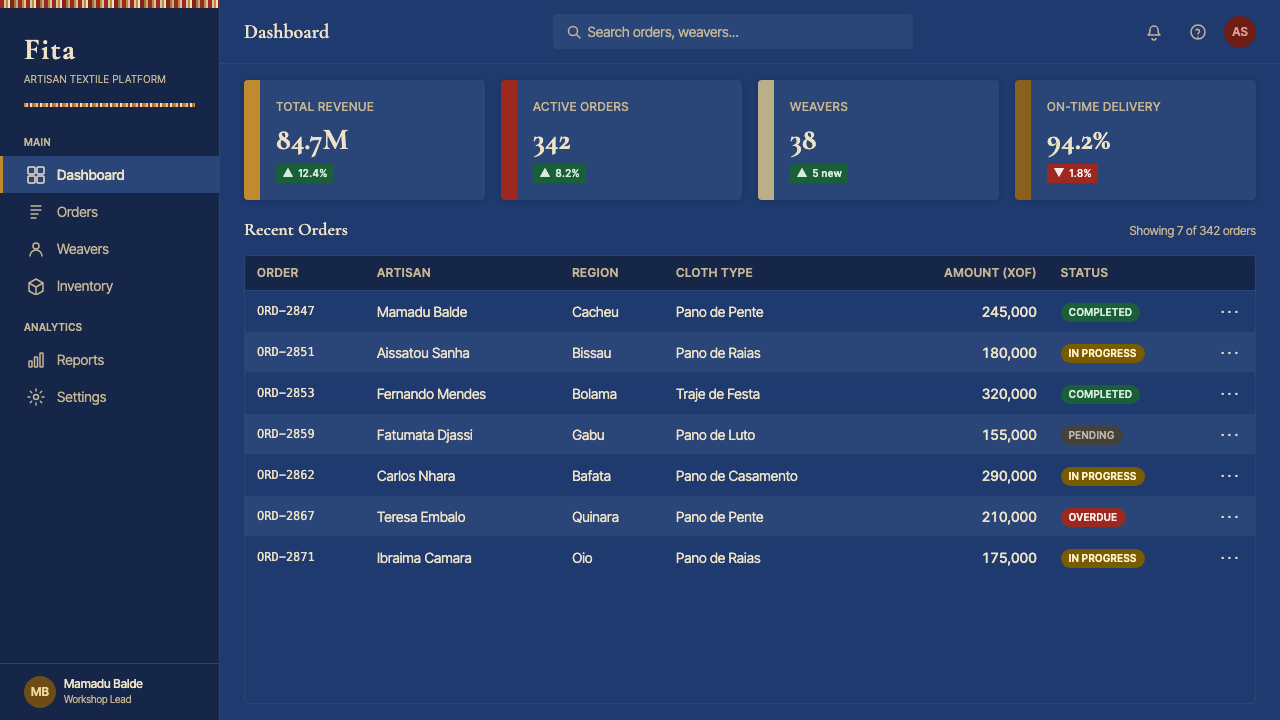
For web interfaces and dashboards, the pano aesthetic supports layouts where vertical column structure is paramount. A dashboard grid that makes its column boundaries visible — through subtle vertical rules or alternating column backgrounds — echoes the seam-as-structure logic of the assembled cloth. Navigation systems and sidebar components work well as vertical-strip modules: contained, self-sufficient, distinct in their content but rhythmically consistent with adjacent panels. The two-tone palette keeps cognitive load low on data-heavy screens while maintaining strong visual identity.
For editorial and marketing work, the style's most powerful quality is its combination of visual boldness and structural restraint. A magazine spread or marketing page built on the pano logic uses alternating full-bleed column blocks — deep indigo sections interrupted by cream or white sections — to create rhythm and emphasis without ornament. Pull quotes and callouts work as narrow bands set against a contrasting ground, in exactly the proportion a weaver might allocate to an accent strip. Headlines set in heavy, spaced letterforms against the indigo ground recall the way pattern figures read off the cloth's dark field.
A common mistake is treating the deep blue as a background color to be neutralized by other elements. In pano de pente, the indigo is active — it is the ground from which the pattern figures emerge, and its depth is what gives them their legibility. Designs that reduce the indigo to a pale blue accent or dilute it with multiple additional colors lose the foundational tension that makes the system work. The palette should remain essentially binary, with the indigo asserting full saturation whenever it appears. A second common error is introducing rounded forms — the geometry of pano de pente is exclusively angular, built from the logic of the thread grid, and curves have no place in an authentic translation.
Bissau-Guinean Pano de Pente — FAQ
How is pano de pente different from kente cloth?
Both are West African strip-woven textiles assembled from narrow bands, but their visual logic and cultural contexts differ substantially. Kente, from Ghana and the Akan-speaking world, is celebrated for its multi-color silk and cotton patterns — dense, jewel-toned, and symbolically rich in meaning assigned to specific named patterns. Pano de pente is fundamentally two-tone: deep indigo and undyed white, with pattern generated by the weave structure rather than by color variation. Kente's geometry tends toward diagonal and diamond forms; pano de pente stays within the strict vertical and horizontal register of its weft-structure drawdowns. Where kente reads as exuberant and declarative, pano de pente reads as spare and structural — quiet authority rather than celebratory display.
Can the style work in a light-background context?
Yes, with a significant inversion. The authentic pano de pente is dark-ground — the indigo is the base, and the white geometric figures float on top of it. A light inversion reverses this: a cream or white ground with deep indigo geometric figures. This version is viable and maintains the binary logic, but it changes the perceptual weight of the composition substantially. Dark-ground pano reads as dense and solemn; light-ground reads as crisp and graphic. For interface work where extensive reading is expected, the light inversion is often more practical. For ceremonial or high-impact visual contexts, the dark original ground is more faithful to the tradition's mood.
Is it appropriate for brands outside Guinea-Bissau to use this aesthetic?
This is a question worth taking seriously. Pano de pente is not an abstracted African geometric motif — it is a specific, living tradition with active ceremonial use and traceable community ownership. The most defensible approach for outside brands is to engage with the visual logic rather than reproduce specific traditional patterns, and to acknowledge the source explicitly in brand communication. Designs that translate the modular column structure, the binary palette, and the weft-structure geometry into new contexts are doing something different from designs that lift specific pattern sequences that belong to specific weaving communities. Transparency about inspiration and, where possible, economic connection to the tradition's practitioners, converts cultural reference into cultural exchange.
How does the textile's ceremonial seriousness translate into interface design?
The ceremonial weight of pano de pente suggests a design approach that treats nothing as arbitrary. In practice: avoid decorative elements that do not carry structural meaning, keep the palette binary unless a specific communicative need justifies a third tone, and use the deep indigo ground for contexts where gravity and authority are appropriate — authentication screens, confirmation dialogs, high-stakes decision points. The style is ill-suited to playful, casual, or discovery-oriented interfaces. Where it works, it works because the seriousness of the visual language signals to the user that what they are doing matters. That signal is most powerful when the product actually deserves it.
What distinguishes an authentic reference to this tradition from a superficial one?
The clearest test is whether the design works for structural reasons or decorative ones. An authentic reference engages with the modular column logic — why the composition is divided the way it is, what the strip width means for information hierarchy, how the binary palette creates legibility at distance. A superficial reference takes the surface pattern — the zigzag and diamond motifs — and applies them as texture or wallpaper without understanding why those forms exist. Authentic references also tend to maintain the palette discipline: two tones, maximum, with occasional accent. Superficial ones often dilute the indigo, add tertiary colors, and round the geometry — all of which dissolve the tradition's specific visual character into generic multicultural decoration.
Related design styles
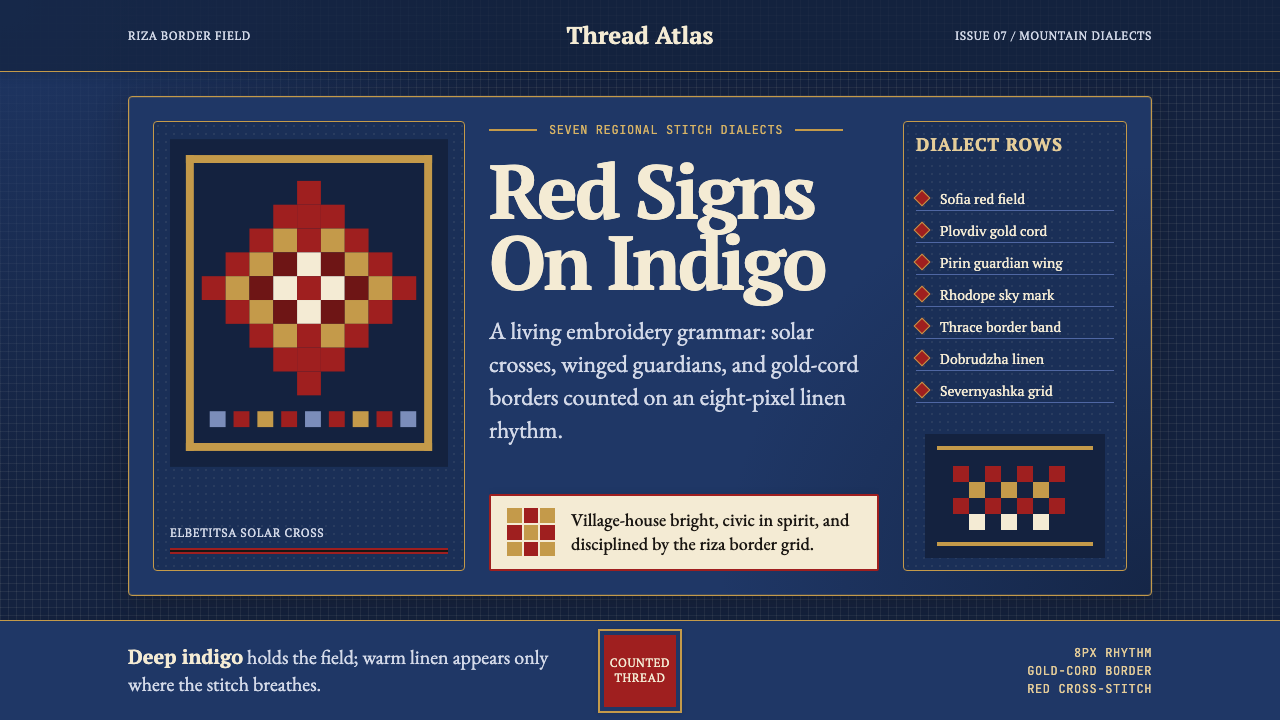 Bulgarian Shevitsa Folk EmbroideryVillage-bright code. Deep indigo carries shevitsa red crosses and gold-cord b…
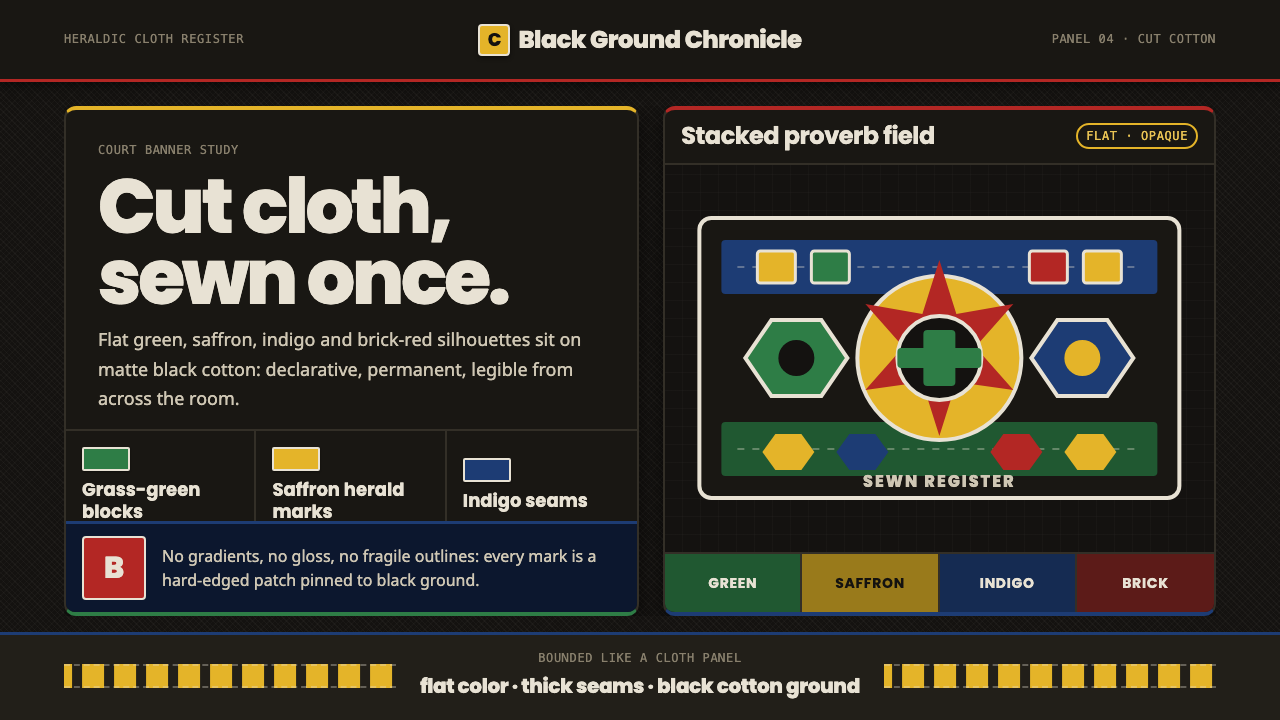 Fon Applique Banner AbomeyRoyal cloth speaks plainly. Flat saffron, green and indigo silhouettes on bla…
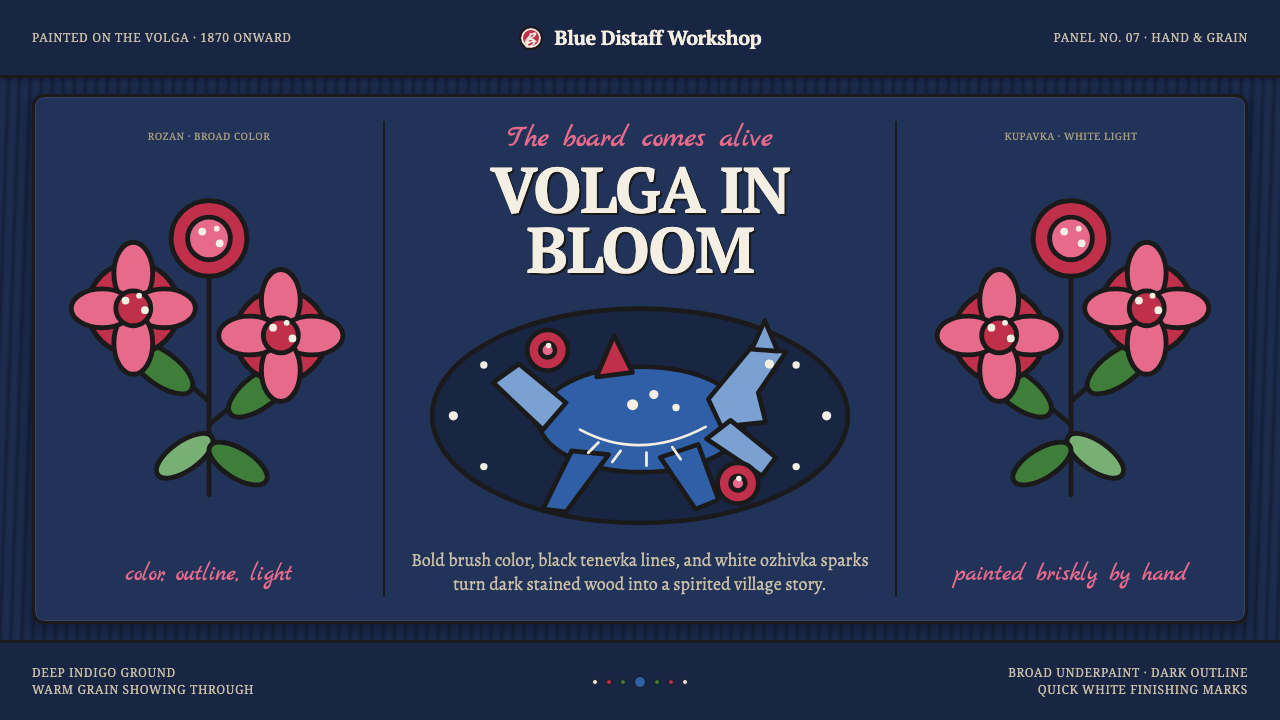 Gorodets Folk Panel PaintingFolk color moves at a gallop. Blue forms, red roses and white dots spark on i…
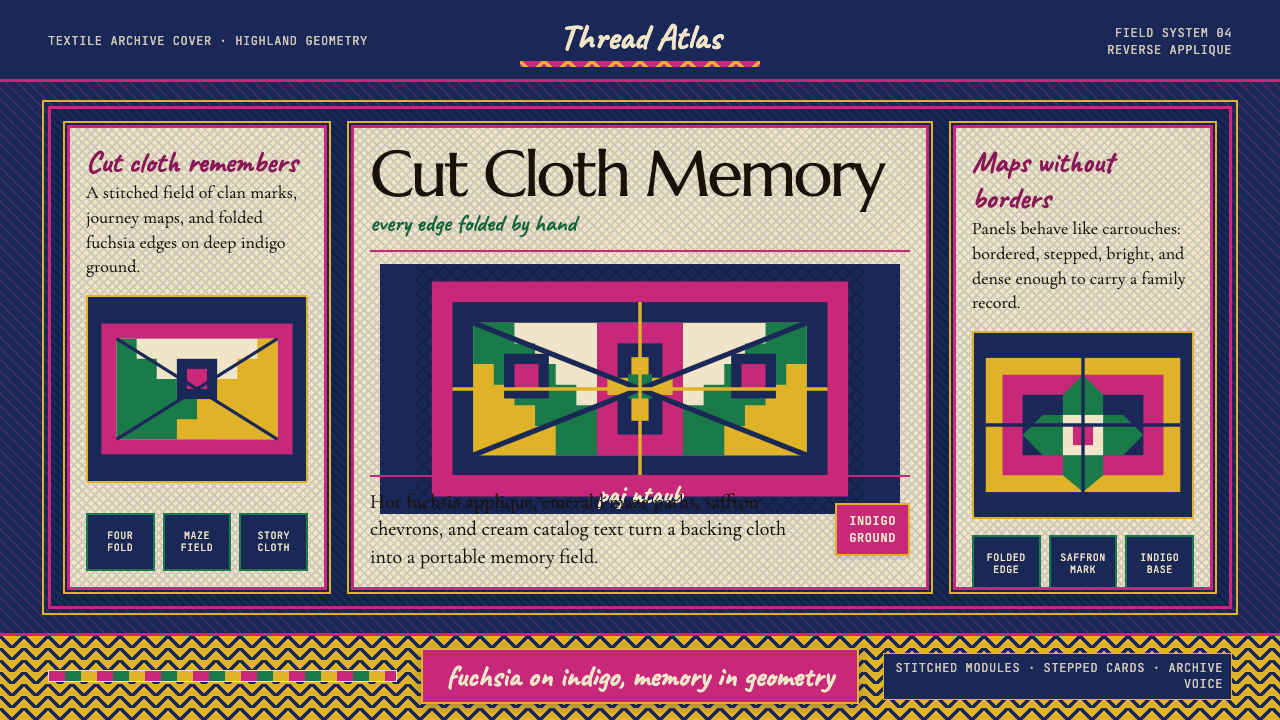 Hmong Paj Ntaub (Flower Cloth)Memory is geometric. Fuchsia applique on indigo forms stepped maze panels.
 Kongo Nkisi Nkondi FigurePower accumulates in darkness. Black wood, iron studs, and one mirror glint h…
 Saudi Asiri Qatt Wall PaintingPainted walls speak loudly. Indigo bands, red triangles, ochre teeth, black o…