What is Fijian Masi (Bark Stencil)?
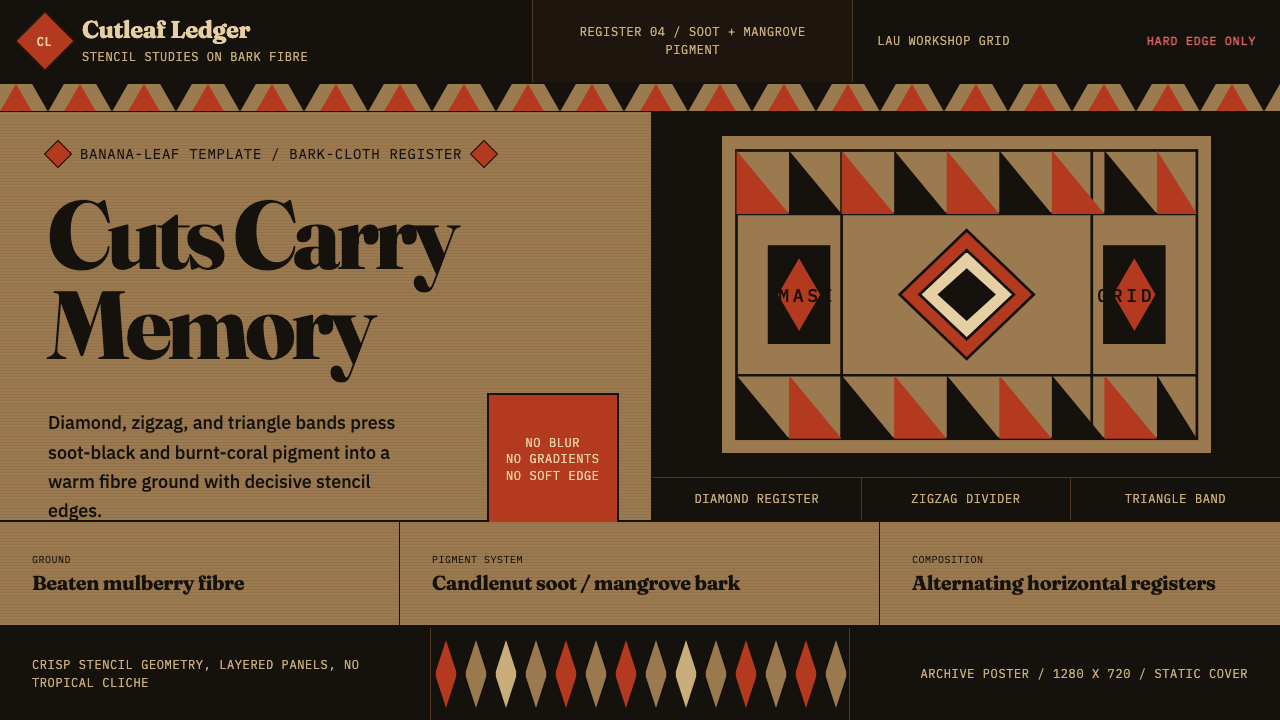
Fijian masi turns bark cloth into a poster medium — banana-leaf stencils and candlenut-soot ink produce geometry so crisp it looks printed, not handmade.
Fijian Masi (Bark Stencil) in brief
Fijian masi is bark cloth — produced by beating the inner bark of the paper mulberry tree into thin, fibrous sheets — decorated through a distinctive stencil technique unique among the tapa traditions of the Pacific. While neighboring cultures in Tonga and Samoa typically rub pigment over incised boards, the Fijian method cuts templates from dried banana leaves and prints through them, producing edges so clean and shapes so precise that the cloth reads as a graphic system rather than a textile.
The visual language is built from a limited vocabulary of forms: diamond grids, stepped triangles, zigzag bands, and chevron sequences arranged in alternating horizontal registers. Against the warm, honey-colored ground of the unpainted bark, deep soot-black and burnt-coral red mark the stenciled zones, creating a rhythm of light and dark that carries across the full length of a cloth. Every shape is a deliberate geometric decision with a name, a position in the composition, and often a ritual significance tied to the ceremony for which the cloth was made.
The style operates through repetition and interval rather than through single iconic motifs. A masi cloth reads differently from arm's length than it does from across a room: up close, each stenciled shape reveals the slight pressure variation of a human hand; from a distance, the field locks into an impeccably ordered graphic composition. This dual register — intimate craft and bold graphic impact — is the defining quality that makes the Fijian masi vocabulary so transferable to contemporary visual work.
Where does Fijian Masi (Bark Stencil) come from?
Bark cloth production in Fiji dates back at least to the early settlement of the islands, roughly three thousand years ago, when Lapita seafarers carried both the paper mulberry plant and the knowledge of beating bark into cloth across the western Pacific. The specific stencil technique that distinguishes Fijian masi from other regional tapa traditions is harder to date precisely, but historical accounts from the first European visitors to Fiji in the late eighteenth century already describe the finished cloths as strongly geometric and patterned, suggesting that the stencil system was established long before outside contact.
The center of masi production has historically been concentrated in specific geographic zones: Vatulele Island, a small raised coral island south of Viti Levu, became renowned for producing the finest and most densely patterned cloths; the Lau Group, an archipelago of islands in eastern Fiji that sits at a cultural crossroads between Fiji and Tonga, developed a regional variant that incorporated both the Fijian stencil technique and Tongan compositional sensibilities; and the Cakaudrove region of Vanua Levu maintained its own production traditions. Each community produced masi for specific ceremonial purposes — birth, marriage, death, and chiefly investiture — with particular patterns prescribed for each occasion.
The nineteenth and early twentieth centuries brought disruption. Christian missionary influence in Fiji, beginning in the 1830s, reshaped many aspects of ceremonial life; some uses of masi declined as the ceremonies they had served were modified or abandoned. Colonial economic changes also altered production patterns — commercial cloth became available, and some communities shifted away from bark cloth entirely. By the mid-twentieth century, masi production had contracted significantly and the specialized knowledge held by master makers was concentrated in fewer hands.
The 1970s marked a turning point. A broader Pacific cultural renaissance — driven in part by the independence movements of that era and in part by scholars and artists who recognized what was being lost — encouraged a deliberate revival of traditional crafts across Oceania. In Fiji, women artisans in Vatulele and the Lau Group took the lead, re-learning techniques from elders and establishing cooperative production structures. Makereta Matemosi, widely credited as a pivotal figure in this revival, not only preserved traditional stencil patterns but also worked to document the names, symbolism, and ceremonial contexts of specific designs. The contemporary global market for Pacific art further accelerated recovery: collections in New Zealand, Australia, and the United States created sustained demand for high-quality masi, providing economic incentives that supported continued production through the final decades of the twentieth century and into the twenty-first.
What defines the Fijian Masi (Bark Stencil) look?
Stencil Edge Precision
The defining visual quality of Fijian masi is the sharpness of its printed edges. Where rubbed tapa traditions produce soft, slightly blurred contours, the stencil technique prints a hard boundary between pigmented and unpigmented zones. This crispness is achieved by pressing the banana-leaf template firmly against the bark surface and applying pigment with a consistent, controlled motion. The result reads less like painted cloth and more like a woodcut print — each shape contained within a clean perimeter, the bark texture visible within the field but not softening the boundary.
Band Structure
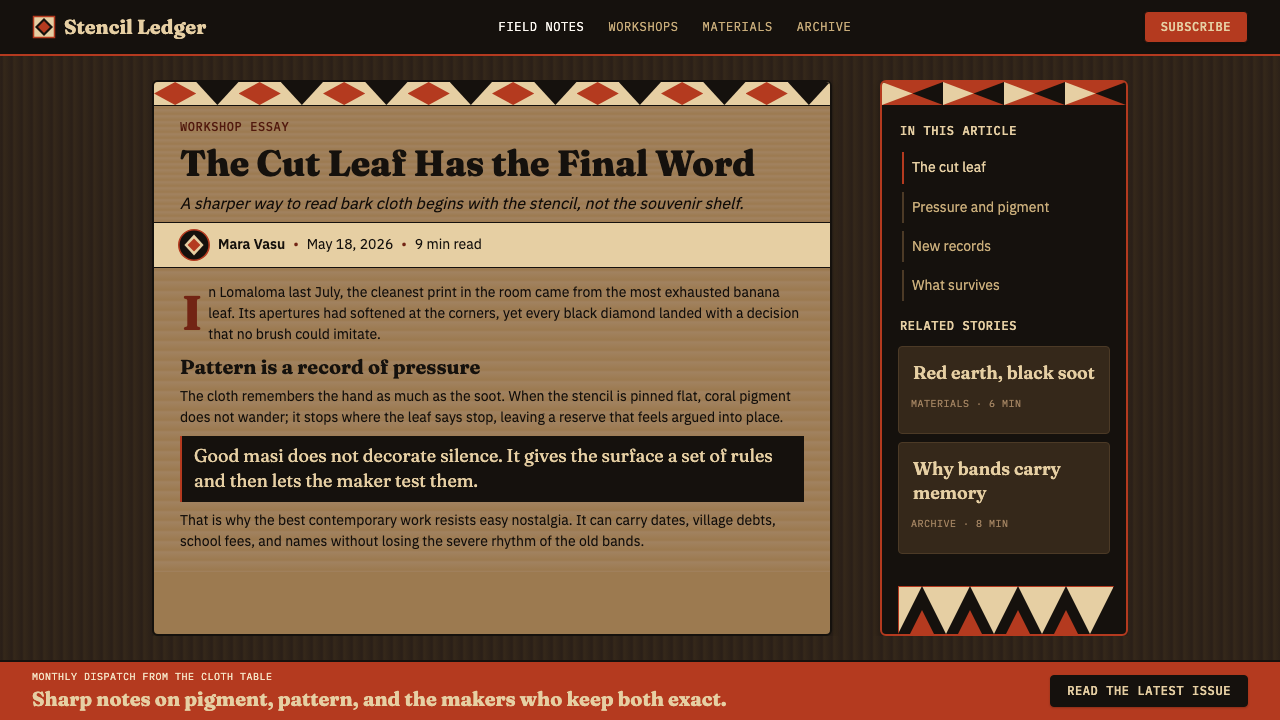
Masi compositions are organized into horizontal bands of varying widths, each filled with a different geometric motif. Wide bands might carry a large diamond grid; narrow bands serve as separators filled with tight zigzag or stepped chevron sequences. The interplay of broad and narrow registers, open and dense fill patterns, creates a vertical rhythm across the cloth that draws the eye from edge to edge without a fixed focal point. This band logic is the primary organizational grammar of the style and the element most directly transferable to other design contexts.
Ground Presence
The unpainted bark ground is not neutral background — it is an active compositional element. The warm, textured surface of beaten mulberry bark carries its own visual weight: the irregular fiber patterns visible within each stenciled shape give the pigmented areas a living quality, and the unpainted zones between bands breathe rather than simply recede. In the masi visual system, negative space is not empty; it is the ground asserting itself against the figure, as important to the composition's balance as the inked shapes themselves.
Two-Tone Palette
Traditional Fijian masi operates with a strict two-color system applied over the natural bark ground. Deep soot-black — produced from candlenut (lumi) burned and collected as carbon — provides the primary structural marks. Burnt-coral red — derived from the bark of the mangrove or from specific clays — provides the secondary accent, often used in alternating bands or to mark ceremonially significant geometric elements. The combination of warm ground, dense black, and activated red creates a palette that reads as simultaneously earthy and graphic, ancient and poster-bold.
Geometric Vocabulary
The shapes used in masi are not abstract in the Western modernist sense — each has a name in Fijian and many carry specific cultural meanings — but they are fully geometric in their execution: straight edges, consistent angles, repeating units. Diamonds, stepped triangles, interlocking chevrons, and cross-hatched grids appear across all regional masi traditions, with variation in density, scale, and arrangement distinguishing the output of different island communities. The shared vocabulary is simple enough to permit infinite variation through combination, scale change, and sequencing.
Ceremonial Registration
Unlike decorative textile traditions where pattern choice is primarily aesthetic, masi patterns carry ceremonial registration — specific designs are associated with specific occasions, social ranks, or island identities. A cloth made for a funeral uses different pattern arrangements than one made for a chiefly gift. This embeds meaning into the geometry in a way that affects how the visual system should be interpreted: the boldness is not arbitrary expressionism but a form of precise statement. When applying the style outside its ceremonial context, this quality — that every mark intends something — is worth preserving as a design ethic.
Handmade Irregularity Within Order
Despite its poster-like crispness from a distance, masi carries the evidence of hand production at close range. Slight pressure variations leave areas of denser and lighter pigment within a single stenciled shape. The bark ground is never perfectly uniform — thickness varies, fiber orientation shifts. These irregularities do not undermine the geometric system; they animate it. The style's visual power comes precisely from this tension: the geometry is strict enough to read as a system, but the execution is human enough to breathe. Reproducing the style digitally requires a deliberate decision about how much of this handmade quality to retain or simulate.
Who shaped Fijian Masi (Bark Stencil)?
Matemosi is widely regarded as the most significant figure in the modern documentation and revival of Fijian masi. Working from Vatulele Island through the later decades of the twentieth century, she combined the role of master practitioner with that of cultural historian, systematically recording the names, associated ceremonies, and compositional rules of specific stencil patterns that had been in danger of being lost as older practitioners died without successors. Her work provided the foundation on which subsequent generations of Fijian masi makers have built, and her cloths are represented in major Pacific collections internationally.
Carling represents a later generation of Fijian masi practitioners who have worked to bridge traditional practice with contemporary Pacific design discourse. Her approach takes the inherited stencil vocabulary as a point of departure rather than a fixed endpoint, exploring how the geometric grammar of masi can engage with current questions about Pacific identity, cultural sovereignty, and the relationship between traditional craft and contemporary art markets. Her exhibitions in New Zealand and Australia have introduced Fijian masi to audiences who encounter it as fine art rather than as ethnographic object.
Vaka'uta has worked at the intersection of Pacific theology, cultural studies, and material culture, contributing scholarly analysis of the ceremonial functions of masi that has helped situate the visual tradition within its full social context. His research emphasizes the relational dimension of masi production — that cloth is not made as an individual artistic statement but as a contribution to an ongoing network of social obligations, gifts, and reciprocities — a framework that has influenced how designers and curators approach the tradition.
Lewuravu is associated with efforts to sustain masi production in the Cakaudrove region of Vanua Levu, where the tradition differs in certain pattern conventions from Vatulele and Lau production. His work has been important in maintaining regional diversity within Fijian masi rather than allowing the tradition to consolidate around a single celebrated center. The preservation of regional variation is significant for the design vocabulary because it demonstrates that the geometric grammar of masi is a shared language that accommodates local dialects rather than a uniform national style.
How do you use Fijian Masi (Bark Stencil) today?
The Fijian masi visual system is unusually ready to move into contemporary design contexts because its organizing principles — band structure, two-tone restraint, stencil-sharp edges, and geometric repetition — are already abstract enough to function without their ceremonial apparatus. What the style offers is not just a set of patterns but a structural grammar: a way of building composition through horizontal registers, controlled contrast, and the productive tension between dense fill and open ground.
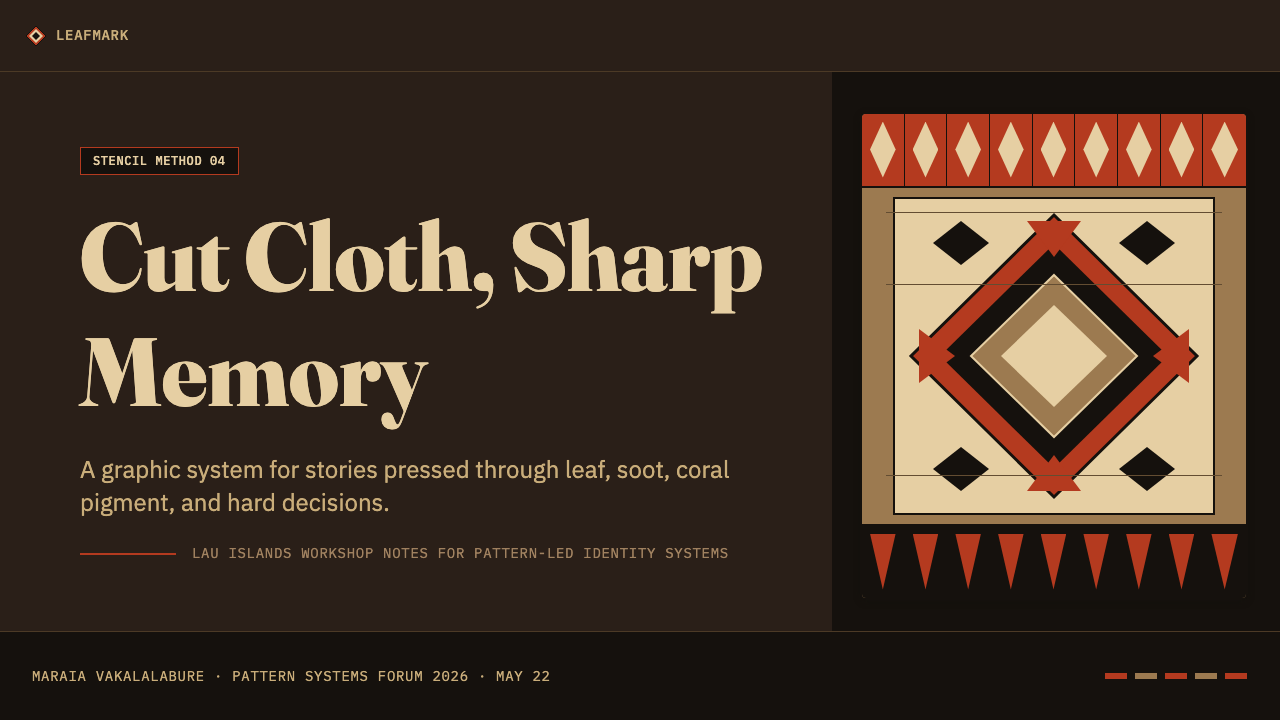
For presentation slides, the band logic of masi translates directly into cover and section-break page design. A cover built on masi principles uses the full slide width as a cloth surface: a wide geometric band in dark soot-toned graphic fills the lower quarter, a narrower separator band carries a small repeated diamond or chevron motif above it, and the title sits in the open warm ground above both bands. The two-tone constraint — one dark structural ink, one warm accent tone, against an off-white or warm cream field — should be maintained throughout the deck rather than expanded into a broader palette. Content slides benefit from the band approach applied as a horizontal rule divider between sections, using the masi zigzag or stepped-triangle border motif as a decorative rule that serves a structural function.
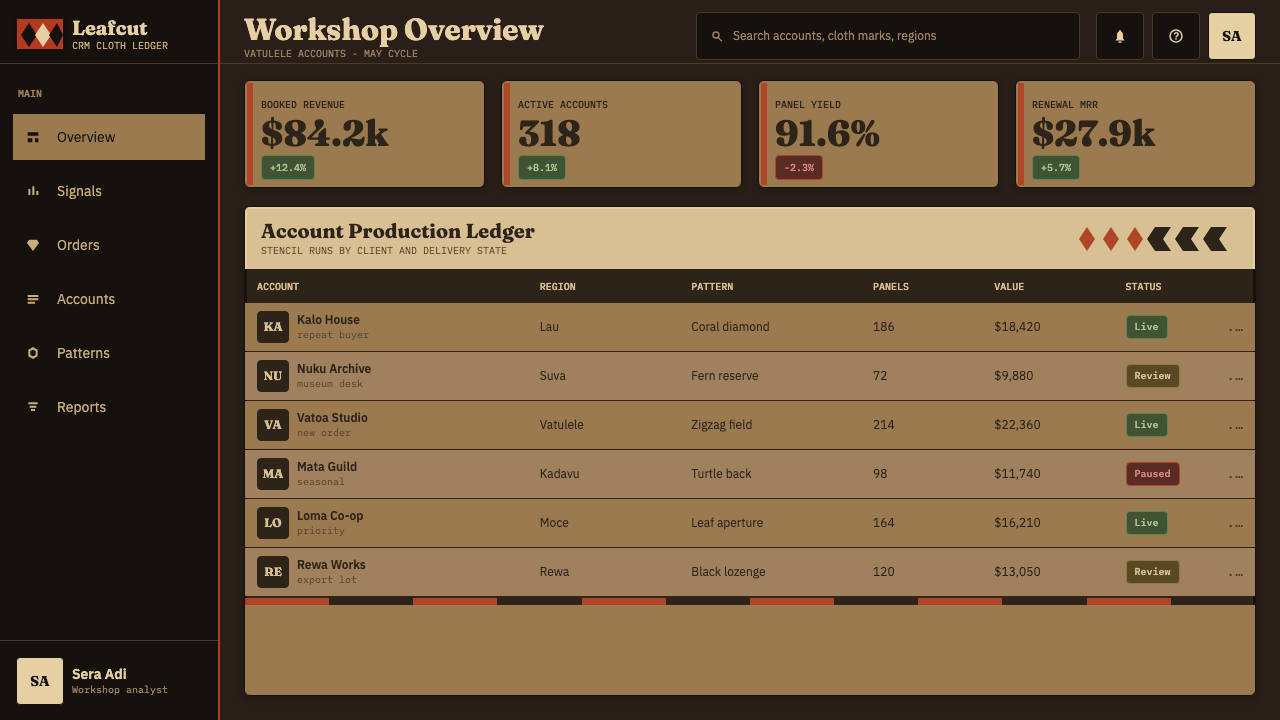
For web and digital interfaces, the style works most naturally in contexts that benefit from strong visual rhythm and pattern-driven section definition. A marketing landing page can use full-width band components — alternating between a dark soot-toned background carrying the geometric border as a texture treatment, and an open warm ground for text-heavy content blocks. Dashboards and data interfaces can apply the two-tone constraint as a strict visual logic: one dark structural color for primary data marks and labels, one warm accent for highlighted values or interactive states, the background kept neutral and quiet. The stencil-sharp edge quality argues against soft shadows and blurred transitions; card components and modal overlays should have decisive, hard-edged borders rather than diffuse drop shadows.
In editorial and marketing contexts, the style supports a bold, posterlike hierarchy that works well for feature announcements, event promotion, and cultural-sector communications. Full-bleed band headers — using the masi geometric border pattern as a repeating horizontal element above a hero image or headline — signal cultural seriousness without requiring literal Fijian iconography. For publication layouts, the band structure can organize an article's visual architecture: a decorative geometric rule separates major sections, pull quotes sit in narrow accent-colored sidebar bands, and the overall page maintains the masi principle of ordered registers rather than free-form composition.
A common error when applying this style is treating the geometric patterns as surface decoration applied on top of an otherwise conventional layout. Authentic masi logic is structural from the ground up — the bands do not decorate a composition, they are the composition. A second frequent mistake is expanding beyond the two-tone palette: adding a third or fourth color breaks the discipline that gives the style its graphic authority. If a brand palette requires more colors, introduce them only as minor accents within the established soot-and-coral framework, and never at the same visual weight as the primary structural ink.
Fijian Masi (Bark Stencil) — FAQ
How is Fijian masi different from other Pacific tapa traditions?
The defining difference is the stencil technique. Most other Pacific bark cloth traditions — Tongan ngatu, Samoan siapo, Hawaiian kapa — decorate cloth through rubbing pigment over carved or incised boards placed beneath the cloth, a process that produces softer, more diffuse patterns. Fijian masi uses cut banana-leaf templates pressed against the cloth surface, printing through the template opening to produce sharp, poster-like edges. The visual result is fundamentally different: masi reads as a printed graphic system rather than a painted textile, which is why its vocabulary transfers so naturally to contemporary design contexts that deal in sharp-edged, reproducible marks.
Are the geometric patterns in masi symbolic or purely decorative?
They are neither purely symbolic nor purely decorative — they occupy a middle ground that has no precise equivalent in Western design tradition. Specific patterns are associated with specific ceremonial occasions, social ranks, and island identities: a pattern appropriate for a chiefly investiture cloth would not appear on a cloth made for everyday trade. Within a single composition, the arrangement of bands and motifs follows rules that a knowledgeable practitioner reads as purposeful statements. However, the patterns are not a code with one-to-one correspondence between symbol and meaning in the way heraldry works; their significance is relational and contextual rather than fixed and lexical. For design applications outside the ceremonial context, this means the vocabulary can be used with aesthetic integrity without the practitioner needing to master its full ceremonial grammar.
Can the masi palette work outside its traditional warm-ground context?
Yes, but it requires deliberate adaptation. The warmth of the natural bark ground is integral to how the soot-black and coral-red pigments read — against a warm off-white, the dark marks feel grounded and the warm accent feels activated rather than alarming. Transposing the palette directly onto a cold white or a very light cool grey weakens this relationship; the warm accent in particular can appear harsher. A dark-background inversion is possible: soot-black becomes the ground, and the warm coral accent and a lighter near-cream tone provide the marks and fills. This reversal can be effective for digital screens where dark modes are preferred, but it fundamentally changes the visual character — from the feeling of marks pressed onto a warm surface to something closer to a luminous display, which shifts the emotional register significantly.
How does masi handle large blocks of text or data-dense content?
Traditional masi does not contain text at all — it is a purely visual, non-linguistic system — so the question of text handling is entirely a contemporary design challenge. The style's band logic provides the answer: text and data should be treated as fills within bands rather than as content floating on a neutral field. A band of body text occupies its horizontal register the way a geometric fill occupies its band in a cloth, defined by the band boundaries rather than by the text's own visual edges. This approach works best when text hierarchies are simplified — one heading size, one body size, consistent leading throughout — so that the typographic field maintains the visual density and regularity of a geometric fill rather than reading as an undifferentiated grey mass.
Is it appropriate to use Fijian masi patterns outside a Pacific cultural context?
The question deserves honest engagement rather than a quick answer in either direction. Masi patterns are living cultural property — the tradition is actively maintained by Fijian women artisans today, and specific patterns carry social and ceremonial significance within their originating communities. Using the geometric vocabulary as a surface style without acknowledging its origins sits in uncomfortable territory. A more thoughtful approach treats the visual grammar — the band logic, the two-tone constraint, the stencil-edge quality — as a set of transferable structural principles while being explicit about the source, avoiding direct reproduction of specific named ceremonial patterns, and where possible directing audiences toward the work of contemporary Fijian practitioners. The goal is to learn from the tradition rather than to borrow its most visible surface.
Related design styles
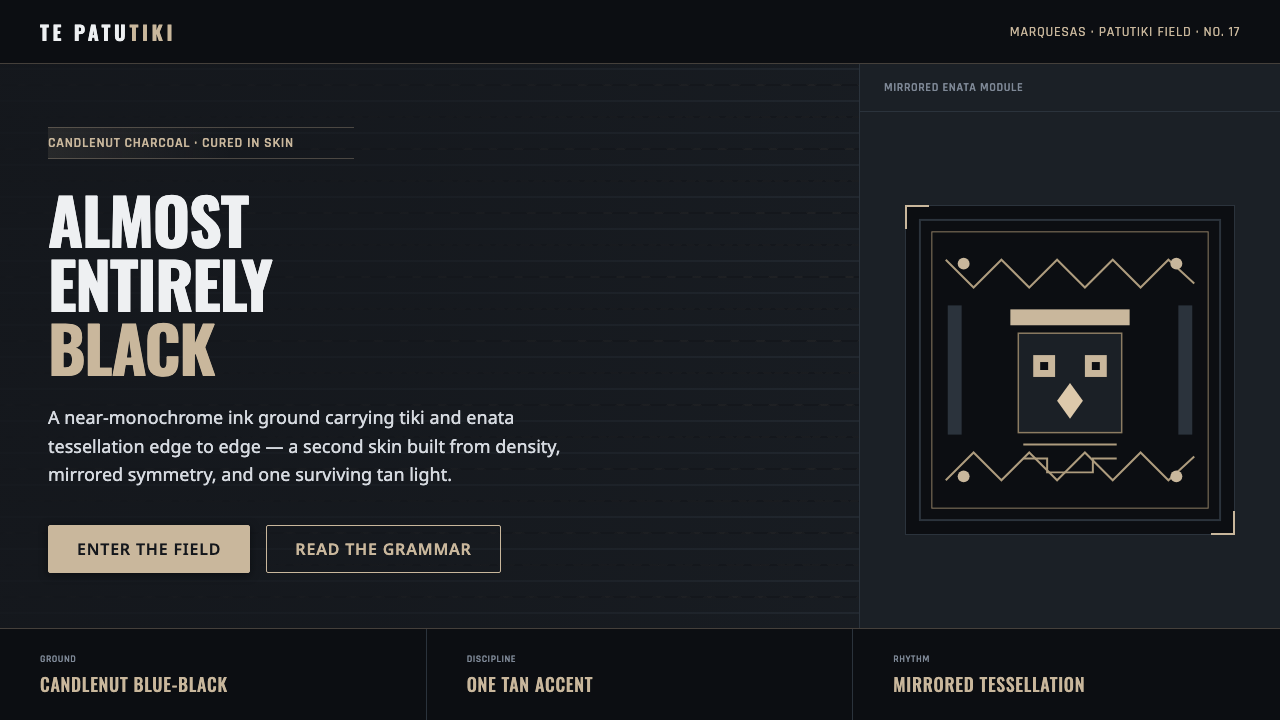 Marquesan Tatu PatternDensity as authority. Tiki and enata tessellation inked into blue-black, lit…
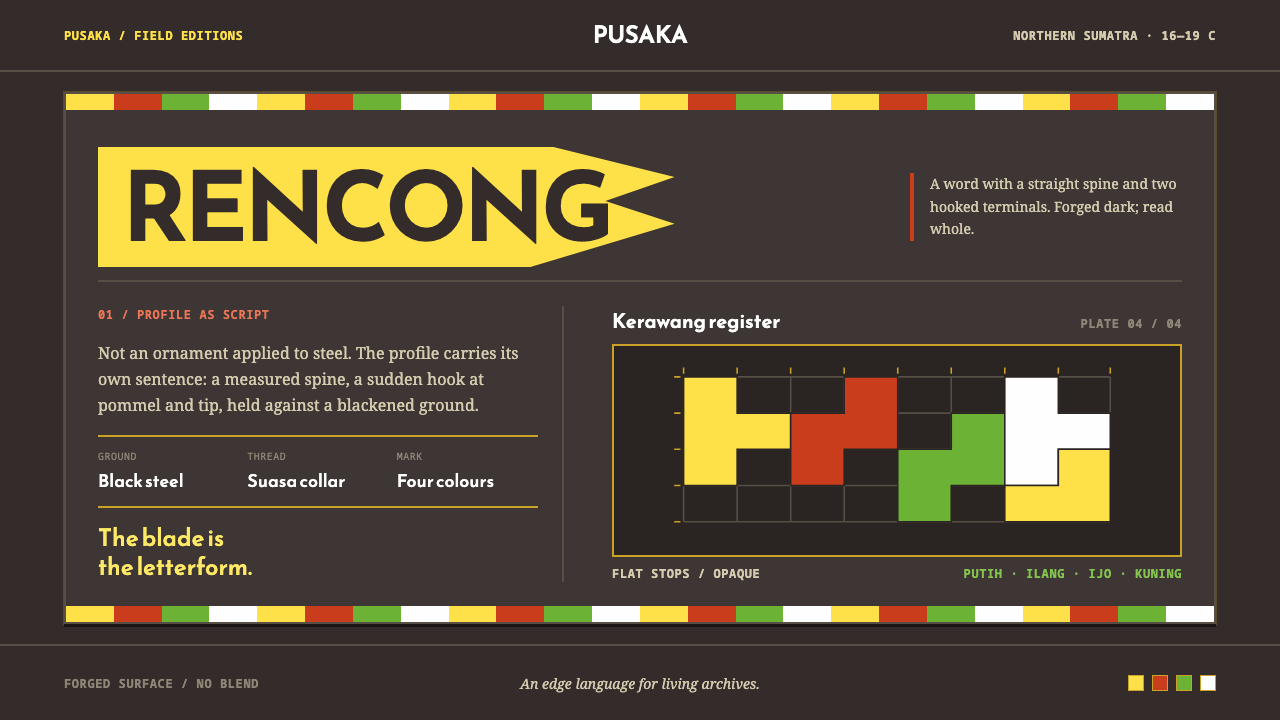 Acehnese Rencong MotifA blade that reads as a word. Flat kerawang red, white, green and yellow lock…
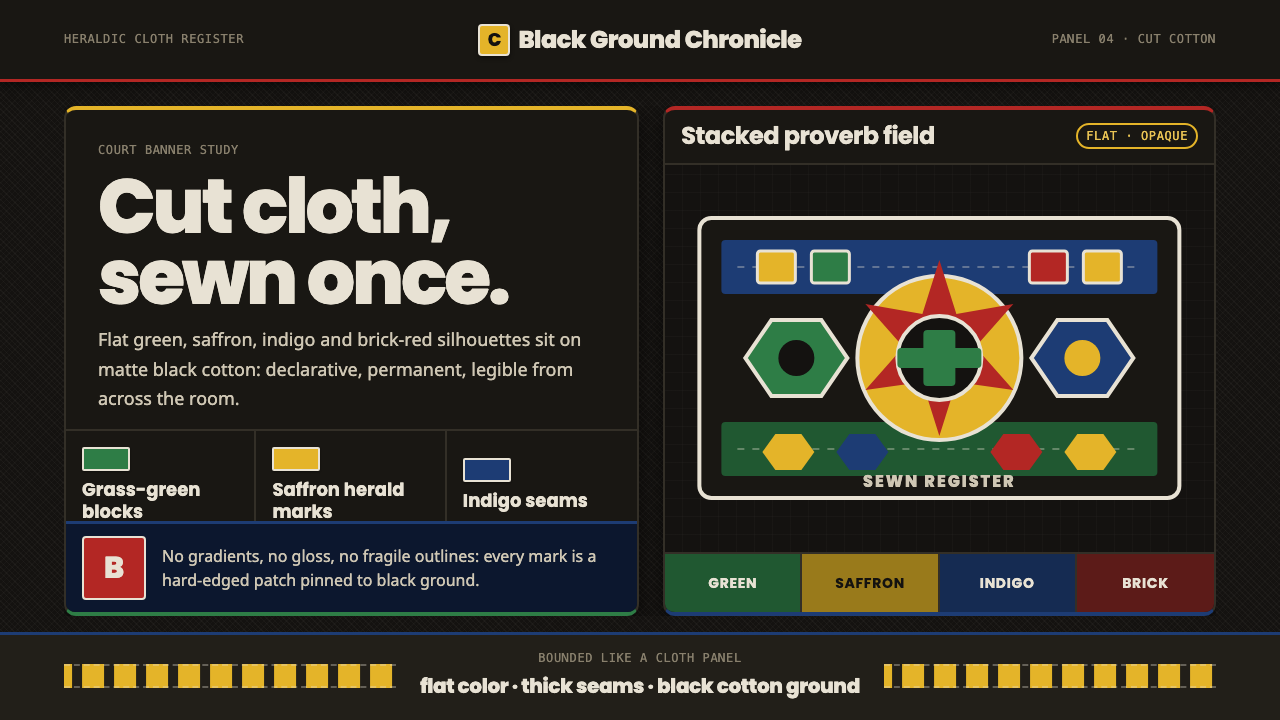 Fon Applique Banner AbomeyRoyal cloth speaks plainly. Flat saffron, green and indigo silhouettes on bla…
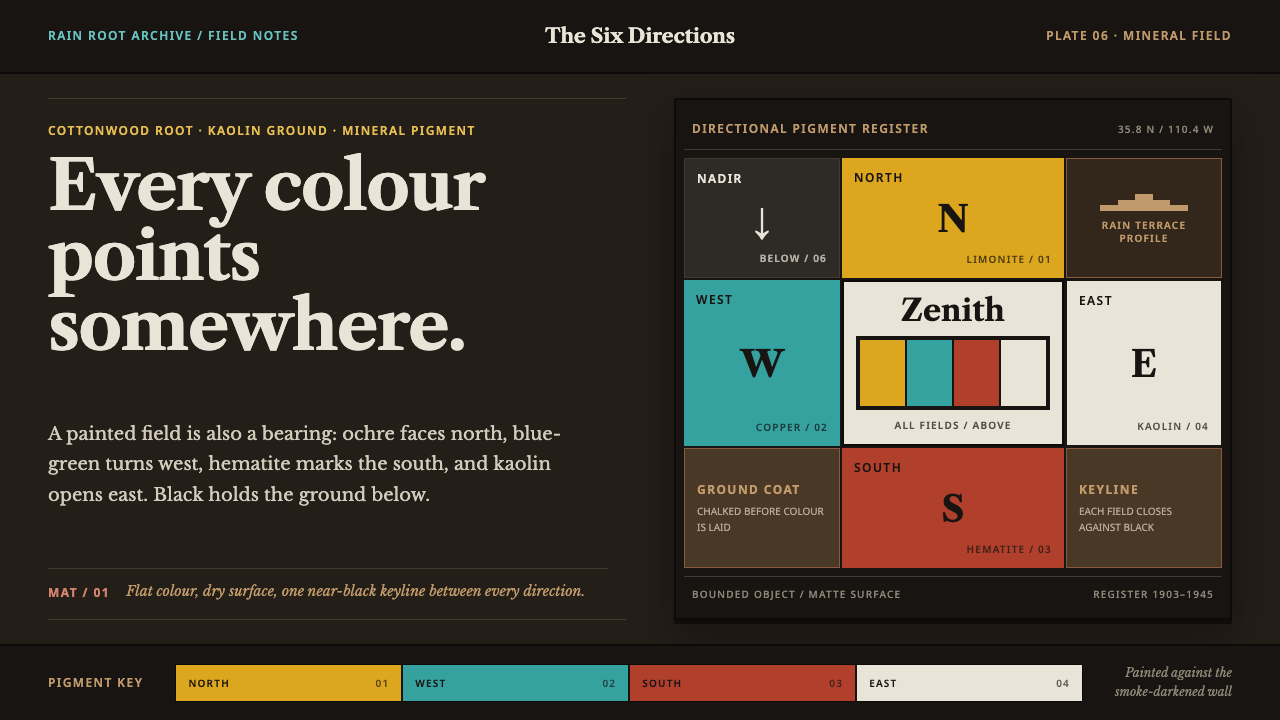 Hopi Katsina TihuEvery colour is a direction. Matte mineral fields meet in smoke-black keyline…
 Kongo Nkisi Nkondi FigurePower accumulates in darkness. Black wood, iron studs, and one mirror glint h…
 Māori Tā Moko (Facial Tattoo)Ancestry feels carved. Blue-black spirals on tan ground carry a restrained Ga…