What is Maasai Shuka & Beadwork?
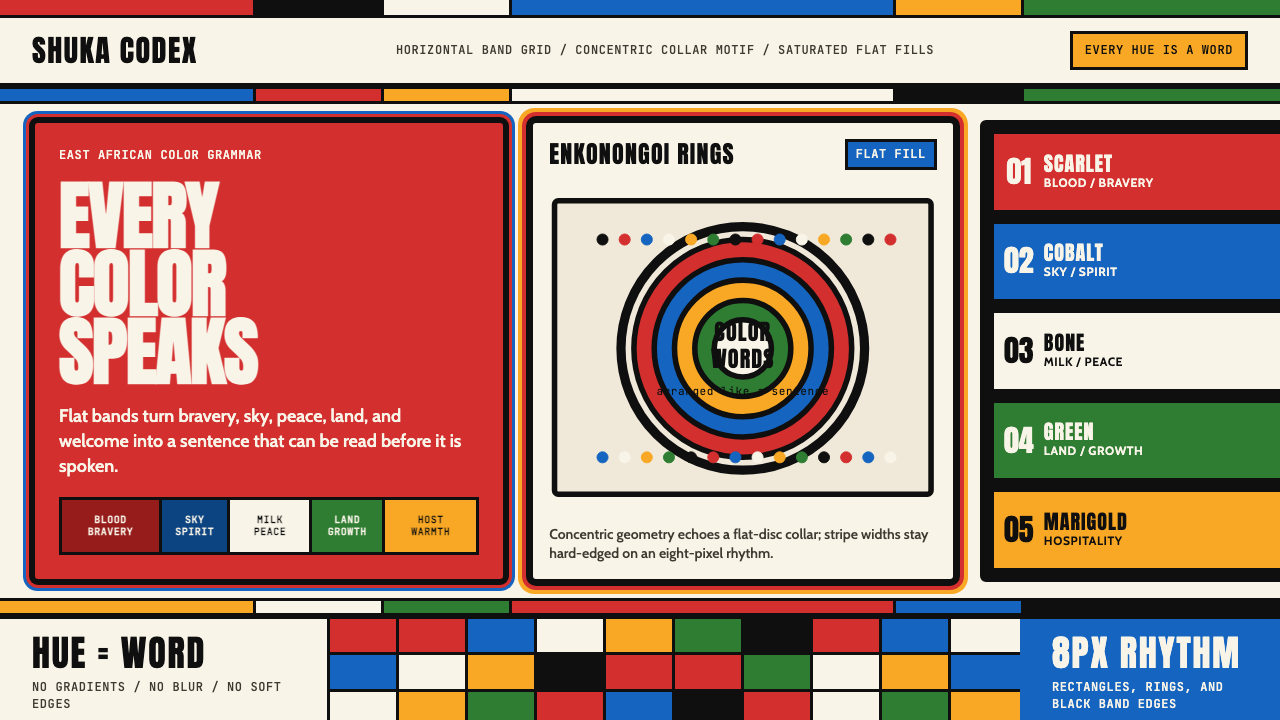
Among the world's color-coded visual systems, Maasai shuka cloth and beadwork stand apart — every hue a word, every geometric arrangement a sentence carrying age, lineage, and ceremony.
Maasai Shuka & Beadwork in brief
Maasai shuka and beadwork constitute one of the most legible and semantically precise visual systems in the world. Unlike decorative traditions where color choice is primarily aesthetic, every hue in the Maasai palette carries a fixed, community-agreed meaning: red speaks of blood and bravery, blue represents the sky and the divine, white evokes peace and the nourishment of milk, green stands for the land that sustains the herds, and yellow signals hospitality and fertility. These meanings are not metaphorical suggestions — they are established vocabulary, as fixed as letters in an alphabet.
The woven shuka — a rectangular cloth worn draped over one or both shoulders — is the garment form that carries this palette in its most public and immediately visible expression. Traditionally woven in strong horizontal bands and bold check patterns, the shuka's geometry derives from the practical constraints of East African pastoral life: flat, durable, highly visible across open savanna. The beadwork tradition, practiced primarily by women within age-set collectives, extends this system into jewelry: flat-disc collars called enkonongoi, stacked bracelets, headbands, and earrings that communicate a woman's marital status, age-grade, and community affiliation through the specific arrangement and proportion of colored beads.
As a design vocabulary for contemporary digital work, this tradition offers something rare: a complete color-meaning system with geometric rigor already built in. The visual grammar is one of hard edges, flat saturated fills, horizontal banding, and concentric ring motifs — all derived directly from the textile and beadwork forms. Gradients, soft shadows, and organic curves have no place in this vocabulary. The result is a visual language that is simultaneously ancient, encyclopedic, and strikingly modern in its geometric clarity.

Where does Maasai Shuka & Beadwork come from?
The Maasai are a Nilotic people whose ancestors migrated southward from the Nile Valley region into the Great Rift Valley area of East Africa over several centuries, with significant settlement of what is now southern Kenya and northern Tanzania — encompassing the Kajiado and Narok counties and the Arusha and Manyara regions of Tanzania — established by roughly the seventeenth and eighteenth centuries. They developed as a semi-nomadic pastoral society organized around cattle herding, and their material culture — including dress, jewelry, and body adornment — evolved to serve the social requirements of a community constantly on the move, where portable visual markers of identity, status, and ceremony were essential.
Beads entered Maasai material culture through the extensive trade networks of the Swahili coast. Glass and ceramic beads — originally from Venice, Bohemia, and later from South Asia and Japan — reached the interior of East Africa via Swahili-speaking merchants along the Indian Ocean trade routes. By the nineteenth century, Maasai beadwork had absorbed and transformed these imported materials into a highly codified local tradition. The color-meaning assignments that define the system — red for bravery, blue for the sky and God, white for peace and milk, green for land, yellow for hospitality — appear to have stabilized into broadly agreed community conventions during the nineteenth and twentieth centuries, though some color associations have deeper roots in pre-colonial pastoral symbolism.
The shuka cloth's characteristic check and stripe patterns have roots in trade cloth traditions, with the bold red-and-blue or red-and-white check patterns that became most iconic emerging as commercially woven blankets became available and were adopted and adapted into Maasai dress. The shuka is not a garment of pure pre-colonial origin but rather a living tradition that absorbed external materials while maintaining internal meaning. This capacity for absorption without loss of semantic precision is one of the tradition's most remarkable characteristics.
Age-grade systems — which organize Maasai society into cohorts of men and women who move through defined life stages together — are the primary social mechanism that gives beadwork its communicative precision. Women's age-set beadwork collectives are responsible for producing the jewelry that marks transitions between life stages: a girl's beadwork differs from that of a newly initiated woman, which differs again from that of a married woman or an elder. The enkonongoi collar, worn as a flat disc of concentric colored rings, is one of the most visually distinctive expressions of this system, with its ring structure encoding social information through color sequence and proportion. In more recent decades, designers including Anyango Mpinga and the studio Pichulik have worked with Maasai beadwork traditions to develop contemporary jewelry and fashion that honor the geometric and chromatic logic of the source material while engaging global design conversations.
What defines the Maasai Shuka & Beadwork look?
Saturated Flat Color
Every color in the Maasai palette is applied at maximum saturation with no gradation, tinting, or shading. The fills are absolute: a band of red is fully red from edge to edge, a bead of cobalt blue is uniform across its entire surface. This flatness is not a simplification — it is a requirement of the semantic system, because gradients would introduce ambiguity into what is designed to be an unambiguous code. In digital application, this means fills should be pure and undiluted, with no atmospheric haze or glow effects blending one color into another.
Horizontal Banding
The shuka's most fundamental compositional unit is the horizontal band — a full-width stripe of solid color that stacks with other bands to form the complete textile. This orientation is not arbitrary: it follows the natural drape of cloth across the body, the horizon line of the open landscape, and the practical logic of a loom. In design application, horizontal banding means organizing layouts into stacked full-width registers rather than modular cards or scattered elements. Each register can carry one dominant color and one information function, creating pages that read from top to bottom with the same clarity that a shuka reads from collar to hem.
Concentric Ring Motif
The enkonongoi collar — the flat circular beadwork disc worn around the neck — is built from concentric rings of alternating colors, each ring encoded with social meaning through its hue and its position relative to the center and the outer edge. This radial structure translates directly into circular design elements: progress indicators, data visualizations, icon frames, and decorative borders that work outward from a center. The key discipline is that the rings must be clearly distinct — each ring reads as a separate band, not as a gradient transition. The concentric form should feel architectural rather than decorative.
Semantic Color Assignment
What makes this system unusual among world textile traditions is that its colors are not chosen for visual harmony or regional taste — they are chosen for what they mean. Red communicates blood, sacrifice, and bravery. Blue addresses the divine and the sky. White carries peace, purity, and milk. Green speaks of land, sustenance, and growth. Yellow conveys warmth, hospitality, and sun. In digital application, this means each color should be assigned a consistent role — one color for calls to action, one for informational elements, one for status indicators — rather than being deployed interchangeably for visual variety. The meaning should be stable across the entire system.
Hard Geometric Edges
Beadwork and woven textiles share one structural property: their edges are always hard. A bead ends where the thread holds it; a woven stripe ends where the weft changes color. There are no feathered boundaries, no blended transitions, no soft zones of influence between one color region and the next. In digital translation, this means borders between color blocks should be sharp and precise — a thin dividing line or an abrupt color change, never a gradient buffer zone. Rounded corners should be used with restraint; the geometry of this tradition is rectangular and circular, not soft-edged or pill-shaped.
Check and Grid Pattern
The shuka's check pattern — created by the intersection of differently colored warp and weft threads — produces a regular grid of color blocks that is one of the most recognizable elements of Maasai visual identity. In this pattern, every cell is equal in size, every color is equally saturated, and the overall rhythm is relentlessly regular. In design work, this translates to a disciplined grid where column widths and row heights follow a consistent ratio, and where variations in content are contained within identical structural cells rather than allowed to break the container.
No Gradient, No Ornament
The Maasai visual tradition produces objects — beads, cloth, leather — that are entirely flat, entirely saturated, and entirely without decorative embellishment that does not carry semantic weight. There are no flourishes, no filigree, no softening effects. The beads do not glow; the cloth does not shimmer in its representation. When translated into screen design, this principle means rejecting drop shadows intended to suggest depth, rejecting gradient fills intended to suggest luminosity, and rejecting decorative elements — botanical motifs, abstract textures, subtle patterns — that have no role in the system's communication logic. Every element that appears on the screen should be there because it means something.

Who shaped Maasai Shuka & Beadwork?
The primary custodians and innovators of the beadwork tradition are not individual named artists but the age-set collectives — groups of women of the same approximate generation who learn, practice, and transmit beadwork knowledge together. Within these collectives, color choices, bead arrangements, and collar construction techniques are taught, debated, and refined across generations. The collectives function as both quality-control institutions and living archives of social knowledge, ensuring that the semantic content of each beadwork piece remains legible to community members across different regions and generations. Their anonymous, collective authorship is itself a design principle: the system's meaning derives from community consensus, not individual invention.
Anyango Mpinga is a Kenyan-born, internationally active fashion designer whose work has directly engaged with Maasai and broader East African textile and beadwork traditions. Working across ready-to-wear and couture contexts, Mpinga has brought the color logic and geometric vocabulary of Maasai visual culture into contemporary fashion in ways that acknowledge the tradition's cultural specificity while projecting it onto global platforms. Her work is notable for treating the beadwork color system as a living design language rather than an ethnographic reference — using the semantic color assignments as active organizational principles in contemporary garment construction.
Pichulik is a Cape Town-based jewelry and accessories studio founded by Katherine-Mary Pichulik, whose practice draws explicitly on African beadwork traditions — including Maasai beadwork — to develop bold, wearable geometric jewelry in rope, bead, and textile combinations. The studio's work demonstrates how the concentric ring structures, saturated flat color logic, and hard geometric forms of beadwork traditions can be translated into contemporary product design without losing the visual authority that comes from a coherent underlying system. Pichulik's pieces are widely cited in conversations about how African design traditions can inform global contemporary aesthetics.
The material history of Maasai beadwork cannot be told without the Indian Ocean trade networks centered on the Swahili coast. From roughly the ninth century onward, Swahili-speaking merchants acted as intermediaries between Indian Ocean trading partners — including Arab, Indian, and later European traders — and the East African interior. Glass beads manufactured in Venice, Bohemia, and later in South Asia and Japan flowed inland through these networks and were adopted by interior communities including the Maasai, who transformed imported trade goods into the raw material of an entirely local semantic system. The tradition's capacity to absorb external materials without losing internal coherence is one of the defining characteristics of its design intelligence.
How do you use Maasai Shuka & Beadwork today?
Maasai Shuka and Beadwork is a design system built on semantic precision rather than aesthetic mood, which makes it one of the more disciplined historical styles to apply in contemporary digital work. Getting it right requires understanding the color system as a system — assigning each hue a fixed communicative role and maintaining that assignment consistently across every surface and element. The visual effect is immediate and high-contrast: users will notice the palette before they notice anything else about the layout, so the palette must be doing real communicative work rather than simply creating visual interest.
For presentation slides, the style excels on both cover and content pages but demands different approaches to each. A cover slide benefits from treating the full surface as a shuka composition: stacked horizontal bands of two or three colors, with the title placed as a white or black text block within the dominant band. No photographic background, no gradient overlay — just flat registers of saturated color with type placed at high contrast within one band. Content slides should commit to the horizontal register logic: one band per major information category, with the band color indicating the category type (red for warnings or critical data, blue for contextual information, green for growth metrics, yellow for opportunities). Data slides work exceptionally well: bar charts rendered as geometric blocks in the primary colors, with consistent color-to-category assignments across the entire deck.
For web user interfaces, dashboards and pricing pages are the natural home of this vocabulary. The approach begins with defining a strict horizontal grid — the page organized into full-width sections that stack like shuka bands rather than into a field of floating cards. Navigation should be typographically clean with color reserved for active states. Dashboard components work best when data categories map to specific colors from the palette, and those mappings are stated explicitly in a legend that respects the geometric precision of the tradition. Pricing tiers can use one color per tier, applied as a full-width band behind the tier name and carried through into the call-to-action button and any highlighted features. Hard borders replace soft-shadow cards; solid backgrounds replace frosted glass or blur effects.
For editorial and marketing work, the vocabulary supports strong visual hierarchy and immediate readability at a distance — qualities that made shuka patterns legible across open savanna are equally useful in digital advertising and editorial layout. Full-width color bands alternating between two or three hues from the palette create a reading rhythm that feels organized rather than monotonous. Marketing pages work well with large typographic statements placed within colored bands — white type on a red band for a hero statement, black type on a white or cream band for body content, a yellow band for a featured testimonial or call-to-action section. The geometric precision of concentric rings makes excellent candidates for icons, loading indicators, and section markers: a series of concentric circles in alternating palette colors reads immediately as a Maasai-derived motif while remaining completely functional as a UI element.
A common mistake when applying this style is using all five palette colors simultaneously across a single surface without assigning them stable roles. In authentic Maasai beadwork, color combinations within a single piece are deliberate and rule-governed — not every bead color appears in every collar. In digital application, selecting two or three colors as primary working colors and reserving the remaining palette colors for specific exceptions (alerts, highlights, interactive states) produces far more coherent results than attempting to deploy the full chromatic range everywhere. A second common error is softening the system with gradients or rounded elements out of an instinct to make it feel more contemporary or approachable. The authority of this visual tradition comes precisely from its refusal to soften, and that authority is what the style offers to the products that use it.

Maasai Shuka & Beadwork — FAQ
Is this style appropriate for non-African products and brands, or does it risk cultural appropriation?
The distinction that matters most is between appropriation and informed application. Using Maasai visual vocabulary without acknowledgment, stripping it of meaning, or deploying it as mere exotic decoration is appropriation. Applying it as a design system with an understanding of what each element communicates — and presenting it to users with that context — is something different. The Curio framework treats this tradition as a design system with specific structural properties, not as a surface aesthetic for borrowing. Designers using it should be prepared to acknowledge the source tradition and should avoid applications that flatten the semantic content of the color system into pure decoration. The style works best for products whose values align with the tradition's core qualities: clarity, communal legibility, and the principle that every visual element carries meaning.
Can this style work on a dark background, or is a light ground required?
The tradition itself is neutral on this question — shuka cloth exists on cream, white, and occasionally dark grounds depending on the dye used for the base fabric, and beadwork is often set against dark leather. A dark-ground application is entirely viable, but it requires reassigning the roles of white and black within the palette. On a dark ground, white becomes a high-visibility accent color rather than a neutral base, which shifts its semantic weight considerably. The discipline required on a dark ground is greater: with all five primary palette colors potentially appearing at high contrast against dark, the risk of chromatic overload increases sharply. A practical approach is to commit to one or two palette colors as foreground elements and treat the dark ground as the background register, reserving the full palette for accent and data roles only.
How do I handle typography within this system — does it have a specific type style?
The tradition itself is non-typographic — Maasai visual culture does not have a historic script or typographic system that can be directly translated. What the tradition does supply is a set of compositional principles that constrain type choices: high contrast between text and ground, clear and unambiguous letterforms, and text that functions as a visual block within the horizontal register system rather than as flowing prose. In practice, this points toward geometric sans-serif typefaces that share the tradition's formal qualities — faces whose characters are constructed from simple curves and straight lines, set in strong size contrasts to establish hierarchy, and placed within colored bands rather than on complex textured backgrounds. Avoid typefaces with pronounced calligraphic variation or high stroke contrast — these qualities belong to different visual traditions and will compete with the beadwork vocabulary's flatness.
What is the difference between this style and other African textile-inspired design systems?
African textile traditions are enormously diverse, and the visual systems they generate are correspondingly distinct. Kente cloth from Ghana is characterized by narrative strip-weaving with complex multi-color sequences and symbolic patterns that encode royal and social histories — its geometry is narrower and its color logic more complex. West African wax-print (ankara) traditions use curvilinear, high-density pattern repeats that are the visual opposite of Maasai flatness and horizontal banding. Ndebele geometric painting from southern Africa uses bold angular forms and strong color blocks but on an architectural rather than textile surface. What distinguishes the Maasai system specifically is the semantic precision of its five-color palette, the combination of horizontal banding with concentric ring motifs, and the absolute commitment to flat saturated fills with no surface complexity. It is the most directly translatable to digital interfaces precisely because its visual logic most closely resembles the logic of digital color blocks and modular layout grids.
Does this style suit consumer-facing products, or is it better suited to professional tools?
The style's high-contrast, semantically dense visual language gives it authority and clarity — qualities that map well to professional tools, data platforms, educational content, and any product where users need to parse information quickly and reliably. It can work in consumer contexts, but the products that will benefit most are those where the user relationship is one of trust and clarity rather than emotional warmth. Financial products, health monitoring dashboards, travel planning tools, and productivity applications align well with the style's visual values. It struggles in contexts that require softness, intimacy, or sensory pleasure as the primary emotional register — luxury goods, wellness brands, children's applications, and food experiences are environments where the style's flatness and semantic rigidity can feel cold or inaccessible. The test is whether the product's core value proposition is best expressed through clarity and precision, or through warmth and sensory richness.
Related design styles
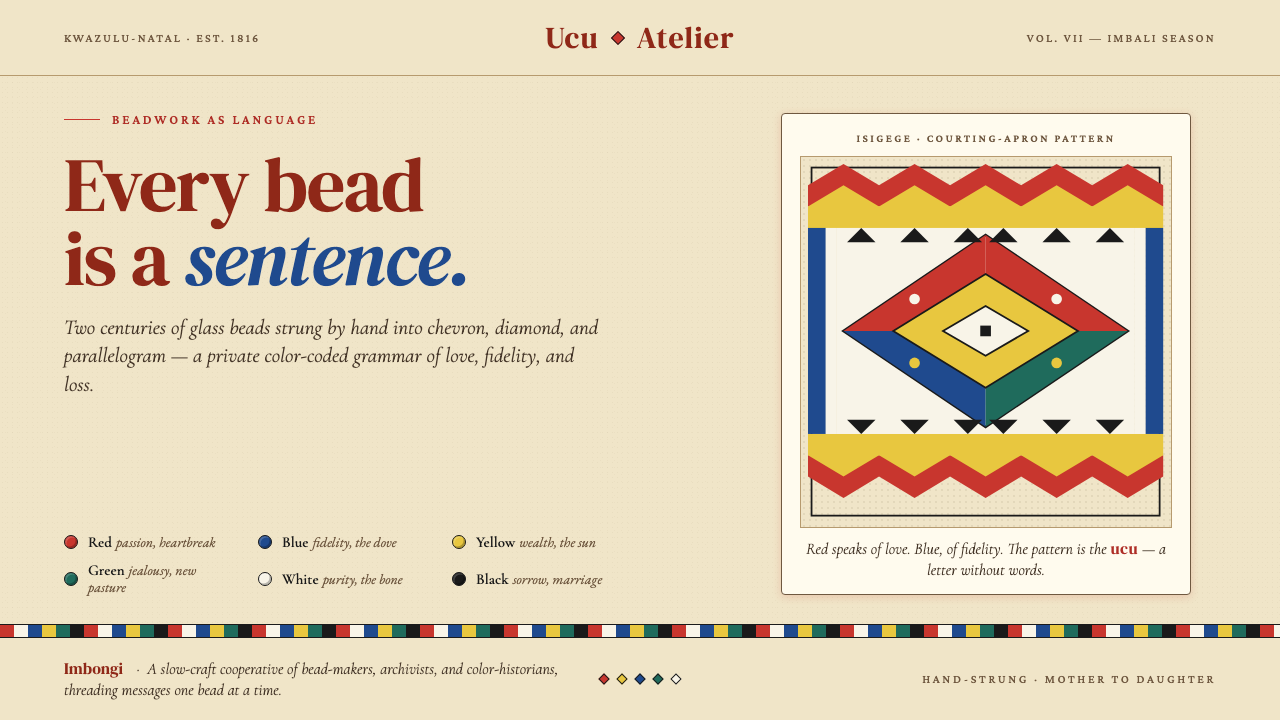 Zulu Beadwork (KwaZulu-Natal)Every bead is a sentence. Saturated glass primaries strung into chevron and d…
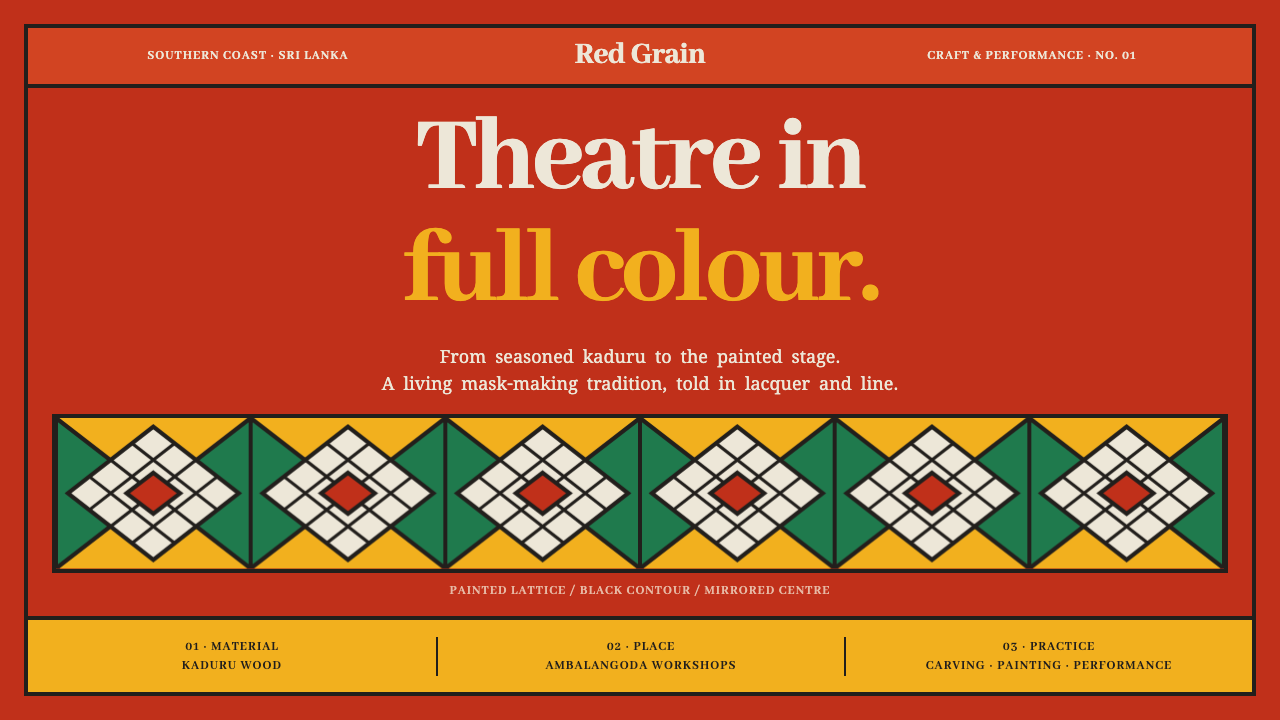 Ambalangoda Raksha MaskColour with carved authority. Vermilion, chrome yellow and black lattice hold…
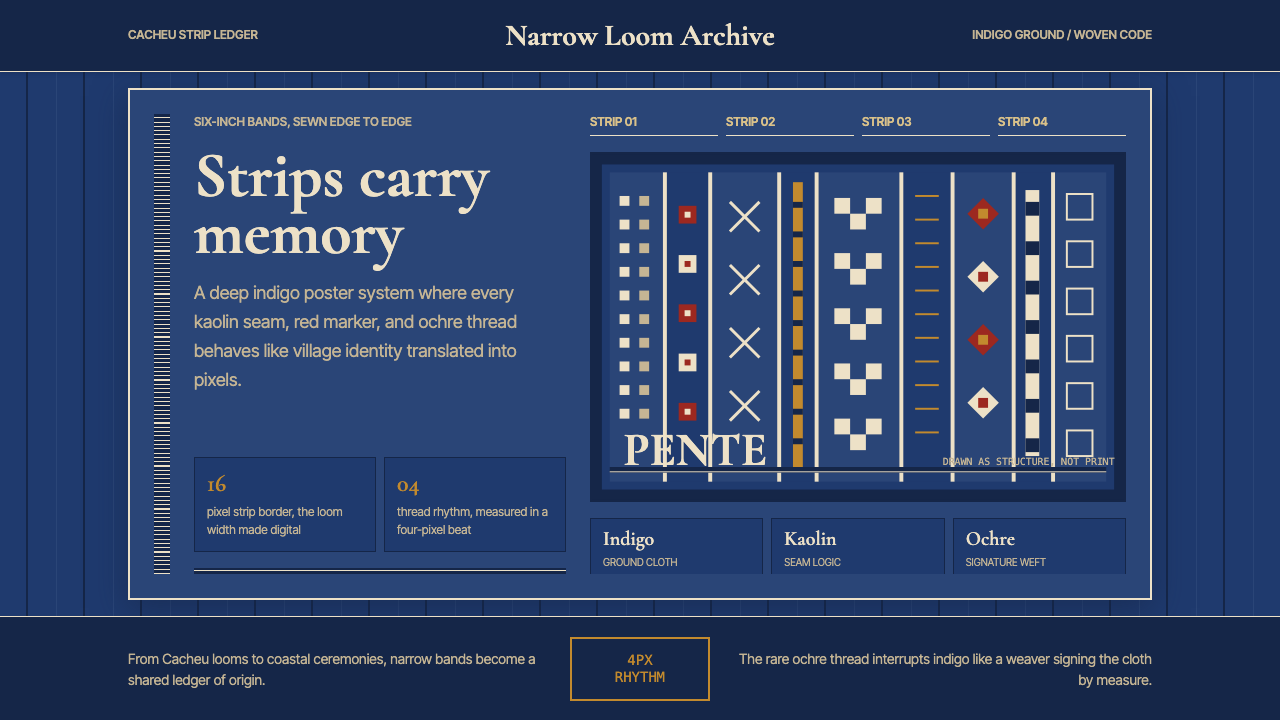 Bissau-Guinean Pano de PenteIndigo remembers. Narrow bands and kaolin seams turn weave grammar into pixel…
 Fon Applique Banner AbomeyRoyal cloth speaks plainly. Flat saffron, green and indigo silhouettes on bla…
 Kandyan Temple Mural FriezeTemple-wall gravity. Red ochre, gold planes, black contours, white-dot regist…
 Kenyan Kanga PrintText speaks first. Hot pink ground, lime pindo border, indigo italic proverb…