What is Memphis (Sottsass 1981)?
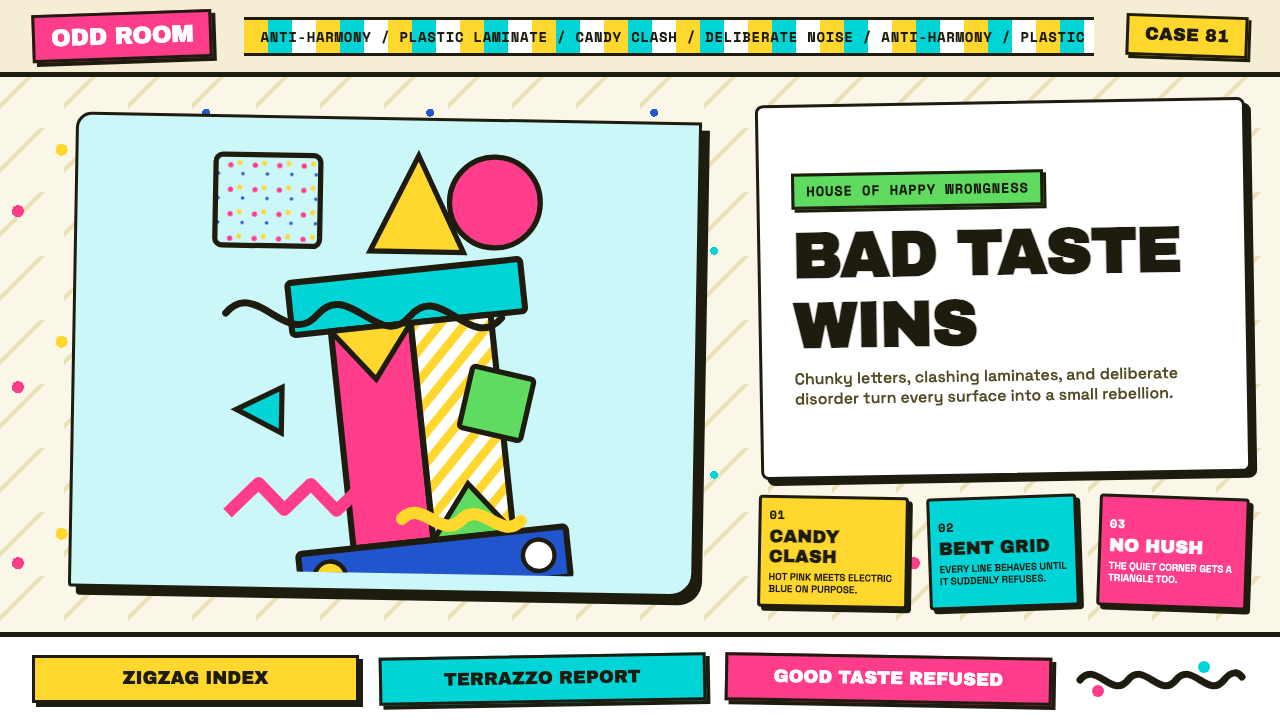
The Memphis Group crashed the 1981 Milan furniture fair with clashing laminates, day-glo geometry, and a deliberate celebration of bad taste — and permanently rewired how designers think about joy.
Memphis (Sottsass 1981) in brief
Memphis is a postmodern design movement founded in Milan in 1981 by Ettore Sottsass and a circle of younger collaborators. Its visual signature is instantly recognizable: hot pink alongside electric turquoise, terrazzo-speckle laminate surfaces, thick black outlines enclosing geometric shapes, zigzag lines that refuse to resolve into elegance, and a deliberate asymmetry that seems to tumble across the canvas rather than rest on it. Nothing harmonizes. Everything competes. That competition is the point.
Where modernism and its Italian cousin — the refined rationalism of mid-century Milan — demanded that form serve function and that decoration justify itself structurally, Memphis declared the opposite: decoration is the function. Surfaces printed with squiggle patterns and confetti dots exist to produce delight, provoke reaction, and assert that usefulness and seriousness are not the same thing. The style wore its influences openly — Pop Art's commercial exuberance, kitsch consumer culture, the color saturation of 1960s Italian graphic design — and mixed them without apology.
Visually, Memphis work is characterized by a specific tension between the flat and the tactile. Surfaces are pattern-heavy — geometric repeats, dot fields, diagonal stripes — but the overall composition is planar, without soft shadows or simulated depth. The hard-offset cartoon shadow (a solid block of near-black displaced to the lower right) creates a pop-up-book sense of depth without ever pretending to be real light. This flatness-with-attitude carries directly into the digital applications of the style today.
Where does Memphis (Sottsass 1981) come from?
The Memphis Group's founding story has a mythic quality appropriate to its outsized influence. In December 1980, Ettore Sottsass — already a celebrated industrial designer known for his work at Olivetti — gathered a group of younger designers in his Milan apartment. According to the story, Bob Dylan's 'Stuck Inside of Mobile with the Memphis Blues Again' happened to be playing on repeat. The group named itself after the song, then spent the winter designing a furniture collection that would debut at the Salone del Mobile in September 1981. The reaction was immediate and polarized: critics called the pieces ugly; the public was electrified.
The context that produced Memphis was the exhaustion of Italian design rationalism in the late 1970s. Post-war Italian design — the celebrated 'bel design' of firms like Cassina and brands like Olivetti — had built its prestige on refinement, functional elegance, and a certain aristocratic restraint. By the late 1970s, a generation of younger designers found this vocabulary stifling. The radical design movements of the early 1970s — Studio Alchimia, Global Tools — had already begun pushing against the clean-line consensus, embracing kitsch, historicism, and provocation. Memphis crystallized this opposition into a coherent, commercially visible movement.
Sottsass brought intellectual weight to what could have been mere provocation. He had spent years traveling in India and had been deeply influenced by the non-Western tradition of decoration as spiritual practice — the idea that surfaces could carry meaning through pattern and color rather than through structural logic alone. He was also responding to the emergence of postmodern theory in architecture: Robert Venturi's 'Learning from Las Vegas' (1972) had already argued that the decorated shed — populist, historical, ironic — was more honest than the heroic glass tower. Memphis was the furniture equivalent of that argument.
The group operated as a collective from 1981 to 1987, releasing annual collections at the Salone. By the mid-1980s, Memphis had become a genuine cultural phenomenon — its patterns appeared on album covers, in music videos, in fashion, and on the sets of television shows. When Sottsass dissolved the group in 1987, he said he felt the movement risked becoming a style rather than a provocation. The irony is that it became both: a fully realized aesthetic system that continues to be quoted, remixed, and applied wherever energy, playfulness, and anti-establishment attitude are called for.
What defines the Memphis (Sottsass 1981) look?
Color Clash
Memphis color is anti-harmony by principle. Hot pink, electric turquoise, sunshine yellow, cobalt blue, and lime green are not arranged to complement each other — they are placed side by side specifically because they clash. The palette descends from Pop Art's appropriation of commercial printing's most saturated inks and is filtered through 1980s Italian irreverence. The neutral base is a warm cream evoking terrazzo flooring, speckled rather than plain. No two adjacent colors should feel at ease with each other; visual tension is the goal, not visual balance.
Pattern Surfaces
One of Memphis's most distinctive contributions is its surface decoration: laminate sheets printed with patterns — terrazzo speckle, squiggly lines, diagonal stripes, polka dots, geometric mesh — applied to furniture, walls, and objects. These patterns do not communicate structural information; they exist purely as visual texture and noise. In two-dimensional applications, the same logic translates to decorated backgrounds, patterned fills, and ornamental dividers that would be strictly forbidden in modernist or Swiss-style work.
Geometry Without Resolution
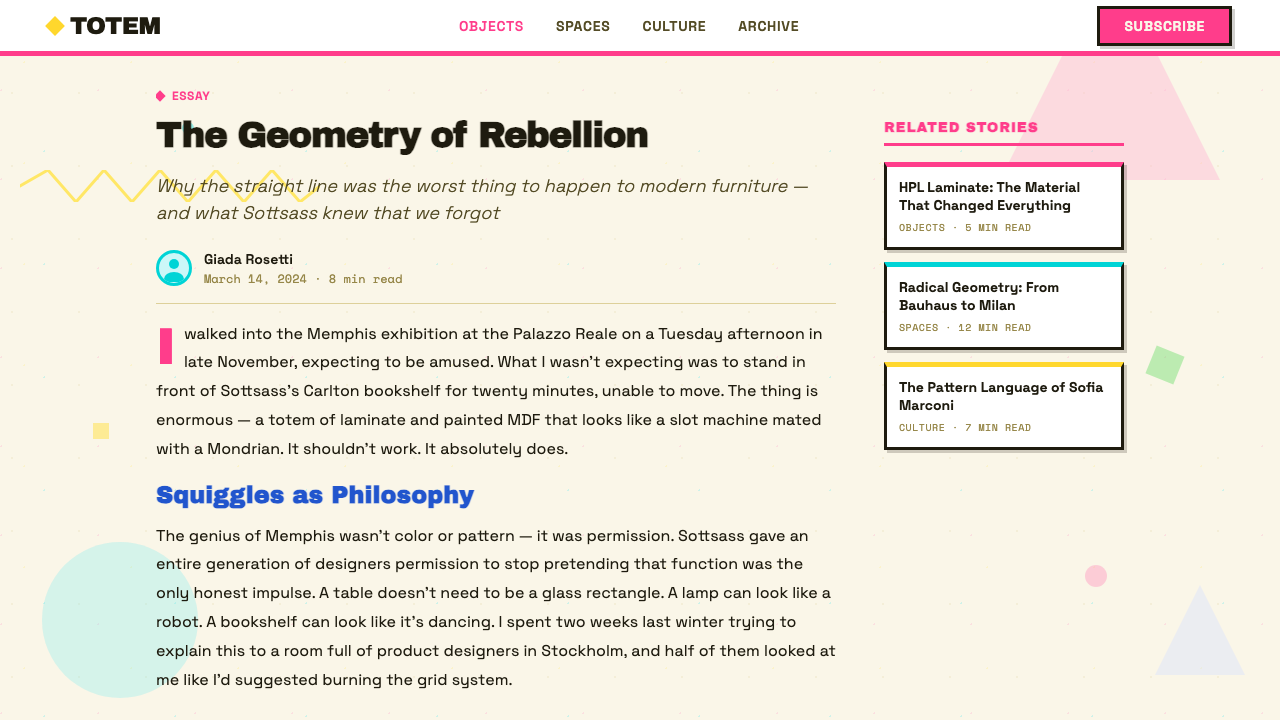
Memphis uses the same geometric vocabulary as the Bauhaus — circles, triangles, rectangles, zigzags — but deploys them in a fundamentally different spirit. Where Bauhaus geometry seeks order, resolution, and structural clarity, Memphis geometry is deliberately unresolved: shapes are juxtaposed at odd angles, overlapped without hierarchy, and scaled in ways that feel arbitrary rather than systematic. The Carlton bookcase — a totemic zigzag form in clashing laminate colors — became the movement's icon precisely because it looks like a geometry lesson interrupted by a practical joke.
Hard-Offset Shadow
Memphis depth is cartoonish and literal. Shadows are hard-edged blocks of solid near-black, offset consistently to the lower right at a small but noticeable fixed distance. There is no blur, no gradient, no ambient occlusion. The effect reads like a popup book or a poorly registered screenprint: flat objects cast flat shadows, and the whole composition feels like it was assembled by cutting and placing shapes rather than by rendering a lit scene. This technique became one of the most widely borrowed elements of the Memphis visual vocabulary.
Asymmetric Composition
Memphis layouts are structured but refuse equilibrium. Elements are positioned off-axis, rotated, or placed at the edge of the canvas in ways that create energy rather than rest. The grid exists but is there to be broken: a circle might intrude from outside the frame, a text block might sit at an unexpected diagonal, a decorative shape might overlap two otherwise distinct content areas. This dynamic instability distinguishes Memphis from the principled asymmetry of Bauhaus — the Memphis version feels wilful and playful rather than rigorously calculated.
Playful Typography
Memphis typography favors chunky, assertive geometric sans-serif typefaces — letterforms with maximum visual weight, zero delicacy, and an almost silkscreen-poster quality. Headings are sized aggressively large, as if the text might burst through the frame. All-caps labeling is common. The type system does not aim for elegant hierarchy; it aims for presence and loudness. Unlike Bauhaus typography, where type serves the grid, Memphis type treats letterforms as decorative objects in their own right — to be scaled, colored, and positioned with the same recklessness as any other shape.
Material Abundance
The original Memphis furniture was built from cheap industrial materials — plastic laminates, glass, metal tubes — that were traditionally considered unsuitable for serious design. Sottsass's choice to use these materials was partly a political statement about access and taste, and partly a formal one: laminate could be printed with any pattern, which meant surface decoration was unlimited in a way that natural wood grain or marble could not be. In digital design, this principle translates to a willingness to use visual elements — gradients, patterns, fills — that would be considered excessive in more austere aesthetics.

Who shaped Memphis (Sottsass 1981)?
Sottsass was the intellectual and spiritual center of Memphis. His earlier career at Olivetti — designing typewriters and early personal computers with a sensibility that bridged industrial utility and sculptural form — gave him credibility in mainstream design circles that Memphis's younger members lacked. His founding role and his articulate defense of the movement's principles (he gave extensive interviews arguing that Memphis was about liberation from good taste as an oppressive norm) shaped how Memphis was received and discussed. After dissolving the group in 1987, he continued designing independently until his death in 2007.
De Lucchi was among the founding members and one of Memphis's most prolific designers. His work epitomized the movement's visual energy: his First Chair (1983) — a steel sphere on a thin pole with a circular backrest — became one of the most recognizable objects of the decade. He had previously been involved with Studio Alchimia, the radical design laboratory that prefigured Memphis's anti-functionalist stance. After Memphis, de Lucchi went on to a distinguished career in corporate design, demonstrating that the movement's alumni were not limited to countercultural provocation.
Du Pasquier was the driving force behind Memphis's textile and surface pattern design. A self-taught designer who had traveled extensively through Africa and Asia before joining the group, she brought an anthropological sensitivity to decoration — treating pattern as a carrier of cultural meaning rather than mere visual noise. Her laminate patterns — geometric repeats, abstract organic forms, kaleidoscopic arrangements — defined the tactile identity of the Memphis aesthetic and remain its most widely reproduced visual element today.
Sowden, a British designer who had settled in Milan, contributed some of the movement's most distinctive product designs, including clocks, watches, and appliances where the functional object was simultaneously a visual provocation. His work demonstrated that Memphis principles could be applied to products requiring precise engineering, not just expressive furniture. He also developed significant work in textile and pattern design alongside du Pasquier, and continued designing and writing about the relationship between handcraft and industrial production after Memphis dissolved.
Radice was not primarily a designer but the movement's theorist and chronicler. As Sottsass's partner and the author of the definitive 1984 book 'Memphis: Research, Experiences, Results, Failures and Successes of New Design', she gave the movement its most articulate intellectual framing. Her writing argued that Memphis was not decoration for decoration's sake but a critique of the cultural assumptions embedded in 'good taste' — the idea that restraint, neutrality, and refinement are values rather than the preferences of a particular class. Without Radice's theoretical work, Memphis might have remained a striking but poorly understood episode.
How do you use Memphis (Sottsass 1981) today?
Memphis transfers into digital work with unusual directness, because its visual logic is already two-dimensional and pattern-based. The key insight for any application is that Memphis is not an accent — you cannot add a few squiggles to an otherwise conventional layout and call it Memphis. The style works when it governs the entire compositional system: the color palette, the shadow treatment, the surface patterns, the typographic scale, the willingness to let elements collide. Applying it at half-measures produces muddle, not energy.
For presentation slides, Memphis is particularly effective for keynote-style covers and section dividers. A Memphis cover slide benefits from a strongly asymmetric layout: place the title in a bold uppercase geometric sans at scale large enough to feel oversized, anchor one corner with a geometric shape in a clashing color (a hot-pink circle against a turquoise background, for instance), and scatter a terrazzo dot pattern across the remaining surface. Section divider slides should use full-bleed color blocks — each section in a different saturated hue — with minimal text. Data slides require more restraint: use Memphis color to encode categories in charts (one hue per series, fully saturated, no desaturated neutrals) but keep the chart backgrounds plain cream to avoid competing with the data itself.
For web UI — dashboards, pricing pages, and product landing pages — Memphis delivers energy that no other historical style matches. The dashboard application works best when the widget system is built around hard-offset shadow cards — a solid dark block offset to one corner, no blur, a bold black border — on a warm cream page background. Use saturated color to encode status and category, not just for decoration: metric cards can be hot pink for warnings, electric turquoise for active states, and yellow for neutral/informational. Pricing page tiers benefit from full-bleed colored sections — one tier per color block — with the recommended tier highlighted by a thicker black border and a contrasting shadow. Navigation should be typographic-only, with the wordmark in a heavy geometric sans.
For editorial and marketing work — posters, social media graphics, event branding, and packaging — Memphis is near-ideal. The style's poster heritage means it scales down to small formats (Instagram square, story card) without losing legibility, because the visual system is built on bold shapes rather than fine detail. A Memphis marketing graphic works with a maximum of three elements: a bold typographic statement, a geometric shape or pattern fill, and a hard border or offset shadow. Resist the urge to add photography — Memphis is a graphic system, not a photographic one, and mixing the two dilutes both.
The most common mistake when applying Memphis is confusing energy with chaos. Memphis is not random — its apparent disorder is carefully controlled. The underlying grid is always present, even when it is being broken. The color clashes are deliberate pairings, not arbitrary combinations. A design that simply throws saturated colors and irregular shapes at the screen without this underlying structure will look accidental rather than provoked. The discipline: always start with a clear grid, choose a specific color pairing rather than the full palette simultaneously, and let the asymmetry and clashes emerge from deliberate decisions rather than from the absence of decisions.
Memphis (Sottsass 1981) — FAQ
What is the Carlton bookcase and why does it matter?
The Carlton bookcase, designed by Sottsass for the first Memphis collection in 1981, is a six-foot-tall asymmetric tower of shelves built from laminate-covered particleboard. Its profile is an irregular zigzag — no two horizontal planes at the same height, no vertical element quite plumb — and its surfaces are covered in the movement's signature clashing laminates: terrazzo speckle, solid hot colors, diagonal stripe. It became Memphis's most reproduced icon because it makes the movement's principles physical: it is usable as furniture (it holds books and objects) while being simultaneously a sculpture, a manifesto, and a deliberate visual assault. A rational bookcase has shelves that align; Carlton's refusal to align is the argument.
Is Memphis the same as 80s retro or vaporwave?
They overlap in cultural mood and period reference but are distinct visual systems. Memphis is a specific design movement with identifiable principles: hard-offset shadows, terrazzo patterns, thick black borders, geometric sans typography, and deliberate color clash. Vaporwave draws on 1980s and early 1990s digital aesthetics — glitch artifacts, early CGI textures, pastel gradients, and a sense of corporate optimism gone melancholy — and is primarily photographic and atmospheric. 80s retro is a broader, more diffuse category that borrows from multiple sources including Memphis but also from neon-on-dark aesthetics, sport typography, and early video game graphics. Memphis is the more intellectually grounded of the three and is the one most associated with designed objects and interiors rather than digital or screen culture.
Why did Memphis only last six years as a movement?
Sottsass dissolved the group in 1987, reportedly because he felt Memphis was becoming a style — a set of repeatable surfaces and moves — rather than a provocation. The movement had succeeded almost too well: its aesthetic had been absorbed into fashion, graphic design, television, and consumer products so quickly that the original critique of good taste had become, ironically, its own new form of good taste. The group was also practically a coalition of independent designers rather than a studio, and the commercial success of early Memphis pieces had drawn the members toward individual celebrity careers. Sottsass himself was characteristically honest about this: the dissolution was not a failure but a recognition that the argument had been made and it was time to stop repeating it.
How does Memphis relate to Postmodernism in architecture?
Memphis is the furniture-and-product equivalent of Postmodern architecture's challenge to Modernist orthodoxy. Both share the same intellectual moment — the late 1970s and early 1980s critique of Modernism's rationalist certainties — and many of the same conceptual moves: the embrace of historical reference, the legitimization of decoration, the ironic quotation of vernacular and commercial culture, and the rejection of the idea that there is one correct formal solution to any design problem. Sottsass was in dialogue with architects of the period, and Robert Venturi's arguments in 'Learning from Las Vegas' directly informed the Memphis position. The key difference is scale and duration: Postmodern architecture had a longer institutional life because buildings take longer to build and replace, while Memphis furniture could be purchased, absorbed, and discarded in a season.
Is Memphis suitable for professional or corporate contexts, or only for playful brands?
Memphis sits at the energetic end of the design spectrum and is genuinely ill-suited to contexts that require authority, sobriety, or conservative trust-signaling — finance, healthcare, legal services, or government interfaces are unlikely candidates. However, within the technology and creative industries, Memphis has been adapted for professional use by leaning on its structural bones while restraining its most excessive surface moves. The approach: use the hard-offset shadow system and the thick-border card language (both of which read as bold rather than childish), commit to a two-color palette rather than the full five-color clash, and replace terrazzo pattern backgrounds with solid cream or white. This tightened version retains Memphis's energy and distinctiveness without the kitsch associations that come from full deployment. For any brand where differentiation and personality are competitive assets — SaaS tools, creative platforms, developer tooling — a controlled Memphis application can be more effective than generic minimalism.
Related design styles
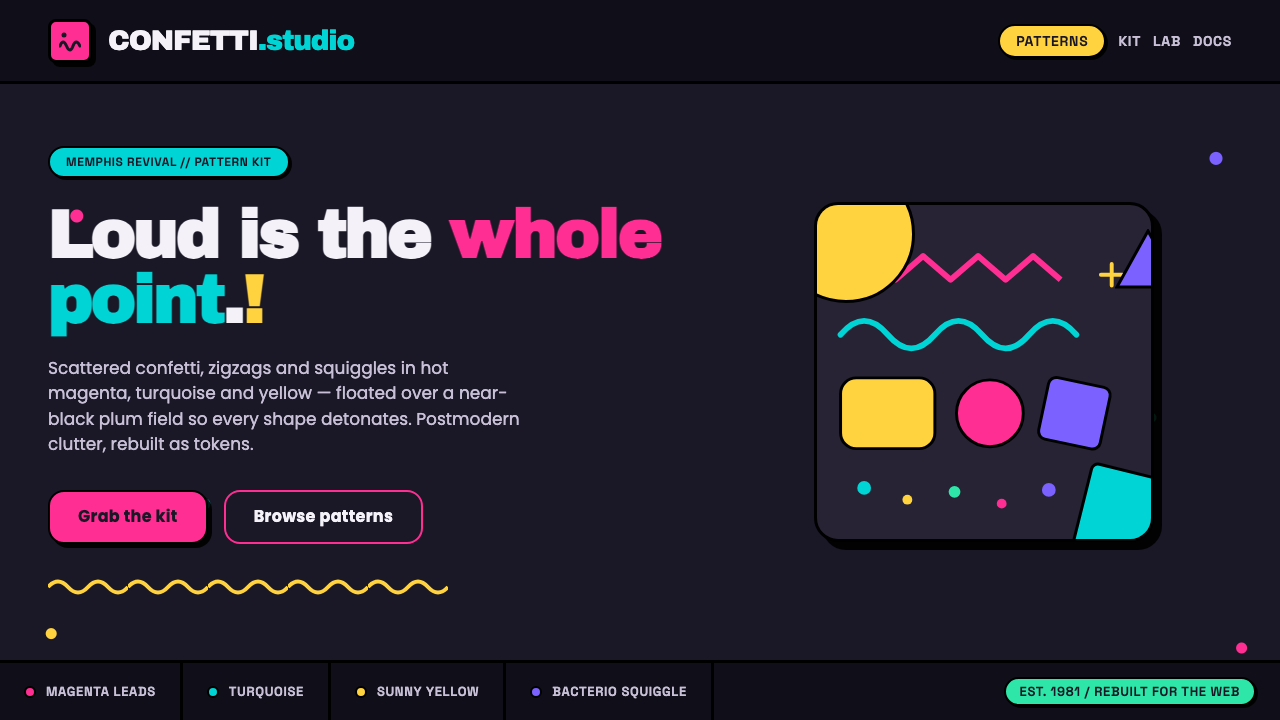 Memphis Web Pattern RevivalLoud is the point. Confetti dots, zigzags and Bacterio squiggles in hot magen…
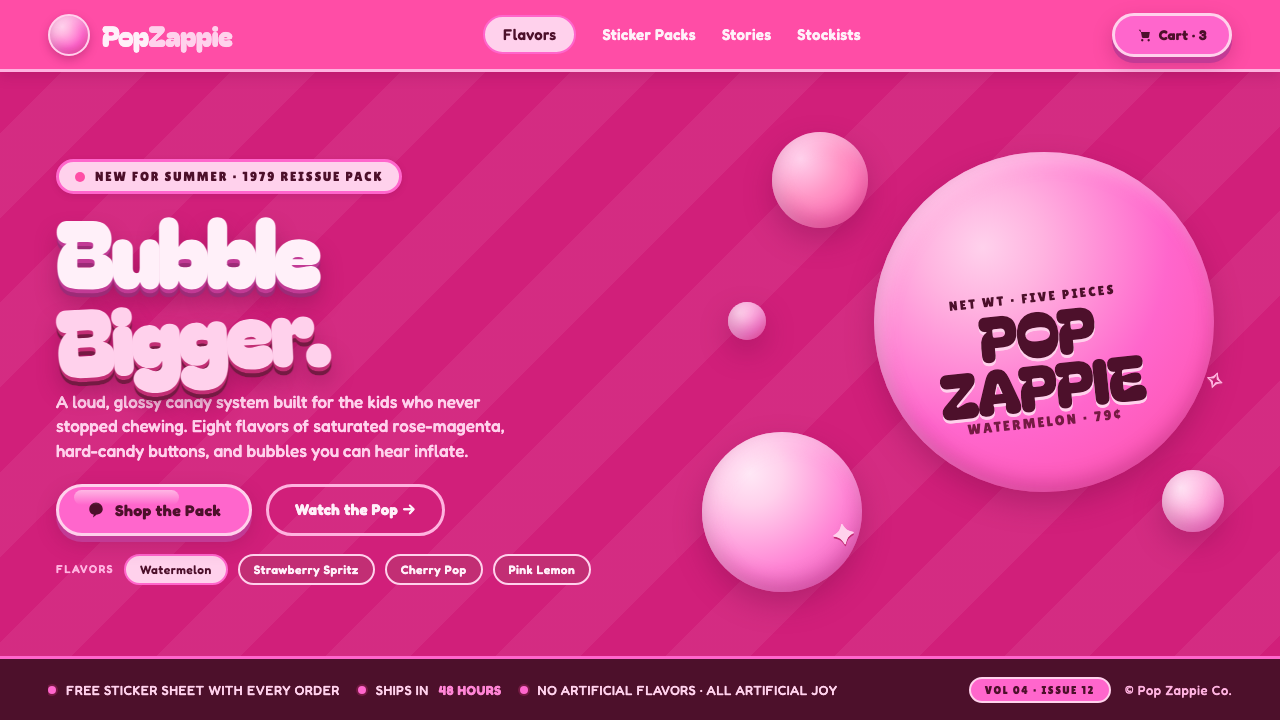 Watermelon Bubblegum Pink80s candy maximalism. Neon pink on rose-magenta, sugar-shine highlights, infl…
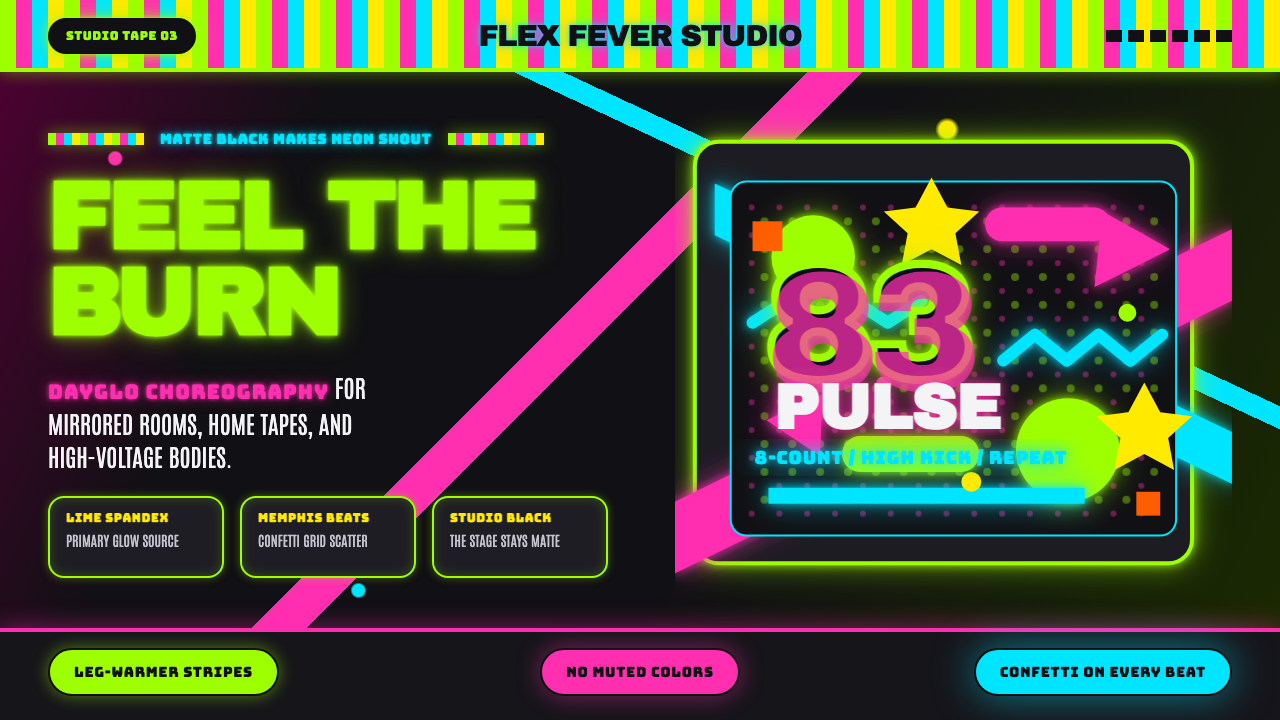 80s Aerobics Fluoro SpandexNeon refuses restraint. Lime spandex, pink-cyan confetti, and black-stage typ…
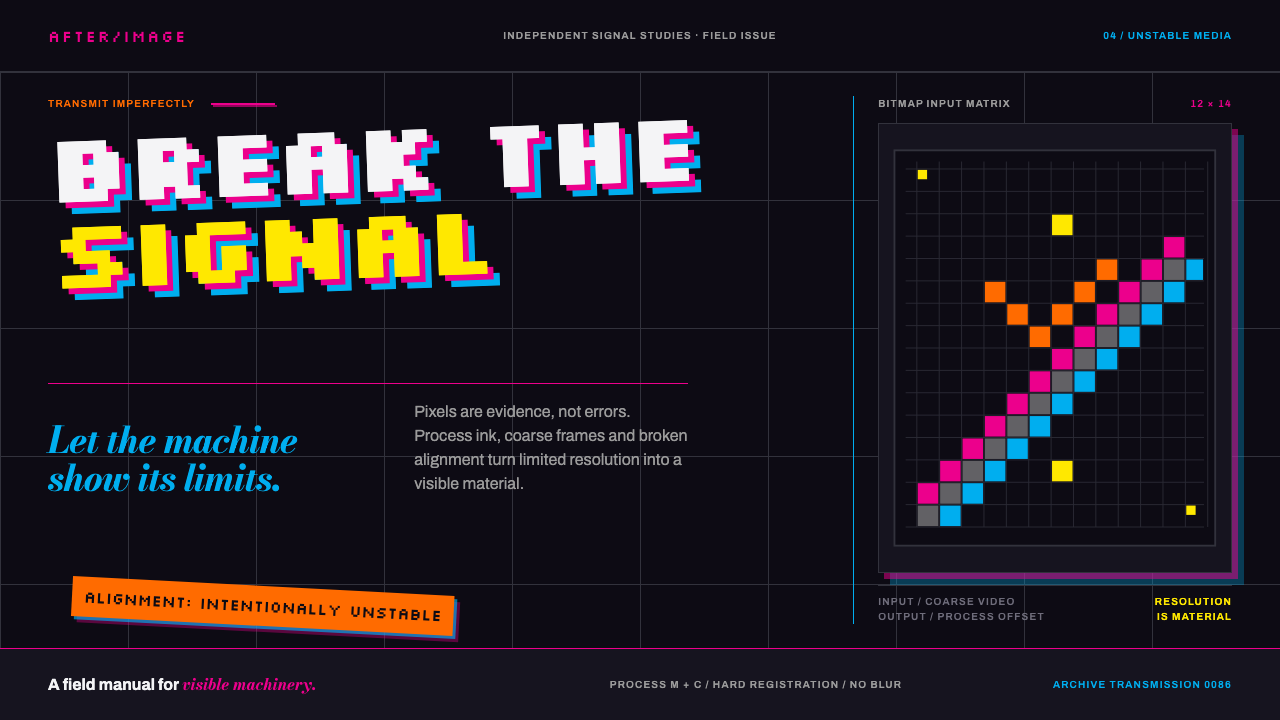 April Greiman HybridResolution becomes material. Bitmap type and process magenta collide on a bro…
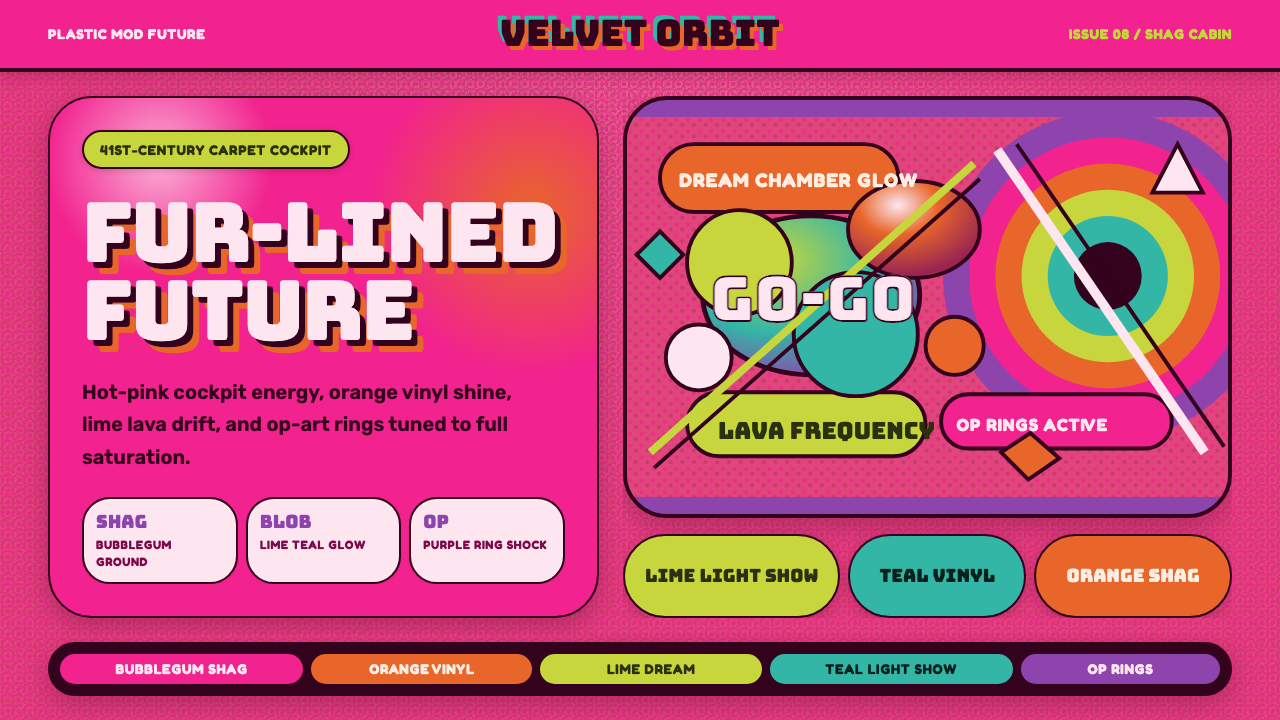 BarbarellaSpace-camp overload. Hot pink shag, lava blobs, and op-art rings collide.
 Chicago HouseDarkness starts the track. Neon pink, yellow and cyan hit black like Xerox st…