What is Traditional Goth?
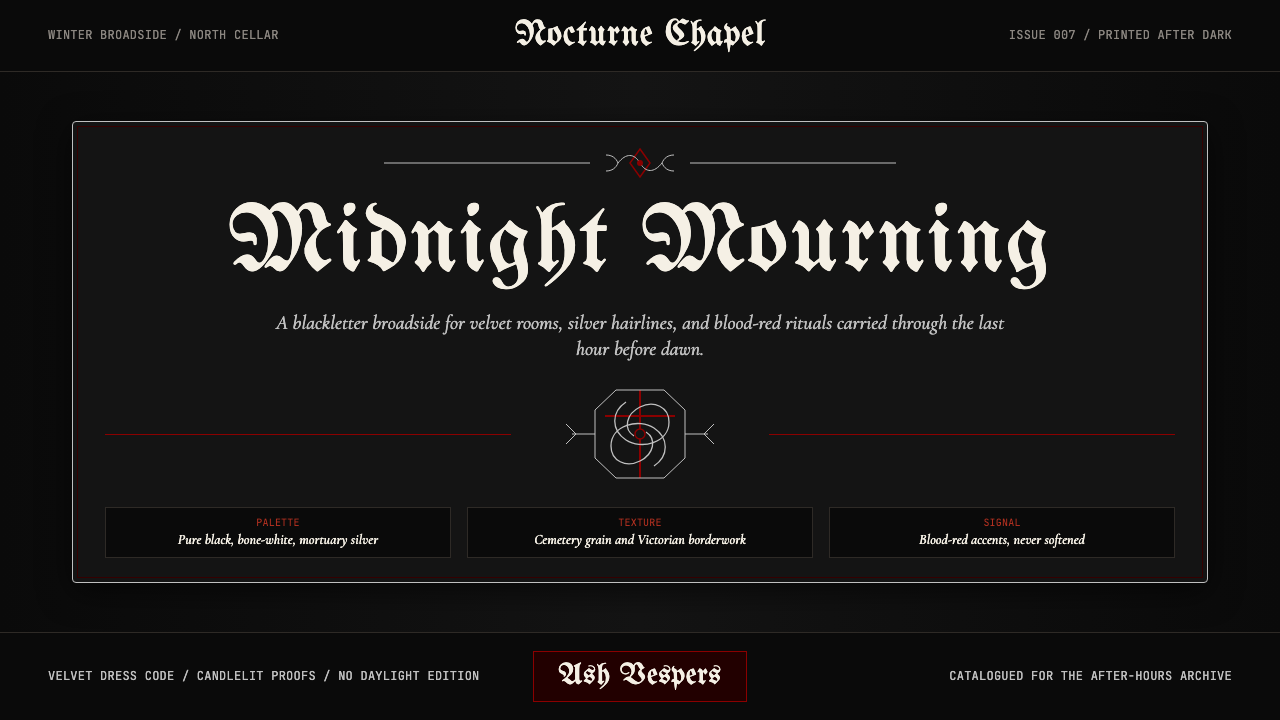
Post-punk's visual funeral — pure black, blood red, and bone white drawn from Victorian mourning rites and the stark album sleeves of the Batcave era.
Traditional Goth in brief
Traditional Goth is the original visual language of the post-punk subculture that crystallized in London and Leeds in the early 1980s. Its palette is a controlled extremity: pure black grounds, blood-red accents that carry the weight of ritual and danger, bone-white or mortuary-silver text that reads like an inscription on stone. Ornament is permitted — but only the right kind of ornament, drawn from Victorian mourning jewelry, blackletter calligraphy, wrought-iron cemetery gates, and the high-contrast photography of artists working within the goth-rock scene.
Unlike minimalism, which strips the canvas bare, Traditional Goth loads the canvas with meaning — but meaning of a specific register: death, beauty, transgression, and the uncanny. Every element is intentional and symbolic. A border is not decoration; it is a frame for something sacred or forbidden. Letterforms are chosen to evoke antiquity and weight rather than legibility or friendliness. Negative space functions as shadow rather than air — the black field is not emptiness but presence.
The style's visual DNA is remarkably stable across four decades of revival cycles. Whether encountered on a 1983 cassette insert, a 1990s zine, or a contemporary web presence, Traditional Goth is immediately recognizable: its palette refuses warmth, its typography refuses playfulness, and its ornamental instinct refuses anything that could be mistaken for innocence. That consistency is not rigidity — it is the coherence of a visual system built around a clearly held worldview.

Where does Traditional Goth come from?
The proximate origin of Traditional Goth as a visual style is the night of 6 August 1979, when Bauhaus — a four-piece from Northampton — released the single 'Bela Lugosi's Dead'. The nine-minute track, recorded in a single take, drew on dub reggae space, post-punk austerity, and explicit vampire-film imagery. Its cover art established a template: stark, high-contrast black-and-white photography, no color, a typeface that communicated weight and antiquity. The record did not invent the aesthetic wholesale, but it named and crystallized a set of visual instincts that had been forming around bands like Siouxsie and the Banshees since 1977.
The institutional center of early goth culture was the Batcave Club, which opened in Soho, London in July 1982. Hosted by Ollie Wisdom of the band Specimen, the Batcave became a weekly gathering for bands and fans who shared an aesthetic rooted in black clothing, theatrical makeup, androgynous styling, and a visual culture drawn from horror cinema, Victorian mourning practices, and occult symbolism. The Leeds scene, centered on acts like The Sisters of Mercy and The Mission, developed in parallel, with a slightly more austere and industrial visual register — less cabaret-gothic, more monastic darkness.
The visual system that Traditional Goth draws from reaches back much further than the 1980s. Victorian mourning culture, which flourished especially in England after Prince Albert's death in 1861, produced an elaborate visual vocabulary: jet-black jewelry, mourning stationery printed with black borders, memorial portraiture, and elaborate funerary architecture. This culture treated death as an aesthetic occasion and developed highly specific conventions for its representation. Gothic literature and Gothic Revival architecture — the pointed arches, the gargoyles, the wrought-iron railings — provided the architectural and literary substrates that the subculture would later absorb and transform.
Blackletter calligraphy, the script form associated with medieval manuscripts and Northern European printing traditions, became a typographic anchor for the style. Its dense, vertical strokes communicate authority, antiquity, and a certain illegibility that functions as gatekeeping — this is not a typeface chosen for welcome. Anton Corbijn's photography of bands like Depeche Mode, Joy Division, and The Sisters of Mercy — high-contrast, often desaturated, always striking in its use of shadow — helped establish the photographic grammar of the genre. By the mid-1980s, Traditional Goth had become a stable and self-consistent visual system, one capable of absorbing influences from death-rock in California and darkwave in Europe while retaining its core black-palette severity.
What defines the Traditional Goth look?
Color
The palette is built around an absolute black ground — not dark grey, not near-black, but the deepest achievable darkness. Against this field, blood red functions as the primary accent: it carries connotations of violence, ritual, and vitality that are held in productive tension with the surrounding black. Bone white or cold grey-white provides the primary reading color for text and fine ornamental detail, evoking ivory, marble, and exposed bone. Mortuary silver — the cool metallic tone of aged metal and candlelight on stone — appears in ornamental elements. No warm tones, no yellows, no soft pinks enter the palette; warmth is categorically excluded as incompatible with the emotional register the style maintains.
Typography
Blackletter and blackletter-derived letterforms are the typographic signature of Traditional Goth — the dense, vertical strokes and angular terminals that read as both medieval and ceremonial. These are used for display and heading purposes, where legibility can be sacrificed to atmosphere. For body text, a high-contrast serif is common: the kind with pronounced thick-thin stroke variation that reads as both classical and slightly ominous. Condensed letterforms appear frequently, compressing text into vertical columns that reinforce the downward, gravity-pulled visual movement that defines the style. Generous leading and tight tracking at display sizes creates a sense of formal inscription rather than casual communication.
Ornament
Where Bauhaus forbids ornament entirely, Traditional Goth requires it — but demands that every ornamental element carry symbolic weight. The vocabulary is drawn from specific historical and subcultural sources: Gothic Revival architectural details (pointed arches, tracery, gargoyle silhouettes), Victorian mourning jewelry motifs (skulls, serpents, weeping willows, jet-black borders), occult and alchemical symbols, wrought-iron scrollwork, and candelabra and cross forms. These elements are never applied casually; they frame, divide, and accent the composition with the deliberateness of a funeral arrangement. Thin filigree borders replace simple ruled lines; ornamental dividers replace plain horizontal rules.
Photography and Image
Imagery within Traditional Goth is almost always high-contrast and frequently desaturated to near-monochrome. The photographic grammar established by artists like Anton Corbijn favors dramatic shadow, strong rim lighting against dark backgrounds, and the elimination of mid-tones that might introduce ambiguity or comfort. Subjects are posed with theatrical deliberateness — faces partially obscured, figures in silhouette, environments that read as ruins, crypts, or empty industrial spaces. Representational illustration, when it appears, follows the same logic: cross-hatching and etching traditions produce the fine-line darkness of nineteenth-century engraving. There is no room for bright, documentary, or warmly naturalistic imagery.
Spatial Logic
Traditional Goth compositions do not use the clean mathematical grids of Swiss or Bauhaus design. Instead, they organize around a central vertical axis — suggesting processional, ceremonial, or altar-like arrangement — while allowing asymmetric weight at the margins. The black field absorbs negative space, so the operative tension is not between elements and emptiness but between elements and darkness. Dense ornamental frames define the boundary between content and void. Text and imagery tend toward the center or lower half of the composition, anchored as if by gravity or solemnity. There is a heaviness to the spatial distribution that is the opposite of the airy openness of modernist grid systems.
Texture and Surface
Unlike the flat, material-honest surfaces of Bauhaus-derived work, Traditional Goth actively cultivates the illusion of physical texture — the grain of aged paper, the bite of letterpress printing into heavy stock, the pitting of corroded metal, the matte surface of stone. These textures are evoked rather than literally reproduced: overlaid noise, distressed type treatments, and uneven ink distribution suggest age and physical materiality. The goal is a surface that feels like it has existed for a long time, that carries the patina of history. Slick, frictionless digital surfaces work against the style; every composition should feel as though it could be held, folded, or worn.
Hierarchy and Ceremony
Information hierarchy in Traditional Goth is not established through the clean size-and-weight logic of modernist typography but through a ceremonial register — what feels most sacred or most forbidden is given the most prominent position and the most elaborate treatment. A band name in massive blackletter at the top of a composition reads as an altar inscription. Supporting text in a finer, lighter weight falls below as a kind of liturgical annotation. The hierarchy mimics the structure of ritual communication: proclamation, then detail, then the fine print that only the initiated will read closely. This ceremonial logic gives Traditional Goth compositions a gravity that purely functional hierarchies rarely achieve.

Who shaped Traditional Goth?
As the vocalist and visual focal point of Bauhaus, Peter Murphy embodied the aesthetic before it had a name. His tall, gaunt frame, theatrical stage presence, and the cover photography for the band's early releases — high-contrast, deeply shadowed, shot to emphasize bone structure and intensity — established the visual template for the goth front-figure. After Bauhaus dissolved in 1983, Murphy's solo career continued to develop and disseminate the aesthetic into the later decades, making him one of the few figures who spanned the style's entire peak and revival arc.
Siouxsie Sioux and the Banshees arrived slightly before the term 'goth' was in common use, but their visual vocabulary — high-contrast eye makeup, dramatic hair, monochromatic clothing, and album art rooted in isolation and darkness — became foundational to the style. Siouxsie's visual persona demonstrated that goth aesthetics were not primarily masculine or macabre but could be wielded as a form of confrontational femininity. Her influence on the style's approach to the face as a painted, constructed surface — rather than a natural one to be flattered — remains evident across every revival.
As the architect of The Sisters of Mercy's visual identity from the band's formation in Leeds in 1980, Andrew Eldritch pushed the aesthetic toward a more austere, high-contrast, and deliberately unromantic register. The band's visual presentation — minimal color, heavy use of stark black-and-white photography, an avoidance of the more theatrical elements of southern English goth — influenced the darkwave and post-goth movements that followed and established a template for how the style could operate at maximum severity without sacrificing visual impact.
Dutch photographer Anton Corbijn was not a musician but became one of the defining visual architects of the goth and post-punk aesthetic through his photographic work. His images for Joy Division, Depeche Mode, The Sisters of Mercy, and other bands established the photographic grammar of the scene: heavy shadow, desaturated tones, locations that read as post-industrial or ruined, subjects rendered in ways that emphasized isolation and weight rather than celebrity approachability. Corbijn's visual approach proved so influential that it became the default language for serious goth and darkwave promotional imagery well into the 1990s.
As the front figure of The Cure from the late 1970s onward, Robert Smith bridged the divide between punk, post-punk, and what would become recognized as goth. His visual persona — smeared red lipstick, dark-circled eyes, wild back-combed hair, pallid skin — became one of the most globally recognized visual shorthand for the goth aesthetic. The Cure's album art, particularly across releases in the early to mid 1980s, demonstrated that the Traditional Goth visual system could operate at different temperatures: from the most austere and monochromatic to the more romantically saturated, while retaining the style's fundamental commitment to darkness and emotional extremity.
How do you use Traditional Goth today?
Traditional Goth translates into contemporary design work most successfully when the application context shares the style's underlying values: seriousness, exclusivity, a certain disdain for mass-market legibility, and a willingness to let atmosphere take precedence over accessibility. The style works poorly for products that need to communicate openness, warmth, or democratic availability. It works exceptionally well for products that want to communicate edge, authenticity, and a specific kind of cultural seriousness — music, independent publishing, fashion at the darker end of the spectrum, immersive entertainment, and certain categories of luxury goods where heritage and darkness are brand values.
For presentation slides, Traditional Goth operates best as a full-commitment system rather than a light overlay. A cover slide benefits from the full palette treatment: pure black ground, a single display element in bone-white or blood red — perhaps an ornamental frame or a blackletter headline — and nothing else. Content slides work within a high-contrast framework: white or near-white text on black, with red used only for emphasis or critical data points. Data visualizations should be treated as monochromatic with a single red accent for the most important series or value. Avoid the temptation to introduce mid-tones or warm greys; they immediately dissolve the style's internal logic and read as compromise.
For web interfaces and digital dashboards, Traditional Goth requires careful attention to functional accessibility — the style's commitment to black grounds and fine white text can create contrast ratios that pass readability standards but feel fatiguing over extended sessions. The approach that works best is disciplined restraint in the ornamental layer: use the blackletter and filigree vocabulary for branding and display elements, but keep the interface's functional elements — navigation, data tables, form inputs — in a cleaner, higher-legibility register. Pricing pages and landing pages for goth-adjacent products, event platforms, and music services benefit from the style's poster-like boldness: alternating full-width sections of black and deep charcoal, with bone-white headlines and red calls to action.
For editorial and marketing work, the style's historical connection to print culture — zines, cassette inserts, festival programs — gives it an authentic material quality that digital reproduction can approximate but never fully replicate. The most effective editorial applications lean into this: they use textured overlays to suggest aged paper, letterpress-weight type treatments for headlines, and the narrow-measure, heavily-leaded body text of zine production. Marketing work for music releases, independent films, or nightlife events can deploy the style's full vocabulary without irony — here it is not a reference or a pastiche but the native language of the audience.
The most common mistake when applying Traditional Goth is treating it as a simple palette swap — replacing white grounds with black and calling the result goth. Authentic application requires engaging with the ornamental vocabulary, the typographic conventions, and the spatial logic of the style. A second common error is mixing warmth into the palette — adding burnt orange, warm brown, or desaturated olive to 'balance' the severity — which immediately signals unfamiliarity with the visual system. A third mistake is lightening the black ground to improve legibility, which collapses the fundamental contrast that gives the style its visual authority. If the black ground must be compromised for accessibility reasons, it is better to acknowledge that this context requires a different style entirely than to apply a diluted version that satisfies neither function nor aesthetic intent.

Traditional Goth — FAQ
Is Traditional Goth the same as Dark Mode or dark UI design?
No — they share a dark ground but are fundamentally different systems. Dark Mode in contemporary interface design is an accessibility and preference feature: it takes a standard light-mode interface and inverts the value relationships, using dark greys rather than pure black, maintaining the same clean sans-serif typography and flat icon systems. Traditional Goth is not an inverted light mode — it is a design language built from the ground up around darkness, ornament, and a specific symbolic palette. Its black is absolute, its typography is chosen for atmosphere rather than legibility optimization, and its ornamental layer is essential rather than optional. Applying dark mode conventions to a goth project produces something that looks like neither.
Can Traditional Goth work for a brand that is not in the music or fashion space?
Yes, but the application requires honestly assessing whether the brand's values and the style's values are genuinely compatible. The style works well for any product or service that benefits from associations of exclusivity, heritage, darkness-as-brand-value, and a deliberately non-mainstream positioning: certain independent book publishers, niche fragrance houses, occult and esoteric goods retailers, immersive theatre, specific categories of wellness or ritual-adjacent products where the ceremonial register is appropriate, and some categories of whisky or spirits where the darker end of the heritage spectrum is desirable. It works poorly for anything requiring approachability, optimism, or mass-market inclusivity. The test is not whether the brand is in the right industry but whether the emotional register the style produces matches what the brand genuinely wants to communicate.
How does Traditional Goth differ from Victorian or Steampunk design styles?
All three draw on nineteenth-century English visual culture, but they diverge significantly in what they select from it and why. Victorian design as a contemporary style tends toward warmth, richness, and abundance: it embraces jewel tones, gilding, pattern-on-pattern complexity, and a sense of material comfort and display. Steampunk layers Victorian aesthetics with retrofuturist industrial machinery imagery and tends toward warmer browns, coppers, and ambers. Traditional Goth selects specifically the mortuary and ecclesiastical end of Victorian visual culture — the mourning practices, the Gothic Revival architecture, the memorial photography — and strips away the warmth and comfort entirely. The palette is cold where Victorian is warm, the mood is ceremonial and severe where Steampunk is playful and adventurous.
Does Traditional Goth have to use blackletter type, or can it work with other typefaces?
Blackletter is the most historically grounded and immediately recognizable typographic choice, but it is not the only valid one. High-contrast serifs — the kind with pronounced thick-thin stroke variation and fine hairlines — carry significant goth-adjacent weight when deployed at the right scale and in the right palette. Condensed serifs with pointed apexes and terminals can read as goth without reaching for blackletter. What the style cannot accommodate is anything that communicates friendliness, roundness, or contemporary cleanliness: geometric sans-serifs, humanist sans-serifs, rounded terminals, and low-contrast letterforms all undermine the style's tonal register. The blackletter is not mandatory, but the typographic choice must communicate antiquity, weight, and ceremony by whatever means it uses.
What is the difference between Traditional Goth and Nu-Goth or Pastel Goth aesthetics?
Traditional Goth is the root style; Nu-Goth and Pastel Goth are later mutations that modify it by introducing elements the original categorically refused. Nu-Goth, which emerged primarily through Tumblr culture in the early 2010s, retained the black ground and some occult symbolism but introduced cleaner, more minimal typography, contemporary sans-serif fonts, and a generally more internet-native visual sensibility — removing the ornamental density and the historical typographic vocabulary. Pastel Goth goes further, introducing soft pinks, lilacs, and mint greens alongside the black, creating a deliberate aesthetic dissonance that functions as commentary on or subversion of the original. Traditional Goth practitioners typically regard both as dilutions that trade the original's coherent worldview for broader accessibility — which is, in fact, exactly what they do.
Related design styles
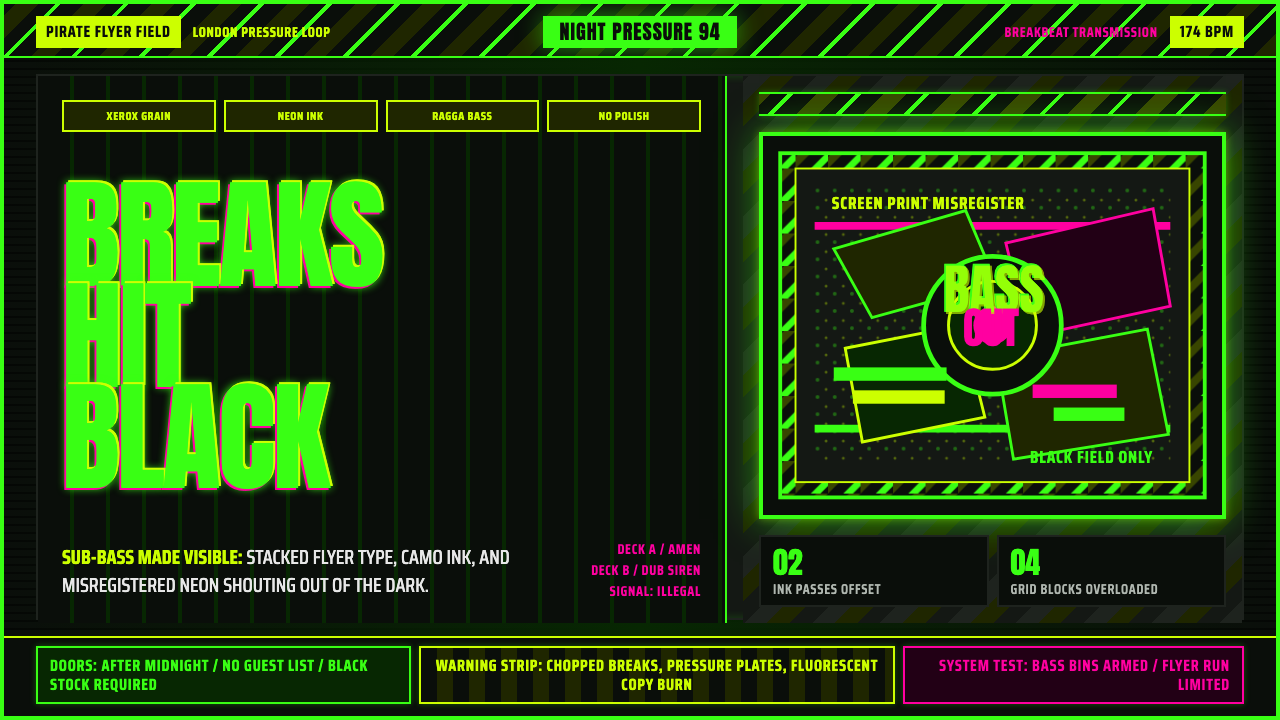 Jungle / Drum & BassRaw rave voltage. Neon green Anton, camo strips, and xerox grain hit black.
 Arcade Cabinet MarqueeToo loud to ignore. Black-indigo glass, violet glow, cyan grids, hot-pink arc…
 Doom 1993 Toxic GreenRadioactive metal bites. Toxic green readouts glow over rust bevels and CRT g…
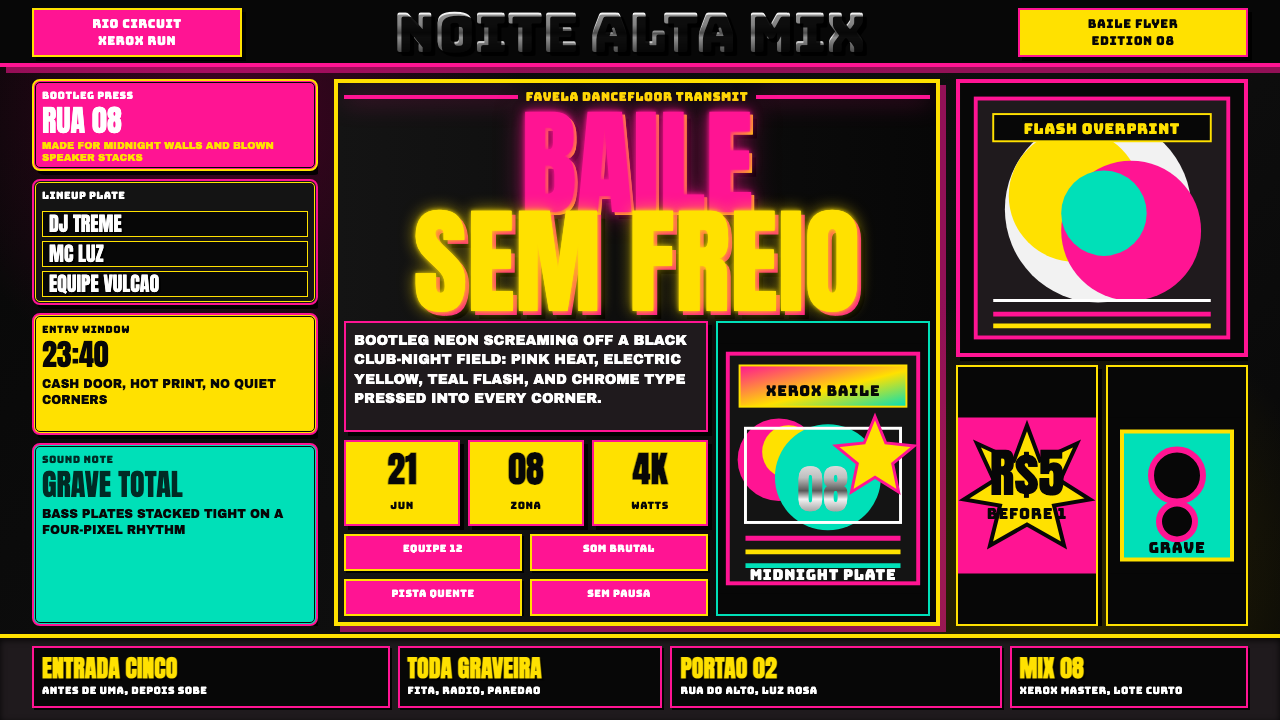 Funk Baile MixtapeNight refuses subtlety. Neon pink/yellow flyer plates cram chrome type on bla…
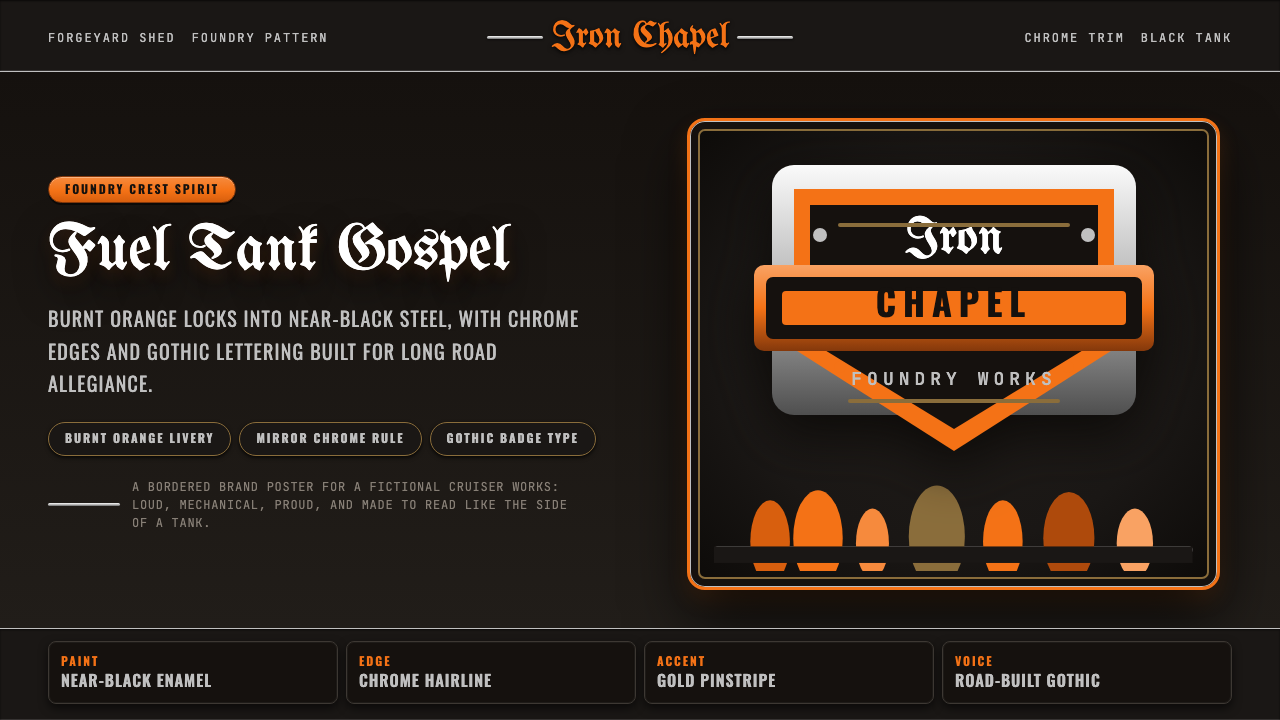 Harley Orange & BlackBuilt like a tank badge. Burnt orange, chrome hairlines, gothic type on near…
 Lucha Libre PosterStreet-poster voltage. Yellow Anton banners, crimson diagonals, cobalt grids…