What is Bauhaus Weimar?
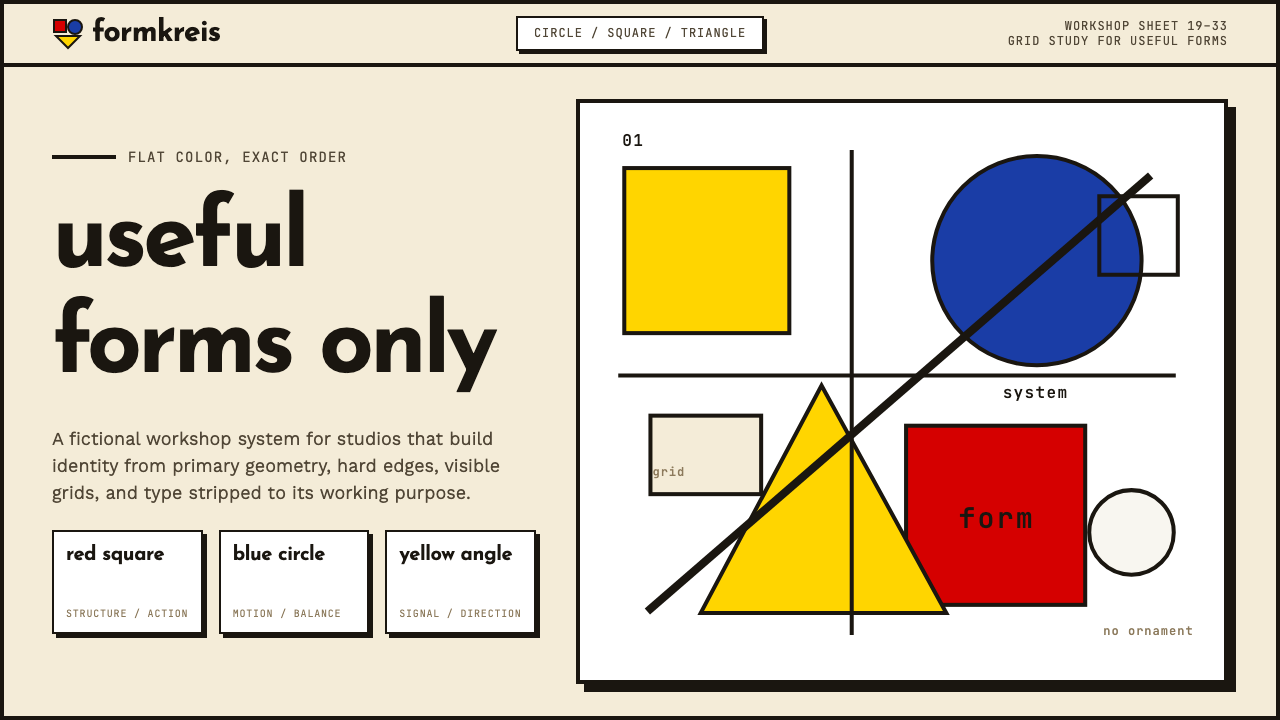
Bauhaus stripped design to its skeleton — primary colors, geometric form, and the conviction that beauty and usefulness were the same thing.
Bauhaus Weimar in brief
Bauhaus is a German design school and movement (1919–1933) whose visual language — primary red, blue, and yellow on cream or white grounds, hard geometric forms, asymmetric grid layouts, and a total rejection of surface ornament — became the most copied aesthetic of the twentieth century.
The movement held that every designed object, from a teapot to a typeface to a building facade, should be governed by the same principle: form follows function. Decoration that serves no structural or communicative purpose is waste. What remains after all waste is removed is not austerity — it is clarity.
Visually, Bauhaus work is instantly recognizable. Heavy sans-serif type sits alongside ruled lines and flat geometric shapes. Color is used symbolically and sparingly: red anchors structure, blue implies space and movement, yellow signals energy or direction. Shadows, where they appear, are hard and offset rather than soft and diffuse. Nothing fades or gradients; edges are decisions.
Where does Bauhaus Weimar come from?
The Bauhaus — the name fuses the German words for 'building' (Bau) and 'house' (Haus), deliberately evoking the medieval guild lodge — was founded in Weimar in April 1919 by architect Walter Gropius. The timing was not incidental. Germany had just lost the First World War. The Weimar Republic was days old. Gropius, who had served on the Western Front, returned convinced that art and craft had been severed from everyday life and that this rupture was itself a kind of cultural catastrophe. His founding manifesto declared that 'the ultimate aim of all creative activity is building' and called for the reunion of fine art and applied craft under a single roof.
The school absorbed the remnants of two older Weimar institutions: the Grand Ducal Saxon School of Arts and Crafts and the Weimar Academy of Fine Arts. From the start, Gropius organized teaching around a 'double faculty' model: each workshop was led simultaneously by a master craftsman and a master of form (a practicing artist). Early masters of form included the painter Johannes Itten, the Swiss mystic who developed the foundational course (Vorkurs) in which students explored texture, contrast, and the expressive properties of basic materials before touching any specialized discipline. Itten's spiritual intensity eventually clashed with Gropius's more rational industrial ambitions, and in 1923 he was replaced by László Moholy-Nagy, whose mechanist, photographic sensibility pushed the school decisively toward industrial production and mass reproducibility.
The political environment shaped the aesthetic. Weimar-era Germany was a crucible of competing ideologies, and the Bauhaus attracted both utopian socialists and pragmatic industrialists. Its teachers read Marx and corresponded with the Soviet Constructivists; they also negotiated contracts with German manufacturers. The tension between idealism and commerce never fully resolved, but it produced a design language that was simultaneously radical and functional — readable on a mass-produced lamp as clearly as on a political poster.
In 1925, rising hostility from the Thuringian state government — which found the school too politically left-leaning — forced a move to Dessau, an industrial city whose Social Democratic government was more sympathetic. The Dessau years (1925–1932) were the school's most productive. Gropius designed the famous Dessau campus, a building whose glass curtain walls, asymmetric massing, and flat roofs embodied everything the school preached. Moholy-Nagy, Herbert Bayer, Marcel Breuer, and Oskar Schlemmer produced canonical works here: Bayer's Universal typeface, Breuer's tubular steel furniture, Moholy-Nagy's light-space experiments. In 1928 Gropius resigned and was succeeded by the Swiss architect Hannes Meyer, who pushed the school further toward functionalist collectivism, then by Ludwig Mies van der Rohe in 1930. Mies relocated the school to Berlin in 1932, but Nazi political pressure finally closed it in July 1933. Many faculty emigrated — to Britain, the United States, Israel — and carried the Bauhaus vocabulary with them, seeding modernism worldwide.
What defines the Bauhaus Weimar look?
Color
The palette is restricted to primary red, blue, and yellow, deployed against cream or pure white grounds, with black used for type and structural lines. Color carries symbolic weight derived from Kandinsky's theory: red is active and structural, blue is recessive and spatial, yellow is acute and energetic. Secondary and tertiary hues rarely appear; when they do, they are used to signal hierarchy rather than decoration.
Typography
Sans-serif letterforms dominate, reflecting the conviction that serifs are vestigial ornament with no functional justification. Herbert Bayer's Universal alphabet — designed at Dessau — reduced each character to its geometrically simplest readable form. Type is set with deliberate contrast in scale: a headline might be several times the weight and size of body text, using scale itself as the primary organizing device rather than color or decorative borders.
Geometry
The circle, square, and triangle — the Bauhaus formkreis — are the fundamental vocabulary. Gropius's workshop assignments and Itten's preliminary course both required students to work through permutations of these three forms before tackling applied design. In finished work, circles appear as focal points or mechanical motifs, squares as grid anchors, and triangles as directional signals. Overlapping flat shapes replace representational illustration entirely.
Grid and Asymmetry
Bauhaus layouts are rigorously gridded but never symmetrical in the traditional sense. Composition is balanced through weight and tension rather than mirroring — a large black rectangle on the left offset by a small red circle on the right, a column of tight body text anchored against a single large numeral. This asymmetric balance was partly political (symmetry was associated with classical authority) and partly functional: it creates natural reading direction.
Shadow and Depth
Where shadow is used at all, it is hard-edged, offset at a consistent angle, and rendered as a solid flat shape rather than a gradient. This approach treats shadow as a structural element — another geometric form on the page — rather than a lighting simulation. The effect is bold and almost diagrammatic: objects look cut out and placed, not rendered and lit.
Material Honesty
In physical products, the Bauhaus insisted that materials be used in ways consistent with their structural properties: steel should look like steel, wood like wood. In two-dimensional work, this principle translates to flatness — no simulated textures, no fake depth, no skeuomorphic surfaces. Every element is what it appears to be. This discipline distinguishes authentic Bauhaus-derived work from pastiches that borrow the color palette but retain decorative layering.
Zero Ornament
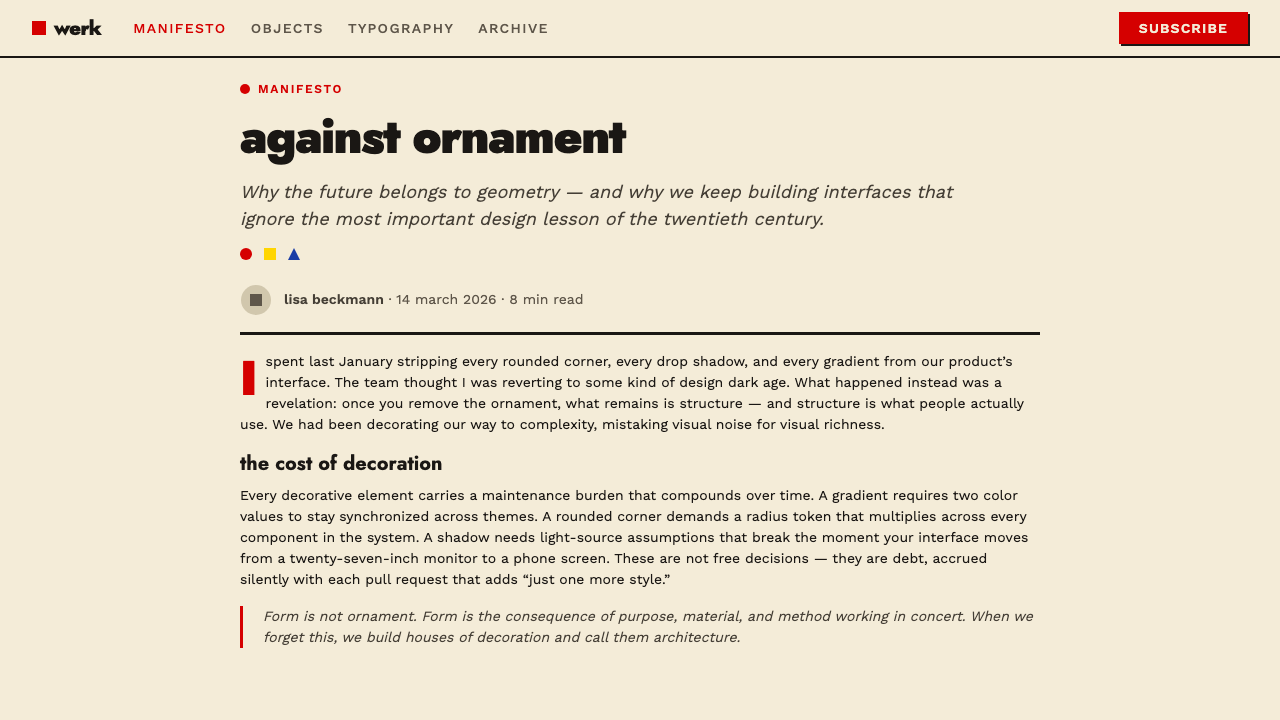
The most absolute of Bauhaus principles: if a visual element cannot be justified by structure or communication, it should not exist. No flourishes on letterforms, no decorative borders, no gradient fills applied for visual richness, no ambient shadows softening edges. The restraint is not minimalism in the contemporary sense — it is principled refusal. Every absence is an argument.

Who shaped Bauhaus Weimar?
Gropius founded the Bauhaus and wrote its founding manifesto, which called for the reunion of fine art and craft. His administrative and diplomatic skills kept the school financially viable through multiple political crises. His Dessau campus building — with its glass curtain walls and flat roofs — remains a definitive statement of the movement's architectural ambitions, and his emigration to Harvard in 1937 helped transplant Bauhaus thinking directly into American design and architectural education.
Moholy-Nagy joined the Bauhaus in 1923 and redirected its preliminary course toward industrial materials and photography. His light-space experiments — constructions that cast moving shadows — explored the intersection of kinetics, light, and form. After the school closed, he founded the New Bauhaus in Chicago in 1937, ensuring that the pedagogical method survived in the United States and continued influencing graphic design, photography, and product design long after the original school's closure.
Kandinsky joined the Bauhaus in 1922 after the closure of the avant-garde school Inkhuk in Moscow. At Bauhaus he taught the analytical drawing course and developed his systematic theory linking geometric forms to emotional and psychological states — circle to blue and repose, square to red and stability, triangle to yellow and action. This color-shape symbology became foundational to the Bauhaus visual system and continues to underpin much of what contemporary designers recognize as 'Bauhaus color logic'.
Bayer studied and then taught at Bauhaus, serving as director of the printing and advertising workshop from 1925. His Universal typeface, designed in 1925, attempted to reduce the Latin alphabet to purely geometric, single-stroke letterforms — eliminating capital letters on the grounds that spoken language does not distinguish them. As a typographer and exhibition designer, Bayer developed spatial and typographic systems that influenced corporate identity design, museum exhibition practice, and international information graphics well into the second half of the twentieth century.
Schlemmer directed the Bauhaus theater workshop, where he developed the Triadic Ballet — a performance work in which dancers wore geometric costume-sculptures that reduced the human figure to spheres, cylinders, and cones. His work represents the movement's most direct engagement with the body as a designed form. The theater workshop's output demonstrates that Bauhaus principles were not limited to print or products but extended to performance, costume, and the staging of human presence itself.
How do you use Bauhaus Weimar today?
Bauhaus is among the most transferable historical styles in contemporary design work, because its principles are structural rather than ornamental. Applying it correctly requires understanding what the visual system is actually doing — using color to assign meaning, using geometry to create order, using negative space to give every element breathing room — rather than simply overlaying primary colors on a layout.
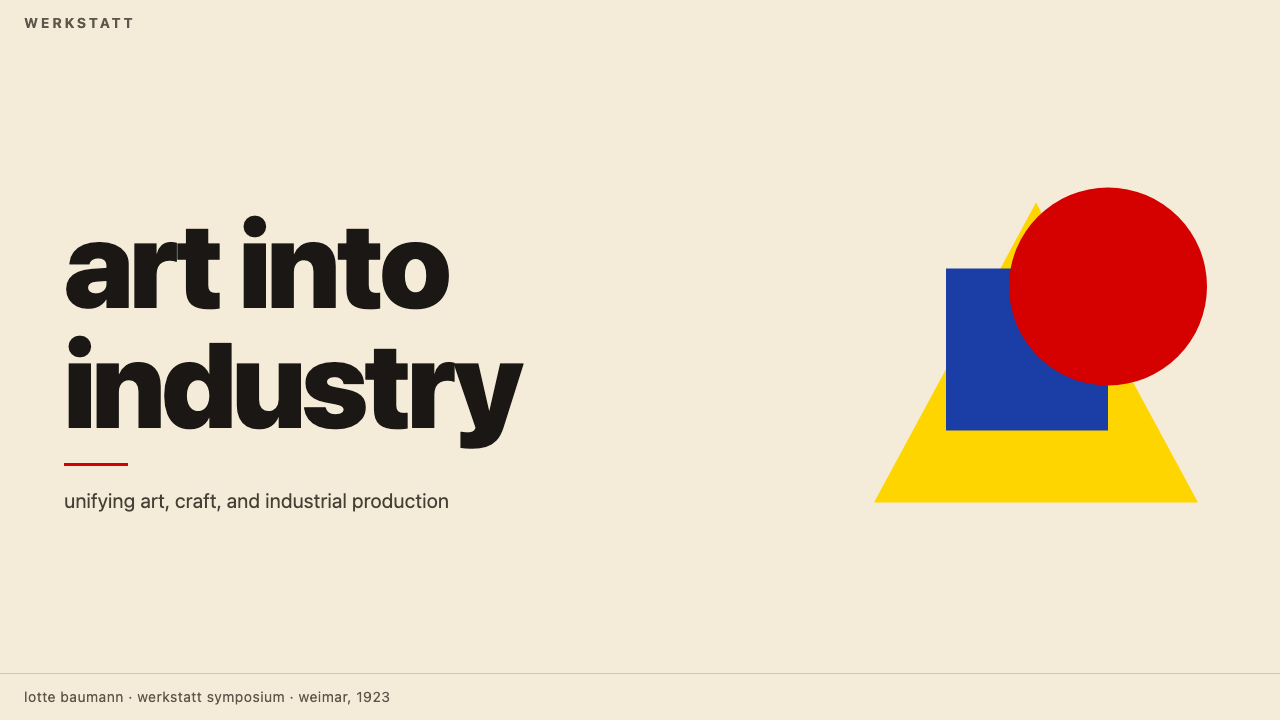
For presentation slides, Bauhaus works exceptionally well on both cover and content pages. A cover benefits from the bold asymmetric composition: a large geometric shape in one primary color anchors a corner while the title sits in high-contrast type against a cream or white field. Content slides should be treated as grids: one organizing line, two or three text hierarchies defined purely by size and weight, no decorative dividers. Data slides take on a diagrammatic quality — bar charts and pie charts become geometric objects in their own right, with bars and segments colored according to the primary palette.
For web interfaces, Bauhaus is well-suited to dashboards and pricing pages where hierarchy and scannability are paramount. The approach: define a strict four-column or twelve-column grid, keep the background near-white or cream, use black for all body text, and reserve the primary colors for interactive states, alerts, or tier differentiation. Hard-shadow card components replace soft-shadow equivalents; bordered inputs replace ghost inputs. Navigation should be typographic — wordmarks and labels — with no icon decoration beyond geometric indicators.
For editorial and marketing work, the style supports strong information hierarchy. A Bauhaus-derived article layout uses a narrow measure for body text, a wide left or right margin for call-outs or metadata, and section breaks marked by a bold horizontal rule rather than decorative ornaments. Marketing pages work well with the style's poster-like boldness: full-width feature blocks alternate between cream-on-black and black-on-cream, with a single primary-color accent used consistently for calls to action.
A common mistake when applying Bauhaus is treating the primary color palette as license to use all three colors simultaneously at high saturation. Authentic Bauhaus work typically leads with one primary and uses a second as accent; the third appears rarely, if at all. Similarly, mixing multiple sans-serif typefaces undermines the system's logic — one typeface at multiple weights and sizes will produce more coherent results than several families in competition.
Bauhaus Weimar — FAQ
Is Bauhaus the same as Swiss International Style?
They are related but distinct. The Bauhaus (1919–1933) established the foundational principles — geometric forms, primary colors, rejection of ornament, grid-based composition — that Swiss International Style (emerging in the 1950s and 1960s) then systematized into a global corporate standard. Swiss Style is more rigorous typographically, more committed to the mathematical grid, and uses a much broader color range including photography. Bauhaus work is bolder, more symbolic in its color use, and more visually confrontational. Think of Swiss Style as Bauhaus with the political urgency removed and the precision dialed up.
Can Bauhaus work in a dark-background layout?
The historic Bauhaus palette was light-ground — cream or white backgrounds were canonical. A dark inversion is possible and not uncommon in contemporary applications, but it requires care. On a black ground, primary yellow tends to dominate aggressively, and the structural clarity that the style depends on can break down if all three primaries are present simultaneously at high contrast. A dark Bauhaus variant works best when it commits to one primary color as foreground accent — typically yellow or red — and treats the other two as structural or typographic elements only.
Why does Bauhaus avoid gradients and soft shadows so strictly?
Because gradients and soft shadows simulate natural lighting — they import the logic of the physical world into a designed artifact. Bauhaus believed the designed artifact should be governed by its own structural logic, not by naturalistic illusion. A soft shadow suggests a light source; a hard shadow is a geometric decision. This matters practically too: flat elements and hard shadows reproduce cleanly across different media, at different scales, in single-color printing, and on early digital screens. The anti-gradient principle was partly a formal commitment and partly a production reality of the 1920s that happened to age well.
How does Bauhaus handle imagery and photography?
Photography entered Bauhaus practice primarily through Moholy-Nagy, who saw the camera as a form-finding tool rather than a documentation device. Bauhaus photography is typically high-contrast, shot from unusual angles, and used to isolate geometric qualities in everyday objects. In layouts, photography is treated as a flat element — cropped aggressively, silhouetted against white, or reproduced in high-contrast duotone — never as a naturalistic window into a scene. Representational illustration is almost entirely absent; when figurative imagery appears, it is reduced to geometric silhouette.
Does Bauhaus suit every kind of product, or are there contexts where it struggles?
Bauhaus is not universally suited. It works well for products where authority, clarity, and rational structure are desired values: dashboards, pricing pages, analytical tools, educational materials, and platforms positioning themselves as modern and principled. It struggles in contexts that call for warmth, sensory richness, or cultural specificity — food brands, children's products, wellness applications, or any context where the user experience depends on organic texture and human warmth. The style's severity can also read as cold or even aggressive in consumer-facing emotional contexts. Knowing where the style's values align with the product's values is more important than technical execution.
Related design styles
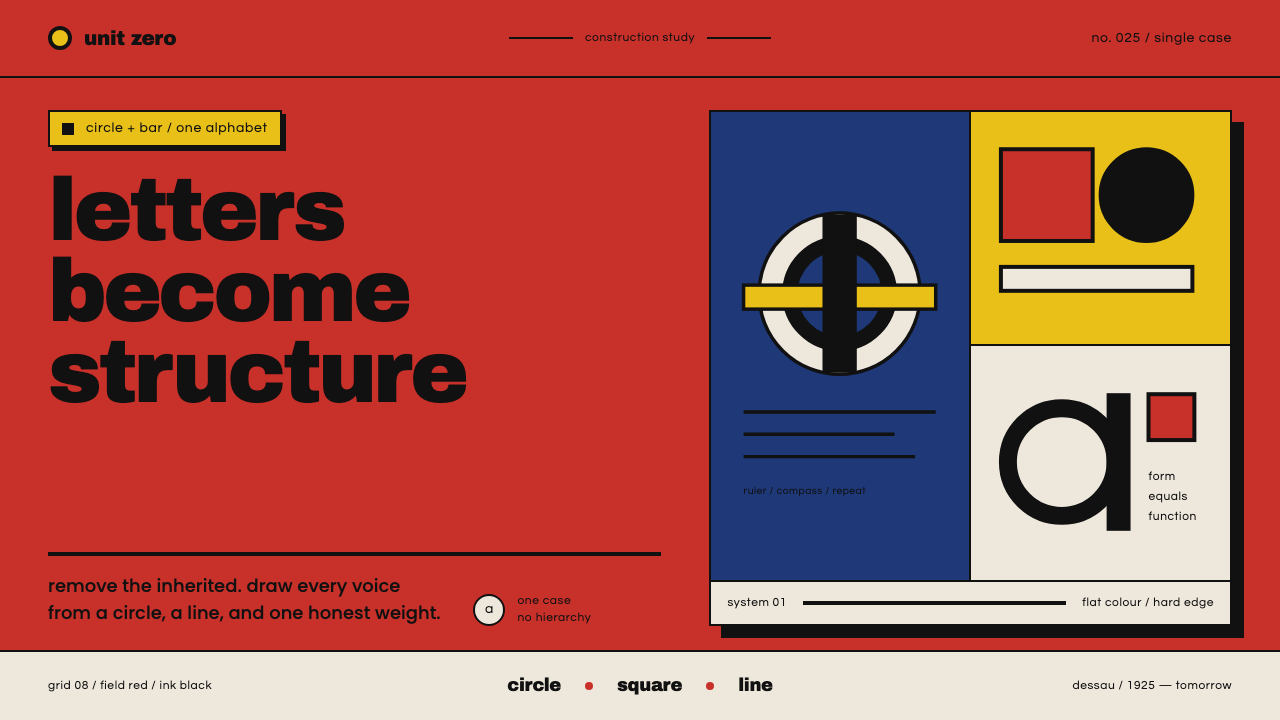 Bayer Universal BauhausLetters become structure. Bauhaus red, primary blocks, and black circle-bar f…
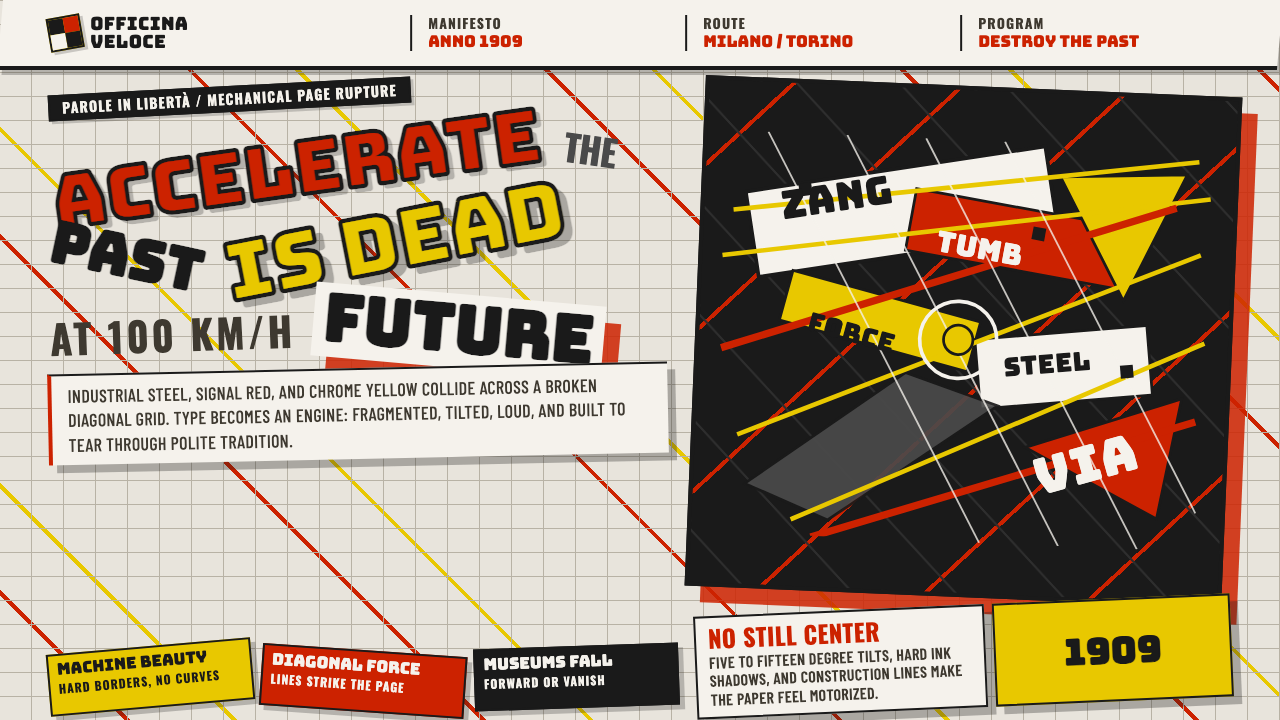 Italian Futurism (Marinetti 1909)Speed murders tradition. Signal red and chrome yellow slash a broken diagonal…
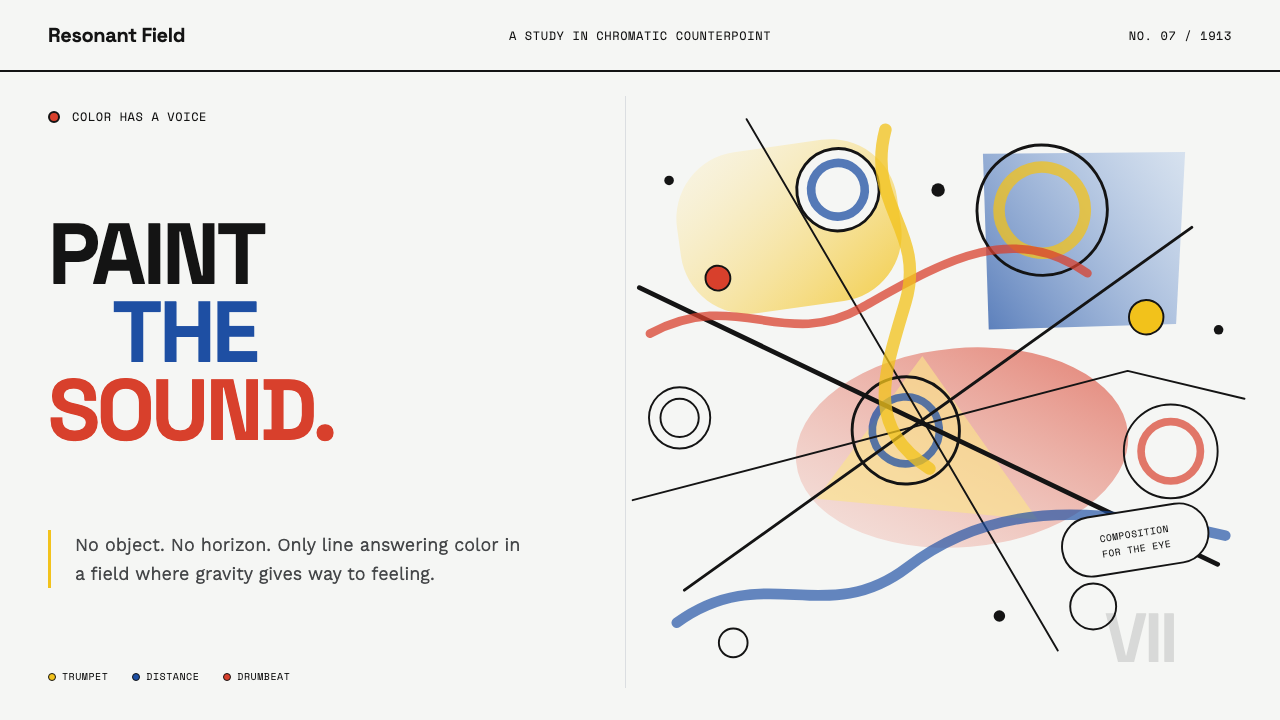 Kandinsky Composition (1913)Color becomes sound. Primary washes, hollow circles, and black diagonals coll…
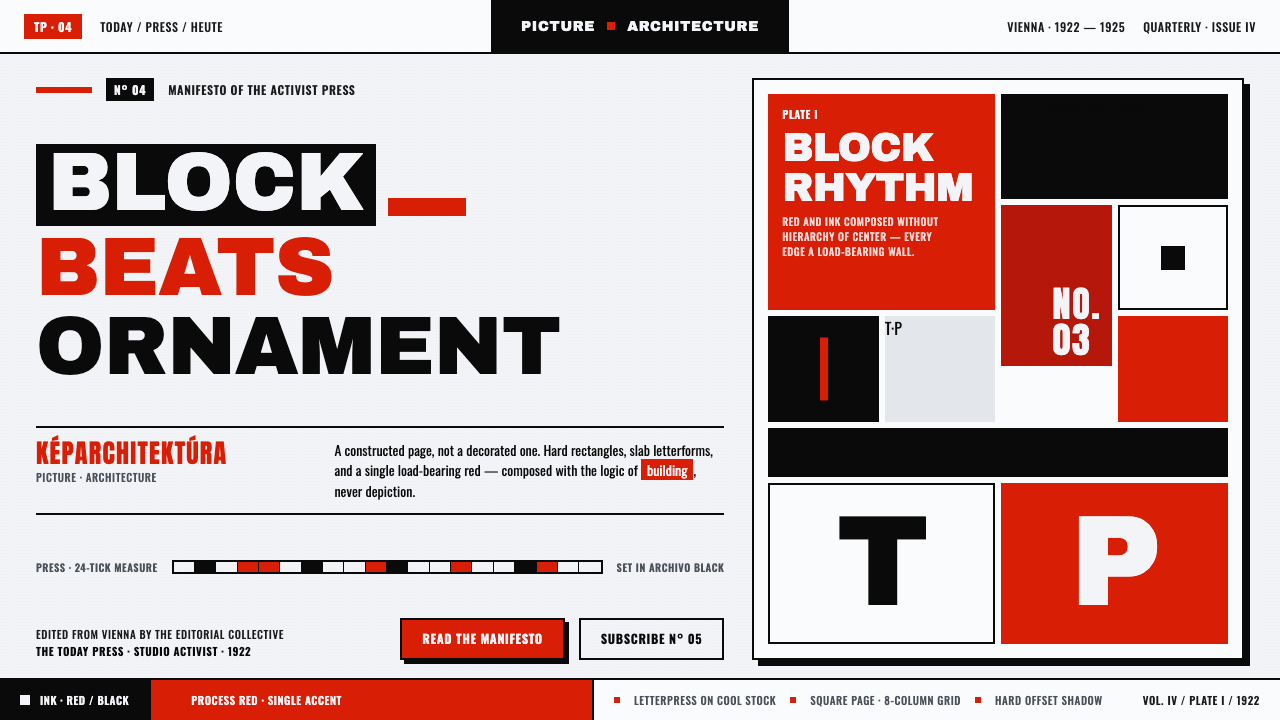 Lajos Kassák MA ConstructivismPage as building, not picture. Red and ink slab-sans blocks set asymmetricall…
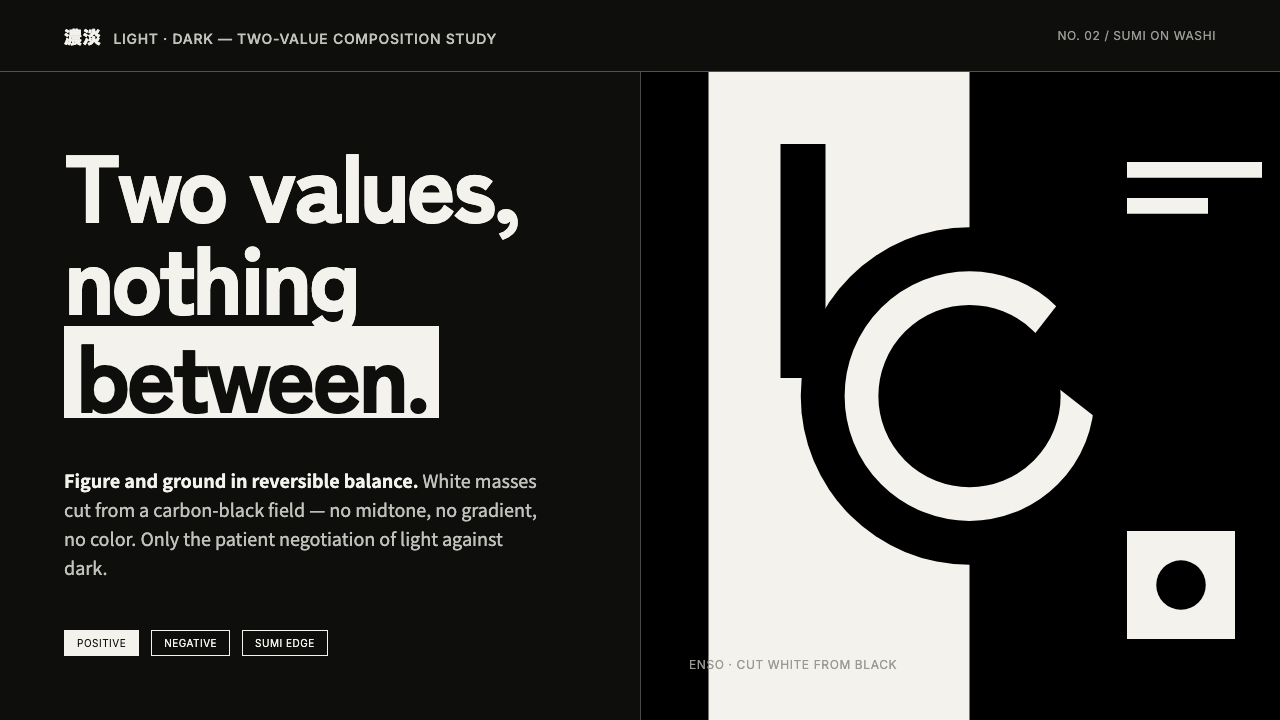 Notan Light-DarkTwo values, nothing between. White masses cut from a carbon-black field, figu…
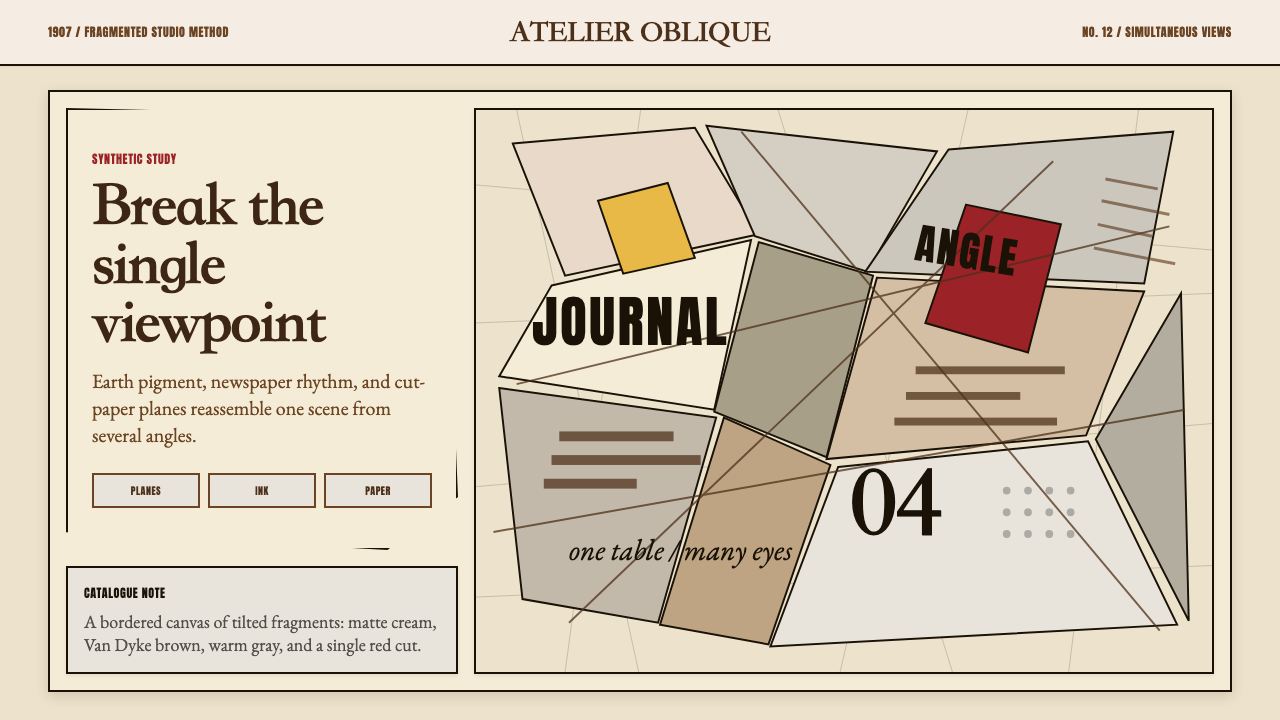 Picasso CubismSingle sight is shattered. Cream collage paper fractures brown-gray planes wi…