What is Streamline Moderne (1930s)?
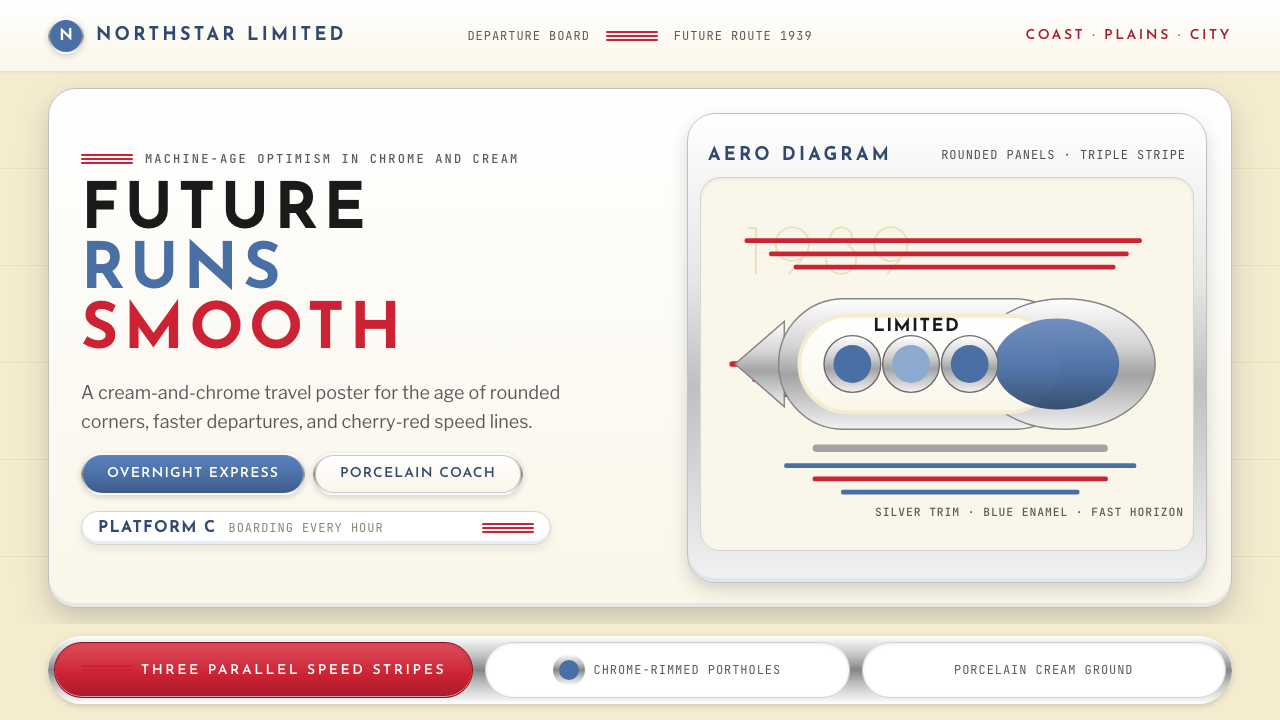
Streamline Moderne bent speed itself into a design language — aerodynamic curves, chrome-trimmed panels, and racing stripes that taught Depression-era America to read the future as smooth, fast, and inevitable.
Streamline Moderne (1930s) in brief
Streamline Moderne is the American industrial design movement of the 1930s and 1940s that translated aerodynamic engineering into a popular visual language. Where Art Deco favored vertical thrust, angular ornament, and exotic materials, Streamline Moderne turned horizontal — speed stripes, teardrop silhouettes, and softly rounded edges wrapped everything from locomotives and ocean liners to kitchen appliances and pencil sharpeners in the promise of effortless forward motion.
The palette is warm and optimistic: creamy off-white grounds offset against deep cherry or poppy red, accented by the cold gleam of chrome and the occasional cerulean or navy stripe. Color is not applied symbolically in the Bauhaus sense but emotionally — the cream-and-chrome combination reads as clean and prosperous, the red stripes as kinetic energy, the rounded corners as the absence of resistance. Nothing about the style is harsh or angular; even its type choices favor letterforms with softened geometry.
Critically, Streamline Moderne is not about abstraction. It is about legibility and optimism in physical form. The movement believed that if an object looked fast and smooth, it communicated reliability and modernity to everyday people — not just to cultural elites. A toaster shaped like a silver bullet was a promise that domestic life could share in the same technological destiny as an ocean liner crossing the Atlantic.

Where does Streamline Moderne (1930s) come from?
The movement emerged directly from the psychological wreckage of the Great Depression. After the 1929 stock market crash, American manufacturers faced collapsing consumer demand and needed a way to make people want to buy again. A generation of newly professionalized industrial designers — Raymond Loewy, Norman Bel Geddes, Walter Dorwin Teague, and Henry Dreyfuss among them — recognized that if you could not change the economic reality, you could change how objects felt. Applying the visual language of speed and progress to everyday goods transformed mundane purchases into acts of participation in a better future. The refrigerator was not just an appliance; it was a spacecraft for the kitchen.
Aerodynamics provided both the engineering rationale and the aesthetic vocabulary. Wind tunnel research, conducted publicly for automobiles, aircraft, and trains throughout the 1930s, demonstrated that teardrop shapes and smoothed surfaces reduced drag. Designers took this engineering logic and applied it far beyond contexts where aerodynamics actually mattered — a pencil sharpener bolted to a desk generates no drag, but a streamlined casing made it look as though progress were built into its very molecules. This transfer of engineering credibility into consumer objects was the movement's central rhetorical act.
The style reached its cultural apex in the transportation icons of the mid-1930s. Loewy's redesign of the Pennsylvania Railroad's GG1 locomotive in 1934 demonstrated that industrial design could transform a functional machine into a national symbol. Dreyfuss's 20th Century Limited locomotive for the New York Central, introduced in 1938, became the image of American modernity itself — low, horizontal, clad in shrouding that turned the engine into a single flowing form. The Greyhound bus, the Douglas DC-3 aircraft, the Chrysler Airflow automobile: these were not just products but cultural artifacts that told Americans their civilization was still moving forward despite everything.
The movement's influence extended far beyond transportation. Loewy redesigned the Lucky Strike cigarette pack, the Coca-Cola fountain dispenser, refrigerators for Frigidaire, and pencil sharpeners for Gestetner — applying the same aerodynamic logic across an enormous range of domestic and commercial objects. By the late 1930s, Streamline Moderne had become the dominant aesthetic of American consumer culture, appearing on everything from radio housings to gas station canopies to the architecture of World's Fair pavilions. The 1939 New York World's Fair, with its theme of the World of Tomorrow, was its apotheosis: Norman Bel Geddes's Futurama exhibit for General Motors showed a utopian highway system, and the entire fairground read as a built argument that the future had already been designed and was on its way.
What defines the Streamline Moderne (1930s) look?
Color
The signature palette is built on creamy off-white or warm ivory grounds — not the pure cold white of modernism, but a softer tone that suggests porcelain enamel and polished surfaces. Against this ground, deep cherry red and occasionally cerulean blue appear as accent stripes and trim, while chrome and silver provide a metallic coolness that prevents the warmth from becoming domestic. Color is applied in bold, confident bands rather than distributed across a surface; the horizontal stripe — two or three parallel lines of saturated color — is the movement's most recognizable motif.
Form and Silhouette
Every object in the Streamline vocabulary reaches toward the teardrop: rounded at the leading edge, tapering toward the rear, with no sharp corners to catch resistance. In two-dimensional work, this translates to softly rounded rectangles, oval frames, and compositions that flow left to right as if moving through air. The silhouette is always smooth and contained — no projecting ornament, no jagged edges, nothing that would interrupt the eye's travel across the surface.
Speed Lines
The horizontal speed stripe — two or three parallel lines running the full width of a surface — is Streamline Moderne's most direct borrowing from transportation design, where such lines were painted on locomotives and buses to suggest velocity even at rest. In graphic work, these stripes function as both decoration and direction: they establish a strong horizontal axis, guide the eye from left to right, and communicate momentum. Their width and spacing vary, but they are always parallel, always horizontal, and always suggest that the composition is moving.
Chrome and Metallic Accents
Chrome trim — the gleaming silver-white border applied to edges, dials, and panels — is structurally integral to the Streamline aesthetic in a way that gold ornament was to Art Deco. It signals technological currency: chrome was a new industrial material in the 1930s, associated with precision manufacturing and scientific progress. In two-dimensional design work, the metallic accent is approximated through light gradients along curved edges, or through the use of silver-toned color alongside warm grounds. The effect is one of controlled luxury — modern rather than antique, industrial rather than handcrafted.
Typography
Type in the Streamline Moderne tradition favors letterforms whose round strokes have been softened and widened — not the geometric precision of Bauhaus sans-serifs, but something warmer and more rounded, evoking the smooth surfaces of the objects the style celebrated. Display type is often set in wide, expansive letterforms with generous spacing, creating a sense of breadth and confidence. Text blocks are secondary to image and form; the style is fundamentally object-centered rather than text-centered, and headlines function more like labels on a beautiful machine than like arguments.
Horizontal Composition
Where Art Deco reaches upward and Bauhaus balances through asymmetric tension, Streamline Moderne lies down and moves sideways. Compositions are strongly horizontal: elements stack in wide bands, images expand to fill the width before the height, and the overall visual weight is low and grounded. This horizontal emphasis was directly inspired by the low-slung profiles of the streamlined vehicles the style was born from — a locomotive hugging the rail, a sedan riding close to the road. On screen or on paper, this produces a sense of stability and forward momentum rather than the upward aspiration of earlier modernist styles.
Optimism as Aesthetic Principle
More than any formal characteristic, Streamline Moderne is distinguished by its emotional register. Designed explicitly as a response to economic despair, every formal choice — the warm palette, the smooth curves, the forward-moving stripes — is in service of a single communicative goal: the future will be better than the present, and the evidence is already here in the shape of things. This is not naive cheerfulness but a deliberate rhetorical strategy, and it gives authentic Streamline work a particular quality of conviction that parodies of the style tend to miss.

Who shaped Streamline Moderne (1930s)?
Loewy was the movement's most prolific and publicly visible practitioner, described by Time magazine in 1949 as the man who shaped America. Born in Paris and trained as an engineer, he emigrated to the United States in 1919 and built the most commercially successful industrial design practice of the century. His clients ranged from the Pennsylvania Railroad to Studebaker to Shell to NASA, and he applied the same streamlined logic to each: identify the object's forward face, smooth every surface that meets air or eye, and anchor the design with a strong horizontal band. The Pennsylvania Railroad's GG1 locomotive, the Studebaker Avanti, and the NASA Skylab interior demonstrate the breadth of his application of a single formal vocabulary.
Where Loewy was pragmatic and commercial, Bel Geddes was visionary and theatrical. A stage designer by training, he transferred his sense of spectacle to industrial design with a scale of imagination that outran any single client's budget. His 1932 book Horizons laid out a future of teardrop automobiles, vast ocean liners, and flying-wing aircraft that had not yet been built but looked utterly inevitable in his renderings. His Futurama exhibit for General Motors at the 1939 New York World's Fair — a diorama of a streamlined 1960s America seen from a moving ride — was experienced by over five million visitors and remains the canonical statement of Streamline Moderne as civic aspiration rather than product design.
Dreyfuss brought a discipline to Streamline Moderne that distinguished him from his more flamboyant contemporaries: he grounded every formal decision in human factors research. His books Designing for People (1955) and The Measure of Man (1960) codified ergonomic principles that are still referenced today. His most celebrated work — the 20th Century Limited locomotive for the New York Central Railroad, introduced in 1938 — was the result of meticulous attention to both the machine's aerodynamic performance and the passengers' experience of boarding and riding it. The telephone handset he designed for Bell in the late 1930s remained essentially unchanged for decades, demonstrating that good streamlined form, when it truly follows human use, has remarkable longevity.
Teague was the most architecturally minded of the major Streamline designers, and his work demonstrated that the style could operate at every scale from a camera to a World's Fair pavilion. His long relationship with Kodak produced a series of camera designs — notably the Bantam Special of 1936 — that applied streamlined logic to precision instruments, wrapping complex mechanical interiors in smooth aluminum shells with chrome accents. His contribution to the 1939 World's Fair, where he designed pavilions for Ford, Du Pont, and the National Cash Register, showed that Streamline Moderne was as capable of working at architectural scale as at the scale of a product sitting in the hand.
While not an industrial designer, Brodovitch — art director of Harper's Bazaar from 1934 to 1958 — translated Streamline Moderne's formal principles into editorial design with a sophistication that elevated magazine layout to an art form. His genius was to apply the movement's horizontality, its sense of objects in motion, and its confidence with white space to fashion photography and typography in ways that felt simultaneously luxurious and aerodynamically inevitable. His layouts introduced a generation of American readers to the idea that a printed page could have the same quality of forward momentum as a locomotive.
How do you use Streamline Moderne (1930s) today?
Streamline Moderne translates into contemporary design work with surprising directness, because its formal vocabulary — horizontal bands, rounded edges, chrome-adjacent metallic accents, warm grounds — maps cleanly onto the components of modern interface and presentation design. The key to applying it authentically is to treat every horizontal element as a speed stripe waiting to happen, and every corner as a decision about how much momentum the design should communicate.
For presentation slides, Streamline Moderne is particularly effective on cover pages and section dividers. A cover built in this style places a wide, low composition against a warm ivory or cream ground: a large rounded-rectangle hero image or bold display headline anchors the upper two-thirds, and two or three horizontal accent stripes in deep red or chrome-adjacent silver run across the lower band. Content slides work best when they commit to the horizontal register — wide image panels above narrow text captions, data visualizations that expand left-to-right before they expand top-to-bottom, and section headers marked by a single bold rule rather than vertical dividers. The style rewards consistency: every slide should feel like it is moving in the same direction.
For web interfaces, dashboards and marketing landing pages are the native habitat of Streamline Moderne. A dashboard in this style uses a warm near-white background, card components with generously rounded corners and a subtle chrome-like border or shadow along their lower edge, and a top navigation bar with two or three thin accent stripes as a decorative footer element. Pricing pages benefit from the style's innate sense of progression — three tiers arranged horizontally, the recommended tier marked by a deeper red or metallic accent, each card with the same soft horizontal band at its base. The style does not suit dense information-heavy interfaces where the user needs to scan vertical lists; it is fundamentally about forward movement, not top-to-bottom hierarchy.
For editorial and marketing work, the style excels at material that needs to feel simultaneously modern and warm — brand identity systems, print advertisements, packaging, and long-form articles where the reader should feel carried through the content rather than challenged by it. An editorial layout in this mode uses wide horizontal image bleeds with narrow body text below, section breaks marked by the signature double or triple stripe, and pull quotes framed in rounded rectangles with a warm ground. Marketing materials work particularly well when they lean into the style's optimism: full-width feature sections that alternate between warm ivory and deep red grounds, chrome-adjacent accents on calls to action, and headlines set in broad, confident letterforms with generous tracking.
The most common mistake when applying Streamline Moderne is confusing it with either Art Deco or 1950s retrofuturism. Art Deco is vertical, angular, and ornamental; Streamline Moderne is horizontal, curved, and restrained. 1950s retrofuturism adds rocket fins, starbursts, and a campy exuberance that Streamline Moderne never had — the 1930s style is fundamentally serious, even austere in its own way, born from economic hardship rather than postwar abundance. A second common error is over-applying the speed stripe — three stripes in the right place read as momentum; stripes scattered across every surface read as decoration, which is precisely what the style was trying to avoid. Use the stripe as a punctuation mark, not a pattern fill.

Streamline Moderne (1930s) — FAQ
What is the difference between Art Deco and Streamline Moderne?
Art Deco (roughly 1920s–early 1930s) is vertical, angular, and ornamental — it reaches upward with chevrons, zigzags, sunburst patterns, and exotic materials like lacquered wood, ivory, and hammered metal. Streamline Moderne (mid-1930s through 1940s) is horizontal, curved, and restrained — it moves sideways with teardrop forms, smooth surfaces, and parallel speed stripes. Art Deco celebrates craftsmanship and cultural exoticism; Streamline Moderne celebrates engineering and the promise of mass-produced prosperity. They share a foundational confidence and a willingness to make objects beautiful rather than merely functional, but in almost every formal characteristic they pull in opposite directions.
Can Streamline Moderne work in a dark color scheme?
The canonical palette is warm and light-ground — the cream and chrome combination depends on the warm ground for its sense of cleanliness and optimism. A dark inversion is possible but requires careful handling. On a deep navy or charcoal ground, the cherry red and chrome accents can work well if the warm ivory is shifted to a light accent rather than a background fill. The risk is losing the forward-moving optimism that defines the style — dark versions tend to read as noir or retro-futurist rather than genuinely Streamline Moderne. If a dark background is required, commit to a single warm accent color and use the speed stripes sparingly as bright bands against the dark field rather than decorative elements.
How do I avoid Streamline Moderne looking like 1950s diner kitsch?
The 1950s diner aesthetic — itself derived from Streamline Moderne — added elements that the original movement never had: checkerboard floors, neon pink and turquoise, chrome barstools with red vinyl cushions, and a general atmosphere of campy nostalgia. Authentic Streamline Moderne is more restrained and more serious: the palette is limited to cream, red, and chrome-adjacent silver; the forms are smooth and purposeful rather than exuberant; and the overall register is optimistic but not playful. Keeping the color count low, avoiding any checkerboard or diamond patterns, and ensuring that rounded forms feel aerodynamic rather than cartoonish will maintain the distinction. The historical reference point should be the 1934 locomotive, not the 1956 diner.
Is Streamline Moderne appropriate for technology brands and SaaS products?
It can be highly effective, but with a specific positioning caveat. Streamline Moderne communicates optimism, forward momentum, and confidence in progress — values that align well with growth-stage technology companies that want to feel established and trustworthy without the coldness of pure minimalism. It works particularly well for infrastructure products, mobility technology, logistics platforms, and any context where the metaphor of things moving efficiently and reliably resonates with the product's function. It is less suited to products that need to communicate cutting-edge abstraction, deep technical complexity, or the austere precision of developer tools — contexts where Bauhaus or Swiss-derived minimalism will read more authentically. The warm palette also means it can feel slightly retro to audiences who associate the future with cool, dark, high-contrast interfaces.
How many speed stripes is the right number, and where should they go?
Two or three parallel horizontal stripes is the canonical number — enough to read as a deliberate motif rather than a single accident, but not so many that they become a pattern or texture. Historically, the stripes appeared at the threshold between two zones of a composition: the border between a vehicle's body and its lower panel, the line where a building's facade meets the street, the base of a poster where the headline gives way to the tagline. In contemporary work, they work best as a single compositional accent — at the bottom of a slide, across the foot of a hero section, or as a page divider — rather than repeated throughout. The stripes should feel like something painted on in one deliberate pass, not scattered. When in doubt, use two rather than three, and place them where the composition needs a strong horizontal anchor rather than where they seem decorative.
Related design styles
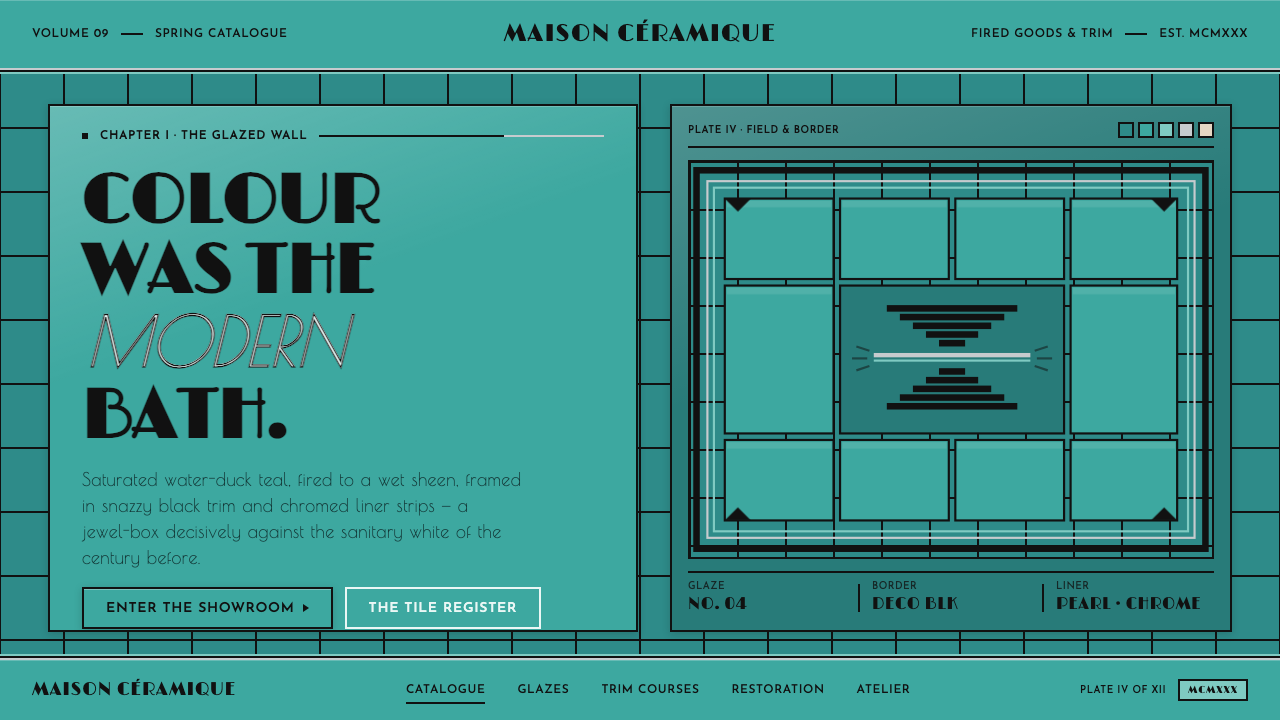 Art Deco Teal BathroomColour was the modern bath. Water-duck teal glaze, snazzy black trim, Limelig…
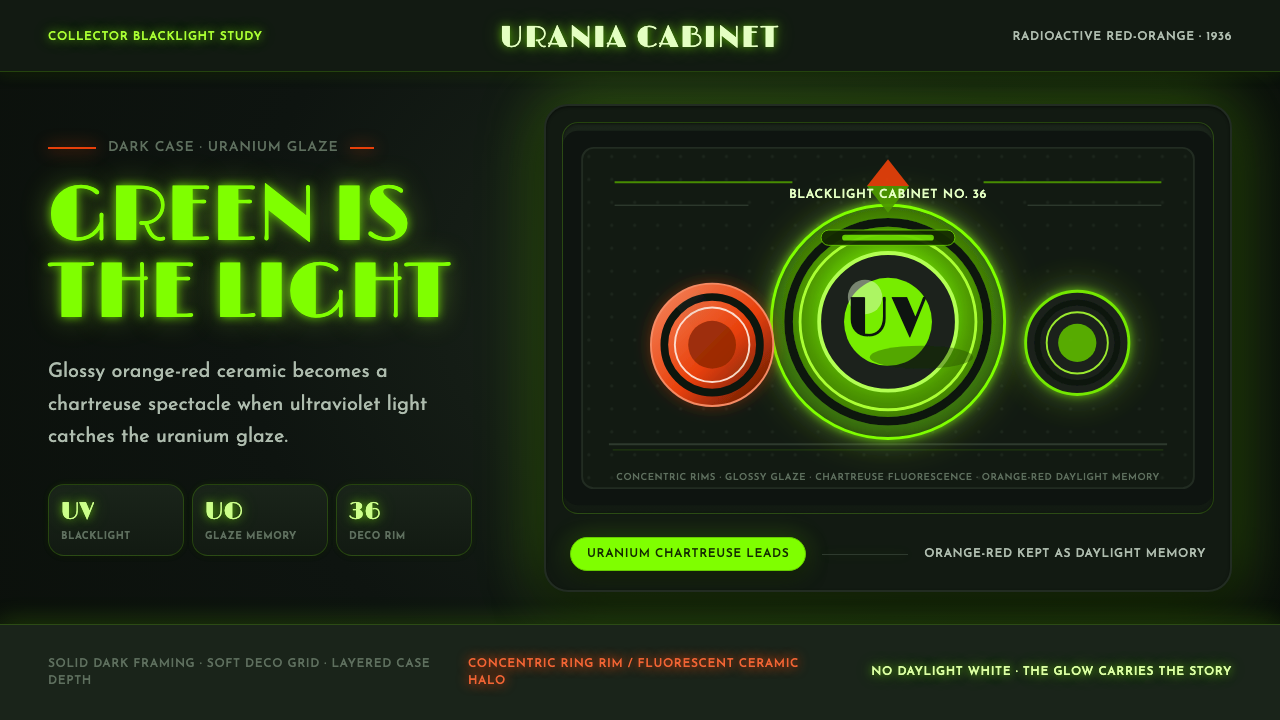 Fiestaware Radioactive Red-OrangeGlows like a collector's secret. Chartreuse rims cut through a dark deco case.
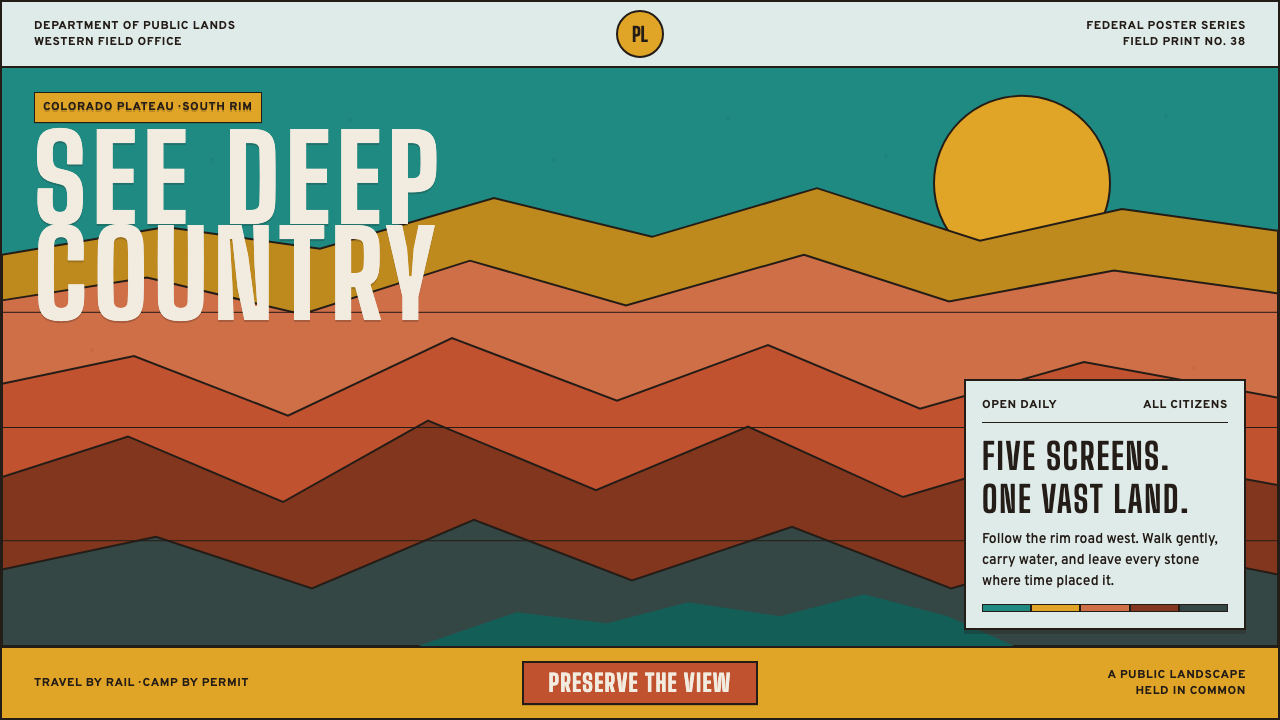 Grand Canyon WPA (1938)Public grandeur in five screens. Turquoise, ochre and terracotta stack in har…
 Harley Orange & BlackBuilt like a tank badge. Burnt orange, chrome hairlines, gothic type on near…
 Hollywood Golden Age (1930)Black-and-gold spectacle commands the night. Marquee bulbs frame monumental D…
 JPL Visions of the FutureSpace travel as print craft. Burnt orange silhouettes and Deco tan type on na…