What is Russian Constructivism?
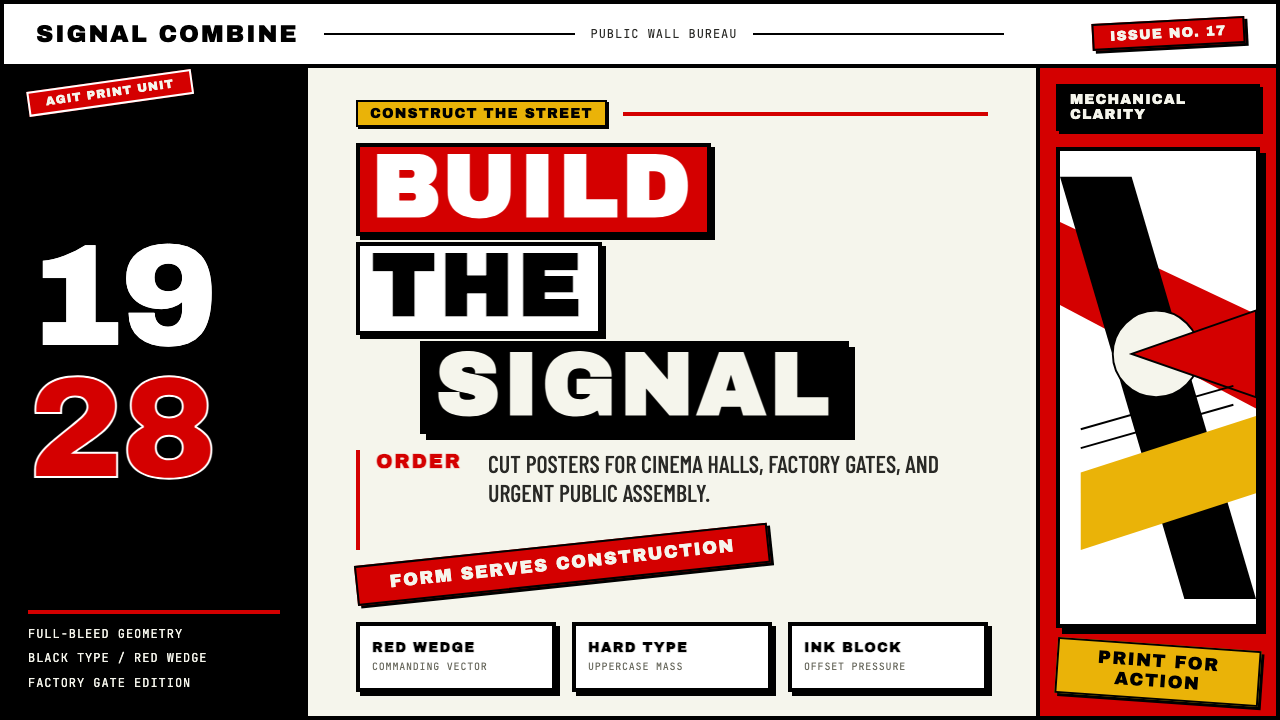
Revolution red slashed across black and white — Russian Constructivism made militant clarity the only acceptable aesthetic.
Russian Constructivism in brief
Russian Constructivism is a design and art movement that emerged from the 1917 October Revolution as a radical demand that visual form serve social purpose. It rejected 'art for art's sake' entirely, insisting that the poster, the book cover, the film title, and the exhibition display were all instruments of socialist construction — as purposeful and engineered as a bridge or a factory. The name itself is deliberate: to construct, not to decorate.
The movement's visual language is immediately recognizable. Revolutionary red — saturated, flat, unmodulated — is cut and slashed against black and white fields. Heavy geometric sans-serif type is set at aggressive diagonals, often thirty or forty-five degrees off horizontal. Photographs are torn apart and recombined in photomontage collisions that feel urgent and destabilizing. Compositions are asymmetric by principle, with elements arranged along strong diagonal axes that seem to refuse stillness. Nothing is centered, nothing is at rest.
Suppressed by Stalin's doctrine of Socialist Realism around 1934, which demanded legible figurative imagery over abstract formal experiment, Constructivism was effectively erased from Soviet cultural life. But the movement's afterlife has been extraordinary: its diagonal grids echo through Swiss punk typography of the 1970s, its photomontage technique recurs in radical editorial design, and its stripped geometry anticipates contemporary brutalist web aesthetics. Nearly every designed artifact that uses aggressive diagonal composition and stark color contrast owes something to Constructivism.

Where does Russian Constructivism come from?
The intellectual ground for Constructivism was prepared before the Revolution. Suprematism — the radical abstraction developed by Kazimir Malevich beginning around 1915 — had already dissolved the Russian avant-garde's attachment to representational form, reducing the painted canvas to pure geometric relationships: black squares, red circles, cross-forms floating in white space. Malevich insisted these were not decorations but the essential structure of visual experience stripped of social convention. His students and peers absorbed this lesson thoroughly, even as they would later turn against his apolitical spiritualism.
The October Revolution of 1917 gave the avant-garde both a mission and an institutional foothold. Designers and artists were recruited by the new Soviet state to produce propaganda for a largely illiterate population — posters that could be read across a city square, banners that communicated allegiance at a glance. Aleksandr Rodchenko, who had trained as a painter under Malevich's influence, brought his abstract compositional instincts into direct contact with this mass communication demand. He and his collaborator Varvara Stepanova developed what they called Productivism: the argument that the artist's proper role was not studio production of unique objects but the design of functional things for industrial reproduction. A poster that could be printed ten thousand times was worth more than a canvas painting that lived in one room.
El Lissitzky, working initially in the Jewish cultural milieu of Vitebsk under Marc Chagall before the two fell out over Malevich's arrival, became the movement's most internationally connected figure. His series of abstract compositions called Proun — 'Project for the Affirmation of the New' — explored the representation of architectural space through geometric forms floating on the page, combining Suprematist flatness with a sense of three-dimensional construction. More critically, Lissitzky traveled extensively to Germany and the Netherlands, where he met and influenced the De Stijl group and the nascent Bauhaus, creating one of the most fertile cross-pollinations in modern design history. His typographic experiments, particularly the layout work for the journal Veshch and for various Soviet and German publications, introduced diagonal composition and photomontage to Western graphic practice.
Vladimir Tatlin, though primarily a sculptor and architect, contributed the movement's most iconic emblem: the proposed Monument to the Third International (1919–1920), a rotating tower of steel and glass intended to surpass the Eiffel Tower in height and symbolize the dynamism of the Revolution. It was never built, but the image of Tatlin's Tower — a double helix of steel climbing through the air — became the visual shorthand for Constructivist ambition: engineering as ideology, structure as politics. By the early 1920s, the movement had expanded into textile design, film titles, exhibition architecture, and book design, with figures like Stepanova designing factory uniforms and Lissitzky designing landmark exhibitions. The suppression came gradually: by the late 1920s, Socialist Realism was consolidating its hold, and by 1934, the abstract formal experiment that defined Constructivism was officially condemned.
What defines the Russian Constructivism look?
Revolutionary Red on Black and White
The Constructivist palette is built on a near-total restriction: revolutionary red deployed against black and white. Red is not simply one color among many — it is the ideological primary, carrying the weight of political urgency and mass mobilization. Black and white establish the structural field, creating maximum contrast. The palette functions less like an aesthetic choice and more like a signaling system. Secondary colors rarely appear, and when they do, they serve to distinguish information layers rather than to create visual variety for its own sake.
Diagonal Composition and Kinetic Energy
Perhaps the most distinctive feature of Constructivist design is its commitment to the diagonal as the primary compositional axis. Unlike the horizontal and vertical grids that organize most Western page design, Constructivist layouts rotate type, rules, and geometric shapes to angles that feel unstable and urgent — a visual equivalent of the revolutionary momentum the work was meant to communicate. These diagonals are not decorative; they are structural. They create reading paths and establish hierarchies, but they refuse the settled authority of the orthogonal.
Photomontage and Collision
Constructivist designers were among the first to make photomontage a primary expressive and communicative method. Photographs were not used naturalistically — they were cut, cropped at severe angles, scaled to disproportionate sizes, and collided with type and geometric forms on the same surface. The photomontage technique, developed in parallel by Berlin Dadaists and Soviet Constructivists, implies that reality can be reordered and that the viewer's habitual perception can be disrupted. Images of workers, machines, and crowds are made to feel simultaneous and overwhelming rather than sequential and calm.
Heavy Geometric Sans-Serif Type
Constructivist typography favors letterforms that are blocky, geometric, and heavy — forms whose thick strokes and even weight distribution read as engineered objects rather than calligraphic traces. Type is used at extreme contrasts of scale: a single enormous word or letter may occupy a quarter of the composition, serving as both text and visual mass. Type and image are treated as compositional equals, not as figure and ground. Rules, bars, and geometric shapes are used to anchor type, extend it, or interrupt it — the typographic arrangement is itself a constructed object.
Asymmetric Tension, Not Decorative Balance
Constructivist compositions achieve balance through tension rather than symmetry. A heavy mass of text in one corner is countered by a bold geometric shape in the opposite zone; a diagonal rule pulls against a vertical column of type. This is balance understood as a dynamic system of forces, not as a stable resting point. Traditional symmetric compositions — the centered title, the mirrored page — were associated with classical authority and bourgeois convention. Asymmetry was a formal rejection of that authority, carried through the design itself.
Machine Aesthetic and Productivist Ethics
Underlying Constructivist form is a philosophical commitment to the machine as model. Where earlier decorative traditions looked to nature or classical antiquity for their formal vocabulary, Constructivism looked to engineering. Straight lines, precise angles, flat planes, and systematic repetition are all marks of industrial production — and they were embraced not merely as aesthetic choices but as ethical statements about what culture should value. The hand-rendered flourish was a mark of aristocratic leisure; the geometric rule was a mark of productive labor. This is why authentic Constructivist work feels deliberately hard and unaccommodating.
Flatness and Zero Illusionism
Constructivist work is resolutely flat. There are no simulated depths, no soft gradients suggesting volume, no naturalistic shading. When a circle appears on the page, it is a flat disk — a shape, not a sphere. When type casts a shadow, the shadow is a hard geometric offset, not a diffuse atmospheric halo. This flatness is both an aesthetic and an ideological position: illusionism was associated with the deceptive conventions of bourgeois representational culture. The constructed image should be legible as a constructed image — it should not pretend to be a window onto the world.

Who shaped Russian Constructivism?
Rodchenko is the figure most central to Constructivism's visual identity. Beginning as a painter experimenting with pure black compositions, he moved into graphic design, photography, and textile design, always under the conviction that art must serve social function. His poster work — particularly the 1924 advertisement for Lengiz books featuring Lilya Brik photographed from below, mouth open, calling out a slogan — defines the movement's photomontage and diagonal typographic synthesis. He also designed book covers, magazine spreads, and film advertisement boards that remain canonical reference points. His later photography, characteristically shot from extreme high or low angles, pioneered the use of the camera as a formal instrument rather than a documentary one.
Lissitzky was the movement's great connector — the figure who built the bridges between Soviet Constructivism and the Western European avant-garde. His Proun series of abstract compositions explored the intersection of flat Suprematist geometry and implied architectural space, creating forms that appear to float, rotate, and intersect in ambiguous virtual depth. His typographic work — particularly his design of the 1923 publication 'Of Two Squares,' a children's story told entirely through abstract shapes, and his layouts for the journal Veshch — introduced Constructivist formal vocabulary to European designers and influenced a generation of Bauhaus typographers. He also designed landmark Soviet exhibition pavilions in Germany and the Netherlands, staging Soviet modernity for international audiences.
Stepanova is one of the most complete embodiments of the Productivist ethic. Her work spans poetry, painting, graphic design, and textile design, and she was among the most committed advocates for the idea that the artist should abandon studio production for the design of functional, reproducible objects. Her textile designs for the First State Textile Print Factory — geometric patterns built on repeated angular forms — attempted to bring Constructivist form into everyday life through mass-produced fabric. Her magazine and book design, produced in close collaboration with Rodchenko, matches his formal rigor while often incorporating a more systematic, modular approach to grid organization.
Tatlin's contribution to Constructivism is more architectural and sculptural than graphic, but his influence on the movement's ideology was foundational. His counter-reliefs — three-dimensional constructions of industrial materials assembled without traditional craft methods — established the principle that artistic construction should use the materials and methods of industry. His Monument to the Third International, the great unbuilt tower, proposed a building that was also a machine and also a symbol: a steel double-helix rotating on different schedules at different levels, housing the organs of the Third Communist International. It summarized the movement's belief that structure, function, and political meaning could be unified in a single designed object.
As life and professional partners, Rodchenko and Stepanova represent the movement's most sustained and productive artistic relationship. Their joint work — on the journal LEF, on textile and clothing design, on exhibition installations — demonstrates how Constructivist principles operated as a shared working method rather than merely an individual style. Stepanova's rigorously modular approach often provided structural architecture for compositions that Rodchenko then charged with photographic and diagonal energy. Together they show that Constructivism was above all a social practice: design as collective labor in service of collective transformation.
How do you use Russian Constructivism today?
Russian Constructivism is one of the most transferable historical styles in contemporary visual communication — not because it is easy to apply, but because its logic is structural and therefore scalable. The style does not ask you to copy a historical artifact; it asks you to understand why red is slashed diagonally and not placed centrally, why the type is rotated and not set horizontal, why the photograph is collided with geometry and not given clean white space. Applying Constructivism correctly means internalizing the movement's formal argument: urgency through diagonal, hierarchy through scale, meaning through color, structure through flatness.
For presentation slides, Constructivism offers a distinct and memorable alternative to conventional template layouts. A cover slide benefits from the movement's core compositional logic: a dominant diagonal element — a colored bar, a heavy typographic block, or a cropped photographic form — cuts across the field at an aggressive angle while the title sits in oversized, heavy type. The result should feel like a poster, not a slide. Content slides should similarly embrace extreme scale contrast: section headers several times the visual weight of body text, a bold horizontal or diagonal rule separating content zones, and color used only to signal the most critical element on the page. Data visualizations take on a geometric authority in this style — bar charts become architectural forms, and selective use of revolutionary red draws the eye to the single most important data point.
For web interfaces, the style translates most naturally to dashboards, analytics platforms, and pages designed for experienced users who need to scan and act quickly rather than be welcomed or soothed. The structural approach is to establish a rigorous grid, set type in a heavy weight with strong scale contrast between headers and body, and use the restricted palette — red for interactive or alert states, black for primary content, white or near-white for backgrounds — with disciplined restraint. Navigation can be purely typographic: large, bold labels without icons, positioned asymmetrically. Avoid soft card shadows and gradient backgrounds, which undercut the aesthetic's flatness; instead, use hard borders, bold rules, and flat color fills. On pricing pages, Constructivist treatment can make a featured tier feel genuinely dominant rather than merely highlighted.
For editorial and marketing work, the style is best suited to contexts where authority and confrontation are desirable qualities — cultural institutions, political commentary, technology brands positioning themselves as challengers rather than incumbents, or print work that needs to stand apart from polished commercial aesthetics. A Constructivist editorial layout places the headline at maximum scale and maximum weight, rotates it or sets it against a bold color field, and treats the body text as a dense column that contrasts with generous negative space elsewhere on the spread. Marketing campaigns benefit from the poster-like singularity of the style: each piece should communicate one dominant idea, supported by one dominant visual, in a palette of no more than two or three colors at maximum.
A common and revealing mistake when applying Constructivism is to treat the diagonal as decoration. The diagonal in authentic Constructivist work is always load-bearing — it is the direction of the composition's primary thrust, the axis along which the main visual and typographic elements are organized. Placing a single rotated text element against an otherwise conventional layout is not Constructivism; it is a quotation mark around an empty reference. Similarly, using the red-black-white palette without committing to the compositional logic — without the aggressive scale, the asymmetric tension, the photomontage collision — produces work that looks historical but feels inert. The style's power is systemic, not cosmetic.

Russian Constructivism — FAQ
How is Russian Constructivism different from Bauhaus?
The two movements were roughly contemporary — Constructivism from 1917, Bauhaus from 1919 — and cross-pollinated heavily through El Lissitzky's travels and correspondence. But their core logic differs. Bauhaus sought the union of art and industry to produce well-designed objects for everyday life; its ideological commitment was to functional clarity and reproducibility. Constructivism was more explicitly political and more formally radical: it emerged from revolutionary upheaval and used visual aggression as a communicative strategy. Bauhaus work tends toward organized calm within its geometric vocabulary; Constructivist work is deliberately destabilizing. A Bauhaus poster explains; a Constructivist poster mobilizes.
Can Constructivism work for brands that are not overtly political?
Yes, with an important qualification. The style's formal vocabulary — diagonal composition, flat geometric shapes, heavy type, restricted palette — is separable from its original ideological content, and contemporary designers regularly deploy it for technology products, cultural institutions, and challenger brands without any socialist intent. What it retains is a disposition: anti-decorative, confrontational, flat, and structurally aggressive. This disposition aligns well with brands that want to signal that they are serious, unconventional, or fundamentally different from incumbent competitors. It aligns poorly with brands whose value proposition depends on warmth, organic naturalness, luxury softness, or emotional approachability.
Is photomontage necessary for an authentic Constructivist look?
Not strictly necessary, but it is deeply characteristic. Many of the most iconic Constructivist works are purely typographic and geometric, without any photography — particularly the more abstract compositions by Lissitzky and the early works of Rodchenko. Photomontage became central to the movement's poster and mass-communication work because it combined the urgency of documentary photography with the compositional freedom of abstract design. In contemporary application, the equivalent of photomontage might be high-contrast photography treated as a flat shape — cropped hard, silhouetted, or printed in a single-color duotone — rather than naturalistic imagery given clean separation.
What are the most common mistakes when applying this style today?
Three mistakes recur most often. First: treating the diagonal as a single decorative accent rather than the organizing principle of the entire composition. One tilted word does not make a Constructivist layout. Second: using the red-black-white palette as visual shorthand without committing to the formal logic — flat geometry, heavy type, aggressive scale contrast — that makes the palette meaningful rather than merely historical. Third: softening the edges. Constructivism is hard: hard shadows, hard crops, hard type, hard geometry. The instinct to add rounded corners, soft gradients, or ambient shadows to make the style feel 'contemporary' produces work that is neither Constructivist nor contemporary but stranded between two aesthetics.
Why does Constructivism feel so contemporary even though it is over a century old?
Several reasons converge. Constructivism was itself a reaction against ornament and tradition, so it shares a formal vocabulary with any subsequent movement that makes the same rejection — including contemporary digital brutalism, flat design, and much of the current graphic design renaissance. Its flatness was a constraint of printing technology in the 1920s that has become a design preference in the age of screen display. Its diagonal dynamism translates naturally to scroll-based web interaction and video motion graphics. And its color restriction — essentially a two-or-three-color system — maps directly onto modern design tokens and brand palette architecture. What felt radical and industrial in 1923 feels principled and systematic in the present.
Related design styles
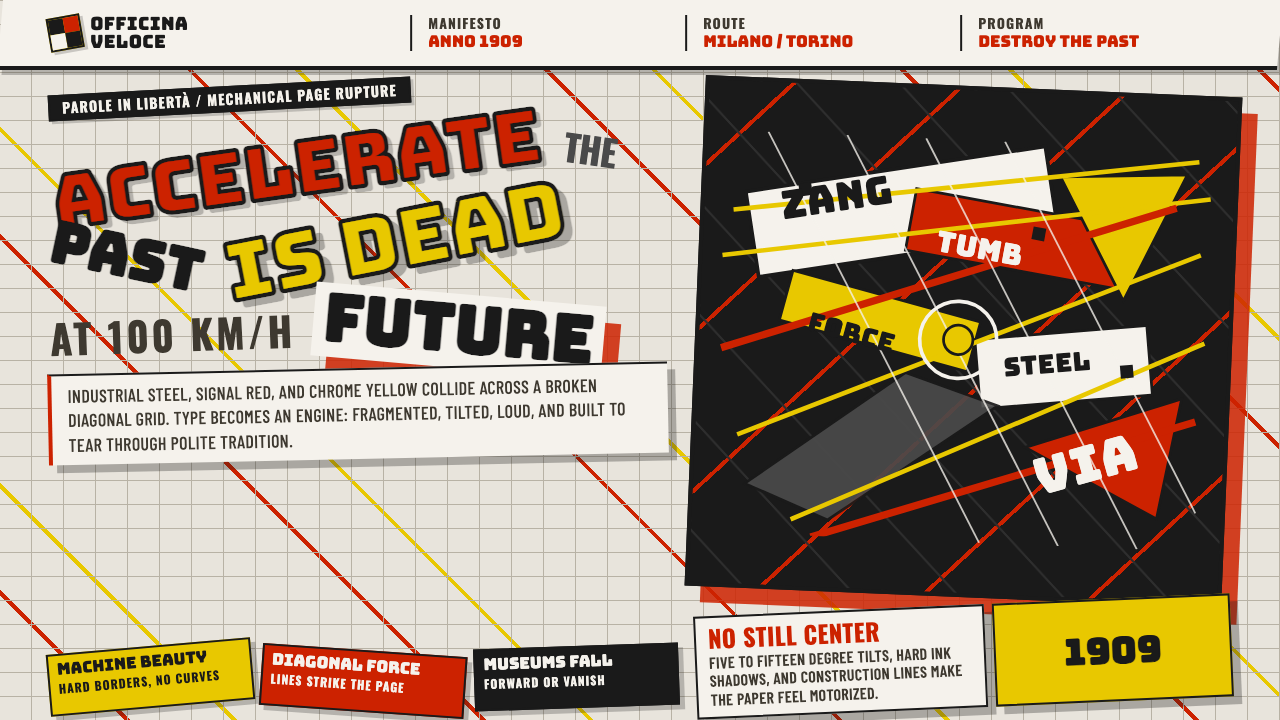 Italian Futurism (Marinetti 1909)Speed murders tradition. Signal red and chrome yellow slash a broken diagonal…
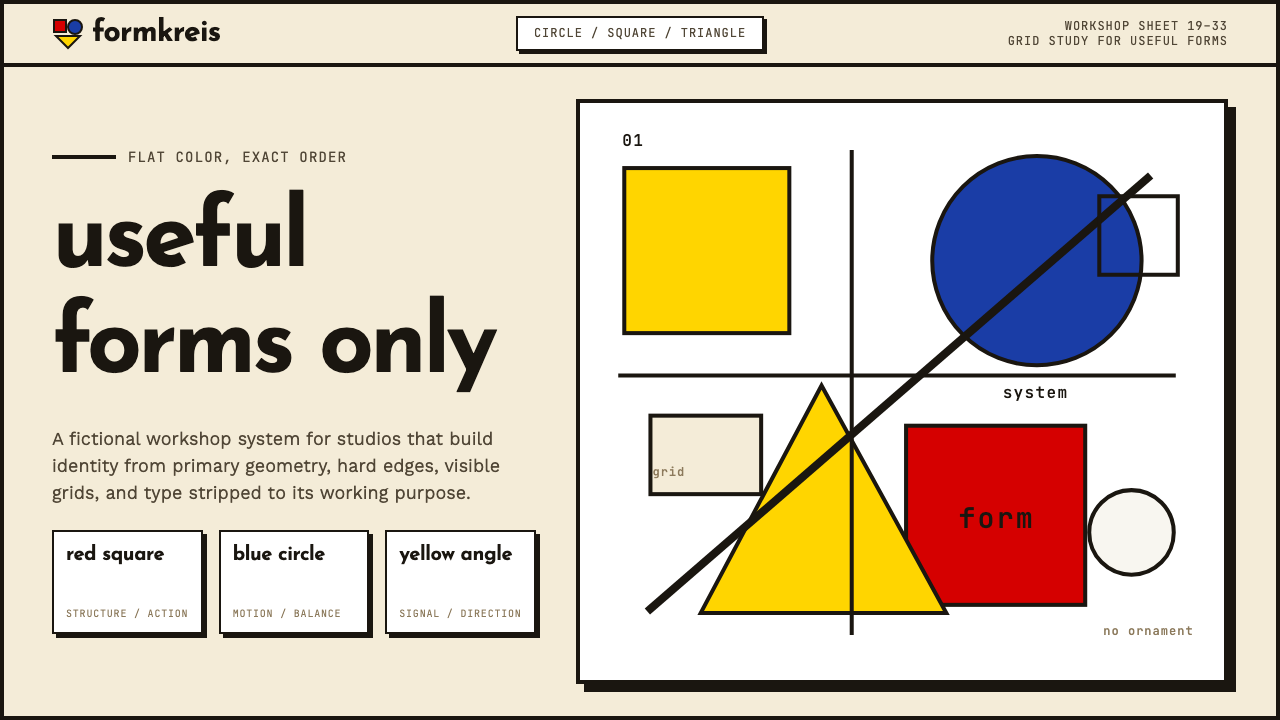 Bauhaus WeimarForm follows revolution. Primary red-blue-yellow on cream, hard shadows, no o…
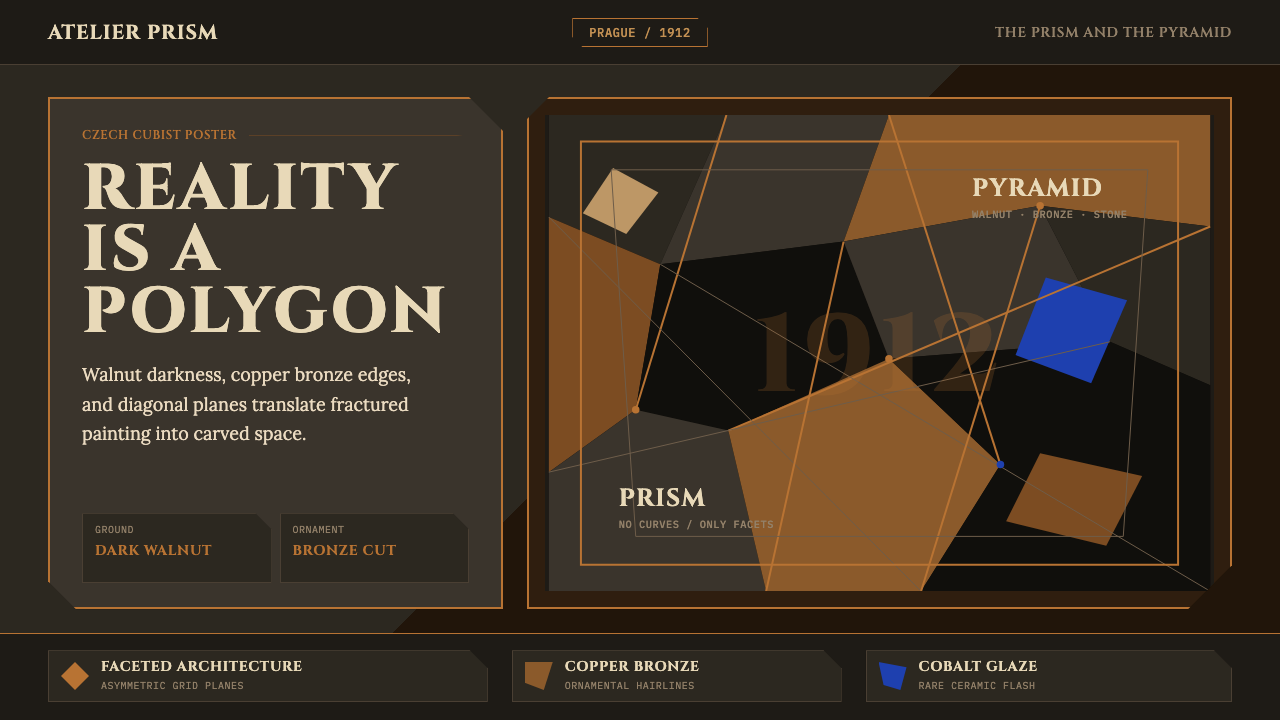 Czech Cubism (Prague 1912)Reality is faceted. Walnut ground, Cinzel capitals, and bronze diagonals cut…
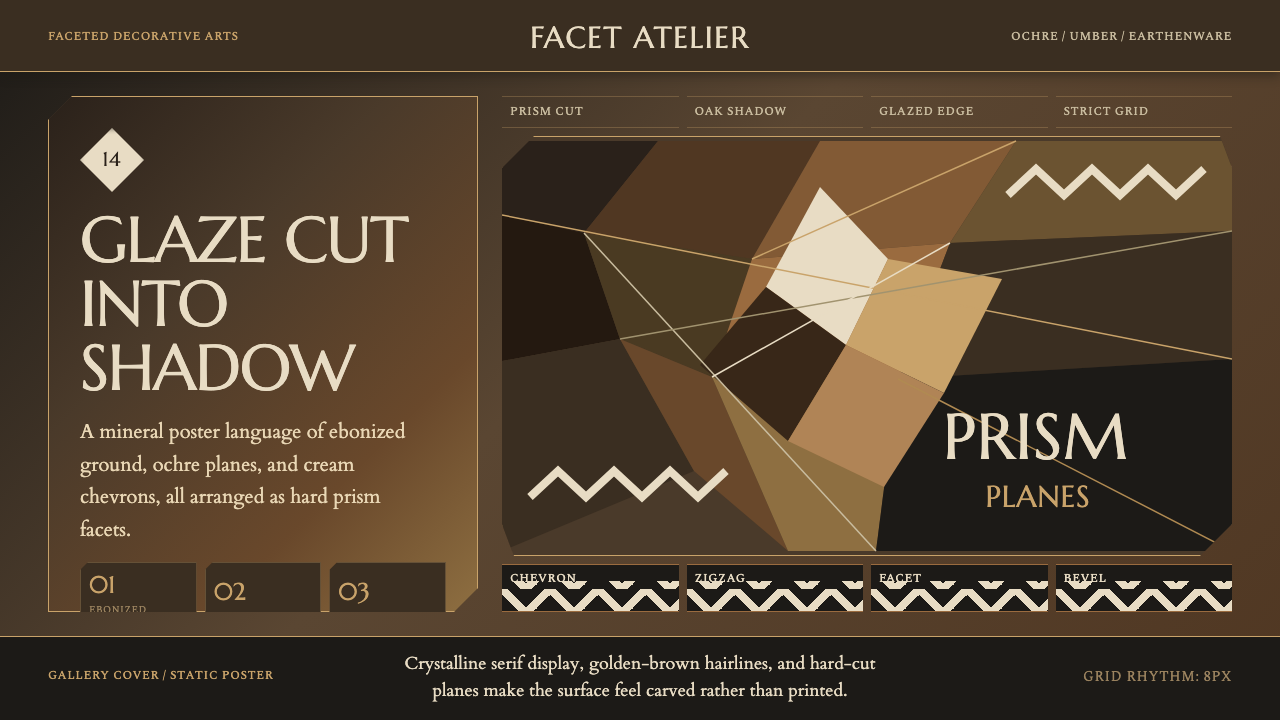 Czech Cubist Decorative ArtsGlazed geometry feels carved. Umber ground, ochre facets, and cream chevrons…
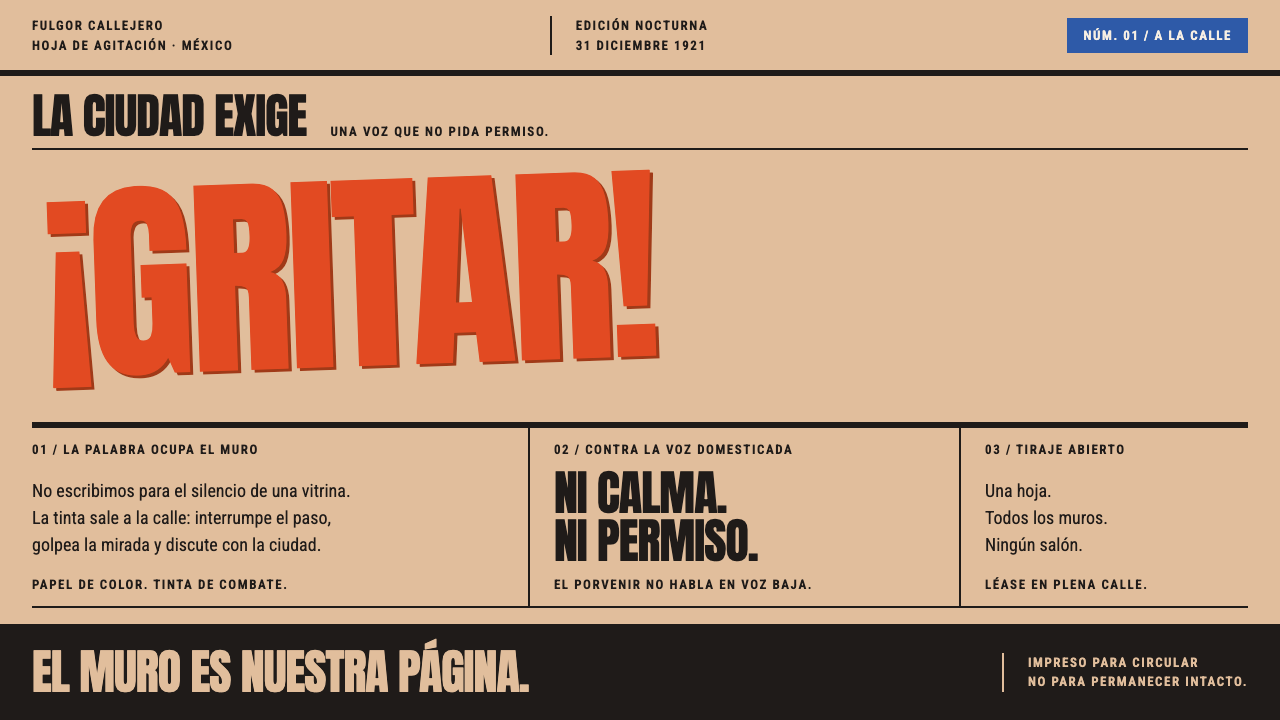 EstridentismoPrinted to interrupt. Vermilion condensed type tilts across buff stock, fence…
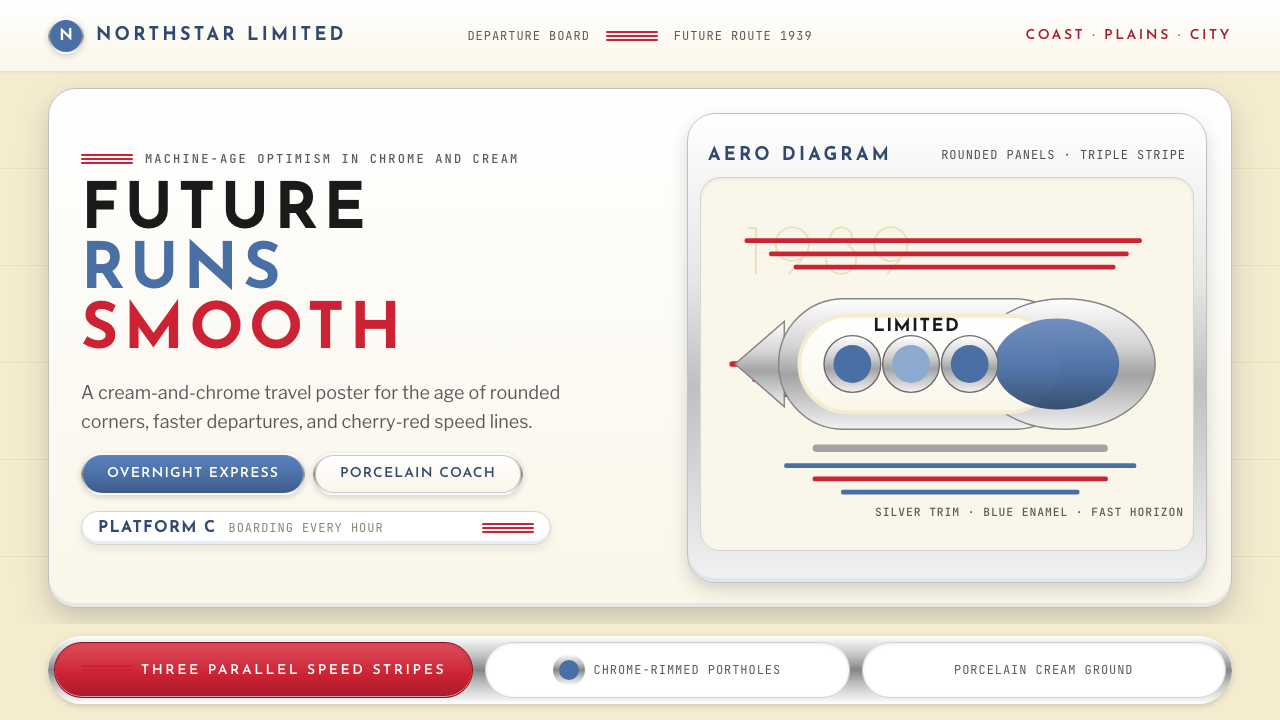 Streamline Moderne (1930s)Optimism made aerodynamic. Cream ground, chrome ovals, and cherry stripes dri…