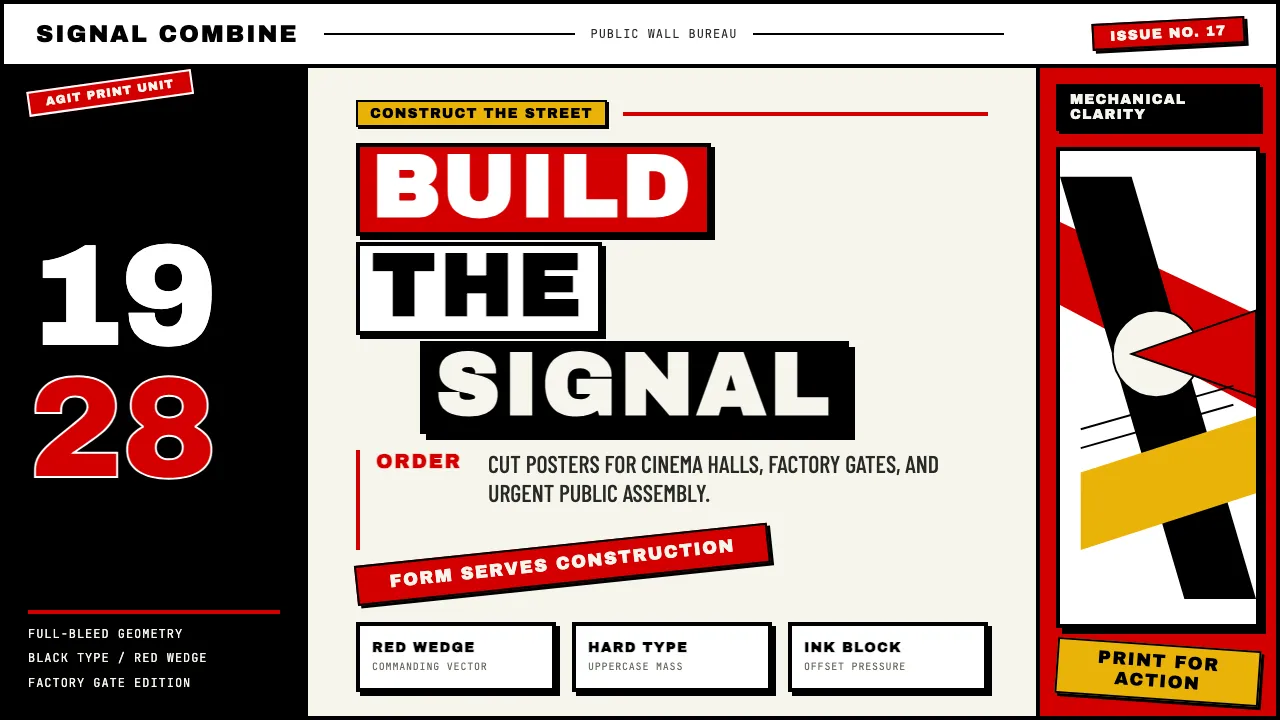
About Russian Constructivism
Russian Constructivism arose from the 1917 October Revolution as a radical rejection of "art for art's sake." Designers like Rodchenko, Lissitzky, and Stepanova demanded that visual form serve socialist construction — producing propaganda posters, book covers, and film advertisements with militant clarity.
The movement's visual language is unmistakable: revolutionary red slashed across black and white, heavy geometric sans-serif type set at aggressive diagonals, photomontage collisions, and asymmetric compositions that feel perpetually in motion. Suppressed by Stalin's doctrine around 1934, its influence echoes through punk graphics, Bauhaus typography, and contemporary brutalist web design.
- Origin
- Soviet Union (Moscow, Vitebsk)
- Era
- 1917–early 1930s; suppressed by Socialist Realism ~1934
- Key figures
- Aleksandr Rodchenko · El Lissitzky · Vladimir Tatlin · Varvara Stepanova
- Movements
- Suprematism · Productivism · Bauhaus-adjacent
Russian Constructivism design spec
Colors
Typography
The other 11 sections — buttons, cards, spacing, motion, techniques and more — open once you unlock. Download the DESIGN.md or send it to your AI in one click. Unlock once, yours forever.
Sign up nowStyles similar to Russian Constructivism
Also inspired by design movements, with a close feel.
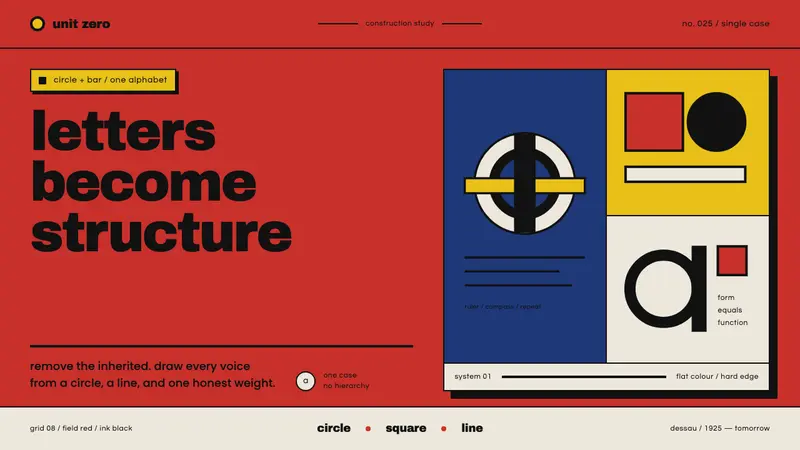 Bayer Universal BauhausLetters become structure. Bauhaus red, primary blocks, and black circle-bar forms enforce order.
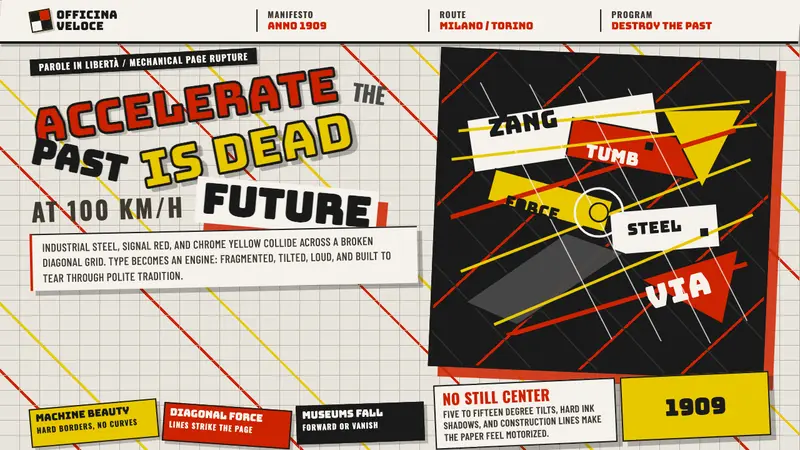 Italian Futurism (Marinetti 1909)Speed murders tradition. Signal red and chrome yellow slash a broken diagonal grid.
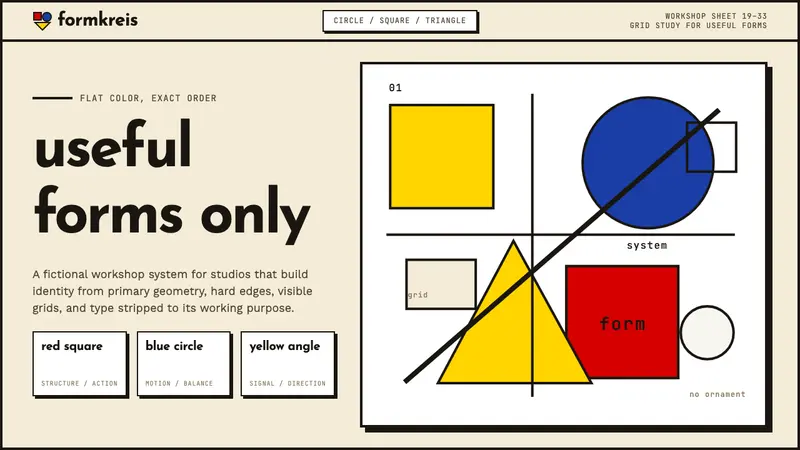 Bauhaus WeimarForm follows revolution. Primary red-blue-yellow on cream, hard shadows, no ornament — pure form.
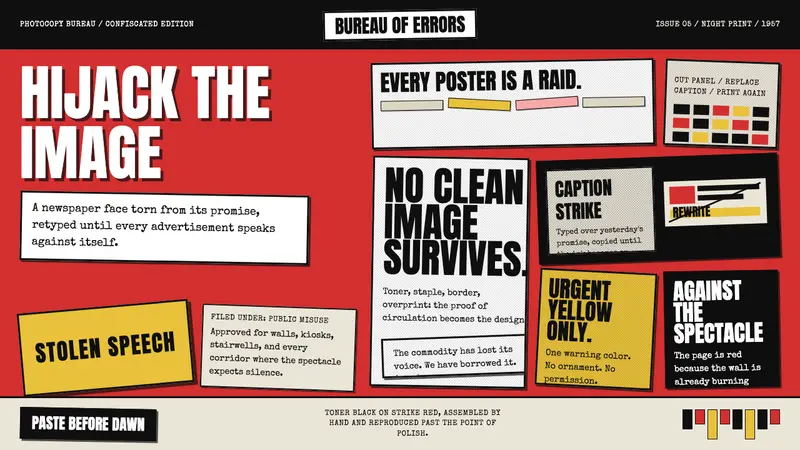 Situationist Détournement (1957)Contraband urgency. Strike red, toner black, and jagged comic panels make theory look stolen.