What is Italian Futurism (Marinetti 1909)?
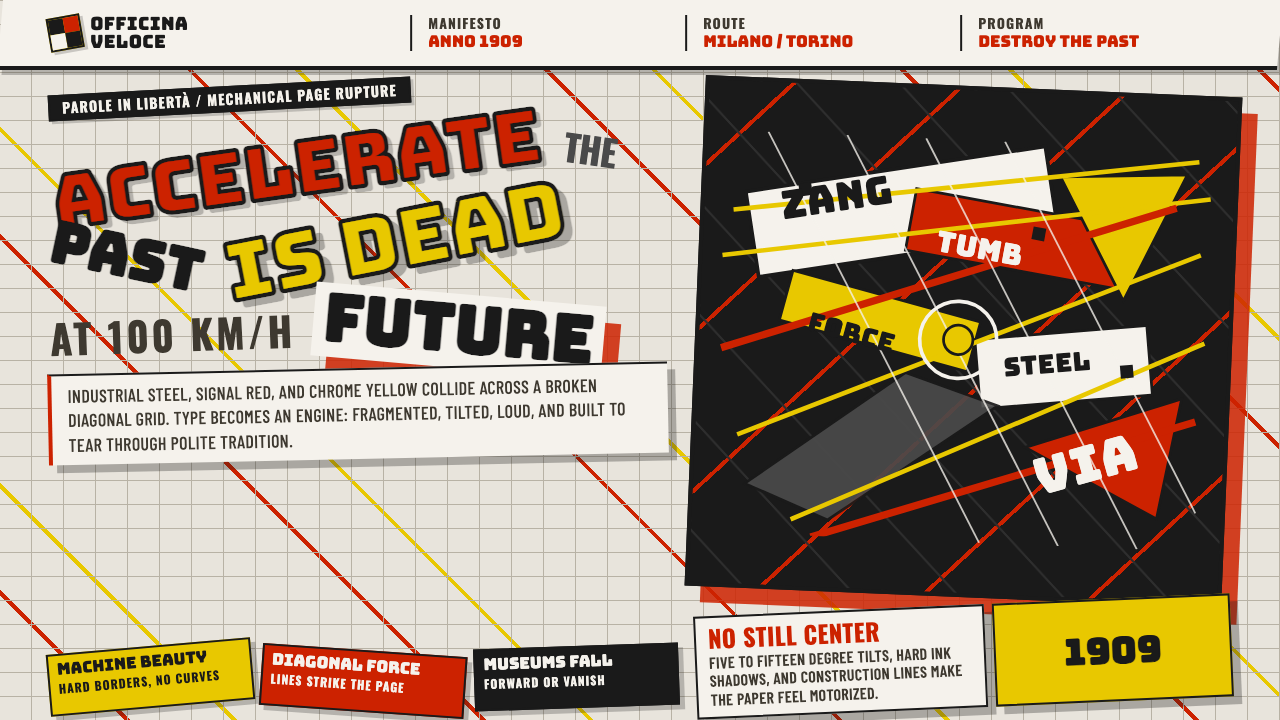
Marinetti's 1909 manifesto detonated a century of still composition — Futurism made speed, noise, and the machine the only worthy subjects of art.
Italian Futurism (Marinetti 1909) in brief
Italian Futurism was the twentieth century's first self-declared avant-garde movement — a violent rejection of museums, libraries, and all inherited tradition, launched by poet Filippo Tommaso Marinetti with his Manifesto of Futurism, published on the front page of the Paris newspaper Le Figaro on 20 February 1909. Where earlier modernisms sought to reform visual culture gradually, Futurism demanded its immediate destruction and replacement with the aesthetics of the machine age: speed, simultaneity, force, and industrial noise.
The Futurist visual language translates these values into a distinctive graphic grammar. Compositions shatter into overlapping diagonal planes, suggesting objects caught mid-motion. Typography breaks free of the horizontal baseline — letters grow and shrink, rotate, and collide on the page in what Marinetti called parole in libertà (words in freedom). Color is industrial and declarative: signal red, chrome yellow, steel grey, and the white of unprinted paper serve as the primary palette. Nothing in a Futurist composition is meant to rest the eye; every element charges forward.
Though the movement was short-lived as a coherent political and artistic program — absorbed by Italian Fascism in the 1920s and exhausted by the Second World War — its visual vocabulary proved extraordinarily durable. The diagonal grid, the force line, the fragmented letterform, and the collision composition became foundational tools of twentieth-century graphic design, influencing Constructivism, De Stijl, punk typography, and contemporary motion graphics alike.

Where does Italian Futurism (Marinetti 1909) come from?
The Manifesto of Futurism arrived at a moment of acute cultural frustration. Northern Italian industrial cities — Milan, Turin — were undergoing rapid transformation, their factories and trams and automobiles reshaping daily life at a pace that painting, poetry, and architecture had entirely failed to register. Marinetti, a wealthy Milanese writer who had absorbed Symbolism and the provocations of Alfred Jarry's Ubu Roi, concluded that the problem was not merely stylistic but ontological: European culture was a corpse being venerated in museums. His manifesto called for burning the museums and flooding the libraries, and for replacing beauty with the roaring automobile, which he declared more beautiful than the Winged Victory of Samothrace.
The visual arts response to Marinetti's provocation came from a group of painters — Umberto Boccioni, Carlo Carrà, Luigi Russolo, Giacomo Balla, and Gino Severini — who signed the Manifesto of Futurist Painters in February 1910 and a companion Technical Manifesto of Futurist Painting in April of the same year. Their central problem was representing motion and simultaneity in static media. Drawing on Divisionism (the Italian variant of Pointillism) and on the sequential photography of Étienne-Jules Marey and Eadweard Muybridge, they developed a technique of overlapping translucent planes and radiating force lines — lines of force — to suggest a figure or machine at multiple positions within a single frame.
Boccioni pushed the program furthest into three dimensions. His sculpture series States of Mind (1911) and the bronze Unique Forms of Continuity in Space (1913) dissolved the traditional sculptural boundary between figure and environment, allowing the figure's motion to ripple outward into the surrounding atmosphere as interlocking planes of streaked form. Meanwhile Balla, whose Dynamism of a Dog on a Leash (1912) had fragmented a dachshund's legs into a blur of overlapping silhouettes, moved by 1914 toward pure abstraction: his abstract speed paintings reduced the automobile and its velocity to interpenetrating wedges and arcs of color, entirely shedding representation.
Marinetti's own contribution to visual culture was typographic. His 1914 book Zang Tumb Tumb, describing the 1912 siege of Adrianople through sound poetry, deployed multiple typefaces, multiple sizes, rotated text blocks, and onomatopoeic word clusters across the page in total defiance of conventional book layout. This practice of parole in libertà — words in freedom — became Futurism's most direct and lasting contribution to graphic design. The fragmented, multi-directional page, in which the act of reading becomes physically active rather than passively linear, anticipates twentieth-century experimental typography from Dada through punk zines to contemporary digital motion design.
What defines the Italian Futurism (Marinetti 1909) look?
Diagonal Dynamism
The diagonal is Futurism's defining compositional axis. Where academic composition balanced elements along stable horizontals and verticals, Futurist layouts tilt every element — planes, text blocks, figure contours — to suggest arrested motion. The diagonal reads as a vector: something is moving from one corner toward another, and the viewer's eye is pulled along with it. In typographic work, diagonal text blocks collide with horizontal ones, generating visual friction that mimics the sensation of mechanical speed.
Force Lines
Futurist painters borrowed the concept of force lines — radiating strokes that extend outward from a moving object — from the study of electricity and from sequential photography. In painting, these lines do not represent visible streaks but the kinetic energy that a body in motion generates in its surrounding environment. In graphic design, force lines translate into radiating rules, speed stripes, or burst patterns that emanate from a central focal point, pushing the composition outward and amplifying the sense that the image is on the verge of exploding off the page.
Fragmented Typography
Marinetti's parole in libertà practice shattered the conventions of the printed page. A single composition might combine hand-lettering, bold display type, condensed sans-serif, and italic roman in radically different sizes, each rotated or stacked according to sonic and emotional logic rather than reading order. Large words suggest shouts; tiny clusters suggest whispers or machinery noise. This approach treats the page as a scored musical manuscript — a performance instruction as much as a text — and it remains one of the most radical typographic ideas in the history of print.
Simultaneous Planes
Futurist painting developed a technique of overlapping semi-transparent planes to compress multiple moments of a motion sequence into a single image. A running figure appears in several positions at once; a speeding tram fractures into interlocking wedges of color and form. In graphic design, this principle produces layered compositions where shapes stack at varying degrees of opacity, creating depth through transparency rather than through perspective or shadow. The effect suggests cinematic superimposition — multiple frames collapsed onto one.
Industrial Color Palette
Futurism's palette is drawn from the factory floor and the racing circuit rather than from nature or classical tradition. Signal red — the red of danger warnings and racing livery — anchors energy and urgency. Chrome yellow, the color of industrial chrome and early automobile bodywork, signals speed and modernity. Steel grey and iron black provide structural weight. Unprinted white or the warm off-white of newsprint serves as the ground. The palette reads as deliberately harsh and modern: it has no softness, no atmospheric haze, no pastoral reference.
Noise and Simultaneity
Futurism was one of the first visual movements to try to represent sound as image. Luigi Russolo's Art of Noises manifesto (1913) called for new instruments built from industrial sound sources; Balla's paintings attempted to render the visual equivalent of a chord. In graphic work, this principle translates into visual density — the deliberate accumulation of competing text sizes, overlapping shapes, and clashing diagonals that forces the eye to process multiple signals simultaneously, as if reading a score rather than a sentence. Silence and empty space are not valued; they register as absence of energy.
Manifesto as Medium
Uniquely among art movements, Futurism used the published manifesto as both a political and a designed artifact. Marinetti produced over fifty manifestos between 1909 and 1944, each printed with aggressive typographic choices — heavy display rules, dramatic size contrast, bold declarative sentences set flush left against dense body copy. The manifesto format — short, numbered, aggressive, addressed directly to the reader — influenced not only political propaganda but the format of advertising copy, product launch communications, and digital announcement posts that are now ubiquitous.

Who shaped Italian Futurism (Marinetti 1909)?
Marinetti was the movement's founder, impresario, and primary theorist. Born in Alexandria, Egypt, to wealthy Italian parents, he was educated in French-language schools and came to Paris as a poet before returning to Milan. His 1909 manifesto made him internationally famous overnight. Over the following three decades he organized Futurist exhibitions, wrote performance texts, designed books, and relentlessly promoted the movement across Europe and beyond. His typographic innovations in Zang Tumb Tumb (1914) and Les Mots en liberté futuristes (1919) remain foundational texts in the history of experimental printing.
Boccioni was the movement's most gifted visual artist, working across painting and sculpture to produce its most ambitious formal achievements. His triptych States of Mind (1911) tried to give painted form to the emotions of departure and arrival at a railway station — melancholy of those who go, farewells of those who stay — through overlapping planes of distorted color and form. His bronze Unique Forms of Continuity in Space (1913) solved, in three dimensions, the problem the painters had been wrestling with in two: how to render the interpenetration of figure and environment during motion. Boccioni died in 1916 after falling from a horse during military exercises, cutting short one of the most original artistic trajectories of his generation.
Balla was the oldest of the Futurist painters and the one who pushed furthest into pure abstraction. His Dynamism of a Dog on a Leash (1912) — depicting the blurred multiple-position legs of a dachshund and its owner — became one of the movement's most recognized images precisely because its subject is so domestic while its method is so radical. By the mid-1910s Balla had abandoned representation entirely, producing paintings of pure color wedges and velocity arcs that anticipate later hard-edge abstraction. He also applied Futurist principles to interior design and furniture, and his collaborations with Fortunato Depero on the Futurist Reconstruction of the Universe (1915) extended the movement's reach into total environmental design.
Depero was the Futurist figure most directly engaged with commercial and applied design. His Futurist House in Rovereto functioned as a workshop producing tapestries, toys, and theatrical sets. His advertising work for Campari — including the famous Campari Soda bottle design and a series of graphic advertisements that deployed Futurist diagonal energy directly in commercial contexts — demonstrated that the movement's visual language could survive translation into mass market communications without losing its charge. Depero's work in New York from 1928 to 1930, where he produced covers for Vogue, Vanity Fair, and The New Yorker, showed how the Futurist vocabulary could infiltrate mainstream American publishing.
Russolo is the Futurist least remembered as a painter and most remembered as a sound theorist. His manifesto The Art of Noises (1913) argued that the sonic environment of industrial civilization — factory machinery, trains, street crowds, electrical hum — had permanently altered what music could mean, and that composers had an obligation to incorporate this expanded sonic palette. He built a series of acoustic instruments he called intonarumori (noise intoners) and performed with them across Europe before they were destroyed in the First World War. In graphic design terms, Russolo's theoretical framework — that industrial noise is itself an expressive medium — legitimized the idea that visual cacophony and compositional overload could be deliberate aesthetic choices rather than failures of discipline.
How do you use Italian Futurism (Marinetti 1909) today?
Italian Futurism is one of the more demanding historical styles to apply in contemporary design, because its power comes from controlled aggression rather than from elegance or restraint. Getting it right requires internalizing what the style is actually doing — using diagonal force to generate forward momentum, using typographic fragmentation to create reading experiences that feel active rather than passive, using industrial color to signal urgency and modernity — and then making those choices serve a specific communication goal rather than simply decorating a layout.
For presentation slides, Futurism excels on kinetic cover slides and section dividers. A cover built on this style uses a strong diagonal composition: the title set in multiple weight and size variations — some words large and dominant, others small and recessive — on an off-white or stark white ground with a single signal-red or chrome-yellow accent shape cutting across the corner. Content slides should be more restrained than the cover: one clear typographic hierarchy, one diagonal rule or shape to establish movement, and generous negative space to let the energy breathe. Data slides work especially well when charts are treated as geometric objects — bar charts rendered with thick strokes and hard-edged fills, labeled with bold condensed type that matches the compositional energy.
For web interfaces, Futurism's visual language is best suited to dashboards, launch pages, and high-impact marketing surfaces where urgency and forward motion are genuine values. A Futurist-inflected dashboard uses a near-white or very light background, employs diagonal accent elements sparingly as directional cues, and reserves signal red or chrome yellow exclusively for critical alerts, primary calls to action, or key metrics. Typography hierarchies should be pronounced — a large, heavy weight for primary numbers and headlines, a compact weight for supporting labels — creating the size contrast that reads as Futurist even without explicit diagonal placement. Navigation and card components can incorporate subtle diagonal rules or angled borders rather than purely rectangular framing.
For editorial and marketing work, Futurism's poster heritage makes it particularly strong for announcement contexts: product launches, event promotions, limited-edition campaign materials. The approach here is deliberately bold: full-bleed backgrounds in industrial white or light grey, oversized typography that runs off the edge or collides with a geometric shape, and a single chromatic accent — never two competing accent colors — that carries the eye through the composition. For article layouts, the diagonal energy can be introduced more quietly through pull quotes set at a slight tilt, through section headers that use dramatic size contrast, or through image cropping that emphasizes vectors rather than centering subjects.
A common mistake when applying Futurism is confusing visual loudness with visual energy. Stacking multiple competing accent colors, filling every zone of the composition, and using diagonal elements in every component simultaneously produces chaos rather than dynamism. Authentic Futurist energy comes from contrast — between a large empty field and a dense typographic collision, between a single bold diagonal and a quiet background, between one blazing accent color and a restrained neutral field. The movement was aggressive, not cluttered; every collision in the original works was purposeful. When in doubt, reduce the number of competing elements and increase the intensity of the ones that remain.

Italian Futurism (Marinetti 1909) — FAQ
How is Italian Futurism different from Russian Constructivism, which also uses bold diagonals and industrial color?
The two movements share visual DNA — diagonal composition, primary-adjacent palette, typographic aggression — because Constructivism directly absorbed Futurist influence after the 1909 manifesto circulated in Russia. But their underlying logic diverges sharply. Futurism was individualist and sensation-driven: the goal was to communicate the raw feeling of speed and mechanical power, with the artist as the source of expressive force. Constructivism was collectivist and functionalist: the goal was to serve the social revolution through efficient visual communication, with the designer as an engineer of information. In practice, Constructivist layouts tend to be more structurally ordered and grid-aligned; Futurist layouts tend to be more explosive and less resolved. Constructivism uses the diagonal as a structural device; Futurism uses it as an emotional one.
Can Futurism work in a digital product context, or is it too aggressive for everyday UI?
Futurism can work in digital products, but it requires selective application rather than wholesale adoption. Applied at full intensity across an entire interface, it will exhaust and disorient users. The productive approach is to use Futurist principles at the compositional and typographic level — strong diagonal visual hierarchy, pronounced size contrast, industrial color accents reserved for action states — while keeping individual component design relatively neutral. Think of it as a system where the overall grid and typographic rhythm carries the style's energy, while buttons, inputs, and data tables remain clean and readable. Futurism is most at home in product contexts where speed and urgency are core values: trading platforms, logistics dashboards, performance analytics tools.
Is there an ethical problem with using a style associated with Fascism?
The relationship between Italian Futurism and Fascism is real and should not be minimized. Marinetti was an early supporter of Mussolini, and the movement's cult of violence, its contempt for democratic deliberation, and its glorification of war fed directly into Fascist ideology. Using the style without acknowledging this history is a form of aesthetic laundering. That said, the visual language developed by Futurism — the diagonal composition, the typographic fragmentation, the industrial palette — was adopted by movements across the political spectrum, including anarchist and left-wing publications, and the formal vocabulary has been detached from its original ideological context through a century of use. The ethical approach is contextual awareness: using the style to signal urgency or modernity in commercial or creative contexts is defensible; deploying its aggressive compositional energy in contexts that echo the original movement's glorification of force or exclusion requires more careful consideration.
How do I avoid the most common failure mode — compositions that look chaotic rather than dynamic?
The single most reliable principle: establish one dominant compositional direction before adding anything else. In every strong Futurist work, there is a primary diagonal or a primary force vector that the eye follows first. Everything else — secondary type, color accents, overlapping planes — is subordinate to that primary direction. When chaos occurs in contemporary applications, it is almost always because multiple equal-weight competing vectors are present simultaneously, none of which dominates. Start with the primary force line, commit to it, then add elements that reinforce or slightly deviate from it rather than contradict it. Reduce your color count to one accent and one neutral. Let empty space carry as much compositional weight as the filled zones — in the original works, the tension between density and openness was as important as the diagonal itself.
Are there contexts where Futurism is completely wrong for the job?
Yes, and the list is longer than it might seem. Futurism struggles badly in any context where the primary emotional register is calm, trust, or warmth: healthcare interfaces, financial planning tools, children's products, wellness and meditation applications, luxury goods positioned around heritage and craftsmanship, and any brand whose core value is approachability. The style's aggression and its association with mechanical force are also unsuitable for contexts that require cultural sensitivity or community belonging — it is not a style that invites; it challenges. Additionally, Futurism's emphasis on motion and diagonal tension translates poorly to dense information environments like long-form reading, complex data tables, or reference documentation, where the user needs to rest the eye and process information sequentially rather than simultaneously.
Related design styles
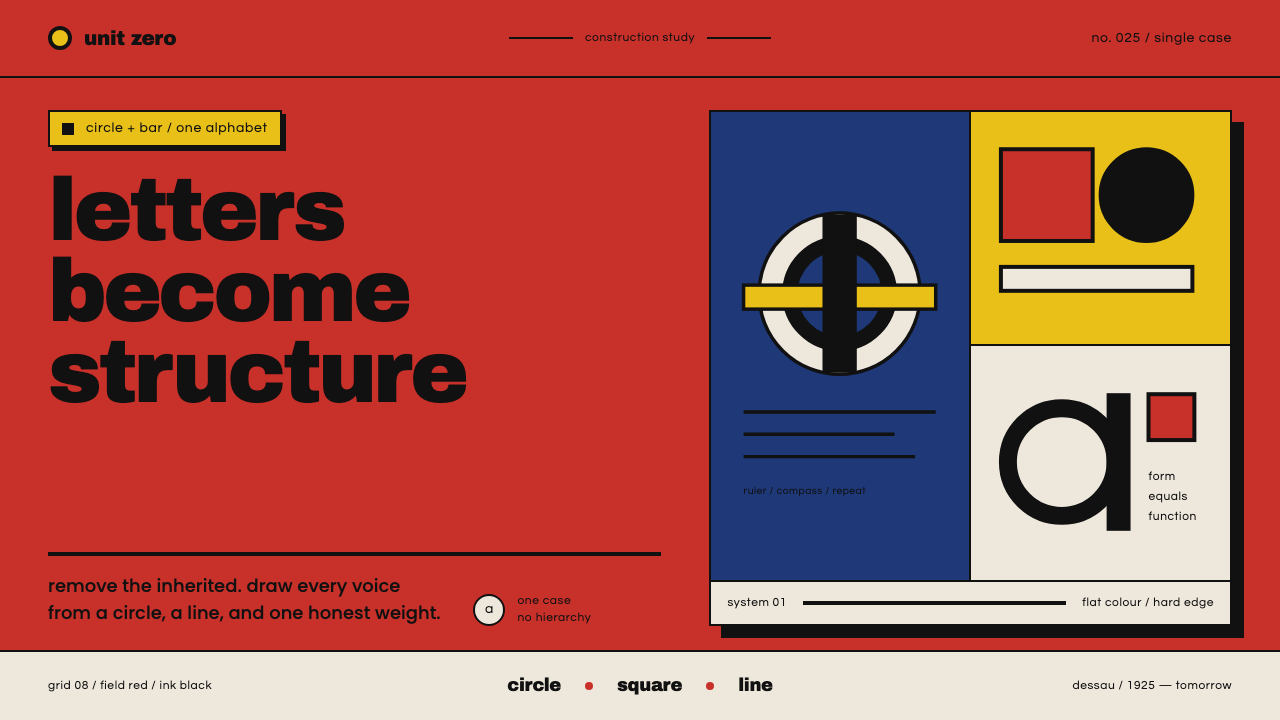 Bayer Universal BauhausLetters become structure. Bauhaus red, primary blocks, and black circle-bar f…
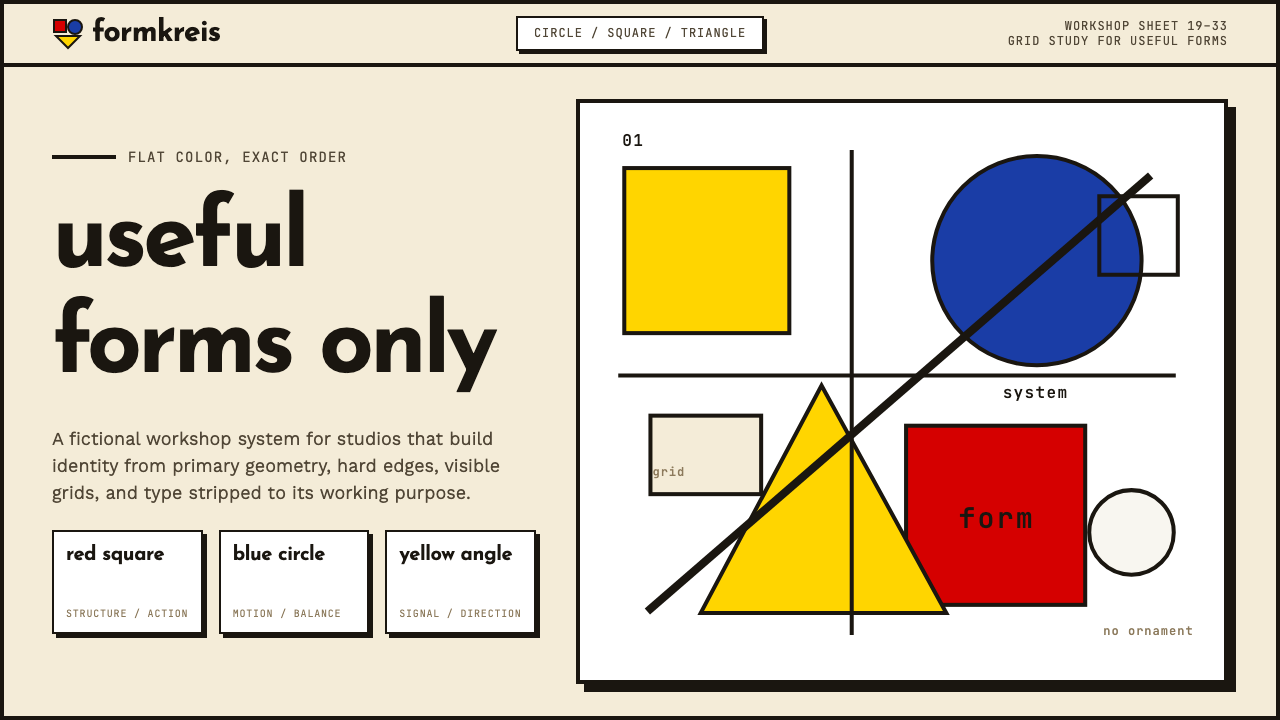 Bauhaus WeimarForm follows revolution. Primary red-blue-yellow on cream, hard shadows, no o…
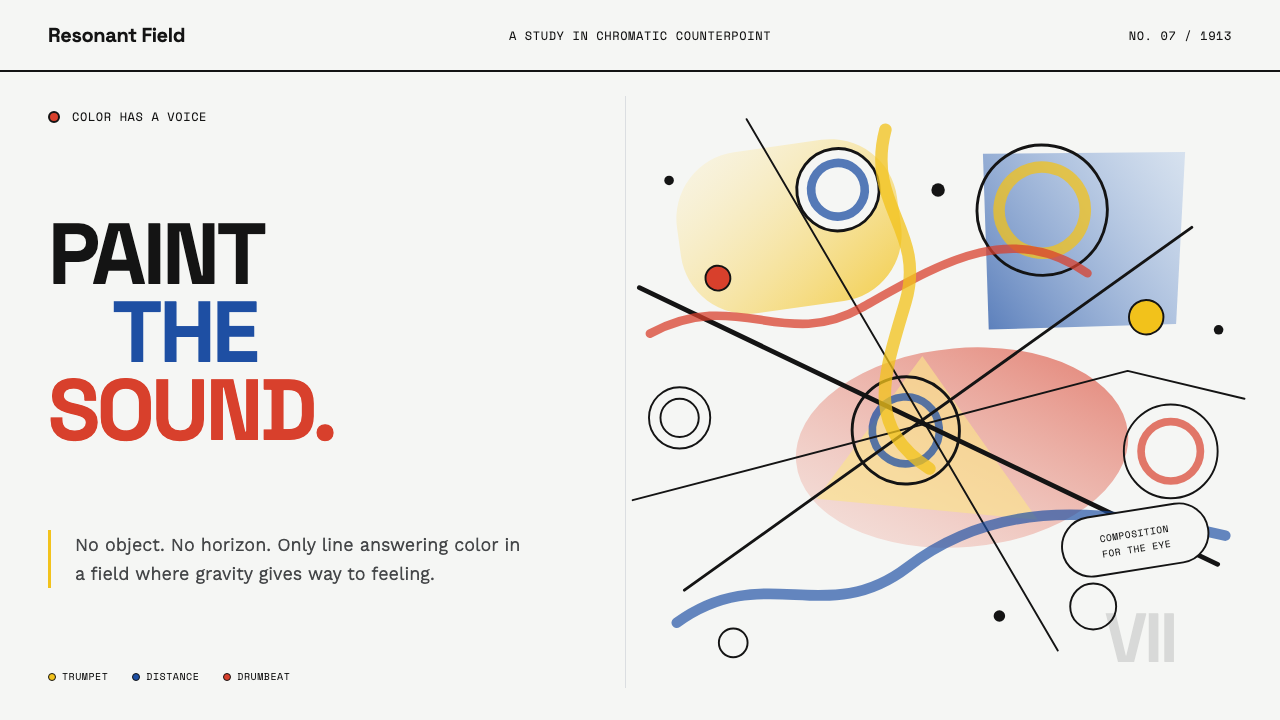 Kandinsky Composition (1913)Color becomes sound. Primary washes, hollow circles, and black diagonals coll…
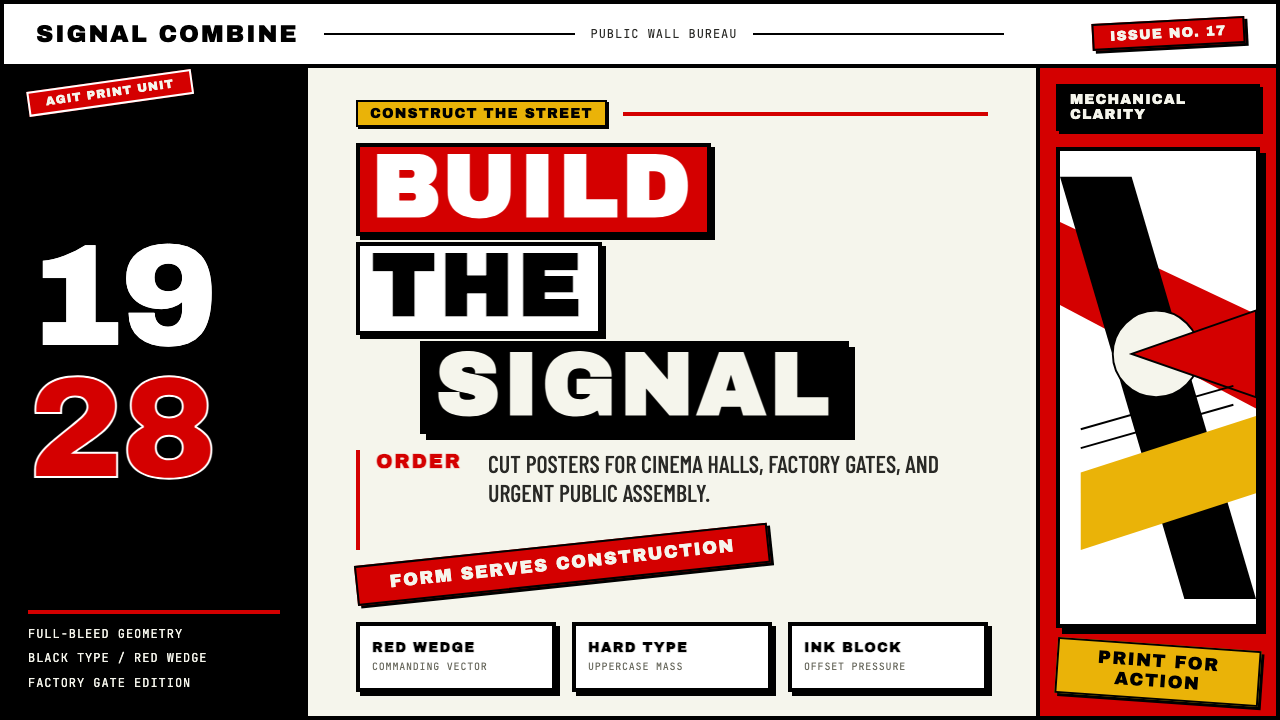 Russian ConstructivismRevolution red, slashed across black and white. Diagonal sans-serif, photomon…
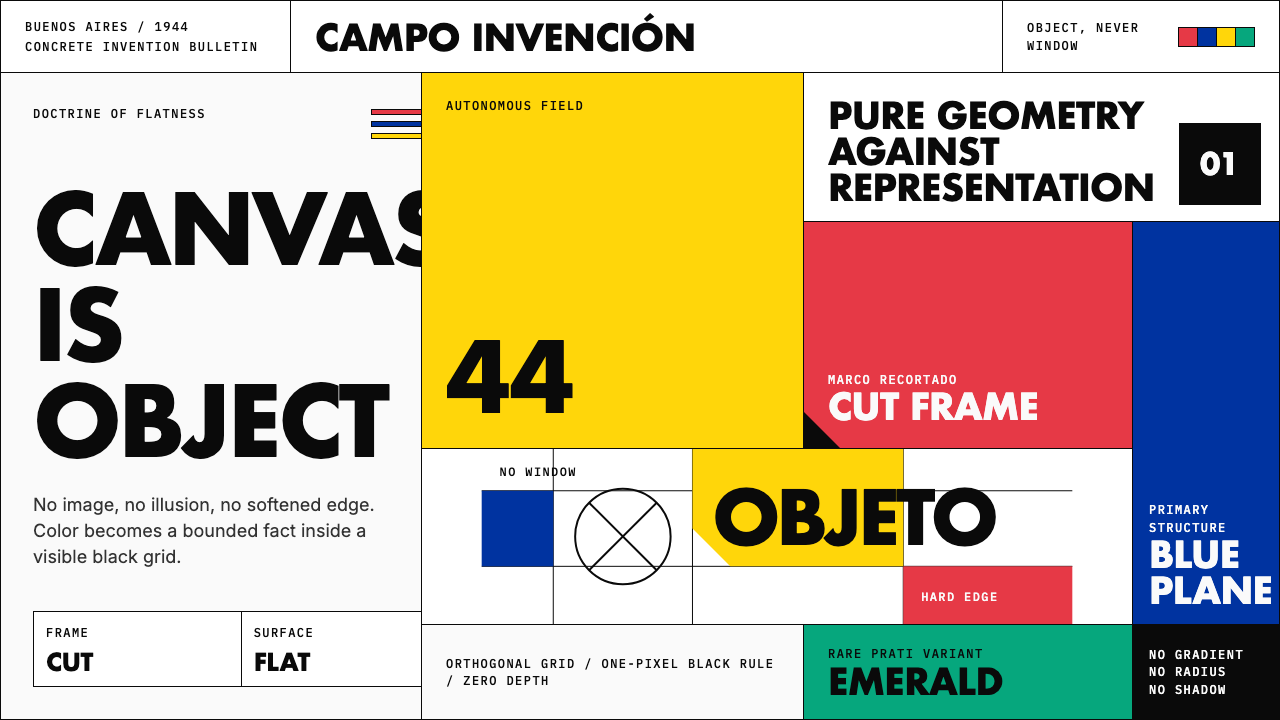 Argentine Arte ConcretoCanvas becomes object. Primary blocks, black hairlines, and a cut-frame grid…
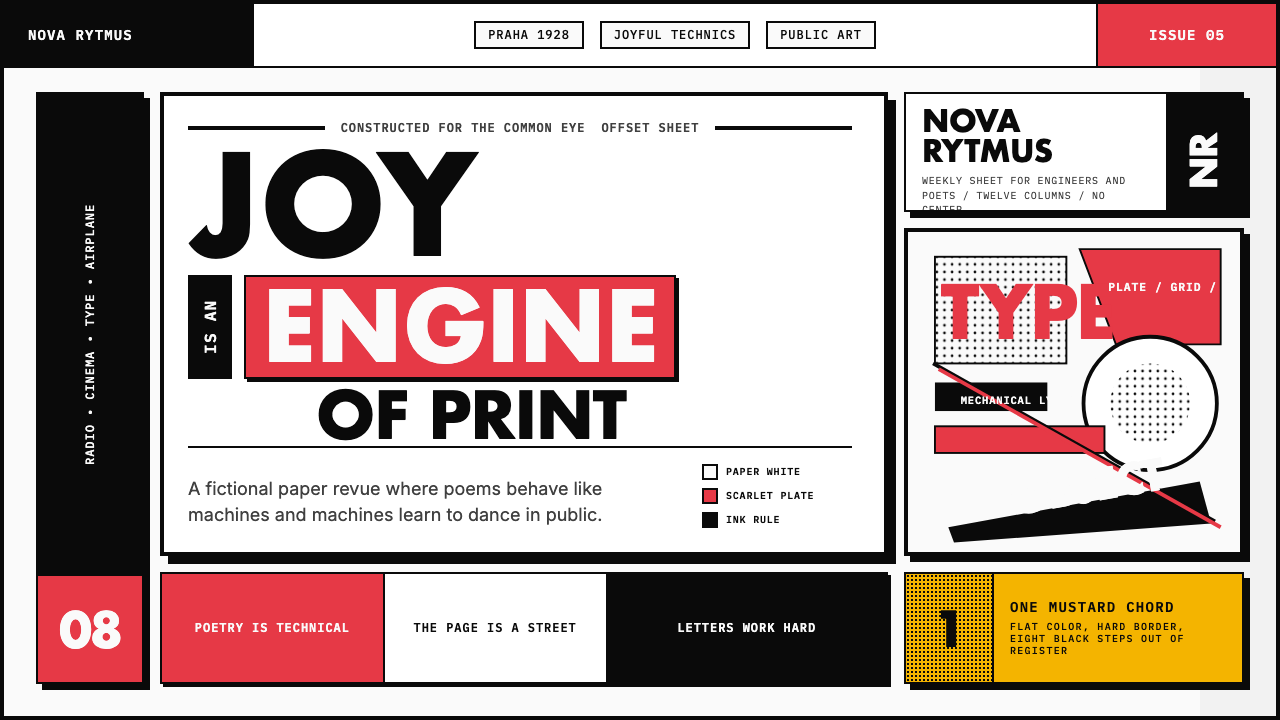 Czech Devětsil Avant-GardeJoy is engineered. Scarlet ink blocks and rotated sans type collide on an asy…