What is Argentine Arte Concreto?
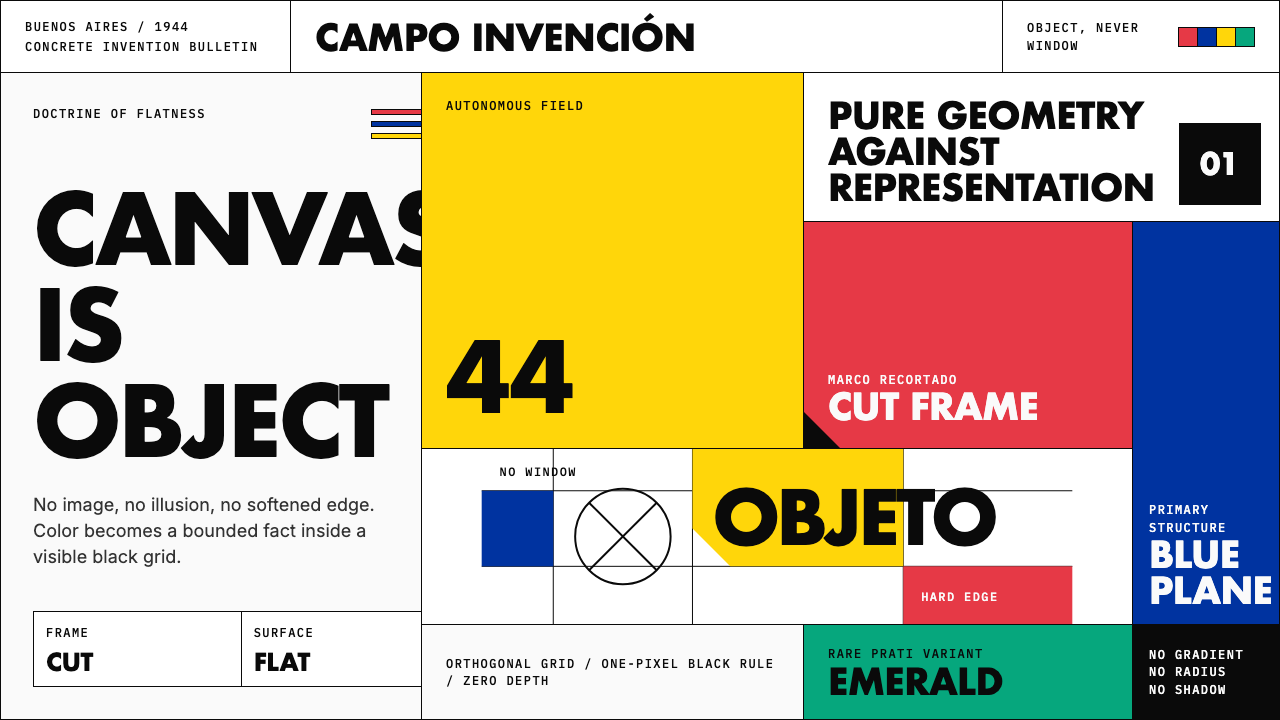
In 1944, Buenos Aires intellectuals cut the canvas into polygons and declared flatness a doctrine — primary color, hard edge, and zero representation.
Argentine Arte Concreto in brief
Argentine Arte Concreto-Invención is a mid-twentieth-century movement born in Buenos Aires that pushed geometric abstraction to its logical extreme: the picture plane is not a window into any imagined space but an autonomous physical object governed solely by its own internal logic. Color is confined to pure black, white, and the saturated primaries — red, yellow, blue — deployed as hard-edged flat zones with no gradation, no shadow, and no illusionistic depth. Composition is built from geometric forms — rectangles, triangles, diagonals — arranged with the rigorous economy of a proof.
The movement's most radical invention was the marco recortado, the cut frame: rather than accepting the rectangle as a neutral container, artists physically cropped the canvas into irregular polygons so that the support itself became part of the composition. This collapsed the distinction between the art object and its boundary. Every edge was a decision; the canvas was not a stage but the work itself.
Emerging from the same theoretical soil as De Stijl, Russian Suprematism, and Swiss Concrete Art, Arte Concreto-Invención added a distinctly Argentine urgency — the conviction that pure invention, liberated from both academic figuration and European Surrealism, was the only honest pictorial act. Its visual discipline later fed directly into postwar information design and design education through Tomás Maldonado's work at the Ulm Hochschule für Gestaltung.

Where does Argentine Arte Concreto come from?
The story begins in 1944 with a single magazine issue. *Arturo: Revista de Artes Abstractas* was conceived by a circle of Buenos Aires intellectuals — among them the poet Edgar Bayley and the painter Tomás Maldonado — as a manifesto-in-print for pure abstraction. Only one issue was ever published, but its theoretical ambition detonated a movement. The magazine declared outright war on figurative art and on the psychic symbolism of Surrealism, arguing that the painted surface must be entirely invented, not derived from observed nature or unconscious imagery.
The following year, 1945, saw the formal founding of the Asociación Arte Concreto-Invención, with Maldonado, Bayley, Lidy Prati, Alfredo Hlito, Manuel Espinosa, and others as core members. They staged group exhibitions, published theoretical texts, and developed their distinctive doctrine of pictorial invention: a painting's elements — its forms, its colors, its edges — must be conceived entirely from within the work's own logic, imported from nowhere outside it. The *marco recortado* became the movement's signature device because it made the argument physical: cut the frame, and the canvas can no longer pretend to be a neutral window.
Buenos Aires in the mid-1940s was an unusually receptive environment for this kind of radical European-inflected modernism. Argentina had remained neutral during the Second World War, and the capital was home to a substantial community of European émigré intellectuals. The group was in close correspondence with Concrete Art circles in Switzerland, particularly around Max Bill, and was conversant with the Dutch De Stijl legacy and Soviet Constructivism. But Arte Concreto-Invención was not derivative: it synthesized these sources into an original program that insisted on geometric invention as a moral and political position, not merely a formal one.
Internal tensions soon split the movement. By 1946 a splinter group led by Gyula Kosice and Rhod Rothfuss broke away to form Grupo Madí, which pushed the cut-frame and the kinetic object further into three-dimensional and participatory territory. Perceptismo, associated with Raúl Lozza, explored how color relationships and spatial illusion could be generated through pure chromatic placement. Maldonado himself gradually shifted toward design theory: in 1954 he joined the newly founded Hochschule für Gestaltung in Ulm, West Germany, eventually becoming its rector, and his influence carried the movement's geometric rigor into the global postwar design mainstream. By the late 1950s the founding moment had dispersed, but its visual logic had entered the DNA of modern information design.
What defines the Argentine Arte Concreto look?
Primary Color Doctrine
The palette is compressed to pure black, pure white, and the saturated primaries — red, yellow, and blue — with virtually no mixing, no tinting, and no tonal gradation between them. Each color arrives at full intensity and is held there: a red zone is red throughout, a white zone is unmodulated white. Lidy Prati occasionally introduced a saturated emerald green as a secondary accent, but the foundational logic remains binary — each zone is either occupied by a primary or it is neutral. Color is never used to describe light falling on a surface; it is a categorical decision, as absolute as a boolean.
Hard Edge, Zero Gradation
Every boundary between color zones is a razor-sharp edge with no blending, no antialiasing, and no softening of any kind. Where red meets white, the transition is instantaneous and total. This hardness is not merely a technical preference — it is a theoretical position. Gradation implies transition, which implies the simulation of three-dimensional space or natural light. The hard edge refuses that implication. It insists that the picture plane is a flat surface where events occur at coordinates, not in depth.
The Cut Frame (Marco Recortado)
The movement's most distinctive formal invention: the physical support — canvas or board — is cut into irregular polygons rather than kept as a rectangle. The frame is no longer a neutral container surrounding the composition; it is itself a shape, a compositional edge that participates in the geometry of the whole. In contemporary digital application, this principle translates to compositions where the bounding box of a design element is irregular, where a card or layout block terminates at a diagonal rather than a right angle, and where the crop itself carries compositional intent.
Pure Geometry, No Representation
No figurative imagery of any kind appears in canonical Arte Concreto work — no silhouettes, no abstracted natural forms, no human figures reduced to geometric approximation. The geometric elements are entirely invented: they refer to nothing outside themselves. A black diagonal is not a shadow or a horizon; a red rectangle is not a wall or a flag. This total rejection of reference distinguishes the movement from more expressive geometric abstraction and aligns it with the mathematical purity of Concrete Art as defined by Theo van Doesburg in 1930.
Modular Grid Logic
Compositions are organized around an underlying modular structure — a grid of equal units that governs the placement and proportioning of every element. Alfredo Hlito's paintings make this logic most transparent: bands of color step across the surface in measured intervals that feel arithmetically derived. The grid is not shown but its presence is legible. In design application, this translates to strict column-and-row systems where every element snaps to a common unit, and the intervals between elements are as precisely considered as the elements themselves.
Object, Not Window
The foundational philosophical distinction of the movement: the designed surface is a physical object that exists in the viewer's space, not a transparent plane opening onto an imagined scene. This changes everything about how depth cues are treated. There is no pictorial recession, no overlapping that implies one form is behind another in a simulated space. When shapes overlap in Arte Concreto work, they do so as flat zones occupying a common plane — one color atop another — not as objects occluding each other in depth.
Invention Over Expression
The Arte Concreto-Invención name encodes its method: the work is invented, not expressed. Unlike Abstract Expressionism or even some strands of European geometric abstraction, the movement explicitly rejected the artist's psychological state as a legitimate source of visual form. Composition is arrived at through reasoned construction — the application of rules, proportional relationships, and formal logic — not through gesture, intuition, or emotional impulse. This disciplined constructivism is what gives the style its cool, architectural authority even at small scales.

Who shaped Argentine Arte Concreto?
Maldonado was the intellectual engine of Arte Concreto-Invención and arguably its most consequential figure in terms of global influence. A co-editor of the *Arturo* magazine and a founding member of the Asociación, he developed the movement's theoretical framework, arguing that pure geometric invention was the only pictorial practice consistent with a rational, materialist worldview. In 1954 he joined the Hochschule für Gestaltung at Ulm in West Germany, eventually becoming its rector, where he translated the movement's geometric rigor into a systematic theory of design and visual communication that shaped postwar design education worldwide. His departure for Ulm marks the point at which Argentine Arte Concreto's influence became truly international.
Prati was one of the movement's most rigorous formal practitioners and, as Maldonado's partner, a central presence in its social and intellectual life. Her paintings are among the most resolved in the canon: composed of interlocking geometric zones in the primary palette with occasional saturated green, they demonstrate extraordinary control of chromatic tension and compositional balance. Where many of her contemporaries treated the cut frame as a radical gesture, Prati used it with architectural precision, ensuring that the irregular support and the internal geometry were logically continuous. Her work was long underrecognized relative to its quality and influence.
Hlito's contribution was a particular refinement of the movement's modular grid logic. His canvases — typically rectangular, without the cut frame — organize color bands in precisely measured horizontal and vertical sequences that recall musical notation or typographic leading. His work demonstrates that Arte Concreto's principles could generate visual richness through interval and proportion alone, without relying on the dramatic gesture of the shaped support. Later in his career, Hlito moved toward a slightly more lyrical use of color while retaining the movement's structural discipline, producing a body of work that bridges the founding moment and the broader Latin American geometric tradition.
Bayley was the poet of the founding circle — a writer and theorist whose essays gave the movement much of its philosophical scaffolding. He co-edited *Arturo* and contributed theoretical texts that articulated why the rejection of representation was not a retreat into formalism but an affirmative ethical position: to invent form rather than copy appearances was to affirm human creative autonomy. His influence was more textual than visual, but the movement's theoretical sophistication — which distinguished it from being merely a style — owes much to his contribution. His ideas about invention as a fundamental human act prefigure later debates in design theory about authorship and construction.
Espinosa was among the most technically adventurous of the founding group, exploring how geometric forms could be made to activate the entire picture surface rather than sitting within it as figure against ground. His paintings often work through diagonal and rhomboid geometries that create the sensation of a field in motion without any element actually moving — the flatness is kinetic rather than static. He remained active in Argentine geometric abstraction for decades after the movement's initial period, becoming a bridge figure between the founding generation and younger artists working in the geometric tradition through the 1970s and beyond.
How do you use Argentine Arte Concreto today?
Argentine Arte Concreto-Invención is a highly transferable design system precisely because its principles are structural rather than decorative. Applying it correctly means understanding what the visual grammar is actually doing: primary color zones assign categorical meaning, hard edges create unambiguous boundaries, modular grid logic ensures that proportions feel reasoned rather than arbitrary, and the absence of gradation or shadow insists on the flatness of the designed surface. Borrowing only the color palette without understanding these structural commitments produces work that looks derivative rather than principled.
For presentation slides, the style functions with particular force on both cover and content layouts. A cover page benefits from the bold asymmetric composition: one primary-color geometric zone occupying a significant portion of the frame, a black or white ground, and a title in a clean geometric sans-serif at high contrast. The cut-frame principle translates digitally as diagonal crops or angled layout blocks that give the composition an edge that participates in the design rather than containing it. Content slides should be built on a strict grid: one organizing axis, two or three text hierarchies defined purely by scale, no decorative dividers or rules beyond what the grid itself requires. Data visualizations — bar charts, area charts, pie charts — become geometric objects in their own right when colored with the primary palette and rendered without gradients or drop shadows.
For web interfaces, the style is well suited to dashboards, pricing pages, and analytical tools where categorical clarity and information hierarchy are the dominant requirements. The approach: establish a strict multi-column grid, use a near-white or pure white ground, deploy black for all body text and structural elements, and reserve the primaries for interactive states, tier differentiation, or status indicators. Card components work well with flat color fills and sharp borders rather than soft shadows; the hard edge of a card becomes a compositional element rather than a container. Navigation should be typographic — wordmarks and labels in a single geometric sans-serif — with the primary palette used only for active or highlighted states.
For editorial and marketing applications, the style supports bold information hierarchy with the poster-like conviction of its origins. An editorial layout in this system uses a narrow text measure with a wide margin reserved for call-outs or metadata, section breaks marked by a bold geometric rule rather than decorative ornament, and image handling that privileges hard crops and flat silhouettes over naturalistic full-bleed photography. Marketing pages work well with full-width feature blocks alternating between contrasting grounds — white zone then primary-color zone — with calls to action rendered in the opposing primary. The rule of the single accent primary should govern the entire page: choose one primary as the active color and treat the others as structural or neutral.
A common mistake when working in this style is treating the three-primary palette as permission to use all three simultaneously at full saturation across a composition. Authentic Arte Concreto work almost never does this: typically one primary dominates, a second appears as a subordinate accent, and the third is either absent or used only as a structural note. Similarly, adding gradient fills, soft drop shadows, or rounded corners to elements that should be geometrically absolute destroys the style's defining tension between flatness and color intensity. The discipline of the style is in the refusals — no gradation, no softening, no representation — and half-measures undermine the whole system.

Argentine Arte Concreto — FAQ
How does Arte Concreto-Invención differ from Mondrian and De Stijl?
The family resemblance is real — both share primary colors, hard edges, and the rejection of representation — but the Argentine movement departs from De Stijl in two important ways. First, De Stijl retained the rectangular canvas as an absolute constraint and treated the orthogonal grid as a near-universal structural principle; Arte Concreto-Invención literally cut the frame, making the support itself an irregular geometric object and extending the composition's logic to its own boundary. Second, where Mondrian's grid carries a quasi-mystical or utopian charge — he believed geometric harmony could embody universal spiritual truths — the Argentine artists were explicitly anti-metaphysical, grounding their practice in materialist rationalism and the politics of pure invention. The Argentine work is cooler, more argumentative, less transcendent.
Can the cut-frame principle be applied in digital design?
Yes, and with considerable expressive power. In digital contexts, the cut-frame principle manifests as compositions where layout elements — cards, image containers, section dividers — have irregular or diagonal boundaries rather than universal right angles. A hero section that terminates at a diagonal instead of a horizontal line, a pricing card whose top edge is angled, or a data panel clipped to a parallelogram all invoke the logic of the marco recortado. The key is that the irregular edge must feel logically continuous with the internal composition, not arbitrary: the angle of the cut should relate to angles within the content, so that the boundary participates in the geometry rather than interrupting it.
Is this style appropriate for color-meaning-sensitive contexts like healthcare or finance?
With care, yes. The primary palette of Arte Concreto — especially the combination of red and blue — does overlap with culturally loaded color meanings in finance (red for loss, blue for institutional trust) and healthcare (red for emergency, blue for clinical calm). When applying the style in these contexts, the safest approach is to designate one primary as structurally neutral — using it for decorative or compositional zones that carry no data meaning — and reserve the others for categorical functions that align with their cultural associations. Yellow, which carries fewer loaded meanings in finance and healthcare than red or blue, often works well as the dominant compositional primary, with red and blue reserved for specific states or categories. The style's hard-edge clarity is actually an asset in both domains — the lack of ambiguity in color zone boundaries maps well onto the categorical precision these fields require.
How strictly should the no-gradation rule be followed in modern digital products?
In its fullest expression, the no-gradation rule is absolute — flat zones of pure color, no transitions, no ambient light effects. In practice, some contemporary adaptations introduce very subtle tonal variation within color zones for accessibility reasons — ensuring sufficient contrast ratios for users with visual impairments — while preserving the hard-edge boundary logic everywhere. What should never be compromised is the boundary itself: a gradient that fades from a primary to neutral across a zone boundary dissolves the style's defining tension entirely. Similarly, background gradients used for visual richness — common in contemporary design — are incompatible with the system's logic. The rule to follow is: gradients that serve a structural or accessibility function can be evaluated case by case; gradients used purely for visual softening should be eliminated.
Does the movement have a relationship to Constructivism and Suprematism, and does that matter for applying the style?
The relationship is direct and acknowledged. The Arte Concreto-Invención founders were deeply conversant with Malevich's Suprematism — particularly its insistence that pure geometric form was independent of any narrative or natural referent — and with El Lissitzky and Soviet Constructivism's fusion of geometric rigor with utilitarian purpose. Where Suprematism tended toward a kind of cosmic spiritualism and Constructivism toward political function, Arte Concreto-Invención stripped both of their non-pictorial allegiances and committed purely to the logic of the invented form. For practical application, this genealogy matters because it explains the style's unusually strong alignment with information design: the Constructivist idea that geometric form can carry semantic content without representation is precisely what makes the style well-suited to data visualization, taxonomic UI, and systems thinking more broadly. Understanding this context helps designers use the style as a logical system rather than a surface treatment.
Related design styles
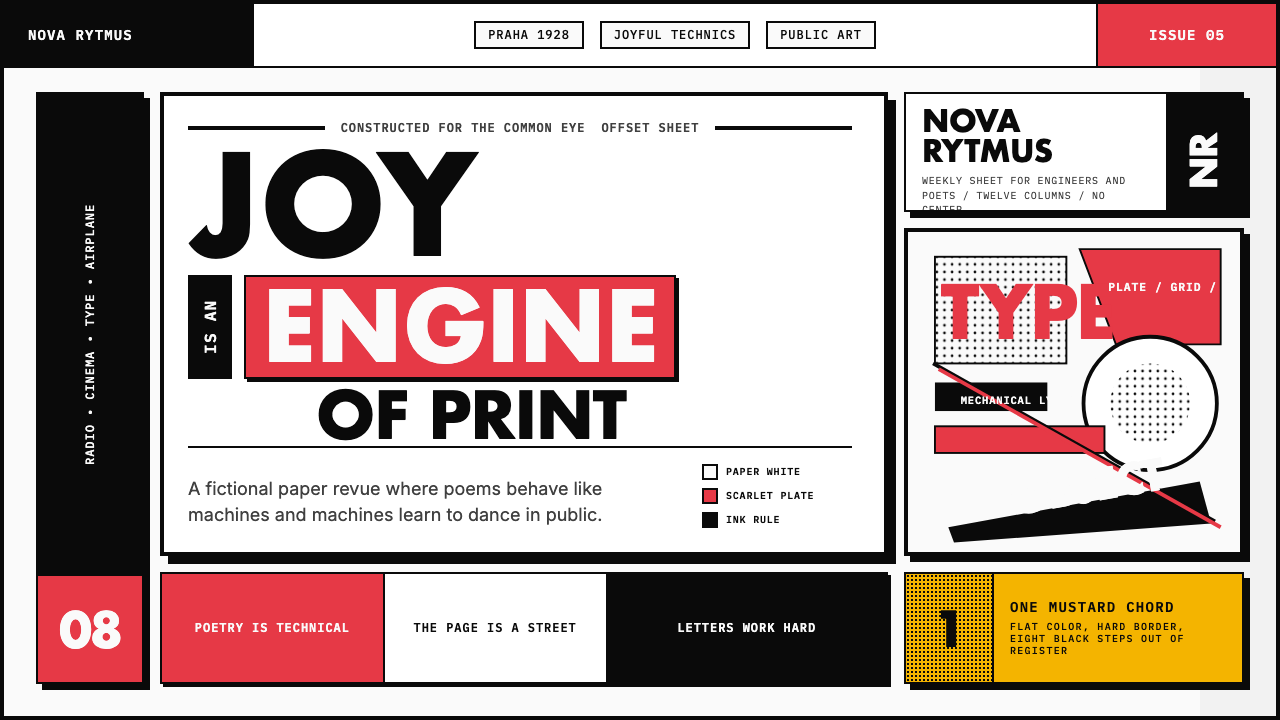 Czech Devětsil Avant-GardeJoy is engineered. Scarlet ink blocks and rotated sans type collide on an asy…
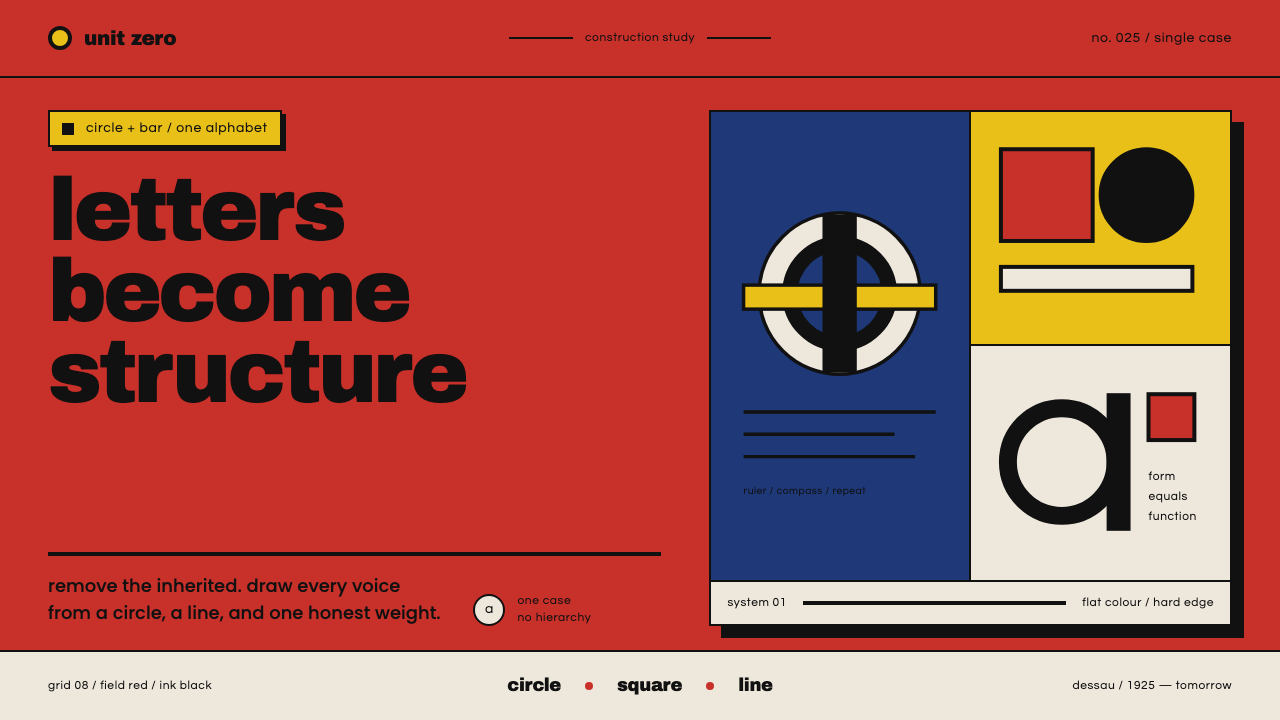 Bayer Universal BauhausLetters become structure. Bauhaus red, primary blocks, and black circle-bar f…
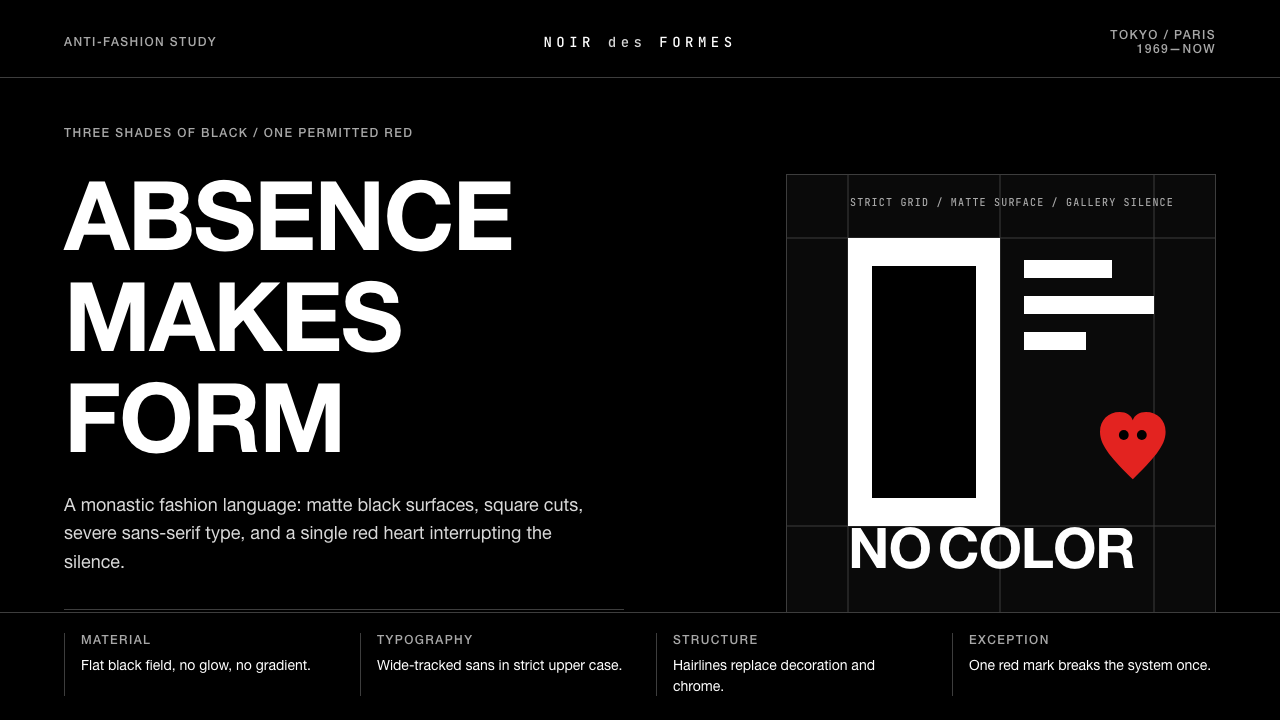 Comme des Garçons (Rei Kawakubo)Austerity becomes the event. Pure black, wide sans type, and one red heart br…
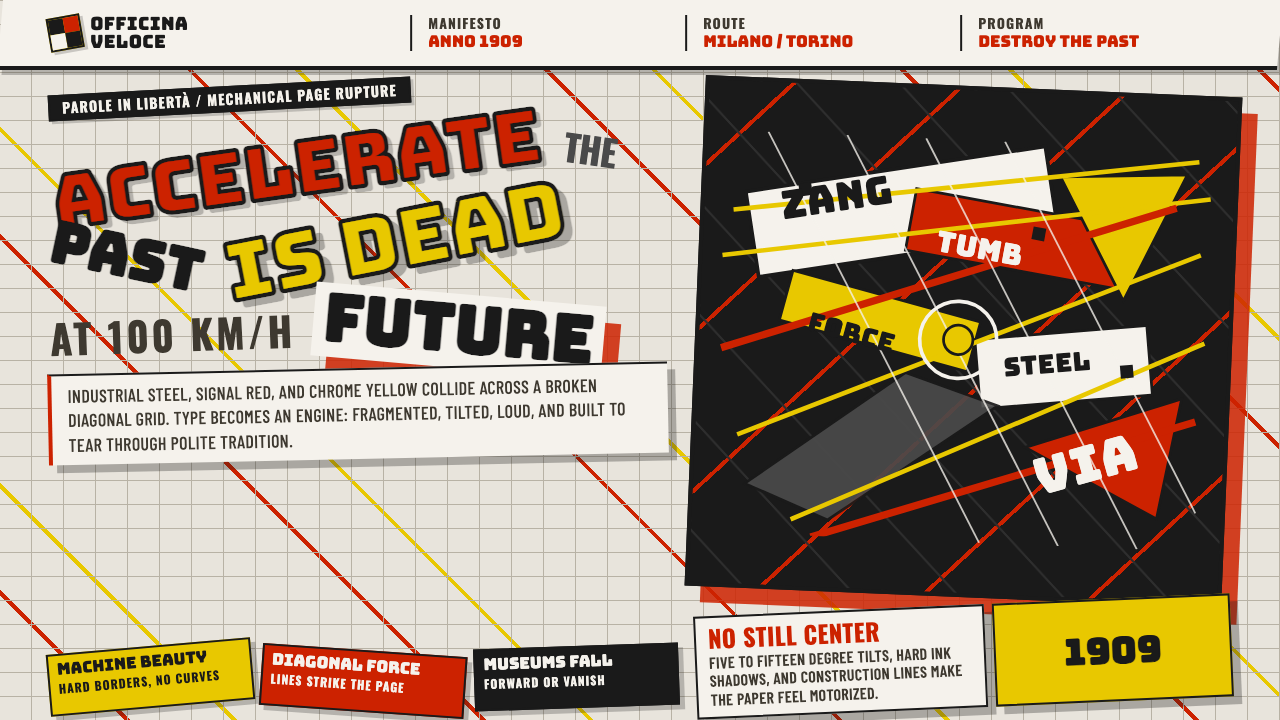 Italian Futurism (Marinetti 1909)Speed murders tradition. Signal red and chrome yellow slash a broken diagonal…
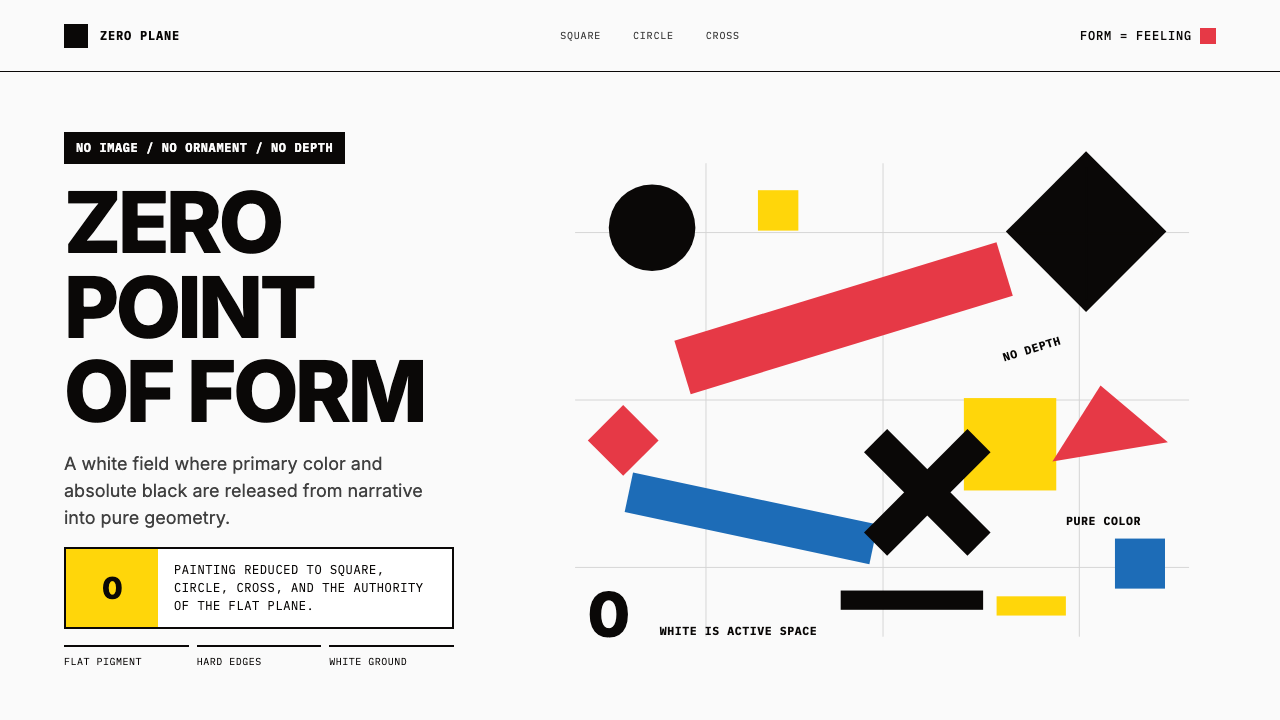 Malevich SuprematismGeometry declares zero. Red, yellow, blue and black blocks float on active wh…
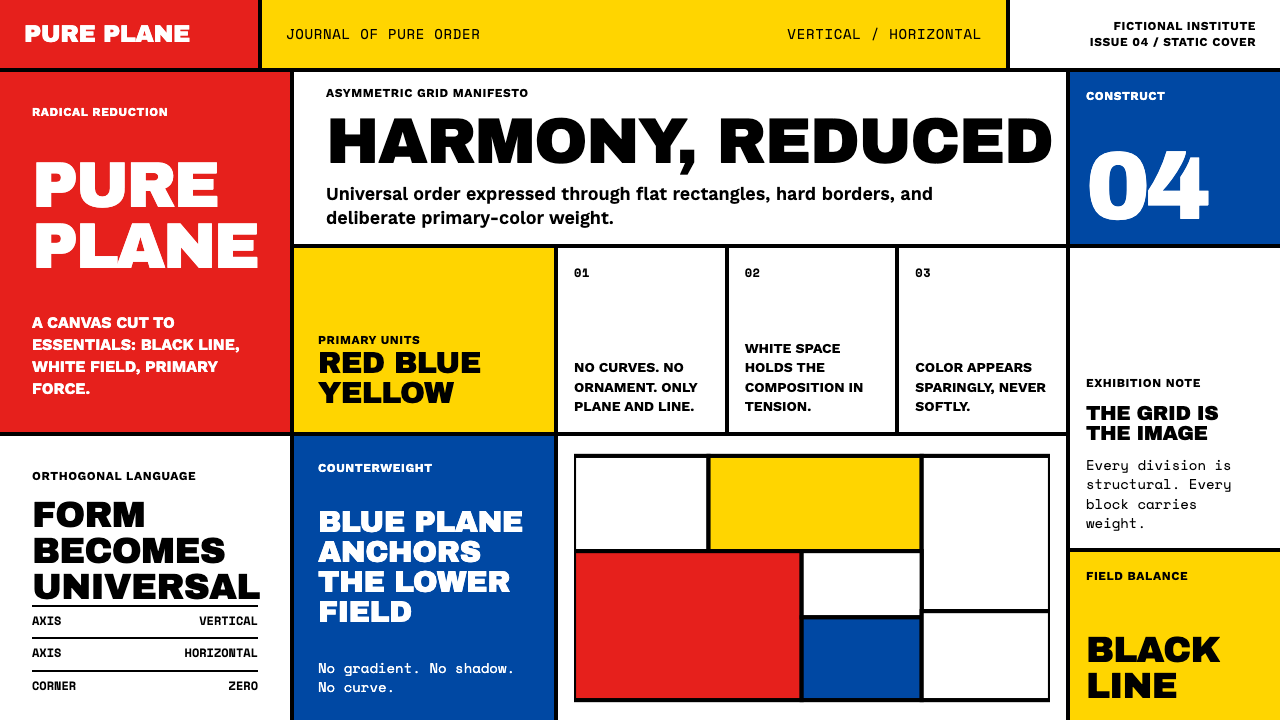 De StijlPrimary colors, locked in a black grid. Mondrian's compositions, in thick bor…