What is Mark Rothko Color Field (1950)?
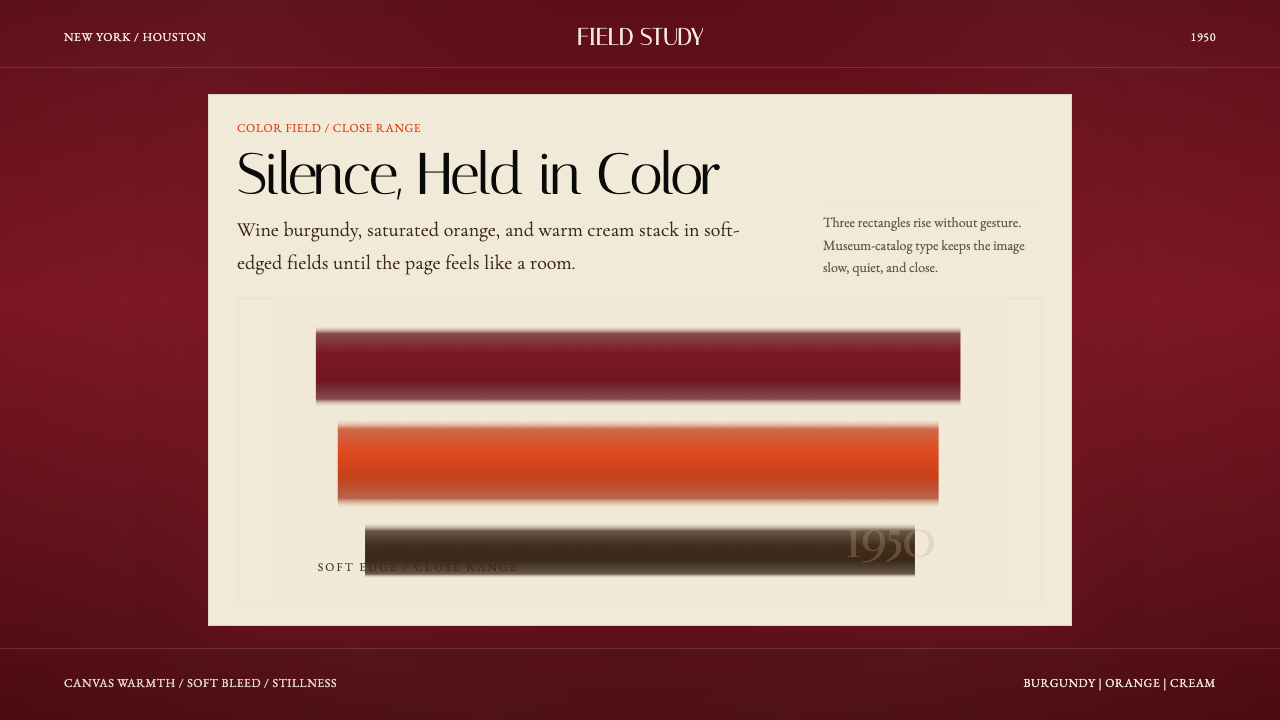
Rothko stripped painting to pure feeling — two or three soft-edged rectangles of saturated pigment that swallow the viewer whole.
Mark Rothko Color Field (1950) in brief
Mark Rothko's color-field paintings, produced in their definitive form from the late 1940s onward, reduce the painted surface to its most elemental condition: two or three large rectangles of deep, saturated pigment stacked vertically, their edges blurred and breathing against one another rather than cleanly cut. From a distance, the compositions read as simple bands of color. Approached closely — as Rothko always insisted they should be — they become immersive environments, expanding beyond their physical boundaries to fill the entire visual field.
The design language derived from this tradition carries that same quality of environmental immersion. Wine burgundy, saturated orange, and warm cream are not used as accent colors or decorative highlights; they flood the page or screen as primary grounds. Classical serif typography, recalling the measured authority of museum catalogs, provides the only structural counterpoint to the expansive color fields. Nothing else competes. No ornamental detail, no illustrative element, no busy pattern asserts itself against the color's dominance.
What distinguishes this approach from surface minimalism is its emotional register. The palette is deliberately weighted toward the mineral and organic — pigments that carry a sense of physical depth and temperature rather than digital brightness. Every surface feels as though it has been painted rather than filled. Edges bleed into one another with soft gradation. The result is contemplative and unapologetically slow: a design vocabulary for communication that asks its audience to pause rather than scan.

Where does Mark Rothko Color Field (1950) come from?
Mark Rothko was born Marcus Rothkowitz in 1903 in Dvinsk, in the Russian Empire, and emigrated with his family to Portland, Oregon, in 1913. He studied briefly at Yale before leaving for New York, where he would spend most of his career. His early work drew on Surrealism and mythology — dense, biomorphic forms derived from Nietzsche, ancient ritual, and the unconscious — but by the mid-1940s he had grown dissatisfied with imagery that still carried representational residue. He wanted painting to speak directly to primal emotion without the mediation of recognizable form.
The breakthrough came between 1947 and 1950, when Rothko moved through a transitional style he called 'multiforms' — loosely organized clouds of color without defined edges — toward the rectangular format that would define the rest of his career. These mature paintings dispensed entirely with figure and ground. Instead, two or three soft-edged rectangles of saturated color occupied the canvas in vertical sequence, each pigment layer built up through multiple thin washes that gave the surface a luminous, atmospheric depth. Critics at the time struggled to locate these works within existing categories; Rothko himself resisted labels, famously stating that he was interested in expressing basic human emotions — tragedy, ecstasy, doom — and that if viewers were moved to tears in front of his paintings, they were having the same religious experience he had while painting them.
The critical and institutional framework around Rothko's mature work was shaped significantly by the critic Clement Greenberg, who championed Abstract Expressionism as the authentic successor to European modernism and positioned color-field painting — alongside the gestural work of Jackson Pollock — as the vanguard of postwar American art. Greenberg's formalist reading emphasized the paintings' literal flatness, their refusal of illusionistic depth, and their assertion of the canvas as a physical object rather than a representational window. This interpretation gave the work institutional legitimacy even as it arguably missed the psychological and spiritual dimensions Rothko cared about most.
The most concentrated encounter with Rothko's vision is the Rothko Chapel in Houston, Texas — fourteen large-scale paintings installed in an octagonal, non-denominational meditation space commissioned by collectors John and Dominique de Menil and inaugurated in 1971, one year after Rothko's death. The chapel paintings are among Rothko's darkest: near-black burgundy and plum tones that seem to absorb rather than emit light, pushing the viewer toward an experience of pure sensation stripped of pleasure. The chapel became an influential model for contemplative public space and confirmed that Rothko's system — large color fields in enclosed environments — was capable of producing a sustained, near-architectural experience distinct from anything oil painting had previously achieved.
What defines the Mark Rothko Color Field (1950) look?
Color as Ground
In Rothko-derived design, color does not accent or highlight — it constitutes the entire surface. Deep wine burgundy, a saturated warm orange, and a soft cream or off-white are used as full-field grounds that flood the page or screen from edge to edge. These are not neutral backgrounds waiting to support other elements; they are the primary visual fact, and everything else exists within them. The palette carries a mineral, pigment-like weight: these are colors with physical depth, not the electric brightness of screen primaries.
Soft Edges and Bleed
The defining formal characteristic of Rothko's mature paintings — and of design that draws from them — is the deliberately softened boundary between adjacent color areas. Where most design systems use hard edges to separate zones, the Rothko approach allows adjacent fields to bleed into one another with a gradual softening. This is not imprecision; it is a considered decision that makes color areas feel atmospheric and breathing rather than cut out. The boundaries between zones become the most charged passages in the composition.
Saturated Depth
Rothko achieved his characteristic surface luminosity by building up color through many thin, semi-transparent washes of paint rather than applying a single opaque layer. The depth visible in his canvases is not an illusion of three-dimensional space — it is the literal depth of accumulated pigment layers. In digital or print contexts, this quality translates to a preference for colors of high saturation and warm undertone, used at scales large enough that the color can be fully perceived rather than merely registered.
Classical Serif Typography
Rothko's paintings were framed institutionally by museum catalogs, critical essays, and gallery wall text — almost invariably set in classical, high-contrast serif typefaces with generous leading and restrained letterspacing. Design that references this tradition adopts the same typographic register: serif letterforms with visible stroke contrast, set at a scale and weight that feels considered and unhurried. Type does not compete with the color fields; it occupies them with quiet authority.
Monumental Scale
Rothko consistently worked at large scale because scale is inseparable from the experience he was after: the color must fill peripheral vision to produce the sense of being inside rather than looking at the painting. Design translations of this principle avoid the tendency to subdivide the surface into many small elements. Large, uninterrupted color areas dominate. When compositional zones are defined, they are defined at a scale that feels generous and expansive rather than segmented.
Contemplative Pacing
The experience of standing before a Rothko painting is deliberately slow. There is nothing to decode, no narrative to follow, no detail to discover — only the sustained encounter with color. Design that draws from this quality structures its hierarchy to reward the viewer who lingers rather than the viewer who scans. Generous whitespace and deep color fields create pauses between information. The pace of reading slows because the visual field encourages looking before processing.
Absence of Decoration
Rothko removed from his paintings everything that was not color and edge: no line, no texture, no figure, no gesture visible as gesture. The design equivalent is a similar severity of reduction. No decorative borders, no illustrative elements, no gradient effects used for visual richness, no ambient shadows softening transitions. What is not directly functional or communicative is absent. This is not minimalism as trend — it is a principled commitment to letting color carry the full communicative weight without assistance.

Who shaped Mark Rothko Color Field (1950)?
Rothko (1903–1970) developed the rectangular color-field format that defines this aesthetic between 1947 and 1950, after passing through Surrealist and mythological phases that he ultimately found too mediated. His insistence that viewers stand close — he specified distances — and that his paintings be hung low enough to occupy the viewer's full visual field reveals a designer's attention to the conditions of reception. He refused to explain his paintings through iconography or allegory, maintaining that they addressed emotion directly. His late work for the Rothko Chapel in Houston, completed just before his death, pushed the color field toward its darkest and most absorbing extreme.
Greenberg (1909–1994) was the most influential American art critic of the postwar period and the primary theoretical architect of Abstract Expressionism's institutional legitimacy. His formalist framework — which valued painting's acknowledgment of its own flatness over illusionistic representation — positioned color-field painters including Rothko, Barnett Newman, and Helen Frankenthaler as the authentic vanguard of modernist painting. His advocacy shaped how these works entered museum collections, how they were written about, and ultimately how subsequent designers and art directors came to understand the color-field tradition as a serious and codified visual language.
Dominique de Menil (1908–1997) was the French-American collector and patron who, together with her husband John de Menil, commissioned the Rothko Chapel in Houston. Her decision to ask Rothko to create an entire environment rather than individual paintings — and to situate that environment within a non-denominational sacred space — gave Rothko's late color-field work its most ambitious and complete architectural realization. The Menil Collection she subsequently founded became one of the world's most respected private museums, and the chapel remains the most visited site specifically dedicated to experiencing color-field painting as an immersive, contemplative environment.
Newman (1905–1970) was Rothko's peer in the New York School and developed a parallel approach to color-field painting through his signature 'zip' paintings — large canvases of uniform color bisected by one or more thin vertical bands. Where Rothko's color areas breathe and bleed into one another, Newman's are hard-edged and absolute, creating a more confrontational, less atmospheric variant of the color-field sensibility. Their careers were intertwined through the same critical advocates and institutional supporters, and together they defined the poles of the mature color-field tradition: Rothko's immersive softness against Newman's structural severity.
How do you use Mark Rothko Color Field (1950) today?
Rothko Color Field is among the most distinctive historical styles available to contemporary designers, and its correct application requires respecting the conditions that made the original paintings powerful: immense scale, saturated depth, and the near-total suppression of competing visual information. Translating this into interface or print work means committing fully to the palette as ground — not treating it as background decoration while layering conventional design elements on top.
For presentation slides, the style works with particular authority on cover and section-divider pages. A cover designed in this tradition gives the full slide surface over to a single deep color field — burgundy, warm orange, or cream — with the title set in a classical serif at a generous scale, sitting low in the composition as Rothko's rectangles typically sat below center. Content slides should preserve the palette's contemplative quality through restraint: limited text per slide, large type, and substantial empty space treated as color rather than as absence. Data visualization in this style works best when charts are treated as geometric forms in their own right — bars and areas filled with palette colors at full saturation, no grid lines, generous padding that lets each element occupy its own territory.
For web and digital interfaces, the style is well suited to contexts where gravitas, cultural authority, and emotional depth are valued over information density. Museum microsites, cultural institution landing pages, luxury brand experiences, and premium editorial platforms all benefit from the style's immersive quality. The approach: designate large sections of the page to a single palette color as full-width background, use the classical serif for headings and display text, and allow content to be sparser and more widely spaced than convention suggests. Dashboard and data-product applications can use the palette for section headers, sidebar backgrounds, or hero zones while maintaining conventional density in data tables and charts.
For editorial and marketing applications, the style supports powerful hierarchy through color-field blocking rather than through typographic complexity. A marketing page can alternate full-width sections between the palette's three primary grounds — burgundy, orange, cream — each carrying a single headline and a brief text passage. The transitions between sections become the visual events, echoing the soft edges between Rothko's painted rectangles. Print editorial work benefits similarly: a feature opener that gives an entire spread to a single color field with one line of classical serif type set across it creates a pacing pause that orients the reader before the main text begins.
The most common mistake when applying this style is underdoing the color — using the palette at reduced saturation or small scale, then compensating with conventional design elements that undermine the style's core logic. Rothko's canvases worked because the color had nowhere to escape; it was total. A burgundy sidebar on a white page is not Rothko Color Field. A second frequent error is mixing the saturated palette with contemporary sans-serif typography, which breaks the period register and produces a hybrid that carries neither the warmth of the historical reference nor the clarity of a modern system. The classical serif is not decorative here — it is structural to the aesthetic.
A third error worth noting is treating the soft-edge effect as a technical effect to be applied uniformly, rather than as a considered choice about where color areas should meet. Blurred edges everywhere produce visual noise; the effect is most powerful when reserved for the transitions between major color zones and suppressed within those zones, where the color should feel flat, deep, and settled.

Mark Rothko Color Field (1950) — FAQ
Does this style require literal soft-glow or blur effects to be authentic?
Not necessarily. The soft edges in Rothko's paintings result from his painting technique — thin, layered washes that diffuse the boundary between adjacent color zones. In digital work, that quality can be achieved through actual blurred transitions, but it can also be suggested through careful color adjacency: placing warm tones next to warm tones so that the boundary is felt as gentle rather than harsh, even when it is technically hard. What matters is that the color areas feel settled and absorbed rather than placed and bounded. A design that achieves that quality through thoughtful palette pairing and generous scale is more authentically Rothko in spirit than one that simply applies a blur filter to every color boundary.
Can this style work in a dark mode or light mode interface?
The palette as historically sourced is warm-ground: the canonical Rothko Color Field draws on burgundy, orange, and cream, which means the 'light mode' is actually a warm cream rather than a neutral white, and the 'dark mode' is a deep wine red or near-black burgundy rather than a conventional dark gray. Both work, but they produce very different registers. The cream and orange palette is expansive and warm — receptive. The deep burgundy and plum palette, as seen in the Rothko Chapel paintings, is more absorbing and severe. For digital products, the decision between the two should track the emotional register desired: the warm-light version for openness and cultural warmth, the deep-dark version for gravitas, luxury, or contemplative depth.
How does this style differ from other color-field or minimalist aesthetics like Swiss Style or contemporary flat design?
Swiss International Style and contemporary flat design both reduce visual complexity, but their underlying logic is organizational rather than emotional. Swiss Style uses grid rigor and typographic precision to create clarity; flat design uses simplified illustration and bold primary colors to achieve approachability and speed. Rothko Color Field, by contrast, is not primarily interested in clarity or speed — it is interested in saturation, depth, and duration. The palette is warmer and more specific than Swiss primaries; the typography is classical and serif rather than geometric and sans-serif; the spatial logic is immersive rather than informational. Where Swiss Style and flat design direct the eye, Rothko Color Field absorbs it.
Is this style appropriate for brands that need to communicate warmth and human connection?
The style carries warmth in its palette — wine burgundy and orange are among the warmest tones in painting's historical vocabulary — but it is a particular kind of warmth: dignified, contemplative, and somewhat austere. It suits brands that want to project cultural depth, seriousness of purpose, and refined taste rather than casual friendliness or playful energy. A museum, a publisher of serious nonfiction, a high-end hospitality brand, or a financial institution positioning itself as an enduring institution rather than a nimble startup would all benefit from this register. Brands that need to communicate lightness, humor, accessibility, or youth should look elsewhere — the style's deliberate slowness and saturated gravity do not accommodate those values.
How many colors from the palette should be used simultaneously in a single composition?
Rothko himself typically used two or three colors per canvas, and the relational tension between them — the way a warm orange sitting above a deep burgundy changes both colors — was the core content of the work. Design compositions should follow the same discipline: two or three palette colors per layout, used in large fields, with one dominating and the others in secondary roles. Using all three palette colors at equal proportion eliminates the hierarchy that makes the system readable. The most effective single-surface compositions — a slide, a landing page section, a poster — will designate one color as ground, a second as a large secondary zone, and treat the third sparingly if at all.
Related design styles
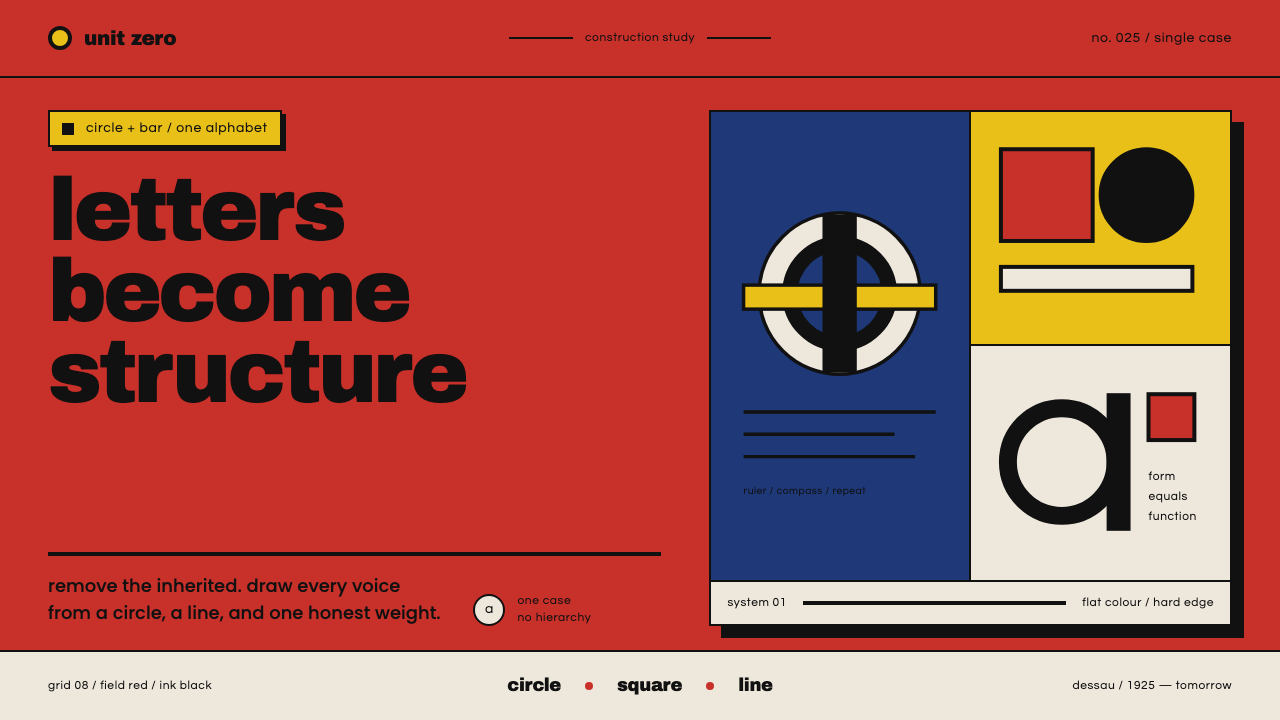 Bayer Universal BauhausLetters become structure. Bauhaus red, primary blocks, and black circle-bar f…
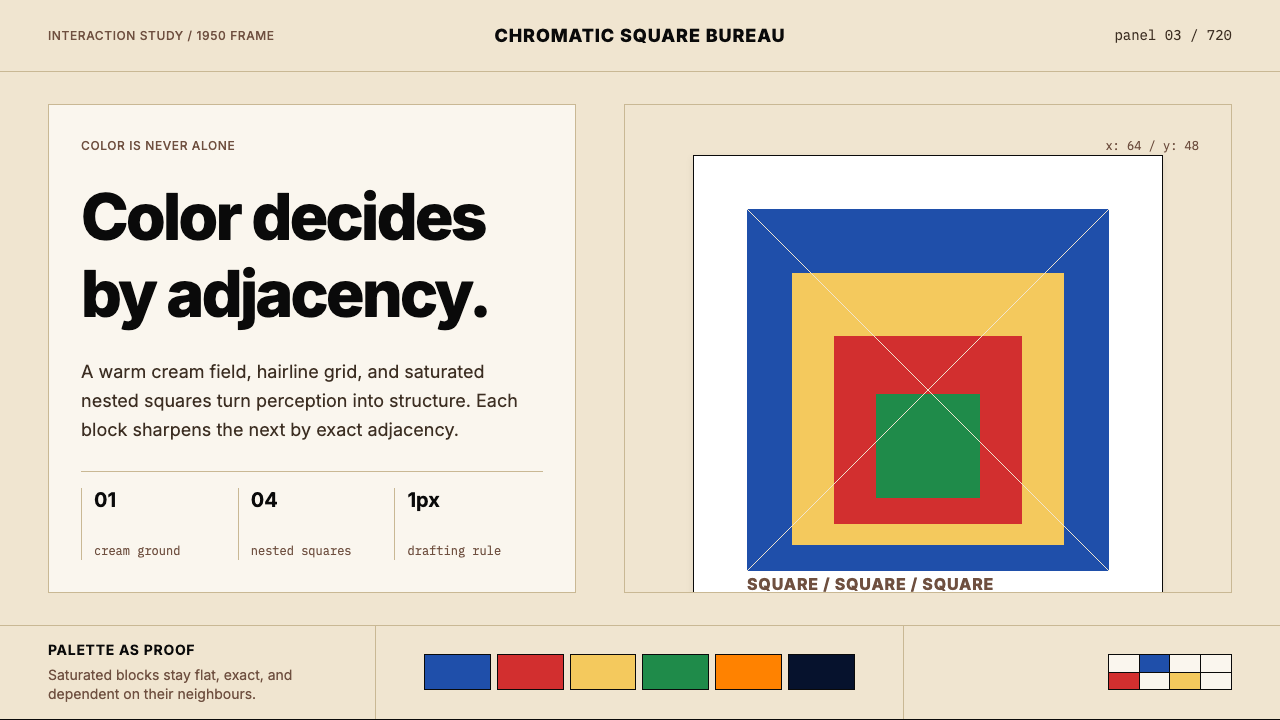 Josef Albers — Homage to the SquareColor becomes event. Warm cream, cobalt-red-yellow nested squares, exact hair…
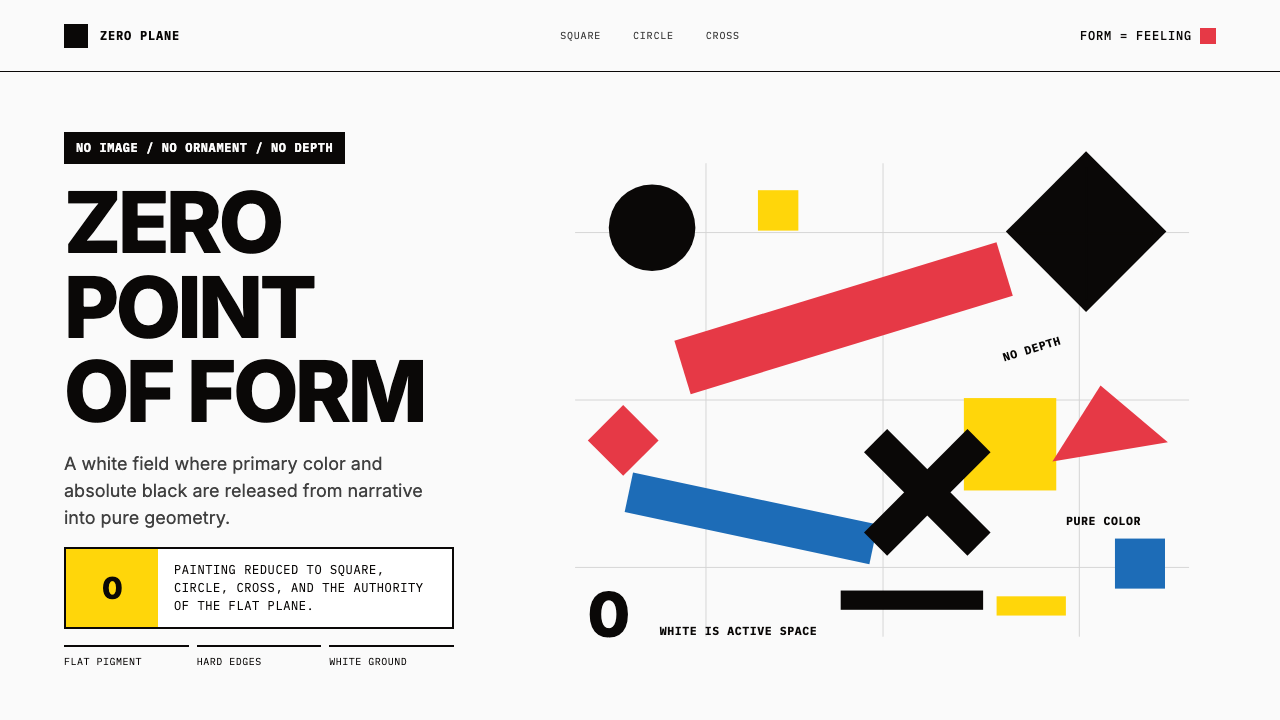 Malevich SuprematismGeometry declares zero. Red, yellow, blue and black blocks float on active wh…
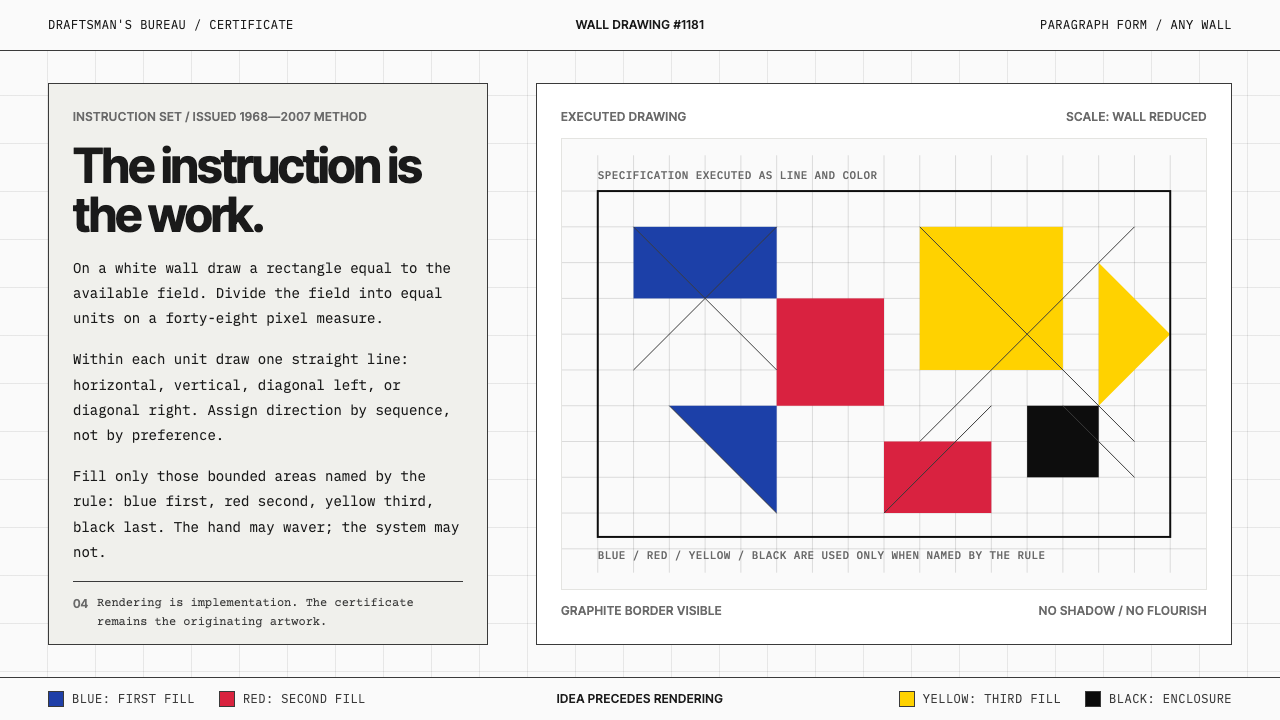 Sol LeWitt ConceptualInstruction becomes art. Mono certificates face wavering graphite grids in fo…
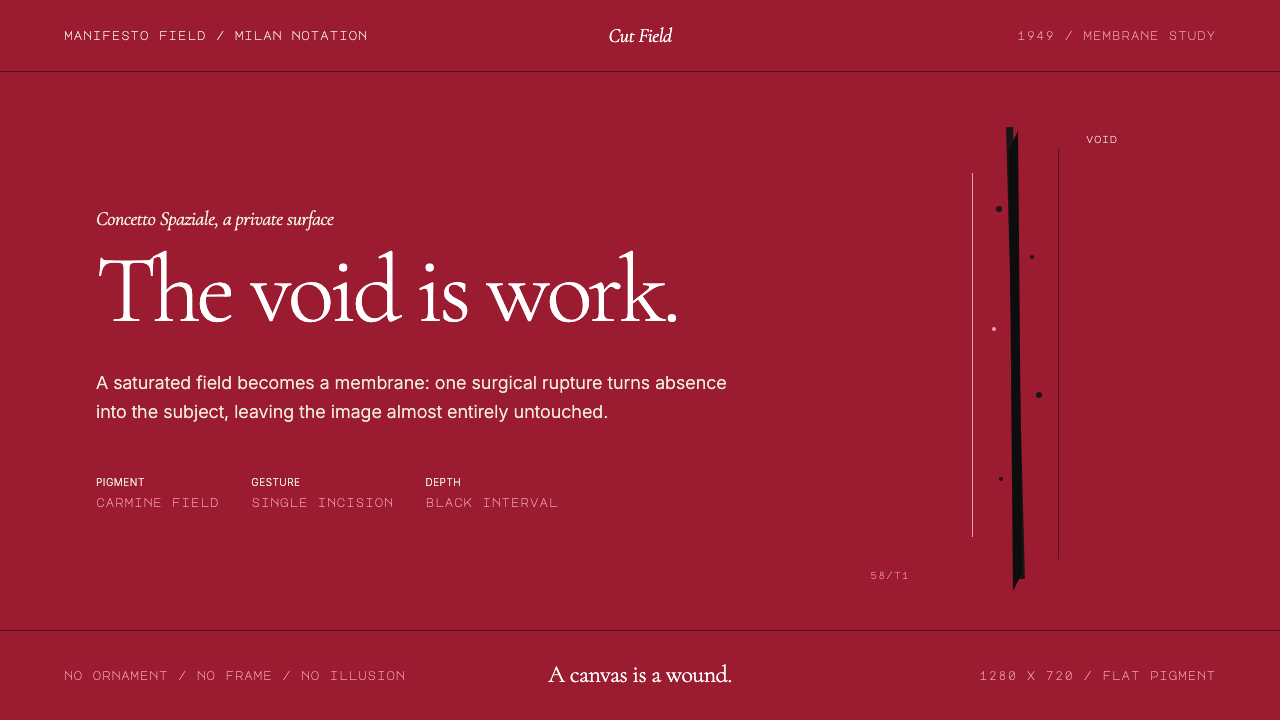 Spatialism (Fontana Cut, 1949)Absence becomes medium. Carmine field, Garamond restraint, one black incision.
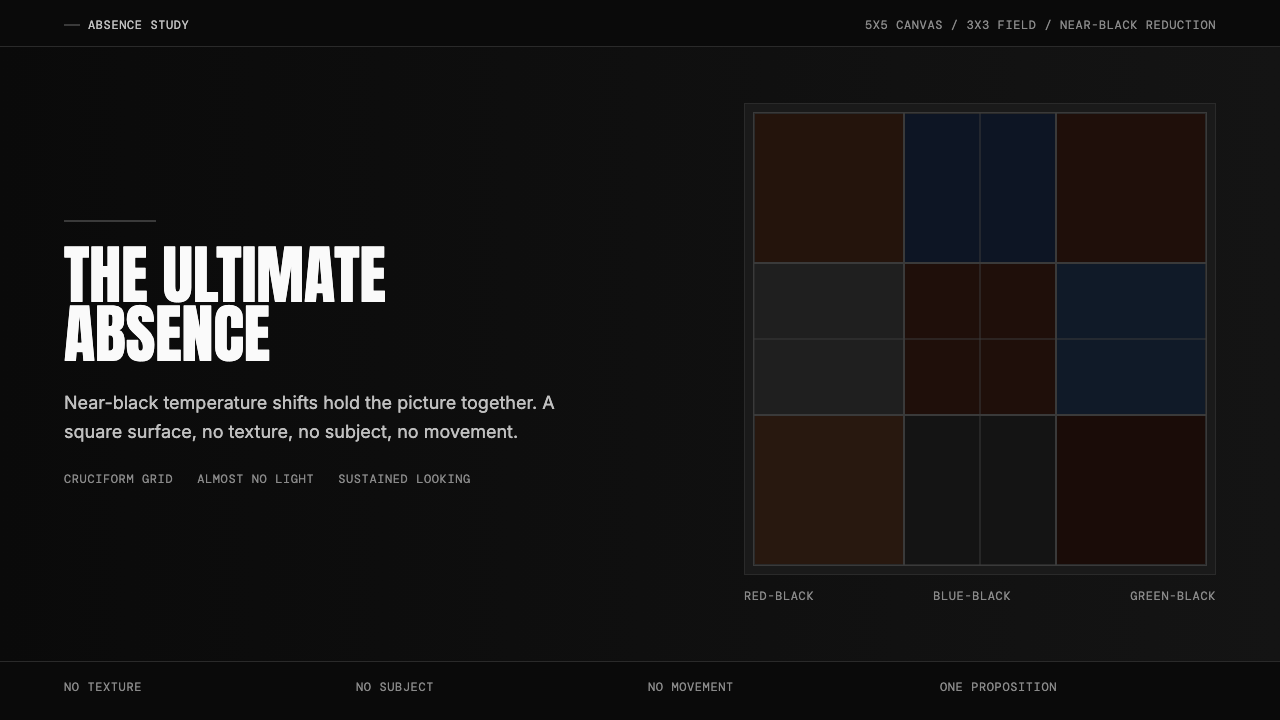 Ad Reinhardt Black Painting (1953)Austere absence. Near-black grid shifts reveal structure on sustained looking.