What is Josef Albers — Homage to the Square?
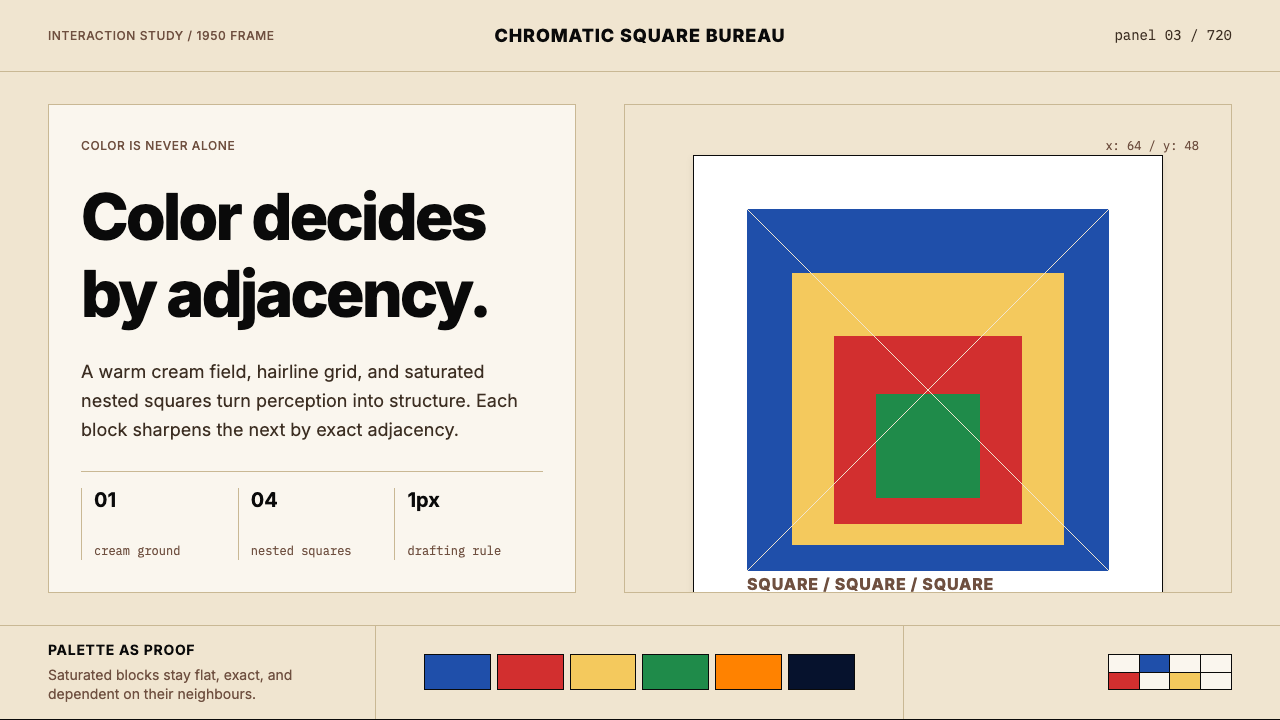
Josef Albers spent twenty-six years painting nested squares to prove that color is not a fixed property but a living event created by the eye and its neighbors.
Josef Albers — Homage to the Square in brief
Josef Albers — Homage to the Square is a design language derived from the most sustained single-series painting project of the twentieth century. Between 1950 and 1976, Albers produced more than a thousand paintings on the same formal premise: three or four concentric squares, nested according to a precise internal geometry, painted in fully saturated color on a warm cream gesso ground. No brushwork was visible. No texture. No narrative. The only variable was color — and through that single variable, Albers demonstrated that color perception is fundamentally relational.
Translated into a visual system, the style reads as rigorous Bauhaus-modernist discipline applied to chromatic exploration. The foundation is a warm cream or off-white ground. Geometric forms — always rectilinear, always crisp — sit without shadows or depth simulation. A small palette of fully saturated chromatic colors is used in nested or adjacent configurations, so that each color modifies the apparent temperature, weight, and brightness of every color beside it. The effect is simultaneously scientific and sensory: the compositions feel tuned rather than decorated.
Unlike many mid-century modernist styles, this one carries an explicit pedagogical dimension. Albers published his landmark book Interaction of Color in 1963, which documented with reproducible experiments how the same gray appears warm or cool depending on its surroundings, how a small area of color can appear to vibrate against a complementary neighbor, how the eye can be made to see colors that are not present. The design system inherits this spirit: every color decision is understood as an argument, not an accident.

Where does Josef Albers — Homage to the Square come from?
Josef Albers was born in 1888 in Bottrop, Germany, and trained as a primary school teacher before studying at the Royal Art School in Berlin. He arrived at the Bauhaus in Weimar in 1920 as a student and became one of the few students ever promoted to the rank of master. He ran the preliminary course alongside László Moholy-Nagy and eventually directed the furniture workshop. When the Nazis closed the Bauhaus in 1933, Albers was among the first faculty invited to teach in the United States — at Black Mountain College in North Carolina, an experimental liberal arts institution that had gathered many of the European modernist emigres of the period.
Black Mountain College proved to be the crucible. Without the institutional structure of a European art academy, Albers was free to concentrate his pedagogy almost entirely on perception and the experience of color. He taught there from 1933 to 1949, and it was during this period that the ideas that would generate the Homage to the Square series fully matured. In 1950, the year he accepted a position as head of the design department at Yale University — where he would remain until 1960 — he began the series. The formal constraint was deliberate: by fixing everything except color, Albers created a controlled experiment that could run for decades.
The Homage to the Square series is inseparable from its publication companion. When Yale University Press published Interaction of Color in 1963, it was issued as a limited portfolio edition with hand-silkscreened color plates — each plate a physical demonstration of a perceptual principle. The book became one of the most influential texts in design education of the twentieth century, and its arguments directly shaped how subsequent generations of designers understood color relationships. The series and the book are best understood together: the paintings are the data, the book is the analysis.
Albers died in 1976 in New Haven, Connecticut — the same year the Homage to the Square series concluded. The Josef and Anni Albers Foundation, established to preserve and extend the legacy of both Josef and his wife Anni, a pioneering textile artist and weaver, has since documented the complete series. Anni Albers, who was herself a Bauhaus-trained artist, brought parallel rigor to the study of woven structure and surface, and the two together represent one of the most complete explorations of visual perception and material honesty in the history of modern design.
What defines the Josef Albers — Homage to the Square look?
Nested Concentric Squares
The defining compositional element is three or four squares arranged concentrically, each inset from the one outside it according to a fixed proportional system. The squares are never centered on the canvas; Albers positioned the inner square slightly lower and toward the center, creating an upward visual lift. This specific asymmetric nesting is what separates the style from generic geometric abstraction — the geometry is not arbitrary but precisely calibrated to control how the eye moves through the color relationships.
Warm Cream Ground
The ground is never pure white. Albers worked on a warm cream gesso, and this ground color is active — it is the outermost color in the compositional system and interacts with all the chromatic squares inside it. In interface translation, the background reads as warm off-white rather than neutral white, and this distinction is perceptually significant: it prevents the overall composition from feeling clinical or inert, and it causes all other colors present to appear slightly warmer and more luminous than they would on a cold white ground.
Saturated Chromatic Palette
The chromatic colors used in the series are fully saturated — not muted, not pastel, not tinted. Albers favored colors at or near their maximum chroma: cobalt blue, cadmium red, cadmium yellow, emerald green, deep violet, and warm orange appear across the series. The key design decision is not which colors to include but which two or three to place in adjacency, because the perceptual effect of the whole depends almost entirely on the specific color relationships rather than on any individual color considered in isolation.
Hairline Edges and Zero Radius
Every boundary between color areas is a crisp, hard edge with no softening, blending, or anti-aliasing beyond what the medium requires. There are no rounded corners. The precision of these edges is what generates the perceptual intensity of the color interactions — a blurred or softened edge would dissipate the relational effect. In digital application, this means absolutely no border-radius on chromatic elements, no gradient transitions between color areas, and no glow or bloom effects at boundaries.
Typographic Restraint
Where typography appears in Albers-derived work, it follows the Bauhaus lineage he was trained in: geometric sans-serif letterforms, set with deliberate spacing and strong scale contrast between hierarchical levels. No decorative typefaces, no script, no display faces with historical references. Text is treated as a structural element in the same grid as the geometric forms — it neither competes with the color relationships nor retreats into invisibility, but holds a clear functional position.
Flat Surfaces and No Depth Simulation
There are no drop shadows, no cast shadows, no simulated three-dimensionality of any kind. The apparent depth that viewers perceive in Homage to the Square compositions — some inner squares appear to advance toward the viewer while others recede — is generated entirely by color relationships, not by spatial illusion. In interface design, this principle means achieving visual hierarchy through color temperature and saturation contrast rather than through shadow, elevation, or z-axis metaphors.
Relational Color Logic
The most distinctive intellectual contribution of the Albers system is the explicit understanding that no color exists independently. Every color choice is simultaneously a choice about all neighboring colors. A cobalt blue square looks entirely different when nested inside cadmium red than when nested inside warm yellow — not because the blue has changed but because perception is comparative. Applied design that takes this seriously treats the color palette as a relational system: each color is selected not only for its own qualities but for what it does to the colors it touches.

Who shaped Josef Albers — Homage to the Square?
Albers was simultaneously a practicing painter, a design educator, and a theorist of perception. Trained at the Bauhaus under Paul Klee and Wassily Kandinsky, he absorbed the school's foundational rigor and then spent the rest of his career extending its color implications beyond what the Bauhaus itself had explored. At Black Mountain College and Yale, he taught an entire generation of American designers, architects, and artists — including Eva Hesse, Robert Rauschenberg, and Kenneth Noland — to think about color as a relational, perceptual, and argumentative phenomenon rather than as a property of pigment.
Anni Albers was Josef's wife and an equally rigorous artist in her own right — a textile designer and weaver trained at the Bauhaus women's workshop, where she elevated weaving from craft to art through systematic investigation of structure, material, and surface. Her 1965 book On Weaving remains a foundational text. The Josef and Anni Albers Foundation that administers both their legacies reflects the deep intellectual collaboration that defined their shared practice: both were committed to understanding perception through constraint, repetition, and material honesty.
Kandinsky's Bauhaus-period theory of color-shape correspondence — which Albers encountered firsthand as a student and then colleague — provided one of the key intellectual foundations for the Homage to the Square project. Where Kandinsky sought to establish fixed emotional equivalences between colors and forms, Albers pushed back experimentally, demonstrating that apparent color properties shift with context. The Homage to the Square series can be read in part as a respectful but empirically rigorous rebuttal to Kandinsky's more symbolic approach.
Klee was a Bauhaus master who taught alongside Albers, and his influence on Albers was direct and lasting. Klee's approach to color — which treated it as a living substance with internal logic rather than a fixed code — resonated deeply with Albers's own developing sensibility. Klee's Pedagogical Sketchbook and his Bauhaus courses on visual thinking helped establish the intellectual climate in which the questions Albers would spend his career answering were first seriously posed.
Judd, the American minimalist sculptor and critic, engaged directly with Albers's work and shared its commitment to seriality, material precision, and the rejection of expressionistic gesture. Judd's boxes and stacks — industrial forms in precise chromatic surfaces — can be understood as a three-dimensional extension of the same inquiry that Albers conducted on the picture plane. Judd's critical writing also helped establish the theoretical framework within which the Homage to the Square series was received as rigorous intellectual work rather than decorative painting.
How do you use Josef Albers — Homage to the Square today?
Applying the Albers — Homage to the Square system to designed artifacts requires committing to its core logic: color relationships do the work, and everything else exists to support those relationships. This means the background color, the border colors, and the accent colors must all be chosen as a relational set, not selected independently and then assembled. The designer's task is to compose a color argument, not to fill a palette.
For presentation slides, the style produces some of its strongest results on cover and section-divider pages. A cover built in this system places one large color field — a fully saturated block at the center or anchoring a corner — against the warm cream ground, then nests a contrasting inner block within it. The title and subtitle sit in clean geometric type, with scale used as the primary hierarchy signal. Content slides should be simpler: the warm ground stays consistent, structured colored blocks highlight key data or quotations, and section indicators use the nested square motif reduced to a small navigational marker. Data slides translate naturally — bar charts and table headers become geometric color objects governed by the same relational palette, so the data visualization and the slide design share a visual grammar.
For web interfaces, the style is best deployed in contexts where analytical clarity and intellectual authority are the intended impression: dashboards, documentation sites, pricing and comparison pages, academic or research platforms. The approach begins with the background: a warm near-white rather than pure white. Primary navigation and structural dividers use fine lines rather than color fills. Chromatic colors — fully saturated, used sparingly — appear in interactive states, category tags, alert indicators, and tier differentiation. Card components are bordered with crisp lines and zero radius. Hover states shift color temperature or saturation rather than adding depth or shadow. The result is a UI that feels precise and considered rather than decorated.
For editorial and marketing work, the system supports bold, poster-like compositions that age well. A feature spread or marketing section page works by treating the layout itself as a nested structure: a full-width colored band contains a secondary block in a contrasting color, and the typography sits within that inner field. Pull quotes and call-out figures can be given their own chromatic blocks, making the information hierarchy visually immediate. Marketing pages using this system benefit from restraint in the number of distinct colors used: two chromatic colors and the warm ground will be more powerful than four or five colors competing for attention.
A common mistake when working in this style is selecting colors for their individual appeal rather than for their relational behavior. A color that looks strong in isolation may weaken or clash when placed inside or beside the colors surrounding it in the composition. The correct method is to evaluate every color only in context — assembled together on the ground color, in the nesting relationship they will actually occupy. A second common error is softening the edges between color areas with gradients or blurs, believing this will make the result feel more refined. It has the opposite effect: the perceptual intensity that gives the style its authority depends on precise, unapologetic hard edges.

Josef Albers — Homage to the Square — FAQ
Is this style the same as Bauhaus, or is it something different?
It shares the Bauhaus lineage — Albers was Bauhaus-trained and the visual DNA is closely related — but the emphasis is different. Classic Bauhaus style uses primary red, blue, and yellow as symbolic carriers of structure, space, and energy, following Kandinsky's color-shape theory. The Albers system is more empirical and less symbolic: it uses fully saturated colors of any hue, and the selection principle is relational rather than hierarchical. Bauhaus color tends to be used declaratively; Albers color is used interrogatively. The result is a system that feels slightly more perceptually alive and less ideologically fixed than canonical Bauhaus work.
How many colors should a composition in this style use?
The Homage to the Square paintings themselves use only two or three chromatic colors per panel — the warm cream ground, and two or three nested color fields. This constraint is not accidental: with more than three chromatic colors, the relational dynamics become too complex to control, and the compositional logic starts to break down. In designed artifacts, this suggests a working palette of one background, one structural or typographic dark, and two chromatic colors at most — with one used more sparingly as a true accent. Using more colors is possible but requires significant experience with relational color work to avoid visual noise.
Can this style work in a dark-mode interface?
It can, but it requires rebuilding the relational logic from the ground up rather than simply inverting the light version. The warm cream ground is the outermost color in the nested system, and replacing it with a deep neutral changes every color relationship built on top of it. On a dark ground, fully saturated colors tend to feel more aggressive and luminous, which can easily tip into visual instability. A dark-mode Albers-derived system works best when it commits to a very limited chromatic palette — one or two chromatic colors at most — and treats them as deliberate accent against an otherwise achromatic dark structure. The disciplined version is powerful; the undisciplined dark version reads as garish.
How does this style handle typography — does it have its own typographic rules?
The Albers system has no proprietary typeface, but its Bauhaus inheritance implies clear typographic preferences. Geometric sans-serif letterforms are the natural companion to the rectilinear geometry of the squares. Type should be treated with the same structural discipline as the color fields: clear hierarchical levels defined by scale contrast, deliberate spacing, and consistent alignment. The most important rule is that typography should not compete with the color system — it should occupy a distinct functional register, usually in the structural dark or in a neutral field, leaving the chromatic colors free to do their relational work without textual interruption.
What kinds of products or brands is this style least suited to?
The Albers style projects intellectual precision, perceptual rigor, and a certain cool authority. These qualities align well with analytical tools, research platforms, design-forward technology products, educational institutions, and premium products that want to signal seriousness rather than warmth. The style struggles in contexts that require organic warmth, tactile richness, or cultural intimacy — food and hospitality brands, children's products, community platforms, wellness and lifestyle applications. It also tends to work poorly for brands that need to feel approachable and unpretentious: the system's intellectual heritage can read as exclusive or demanding. Knowing what values the style embodies is as important as knowing how to execute it technically.
Related design styles
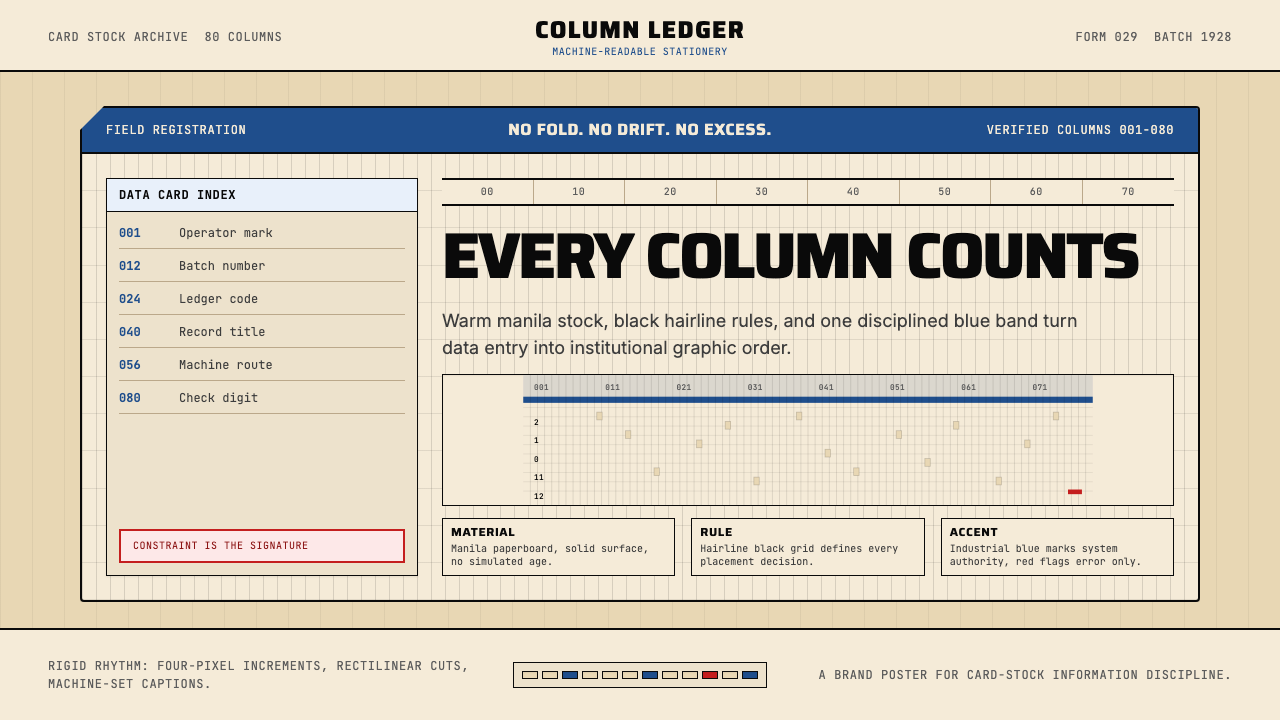 IBM Punchcard 029 (1928)Constraint becomes authority. Manila stock, hairline grid, industrial blue.
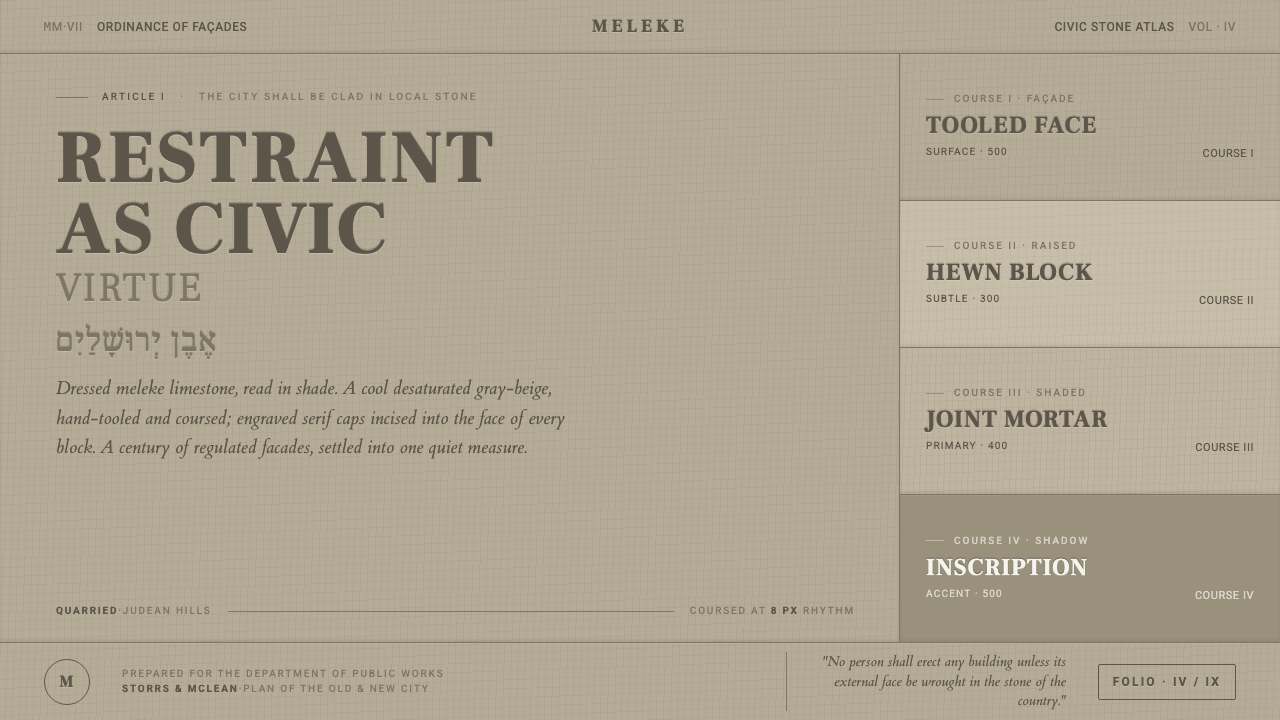 Jerusalem Stone GrayRestraint as civic virtue. Cool dressed-limestone gray-beige, ashlar coursing…
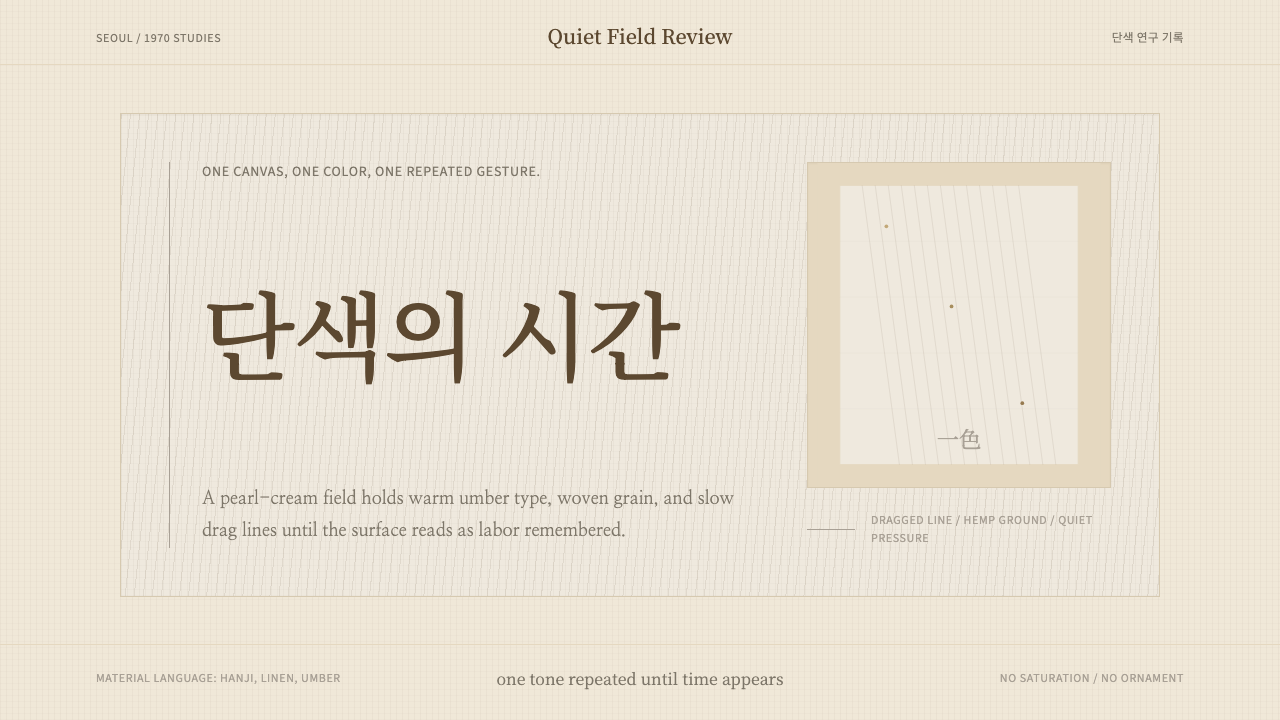 Korean Dansaekhwa MonochromeLabor becomes stillness. Umber serif type and drag lines on pearl cream.
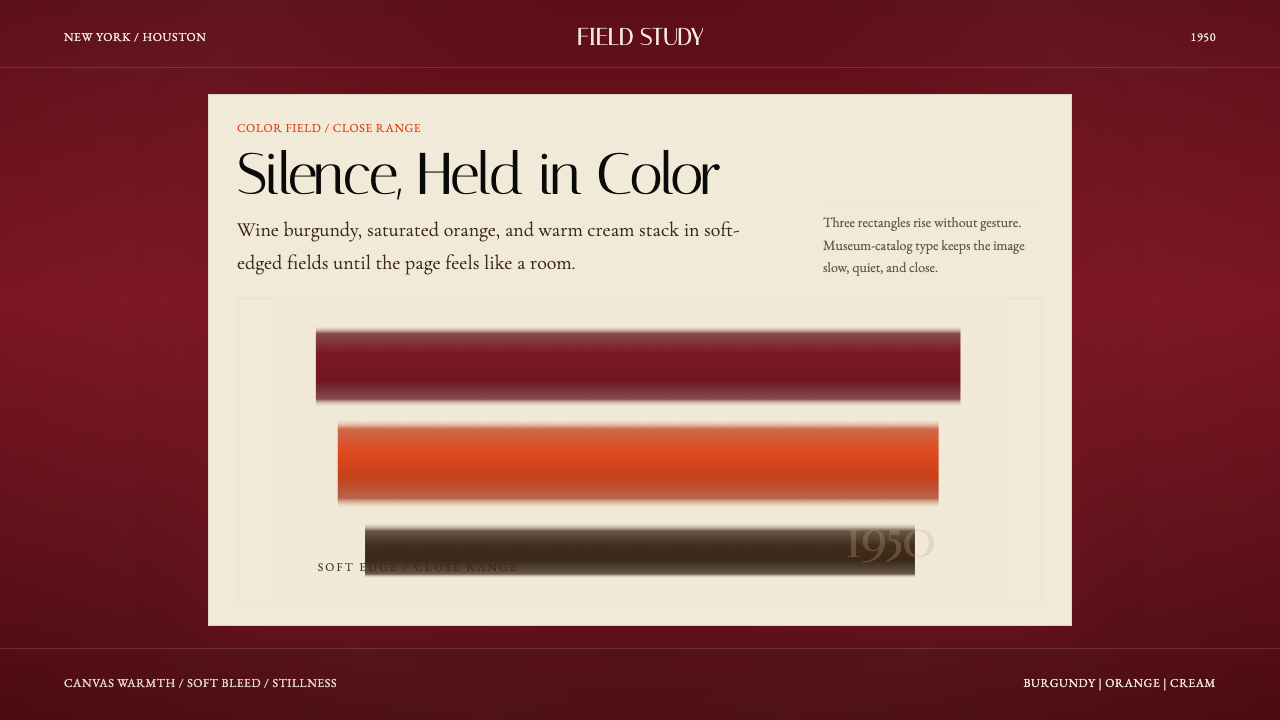 Mark Rothko Color Field (1950)Silence made visible. Burgundy, orange, and cream stack in soft-edged fields.
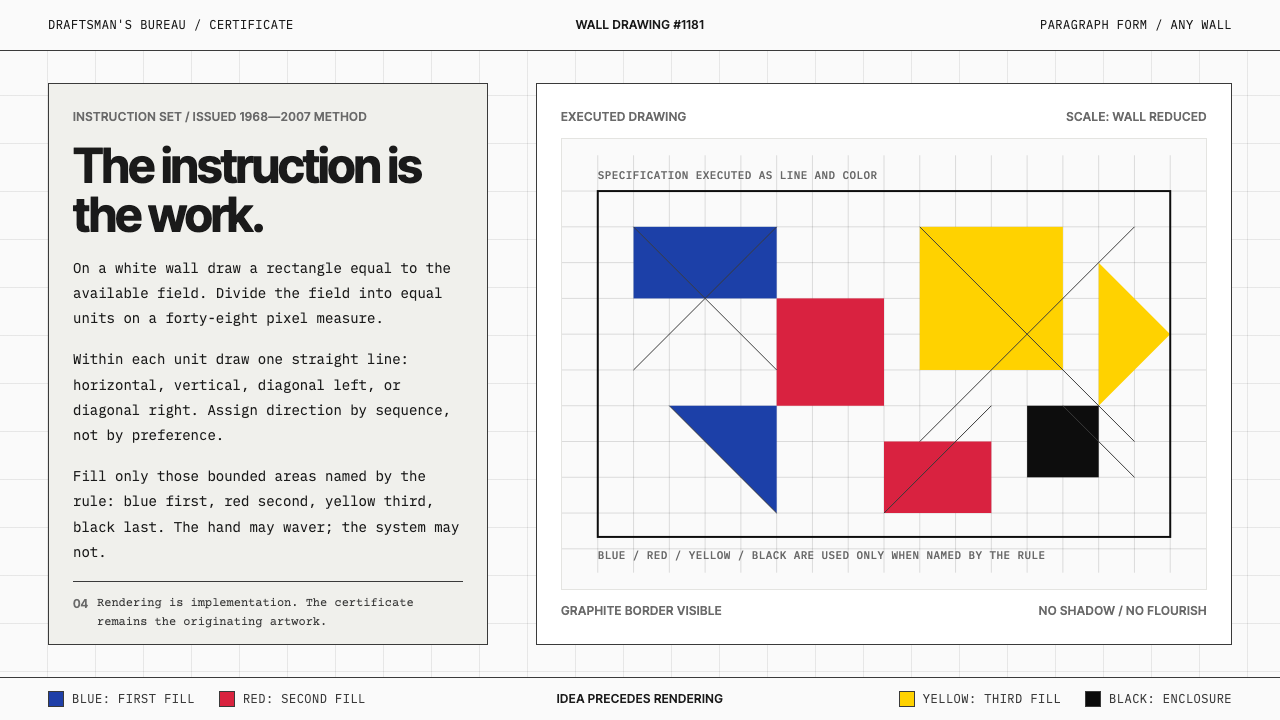 Sol LeWitt ConceptualInstruction becomes art. Mono certificates face wavering graphite grids in fo…
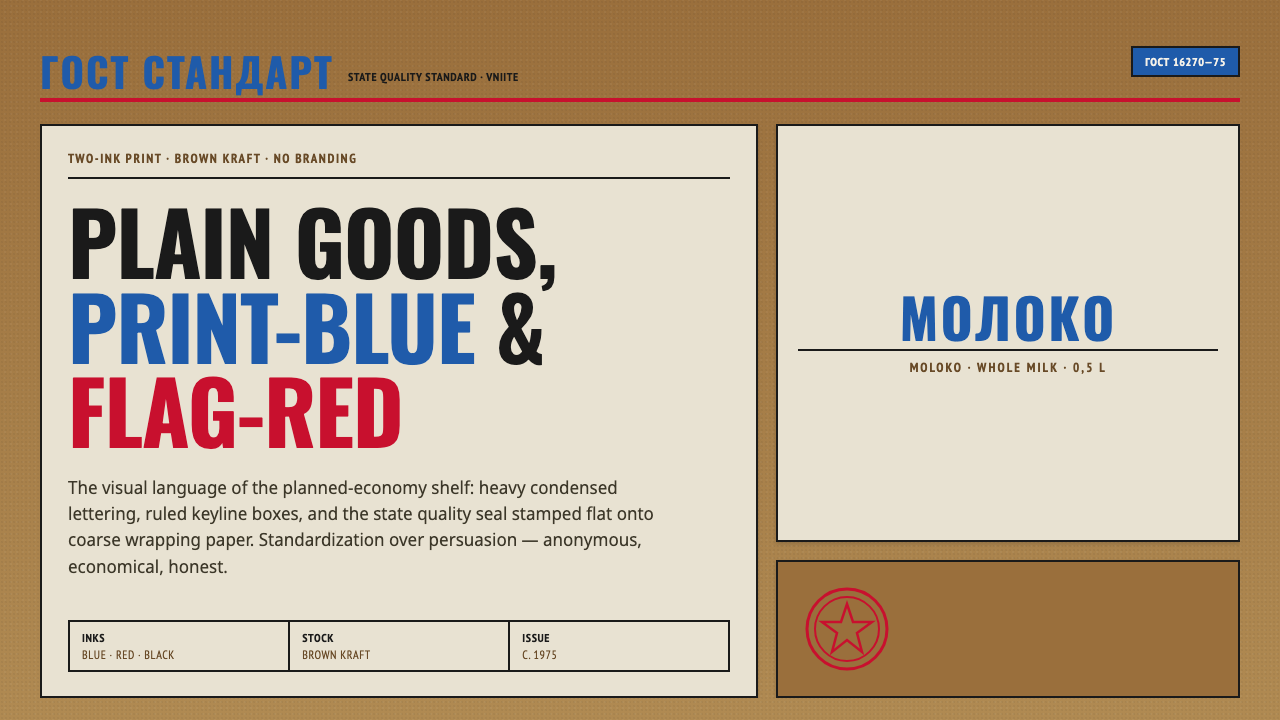 Soviet GOST PackagingAnonymous and strict. Kraft ground, red-blue ink, ruled boxes, condensed type.