What is IBM Punchcard 029 (1928)?
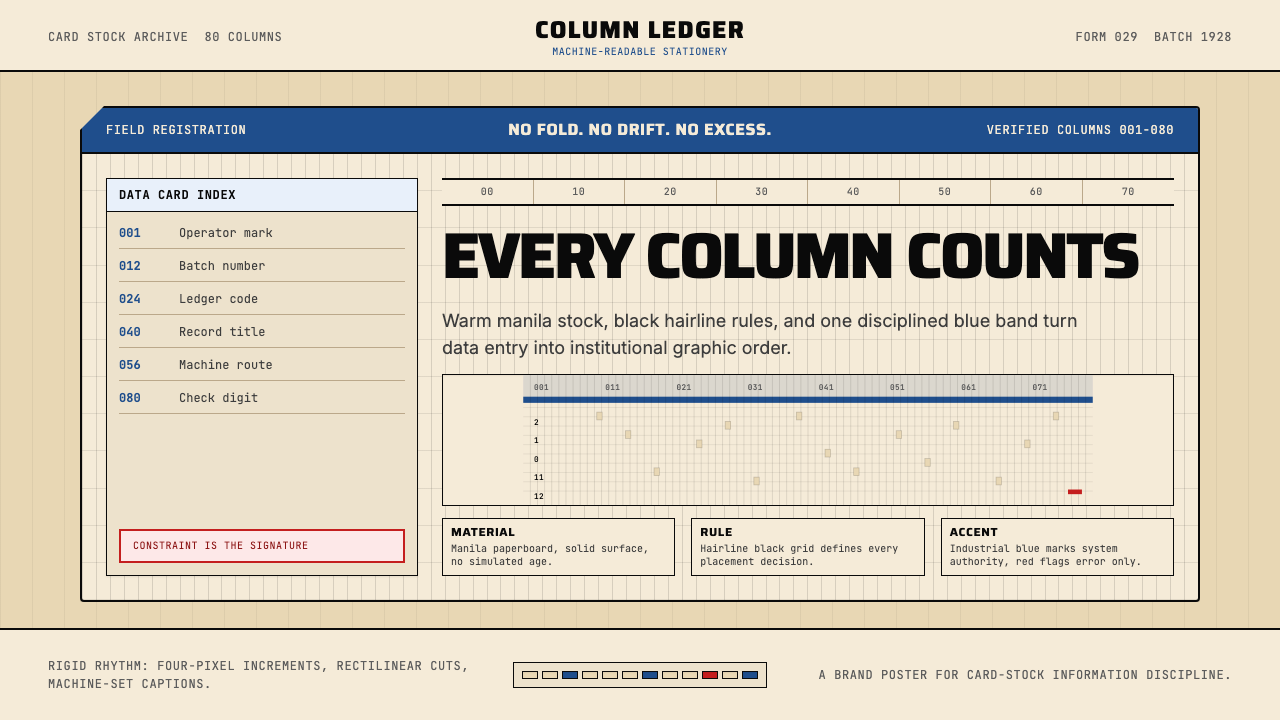
The IBM punchcard turned industrial constraint into a design language — warm cream stock, hairline grid, and the quiet authority of eighty columns that once held the world's data.
IBM Punchcard 029 (1928) in brief
The IBM Punchcard 029 design language is rooted in the visual vocabulary of the 80-column tabulating card — a physical artifact that served as the universal data-entry medium for mid-twentieth-century business, government, and scientific computing. The aesthetic distills the card's physical properties into a design system: a warm cream or manila ground, hairline black grid lines arranged in strict vertical columns, and accents of IBM industrial blue that carry the weight of institutional authority.
Where Bauhaus geometry is expressive and symbolic, punchcard aesthetics are instrumental and procedural. Every visual element exists because a physical process demanded it — column numbers aid keypunch operators, border cuts orient card readers, the grid maps directly to the data it encodes. Translated into contemporary design, this means surfaces that read as structured, purposeful, and engineered rather than decorated. The palette is deliberately narrow: cream grounds, black or very dark ink for type and grid, and a single restrained blue for hierarchy and emphasis.
The style carries the character of mid-century American institutional confidence — the same visual logic that appeared on government census forms, payroll ledgers, and university registration cards. It is neither warm nor cold in the emotional sense; it is precise, procedural, and authoritative. Applied thoughtfully, this language signals data integrity, systematic thinking, and a kind of honest industrial craft that contemporary audiences increasingly recognize as an alternative to over-polished digital aesthetics.

Where does IBM Punchcard 029 (1928) come from?
The story begins with Herman Hollerith, a statistician who worked for the United States Census Bureau and faced a genuine computational crisis: the 1880 census had taken eight years to tabulate by hand, and the 1890 census — with a much larger population — threatened to exceed its own ten-year deadline before counting even began. Hollerith's solution was mechanical: a card punched with holes in specific positions, each position encoding a data value, read by electrical contacts that completed circuits when a metal pin passed through a hole. His Hollerith Electric Tabulating System processed the 1890 census in under three years. The basic card format — rectangular, stiff, with standardized column positions — was established in this period.
Hollerith's Tabulating Machine Company was eventually consolidated, through a series of mergers, into the Computing-Tabulating-Recording Company in 1911 and renamed International Business Machines — IBM — in 1924 under the direction of Thomas J. Watson Sr. Watson transformed IBM from a tabulating-equipment vendor into the dominant force in American business automation. The 80-column card format was standardized in 1928, replacing earlier 45-column designs and establishing the physical parameters that would remain in use for more than five decades: the card's width, its row and column count, the precise spacing of positions, and the characteristic rectangular corner cut that prevented cards from being inserted upside down or reversed.
The IBM 029 Keypunch machine, introduced in 1964, became the most widely used data-entry device of the mainframe era. Operators sat at keypunch consoles and typed data; the machine punched holes and printed the character above each column in a narrow strip at the top of the card, creating the distinctive visual signature of printed column characters running across the cream card face. The machine was designed for sustained, repetitive use — its keyboard had a deliberate tactile response, and its mechanical reliability was central to IBM's institutional reputation. In universities, corporations, and government agencies, learning to use the 029 keypunch was a standard professional skill from the mid-1960s through the late 1970s.
The punchcard era formally ended as interactive terminals and disk storage displaced batch processing through the late 1970s and into the 1980s. IBM shipped its last cards in 1982. But the visual language of the punchcard — the cream ground, the column grid, the institutional blue, the sense of data as a physical and countable thing — survived as a cultural memory embedded in early computing aesthetics and has re-emerged repeatedly in design work that seeks to reference precision, data authority, or mid-century industrial craft.
What defines the IBM Punchcard 029 (1928) look?
Ground Color
The foundation is a warm, slightly yellowed cream — the color of manila card stock aged just enough to read as archival rather than fresh. This is not a neutral off-white or a cold parchment; it carries warmth that distinguishes it from modern screen defaults. Against this ground, black ink reads with high contrast and a sense of physical registration, as if the characters were pressed into the surface rather than rendered on a screen.
Grid and Column Structure
The defining structural element is the hairline vertical column grid — extremely fine ruled lines that divide the surface into equal, numbered units. These lines are not decorative; they map directly to the card's data capacity and reading mechanism. In design application, this grid provides an unusually strict and regular organizing system: all content aligns to column boundaries, spacing is rhythmic and machine-like, and the grid itself is visible rather than implied. The legibility of column numbers at the top of each column is a characteristic finishing detail.
Industrial Blue Accent
A single, restrained blue — the institutional blue associated with IBM's mid-century corporate identity — serves as the only chromatic accent in the system. It is not a bright or saturated blue, nor a soft or muted one; it sits at the confident midpoint of institutional authority. This blue appears on column headers, border rules, or key informational elements — never as a background fill. Its sparing use gives it genuine weight: in a cream-and-black composition, every appearance of the blue registers as significant.
Monospaced Type Logic
Type in the punchcard system is inherently monospaced — each character occupies exactly one column, regardless of its visual width. This mechanical equality produces a distinctive typographic texture: dense, evenly-spaced characters with no proportional variation. In design application, this translates to a preference for monospaced or mechanically-regular letterforms, where the rhythm of characters is uniform and the spacing carries the visual logic of a fixed-pitch typewriter rather than optical kerning. The effect reads as data rather than prose.
Border and Registration Marks
The physical punchcard's border — a thin rectangular rule enclosing the entire card face, with characteristic corner cuts and edge markings — translates into a design preference for contained, bordered compositions. Layouts feel framed rather than open; content lives inside defined rectangles. Corner treatments echo the physical card's functional cuts. This sense of containment and registration gives compositions a quality of completeness: each layout is a discrete, self-contained data object rather than a fragment of a larger continuous surface.
Procedural Hierarchy
Hierarchy in punchcard-derived design is established through structural position rather than decorative emphasis. Row numbers appear at a consistent position; column headers occupy a fixed zone; data content fills the body. This positional clarity means hierarchy is legible without color or scale variation — a characteristic that makes the system exceptionally robust across different reproduction contexts and screen sizes. When color or scale variation is used, it serves to reinforce a positional logic that already exists, not to create hierarchy from scratch.
Absence of Ornament
Like all genuine information-design systems, the punchcard aesthetic contains no decorative elements — nothing exists that is not required by the data or the reading mechanism. There are no flourishes, no gradient fills, no ambient shadows, no texture overlays, no illustrative elements. What reads as 'style' is in fact functional residue: the visible grid, the border, the column numbers, the institutional blue — all were there because a machine or an operator needed them. In contemporary application, honoring this constraint means resisting the impulse to add visual interest through decoration rather than through structural clarity.

Who shaped IBM Punchcard 029 (1928)?
Hollerith invented the electric tabulating system that established the punchcard as a data-storage medium. His solution to the 1890 census problem — encoding demographic data as hole positions on a standard card, then reading those positions electrically — set the physical and conceptual template for all subsequent punchcard systems. His company eventually became part of IBM, and his basic format decisions — card dimensions, column spacing, the electrical contact reading principle — persisted largely unchanged for sixty years.
Watson led IBM from 1914 to 1956 and built the institutional identity that gave the punchcard system its cultural authority. Under his direction, IBM developed not just the machines but a complete visual and corporate language — including the deep blue corporate color, the emphasis on precision and reliability, and the salesman-engineer culture — that made the IBM card synonymous with modern, trustworthy data processing. The card's visual restraint and institutional confidence reflects Watson's vision of IBM as a business civilization, not merely a technology company.
The team responsible for the 1928 card standardization and the subsequent 029 Keypunch machine resolved a series of engineering constraints — card stiffness, punching tolerance, electrical contact reliability, operator ergonomics — into the finished artifact whose visual properties are still recognizable today. Their decisions about column spacing, border dimensions, character printing at the card top, and the physical corner cut were functional engineering choices that happened to produce a distinctive and durable aesthetic. The 029 machine's console design also influenced the broader visual language of mid-century computing hardware.
Though not an IBM employee, Rear Admiral Grace Hopper was the most significant figure in establishing the operational culture of punchcard-era computing. Her work on early compilers and the COBOL programming language defined how data — much of it encoded on IBM cards — was structured, described, and processed in American business and government computing through the 1960s and 1970s. The formatting conventions she championed, including the idea that programs should be readable by non-specialists, reinforced the punchcard system's institutional legibility values and influenced how data-display aesthetics were understood across the era.
As a Columbia University computing historian, da Cruz produced the most thorough documentary record of punchcard systems — photographs, technical specifications, operational manuals — that preserved the visual and material culture of the IBM card era for subsequent researchers and designers. His archival work at the Columbia University Computing History project made high-quality reference material for the card's physical dimensions, printing styles, and operational contexts widely available, enabling designers decades later to work with authentic visual reference rather than reconstructed approximations.
How do you use IBM Punchcard 029 (1928) today?
The punchcard aesthetic is particularly well-suited to design work that needs to communicate data authority, systematic precision, or a knowing reference to computation's physical past. Its visual logic is structural rather than decorative, which means correct application requires understanding what the system is actually doing — using the grid to establish hierarchy, using the cream ground to signal warmth-within-precision, using the institutional blue to mark what matters — rather than simply applying a cream-and-monospace overlay to existing layouts.
For presentation slides, the style works powerfully on both cover and content pages. A cover benefits from the contained, bordered composition: the full card-edge border frames the slide, a column-grid structure organizes title and subtitle with strict alignment, and the IBM blue appears on a single headline element or a column-number detail. Content slides should treat the column grid as a genuine organizing principle — text, data, and labels all align to column positions, with the grid lines remaining faintly visible as structural guides. Data slides are where the style achieves its greatest specificity: tables and grids of numbers look native in this aesthetic, and charts designed with the grid's column logic read as if the data itself demanded this format.
For web interfaces — particularly dashboards, analytics platforms, and pricing pages — the punchcard language provides an unusually strong framework for information-dense layouts. The approach is to establish a visible or near-visible column grid as the actual layout grid, keep the background in the warm cream register, use monospaced or mechanically-regular type for all data values and labels, and reserve the institutional blue for primary interactive states or tier differentiation. Table components align naturally to the card metaphor: rows alternate subtly, column headers sit in a defined registration zone, and borders are visible hairlines rather than soft separators.
For editorial and marketing applications, the style supports a distinct visual register that distinguishes data-forward content from purely narrative work. Feature comparisons, specification sheets, and technical documentation all benefit from the strict column alignment and monospaced type logic. Marketing pages can use the card border as a compositional device — full-bleed sections framed by visible rules, with the cream-and-blue palette providing enough warmth to prevent the layout from reading as purely utilitarian. The style's institutional character also makes it suitable for brands positioning themselves as trustworthy, established, or analytically rigorous rather than fashionable or trend-driven.
A common mistake when applying punchcard aesthetics is treating the monospaced type and visible grid as texture rather than structure — using them as decorative overlays on layouts that otherwise follow standard proportional-type design logic. The system breaks down when the grid is visible but content does not actually align to it, or when monospaced type is used for headlines while proportional type handles data values. A second common error is over-saturating the institutional blue, which reads as corporate and contemporary rather than archival and authoritative. The blue should appear at a weight that feels restrained — present and purposeful, but never dominant.

IBM Punchcard 029 (1928) — FAQ
Is punchcard design the same as retro-computing or pixel aesthetics?
They are related references to computing history but operate through entirely different visual logics. Retro-computing aesthetics — pixel art, CRT scanlines, early video game palettes — are rooted in the screen-based era of the late 1970s and 1980s, and their visual character comes from the resolution limits and color constraints of early display hardware. Punchcard aesthetics are pre-screen and pre-digital: they derive from the physical properties of paper card, mechanical printing, and electrical reading mechanisms. The punchcard palette is warm and archival; retro-computing palettes tend toward phosphor green, amber, or constrained RGB. The punchcard grid is hairline-fine and column-regular; pixel grids are coarse and square. Mixing them produces visual incoherence.
Does the punchcard style work on dark backgrounds?
The authentic punchcard was always light-ground — cream on cream, black type on manila stock. A dark inversion is possible but requires careful judgment. The system's character depends significantly on the warmth of the cream ground; inverting to a dark background removes this foundational warmth and tends to push the aesthetic toward generic monospace-terminal associations rather than archival card associations. If a dark variant is needed, the most coherent approach is to treat the dark background as if it were the unexposed surface of photographic paper — pairing it with cream or warm-tinted type rather than pure white, and keeping the IBM blue as the sole chromatic accent at full restraint.
How should photographs or illustrations be used within this aesthetic?
The punchcard system had no place for imagery — cards held alphanumeric data only. In contemporary design application, this means photography and illustration should be used sparingly and only when content genuinely requires it. When imagery does appear, it works best treated as a contained data element: cropped to a strict rectangular region that aligns to the column grid, reproduced in high-contrast duotone using the cream-and-blue or cream-and-black palette, or presented as a silhouetted figure against the card ground. Full-color naturalistic photography breaks the system's logic entirely; if a photograph must be full-color, it should be contained within a hard-bordered card frame that makes it read as an inserted document rather than an ambient background.
What kind of brands or products are the best fit for this style?
The punchcard style is best matched to products and brands where the association with data integrity, institutional authority, and systematic precision is a genuine asset rather than an ironic gesture. Financial data platforms, research and analytics tools, archival or records-management software, enterprise productivity tools, and educational materials in technical fields all benefit from the style's undecorated authority. It is also well-suited to brands seeking to differentiate from over-polished consumer tech aesthetics by signaling depth and seriousness. It struggles in consumer contexts that require warmth, playfulness, or sensory richness — food, wellness, children's products, entertainment — and should be avoided where the computing-era reference reads as cold or exclusionary rather than authoritative.
How is the punchcard style different from Swiss International Style or Bauhaus?
All three are grid-based, restrained, and non-ornamental, but their origins and emotional registers are quite different. Bauhaus is ideological and expressive — its geometry and primary colors carry symbolic weight derived from theories of color psychology and political commitment. Swiss International Style is rationalist and universal — it aspires to a neutrality that transcends cultural context, and its mathematical grid and extensive use of photography make it the most cosmopolitan of the three. Punchcard design is instrumental and archival — it derives from a physical data artifact rather than a design philosophy, and its visual authority comes from institutional memory and functional necessity rather than ideological argument. Where Bauhaus and Swiss Style make visual arguments, punchcard design presents visual evidence. The sensibility is closer to a well-designed form or ledger than to a poster or a corporate identity.
Related design styles
 Doctor's Clinical Lab CoatSterile by design. Cool clinical white, teal signals, and seam-line grids enf…
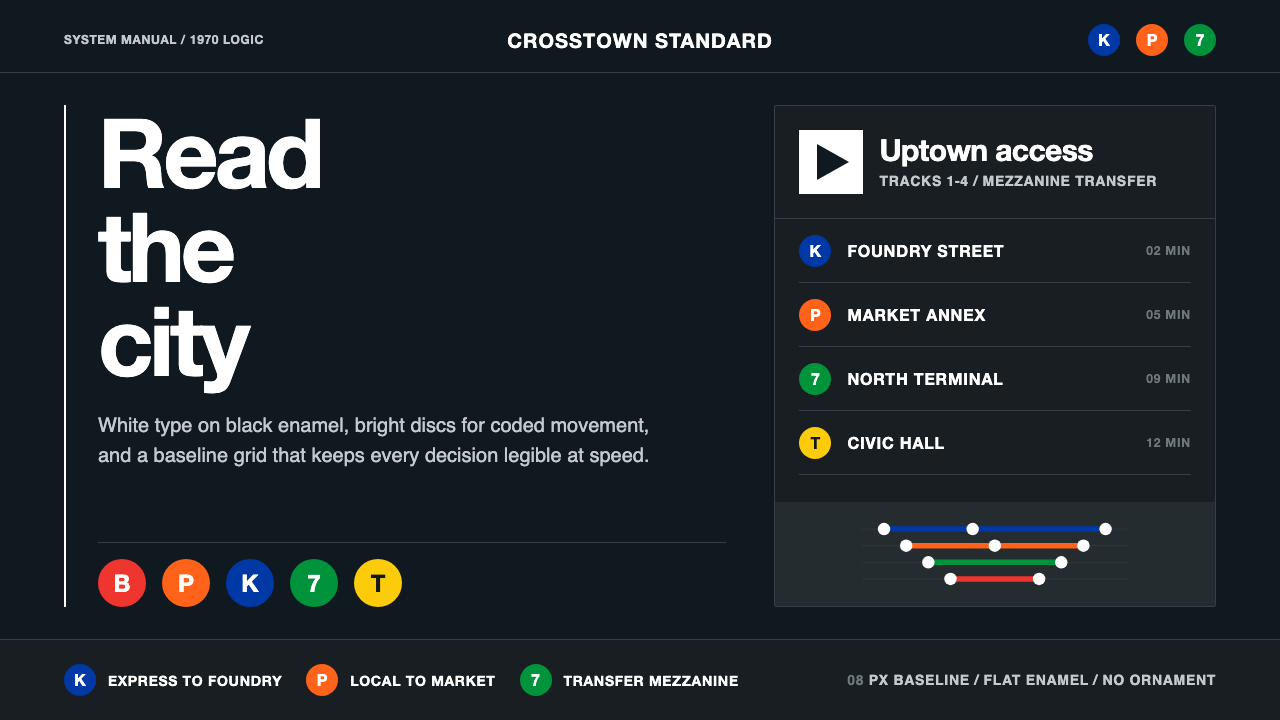 NYC Transit HelveticaOrder made visible. White type, black enamel, route discs, and a grid that ne…
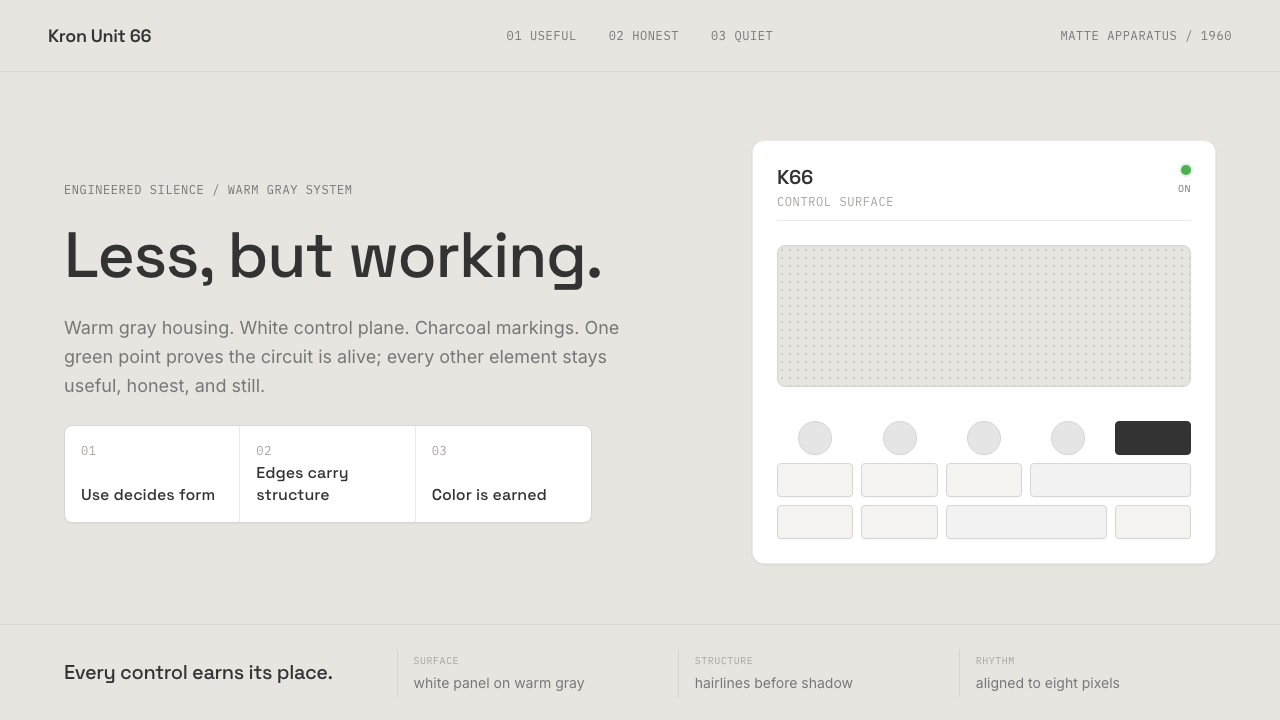 Dieter Rams / BraunQuiet by design. Warm gray, white panels, hairline grids, and one earned gree…
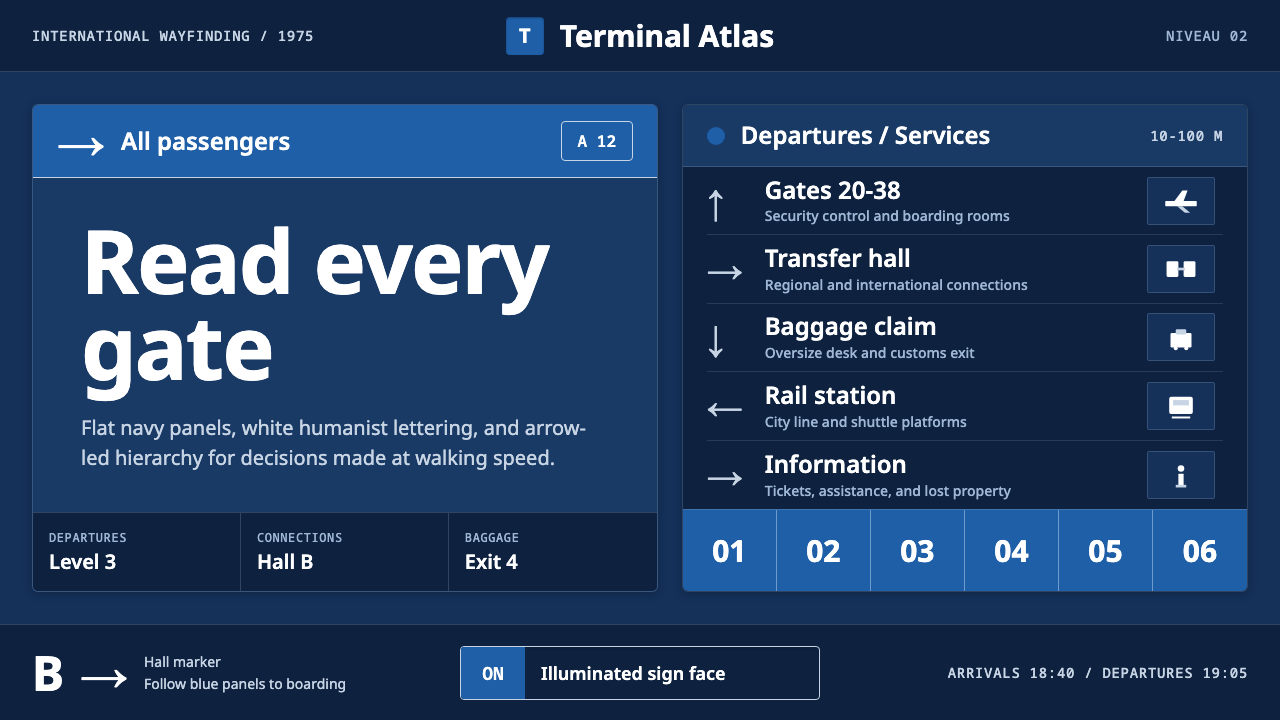 Frutiger CDG AirportLegibility at runway scale. Navy panels, white humanist sans, arrow-led grids.
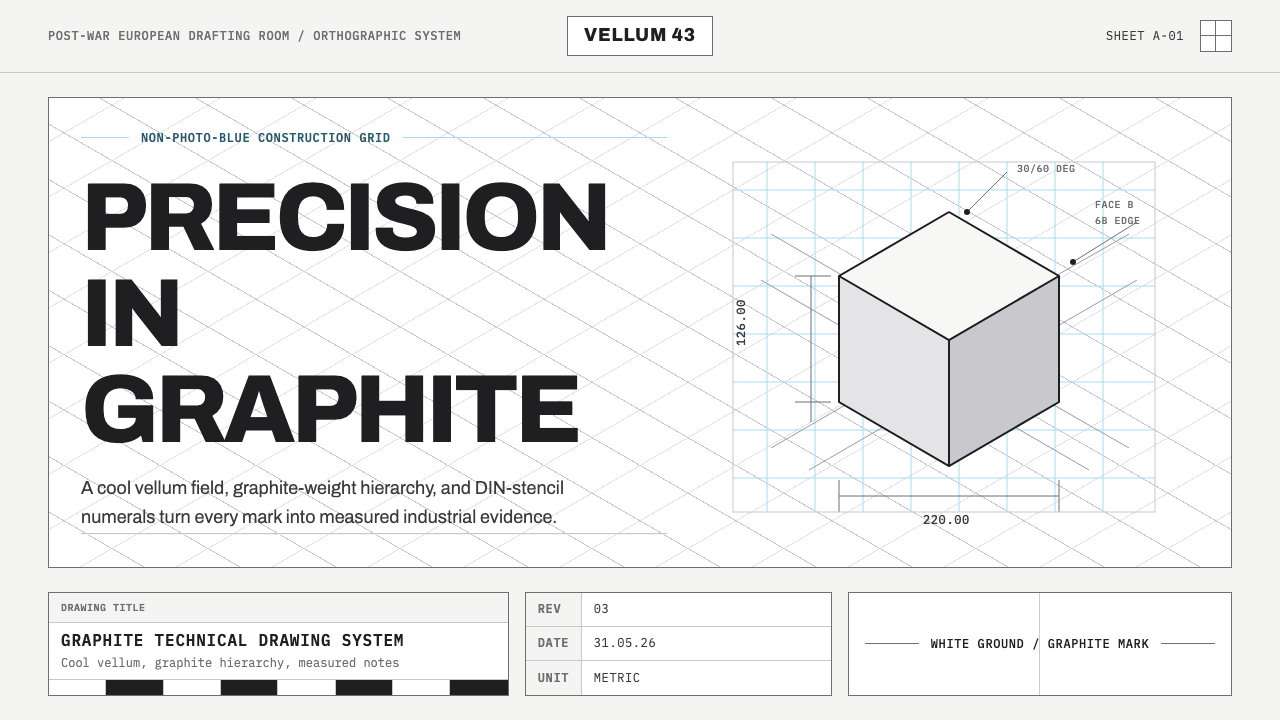 Graphite Technical DrawingDrafting-room precision. Non-photo-blue grid and graphite DIN lettering do th…
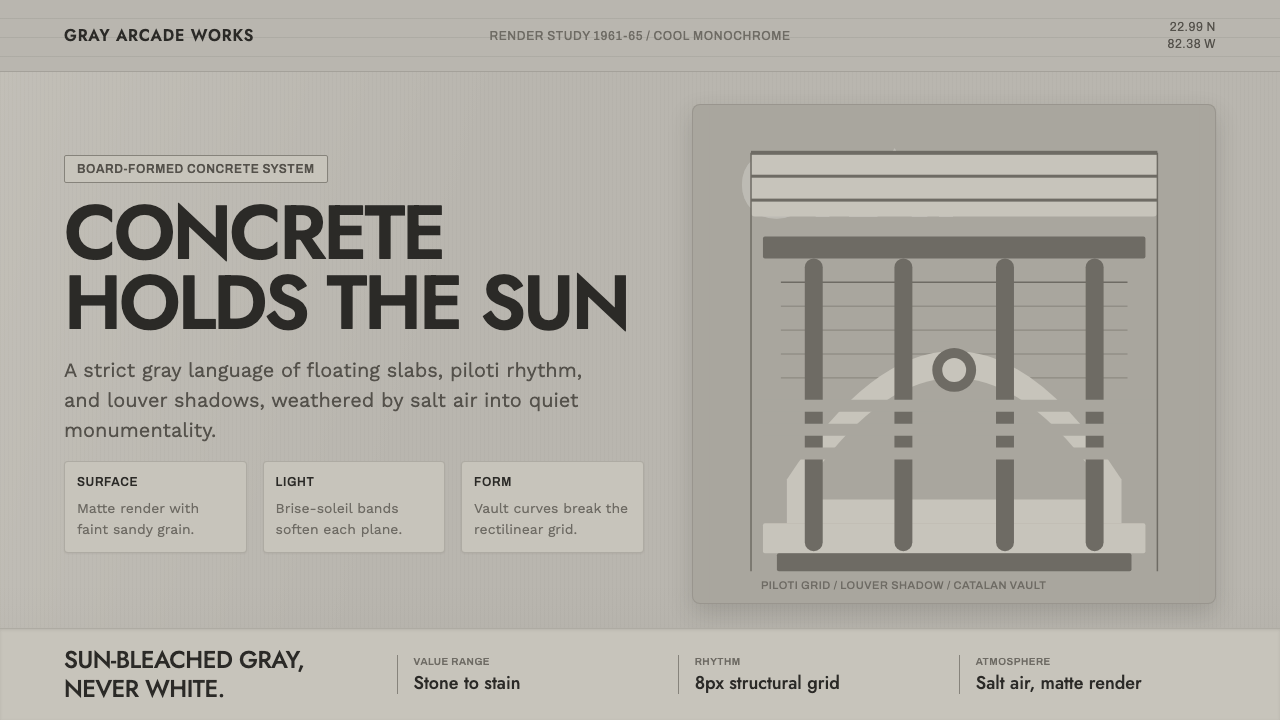 Havana Modernist GrayQuiet monumentality. Jost type, louver bands, and concrete grays hold tropica…