What is Dieter Rams / Braun?
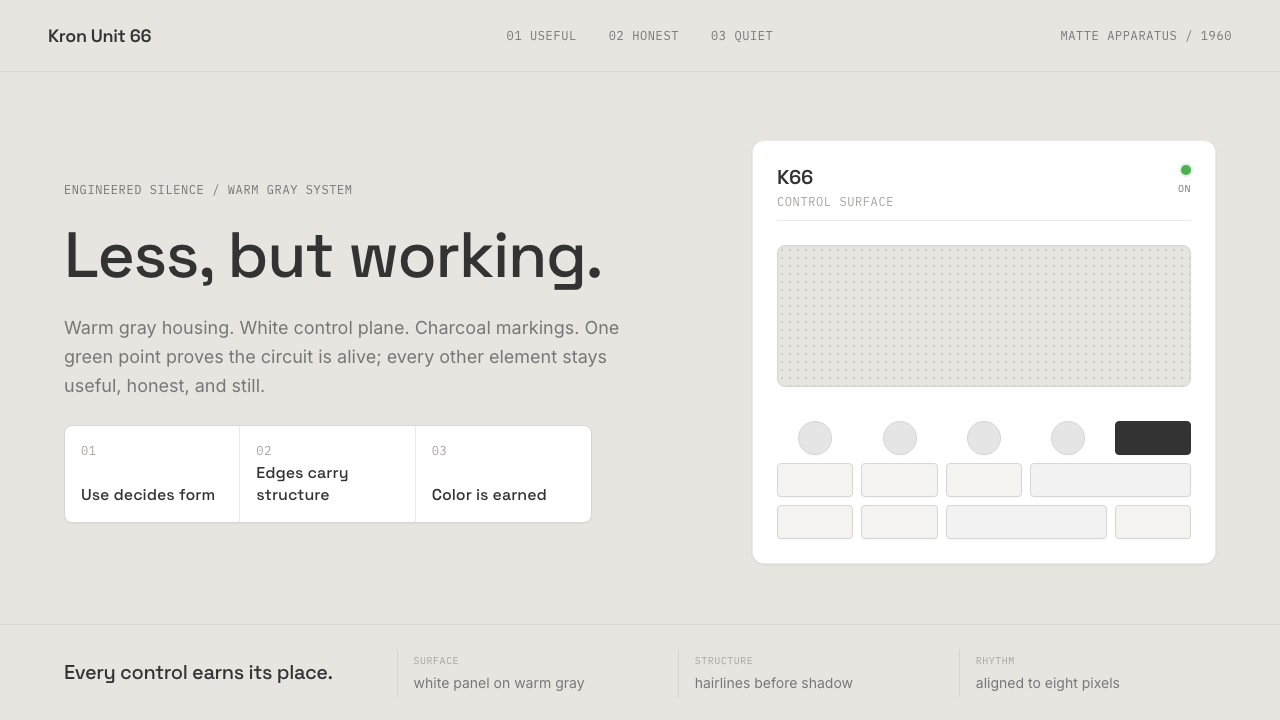
Dieter Rams spent forty years at Braun proving that restraint, not decoration, is the highest form of design intelligence.
Dieter Rams / Braun in brief
The Dieter Rams / Braun design language is a system of warm grays, pure white panels, charcoal text, and a single green indicator dot — the one moment color is permitted to speak. It emerged from the workshops of Braun GmbH in Kronberg im Taunus, West Germany, through a collaboration between Rams and a small team of designers who believed that a well-made object should communicate its function completely, modestly, and without performance. The visual vocabulary is rectangles and circles on a consistent grid, hairline borders doing the structural work that shadows would do elsewhere, and a matte surface quality that refuses to catch the light unnecessarily.
The aesthetic is inseparable from Rams's Ten Principles of Good Design, which he codified in the 1970s: good design is innovative, useful, aesthetic, understandable, unobtrusive, honest, long-lasting, thorough, environmentally friendly, and — the principle that underlies all the others — as little design as possible. Every Braun product, from the 1956 SK4 record player (nicknamed 'Snow White's Coffin' for its unprecedented clear acrylic lid) to the 1987 ET66 calculator, reads as a direct translation of these rules into physical form. Nothing is added that cannot justify its existence; nothing is removed that serves a purpose.
What distinguishes the Braun aesthetic from other modernist traditions is its specific warmth. The page ground is not cold clinical white but a warm functional gray — the color of matte plastic housing, of aluminum brushed in one direction, of the inside of a well-made appliance. White is reserved for panels and surfaces where content lives. This warm-gray / white / charcoal palette creates a system that is severe in principle but comfortable to inhabit over time, which is why its descendants — Apple's early hardware, MUJI's product line, countless SaaS dashboards — remain readable after decades.

Where does Dieter Rams / Braun come from?
Dieter Rams joined Braun as an architect and interior designer in 1955, the year the company's founders died and their sons Erwin and Artur Braun took over and committed to a radical new design direction. The timing placed Rams inside a company that was simultaneously grieving its founders and betting its future on the conviction that functional honesty could be a competitive advantage. His first major project, the SK4 record player designed together with Hans Gugelot in 1956, announced the new program clearly: matte white enamel housing, exposed speaker grille, a clear acrylic lid that let you see the turntable mechanism. It looked like nothing in consumer electronics had looked before.
The intellectual foundation came partly from the Ulm School of Design (Hochschule für Gestaltung Ulm), where Hans Gugelot taught and where the legacy of the Bauhaus had been absorbed and systematized into a more rigorous, less ideologically charged functionalism. HfG Ulm emphasized the relationship between design and engineering, rejected historicism, and trained graduates to think of visual form as a problem of communication and structure rather than expression. Rams shared these convictions and deepened them over four decades into a body of work whose consistency is itself a kind of argument: if you hold to the principles long enough, the catalog becomes its own demonstration.
The Ten Principles of Good Design, which Rams began articulating in lectures during the 1970s, emerged not as an abstract manifesto but as a retrospective description of what the Braun team had already been practicing. The principle that attracted the most attention — 'good design is as little design as possible' — was easily misread as an instruction to remove things. Rams's own explanation was more precise: design should not add to itself for its own sake; every element should serve communication, function, or structure, and nothing else. The German phrase he used, 'weniger, aber besser' — less, but better — became the single most quoted sentence in twentieth-century industrial design.
Rams retired from Braun in 1995, by which time the company's ownership had changed and its design direction had drifted from his principles. The second peak of his influence came in the early 2000s, when Jony Ive at Apple acknowledged Rams as a primary influence on the iPod, iMac, and eventually iOS. The ET66 calculator's button grid became iOS's calculator app almost wholesale. The SK4's matte white panels became the iMac G4. The Braun T3 pocket radio's proportions and control language migrated into the first iPod. This lineage made the Braun aesthetic newly legible to a generation of designers who encountered it through Apple before encountering it through Braun.
What defines the Dieter Rams / Braun look?
Warm Functional Gray
The page ground is not white but a specific warm gray — the color of matte plastic housing, brushed aluminum, the inside of a well-made appliance. This ground color distinguishes the Braun aesthetic from colder Scandinavian minimalism or clinical Swiss functionalism. White is reserved for panels and surfaces where content lives, creating a visual hierarchy between ground and figure before a single word or control is placed. The warmth is subtle enough that most viewers do not consciously register it; it works below the threshold of explicit perception, making the interface feel comfortable rather than harsh.
The Single Green Dot
Across every Braun product, the only high-saturation color is a specific mid-range green used exclusively as the power-on indicator. One dot, small enough to be a whisper, placed beside an active control or state. This discipline treats color as a resource with a strict budget: saturation may be spent exactly once per visual group, on the single most important signal in the interface. The effect is that the green dot becomes genuinely informative — the eye learns to find it and trust it — rather than one color among many competing for attention.
Grid Discipline
Every control, label, and panel in a Braun-derived layout aligns to a consistent base rhythm — a spacing unit small enough to be imperceptible but large enough to impose real discipline. The grid is felt rather than seen: no visible grid lines intrude, but the result of strict adherence is a composition where every element appears to belong exactly where it is. This is the visual equivalent of the ET66 calculator's button grid, where each key is the same size, occupies the same interval, and carries the same visual weight — the cumulative effect reads as engineered rather than arranged. Even a small departure from the grid registers as unease.
Hairline Borders Over Shadows
Depth and separation in the Braun system are communicated almost entirely through hairline borders in a warm mid-gray — fine enough to read as a decision rather than a feature. Shadows exist — the system uses them — but they are so restrained as to be barely perceptible: a faint flat drop no deeper than the lightest whisper of black on a default card surface, nothing more. The principle is that a border is a decision — a drawn line stating that here and there are different — while a soft shadow is a simulation of natural lighting, importing the logic of the physical world into a designed artifact. The Braun system prefers decisions to simulations.
Invisible Typography
Type in the Braun system is invisible by design. Braun products historically used neutral, industrial grotesques whose letterforms step back from what they carry and let content speak. In digital applications, the same principle applies: weight stays in the medium range, tracking is neutral or very slightly tight at display sizes, and there are no custom letterforms, no display personalities, no decorative choices in the typographic system. The measure and leading are generous — enough breathing room that the reader never notices the container, only the content.
Matte Materiality
No glassmorphism, no frosted blur, no gradient fills, no specular highlights. The Braun system is constitutively matte — surfaces absorb rather than reflect, which is both a formal commitment (the physical products were all matte plastic or brushed aluminum) and a philosophical one: a surface that reflects its environment calls attention to itself as a surface, which is precisely what the 'unobtrusive' principle forbids. In digital work, this means solid fills, no blur effects, and shadow values so low they read as structural information rather than lighting drama.
Earned Restraint
The Braun aesthetic is sometimes confused with minimalism — a style that removes things for the sake of visual quietness. The distinction matters: Rams's restraint is earned by function. Every element that remains does so because it serves a specific communicative or structural purpose. The restraint is the result of a process of justification, not a starting aesthetic preference. This means that an interface that slavishly removes elements in pursuit of 'Braun-ness' will fail just as surely as one that adds decorative noise — the question is not how many elements are present, but whether each element earns its place.

Who shaped Dieter Rams / Braun?
Rams joined Braun in 1955 and led its design department until 1995, producing a catalog of consumer electronics whose visual and functional consistency across four decades is unmatched in industrial design history. His Ten Principles of Good Design, codified in the 1970s, remain the most cited framework in product design education worldwide. Beyond Braun, he designed the Vitsoe 606 Universal Shelving System in 1960 — still in production, unchanged — which applies the same principles to furniture: modular, honest, made to outlast fashion.
Gugelot was a Swiss-German designer and faculty member at HfG Ulm who collaborated with Rams on the landmark SK4 record player in 1956. His training at the Ulm School bridged the Bauhaus tradition and a more rigorous systems-thinking approach to product design. Gugelot introduced the logic of modular components and repeatable units — the idea that a product family should be a system, not a collection of individual objects — which became foundational to how Braun approached its entire catalog.
Lubs joined Braun in 1962 and worked alongside Rams for decades, becoming his closest long-term collaborator. His most celebrated contribution is the ET66 calculator of 1987, whose grid of differentiated buttons — white for digits, gray for operations, a single orange equals key — is a masterclass in using color discipline and spatial rhythm to make a complex control surface self-explanatory. The ET66 is the product most directly absorbed by Apple's iOS Calculator, and Lubs's systematic approach to UI organization prefigures what digital product design would later call information architecture.
Eichler was Braun's head of product design and cultural programs from the mid-1950s and played a crucial but often overlooked institutional role: he was the person who created the conditions inside Braun that allowed Rams's design thinking to flourish. Where Erwin and Artur Braun provided ownership-level commitment to design, Eichler provided the organizational and cultural framework — hiring Rams, establishing the design department's authority relative to engineering and marketing, and articulating the company's design philosophy to the outside world.
Ive is not a Braun designer, but his public acknowledgment of Rams as his primary design influence — and the documentary evidence visible in Apple's early 2000s product designs — makes him the pivotal figure in the Braun aesthetic's global transmission. The iPod, iMac G4, MacBook, and iOS interface each borrow specific visual decisions from specific Braun products. Through Apple's market reach, the Braun design language became the primary reference for an entire generation of digital product designers who encountered its logic before encountering its source.
How do you use Dieter Rams / Braun today?
Applying the Braun aesthetic to presentation slides requires understanding the difference between emptiness and earned restraint. A cover slide in this system does not place a hero image or a gradient backdrop; it uses the warm gray ground, a white content panel, and the title in a medium-weight grotesque at generous scale, with nothing else competing for attention. Section divider slides work as pure typographic statements — a large section number in charcoal against warm gray, the section title in a smaller weight below. The goal on every slide is to make the content, not the design, the most memorable thing in the room.
For data slides, treat charts and tables as geometric objects subject to the same grid discipline as everything else. Bars in a bar chart align to the base rhythm; axis labels appear in the same neutral weight as body text; the single green accent highlights the most important data series — but only one series, never two. Pie charts become circle diagrams where segments are filled in the warm gray, white, and charcoal palette, with a single green segment for the value the presenter wants the audience to carry away. This discipline forces clarity about what the data is actually arguing.
For web UI — dashboards, pricing pages, settings interfaces — the Braun approach requires defining a strict grid before touching visual design. A multi-column layout at a wide fixed container width, with generous gutters and components snapping to a consistent small-unit rhythm. The background is warm gray; all card and panel surfaces are white; borders are hairline at the warm neutral default; shadows are present but at the minimum value that communicates elevation. Navigation is typographic, not iconographic — labels and wordmarks rather than pictograms. The single green accent is reserved for active states, the currently selected item, and primary call-to-action buttons on critical conversion paths.
For editorial layouts and marketing pages, the style operates like a very good Swiss grid without the coldness. Long-form article pages use a narrow comfortable measure for body text with generous leading, a wide side margin for annotations or pull quotes in the muted secondary text color, and section breaks marked by a hairline rule rather than any decorative element. Marketing pages with multiple feature sections work well with alternating grounds — warm gray for context sections, white panels for feature content — using the consistent spacing rhythm to create visual breathing room between claims. The voice of the layout should feel like a well-made product, not a promotional poster.
The most common mistake when applying this style is confusing Braun restraint with visual emptiness and then compensating by adding trendy decorative elements to make it feel modern. Glassmorphism, gradient meshes, animated particle backgrounds, or oversized custom illustrative icons all violate the fundamental commitment to material honesty and unobtrusiveness. A second common error is using the warm gray palette as an excuse to de-emphasize all hierarchy — making everything the same quiet weight — so that the interface becomes hard to scan. The Braun system is restrained in decoration and decisive in hierarchy: headings are substantially larger than body text, primary actions substantially darker than secondary ones, and the single green accent reserved for the most important signal on screen.

Dieter Rams / Braun — FAQ
Is the Braun aesthetic the same as minimalism?
Not exactly. Contemporary minimalism is primarily a visual preference — a taste for emptiness, whitespace, and reduced visual stimulus. The Braun aesthetic is a functional doctrine: every element either earns its place by serving communication or structure, or it is removed. The distinction produces different results in practice. A minimalist designer might remove a label from a control to increase visual silence; a Braun-principled designer would keep the label because it serves function, and remove only the decorative border around the label. The results can look similar from a distance, but the reasoning — and therefore the behavior at the edges — is different.
Can this style work for a consumer brand, or is it only suitable for B2B and tools?
The Braun aesthetic works well in consumer contexts where trust, precision, and long-term quality are the primary brand values — premium audio hardware, precision instruments, professional-grade tools, design-forward direct-to-consumer products. It struggles in contexts requiring warmth, playfulness, or sensory richness: food, children's products, wellness brands, fashion. The useful test is to ask whether the product's core promise aligns with the values the aesthetic communicates: honesty, precision, quiet confidence, durability. If those are the values the brand wants to project, the style will carry them. If the brand promise is warmth, joy, or spontaneity, a different aesthetic vocabulary will serve better.
What is the correct way to use the green accent in digital interfaces?
The Braun green functions as an ON indicator — it signals active state, selection, or the single most important interactive signal on a given screen. The rule is one green element per visual group. In a navigation bar, the current page indicator gets the green dot; no other element in the nav does. In a form, the focused input border turns green; no other border does simultaneously. On a pricing page, the recommended tier card has a green accent; the others remain in the neutral palette. Using green for more than one state simultaneously — or as a general positive color for success messages, healthy statistics, and active toggles all at once — collapses the system's signal-to-noise ratio and makes the accent meaningless.
How does the Braun style relate to Apple's design language?
The relationship is well-documented and acknowledged by Apple's longtime design chief Jony Ive, who cited Rams as his primary influence. Specific Braun products map to specific Apple products: the ET66 calculator's button grid is the direct ancestor of iOS Calculator; the T3 pocket radio's proportions and material treatment prefigure the first iPod; the SK4 record player's white enamel and clear lid appear transformed in the iMac G4. Apple's departure from these origins became visible in the post-Ive era, with more gradient, more specular surface, and more expressive motion — choices that Rams himself has publicly criticized as departures from good design. The Braun aesthetic today occupies the position Apple's hardware once held: the clearest available reference for functional beauty in product design.
Does this style work well in dark mode?
A dark inversion of the Braun palette is possible but requires care. The canonical warm gray ground should invert to a warm dark — a very dark brown-gray rather than a neutral or blue-tinted black — to preserve the material warmth that distinguishes the system from colder dark-mode treatments. White surfaces become very dark charcoal panels; the hairline border color shifts to a lighter warm gray; body text becomes near-white but not pure white, to preserve the visual relationship between text and panel. The single green dot remains — it is perhaps even more powerful on a dark ground, where its scarcity is more visible. The trap to avoid is inverting the palette to something that looks like a standard dark-mode template: blue-black backgrounds, bright blue or purple accents, and white text with no warmth. That violates the foundational material identity of the system.
Related design styles
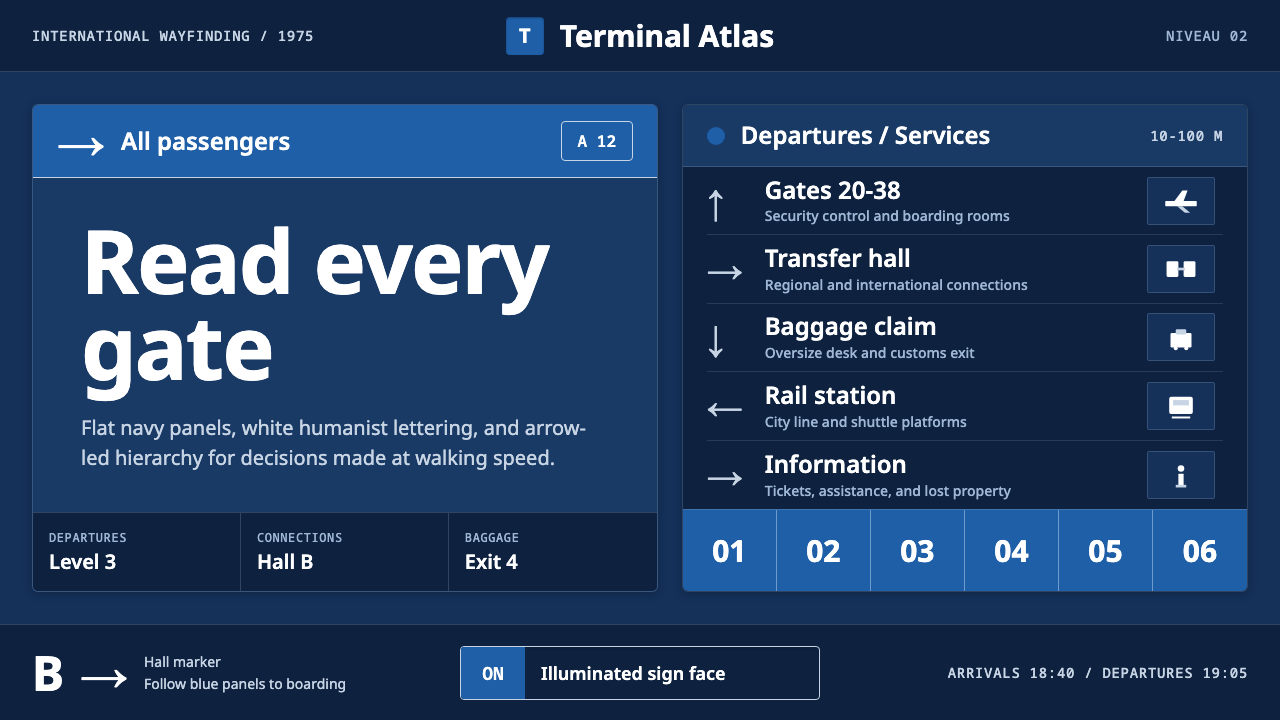 Frutiger CDG AirportLegibility at runway scale. Navy panels, white humanist sans, arrow-led grids.
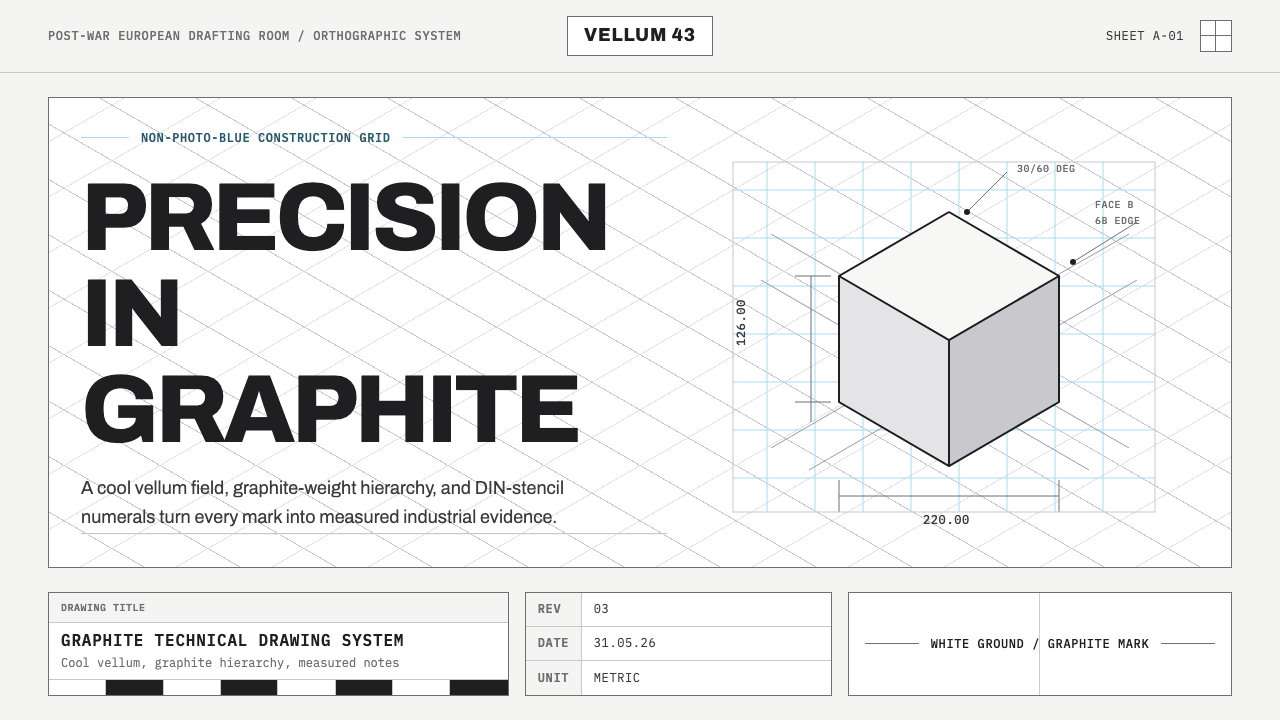 Graphite Technical DrawingDrafting-room precision. Non-photo-blue grid and graphite DIN lettering do th…
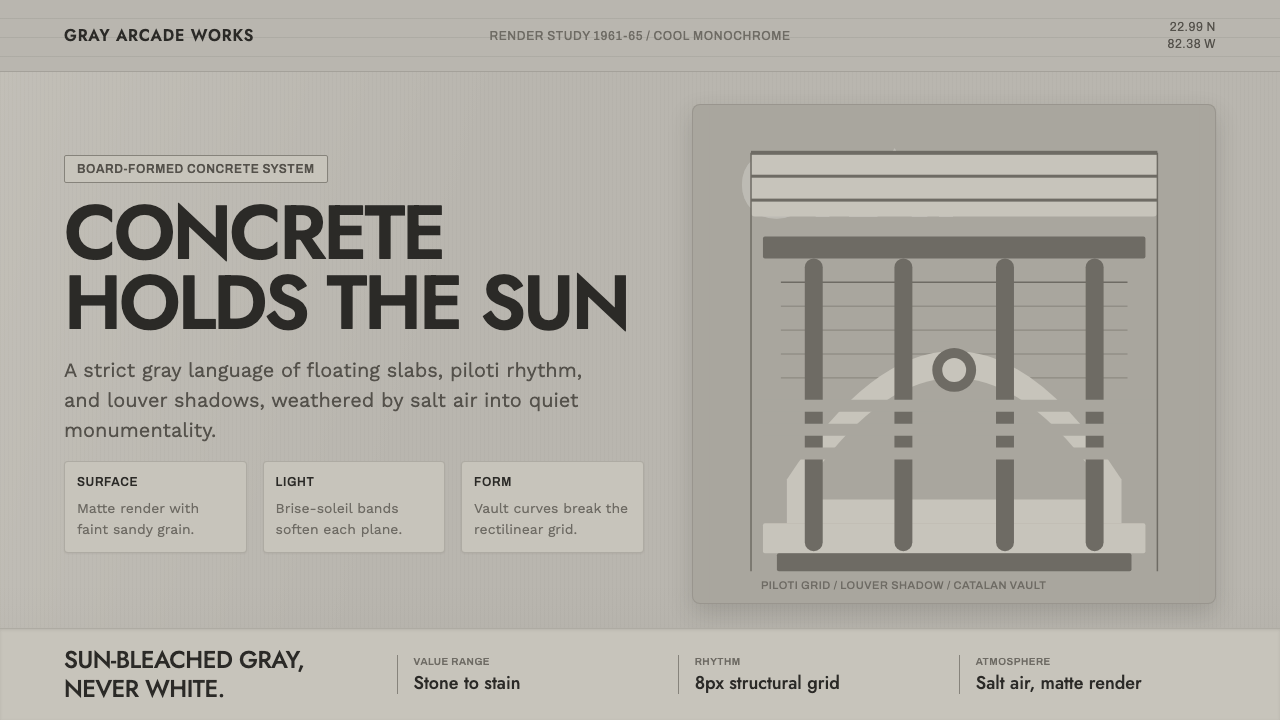 Havana Modernist GrayQuiet monumentality. Jost type, louver bands, and concrete grays hold tropica…
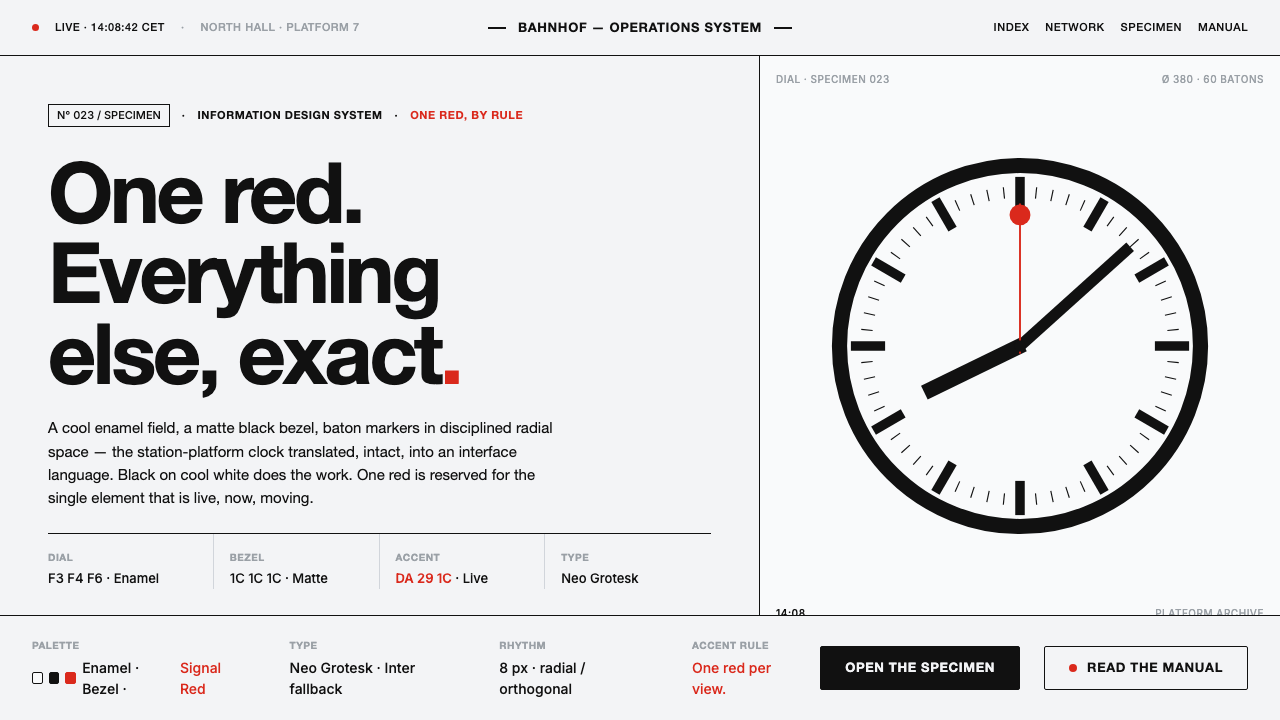 Hilfiker Railway ClockEverything exact, one thing live. Black hands on cool enamel white — one red…
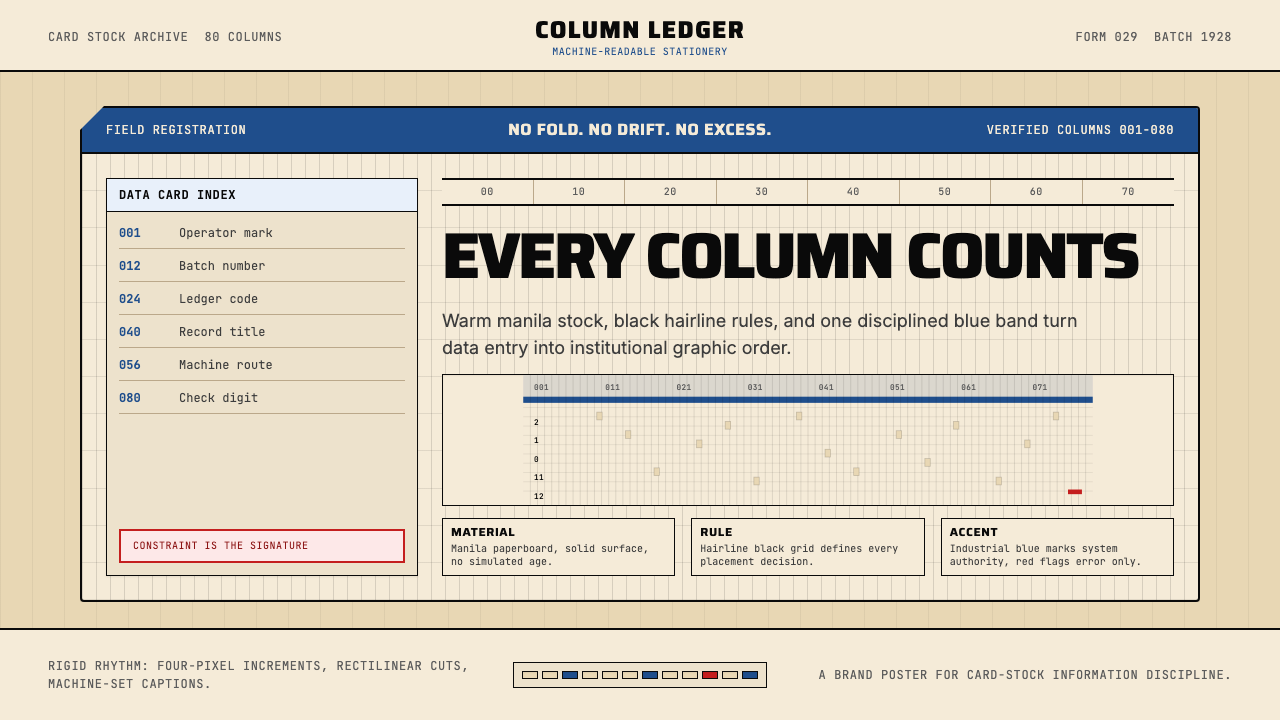 IBM Punchcard 029 (1928)Constraint becomes authority. Manila stock, hairline grid, industrial blue.
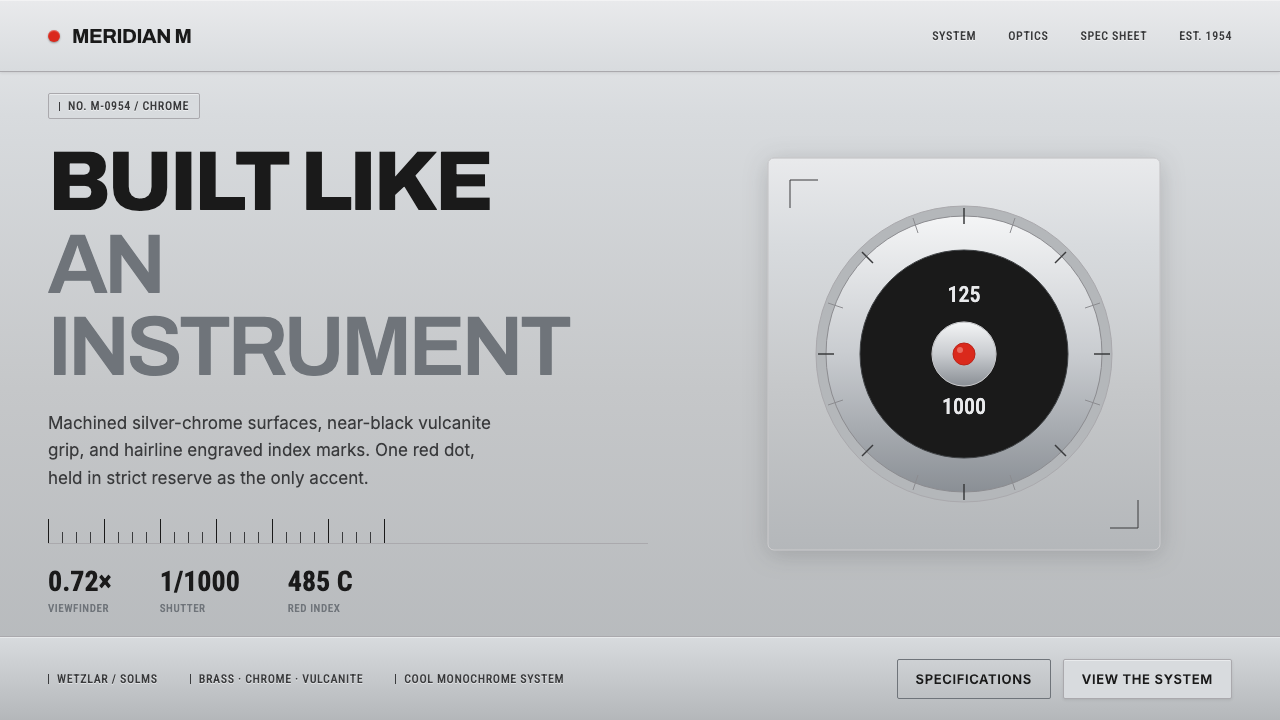 Leica M Silver ChromeBuilt like an instrument. Brushed silver-chrome on near-black vulcanite, one…