What is Electrical Schematic Wiring?
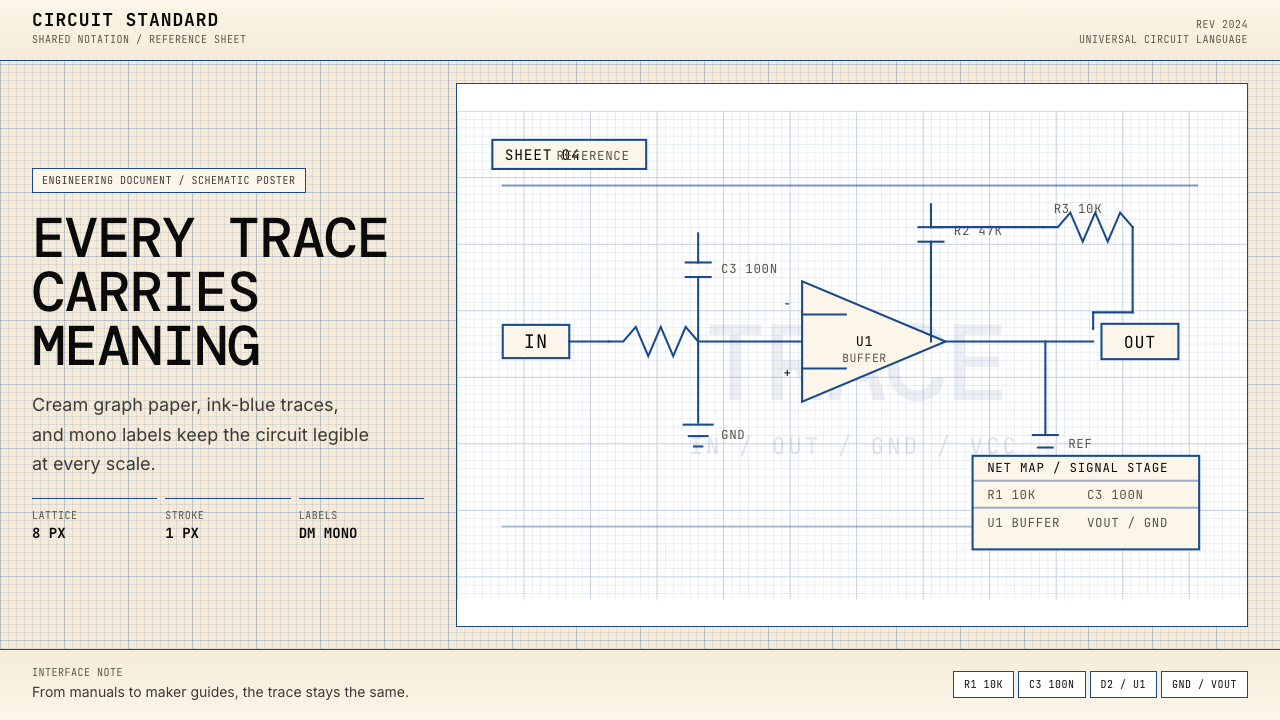
The electrical schematic is engineering's oldest universal visual language — and its austere grammar of hairline traces, monospace labels, and graph-paper cream turns technical precision into a design system of unexpected elegance.
Electrical Schematic Wiring in brief
Electrical Schematic Wiring is a design language derived from the visual conventions of engineering circuit diagrams — the standardized graphic vocabulary that electrical engineers have used since the early twentieth century to communicate how circuits are connected and how components relate to one another. In its design application, the system translates that tradition into a complete aesthetic: graph-paper cream or off-white backgrounds, ink-blue hairline connections, monospace component labels, and the stripped-back clarity of an engineering document where every mark carries meaning.
Unlike decorative or expressionist styles, this language is rooted in function. Every symbol in a real schematic — the zigzag of a resistor, the parallel lines of a capacitor, the triangle of a diode — was standardized precisely because ambiguity is dangerous in a wiring diagram. That principle of zero ambiguity carries directly into the design system: nothing is included for visual richness alone. Backgrounds stay flat, connections are drawn at right angles, and labels are set in monospace type so that every character occupies the same width and nothing visually misleads.
The result is an aesthetic that reads as both rigorously technical and strangely warm. The grid-paper background, the pale ink-blue palette, and the precise labeling recall the hand-drawn circuit boards of mid-century electronics kits — a world of Heathkit manuals and laboratory bench diagrams that carries a nostalgic authority. Applied to contemporary digital work, this visual language signals precision, trustworthiness, and a maker-culture respect for how things actually work.

Where does Electrical Schematic Wiring come from?
The standardized vocabulary of electrical schematics emerged alongside the electrical engineering profession itself. By the 1920s, as radio, telephony, and power distribution expanded rapidly across the industrialized world, engineers in different countries and companies found themselves unable to read each other's diagrams — a practical crisis that demanded a solution. Standards bodies in the United States, Britain, and Germany began producing formal symbol sets, and by the mid-twentieth century, the International Electrotechnical Commission (IEC) and the Institute of Electrical and Electronics Engineers (IEEE) had established the frameworks that persist to this day. IEEE-315, published in 1975, and IEC 60617, formalized in 1983 and revised through 2024, are the twin pillars of the modern schematic vocabulary.
The visual character of the schematic diagram was shaped as much by its production medium as by its logical content. Before digital tools, schematics were drawn by hand on graph paper — the grid providing a registration system that kept connections orthogonal and spacing consistent. Ink was applied with ruling pens, and components were drawn with stencils or Letraset symbol sheets. The graph-paper grid, the hairline trace, the monospace lettering of hand-set labels — these were not aesthetic choices but practical consequences of the medium. When computer-aided design (CAD) tools replaced drafting tables beginning in the 1980s, they preserved these conventions because the engineers using them found them legible and trusted.
The post-World War II consumer electronics kit culture gave schematic diagrams their widest popular reach. Companies like Heathkit in the United States and Maplin in the United Kingdom sold radio sets, oscilloscopes, and hi-fi amplifiers as kits of components, with detailed assembly manuals built around schematic diagrams. These manuals introduced the schematic's visual grammar to millions of hobbyists who were not professional engineers. The Heathkit aesthetic — cream paper, blue-black ink, clean component symbols, precise numerical labels — became a cultural touchstone for a generation of electronics enthusiasts. Paul Horowitz and Winfield Hill's textbook The Art of Electronics, first published in 1980, carried this tradition into the university curriculum and helped cement the schematic's look as the de facto visual language of electronics education.
The maker and Arduino movements of the 2000s and 2010s triggered a broad resurgence of schematic culture. Open-source hardware projects published their designs as public schematics, introducing the vocabulary to a new generation of designers, software engineers, and product builders who might never have encountered it in formal training. Design tools like Fritzing and KiCad made schematic authoring accessible to non-engineers. At the same time, a parallel nostalgia for mid-century technical aesthetics emerged in graphic design — the same period that revived letterpress printing, technical illustration, and blueprint-style graphics. Electrical Schematic Wiring as a design style sits at the intersection of these two currents: genuine technical heritage reinterpreted through a contemporary design lens.
What defines the Electrical Schematic Wiring look?
Ground Color
The background is always a warm off-white or graph-paper cream — never pure white and never a dark ground. This tone references the physical graph paper that engineers used for hand-drawn schematics, and it sets a low-contrast, easy-to-read field against which ink-blue and dark lines register cleanly. The slight warmth keeps the overall palette from feeling sterile or clinical.
Trace Color and Line Weight
Connection lines — the traces — are drawn in a muted ink-blue, close in character to the color of technical drafting ink. This hue is neither the saturated primary blue of a UI accent nor a neutral gray; it sits at a precise tonal point that reads as deliberate and technical. Line weight is consistently thin, suggesting the hairlines of a ruling pen or a fine technical pen. All connections meet at right angles, reinforcing the orthogonal discipline of the grid.
Component Symbols
The vocabulary of standardized schematic symbols — resistor zigzags, capacitor parallel bars, inductor loops, diode triangles, ground rails — appears as decorative and structural elements simultaneously. Each symbol is drawn at the same stroke weight as the connecting traces, so the diagram reads as a single unified graphic system rather than a collection of icons placed on a line drawing. Used as ornament or texture in non-engineering contexts, these symbols carry strong associative weight: precision, technical authority, and maker culture.
Monospace Typography
All text — component reference designators, values, node labels, title blocks — is set in monospace type. The choice is not arbitrary: in real schematics, monospace lettering ensures that labels align vertically and that no character is ambiguous in width. In the design system, monospace type carries the connotation of terminal output, embedded firmware, and engineering notation. It signals that the content is data, not prose, and that every character is meaningful.
Grid Structure
The graph-paper grid is either subtly visible as a very light background ruling or implied by the strict orthogonal alignment of all elements. In either case, the grid is not decoration — it is the organizational skeleton of the entire composition. Elements snap to grid intersections; traces run along grid lines; spacing between components is a consistent multiple of the grid unit. This systematic regularity is what distinguishes the style from retro or novelty aesthetics: the grid is load-bearing.
Sparse Notation and Annotation
Real schematics use just enough labels to identify each component and its value — nothing more. Applied to design, this principle becomes a compositional rule: white space is generous, labels are minimal and precisely placed, and there is no explanatory text that could be removed without loss. The aesthetic effect is a kind of calm legibility — the diagram does not shout for attention but rewards careful reading.
Restrained Accent Color
Beyond the ink-blue traces and cream ground, color is used only as functional accent — to highlight a specific signal path, mark a component under test, or draw the eye to a critical node. When accent color appears, it is a single muted tone: a warm amber, a signal green, or a cautionary red, each used sparingly and with clear communicative purpose. No gradient, no glow, no decorative blending. If a second accent appears at all, it performs a distinct function from the first.

Who shaped Electrical Schematic Wiring?
The IEEE-315 standard, published in 1975, is the document that locked in the graphic symbols and drawing conventions used in North American electrical schematics. Its committee work represented decades of negotiation between manufacturers, universities, and government agencies — all of whom needed to read each other's diagrams without ambiguity. The standard is the invisible author of every American schematic's visual character: the way a resistor is drawn, how a ground symbol is oriented, what a node dot means. As a design system, Electrical Schematic Wiring inherits this committee's decisions as its foundational grammar.
Heathkit, founded in 1926 and at its peak through the 1950s and 1970s, sold electronic kits that introduced schematic reading to an entire generation of American hobbyists. The company's assembly manuals were models of technical communication: step-by-step instructions built around clear, consistently styled schematics. The visual character of Heathkit documentation — cream paper, precise ink-blue line work, legible monospace labels, generous whitespace — is the direct ancestor of the Electrical Schematic Wiring design aesthetic. The brand's cultural weight is significant: Heathkit represented a time when consumers were expected to understand their devices, not merely consume them.
Paul Horowitz, a physicist and electronics educator at Harvard, co-authored The Art of Electronics with Winfield Hill — first published in 1980 and revised in 2015. The book is arguably the most widely read electronics textbook ever written, and its schematic-heavy pedagogy shaped how two generations of engineers and hobbyists learned to visualize circuits. Horowitz's diagrams are notable for their clarity and their careful balance of information density: dense enough to be complete, spare enough to be readable. The book's schematic style — its use of consistent symbol sizing, orthogonal layout, and annotated node labels — is a direct influence on the design language this system codifies.
The Arduino project, launched in 2005 at the Interaction Design Institute Ivrea in Italy, democratized microcontroller programming and, with it, schematic literacy. Arduino's open-source hardware model meant that every board design was published as a public schematic, viewable and modifiable by anyone. This created an enormous new audience for schematic conventions — designers, artists, students, and software engineers who encountered circuit diagrams not through engineering school but through creative coding and physical computing communities. The aesthetic associations of schematics shifted: from exclusively technical documentation to a visual signifier of open, collaborative, maker culture.
Where IEEE-315 governs North American practice, IEC 60617 — developed by the International Electrotechnical Commission and formalized in 1983, with continuous revision through 2024 — defines the schematic symbol vocabulary used across Europe, Asia, and international industrial contexts. The two standards differ in specific symbol forms: a European resistor is drawn as a rectangle, while an American resistor uses the familiar zigzag. These divergences have created two parallel schematic visual dialects, both of which are part of the Electrical Schematic Wiring design heritage. Awareness of the distinction matters when choosing which symbol vocabulary to deploy for a specific audience or cultural context.
How do you use Electrical Schematic Wiring today?
Electrical Schematic Wiring translates most directly into design contexts where technical credibility, precision, and a maker-culture sensibility are desired values. The key to applying it correctly is understanding that every visual decision in a real schematic diagram has a functional justification — and that the design system works by preserving that discipline even when the underlying content is not a circuit. Elements that would be decorative in other styles here serve as structural notation; whitespace is not emptiness but signal separation; monospace type is not a stylistic choice but a legibility requirement.
For presentation slides, the style works exceptionally well for product demos, technical briefings, and data-heavy decks. A cover slide can be built around a simplified schematic fragment as background texture — traces and component symbols rendered faintly beneath the title, evoking a circuit board without obscuring the headline. Content slides should commit to the grid fully: one organizing line of ink-blue at the top, type set in a clean monospace or mono-adjacent face, and data visualized as diagrammatic objects rather than softly styled charts. Tables of specifications read naturally in this style. Avoid the temptation to add photography or gradient fills; the style's authority comes from its restraint.
For web interfaces and dashboards, the schematic aesthetic is well-suited to developer tools, infrastructure monitoring platforms, IoT dashboards, and any product that needs to communicate technical seriousness without sacrificing clarity. The approach: a cream or very light warm-gray background, ink-blue or dark charcoal for structural lines and borders, and monospace type for all data values and labels. Interactive states can use a single amber or green accent drawn from signal-indicator conventions. Card components should have visible borders rather than soft shadows; hover states should shift the border color rather than add glow. The grid should be explicit and regular, not fluid or responsive in ways that break orthogonal alignment.
For editorial and marketing applications, the style supports strong technical positioning. A landing page for a hardware product, developer API, or industrial software can use schematic fragments as section dividers or hero backgrounds — the component symbols functioning as a visual shorthand for how things work. Pricing pages benefit from the style's diagrammatic clarity: tiers differentiated by a single accent color, features listed in monospace type, borders rather than shading to define table regions. For printed materials, the style performs well at large format: posters and specification sheets where the graph-paper grid is allowed to show as a fine background ruling develop a distinctive and authoritative presence.
A common mistake is treating the schematic style as simply a palette choice — applying the cream background and ink-blue color without committing to the underlying structural discipline. The style breaks down when it mixes soft shadows with hard-edged traces, when it uses proportionally-spaced type for labels that should be monospace, or when decorative elements are added that have no functional analog in a real schematic. The other frequent error is overloading the composition with symbol density — packing in component glyphs as texture until the result reads as busy rather than precise. Real schematics are generous with whitespace; the design system should be too.
The style is less suited to contexts that require warmth, organic texture, or emotional softness — consumer lifestyle products, food and beverage brands, wellness applications, or any interface where the primary tone is inviting rather than authoritative. It is also a poor fit for purely decorative or fashion-adjacent design work where technical connotations would feel out of place. Within its natural domain, however, it offers something genuinely rare: an aesthetic with a verifiable historical and functional origin, where every convention can be explained and justified.

Electrical Schematic Wiring — FAQ
Do I need to use actual circuit symbols, or can I abstract the aesthetic?
Both approaches are valid, but they produce different results. Using recognizable schematic symbols — resistor zigzags, capacitor bars, ground rails — anchors the design in a specific technical tradition and reads immediately to anyone with electronics experience. Abstracting to just the grid, orthogonal lines, monospace type, and cream-plus-ink-blue palette is subtler and more broadly applicable, but loses some of the style's most distinctive associative power. The choice should follow the audience: if technical credibility is the goal and the audience is engineers or makers, use the real symbols. If the technical associations are a secondary tone in a more general design context, the abstracted version is less likely to feel niche.
Can this style work with color photography or rich imagery?
With care, yes — but it requires treating photography as a flat, diagrammatic element rather than a naturalistic window. The schematic style works well with high-contrast, desaturated, or duotone photography where the image feels like a technical artifact rather than an ambient scene. A product photograph shot cleanly against a white or cream ground, or an engineering photo converted to a cool-toned duotone in ink-blue and cream, can integrate without disrupting the system's logic. What breaks the style is soft, warm, ambient photography treated as a full-bleed background — that kind of imagery imports naturalistic depth that contradicts the flat, orthogonal discipline the rest of the composition depends on.
How do I avoid the style reading as purely retro or nostalgic?
The schematic style tips into nostalgia when its vintage signals — graph-paper texture, hand-drawn component symbols, aged paper tones — are emphasized over its structural logic. To keep it feeling current rather than retro, prioritize the functional principles: rigorous grid alignment, information-first composition, monospace type used for genuine data legibility rather than decoration, and minimal use of texture. Digital-native elements — clean vector component symbols at crisp resolution, precise hairline traces without ink bleed, consistent modular spacing — keep the style in the present. Reserve the warmest cream tones and any aged-paper effects for contexts where the nostalgic reading is intentional.
Is there a difference between the American and European schematic symbol sets, and does it matter for design?
Yes, there is a real and visible difference. The most recognizable divergence is the resistor: American schematics use a zigzag line (IEEE-315), while European and international schematics use a small rectangle (IEC 60617). Other symbols differ too — inductor coils, capacitor variants, and some logic gate shapes vary between the two systems. For design purposes, the choice of symbol vocabulary is partly an aesthetic decision and partly an audience signal. The zigzag resistor reads as distinctly American and carries associations with mid-century hobbyist culture; the rectangular resistor reads as more globally industrial. Neither is more correct for design use — the choice should reflect the cultural context the design is addressing.
Does the style suit dark mode, or is it inherently light-background only?
The historical schematic is unambiguously a light-background form — real schematics are drawn on white or cream paper, and the visual logic of ink-on-paper is foundational to the aesthetic. A dark inversion is possible but should be approached as a deliberate reinterpretation rather than a direct inversion. On a dark background, the cream ground becomes a very dark warm neutral, ink-blue traces become a lighter cool-blue or pale cyan, and monospace labels appear in light cream or off-white. The graph-paper grid, if shown, should be very subtle — barely distinguishable from the background. Component symbols work in this inverted palette, but the style loses some of its warmth and archival authority. Dark mode works best for interfaces where the technical and contemporary readings are more important than the historical and nostalgic ones.
Related design styles
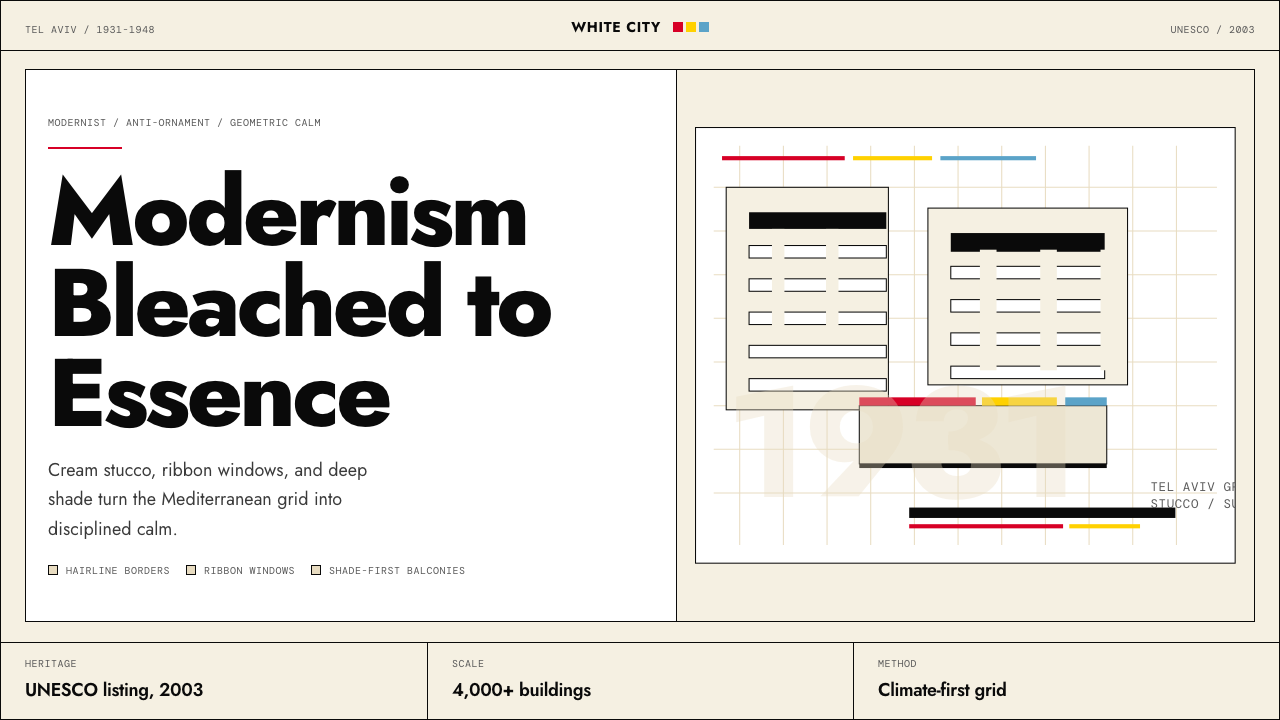 Israeli Bauhaus Tel Aviv (White City)Austere urban modernism. Stucco-white grid, Jost type, hairline borders, and…
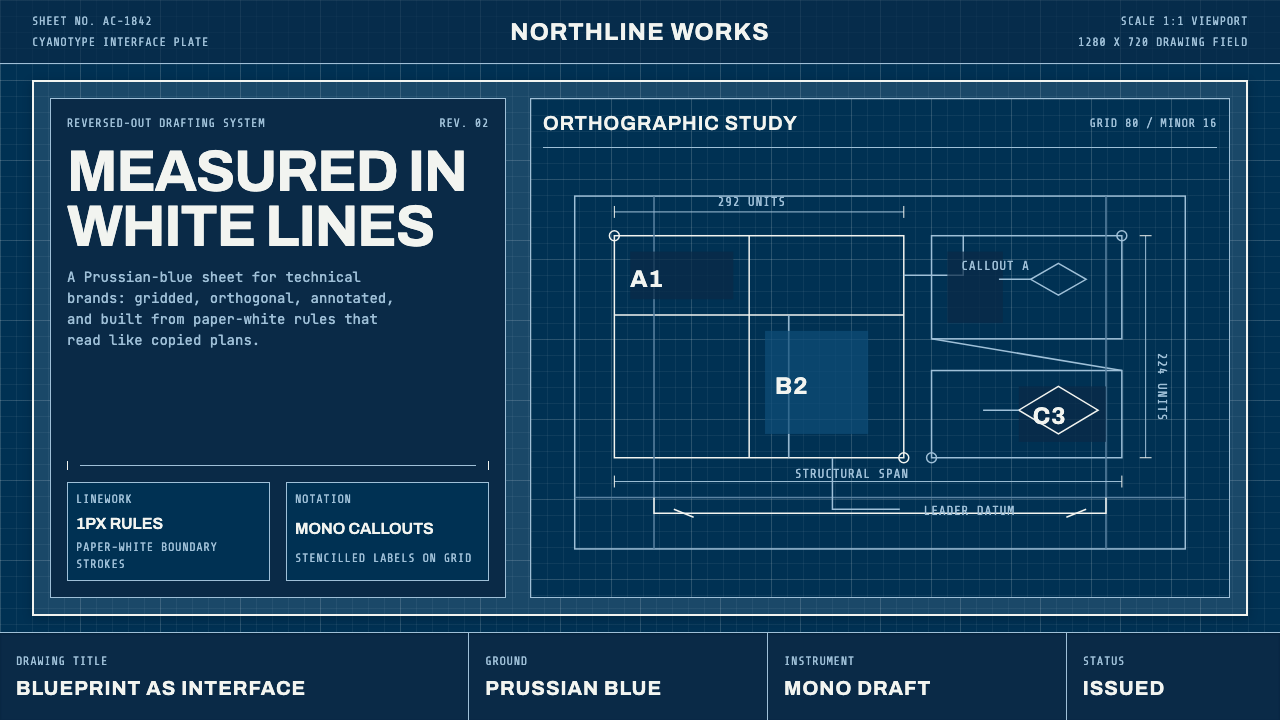 Architect CyanotypePrecision in negative. Prussian blue ground, paper-white grid, mono dimension…
 Brilliant Cut Facet DiagramOptics becomes blueprint. Cyan facet lines and ray paths glow on dark teal.
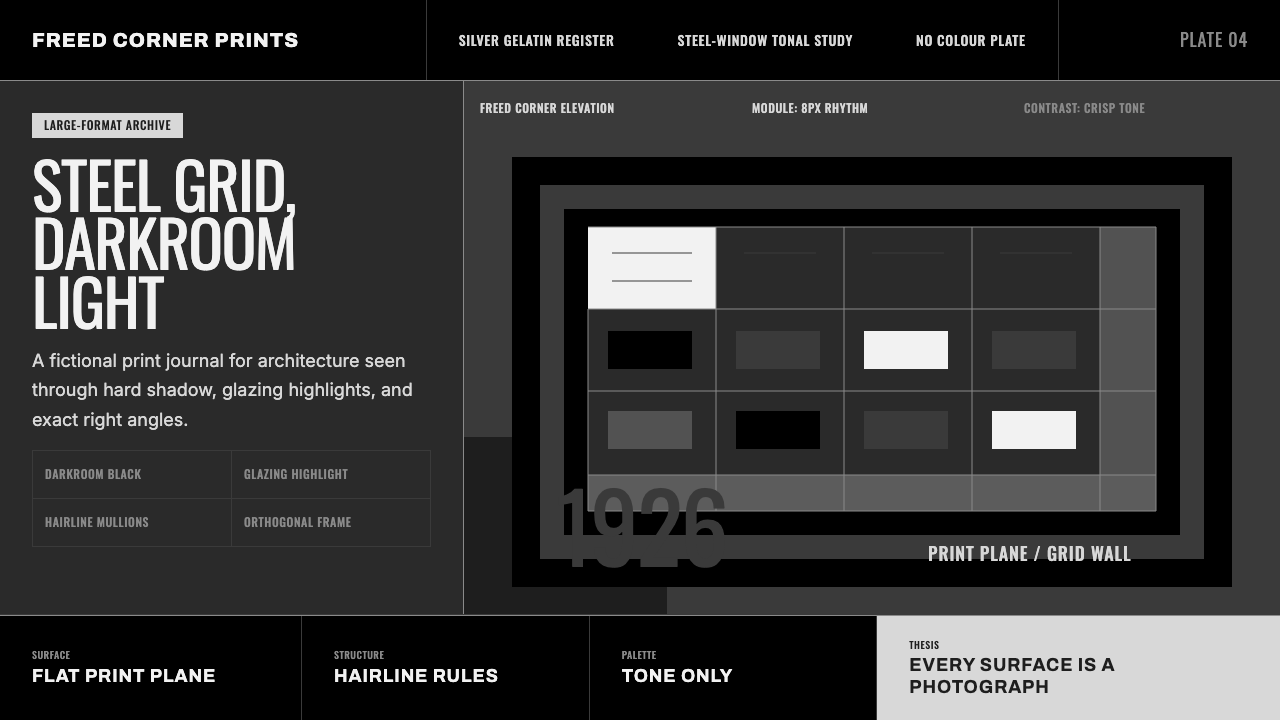 Dessau GrayscaleAustere monochrome authority. Darkroom black, glazing gray, and a steel-windo…
 Dieter Rams / BraunQuiet by design. Warm gray, white panels, hairline grids, and one earned gree…
 DIN 1451 SignageAuthorless and exact. Enamel gray grid, traffic-white DIN type, and RAL signa…