What is Israeli Bauhaus Tel Aviv (White City)?
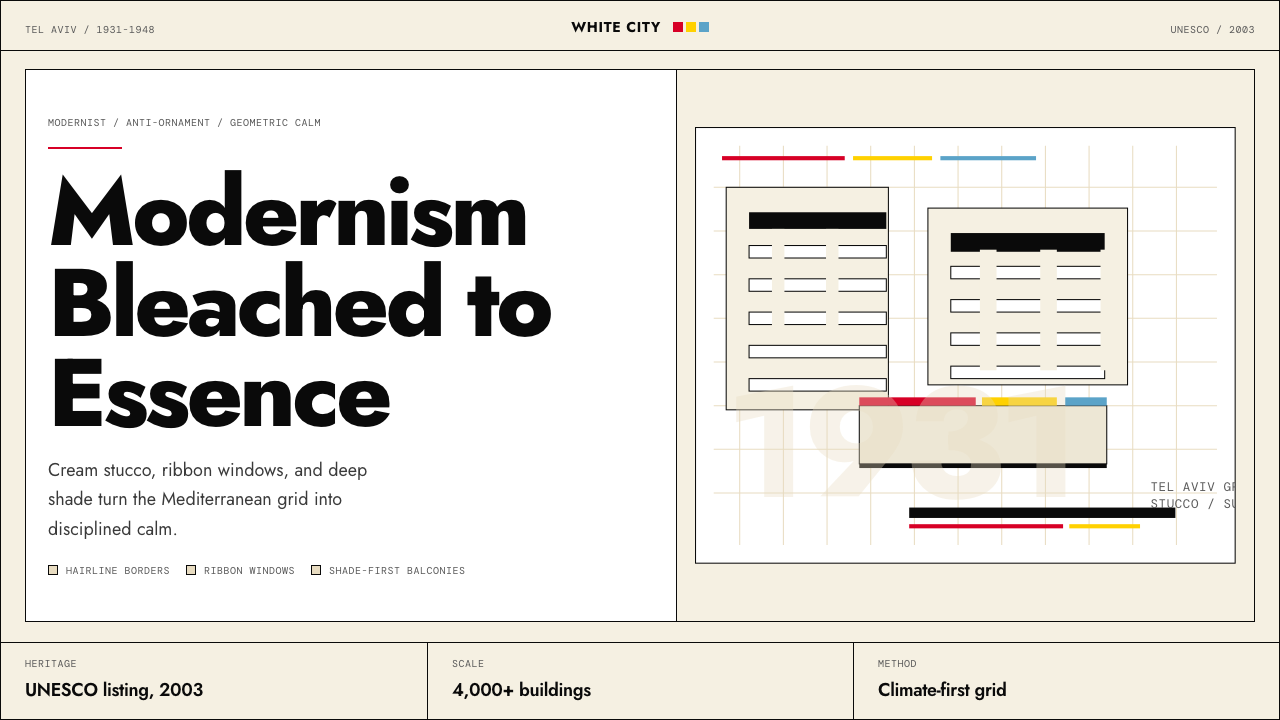
Tel Aviv's White City is where Bauhaus discipline met Mediterranean sun — four thousand cream-white buildings that turned a European exile into a world heritage.
Israeli Bauhaus Tel Aviv (White City) in brief
Israeli Bauhaus — the design system born from Tel Aviv's White City — is a regional inflection of the International Style: strict geometric modernism softened by warm stucco-white grounds, horizontal ribbon windows adapted to shade interiors from intense sunlight, and a palette of restrained primary accents used only for structural emphasis. It is not merely Bauhaus transplanted; it is Bauhaus evolved under a different climate, a different politics, and a different cultural memory.
Where original Weimar or Dessau Bauhaus often operated in an atmosphere of revolutionary urgency, the White City variant carries a quieter confidence. The buildings its architects left behind are functional, durable, and visually coherent at the scale of an entire city quarter — a grid of pale facades, cantilevered balconies casting hard geometric shadows, and pilotis lifting ground floors above the dusty street level. The style prizes clarity over drama, legibility over spectacle.
As a contemporary design system, Israeli Bauhaus translates this architectural vocabulary into two-dimensional and interface work: warm off-white as the primary ground, rigorous geometric sans-serif type, hairline borders that echo balcony railings, and primary colors used with the same restraint as a single painted balcony door on an otherwise white facade. Decoration that cannot be justified by structure simply does not appear.

Where does Israeli Bauhaus Tel Aviv (White City) come from?
The White City's origins are inseparable from the catastrophe of Nazi Germany. From 1931 onward, hundreds of German-Jewish architects and designers fled Europe, many of them graduates or faculty of the Bauhaus school in Dessau or its earlier Weimar incarnation. Palestine under the British Mandate was receiving waves of Jewish immigration, and Tel Aviv — incorporated as a city only in 1909 — was expanding at extraordinary speed. The convergence of desperate emigrant talent and urgent urban need produced one of the most concentrated examples of modernist building in history.
The architects who arrived brought the complete Bauhaus toolkit: flat roofs that doubled as outdoor terraces, continuous ribbon windows that maximized ventilation, pilotis raising structures off the ground to allow air circulation, and facades free of applied ornament. But they adapted these principles to the Levantine climate with deliberate pragmatism. Deep-set windows and projecting balconies created self-shading surfaces. Rounded corners — rarer in northern European Bauhaus buildings — softened the harsh midday light and gave the streetscape a more fluid silhouette. Stucco finishes in cream and pale ochre replaced the steel and glass that would have overheated under the Mediterranean sun.
Patrick Geddes, the Scottish urban planner, had drawn up a master plan for Tel Aviv in 1925 that organized the city on a grid of wide, tree-lined boulevards punctuated by small garden squares. This plan gave the immigrant architects a rational urban armature — an already-modern framework — onto which they could project their modernist buildings without the friction of adapting to a medieval or baroque street pattern. The result was a rare alignment: modernist urbanism at the city scale and modernist architecture at the building scale, mutually reinforcing.
Key architects of the movement included Arieh Sharon, who had trained directly under Hannes Meyer at the Dessau Bauhaus before immigrating to Palestine in 1931; Zeev Rechter, whose work introduced the pilotis system to Tel Aviv; and Genia Averbuch, among the first women architects practicing in the region. UNESCO recognized the White City as a World Heritage Site in 2003, citing its outstanding universal value as the world's largest and most intact concentration of International Style buildings. Conservation efforts since then have restored hundreds of buildings and codified the design language that this system now makes available as a contemporary idiom.
What defines the Israeli Bauhaus Tel Aviv (White City) look?
Stucco-White Ground
The foundational tone is a warm off-white — not the cold clinical white of a hospital, but the cream of sun-bleached lime plaster, slightly yellowed by decades of Mediterranean light. This ground is never neutral in the way a pure white is; it carries warmth without softness, brightness without glare. Against it, even a thin black hairline reads with full authority, and a small primary-color accent acquires the visual weight of a much larger form.
Restrained Primary Accents
Primary red, blue, and yellow appear in the White City style as accents rather than fields — the painted door of an otherwise white balcony, the colored tile inlay of a single entrance surround. In design application, this means primary colors are reserved for the single most important signal on any given surface: a call-to-action button, a data series that demands attention, a section label that anchors navigation. Using two primaries simultaneously at equivalent weight is almost always a mistake; the style's restraint is what gives each accent its power.
Geometric Sans Typography
Type in this system is governed by geometric construction: letterforms built from circles, straight lines, and arcs, with consistent stroke width and no calligraphic variation. The effect is authoritative and slightly impersonal — legible at any size, unambiguous in hierarchy when scaled dramatically between heading and body. Small capitals and tight letter-spacing are characteristic of the style's formal register; loose, organic tracking is foreign to it. Hierarchy is established entirely through size and weight contrast, never through decorative variation.
Hairline Borders and Hard Geometry
The White City's most characteristic architectural detail is the horizontal ribbon — balcony slabs, window bands, and brise-soleil elements that score the facade into a precise horizontal grammar. In two-dimensional work, this translates to hairline rules that divide sections, single-pixel or near-single-pixel borders that define cards and fields, and a strict preference for rectangles and circles over any organic or irregular form. Rounded corners are permissible — the architecture itself has them — but they are subtle, not the large soft radii of contemporary card design.
Hard Shadow as Structural Element
The cantilevered balconies and projecting volumes of White City architecture cast shadows that are among the most architecturally expressive in the modernist canon — sharp-edged, geometrically precise, shifting with the sun's angle through the day. In design, this principle becomes a preference for offset hard shadows on interactive components: a card or button that casts a defined rectangular shadow at a fixed angle reads as solid and physical, grounded rather than floating. Soft, diffused shadows are incompatible with the style's commitment to geometric clarity.
Horizontal Rhythm and Grid Discipline
The White City streetscape is organized around a strong horizontal datum: all buildings share approximately the same cornice height, and the ribbon windows of adjacent structures align in continuous bands. This horizontal emphasis translates into layouts where baseline grids are rigorously observed, text columns align across breakpoints, and visual weight sits low and stable rather than climbing vertically. Wide margins and breathing room between elements are not luxury — they are structural, giving each element the separation it needs to be read independently.
Zero Superfluous Ornament
The White City architects arrived from a tradition that had consciously rejected the ornamental historicism of the nineteenth century, and their buildings are stripped to structure and function. No decorative cornices, no carved keystones, no applied pilasters — only the forms that load-bearing and weathering logic demand. In design, this principle means that every visual element must earn its place by doing structural or communicative work. A decorative border that does not signal a boundary, a gradient that does not encode a value — these are failures of discipline, not stylistic choices.

Who shaped Israeli Bauhaus Tel Aviv (White City)?
Arieh Sharon studied directly under Hannes Meyer at the Dessau Bauhaus, graduating in 1929 before immigrating to Palestine in 1931. He became one of the most prolific architects of the White City period, designing public buildings, workers' housing cooperatives, and urban infrastructure that brought rigorous Bauhaus planning principles into direct confrontation with the social project of a new society. His later work as State Architect of Israel, including the national master plan of 1951, scaled those principles to the entire country, making him perhaps the single figure most responsible for the Bauhaus character of Israeli modernism.
Zeev Rechter was among the first architects to introduce the pilotis — the load-bearing columns that raise a building's ground floor to allow air and pedestrian flow beneath — into Tel Aviv construction. This device, associated with Le Corbusier's Five Points of Architecture and deeply aligned with Bauhaus functional logic, became a signature element of the White City streetscape. Rechter's Engel House of 1933 is often cited as the first building in Tel Aviv to employ the full vocabulary of the International Style at residential scale, setting a precedent that hundreds of subsequent projects followed.
Genia Averbuch was among the first women to practice architecture professionally in the region and one of the early adopters of International Style principles in her residential and public building work during the 1930s and 1940s. Her practice demonstrated that the Bauhaus commitment to functional design was not ideologically restricted to a single cultural origin — it could be adapted, claimed, and practiced by emigrant communities across the social spectrum. Her buildings contributed to the cohesion of the White City's visual language across the Dizengoff Circle area and adjacent neighborhoods.
Patrick Geddes was a Scottish biologist and urban planner whose 1925 master plan for Tel Aviv established the urban armature onto which the White City's Bauhaus buildings were projected. His garden-city influenced grid of wide boulevards and small green squares gave the immigrant architects a rationally organized framework that was already sympathetic to modernist ideas of light, air, and circulation. Geddes himself was not a Bauhaus figure, but his plan's spatial logic — prioritizing movement, ventilation, and human-scale public space — made the White City's characteristic streetscape possible.
How do you use Israeli Bauhaus Tel Aviv (White City) today?
Israeli Bauhaus is among the most practically useful historical design systems available for contemporary work, because its adaptations to climate and human scale have already solved problems that purely theoretical modernism left open. The stucco-white ground is warmer and more inviting than pure Bauhaus white without sacrificing structural authority. The restrained use of primary color as accent rather than field means the system works across a wide range of content types without reading as aggressively branded. Understanding these distinctions — warmth within rigor, accent rather than field — is the key to applying the system well.
For presentation slides, Israeli Bauhaus works at every level of a deck. A cover slide benefits from the system's poster logic: a warm off-white ground, the title in large geometric sans-serif type occupying the upper or lower third, and a single primary-color horizontal rule or geometric element providing the sole accent. Content slides should be treated as facades — organized horizontally, with clear alignment across columns and text levels defined by size contrast alone, no decorative dividers. Data slides take on the quality of architectural drawings: bar charts and timeline elements become geometric forms in their own right, with the primary color palette used selectively to highlight the single most important data series rather than coloring every element differently.
For web UI — particularly dashboards, pricing pages, and analytical tools — the system's strength is its combination of clarity and warmth. Establish a twelve-column grid and commit to it across all breakpoints. Use a warm off-white as the page ground and near-black for all body text. Reserve primary red for error states or primary calls to action, primary blue for informational or secondary actions, and primary yellow for warnings or highlighted values. Card components should use hard offset shadows rather than soft drop shadows; input fields should have visible borders rather than ghost outlines. Navigation should be typographic and minimal, with no decorative iconography beyond simple geometric indicators.
For editorial layouts and marketing pages, the style's Mediterranean confidence translates into a strong sense of visual rhythm. Article layouts benefit from a clear two-zone structure: a narrow primary column for body text and a wider margin zone for pull quotes, captions, or metadata — echoing the horizontal banding of White City facades. Marketing pages work well with the system's alternating logic: full-width blocks that swap between warm-white-on-near-black and near-black-on-warm-white, with a single primary color used consistently for section-anchoring elements and calls to action. The style's restraint makes it particularly effective for brands positioning around reliability, clarity, or principled design.
A common mistake when working with Israeli Bauhaus is softening it past the point of identity — adding rounded corners to every element, swapping the warm white for a beige that reads as casual, or introducing gradients into backgrounds in an attempt to add depth. Each of these moves undermines the structural logic the style depends on. A related error is using all three primary colors at equal weight on the same page; authentic work in this system leads with one primary, uses a second as a meaningful secondary accent, and allows the third to appear only when a third distinct hierarchy level genuinely requires it. The restraint is the system — remove it and you have generic flat design, not Israeli Bauhaus.

Israeli Bauhaus Tel Aviv (White City) — FAQ
How is Israeli Bauhaus different from the original Bauhaus of Weimar and Dessau?
The original Bauhaus operated in a German industrial context and carried a strong political urgency — its visual language was in part a rejection of bourgeois historicism and a statement about the designed future of industrial society. The Israeli variant, built by emigrant architects in a Mediterranean climate under completely different social pressures, retained the formal vocabulary but transformed its mood. The warm stucco-white replaces the colder industrial white; rounded corners appear alongside the hard-edged rectangles; the buildings are sized for human comfort in intense heat rather than northern European conditions. The political urgency is replaced by a quiet civic confidence. As a design system, Israeli Bauhaus is consequently somewhat more approachable than strict Weimar or Dessau Bauhaus — it is rigorous without being confrontational.
Can this style work for products that need warmth or emotional appeal, not just rational clarity?
More so than the original Bauhaus. The stucco-white ground, the subtle rounded corners, and the Mediterranean sensibility of the White City give this system a warmer emotional register than its Weimar or Dessau cousins. It works well for cultural institutions, civic organizations, educational platforms, and any brand that wants to feel principled and modern without feeling cold or corporate. It still struggles with contexts that demand organic warmth — food, wellness, children's products — where the system's geometric discipline reads as clinical rather than caring. The key test is whether the product's values include clarity and considered design: if yes, the system likely fits; if the product primarily needs to feel cozy or playful, look elsewhere.
What is the right way to use primary colors in this system?
Think of primary colors in this system the way the White City architects thought about color on their buildings: an accent that announces the most important threshold or element, not a field that defines large surfaces. On any given screen or page, choose one primary as your lead accent — the color that carries the most important interactive or informational signal. A second primary can appear as a meaningful secondary signal, distinctly different in hierarchy. The third primary should be reserved for a third hierarchy level that genuinely exists and cannot be served by size or weight contrast alone. If you cannot articulate why each primary color is present and what hierarchy level it signals, you are using too many. Restraint in accent is what separates White City from generic colorful modernism.
Is the White City style appropriate for dark-mode interfaces?
The style's canonical form is light-ground — the warm off-white is not incidental but central to the system's identity. A dark inversion is possible but requires reinterpreting rather than simply inverting. A near-black that retains some warmth (leaning toward dark charcoal rather than pure black) better preserves the Mediterranean character. On dark grounds, primary yellow tends to dominate aggressively and primary blue can disappear — calibrate accordingly, typically by leading with a single primary and allowing the others to appear only as typographic or structural elements. The hard-shadow logic, horizontal rhythm, and geometric type discipline translate well to dark contexts; the warmth of the ground does not, and you must compensate for its absence through careful tone selection.
How does Israeli Bauhaus handle photography and imagery?
Photography in this system is treated as a geometric element, not a naturalistic window. Images are cropped to strong rectangular or occasionally circular forms, positioned within the grid with the same discipline as a type column or a horizontal rule. Color photography can be used, but it should be high-contrast and compositionally simple — ideally containing elements that echo the system's own geometric vocabulary. Full-bleed photography used as a background undermines the system's structural logic; if a photo must span the full width, it works best converted to high-contrast duotone using one of the primary colors against near-black or near-white. Representational illustration is largely foreign to the style; geometric or diagrammatic graphics are fully at home.
Related design styles
 Dessau GrayscaleAustere monochrome authority. Darkroom black, glazing gray, and a steel-windo…
 Electrical Schematic WiringAustere and exact. Cream graph paper, ink-blue traces, and mono labels make e…
 Architect CyanotypePrecision in negative. Prussian blue ground, paper-white grid, mono dimension…
 Brilliant Cut Facet DiagramOptics becomes blueprint. Cyan facet lines and ray paths glow on dark teal.
 DIN 1451 SignageAuthorless and exact. Enamel gray grid, traffic-white DIN type, and RAL signa…
 Havana Modernist GrayQuiet monumentality. Jost type, louver bands, and concrete grays hold tropica…