What is Futura Typeface (Renner, 1927)?
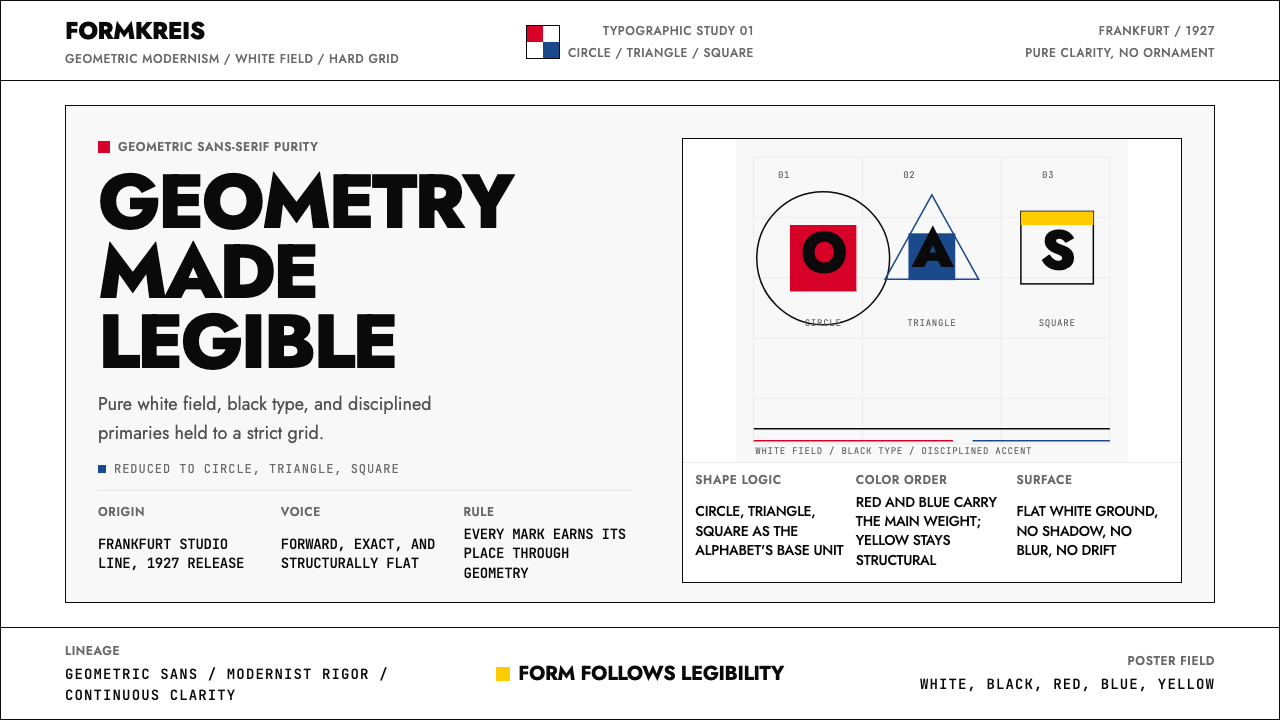
Paul Renner's 1927 typeface reduced the Latin alphabet to circles, triangles, and squares — and the result traveled to the Moon.
Futura Typeface (Renner, 1927) in brief
Futura is a geometric sans-serif typeface designed by Paul Renner and released by the Bauer Type Foundry in Frankfurt in 1927. It belongs to the tradition of German New Typography and the Bauhaus movement's broader conviction that pure geometric form is the most rational and universal basis for visual communication. Where earlier typefaces accumulated historical character — serifs, stroke contrast, calligraphic heritage — Futura stripped the letter back to its Platonic skeleton: the circle, the equilateral triangle, and the square.
What makes Futura visually distinctive is not simplicity alone but geometric consistency. The lowercase 'o' is a near-perfect circle. The 'a' is a single-story form — a circle with a straight stem — rather than the two-story construction used in most serif and many sans-serif faces. The capital 'A' is a triangle with a crossbar; the capital 'M' and 'N' carry strokes of nearly uniform weight. Across all these characters, optical refinements are suppressed in favor of an almost mechanical regularity. The result reads as designed rather than evolved.
Futura is not a Bauhaus typeface in the institutional sense — Renner was not a Bauhaus faculty member — but it is the most successful typographic expression of Bauhaus ideas. It embodies the movement's argument that the alphabet, like any designed system, can be rationalized: rebuilt from first principles, stripped of ornament, and made to serve communication without apology or nostalgia. It has remained in continuous use since its release, appearing on corporate identities, film titles, wayfinding systems, book covers, and the commemorative plaque left on the lunar surface by the Apollo 11 mission.

Where does Futura Typeface (Renner, 1927) come from?
Paul Renner began developing Futura around 1924, working in the cultural environment of Weimar Germany — a moment of intense intellectual ferment in which the Bauhaus, De Stijl, Russian Constructivism, and the New Typography of Jan Tschichold were all arguing, in different ways, that the inherited forms of art and design needed to be rebuilt from rational foundations. Renner was a typographer, painter, and teacher who had published the book 'Typografie als Kunst' (Typography as Art) in 1922. He was sympathetic to modernist ideas but not doctrinaire; his contribution was to apply geometric rationalism specifically to type design rather than to print layout or visual identity.
The Bauer Type Foundry, one of the leading type foundries in Germany, supported and funded the development of Futura. Heinrich Jost, the foundry's art director, played a significant role in refining Renner's original drawings into commercially viable and technically reproducible letterforms. Renner's early sketches had been even more radically geometric than the released version — some characters approached pure construction from circles and line segments — but Jost and the foundry's technical staff introduced subtle optical corrections that made the face more readable at smaller sizes without abandoning its geometric character. The released Futura represents a negotiation between Renner's theoretical ambition and the practical demands of printing technology and legibility.
Futura entered a competitive market but distinguished itself quickly. In 1927, the same year Futura was released, the American Type Founders company released a rival geometric sans-serif called Tempo, and other German foundries responded with their own entries. But Futura's proportions, the elegance of its stroke relationships, and the coherence of its full character set gave it a stability that competitors struggled to match. By the early 1930s it had been adopted by major German publishers and advertisers, and its international distribution through Bauer's network ensured that it reached designers in Britain, the United States, and the Netherlands almost immediately.
The typeface's historical resilience owes much to the breadth of its original design program. Renner and Bauer released Futura in multiple weights — from a spare, almost hairline light to a commanding extra-bold — and in both roman and oblique cuts. This range meant that a single typographic system built around Futura could handle everything from a book text to a display headline to a poster title, without importing a second typeface family. Later in the twentieth century, type designers including Tobias Frere-Jones studied Futura's geometry when developing their own work, and the face has been digitized, licensed, and extended by multiple foundries, ensuring its continued availability in contemporary design practice.
What defines the Futura Typeface (Renner, 1927) look?
Geometric Letterforms
Every character in Futura is derived from a small vocabulary of geometric primitives. The circle dominates the lowercase — in the 'o', 'c', 'e', 'b', 'd', 'p', and 'q' — and its diameter sets the proportional standard against which other characters are measured. The triangle appears explicitly in the capital 'A' and implicitly in the diagonal strokes of 'v', 'w', and 'x'. The square establishes the modular rhythm of characters like 'H', 'I', and 'E'. This derivation from a shared geometric vocabulary gives the face its internal coherence: every character feels as though it belongs to the same system rather than having been drawn independently.
Monolinear Stroke Weight
Traditional typefaces modulate stroke width to reflect the pressure variations of a broad-nib pen held at a consistent angle. Futura rejects this calligraphic inheritance entirely: strokes are optically uniform in weight throughout each character, with no thick-thin contrast. This uniformity is not absolute — microscopic optical adjustments prevent the junctions of strokes from appearing heavier than the strokes themselves — but to the naked eye Futura reads as mechanically consistent. The effect is authority without warmth: type that feels engineered rather than written.
Single-Story Lowercase Forms
The most immediately recognizable feature of Futura to typographically informed readers is its single-story lowercase 'a' and 'g'. Conventional typefaces use a two-story 'a' — a form with a bowl and a separate upper counter — and a two-story 'g' with a closed lower loop. Futura replaces these with their single-story geometric equivalents: the 'a' becomes a circle with a straight stem, the 'g' an open descending tail. These forms are geometrically simpler and visually distinctive, but they slightly reduce the differentiation between characters that aids rapid reading at small sizes — a considered trade-off for geometric consistency.
Optical Tension Between Circle and Line
One of the subtler visual qualities of Futura is the way curved strokes meet vertical stems. In characters like 'b', 'd', 'p', and 'q', a near-perfect circle attaches to a straight vertical stroke. The junction point is a moment of visual tension — the curve does not taper into the stem but meets it more abruptly, creating a slight crispness that distinguishes Futura from more fluid humanist or transitional sans-serifs. This crispness is part of the face's character: it reads as decisive and uncompromising rather than organic and accommodating.
Proportional Range and Weight Spectrum
Futura was designed as a complete typographic system rather than a single-weight novelty. The light weights have an airy delicacy in which the geometric structure is most visible, because the strokes are so thin that the forms are almost skeletal. The bold and extra-bold weights fill the interior of the letterforms with mass, creating a very different texture on the page — dense and impactful — while maintaining the same underlying geometry. This weight range allows designers to use Futura across an entire document hierarchy, from footnotes to chapter titles, without tonal inconsistency.
Absence of Calligraphic Memory
Most typefaces, even very clean modern ones, carry some residual memory of the pen or brush that first drew their letterforms — a slight axis of stress, a suggestion of entry and exit strokes, a modulation in curve quality that echoes hand movement. Futura has almost none of this. Its curves do not remember a tool; they remember a compass. Its terminals are cut horizontally or diagonally in ways that refer to construction geometry rather than to the writer's wrist. This absence of human trace is central to what Futura communicates: a claim that rational design can be fully systematic, that the alphabet need not remember how it was first made.
Versatility Across Scale
Because Futura's design is built on geometric consistency rather than optical tricks tuned for a specific size range, it scales with unusual composure. At very large sizes — a poster headline, a building sign, a film title card — the geometric structure becomes the subject: viewers see the circles and angles as forms in their own right. At text sizes, the monolinear weight and open apertures maintain legibility. This performance across scales explains why Futura has been used successfully in contexts as varied as wayfinding systems (which demand clarity at distance), book typography (which demands legibility in sustained reading), and display advertising (which demands immediate visual impact).

Who shaped Futura Typeface (Renner, 1927)?
Paul Renner (1878–1956) was a German typographer, painter, and educator whose career spanned the transition from nineteenth-century craft printing to twentieth-century industrial typography. He was the director of the Munich School of Design (Meisterschule für Deutschlands Buchdrucker) from 1926, where he ran the institution during the same years he completed and saw Futura through its release. He was not a Bauhaus faculty member but shared the movement's conviction that aesthetic form could be rationalized without destroying it. Renner was later dismissed from his directorship by the Nazi government in 1933, partly because of his association with modernist ideas. Despite this, Futura survived and flourished under various owners of the Bauer foundry's rights, and Renner is remembered as the designer who most successfully translated the geometric idealism of the 1920s into a commercially durable typeface.
Heinrich Jost served as art director at the Bauer Type Foundry during the period of Futura's development and release. His role was the essential bridge between Renner's theoretical drawings and a typeface that could actually be manufactured in metal and reproduced reliably across printing conditions. Renner's early sketches included letterforms of extreme geometric purity that proved optically awkward or technically difficult to produce in the punch-cutting process. Jost's refinements — introducing slight stroke adjustments at junctions, moderating the most radical experimental characters — brought Futura to a point where it was both coherent as a system and practical as a commercial product. His contribution is often underacknowledged in accounts that treat Futura as a pure expression of Renner's individual vision.
Jan Tschichold was not directly involved in Futura's design, but his 1928 manifesto 'Die Neue Typographie' (The New Typography) created the intellectual and commercial environment in which Futura thrived. Tschichold argued that geometric sans-serif typefaces were the only legitimate choice for modern printing — they alone expressed the rationalism and functional directness that the modern world required. Futura, released a year before Tschichold's manifesto but perfectly aligned with its principles, benefited enormously from the theoretical legitimation Tschichold provided. Designers who read 'Die Neue Typographie' frequently turned to Futura as their preferred geometric sans-serif, and Tschichold himself used it in several significant commissions. The two — typeface and manifesto — became mutually reinforcing in establishing geometric sans-serif as the typographic voice of modernism.
Tobias Frere-Jones is a contemporary American type designer whose study of Futura's geometric structure informed several of his own typefaces. His engagement with Futura represents the face's continuing relevance as a model and reference point in professional type design, long after the mechanical constraints that shaped its original production had been replaced by digital tools. Frere-Jones's work illustrates a broader pattern: Futura functions not only as a typeface for use, but as a pedagogical object — a case study in how far geometric rationalism can be pushed in letter design before legibility breaks down. The question Renner posed in 1924 remains productive for type designers today.
How do you use Futura Typeface (Renner, 1927) today?
Futura is one of the most instructive historical typefaces to apply in contemporary design precisely because its geometry is so legible as a system: you can see what it is doing and trace the decisions. Applying it well means understanding that its visual authority comes from consistency — from allowing the geometric logic to operate without interruption across every text element in a composition. Introducing a contrasting face, softening the geometry with a rounded companion, or mixing it with a heavily calligraphic script breaks the internal argument the typeface is making.
For presentation slides — both cover and content pages — Futura rewards sparse composition. A cover built around Futura works best when the title is set at large scale in a heavier weight, positioned asymmetrically against a near-white or deep neutral ground, with minimal secondary text and no decorative framing. The title should do all the work. Content slides should establish a clear typographic hierarchy using weight and scale rather than color or borders: a bold display weight for the section label, a regular or book weight for body points, no underlines or italics unless the face's oblique cut is used deliberately. Data slides benefit from letting charts and diagrams take on the same geometric character as the type — bars and segments that feel angular and precise, with labels in Futura maintaining visual consistency between data and text layers.
For web interfaces — dashboards, pricing pages, product landing pages — Futura's monolinear geometry creates an immediately modern, considered aesthetic. The key discipline is maintaining the clean structure the typeface implies: a clear grid, generous whitespace, and a restrained secondary palette. Navigation labels in Futura carry authority without requiring weight or decoration. Headings in a heavier weight can carry an entire hero section without a supporting image. A common structural decision is pairing Futura display headings with a more neutral or slightly humanist face for long-form body text, where Futura's geometric consistency — which is an asset in display use — can feel slightly mechanical in extended reading.
For editorial and marketing work, Futura's historical association with modernist publishing and advertising makes it a natural choice for any project that wants to signal seriousness, precision, or forward-thinking intent. In editorial layouts, it works well as a titling face paired with a text-optimized serif for body content — the contrast between the geometric headline and the humanist text creates a productive visual dialogue. In marketing applications, Futura's poster sensibility translates directly: a single short message at very large scale in a bold weight, minimal competing elements, and a color accent used once with confidence. The style's strength is in what it omits rather than what it adds.
A common mistake when applying Futura is overloading the composition with geometric variety in an attempt to match the typeface's visual energy. Because Futura itself is so visually assertive, it rarely needs support from complex background treatments, elaborate icon systems, or highly saturated color fields. The discipline the face requires is restraint everywhere else: if the type is doing its work, the rest of the composition should step back. A second mistake is using Futura at small text sizes in contexts demanding long reading — its geometric forms are slower to scan than humanist alternatives in continuous prose, and its single-story 'a' and 'g' contribute less character differentiation. Reserve it for display use and short text blocks; choose a more neutral face when the primary demand is sustained readability.

Futura Typeface (Renner, 1927) — FAQ
Is Futura a Bauhaus typeface?
Not in the institutional sense. Paul Renner was never a Bauhaus faculty member, and Futura was developed and released by the Bauer Type Foundry in Frankfurt, not by the Bauhaus school. However, Futura is the most fully realized typographic expression of Bauhaus principles in the sense that it reduces letterforms to geometric primitives and rejects any historical or calligraphic inheritance. Herbert Bayer's Universal typeface — actually designed at the Bauhaus — is more doctrinaire but less refined; Futura is the version of the idea that worked well enough to survive commercially. The distinction matters historically but is less important to designers applying the style: for visual purposes, Futura and Bauhaus typography are effectively synonymous.
What makes Futura different from other geometric sans-serifs like Avenir or Gill Sans?
The key differences are in how much humanist compromise each face accepts. Futura is the most purely geometric of the major geometric sans-serifs: it suppresses optical corrections in favor of mechanical consistency, and its single-story lowercase forms are the most direct expression of geometric rationalism. Avenir, designed by Adrian Frutiger in 1988, modulates its stroke weight more subtly and introduces a slight humanist axis in some characters — the result is warmer and more legible in extended text. Gill Sans, designed by Eric Gill in 1928, openly references classical Roman proportions in its uppercase and has much more visible humanist trace in its stroke modulation. Futura is the coldest and most systematic; Gill Sans is the most historical; Avenir sits between them.
How should Futura be used with color — does it have a natural palette?
Futura does not dictate a specific palette, but its geometric rationalism aligns most naturally with color approaches that share the same systematic clarity. The historical context of Futura's release — the Bauhaus primary palette of red, blue, and yellow on white grounds — remains the most frequently cited reference, and for good reason: the geometric simplicity of the type and the symbolic clarity of the primary colors reinforce each other. In contemporary practice, Futura is also used effectively with monochromatic systems — black type on white, or white type reversed out of a deep neutral — where the geometry of the letterforms alone carries the visual weight. What tends to work poorly is using Futura alongside color palettes that are soft, gradated, or atmospheric: the type's hard geometry and the colors' organic quality produce a contradiction rather than a complement.
Why is Futura associated with science, technology, and space in popular culture?
The association is partly historical accident and partly genuine typographic logic. The historical accident was NASA's use of Futura — most famously on the commemorative plaque that accompanied the Apollo 11 mission to the Moon in 1969, which read in Futura type: 'Here men from the planet Earth first set foot upon the Moon.' This gave the typeface a literal connection to humanity's furthest technological reach. The typographic logic is that Futura's elimination of historical and calligraphic trace reads as ahistorical and therefore future-oriented. It does not carry the cultural memory of hand-lettering, academic publishing, or traditional authority. Its geometric precision suggests engineering rather than tradition. These qualities made it the preferred typeface for a range of science and technology communications throughout the second half of the twentieth century, and popular culture subsequently coded the association.
Can Futura work for body text, or should it only be used for headlines and display?
Futura can be used for body text, and historically it has been — particularly in modernist book and magazine design of the 1920s through 1950s, where designers used it as a pointed ideological statement about rejecting traditional bookface conventions. In practice, however, the face presents challenges in extended reading. Its monolinear weight reduces the stroke contrast that helps readers differentiate letterforms quickly. Its single-story 'a' and 'g' remove familiar shapes that readers use for rapid word recognition. And its geometric precision creates a texture on the page that, over long passages, can feel effortful rather than transparent. For sustained text, these limitations are real. Futura is at its strongest in display applications — headlines, titles, callouts, labels, short interface copy — where its geometric authority is an asset rather than a friction point.
Related design styles
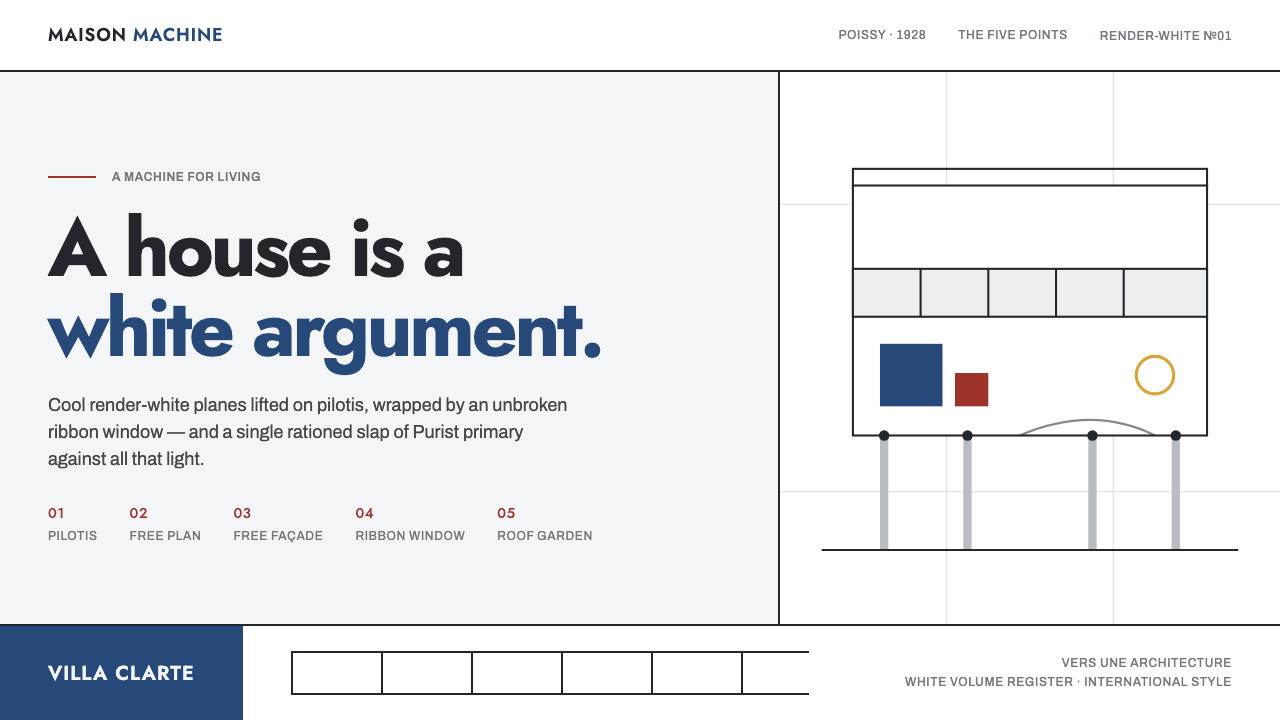 Le Corbusier Purist WhiteA house is a white argument: render-white planes, ribbon windows, one slap of…
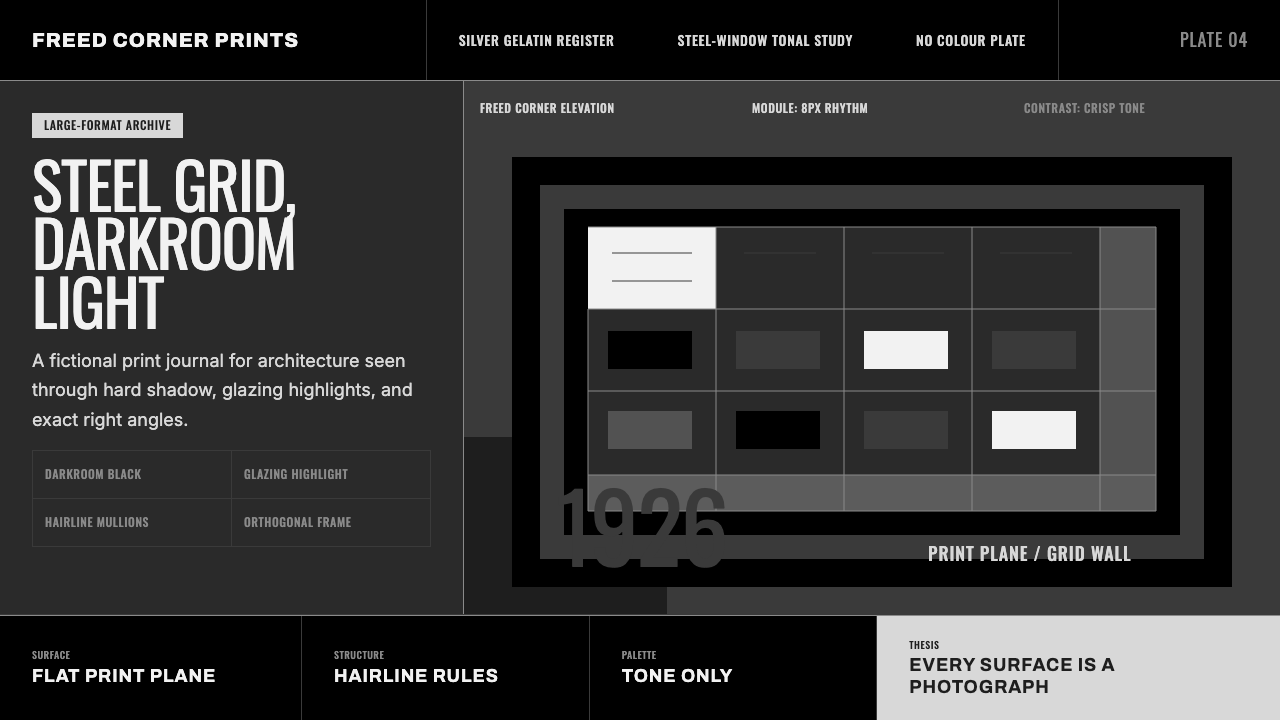 Dessau GrayscaleAustere monochrome authority. Darkroom black, glazing gray, and a steel-windo…
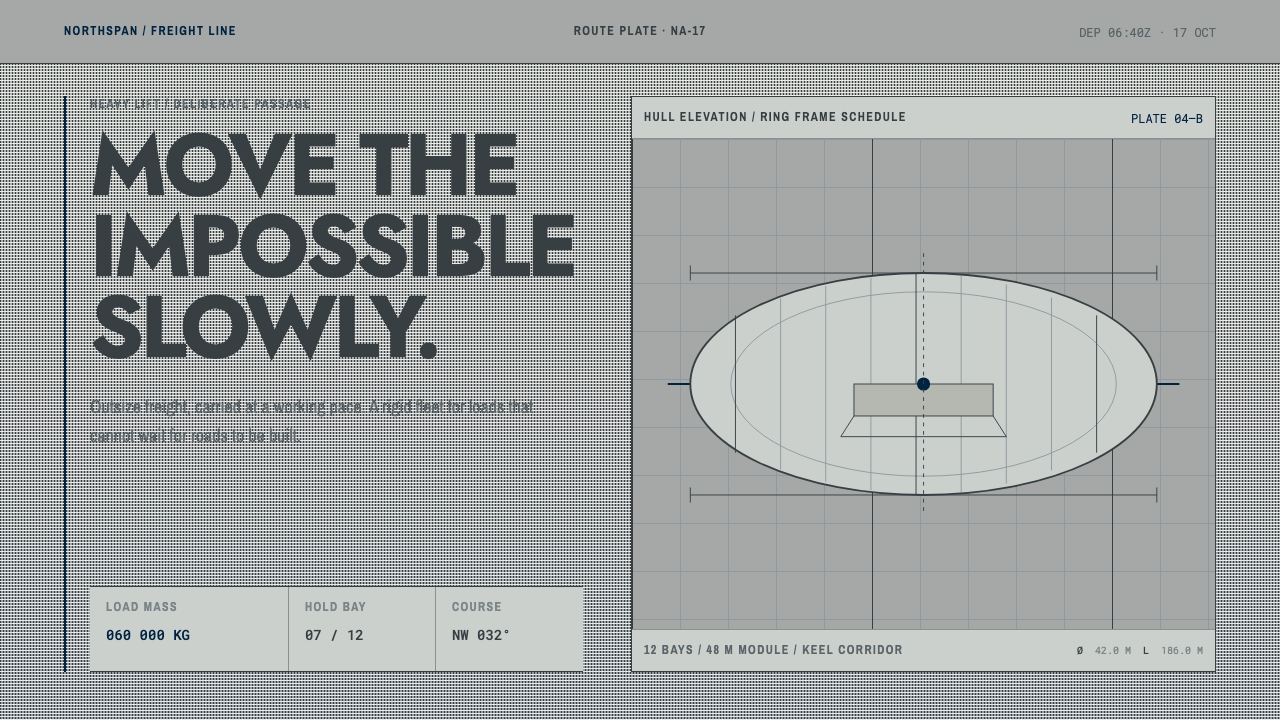 Hydrogen Airship FreightSlow freight is a capability. Matte aluminium grey, DIN grids, and a measured…
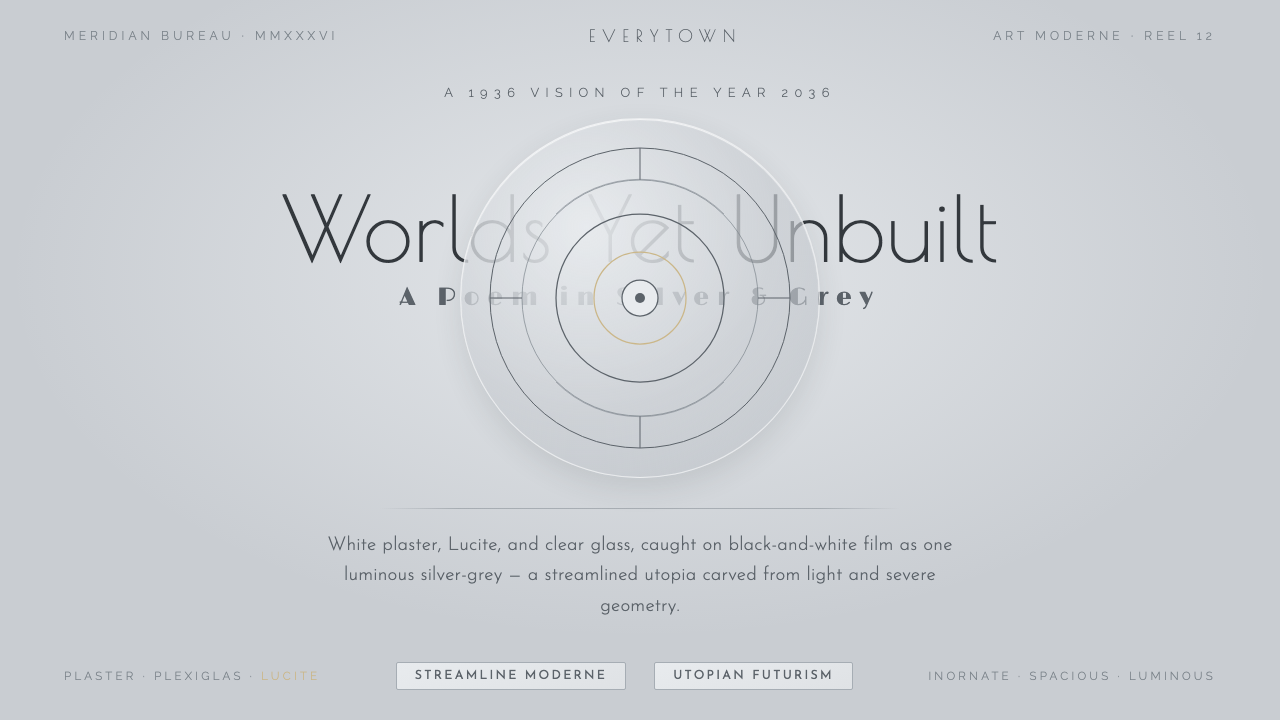 Things to Come (1936)A 1936 future cast in light. Cool silver-grey ground, geometric Poiret One ty…
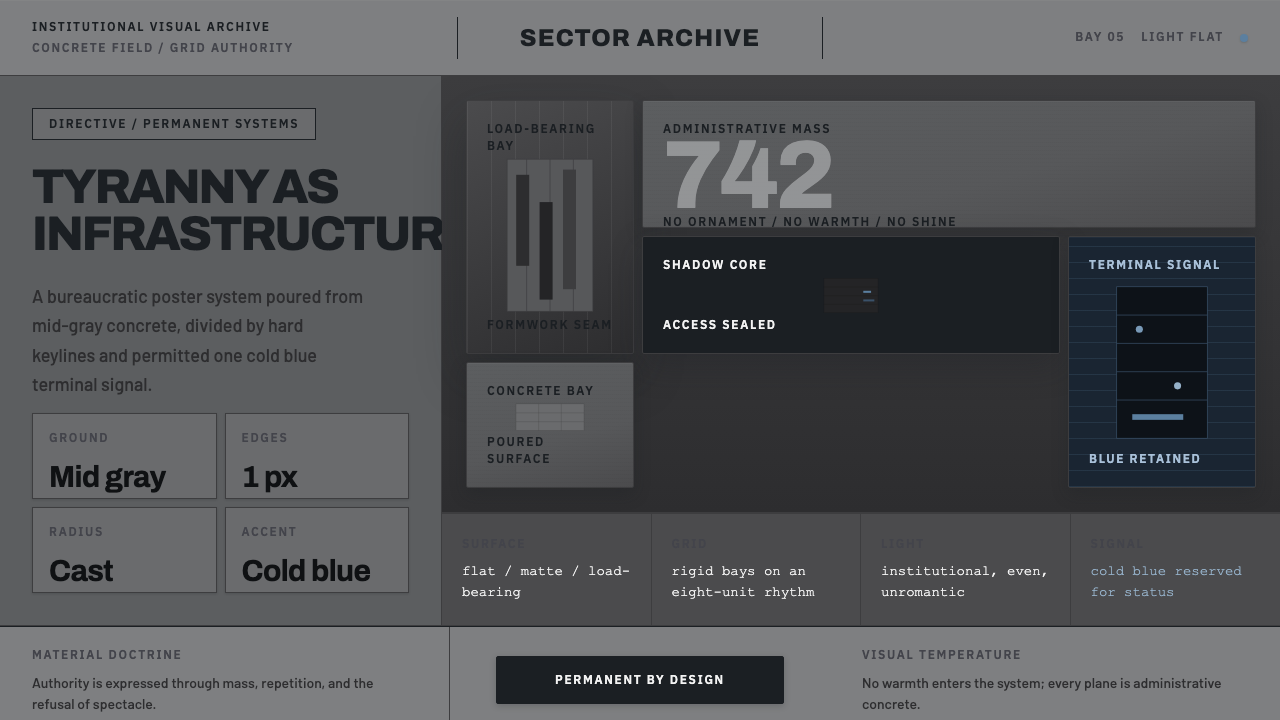 Andor Imperial GrayOppression made ordinary. Mid-gray concrete slabs, hard keylines, one cold bl…
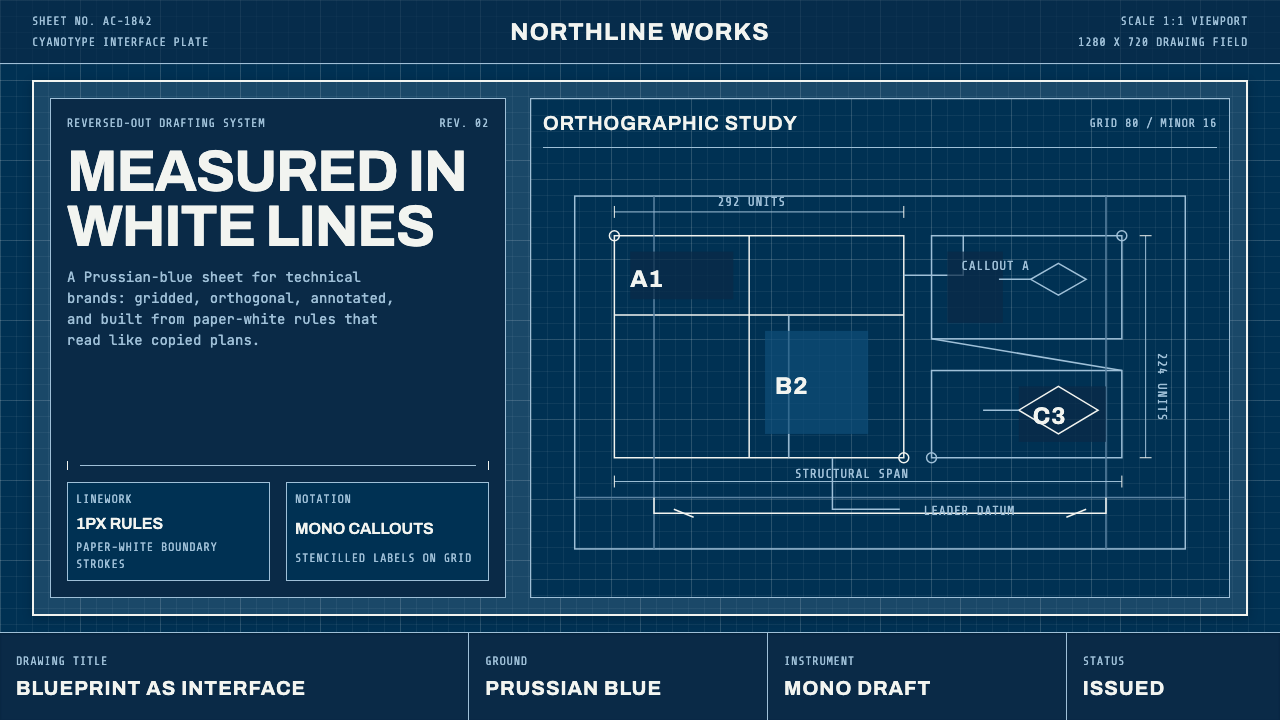 Architect CyanotypePrecision in negative. Prussian blue ground, paper-white grid, mono dimension…