What is Penguin Classics Orange?
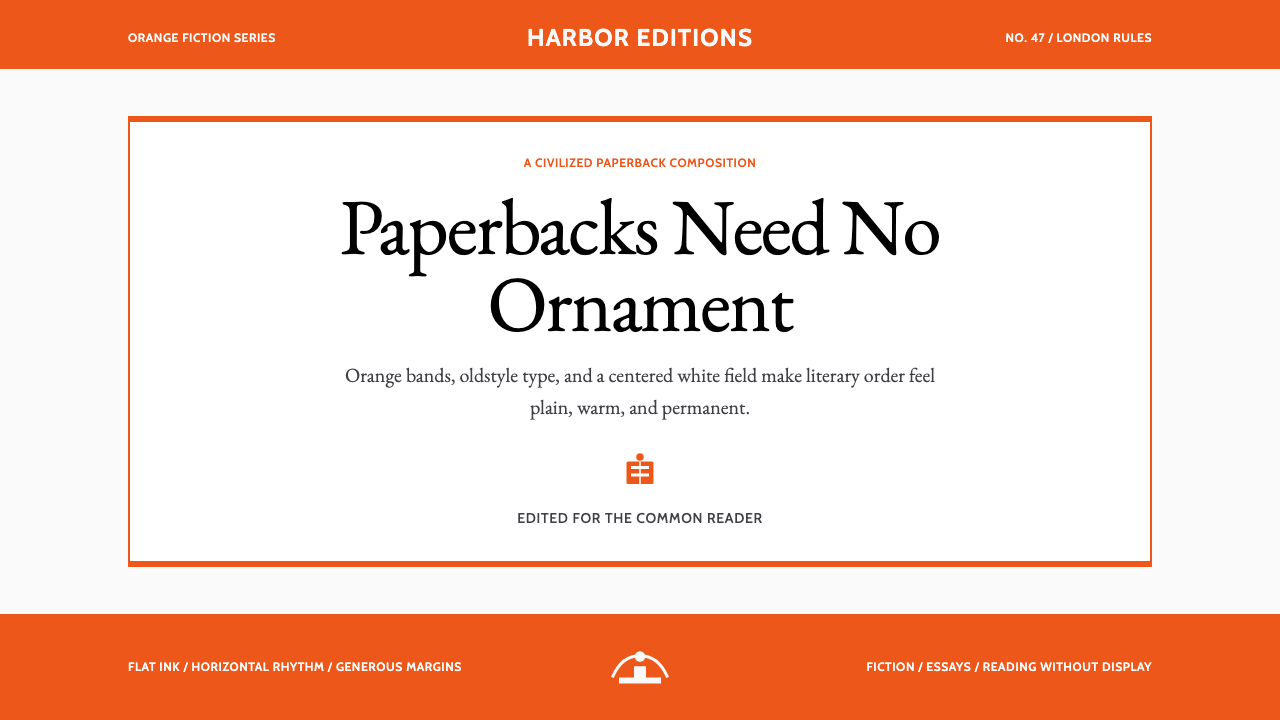
Penguin's three-band paperback cover — bold orange, clean white, and a solitary colophon — proved that a rigorous system needs no ornament to project lasting authority.
Penguin Classics Orange in brief
Penguin Classics Orange is the visual language distilled from one of the most disciplined book-design systems ever produced: the three-band paperback cover that Penguin Books introduced in 1935 and perfected through the postwar years. Its vocabulary is deliberately constrained — a warm, saturated orange occupying the top and bottom bands, an unadorned white panel in the centre holding the author's name and title in classical serif type, and a small illustrative colophon anchoring the lower band. Nothing else is permitted. The restraint is not poverty of imagination; it is the confident product of editorial conviction.
The system belongs to the tradition of Modernist Functionalism, sharing lineage with the New Typography that Jan Tschichold theorized in the 1920s and then — somewhat paradoxically — partially retreated from in the 1940s. Where pure New Typography called for asymmetric grids and sans-serif type above all else, the Penguin system blended classical humanist values with modern structural economy: symmetric title panels, oldstyle serif lettering, and the horizontal rhythm of three clearly delineated bands. The result is neither cold modernism nor nostalgic traditionalism but something that reads simultaneously as civilized and contemporary.
As a design system for digital work, Penguin Classics Orange carries that same double authority. It is bookish without being archaic, structured without being mechanical. The warm orange anchors every primary action and structural band; humanist type headings channel Gill Sans's approachable warmth; oldstyle serif body text keeps the reading experience grounded in the literary tradition. The system works because its constraints are so specific that any application of it immediately signals both seriousness and cultural confidence.

Where does Penguin Classics Orange come from?
The story begins in 1935, when Allen Lane — a young publisher who had recently returned from a train journey frustrated that he could find nothing decent to read at the station bookstall — decided to produce high-quality literary paperbacks at the price of a packet of cigarettes. Penguin Books was founded with a simple premise: serious literature should be cheap enough to reach everyone. Lane asked his young assistant Edward Young to design a cover system. Young, who was twenty-one, proposed the horizontal three-band format with the now-iconic orange as the identifying color for general fiction. He also drew the first penguin colophon himself, reportedly inspired by a trip to London Zoo. The design was functional and economical — it could be printed in one or two colors, required no commissioned illustration, and produced a uniform shelf presence that made the Penguin brand instantly recognizable in any bookshop.
The early Penguin covers were successful but inconsistent. Different titles varied in typographic execution, and the system lacked the disciplined uniformity that Lane increasingly wanted. In 1947, he invited Jan Tschichold — the Swiss typographer who had written the foundational New Typography manifesto in 1928 and then been arrested by the Nazis and forced to flee Germany — to come to London and systematize the entire Penguin production. Tschichold spent two years at Penguin (1947–1949) and transformed what had been a loose house style into one of the most precisely specified typographic systems in publishing history. He wrote rules for every detail: the precise placement of type within the title panel, the relative proportions of the three bands, the handling of series names and author names in relation to titles, the correct weight and spacing of the colophon. He insisted on classical typographic virtues — careful optical spacing, proper hierarchy, oldstyle numerals — that had nothing to do with modernist ideology and everything to do with the reader's comfort and trust.
Tschichold's departure in 1949 did not end the system's coherence. His successor Hans Schmoller, a German émigré typographer who had trained in the classical tradition, maintained and extended Tschichold's standards for the next twenty-five years. Under Schmoller, the Penguin colophon was redrawn and refined, the grid was further codified, and the brand achieved the kind of long-term typographic consistency that is extremely rare in commercial publishing. By the time Schmoller retired in the mid-1970s, the Penguin three-band cover had been in continuous and largely unaltered production for four decades — an almost unparalleled record of disciplined design consistency in mass-market publishing.
The visual language that Edward Young improvised, Tschichold systematized, and Schmoller extended has since become one of the most referenced design systems in the history of graphic design. It is taught in design schools as a case study in how constraints generate identity rather than limit it. Its influence can be seen in countless brand systems, editorial identities, and digital design languages that have adopted the principle of a strong color-band structure, classical typographic hierarchy, and the refusal of decorative illustration in favor of typographic authority. For designers working with digital media today, the Penguin system offers one of the clearest demonstrations available of how a system built on three elements — color, type, and proportion — can establish unmistakable authority without a single pixel of ornament.
What defines the Penguin Classics Orange look?
The Tri-Band Structure
The defining architecture is a horizontal tripartite division: a wide colored band at top, a white or cream title panel in the middle, and a narrower colored band at the bottom. This structure is not merely decorative — it encodes a reading hierarchy. The top band asserts the publisher's identity; the title panel carries the essential information; the bottom band anchors the colophon and series designation. Every application of this system, whether on a printed cover or a digital screen, inherits this clear vertical distribution of authority.
Penguin Orange
The orange is warm, assertive, and occupies the full saturation range of a ripe, almost-red citrus hue. It is not a pastel, not a muted earth tone, and not a bright fluorescent — it sits at the precise point where warmth and authority meet without aggression. On a white or cream ground, it creates maximum contrast without the severity of black, and its organic warmth makes it feel editorial rather than corporate. In digital applications, this orange reads with the same forcefulness whether on screens in bright ambient light or in dark environments.
Classical Serif Typography
The title panel is governed by oldstyle serif letterforms — type that draws on Renaissance humanist manuscript traditions rather than geometric or transitional models. The key quality is warmth: stroke contrast is moderate rather than extreme, serifs are bracketed and organic rather than thin and mechanical, and the overall impression is of a hand that once held a pen rather than a compass. This typographic warmth is what separates the Penguin system from the colder modernist alternatives of its era and gives it enduring legibility across generations of readers.
Humanist Sans-Serif Headings
Where the system uses sans-serif type — for publisher imprint names, series identifiers, and display headings — it draws on the humanist rather than the geometric tradition. Humanist sans-serif letterforms retain a calligraphic skeleton, meaning that individual characters have slightly varied stroke widths and a natural axis that echoes handwriting. This gives headings warmth and approachability that geometric sans-serifs lack, and it ensures that the contrast between heading and body type is a difference in texture and weight rather than a clash of opposing philosophies.
Horizontal Rhythm and White Space
The system's composition is governed by horizontal bands rather than diagonal dynamics or circular focal points. Every element — text, colophon, rule — aligns to a consistent horizontal axis, reinforcing the sense of stable order that is central to the design's authority. White space within the title panel is generous and deliberate: the text does not crowd the panel edges, and the spacing between author name, title, and any subtitle is optically calibrated rather than mathematically mechanical. This gives even densely-worded titles an air of unhurried dignity.
The Colophon as Seal
The penguin colophon functions as a seal of quality rather than a logo in the contemporary marketing sense. Placed in the lower band, it is never oversized, never animated in digital contexts, and never treated as a decorative illustration. Its scale relationship to the band it inhabits is fixed and proportional — just large enough to be immediately legible, not so large that it dominates. This restraint is essential: the colophon's authority derives precisely from its understatement. It is a mark, not an advertisement.
Color Coding by Category
The original Penguin system used color systematically to differentiate series: orange for general fiction, green for crime, blue for biography, cerise for travel. The principle behind this is structural rather than decorative — color does categorical work that text alone would do more slowly. In digital applications derived from this system, the same logic applies: the warm orange anchors the primary or dominant category, while secondary tones drawn from the system's palette signal related but distinct content types. Color earns its presence by carrying meaning, not by providing visual interest.

Who shaped Penguin Classics Orange?
Lane founded Penguin Books in 1935 with the conviction that affordable, well-produced paperbacks could democratize reading. His insistence on quality — both in the literature selected and in the visual presentation of the books — was the founding impulse behind the design system. Lane understood that a consistent, immediately recognizable cover system was not merely branding but an argument: that the books inside deserved as much visual respect as any hardcover published by a prestige house. His commercial instinct and his cultural ambition together created the conditions in which great design could flourish.
Young was twenty-one when he designed the foundational three-band structure and created the first penguin colophon in 1935. The design's longevity is a testament to how well Young understood the problem he was solving: a cover system that could be produced cheaply, maintain visual consistency across thousands of titles, and signal quality without illustration. His choice of orange — warm, authoritative, legible at distance — proved so precisely calibrated to its purpose that it remained essentially unchanged for decades. Young later had a distinguished career in naval intelligence and never returned to professional design, making his contribution to Penguin one of the most consequential single acts of design in the twentieth century.
Tschichold arrived at Penguin in 1947 already one of the most influential typographers of the century. His 1928 manifesto Die neue Typographie had argued forcefully for asymmetric layouts, sans-serif type, and rigorous standardization. By the time he reached London, however, he had substantially revised his views, concluding that classical typographic principles — symmetry, oldstyle serifs, humanist spacing — were better suited to sustained literary reading than his earlier dogmas. His two years at Penguin produced a detailed house-style guide and transformed the production quality of every book the company published. The paradox of Tschichold's Penguin work — that the author of the New Typography spent his most productive professional years perfecting a system rooted in classical values — is itself one of the most instructive stories in the history of design.
Schmoller joined Penguin in 1949 as Tschichold's successor and remained for twenty-five years, becoming in many ways the unsung guardian of the system's integrity. A German émigré trained in the classical tradition, Schmoller refined the colophon, extended the typographic standards to cover the full range of Penguin imprints, and resisted the commercial pressures that in the 1960s and 1970s pushed many publishers toward illustrative covers and more aggressive visual styles. His decades of quiet stewardship meant that when Penguin eventually moved away from the pure three-band system in the 1970s, it was departing from a standard that had been held with unusual rigor for an unusually long time.
Less prominent in design histories but essential to the Penguin production machine, Abrams was among the in-house production editors who applied Tschichold's and Schmoller's specifications at scale. The quality of a design system is only as good as the rigour with which its rules are applied at the working level, and Penguin's remarkable consistency over decades depended on production staff who understood not merely the rules but the intent behind them. Her role represents the often-invisible labor through which a design vision becomes a design standard.
How do you use Penguin Classics Orange today?
Penguin Classics Orange is among the most legible design systems available to contemporary practitioners because its logic is so transparent: one dominant warm color, classical type hierarchy, horizontal band structure, minimal decoration. Applying it correctly requires understanding that every element in the system earns its presence by performing a specific function. The orange signals category and publisher identity; the white panel carries the essential text; the colophon seals the whole. Importing this logic into digital work means asking, for each element, what structural work it is doing.
For presentation slides, the system translates exceptionally well. A cover slide benefits most from the full tri-band treatment: orange band at top anchoring the publisher or organization identity, white central panel with the title in classical serif, and a narrower orange bar at the bottom carrying the date or edition information. Content slides should be treated as white-panel layouts — generous margins, a clean horizontal rule as section divider where needed, and type hierarchy established through size and weight rather than color. Data slides and charts benefit from orange as the accent on primary data series, with all secondary data in neutral tones. The discipline of limiting color to structural roles keeps even complex data slides readable.
For web interfaces — particularly dashboards, pricing pages, and editorial platforms — the system offers a strong structural framework. Define the primary navigation bar in the deep warm orange, keeping all navigation text in white or cream for maximum contrast. Card components and content panels should use white backgrounds with typographic hierarchy rather than background color variation to differentiate sections. Reserve the orange for calls to action, active states, and primary tier highlights only. Hard-edged dividers replace soft shadows; the layout breathes through generous but consistent whitespace rather than through visual decoration. This approach works particularly well for products positioning themselves as authoritative, thoughtful, or literary.
For editorial and marketing applications — article layouts, email newsletters, promotional materials — the system's bookish authority translates into strong brand trustworthiness. A full-width orange header band with white reversed type makes an immediate brand statement; below it, a clean white field for editorial content with body type in an oldstyle serif creates the reading experience the system promises. Marketing pages can adopt the alternating panel structure: orange-on-white feature blocks and white-on-orange reversal blocks, with the colophon or brand mark used consistently but never enlarged beyond its structural role. Pull quotes and callouts work well set in a slightly larger weight of the same serif family used for body text, avoiding the typographic noise of introducing an additional typeface.
The most common mistake when applying Penguin Classics Orange is treating the orange as merely a brand color rather than as a structural color. In the original system, orange was not decorative — it defined spatial zones and carried categorical meaning. Designers who use orange as a highlight color scattered across a layout are breaking the fundamental logic of the system. A second common error is substituting a geometric sans-serif for the humanist type that gives the system its warmth: geometric sans-serifs read as tech-corporate and undermine the editorial authority that is the whole point of the exercise. A third error is allowing the tri-band structure to ossify into a template that is applied mechanically without understanding the proportional relationships between bands. Those proportions are not arbitrary — they were calibrated over decades — and distorting them produces work that looks like a Penguin parody rather than a Penguin derivation.

Penguin Classics Orange — FAQ
Is Penguin Classics Orange a minimalist style?
Not exactly. Minimalism, in the contemporary sense, tends toward near-total neutrality — off-white grounds, light gray type, and the deliberate suppression of any strong visual statement. Penguin Classics Orange is the opposite of neutral: the orange is emphatic, the serif type is characterful, and the tri-band structure makes a strong compositional declaration. It would be more accurate to call it disciplined or systematic rather than minimal. The design uses few elements, but each of those elements is chosen for its expressive force rather than for its ability to disappear. The result is restrained but not self-effacing.
How does Penguin Classics Orange differ from Swiss International Style?
Swiss International Style, which emerged in the 1950s and 1960s, is characterized by mathematical grid systems, flush-left ragged-right text setting, sans-serif type almost exclusively, and a cool, objective visual tone. Penguin Classics Orange shares the Swiss commitment to system and rigor, but diverges in almost every aesthetic value: it uses oldstyle serif type rather than geometric sans-serifs, values warmth over objectivity, and organizes space through horizontal bands rather than modular grids. Swiss Style aims at universal legibility and cultural neutrality; Penguin Orange aims at authority and cultural specificity. The two systems are compatible in their structural discipline but incompatible in their expressive intentions.
Can this system work for dark-mode interfaces?
A dark inversion of Penguin Classics Orange is possible but requires deliberate adaptation rather than simple color reversal. The original system depends on the white title panel as the primary legibility zone — its brightness draws the eye and establishes hierarchy. In a dark inversion, this panel becomes dark, and orange must work harder against a dark ground. The warm orange retains reasonable visibility on dark backgrounds, but the system's characteristic warmth and bookishness are significantly reduced: dark grounds tend to push the system toward a more dramatic, editorial-noir register. This can work well for evening or premium contexts but should be treated as a distinct variant, not as the canonical system with a color swap.
When should I avoid Penguin Classics Orange?
Penguin Classics Orange projects seriousness, literary authority, and structural order. Products that need to communicate the opposite — playfulness, sensory richness, youthful energy, emotional warmth, or cultural specificity outside the Anglo-European literary tradition — will find the style working against them rather than for them. It is also a poor choice for highly technical or data-intensive products that require dense information display, because the system's generous white space and restrained color discipline leave insufficient room for the variety of visual signals that complex data environments demand. Finally, the system performs badly when applied without understanding its proportional logic: half-hearted or misappropriated versions read as parody, which can damage rather than elevate a brand.
Why does the original system use horizontal bands rather than a more flexible grid?
The horizontal tri-band structure was partly a production constraint and partly a design insight. In 1935, paperback cover printing was simple and cheap: a two-color system with ruled horizontal bands was well within the technical and financial reach of mass-market production. But the structure also solves a design problem elegantly — it assigns a fixed zone to each piece of information (publisher identity, title, series mark) and makes the hierarchy immediately legible at bookstall distance. The constraint of the band, paradoxically, gave the system its power: because every element had exactly one place to live, there was no design decision to make and no visual noise to create. Modern applications that relax the band structure into a more flexible grid often find themselves making many small decisions that the original system made for them automatically, and the results lack the decisive clarity that made the original so authoritative.
Related design styles
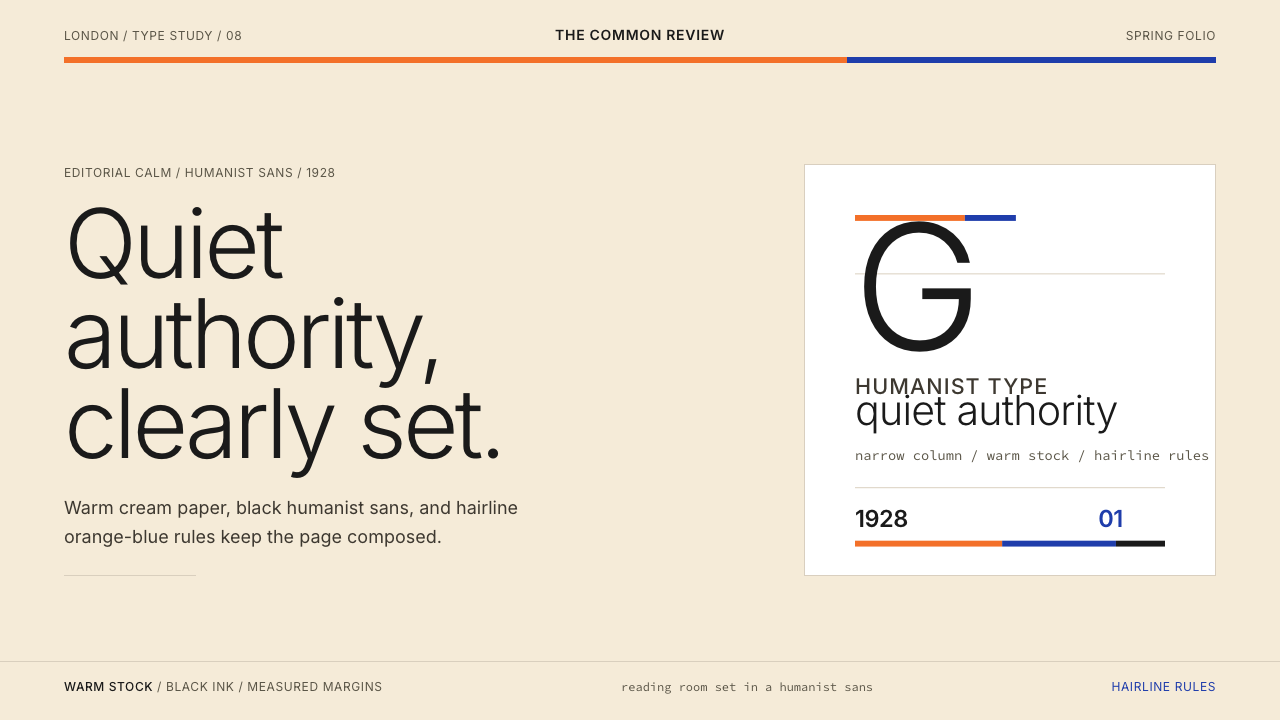 Gill Sans (BBC, 1928)Quiet authority, clearly set. Warm cream, black humanist sans, and hairline o…
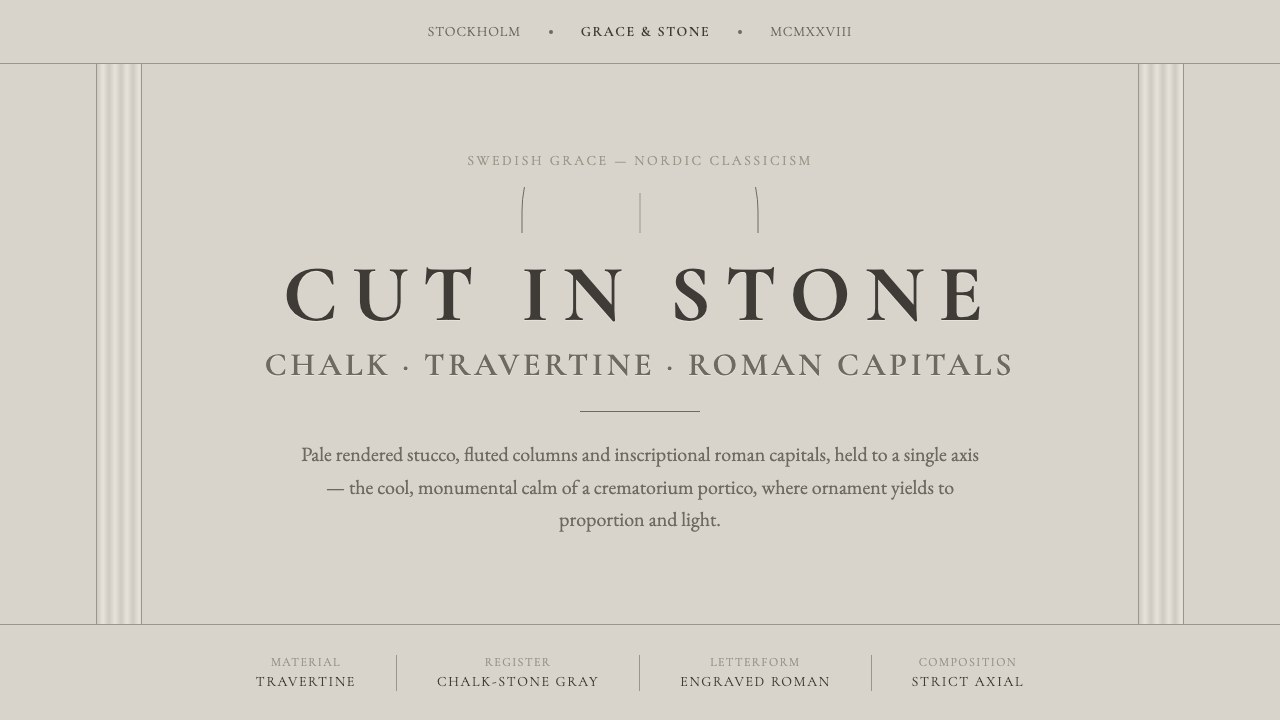 Nordic Classicism AsplundStone, not cream. Engraved Trajan capitals on cool chalk stucco, fluted colum…
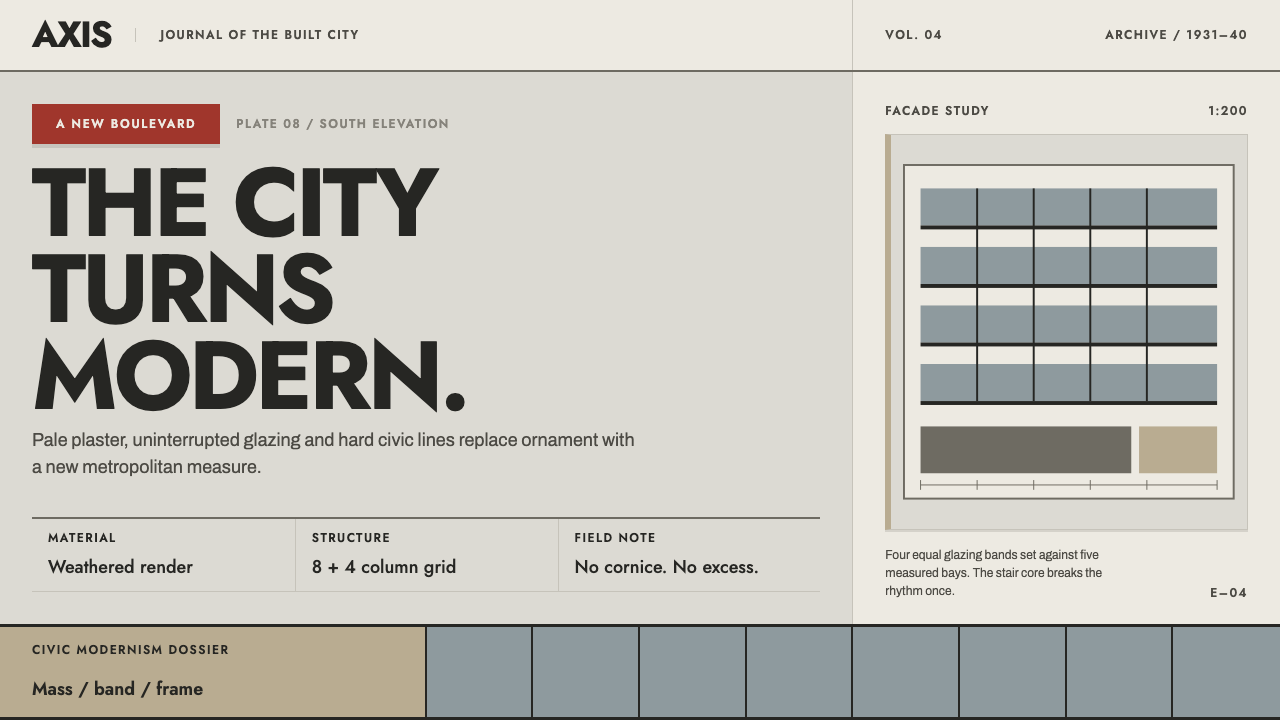 Bucharest Interwar ModernismModernism gathers civic weight. Sooted plaster, strict glazing bands and one…
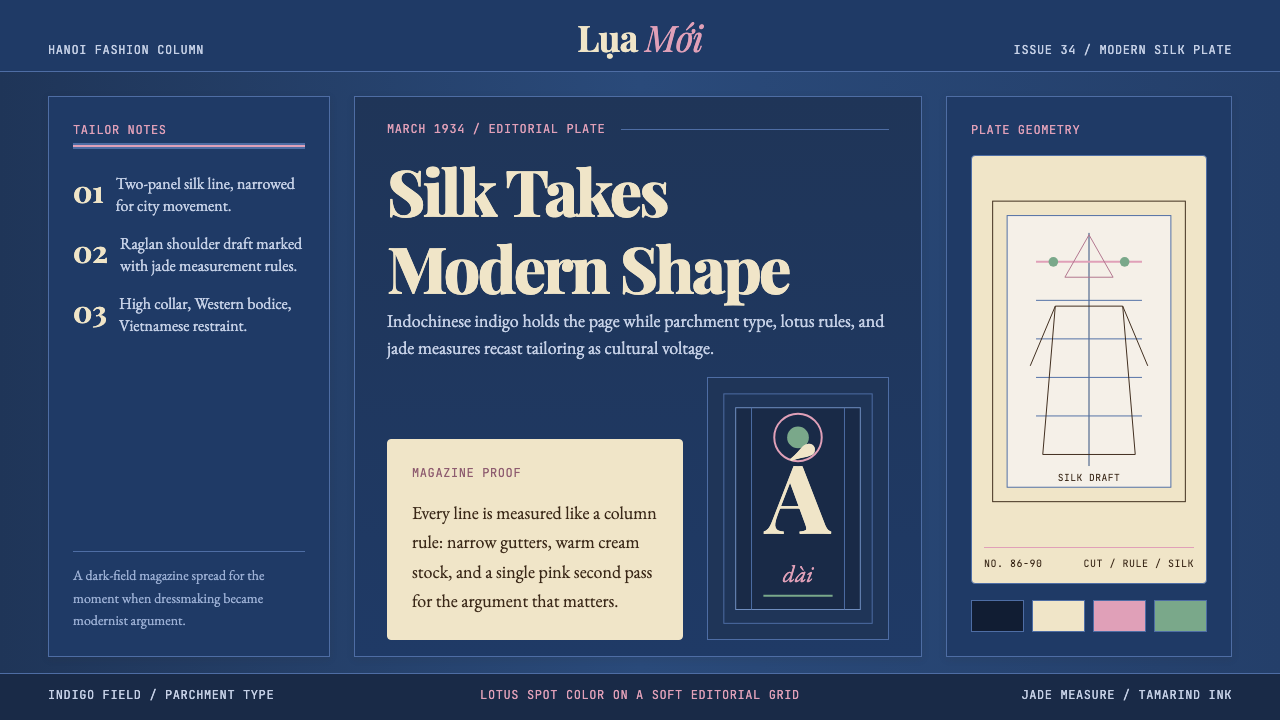 Vietnamese Áo Dài 1934 (Cát Tường)Indigo editorial poise. Parchment serif columns and lotus-pink rules frame th…
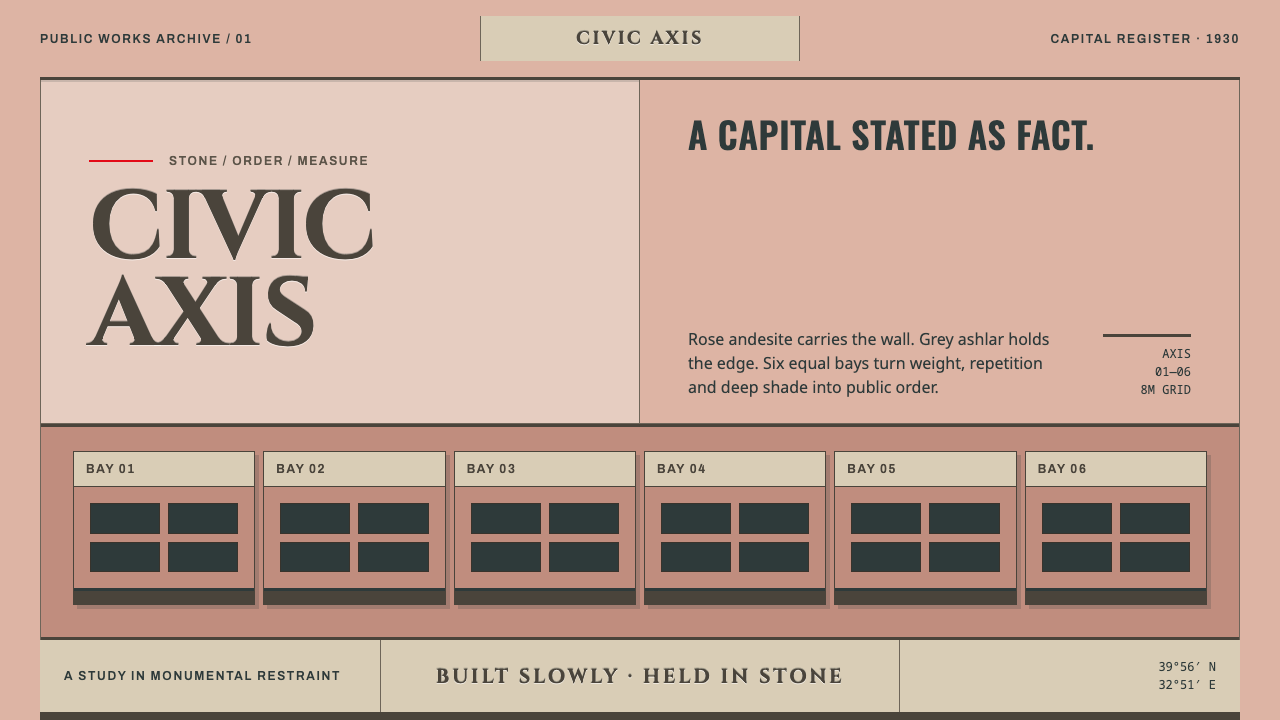 Ankara Republican ArchitectureAuthority moves slowly. Rose andesite, grey ashlar and six equal bays enforce…
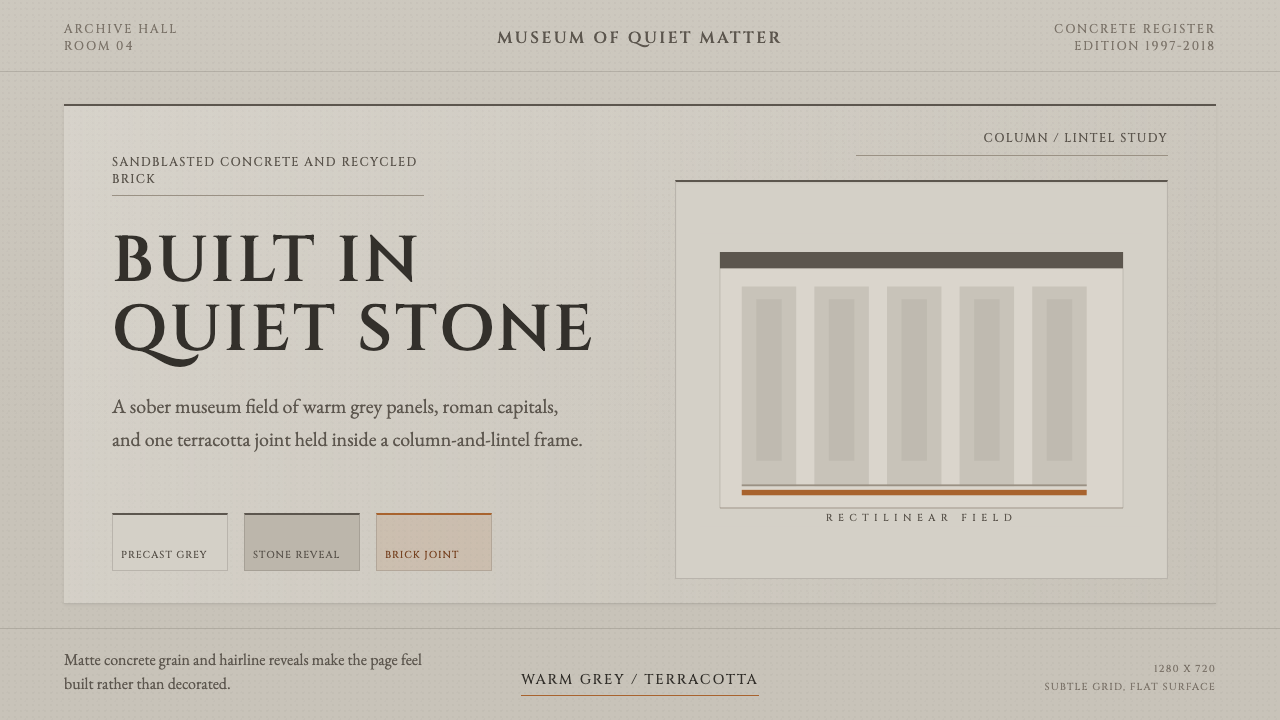 Chipperfield Museum GrayMuseum gravity, rendered quietly. Warm concrete grey, roman capitals, one ter…