What is Hermès?
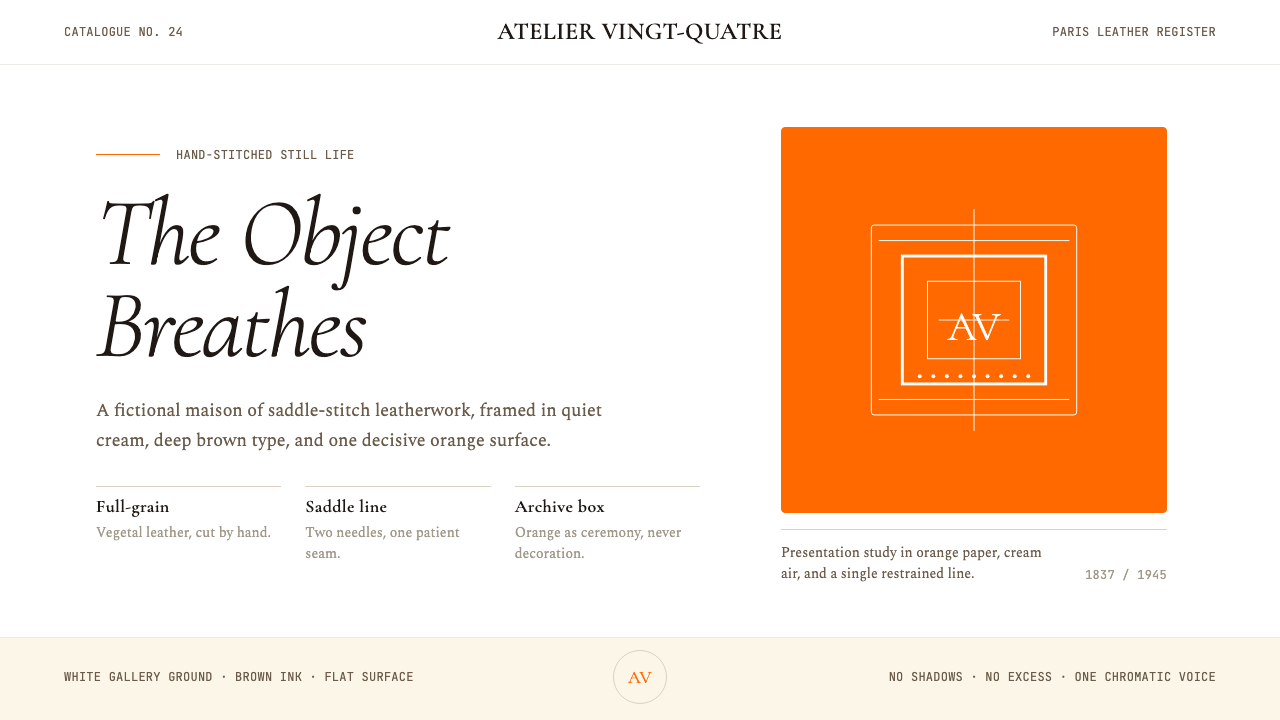
A wartime paper shortage gave the world its most recognizable luxury color — and Hermès turned that accident into nearly eighty years of radically quiet visual authority.
Hermès in brief
Hermès is a Parisian maison founded in 1837 whose visual identity — the unmistakable orange ground, deep-brown classical typography on cream and white, and near-absolute rejection of decoration — has become one of the most studied and widely referenced luxury design languages in the world. The system rests on a single, almost paradoxical conviction: that the object being presented is so extraordinary that the design surrounding it must do almost nothing.
Every surface in the Hermès visual language defers to the product. Generous whitespace functions not as emptiness but as silence — the equivalent of a gallery room cleared so that a single work can be considered without distraction. Typography is classical and unhurried; spacing between letters and between lines is wide enough that reading itself slows to a pace appropriate to the object's status. Ornamental elements are essentially absent: no patterns, no flourishes, no visual noise.
The result is a system that communicates extreme value without stating it. Where lesser luxury brands reach for visible opulence — heavy gilding, complex heraldic devices, elaborate surface texture — Hermès reaches for restraint. The message is that nothing needs to be added because nothing is missing. This is not minimalism in the contemporary tech-industry sense; it is confidence expressed as visual silence.

Where does Hermès come from?
Thierry Hermès founded his harness workshop in the Grands Boulevards quarter of Paris in 1837, supplying bridles, saddles, and equestrian equipment to European noblemen and cavalry officers. The enterprise was built on the principle that craft excellence is its own advertisement: no piece left the atelier that was not stitched, buffed, and fitted to a standard that made every previous version obsolete. This founding ethic — that the object justifies itself — is the deepest root of the visual restraint that defines Hermès design today.
The orange that now anchors the maison's identity was not chosen; it was inherited. Before the Second World War, Hermès used cream-colored boxes with gold lettering — a palette conventional for Parisian luxury of the period. When wartime material restrictions in 1945 exhausted the supply of cream-colored cardboard, the only stock available to the manufacturer was a vivid orange-tinted board. The house adopted it out of necessity. In the decades that followed, rather than reverting to the original cream once supplies normalized, Hermès recognized that the color had become inseparable from its identity and retained it deliberately. The accident became the signature.
The equestrian heritage shaped the visual vocabulary in more ways than color. Hermès's early product line — stirrups, bits, saddle stitching, bridle hardware — established an aesthetic of functional precision: every curve and proportion determined by what a horse and rider require, not by decorative preference. When the house expanded into leather goods, silk, and eventually ready-to-wear in the twentieth century, this underlying grammar of purposeful form accompanied the expansion. The famous carré silk scarves, introduced in 1937, carried equestrian and coaching imagery with the same formal composure that characterized the original saddlery.
The Hermès-Dumas family, which has guided the house through successive generations, consistently positioned the maison against the consolidation trend that swept luxury in the late twentieth century. While competitors merged into conglomerates optimized for brand extension and licensing revenue, Hermès maintained private family ownership, artisanal production in French ateliers, and deliberate scarcity. This organizational posture reinforced the visual language: a house that does not need to announce itself loudly does not design as if it does. Creative directors including Pierre-Alexis Dumas have spoken explicitly about the visual system as an expression of the house's relationship to time — unhurried, continuous, indifferent to fashion cycles.
What defines the Hermès look?
The Signature Orange
The Hermès orange occupies a precise perceptual territory between amber and tangerine — warm enough to read as sumptuous, vivid enough to be unmistakable at a distance, and restrained enough not to compete with what it frames. On the iconic box and ribbon, it functions as a field: the object becomes the figure, and the orange is simply the ground that declares the context. In digital and print applications, the color is deployed with great discipline — it tends to appear as a dominant background, a typographic accent, or a thin structural line, never as a secondary decorative element competing with the primary content.
Deep Brown and Cream Typography
Hermès typography is set in classical serif letterforms whose warmth and historical weight feel continuous with the leather craft tradition. The ink color is a deep, saturated brown — not black, which would read as too sharp and modern — deployed against cream or off-white grounds. This warm-on-warm pairing creates a visual temperature that reads simultaneously as aged and impeccable: the sensation of handling a document from a distinguished archive rather than reading contemporary commercial copy. Letter-spacing is wide, line height generous, and text rarely appears at small sizes, reinforcing the sense that every word is considered.
Radical Whitespace
No characteristic of the Hermès visual language is harder to faithfully reproduce than its use of empty space. The margins on Hermès print materials are not simply ample — they are a statement. The whitespace around a product photograph or a paragraph of text is so generous that it communicates that the subject does not need context, supporting imagery, or proximity to other elements to justify its presence. In digital interfaces, this principle manifests as pages that feel nearly empty to a contemporary eye trained on information density, but which direct attention with absolute precision to the single element the viewer is meant to consider.
Gallery-Quality Product Presentation
Hermès product photography is conceived as still-life painting rather than commercial documentation. Objects are photographed against neutral grounds, often at slight angles that reveal their three-dimensionality, and lit to show surface texture — the grain of leather, the sheen of silk — without dramatic shadows or atmospheric effects. The photographs are then surrounded by space so generous that the product reads as an art object placed in a contemplative environment rather than a commodity positioned for sale. Caption and price information, when present, appears at a distance from the image, never intrusive.
Near-Zero Ornamentation
The surface decoration in Hermès communications — outside of the product objects themselves, which are often extraordinarily embellished — approaches zero. Borders, if they appear at all, are the thinnest possible lines. Backgrounds are flat, never textured or patterned. Dividers between content sections are typographic spacing rather than graphic elements. The carré scarf motifs, the equestrian and coaching imagery, the intricate hand-drawn compositions that appear on the products do not migrate into the communication design; instead, the communications hold a quiet frame around the noise and richness of the objects themselves.
Material and Craft Continuity
The visual language maintains a strong referential relationship to the physical materials of the craft tradition. The cream and brown tones evoke vellum, undyed leather, and aged ivory. The typography's warmth and weight suggest hand-lettered documents and embossed die stamps. Even the orange, historically a dye used in leather treatment, carries a material resonance. This is not simulation — there is no attempt to make a screen surface look like leather — but rather a set of visual choices that remain consistent with and respectful of the material culture from which the brand emerged.
Temporal Unhurriedness
Hermès design communicates a relationship to time that is fundamentally different from most contemporary visual communication. There is no urgency, no call to immediacy, no flashing element or animated transition that implies the viewer must act now. The pacing of information — how much appears on a given surface, how widely spaced the elements — suggests that the viewer has all the time needed. This temporal quality is not accidental; it is a coherent expression of a house that explicitly positions its objects as investments to be used for decades and passed to the next generation.

Who shaped Hermès?
The founder's legacy is not primarily visual but ethical: the conviction that no piece should leave the atelier unless it is the finest achievable version. Thierry Hermès established the harness workshop in Paris in 1837 with a clientele that included the crowned heads of Europe, building the maison on the premise that craft of sufficient quality requires no advertisement beyond itself. This founding posture — confidence expressed as restraint — became the animating principle of the visual language that his descendants would develop over the following century and a half.
Thierry's grandson Émile, who guided the house from 1902, was the figure most responsible for transforming a specialized saddlery into a broader luxury atelier. He expanded the product range into leather accessories and began the maison's engagement with fine craftsmanship outside the equestrian world. Émile was also an avid collector of objects related to horsemanship and travel — his collection formed the visual archive that would later inform the imagery of the carré scarves and the characteristic Hermès subject matter of equestrian life, carriage travel, and the natural world.
The current artistic director and a sixth-generation member of the founding family, Pierre-Alexis Dumas has articulated the house's visual philosophy with unusual clarity in public statements. He has described the Hermès visual system as an expression of the house's relationship to time — continuous, unhurried, and explicitly positioned against the accelerated brand communication of the contemporary industry. Under his direction, the maison has maintained its commitment to restraint in an era when digital channels created pressure toward more aggressive, high-frequency visual communication.
As head window designer for Hermès at the Faubourg Saint-Honoré flagship for nearly four decades, Leïla Menchari created some of the most celebrated retail display environments in the history of luxury commerce. Her window installations — elaborate, fantastical, and deeply narrative — occupied a deliberate counterpoint to the restraint of the house's print and packaging design. The juxtaposition is instructive: the objects themselves, in their packaging, are presented with maximum quiet; in the theater of a Menchari window, they could be placed within environments of extraordinary imaginative richness. The same object, two different frames.
The sustained visual coherence of Hermès over nearly two centuries is inseparable from continuous family stewardship. While most luxury houses of comparable age have passed through the hands of conglomerates, investors, and multiple design directors whose tenures averaged a few years each, Hermès has been guided by successive generations of the founding family. This continuity produced a visual language that evolved incrementally rather than through periodic reinvention — each generation's contribution was an inflection rather than a rupture, maintaining recognizability across the full span of the house's history.
How do you use Hermès today?
The Hermès visual system is one of the most difficult luxury styles to apply correctly in derivative work, because its power lies entirely in what is absent rather than what is present. Designers approaching this aesthetic for the first time tend to add the orange and the cream typography and then stop — resulting in work that has the palette but none of the restraint. Authentic application requires making the subtraction decisions first: what comes out of the layout before the Hermès color arrives.
For presentation slides, this system works best when it is treated as an editorial problem rather than a graphic one. A cover slide in this aesthetic should carry almost nothing: a single product photograph or abstract image, the presentation title in a classical serif at unhurried weight, and a field of orange or cream that occupies most of the slide's surface area. Content slides should be sparing in the extreme — one idea per slide, generous vertical spacing, and type hierarchy defined purely by weight and size rather than color differentiation. If data must appear, it should be charted in the simplest possible form, with labels set in small, wide-spaced type and the data series using the warm brown and orange as the only color variables.
For web interfaces — particularly landing pages, pricing pages, and editorial-style product pages — the style rewards layouts that commit to asymmetric compositions with a strongly dominant whitespace. Navigation should be typographic, with no icon decoration. Buttons and interactive elements should be understated: a thin border or a typographic label on an undecorated background rather than filled, rounded, or shadow-bearing components. The orange, when used in UI, should appear in one role only — primary action or brand accent — never as a categorical color system across multiple interface functions. Dashboard contexts can use the warm neutrals as background tones and reserve the orange for single high-value status indicators.
For editorial and marketing materials — print campaigns, brand books, social content, and event communications — the system supports a poster-like boldness that is different from its quieter product presentation mode. Full-bleed orange grounds with reversed-out cream or white type are authentic to the tradition. Marketing pages can alternate between orange-ground and cream-ground sections, using the shift in ground color as the primary structural device, with product photography floating in either field. The critical discipline in this mode is maintaining the ratio of content to space: even in bold marketing applications, the material should feel as if it could comfortably contain twice as much information as it does.
A common and revealing mistake when working in this aesthetic is using the orange as an accent color sprinkled throughout an otherwise conventional layout. The orange in the Hermès system is not a highlight or a decorative touch — it is a field, a ground, a declaration of context. Using it in small quantities alongside conventional web grays or off-brand neutrals produces work that looks like an approximation rather than a commitment. The equally common opposite mistake is overcrowding: filling a layout with multiple product images, copy blocks, and supporting graphics and then applying the Hermès palette on top. The palette does not fix a crowded layout. The restraint must come first.

Hermès — FAQ
Can the Hermès aesthetic work for brands outside of luxury fashion?
It can, but with significant caveats. The visual system is a credible choice for any product or service category where deliberate scarcity, craft credentials, and premium price positioning are genuine — not aspirational — characteristics of the offer. Fine watchmaking, high-end real estate, rare wine and spirits, bespoke professional services, and the highest tier of hospitality have successfully drawn on similar visual principles. The system struggles wherever the product's actual accessibility contradicts the aspirational exclusivity the visual language projects: a mass-market product dressed in Hermès-inflected restraint reads as pretension rather than confidence.
How should the orange be used when a dark or night-mode interface is required?
Dark-mode application of this aesthetic is inherently more difficult, because the orange was conceived as a ground color, not a foreground accent, and against dark backgrounds it tends to behave more like a warning signal than a luxury field. The most coherent approach is to invert the hierarchy: use a very deep, near-black brown — evoking aged leather or dark mahogany — as the ground, and introduce the orange as a single structural accent applied to the most important typographic element or interactive state only. Cream type on a dark brown ground retains much of the warmth and material character of the original system without requiring the orange to carry weight it was not designed to bear.
What is the difference between the Hermès style and generic 'minimalist luxury' design?
The distinction is specificity of origin. Generic minimalist luxury — the style that many aspirational brands adopt — achieves restraint by subtraction alone: removing decoration, reducing the palette to black and white or beige and white, and using generous whitespace. The result is correct but anonymous. Hermès restraint is grounded in a specific material and historical narrative: the warm orange with its accidental origin, the brown and cream tones that reference leather and aged document, the classical typography that connects to a craft tradition predating industrialization. Every quiet choice in the system points back to something real. The test: if you replaced the orange with a pale blue or sage green and the result looked equally at home, you are working in generic minimalism, not in a Hermès-derived system.
How does this style handle photography and imagery?
Photography in the Hermès visual system is the single area where richness is permitted — but the richness is confined to the object itself, never to the environment surrounding it. Product photographs are taken against neutral grounds and presented with extreme spatial generosity: the image floats, the surrounding space is as important as the image content. The approach excludes lifestyle photography in the conventional sense — there are no aspirational scenes, no models in ambient environments, no suggestions of a lifestyle being purchased. When human figures appear, they tend to be partial, peripheral, or highly stylized. The system trusts the object to carry all the emotional weight; the image's job is simply to present, not to narrate.
Is the Hermès style appropriate for digital product design, or is it primarily a print and packaging aesthetic?
The style was developed in print and packaging contexts and its principles transfer to digital with significant adaptation required. The main friction points are: interaction design conventions that assume visual feedback through color change, fill, and animation; the need for information density that digital interfaces often require; and the difficulty of maintaining the warmth of the palette across the wide variation of screen calibrations and ambient light conditions. Successful digital applications of the style tend to be brand-facing rather than product-facing — the maison's own editorial web presence, campaign microsites, and high-end digital lookbooks — rather than functional applications like e-commerce checkout flows or account dashboards, where usability conventions override aesthetic purity.
Related design styles
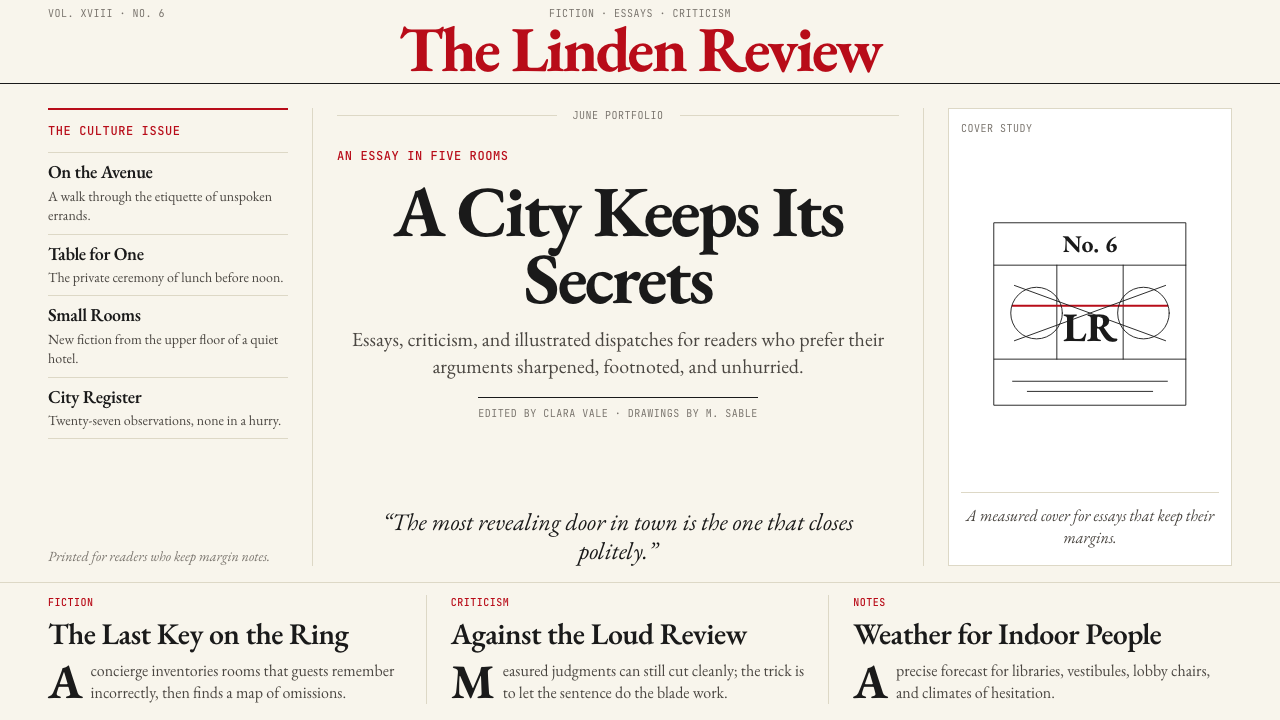 The New Yorker ClassicQuiet authority. Cream paper, EB Garamond columns, ink cartoons, and one red…
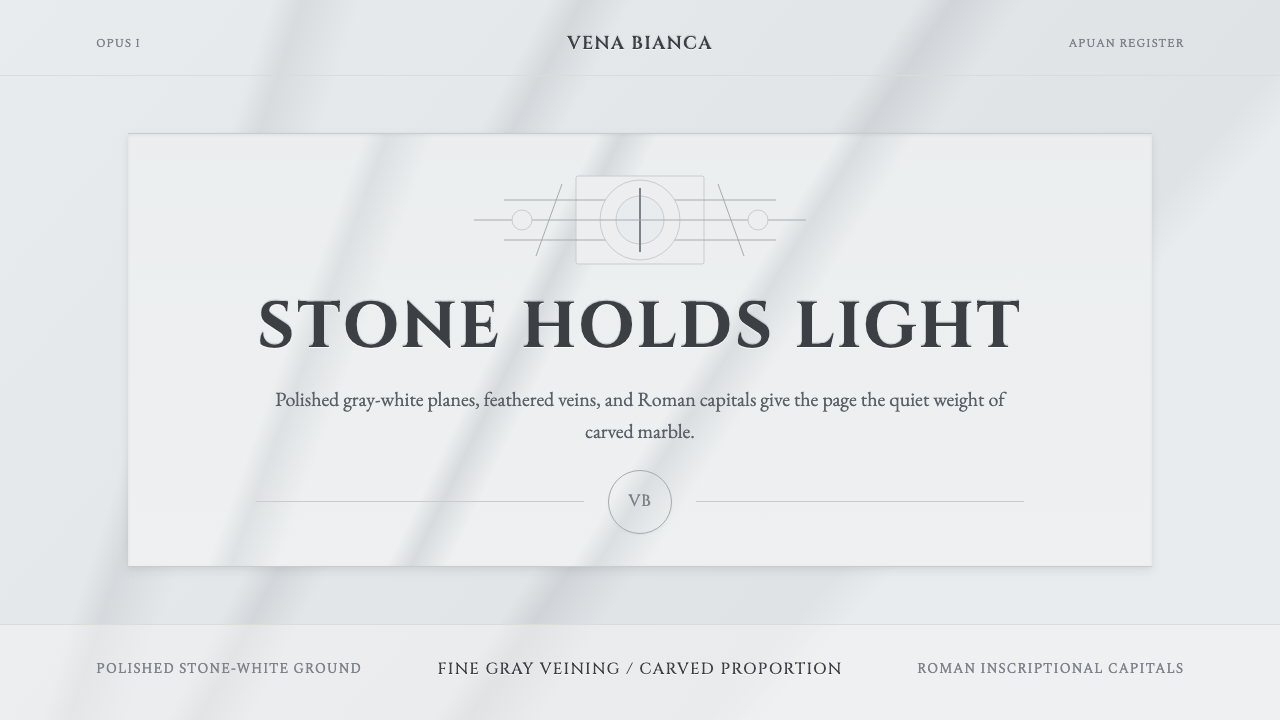 Carrara MarbleLuxury in restraint. Cool stone-white fields, feathery gray veins, and Cinzel…
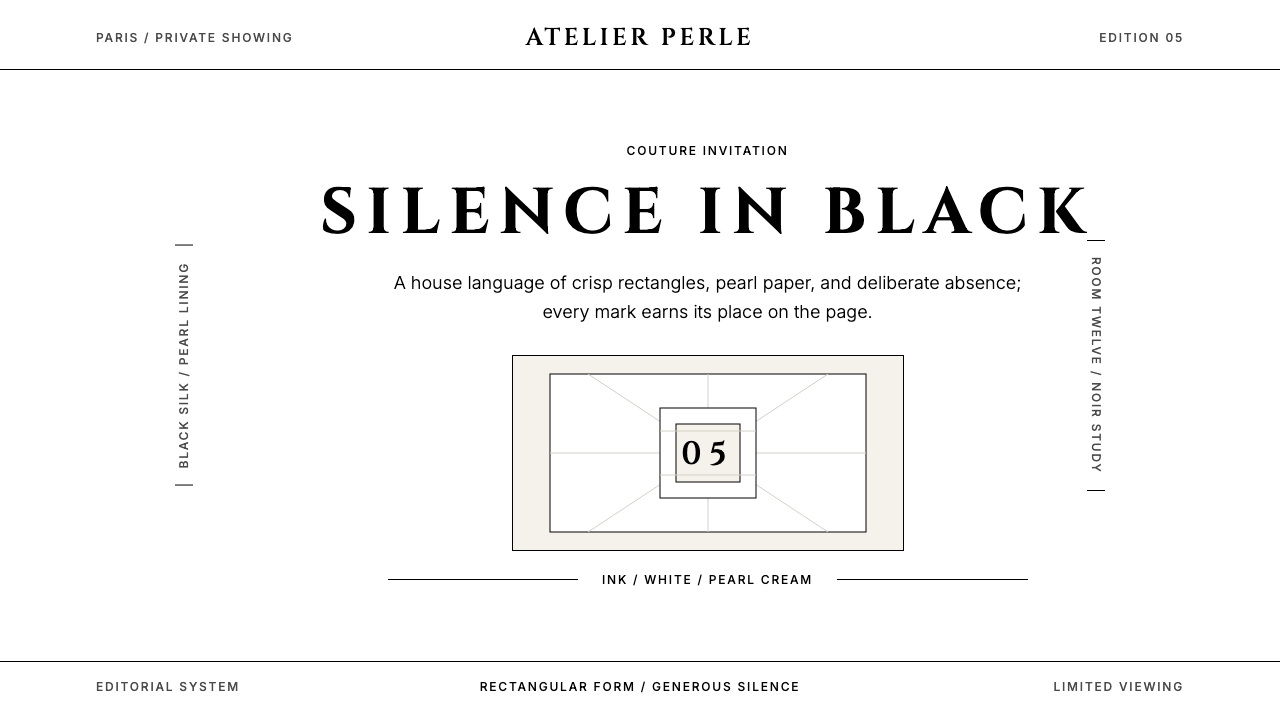 ChanelLuxury needs no color. Black on white, pearl-cream warmth, geometric capitals…
 Grand Piano ActionMechanism as luxury. Brass screws and felt hammers lit out of ebony gloom, se…
 Maldon Sea Salt PyramidCold mineral luxury. Salt-white facets on blue-grey ground, struck once with…
 Paris Zinc RooftopsEvery shade of grey. One weathered zinc palette, set in high-contrast Playfai…