What is British Racing Green (Motorsport, 1907)?
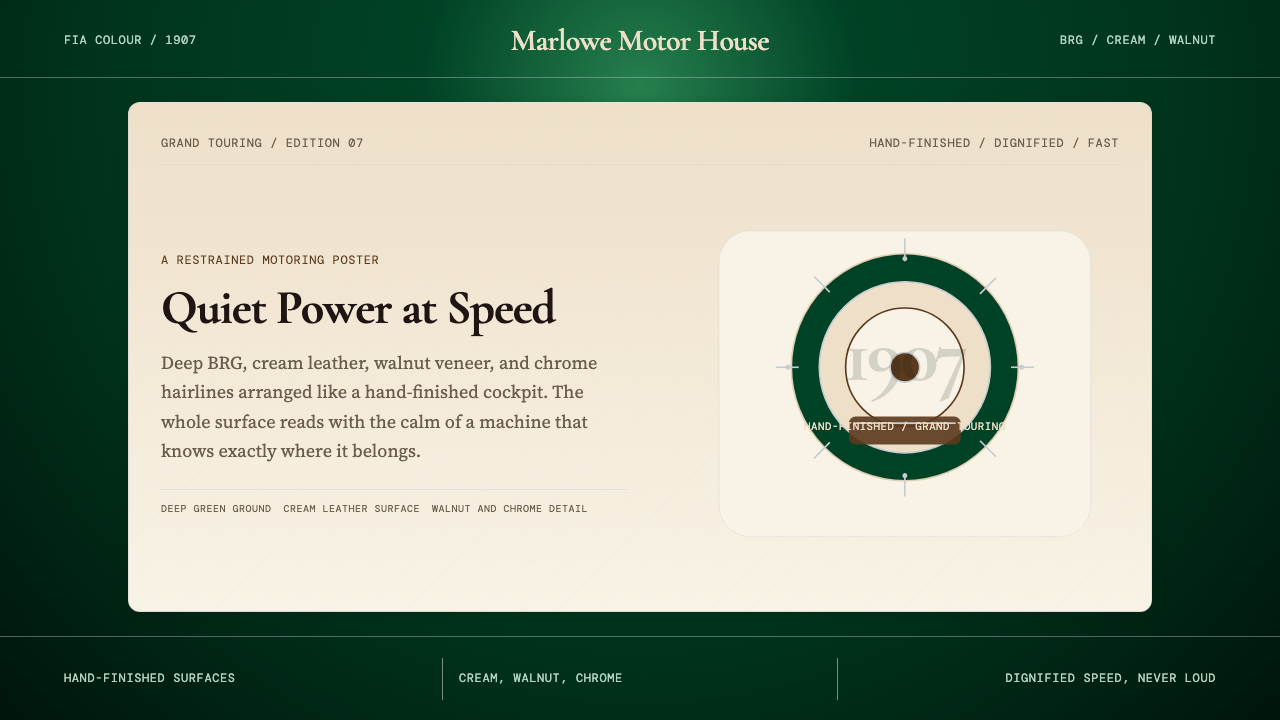
British Racing Green is the deep, olive-shifted forest color that Britain's grand tourers wore as a national identity from 1907 onward — quiet authority in motion.
British Racing Green (Motorsport, 1907) in brief
British Racing Green is a deep, olive-toned forest green that became Britain's official motorsport national color when the FIA assigned national racing colors to competing countries in 1907. It sits at the darker, cooler end of the green spectrum — not the vivid emerald of botanical illustration, nor the warm hunter green of tweed country-wear, but something quieter and more deliberate: a color that absorbs light rather than reflecting it, conveying control and authority without display.
The aesthetic system built around this color draws on the interior of a hand-finished grand tourer: cream leather surfaces against the deep green, warm walnut and polished wood accents, chrome hairlines catching light at precise angles, and engraved serif typography that belongs on a dashboard plaque or instrument bezel. The result is what the British luxury car industry perfected over a century — restrained luxury, dignified and never loud, with the quiet confidence of something exceptional that has nothing to prove.
Unlike purely archival period styles, British Racing Green translates naturally into contemporary digital and print work because its underlying logic is compositional rather than decorative. The palette creates depth through contrast of dark and light, warm and cool, matte and reflective — rather than through color variety. This restraint is what makes it powerful in professional contexts: it reads as authoritative and premium without the visual aggression of high-saturation design systems.

See the British Racing Green (Motorsport, 1907) design system
Where does British Racing Green (Motorsport, 1907) come from?
The story of British Racing Green begins not in Britain but in Ireland. The Gordon Bennett Cup, one of the earliest international motor races, required each competing nation to paint its cars in a designated color for identification. When the 1900 and 1902 races were held, Britain entered under the banner of the Automobile Club of Great Britain and Ireland. A popular account holds that Ireland's allocation — green, the color most associated with the island — was extended to cover the joint team, and when Britain began competing under its own identity, the green had already become indelibly associated with British cars. The precise diplomatic and regulatory history of the color assignment remains debated among automotive historians, but by 1907, when the FIA formalized national racing colors, dark green was Britain's.
The color gained its full cultural weight through the golden era of Bentley at Le Mans. From 1924 to 1930, the Bentley Boys — a group of wealthy, hard-driving gentleman racers including Woolf Barnato, Tim Birkin, and Glen Kidston — campaigned large, powerful Bentley automobiles at the 24 Hours of Le Mans, winning five times across the decade. Their green cars, with their deep paint, cream instrument panels, and the purposeful mechanical noise of a large displacement engine, became the visual and aural signature of British motorsport excellence. W. O. Bentley, the company's founder and engineer, had come from an apprenticeship in the railway workshops of Doncaster, and his cars carried a similar ethos: engineered competence expressed through material quality rather than visual flourish.
The postwar period saw the color migrate from racing circuit to road car as the great British marques — Jaguar, Aston Martin, and later Lotus — adopted variations of the green as their defining livery. Sir William Lyons, who built Jaguar into an internationally recognized brand from his Coventry base, understood that color was inseparable from a car's character. The racing heritage of the green gave Jaguar's road cars a competitive credibility that advertising alone could not manufacture. David Brown, who purchased Aston Martin in 1947 and drove it through its most celebrated period, brought similar thinking: the racing green of the DBR1 that won Le Mans in 1959 was not just a color but a statement of intent.
Colin Chapman and Lotus complicated the story in a productive way. Chapman's racing cars were designed on entirely different principles — lightness, aerodynamic efficiency, and engineering innovation over the traditional British virtues of solidity and craftsmanship. Yet Lotus too raced in green for much of its early history, and Chapman's use of the color for the cars that won constructors' championships in the 1960s and 1970s demonstrated that British Racing Green was elastic enough to accommodate more than one vision of what a British racing car should be. The color had become a shorthand for British engineering ambition, whatever form that ambition took.
What defines the British Racing Green (Motorsport, 1907) look?
Color Palette
The palette is anchored by a deep, olive-shifted forest green that sits at the darker, more saturated end of the spectrum — closer to shadow than to foliage. Against this ground, cream and warm ivory serve as the primary light counterpoint, evoking aged leather and parchment rather than clinical white. Warm metallic tones — the gold of aged brass, the silver-grey of polished chrome — provide the third register, neither fully warm nor cold, catching light without announcing themselves. Black is used sparingly for definition and typography rather than as a dominant ground.
Typography
Letterforms in this system are drawn from the British tradition of engraved and stamped type: classical serif typefaces with pronounced contrast between thick and thin strokes, the kind found on instrument bezels, dashboard plaques, and silverware hallmarks. Headlines carry the weight of formal engraving — deliberate and permanent — while body text holds to a comfortable, unhurried measure. Letterspacing is generous rather than tight, reinforcing the sense that nothing here is rushed. All-capitals settings in small scale echo the precision of mechanical engraving.
Texture and Surface
Where most digital design systems embrace flatness, British Racing Green celebrates measured surface richness. Leather-grain patterns, fine wood veneer striations, and the micro-texture of brushed metal appear as quiet background elements rather than decorative features — they are felt rather than noticed. The visual logic mirrors the grand tourer interior: every surface has been touched by a craftsman's hand, but the finish is so controlled that it reads as natural rather than labored.
Composition and Proportion
Layouts in this style favor generous margins and unhurried white space — or more precisely, deep-ground space — that allows each element to sit with dignity rather than compete for attention. Symmetry is used with more ease than in modernist systems: a centered headline or a balanced two-column arrangement feels appropriate here because the style's references are classical rather than avant-garde. Horizontal rules and fine lines serve as structural dividers, evoking the precise engraved lines of a quality chronograph dial.
Ornament and Detail
Unlike modernist systems that forbid ornament entirely, British Racing Green permits detail at a controlled scale. The key distinction is purpose and restraint: a thin engraved border around a panel, a small crest or badge mark, a hairline rule separating a heading from its subheading — these are not decoration for its own sake but functional signals that something is finished, bounded, and considered. Ornament here always looks as though it was applied by hand at final assembly, not printed on by mass production.
Restraint and Authority
The single most defining quality of this aesthetic is what it withholds. Colors are not at full saturation; voices are not raised; nothing shouts for attention. The confidence is in the quality of the materials and the precision of the execution, not in the volume of the communication. This logic — that authority is demonstrated through restraint rather than assertion — runs through British luxury craft from bespoke tailoring to hand-built motorcars, and it is the quality that distinguishes authentic applications of this style from pastiches that mistake aged color for elegance.
Light and Reflection
British Racing Green design treats light as a material. Chrome hairlines, polished surfaces, and the deep lacquer quality of the green itself all interact with light in different ways — one reflects sharply, another glows, the third absorbs. In two-dimensional work, this translates into a careful hierarchy of surface finishes: matte grounds against which metallic or glossy accents register with precision. Gradients are not banned but are used subtly, to suggest depth within a lacquered surface rather than to add visual interest for its own sake.

See the British Racing Green (Motorsport, 1907) design system
Who shaped British Racing Green (Motorsport, 1907)?
Walter Owen Bentley founded Bentley Motors in 1919, having learned his engineering craft in the railway workshops of Doncaster and through wartime aero-engine development. His ambition was to build a fast car, a good car, the best in its class. The racing Bentleys that won at Le Mans from 1924 to 1930 established a template for what British Racing Green meant as an aesthetic: deep-painted coachwork, cream instruments, the purposeful mechanical presence of a large, well-made engine. Bentley sold the company to Rolls-Royce in 1931 under financial pressure, but his engineering philosophy survived and continues to define how Bentley presents itself visually more than nine decades later.
William Lyons co-founded what would become Jaguar Cars in Blackpool in 1922 and led the company for five decades from his Coventry base. His personal contribution to the aesthetic was the notion that visual beauty in a car should be inseparable from its performance character — the E-Type's long hood, the XK120's swept fenders, the Mark 2's glasshouse — all translated high-speed intention into static form. Lyons selected and approved every styling detail himself, and his instinct for proportion and surface meant that Jaguar's version of British Racing Green always carried a slightly more tapered, more aerodynamic quality than Bentley's more upright interpretation.
David Brown purchased Aston Martin in 1947 for a reported sum of around five hundred pounds following a classified advertisement, and the DBR1 that won the 24 Hours of Le Mans in 1959 — the only British car ever to win overall — wore his initials on every model produced during his tenure. Brown's Aston Martins defined a particular variant of the British Racing Green aesthetic: darker and more intimate than Jaguar, more road-focused than the racing Bentleys, with an emphasis on the driver's immediate environment — leather-wrapped steering wheels, machined aluminum instrument bezels, the sense of a cockpit rather than a cabin.
Colin Chapman founded Lotus Cars in 1952 and built it into one of the most technically innovative racing teams in Formula One history, winning six constructors' championships during his tenure. Where the older British marques expressed the green in terms of weight and material richness, Chapman's Lotus translated it through radical lightness and aerodynamic efficiency — cars that looked taut and purposeful rather than opulent. His background in structural engineering meant that every surface was load-bearing, and the green livery on cars like the Lotus 25, 33, and 49 acquired a different meaning: not the green of leather and walnut, but of carbon-fiber thinking before carbon fiber existed.
Woolf Barnato was a South African-born British businessman who became the most successful of the Bentley Boys, winning all three Le Mans races he entered in 1928, 1929, and 1930. More than his driving record, his significance lies in what he represented: the British Racing Green aesthetic at its social apex. Barnato's personal style — the heavy gold wristwatch, the bespoke tailoring, the casual aristocratic confidence — embodied the off-track character of the green livery. He was simultaneously a racing driver and a gentleman of leisure, and the tension between those two identities is exactly the creative tension that British Racing Green as a design system embodies.
How do you use British Racing Green (Motorsport, 1907) today?
British Racing Green is among the more demanding historical styles to apply correctly in contemporary design work, because its power comes not from a recognizable color alone but from a specific tension between depth and restraint, richness and control. Applying it correctly requires understanding that every element should feel considered and finished — nothing provisional, nothing placeholder, nothing that looks as though it could be swapped out later without consequence.
For presentation slides, this system excels at the cover moment and at data-dense content pages where hierarchy must be communicated without visual noise. A cover slide benefits from a full deep-green ground with cream or ivory headline typography and a single metallic or light-toned accent element — a fine rule, a small badge device, a carefully placed secondary line of information. Content slides should use the deep green sparingly, reserving it for section anchors or emphasis blocks, with a near-cream or light ground carrying the majority of text. Data slides translate well because the palette's limited range forces clarity: bar charts and line charts become compositional elements in their own right, with the green serving as the primary data series color and cream or warm metallic tones marking thresholds or targets.
For web interfaces, British Racing Green is exceptionally well-suited to premium dashboard environments, financial platforms, and pricing pages where the message is competence and trustworthiness rather than approachability or friendliness. The approach: use the deep green as a sidebar or header ground, maintain a warm off-white or cream for the primary content area, and deploy metallic or amber accents for interactive states and primary call-to-action elements. Card components should have fine borders rather than shadow-based depth, with subtle surface textures that suggest material quality without becoming decorative. Navigation typography should favor the classical serif tradition — measured, spaced, unhurried.
For editorial and marketing work, this style creates a distinctive register between the luxury of high-fashion editorial and the authority of financial publishing. A long-form article layout works well with a narrow, elegantly spaced body-text column, wide outer margins carrying pull-quotes or chapter markers in a reduced scale, and horizontal rules rendered as fine lines rather than thick bars. Marketing pages benefit from alternating register between a deep-green feature panel with cream typography and a cream or warm-white panel with green or dark typography — the alternation creates rhythm without requiring decorative elements. Print-oriented applications such as annual reports, capability documents, and event programs find a natural home in this system.
A common mistake when applying British Racing Green is treating the deep green as a background to be filled with lighter elements at high contrast, producing something that reads more like a chalkboard or a blackboard aesthetic than the intended grand tourer interior. The green should feel rich and present, not merely dark. A related error is over-reliance on aged or distressed texture effects — cracked leather, oxidized metal — which push the system toward nostalgia or costume rather than the living, maintained quality of a well-kept classic car. The benchmark is not something weathered and aged, but something polished and prepared: ready to perform, in perfect condition.

See the British Racing Green (Motorsport, 1907) design system
British Racing Green (Motorsport, 1907) — FAQ
What makes British Racing Green different from other green-based design systems?
Most green-based design systems use green as an accent or brand color against neutral grounds. British Racing Green inverts this relationship: the green is the ground, the deep immersive field from which other elements emerge. This gives it a fundamentally different psychological register — closer to an environment than a color note. The specific shade also matters: the olive shift in British Racing Green places it in a territory that reads as cultivated and serious, distinct from the brighter or more saturated greens associated with nature brands, technology platforms, or financial data visualization.
Can this style work for consumer-facing brands, or is it only suited to premium and B2B contexts?
British Racing Green works in consumer contexts when the product genuinely occupies a premium or heritage tier and the target audience values understatement over excitement. It succeeds for watches, spirits, financial services, performance vehicles, travel, and certain categories of menswear or homeware. It struggles where the product must feel inclusive, energetic, youthful, or accessible at multiple price points — the style's inherent formality and restraint work against democratizing signals. The most honest test: if the brand would feel comfortable placing its name on the door of a Bentley, the style is likely appropriate; if the brand's aspiration is to feel like a running shoe or a mobile game, it is not.
How should photography be treated when working within this system?
Photography in this system should be treated as a crafted object, not a window. The most effective approaches are: tight crop to isolate surface quality and detail rather than showing wide environmental context; deliberate depth of field that draws attention to material — a leather stitch, a chrome fixture, a walnut grain — rather than to the scene as a whole; and tonal treatment that pulls the image toward the palette's warm range, avoiding cool-blue shadows or overly clean digital whites. Color photography should feel like it was shot on professional transparency film rather than a contemporary digital sensor: slightly warmer, with more presence in the shadow detail.
Is it appropriate to mix British Racing Green with other historical design styles?
Mixing rarely improves the result. British Racing Green has a strong internal logic — the motorsport heritage, the coachbuilding tradition, the British luxury craft ethos — and introducing the visual vocabulary of another distinct period or cultural context typically creates dissonance rather than richness. The one adjacency that works relatively well is early twentieth-century Art Deco, which shares the chrome accents, the classical serif sensibility, and the celebration of machine precision. Mid-century modernism is a more difficult mix because its palette and attitude toward ornament are quite different. Avoid combining with anything that introduces irony, distress, or digital-native aesthetics — the style depends on sincerity.
How do you avoid making British Racing Green feel nostalgic or costume-like rather than contemporary?
The distinction between living heritage and costume lies in purpose and proportion. A classic car in original condition does not feel like a museum piece when it is driven because its qualities — the precision of the controls, the quality of the materials, the considered ergonomics — still function as intended. The same principle applies in design: if every element is doing a genuine communicative job — the serif type carries the hierarchy, the fine rules demarcate sections, the metallic accents indicate interaction — the system reads as purposeful. The costume version arises when elements are selected for period signaling rather than functional logic: aged paper textures applied to data, crest imagery used without institutional meaning, letterforms chosen for historical association rather than legibility. The test is always: does this element earn its presence?
Related design styles
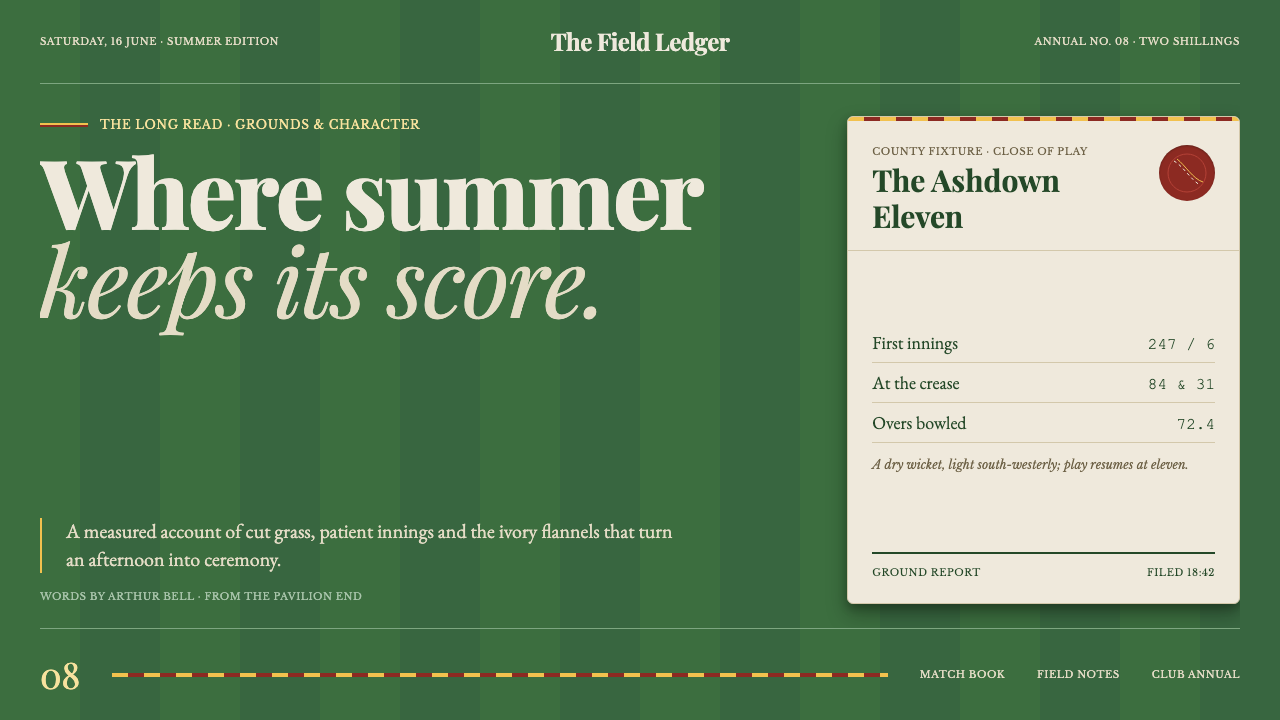 Cricket Whites FlannelsSummer, kept in good order. Ecru serif and fine club trim cross a dark mown g…
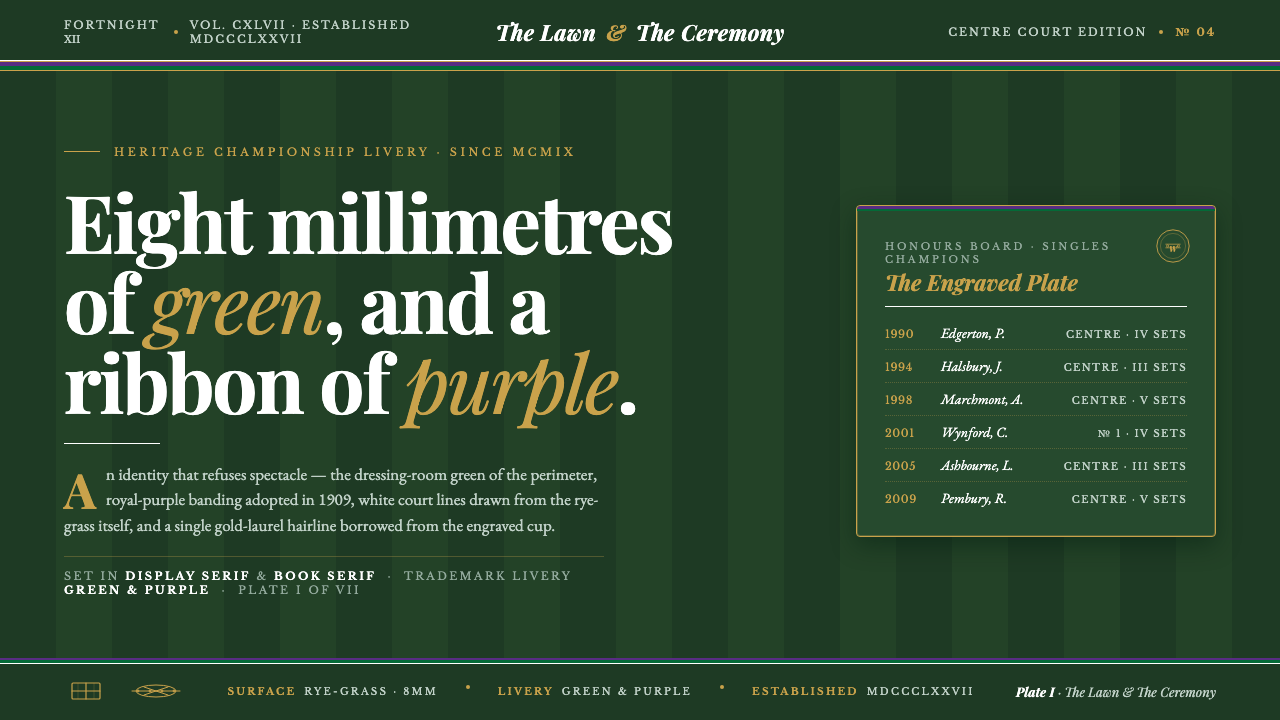 Wimbledon GrassHeritage, not stadium. Championship green ground, purple-and-green livery, go…
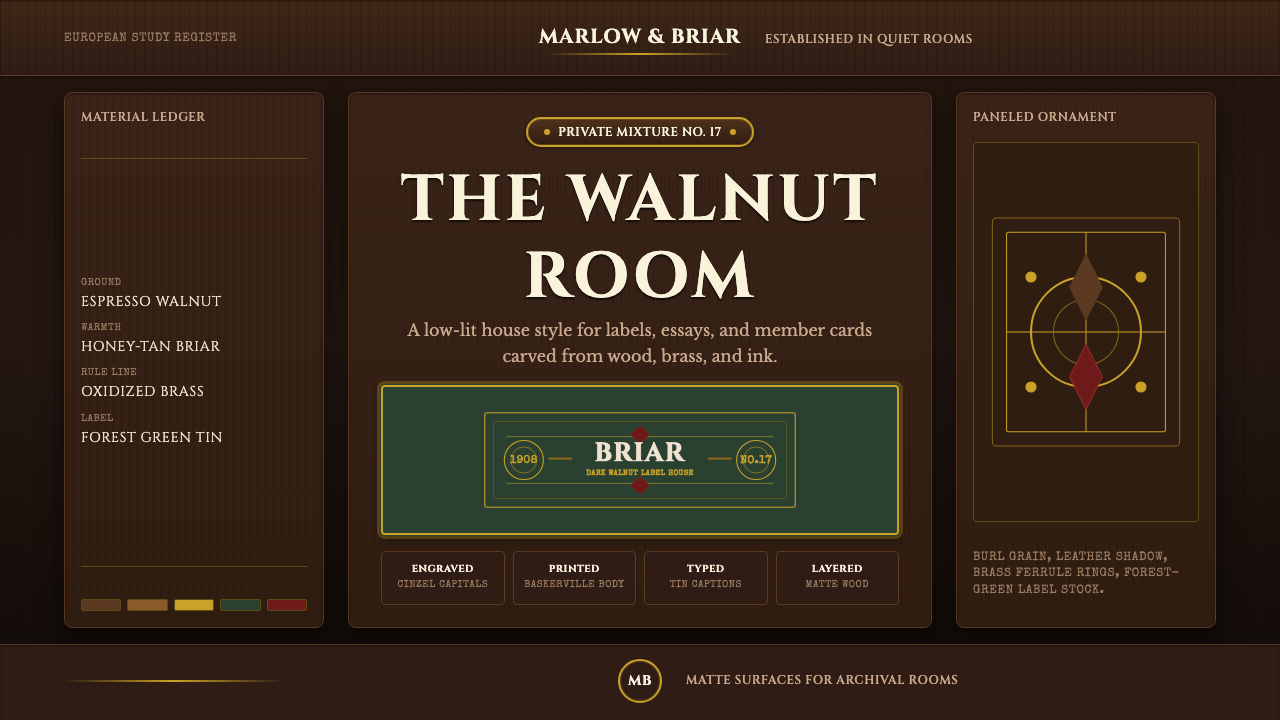 Briar Pipe & TobaccoWarm gloom, precisely aged. Brass rules and Cinzel capitals sit on espresso w…
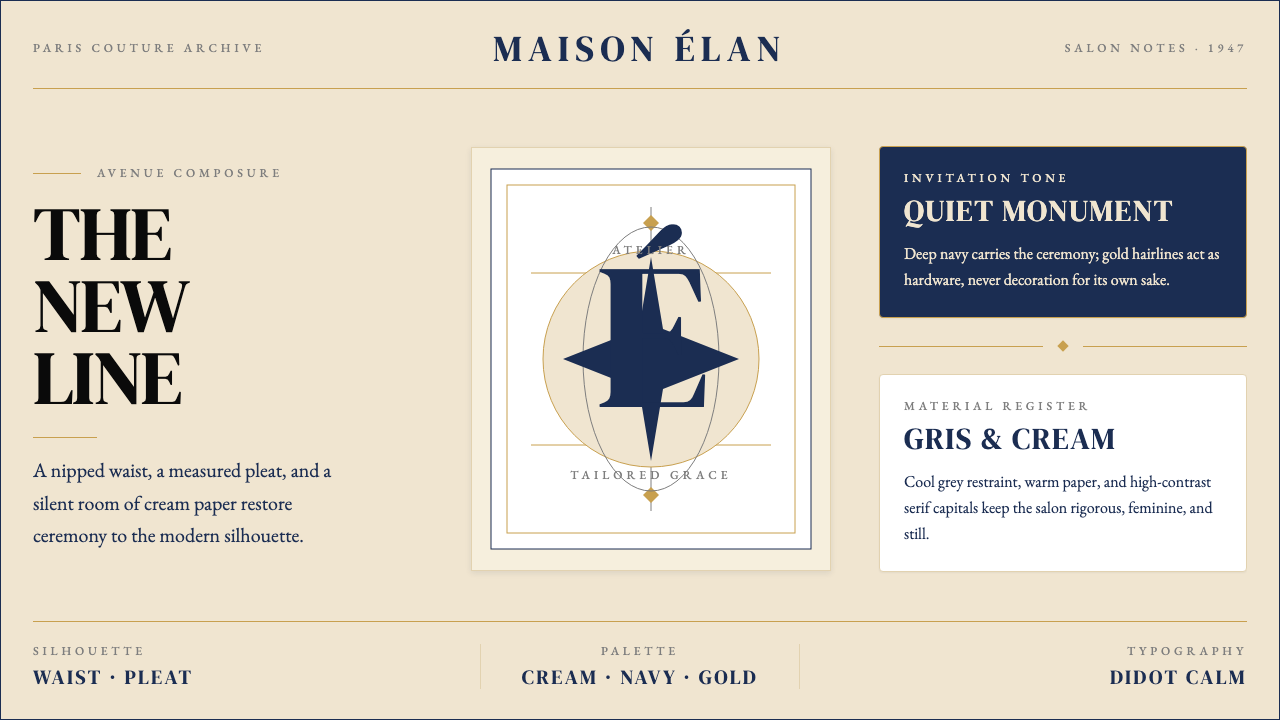 Dior New Look (1947)Couture speaks softly. Cream ground, navy Didot capitals, and gold hairlines…
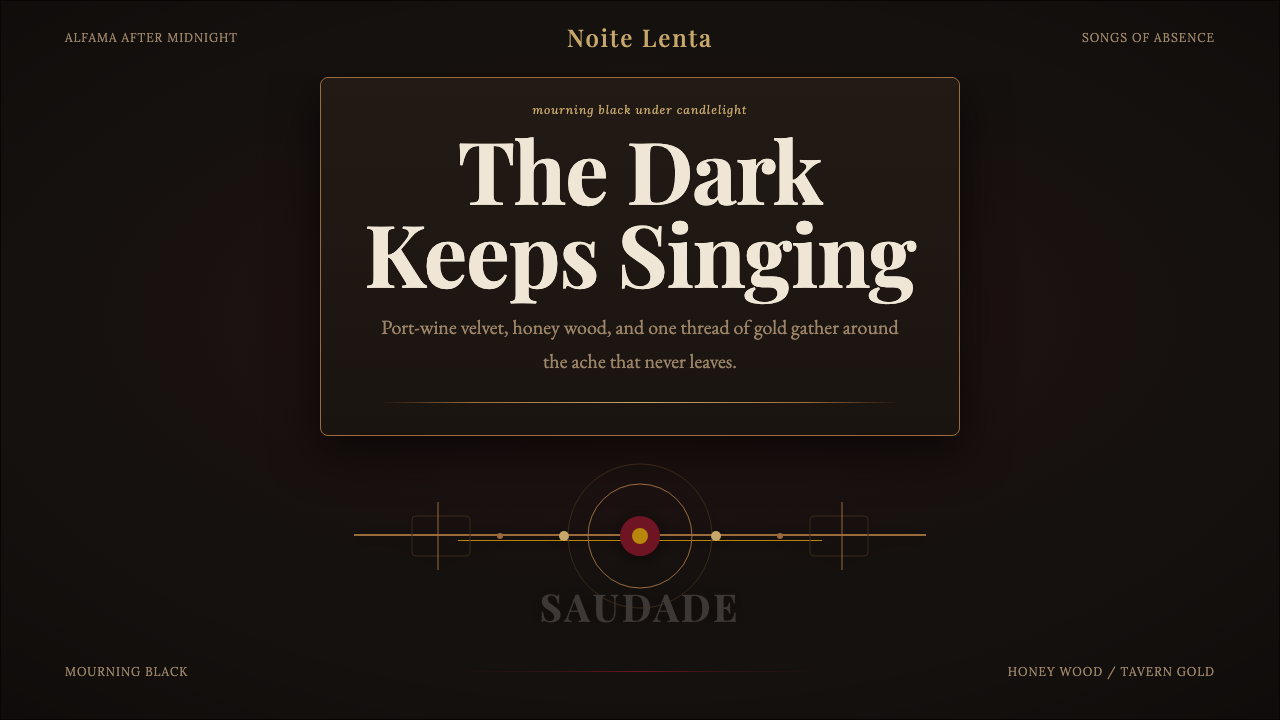 Fado SaudadeSaudade in shadow. Mourning black holds wine red, honey wood, and one gold li…
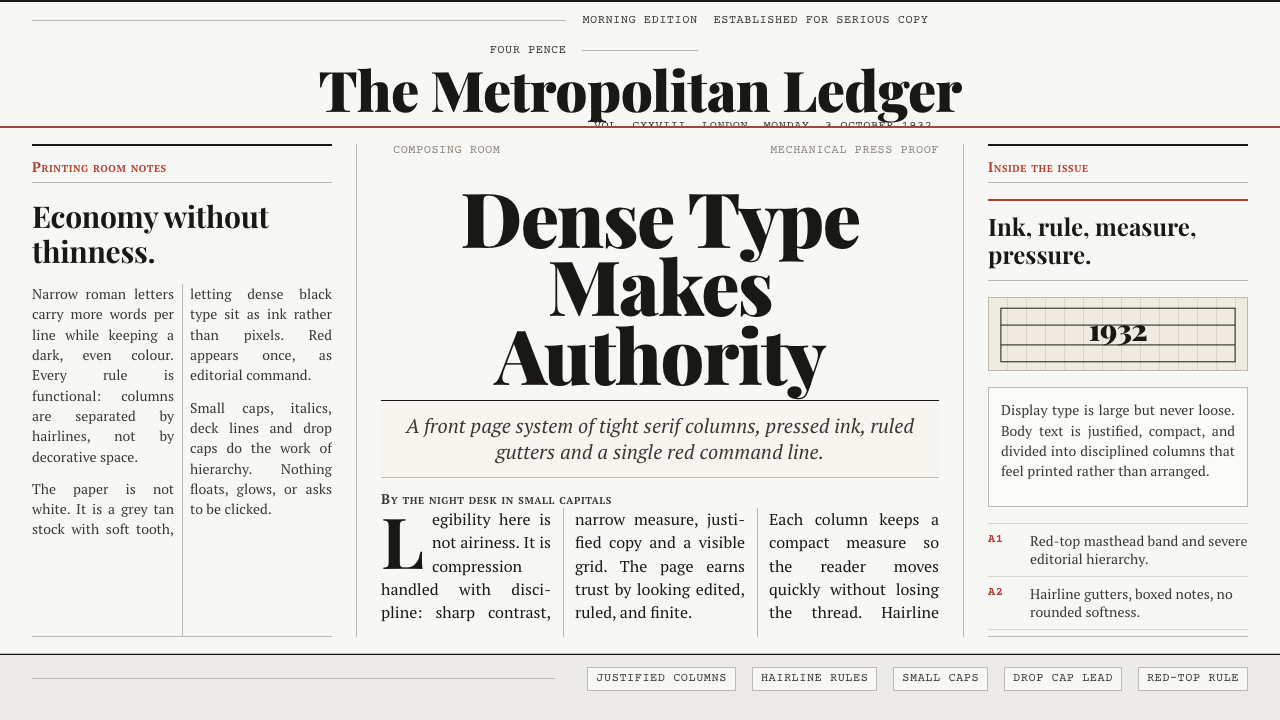 Times New Roman by MorisonAuthority under pressure. Dense black serif columns on grey-tan newsprint, ru…