What is Dior New Look (1947)?
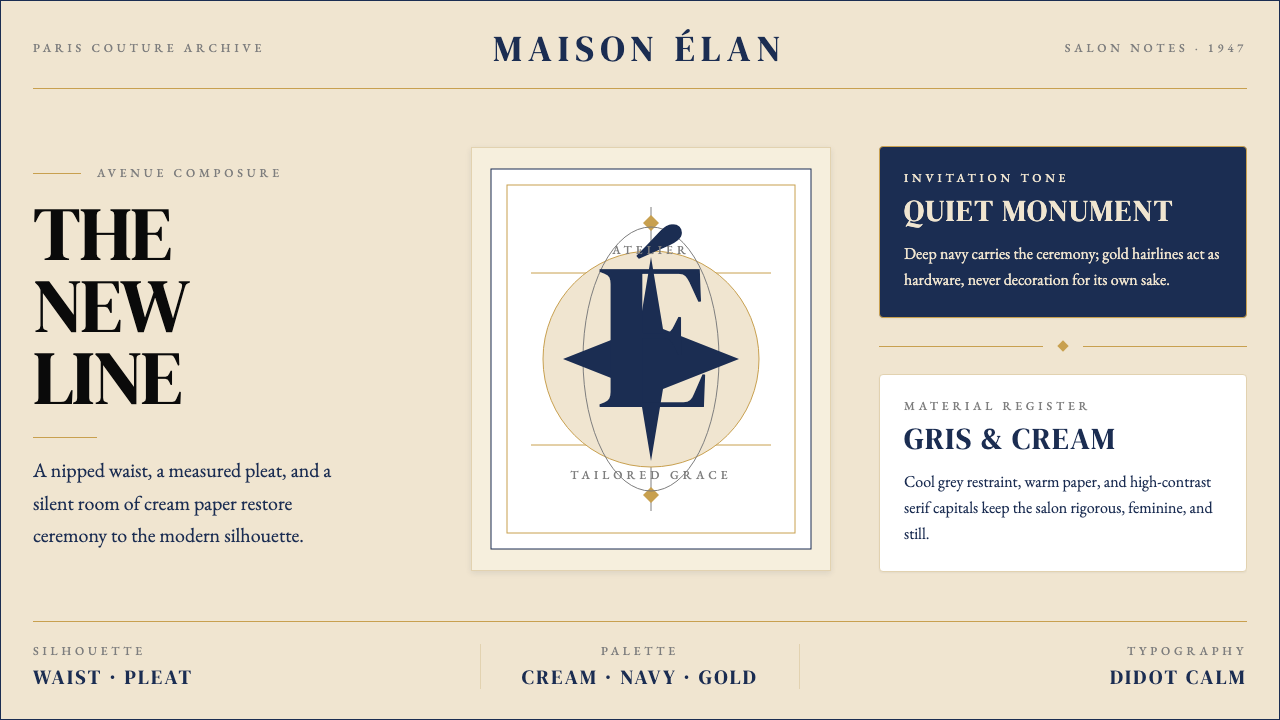
A single Paris couture show in February 1947 redrawn femininity, silence, and luxury into a visual system that still dictates what elegance looks like.
Dior New Look (1947) in brief
The Dior New Look is a visual system born from a single couture collection — Christian Dior's debut, presented February 12, 1947, at 30 Avenue Montaigne in Paris. Its palette is anchored in three colors: a cool, dusty grey known as gris-Dior, a warm cream recalling fine writing paper, and a deep, authoritative navy. Against these grounds, tall Didot-style serif capitals carry headlines with the precision of an engraved calling card. Gold hairlines — filigree-thin — divide compositions as if drawn with a draughtsman's ruling pen. The total effect is monumental restraint: not the loudness of wealth, but the quietness of certainty.
What separates the New Look aesthetic from generic luxury is its relationship to structure. The style's founding garment, the Bar Jacket, was built on an interior architecture of boning, interfacing, and padding that sculpted the silhouette before a single visible seam appeared. The same logic carries into the visual language: every layout decision is load-bearing. Wide letter-spacing in capitals is not decoration but pacing. A generous page margin is not waste but breathing room that confers importance on what occupies the center. Hairline rules are not embellishment but joint lines that articulate where one zone ends and another begins.
The style is not maximalist, and it is not minimalist in the contemporary sense. It is couture-precise — a word chosen deliberately. Where minimalism strips down to emptiness, the New Look strips down to exactitude: only the necessary elements remain, but each of those elements is given the full weight of craft attention. Negative space is active. Cream grounds do not recede; they command. This is elegance defined not by addition but by the discipline of selection.

Where does Dior New Look (1947) come from?
Christian Dior was not an overnight phenomenon. Born in 1905 in Granville, Normandy, he spent the 1930s working as an art dealer and then as a sketch-seller, eventually apprenticing under the couturier Robert Piguet and later under Lucien Lelong during the German occupation of Paris. The occupation years were artistically stifling but technically formative: the skilled petites mains — the seamstresses, embroiderers, and toilers of the ateliers — continued their craft under constraint, and Dior absorbed both the standards and the melancholy of that period. When textile industrialist Marcel Boussac agreed to back a new house in 1946, Dior had already assembled a precise vision of what he wanted to say.
The February 1947 show — which editor Carmel Snow of Harper's Bazaar named the 'New Look' immediately after seeing it — was received as both a revelation and a provocation. The padded shoulders and boxy silhouettes of wartime rationing gave way to a rounded shoulder line, a cinched waist, and a full skirt falling to mid-calf. The Bar Jacket, in pale wool, with its curved peplum and hip padding, was the collection's centerpiece. To some observers the show felt like an affront to austerity; to others it felt like the restoration of something that had been unjustly suppressed. Paris claimed its position as the undisputed capital of fashion, a status it had not been sure of during the occupation.
The visual identity that crystallized around the house — the grey and cream interiors of 30 Avenue Montaigne, the oval-and-serif logo, the tissue-paper wrapping, the gold-stamped boxes — was not an afterthought but an extension of the same couture logic Dior applied to the clothes. He understood, perhaps more consciously than any designer before him, that the environment in which a garment is seen shapes the meaning of the garment itself. The boutique was designed to feel like a private residence of studied elegance, not a retail environment. Every touchpoint — the invitation, the program, the label sewn into the lining — participated in the same visual grammar.
The house has since passed through a succession of creative directors whose work has reinterpreted and sometimes dramatically expanded the original aesthetic. Yves Saint Laurent, who succeeded Dior after his sudden death in 1957, introduced a more youthful edge while preserving the couture architecture. John Galliano, appointed in 1996, pushed the house into theatrical excess and historical pastiche, exploring the New Look's silhouette as a starting point for extremity. Since 2016, Maria Grazia Chiuri has brought a feminist re-reading: citing Dior's female relatives and collaborators, and exploring the political dimensions of the constructed feminine silhouette. Through all these interpretations, the core visual language — the palette, the Didot-style capitals, the hairline gold, the grey and cream — has remained the house's graphic identity, administered with increasing consistency under LVMH ownership since 1984.
What defines the Dior New Look (1947) look?
Palette
The New Look palette is built on three carefully weighted tones: gris-Dior, a cool grey with a faintly blue undertone that reads as both neutral and authoritative; warm cream, which carries the warmth of aged paper and functions as the primary ground; and deep navy, used for type, borders, and structural emphasis. Gold — not yellow, but the restrained warmth of polished hardware — appears as a fourth accent, reserved for hairline rules, monogram stamps, and small graphic flourishes. No bright primaries. No black-and-white stark contrast. The system is pitched at the register of a very quiet confidence.
Typography
Headlines are set in tall, high-contrast serif letterforms in the Didot tradition — letterforms in which the difference between the thinnest stroke and the thickest stroke is extreme, producing an almost engraved quality. Uppercase settings dominate, particularly for brand names, section titles, and any word that needs to carry the weight of a label. Letter-spacing in these uppercase settings is consistently generous — each character given room to stand as an independent form rather than being compressed into a dense word-shape. Body text, when present, is set with deliberate restraint and typically at a smaller scale, treating the editorial density of fine print as a quality rather than a liability.
Silhouette and White Space
Just as the Bar Jacket constructed its elegance through interior architecture invisible to the eye, New Look layouts construct their authority through the management of empty space. Margins are wide — sometimes dramatically so — and this width is not a failure to fill the page but a deliberate elevation of whatever sits within the center. The composition principle is that negative space is as weighted as positive space. An isolated headline on a cream ground carries more authority than the same headline surrounded by competing elements. Single central motifs, placed with mathematical deliberateness, anchor pages and spreads.
Gold Filigree and Linear Detail
Hairline rules in gold — strokes so thin they read as drawn rather than printed — function as the system's primary articulation device. They divide header from body, frame a central motif, or underline a logotype with the precision of a ruled line on formal stationery. This is not decoration in the ornamental sense; it is joinery. The gold hairline marks where one structural zone ends and another begins, performing the same role as the topstitching on a couture lapel. Floral flourishes — particularly lily-of-the-valley, Dior's emblematic flower — appear at the smallest scale, used as period marks or section-end indicators rather than as area-filling motifs.
Photography and Image
New Look imagery follows editorial fashion-photography conventions at their most controlled. Compositions are typically centered or near-centered, lit for sculptural volume rather than documentary flatness, and cropped to emphasize silhouette. The subject occupies a generous amount of frame, surrounded by breathing room. Color photographs appear muted and tonal rather than saturated; black-and-white images lean toward high contrast and deep shadows. There is no lifestyle photography in the candid sense — every image is staged, knowing, and composed with the precision of a still life. Product imagery is photographed against grounds that echo the palette: cream, grey, or deep field.
Restrained Materiality
The New Look visual language implies material quality rather than illustrating it. Cream grounds suggest fine paper without simulating paper texture. Navy type implies ink without imitating the variation of actual ink flow. Gold suggests polished metal without applying a gradient or sheen effect. This restraint is deliberate: simulating texture is a form of insecurity, a signal that the design does not trust its own elegance. The system assumes a viewer who already understands the codes and requires no explicit demonstration. The surface is smooth, precise, and entirely assured.
Monogram and Emblem Logic
The house's oval cartouche — a contained shape framing the brand name in serif capitals — functions as the system's heraldic anchor. It appears at the center of packaging, at the head of correspondence, at the foot of an advertisement. Its shape is complete and self-sufficient: it does not need adjacent elements to read as authoritative. This emblem logic extends to sub-elements: a single initial, a perfume bottle silhouette, a floral sprig can each function as standalone graphic marks when set against the palette grounds. The system is built for reduction — any element, isolated and given space, retains the identity of the whole.

Who shaped Dior New Look (1947)?
Dior (1905–1957) founded the house in 1946 and launched the New Look collection on February 12, 1947. Trained in the ateliers of Robert Piguet and Lucien Lelong, he brought to his own house a thorough command of couture's internal architecture — the bonework of boning, padding, and interfacing that builds silhouette before fabric is cut. His design philosophy was as much curatorial as creative: he studied eighteenth-century French portraiture, the proportions of Second Empire furniture, and the floral grammar of Impressionist painting. The visual language he established — the palette, the typography conventions, the boutique environment — remained legible as his long after his sudden death from a heart attack in Italy in 1957.
Chiuri became the first woman to serve as artistic director of Christian Dior when she was appointed in 2016. Her tenure has been defined by a sustained feminist re-reading of the house's history: her debut collection featured a sheer top printed with 'We Should All Be Feminists,' and she has consistently sourced collaborators from feminist art, craft traditions, and non-Western cultural practice. Crucially, Chiuri has not dismantled the New Look visual grammar but has excavated the women who made it possible — the petites mains, Dior's sister Catherine, the seamstresses and pattern-makers — reframing the house's founding mythology without erasing its aesthetic codes.
Appointed in 1996, Galliano presided over what many consider the most theatrically extravagant era in the house's history. His couture shows — staged as elaborate narrative performances, with invitations printed as newspapers, models entering as Edwardian eccentrics or Egyptian queens — expanded the New Look's formal vocabulary into historical pastiche and baroque accumulation. Paradoxically, this maximalism reinforced the canonical identity: Galliano's most extreme departures were legible as Dior precisely because the underlying palette, the emphasis on sculpted silhouette, and the couture precision of finish remained intact beneath the spectacle.
Often overshadowed by the drama of his successors, Bohan served as artistic director from 1960 to 1989 — the longest tenure in the house's history. His nearly three decades of work were defined by a quiet fidelity to the New Look's structural principles: the sculpted waist, the emphasis on line and proportion, the understated palette. It was Bohan who steered the house through the social upheaval of the 1960s and the shifting silhouettes of the 1970s without abandoning the couture grammar, effectively consolidating the New Look as a continuous aesthetic tradition rather than a period style. His restraint was the condition of the house's longevity.
Arnault acquired Christian Dior as part of his construction of the LVMH luxury conglomerate, taking control in 1984. While not a designer, his stewardship has been decisive for the visual consistency of the brand: LVMH's management philosophy prizes heritage legibility over creative disruption, which in practice means the house's graphic identity — the oval logo, the cream-and-navy palette, the Didot-style serif conventions — has been administered with increasing system discipline. The contemporary Dior visual language, as encountered across packaging, digital, advertising, and retail environments, owes its coherence as much to this institutional commitment as to any single designer.
How do you use Dior New Look (1947) today?
Applying the New Look system correctly depends on understanding what it is actually communicating: not richness in the populist sense, but the specific authority of a house that does not need to compete for attention. Every application decision should ask the same question the couturier asked of every seam: is this element earning its place? The palette, the typography conventions, and the spatial logic must work together as a unified grammar — borrowing only the gold hairlines, or only the Didot-style caps, produces pastiche rather than system.
For presentation slides, the New Look translates into a highly specific visual register. Cover slides should commit to near-total restraint: the title in tall, well-spaced serif capitals on a cream ground, a single hairline rule above or below, and — at most — a monogram or emblem placed with deliberateness. No photography on covers unless it is treated as a full-bleed editorial image with the subject large and the composition centered. Content slides should use the navy-on-cream or cream-on-navy register for section titles, with body text in a smaller, more closely set serif. Data slides should treat charts as diagrammatic objects: axis labels in small caps, bars or segments colored in navy and gris-Dior with a single gold accent line marking a threshold or total.
For web interfaces — particularly dashboards, pricing pages, and brand sites for luxury-adjacent products — the New Look palette provides immediate authority on landing. The approach: use cream as the primary surface, navy for primary type and structural elements, and gris-Dior as a secondary surface for cards, panels, or sidebars. Reserve gold for the most elevated interactive moments: a selected state, a premium badge, a CTA button border. Navigation should be typographic — the brand name in a contained oval or cap-spaced setting, section labels in tracked caps — with no decorative iconography beyond very simple geometric indicators. Button styles should use bordered outlines rather than filled shapes for secondary actions, and filled navy for primary actions.
For editorial and marketing work, the style's strongest suit is the fashion editorial paradigm: an image occupying most of the spread, a title in tall tracked caps at the head or foot, and a pull-quote in italics as the only body copy that appears at reading scale. Marketing pages benefit from a section rhythm that alternates cream grounds and deep-navy grounds, maintaining the palette relationship while creating visual pace. Headlines should always be set in uppercase, with enough tracking to give each word the feeling of a label. Any call-to-action should be understated by contemporary standards — a bordered text link or a small filled button, never a large high-saturation shape.
A persistent mistake when applying the New Look is the assumption that its luxury register licenses visual abundance. In fact the system's authority depends entirely on its restraint. The most common failures: too many gold elements competing with one another (the system calls for a single hairline, not a border made of hairlines); Didot-style type used at body-copy scale where its extreme stroke contrast becomes illegible; photography chosen for lifestyle warmth rather than editorial control, which imports the visual register of a completely different brand system; and backgrounds that drift from the canonical cream-grey-navy toward beige, taupe, or brown, which collapses the palette's cool precision into generic warmth. Restraint is not optional — it is the mechanism.

Dior New Look (1947) — FAQ
Is the New Look style appropriate for brands outside luxury fashion?
Yes, with careful calibration. The New Look visual grammar — restrained palette, Didot-style serif caps, hairline gold accents, generous white space — is transferable to any context where authority, heritage, and quiet confidence are the desired values. Architecture and interior design studios, financial advisory firms, perfumery or cosmetics brands, and premium food or wine producers have all successfully operated within this register. The key test is whether the brand's actual positioning earns the implicit claim the visual system makes. If the product or service is genuinely positioned at the top of its category, the New Look grammar amplifies that positioning. If it is not, the visual language reads as aspiration rather than fact — which is a different and weaker signal.
How does the New Look handle dark or high-contrast themes?
The canonical New Look is a light-ground system — cream as the primary surface, with navy and gold as the structural and accent layers. A dark inversion is possible: deep navy as ground, cream as type, gold as accent. This version exists in Dior's own archive — evening packaging, high-end gift boxes, campaign photography with dark atmospheric grounds. The inversion works because the navy-cream-gold relationship is preserved even when their hierarchy is swapped. What does not work is substituting black for navy: black collapses the palette's cool refinement into generic dark-luxury territory. The specific temperature of deep navy is structural, not cosmetic.
What is the difference between New Look elegance and Swiss International Style precision?
Both systems are highly controlled, but they are controlled toward different ends. Swiss International Style, emerging from the 1950s onward, is a rationalist system: it seeks to achieve maximal legibility and universal applicability through mathematical grids, neutral typefaces, and objective information hierarchy. Decoration is excluded because it interferes with communication. New Look is a prestige system: it seeks to communicate authority and rarity through selective richness — the one gold hairline, the one Didot-style headline, the expanse of cream — deployed with extreme economy. Decoration is not excluded on principle; it is included sparingly, and only when it signals craft. Swiss Style is for everyone; New Look is for a particular kind of someone.
Can the New Look system accommodate warm or organic brand personalities?
Only at the margins. The New Look's cool grey, deep navy, and precision-ruled gold are fundamentally aristocratic in temperature — they read as studied, constructed, and deliberate, not warm or spontaneous. A brand that genuinely needs to communicate human warmth, organic texture, or sensory pleasure in food or wellness terms will find the system resistant. The cream ground carries some warmth, and lily-of-the-valley flourishes add a floral softness, but these are subtle inflections within a dominantly cool and formal frame. The honest answer is that some brand personalities — earthy, playful, communal, inclusive — are simply not New Look territory, and the attempt to make the system carry those values will feel contradictory rather than sophisticated.
How should the New Look system handle digital animation and motion?
Motion in the New Look register should follow the same logic as the static system: deliberate, precise, and never gratuitous. The most characteristic motion decisions are slowness and inevitability — a title that fades in over a long duration, a hairline rule that draws itself from one end to the other, a page transition that resolves into stillness rather than energy. Elements should not bounce, spring, or cascade. The arrival of an element on screen should feel like the placing of an object rather than the throwing of one. Gold hairlines that animate on entry should draw at a consistent pace, not accelerate or decelerate with an easing curve that suggests organic movement. If in doubt, the correct New Look answer to any motion question is: slower, and then slower still.
Related design styles
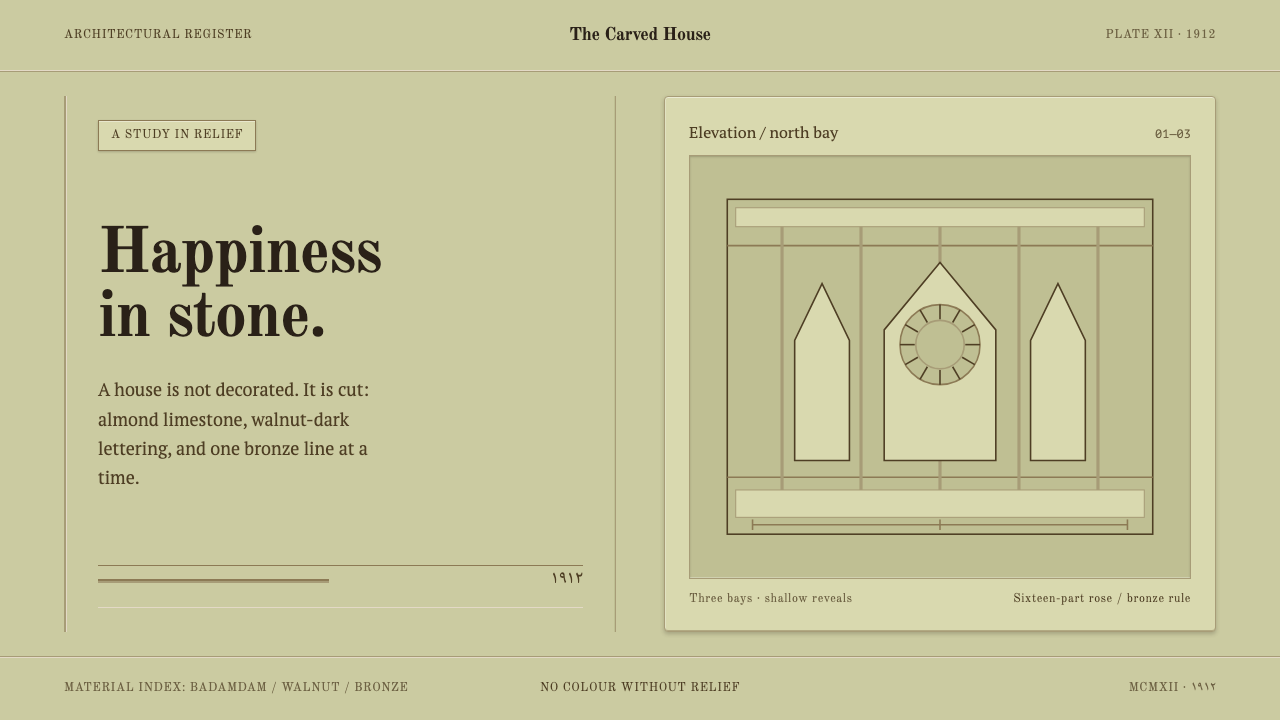 Baku Oil Boom MansionsWealth made tactile. Almond limestone, Old Standard TT, and recessed bays car…
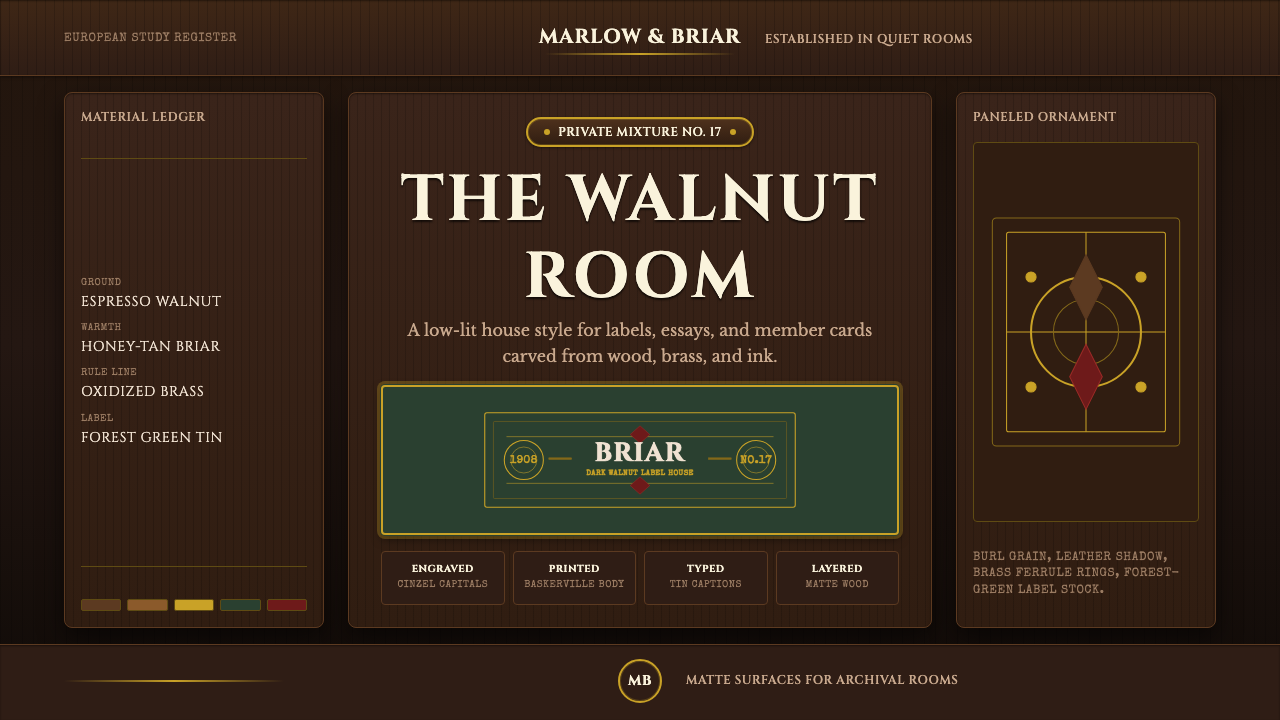 Briar Pipe & TobaccoWarm gloom, precisely aged. Brass rules and Cinzel capitals sit on espresso w…
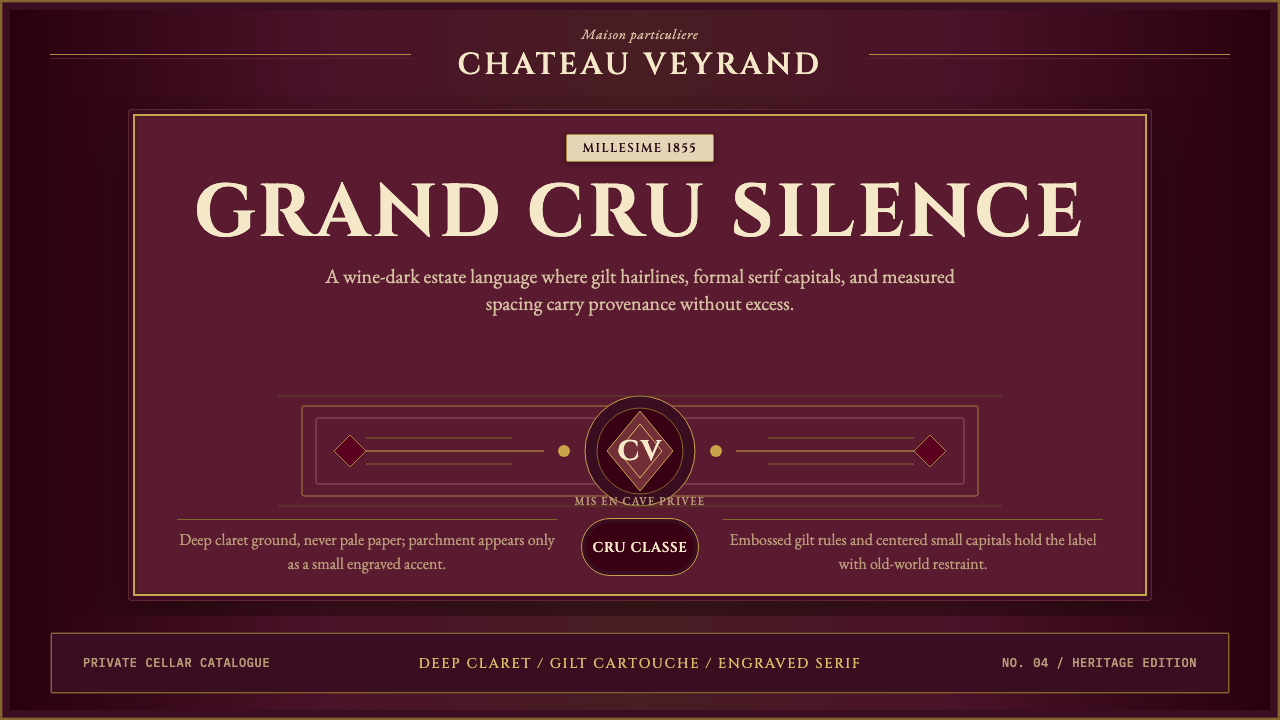 Bordeaux Wine ChâteauAged claret authority. Cinzel capitals, gilt rules, and label symmetry on win…
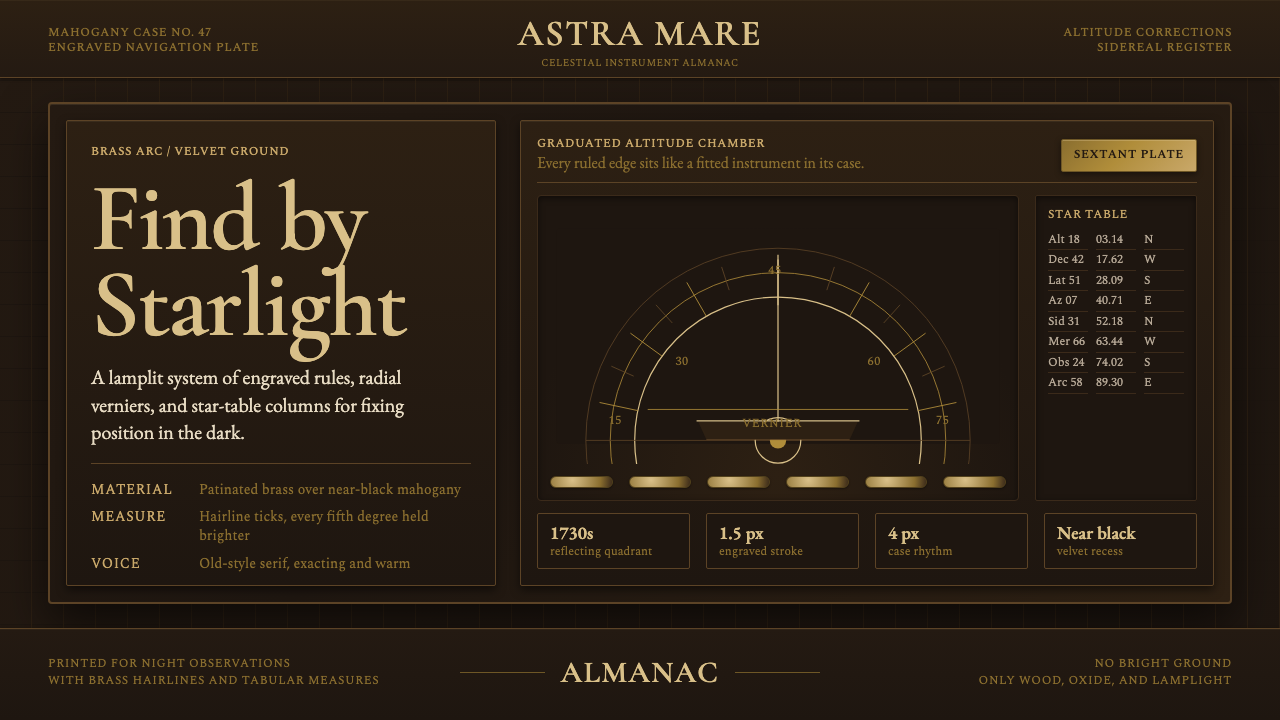 Sextant NavigationPrecision feels ceremonial. Brass ticks and mahogany grids chart the dark by…
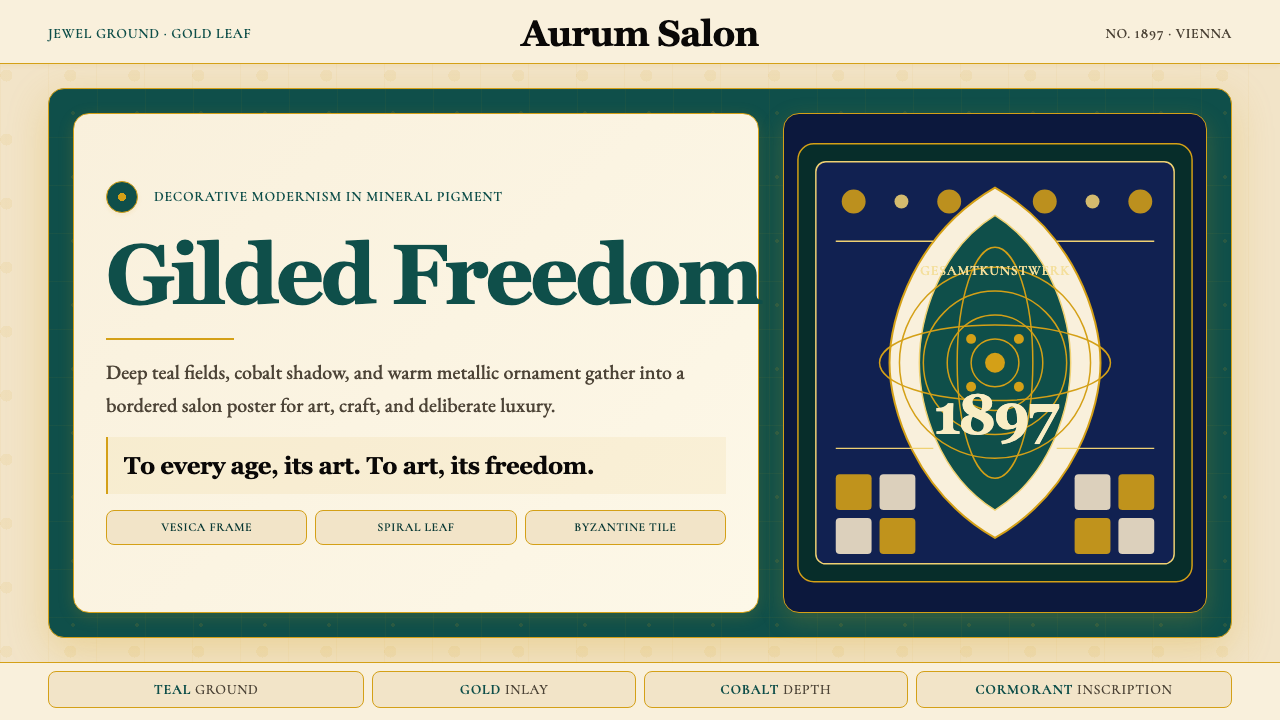 Wiener Secession (Klimt)Opulence made modern. Teal grounds, gold inlay, vesica frames and Cormorant d…
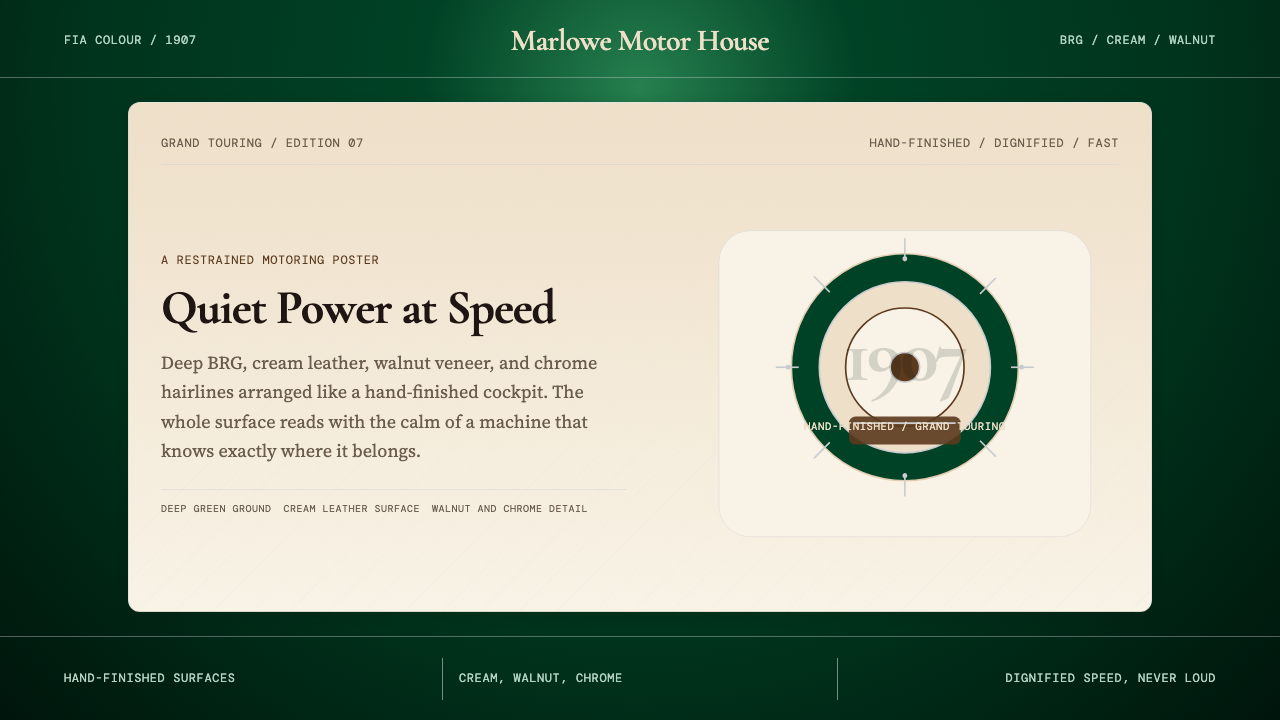 British Racing Green (Motorsport, 1907)Quiet authority at speed. Deep BRG, cream leather, walnut, and chrome hairlin…