What is Wiener Secession (Klimt)?
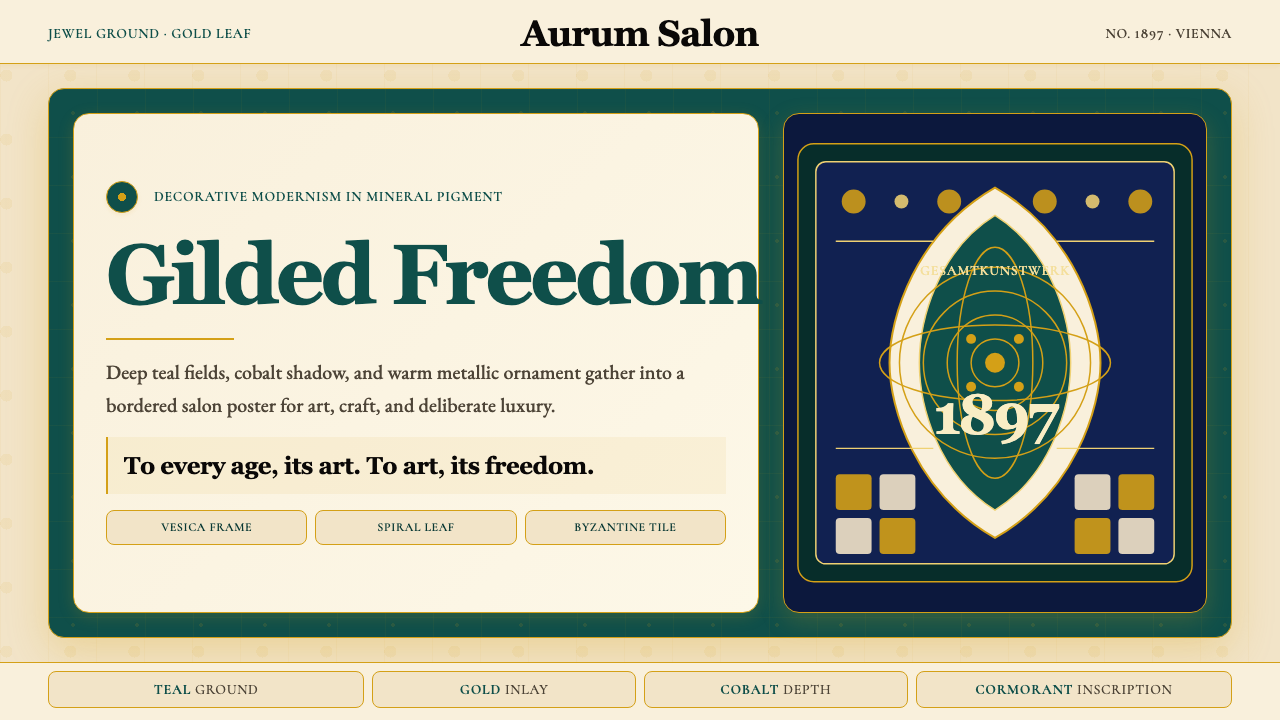
Klimt and nineteen dissidents walked out of Vienna's art establishment in 1897 and returned with gold leaf, jewel-saturated color, and a new definition of beauty that fused Byzantine opulence with fin-de-siècle modernism.
Wiener Secession (Klimt) in brief
The Wiener Secession — Vienna Secession — is the visual language born from one of European modernism's most dramatic institutional ruptures. Nineteen artists, led by painter Gustav Klimt, resigned from the conservative Künstlerhaus in April 1897 and formed their own exhibition society. Within a year they had built their own exhibition hall, launched their journal Ver Sacrum (Sacred Spring), and declared the founding principle that would define everything they made: 'To every age its art, to art its freedom.' What they created was neither pure historicism nor pure abstraction — it was a maximalist synthesis that took the opulence of Byzantine gold-leaf mosaics, the sinuous line of French Art Nouveau, and the geometric ambitions of nascent modernism and wove them into a single, unmistakable idiom.
Visually, Secession work at its peak — roughly the decade from 1898 to 1909, spanning Klimt's gold-phase paintings and the landmark Beethoven Frieze — is defined by the collision of two impulses that should not coexist but do. The first is intense decorative richness: surfaces dissolve into spiraling ornament, tessellated pattern, and fields of warm gold that flatten and dematerialize the picture plane. The second is modernist structural clarity: within that ornament, figures are composed with decisive, simplified silhouettes, spatial recession is suppressed rather than simulated, and negative space is treated as an active compositional force. The result is work that is simultaneously ancient and radical, overwhelming and precise.
The Secession's contribution to design — as distinct from fine art — runs through the Wiener Werkstätte (Vienna Workshops), the craft and design cooperative co-founded by Koloman Moser and Josef Hoffmann in 1903. Where Klimt's paintings explored the full gilded extremity of the style, Werkstätte products translated its principles into furniture, textiles, jewelry, and graphic design. The Werkstätte aesthetic was somewhat more restrained than Klimt's painting — more geometric, less dense with ornament — but it retained the movement's core commitments: rich, non-naturalistic color; the elevation of applied craft to fine art status; and the belief that a beautifully designed spoon or postcard was as serious an artistic act as a canvas.

Where does Wiener Secession (Klimt) come from?
Vienna in the 1890s was the capital of a crumbling empire and one of the most intellectually charged cities in the world. Freud was developing psychoanalysis a few streets away from where Klimt was painting. Mahler was conducting at the Opera. Wittgenstein was growing up in a palace whose walls were hung with Klimt commissions. The Habsburg cultural establishment, however, remained locked in a conservative historicism — neoclassical, academic, and deeply suspicious of international modernist currents. It was this tension between an extraordinarily vital intellectual culture and a calcified official art world that produced the Secession's founding rupture.
The immediate trigger was institutional. The Künstlerhaus, Vienna's dominant artists' association, controlled access to exhibitions and sales through a jury system that younger and more experimentally inclined artists found stifling. Klimt, already celebrated for his academic murals in the Kunsthistorisches Museum, led the resignation in April 1897. The founding members included painters, architects, and designers — a breadth that reflected the Secession's core ambition to dissolve the hierarchy between fine and applied art. Joseph Maria Olbrich designed the Secession Building, completed in 1898, whose gilded openwork dome — the 'golden cabbage' as Viennese wits called it — became an immediate architectural landmark and a physical manifesto of the movement's aesthetic.
The journal Ver Sacrum, published from 1898 to 1903, was the Secession's primary vehicle for disseminating its ideas beyond Vienna. It featured contributions from across European modernism — including work influenced by the British Arts and Crafts movement and the Scottish designer Charles Rennie Mackintosh, whose rectilinear style made a strong impression on the Vienna exhibition of 1900 and helped push the Austrian version of Art Nouveau toward greater geometric discipline. The journal itself was a designed object: its format, typography, and ornamental borders were integral to its argument that design and editorial content were inseparable.
Klimt's gold phase, generally dated from around 1903 and reaching its apex with The Kiss (1907–08) and the portrait of Adele Bloch-Bauer I (1907), drew directly on his exposure to Byzantine mosaics — particularly those at Ravenna, which he visited in 1903. The gold-leaf surface technique he developed — applying actual gold and silver leaf to areas of the canvas alongside oil and other media — was not nostalgic quotation but structural transformation: gold flatness destroyed pictorial depth and collapsed the boundary between figure and decorative field in ways that anticipate later modernist collage. The Beethoven Frieze (1902), painted for the fourteenth Secession exhibition, demonstrated the movement at its most integrated: a ninety-seven-foot mural in which architecture, ornament, figuration, and symbolic program were designed as a single unified experience.
What defines the Wiener Secession (Klimt) look?
Gold and Metallic Richness
Gold is not an accent in Secession work — it is a structural material. Warm metallic gold deployed across large surface areas collapses the distinction between figure and ground, between painting and mosaic, between two and three dimensions. The effect is simultaneously ancient and modern: it references Byzantine devotional art while destroying perspectival illusion in a way that anticipates abstraction. Silver leaf appears as a cooler counterpoint. Together, the metallic surfaces give Secession compositions a jewel-box intensity that no other historical style produces.
Jewel-Saturated Color Grounds
Beyond gold, the Secession palette draws from a deep, gem-like range: deep teal and peacock blue reminiscent of lapis lazuli and malachite, rich cobalt, warm amber, and the deep violet of Byzantine imperial dye. These are not atmospheric or naturalistic colors — they are declarative, drawing the eye forward rather than into depth. Applied as grounds, they give every compositional element above them an intensity amplified by contrast. The palette reads as simultaneously decorative and solemn, which mirrors the movement's ambition to make secular beauty as serious as sacred art.
Spiral and Vesica Patterning
The ornamental vocabulary of Secession work centers on two geometric units: the spiral and the vesica piscis (the almond or eye-shaped form created by the intersection of two circles). Spirals appear as continuous interlocking chains that tile entire compositional zones, echoing ancient Celtic and Mycenaean precedents while remaining entirely contemporary in their graphic sharpness. The vesica frame appears as an isolating device for faces, figures, and key symbolic elements, lending an icon-like frontal gravity to whatever it encloses. Both forms carry the sense of order within proliferation — the sense that infinite ornamental complexity resolves into underlying geometric law.
Flattened Figure and Suppressed Depth
One of the Secession's most powerful formal moves is the treatment of the figure. Faces and hands may be rendered with full naturalistic modeling — the painters were academically trained and their figurative skill was real — but the bodies and the space around them dissolve into ornamental pattern. There is no consistent light source, no cast shadow suggesting three-dimensional space, no atmospheric perspective receding to a horizon. The effect is a productive tension: the human presence is emotionally immediate while the spatial context is resolutely flat. This selective deployment of depth — present where it creates psychological intensity, absent where pattern requires unity — is one of the style's most difficult qualities to reproduce convincingly.
Classical Serif Typography with Generous Contrast
Secession graphic work — posters, journal pages, exhibition catalogues — uses period-appropriate classical serif letterforms, often with strong contrast between thick and thin strokes that amplifies the jewel-like intensity of the overall palette. Type is not treated as a neutral carrier of information; it participates in the ornamental program. Headlines are often set large enough to function as architectural elements in the composition, framing or anchoring the pictorial content. The hand-lettering tradition, still powerful in 1890s design, means that letterforms in Secession work often have a calligraphic expressiveness that distinguishes them from mechanically composed type.
Symbolic and Allegorical Subject Matter
The Secession was not purely a formal movement — it was deeply engaged with symbolist content. Eros, death, transcendence, the cycle of nature, and the redemptive power of art are recurring subjects. This content demands a visual language that is simultaneously legible as representation and excessive as symbol — which is precisely what the movement's gilded, pattern-saturated surfaces deliver. Applied to contemporary design contexts, this symbolic dimension is not directly exportable, but its formal consequence is: the Secession aesthetic carries a weight of intentionality that distinguishes it from purely decorative historicism.
Synthesis of Fine and Applied Art
Perhaps the Secession's most consequential idea was the refusal of hierarchy between fine and applied art. A Klimt painting and a Moser textile were understood as expressions of the same underlying aesthetic intelligence. This meant that the style was designed from the beginning to travel across media: wall, canvas, poster, journal, piece of jewelry, piece of furniture. The formal consistency that makes Secession work recognizable across such different objects — the jewel colors, the ornamental density, the gold — is not accidental. It was the deliberate result of a philosophy that insisted beauty was indivisible.

Who shaped Wiener Secession (Klimt)?
Klimt was the president of the Secession at its founding and the movement's defining artistic intelligence. His trajectory from academic muralist — his early ceiling paintings for the Kunsthistorisches Museum are competent historicist work — to the radical gold-leaf canvases of his mature period represents one of the sharpest individual stylistic transformations in modernism's early history. His University paintings (Philosophy, Medicine, Jurisprudence), commissioned for the University of Vienna in 1894 and delivered between 1899 and 1907, provoked a formal scandal because they replaced the expected allegorical clarity with ambiguous, densely symbolic figuration — a controversy that illuminates exactly what made the Secession so unsettling to the academic establishment. His gold-phase masterworks, including The Kiss and Danaë, remain the most widely recognized images of the entire movement.
Moser was perhaps the Secession's most versatile designer, working fluently across illustration, textile design, furniture, stained glass, postage stamps, and poster art. His visual language, while participating in the Secession's ornamental richness, tends toward greater geometric order than Klimt's — in this he anticipates the Werkstätte's subsequent evolution toward a more rectilinear Art Deco sensibility. He co-founded the Wiener Werkstätte with Hoffmann in 1903, which became the primary vehicle for translating Secession aesthetics into designed objects for domestic life. His poster designs for the Secession exhibitions are among the period's most accomplished examples of integrated typographic and ornamental composition.
Hoffmann was the Secession's primary architect and the designer who most deliberately moved the movement's aesthetic toward geometric restraint. His Palais Stoclet in Brussels (begun 1905), often called the first truly modern house, is a landmark of the transition from Art Nouveau to early modernism: its exterior marble surfaces are edged with gilded bronze trim, creating a gridded, almost abstract surface that reads as simultaneously Secession and proto-Deco. At the Wiener Werkstätte, Hoffmann oversaw the creation of an integrated aesthetic for interior environments that influenced European design well into the 1920s. His interest in the right angle as a design principle earned him the nickname 'Quadratl-Hoffmann' — Square Hoffmann — among contemporaries.
Wagner was the elder statesman among the Secession's associated architects — a generation older than Klimt, already a professor at the Vienna Academy when the movement formed. His importance to the Secession lies in his theoretical articulation of what Viennese modernism should be. His treatise Moderne Architektur (1895) argued that architecture must proceed from contemporary conditions — materials, construction methods, social needs — rather than historical precedent. His built work in Vienna, including the Postal Savings Bank (1904–12) with its aluminum-bolted marble cladding and glass-roofed banking hall, demonstrated that ornament and structural rationalism were not inherently opposed — a position that the Secession's entire program depended on.
Schiele was a generation younger than Klimt and represents the Secession's most psychologically intense extension. He studied under Klimt's influence and participated in Secession exhibitions, but his work took the movement's symbolist undercurrent in a rawer direction — replacing Klimt's golden opulence with angular, anguished figuration rendered in harsh color against near-empty grounds. Schiele's contribution is important to understanding the Secession's full range: it was not only a style of richness and beauty but of psychological urgency, and that urgency could be expressed through austerity as much as through ornamental excess. His draftsmanship, widely considered among the finest of the early twentieth century, demonstrates that line quality was as central to Secession aesthetics as surface pattern.
How do you use Wiener Secession (Klimt) today?
The Wiener Secession style is among the most demanding historical aesthetics to apply in contemporary design work, precisely because its power depends on a specific balance between richness and precision. Applied carelessly, it becomes pastiche — a costume of gold and teal without the underlying structural logic. Applied thoughtfully, it produces work of genuine visual weight: the sense that a layout or presentation has been made rather than assembled, that every compositional decision was intentional. The key discipline is understanding that ornament in Secession work is never arbitrary — it is always bounded, always organized by the geometric units that underlie it.
For presentation slides, the Secession idiom works best on cover and section-divider pages rather than content-heavy body slides. A cover designed in this style should commit to a deep jewel-toned ground — deep teal, cobalt, or warm amber — with gold used for key typographic elements and a single ornamental motif that frames the title. The framing device should be simple — a vesica-derived oval, a spiral border, a symmetric geometric panel — so that the ornament reads as intentional architecture rather than decorative noise. Body slides within the same deck should be restrained: the jewel-toned palette can be carried in small accents — a colored rule, a tinted section header — against a lighter field. Data slides benefit from treating charts as ornamental objects in their own right: a warm gold-toned bar chart on a deep teal ground reads as designed rather than merely generated.
For web interfaces — particularly dashboards, pricing pages, and brand-forward landing pages — the Secession aesthetic translates into a distinctive vocabulary of richness and order. A dark teal or deep cobalt primary surface provides the jewel-box ground; warm metallic-toned borders, dividers, and highlights replace the all-purpose gray that dominates most contemporary UI. Typography should be classical and high-contrast in stroke weight, used sparingly so that individual text elements carry genuine visual gravity. Navigation and UI chrome should be treated as architectural elements — framed, bordered, given weight — rather than as minimalist ghosts. The risk is heaviness: the palette and ornamental vocabulary must be applied with genuine editorial discipline, with generous use of near-white or very pale tonal grounds for content areas.
For editorial and marketing design — posters, magazine spreads, event collateral, brand identity systems — the Secession offers one of the richest historical precedents available. A marketing poster in this style positions itself at the furthest possible remove from the anti-aesthetic of much contemporary digital design: it declares that beauty is a value, that richness is not excess, that the act of looking should itself be pleasurable. This positioning makes the style well-suited to luxury brands, cultural institutions, arts organizations, fashion, and any product that earns a premium through perceived quality and aesthetic seriousness. The ornamental vocabulary — spirals, vesica frames, tessellated geometric grounds — should be designed rather than sourced from clip art, or the result will read as costume. The typographic dimension is equally important: classical serifs with genuine historical authority, set with care for optical spacing and hierarchical contrast, anchor the richness of the pictorial elements.
A persistent mistake when applying the Secession aesthetic is treating gold as a color when it is actually a surface quality. Digital gold — simulated through warm yellow or orange tones — reads as flat and cheap against the jewel-saturated grounds that the Secession requires. Wherever budget and medium allow, the metallic quality should be suggested through gradient-free tonal contrast: a pale warm tone against a deep warm tone, with the darkest values suggesting shadow and the lightest suggesting reflected light, never through a literal gradient or glow effect. A second common mistake is combining the jewel palette with contemporary UI conventions — rounded corners, soft shadows, blur effects — that belong to a completely different visual logic. The Secession aesthetic demands hard edges, deliberate ornament, and a refusal of the casualness that the contemporary 'friendly' UI vocabulary implies. Mixing the two produces work that satisfies neither expectation.

Wiener Secession (Klimt) — FAQ
How is Wiener Secession different from French Art Nouveau?
Both movements emerged in the 1890s as reactions against academic historicism, and both elevated ornament and the applied arts. But their visual languages diverge sharply. French Art Nouveau — the style of Mucha, Guimard, and the Nancy School — is characterized by organic naturalism: the curving line derives from plant forms, and the palette tends toward the soft, botanical, and pastel. Viennese Secession ornament is more geometric and more abstract, drawing on ancient precedents — Byzantine, Celtic, Mycenaean — rather than the natural world. Klimt's gold surfaces have no French equivalent. The Secession also developed a stronger architectural and design dimension through the Wiener Werkstätte, moving more decisively toward what would become the rectilinear order of Art Deco. The two movements are cousins, not twins.
Is the Secession style appropriate for digital products, or is it too historical?
The Secession is absolutely usable in digital contexts — but it requires honest selection about which of its qualities translate and which do not. What translates well: the jewel-saturated color palette, the gold-accented typographic hierarchy, the geometric ornamental borders, the sense of visual weight and deliberate richness. What does not translate: the actual use of gold leaf (obviously), the dense figural symbolism of Klimt's paintings, and the hand-made quality of period ornament that gives it life. Digital applications work best when they abstract the Secession's visual principles rather than literally reproducing its period artifacts. A dashboard with a deep teal ground, warm metallic-toned dividers, and high-contrast classical typography is Secession-derived without being historical costume.
What is the Gesamtkunstwerk ideal and why does it matter for applying this style?
Gesamtkunstwerk — total work of art, a concept drawn from Wagner's operatic theory — was a central ambition of the Secession. The idea is that architecture, painting, furniture, textiles, typography, and even cutlery should be conceived as a single unified aesthetic experience, each element designed in relation to the whole. The Beethoven Frieze in its original installation was a Gesamtkunstwerk: Klimt's frieze, Max Klinger's sculpture, and the architectural setting of the Secession Building were intended to be experienced as one. This matters practically because applying Secession aesthetics to only one element of a designed environment — say, a hero image in an otherwise generic-looking website — will always look incongruous. The style rewards systemic application: every touchpoint of a brand or presentation should participate in the same visual logic.
How does the Secession relate to Art Deco — are they interchangeable?
They are not interchangeable, though Art Deco grew directly from the Secession's later, more geometric phase. The Wiener Werkstätte's rectilinear work — Hoffmann's grid-based surfaces, Moser's more geometric patterns — prefigured Art Deco's emphasis on angular symmetry and machine-age streamlining. But the Secession at its fullest expression, dominated by Klimt's gold-phase painting, is far more organic, symbolically loaded, and spiritually inflected than Art Deco ever was. Art Deco is extroverted, commercial, and confident; the Secession is inward, symbolist, and weighted with fin-de-siècle anxiety. Art Deco tends toward sleek surfaces; the Secession tends toward dense, accumulated ornament. Confusing them produces work that satisfies neither — Art Deco applied with Secession symbolism reads as confused, and Secession color applied with Art Deco geometry reads as cold.
Can the Secession aesthetic work for a light-background layout, or does it require dark grounds?
The historic Secession worked across both light and dark grounds — Ver Sacrum journal pages often used cream or white grounds for body text with ornamental elements and color accents confined to borders, headers, and illustration areas. A light-ground Secession layout is entirely legitimate, but it requires careful calibration. The jewel-saturated palette needs a resting place: cream or warm ivory grounds allow the deep teal, cobalt, and gold accents to read with full intensity rather than competing. On pure white, Secession ornament can look stark or harsh — the historic preference for warm rather than cool whites is not accidental. The gold accent remains essential regardless of ground color; without it, the result tends to read as generic historicist ornament rather than as distinctively Secession.
Related design styles
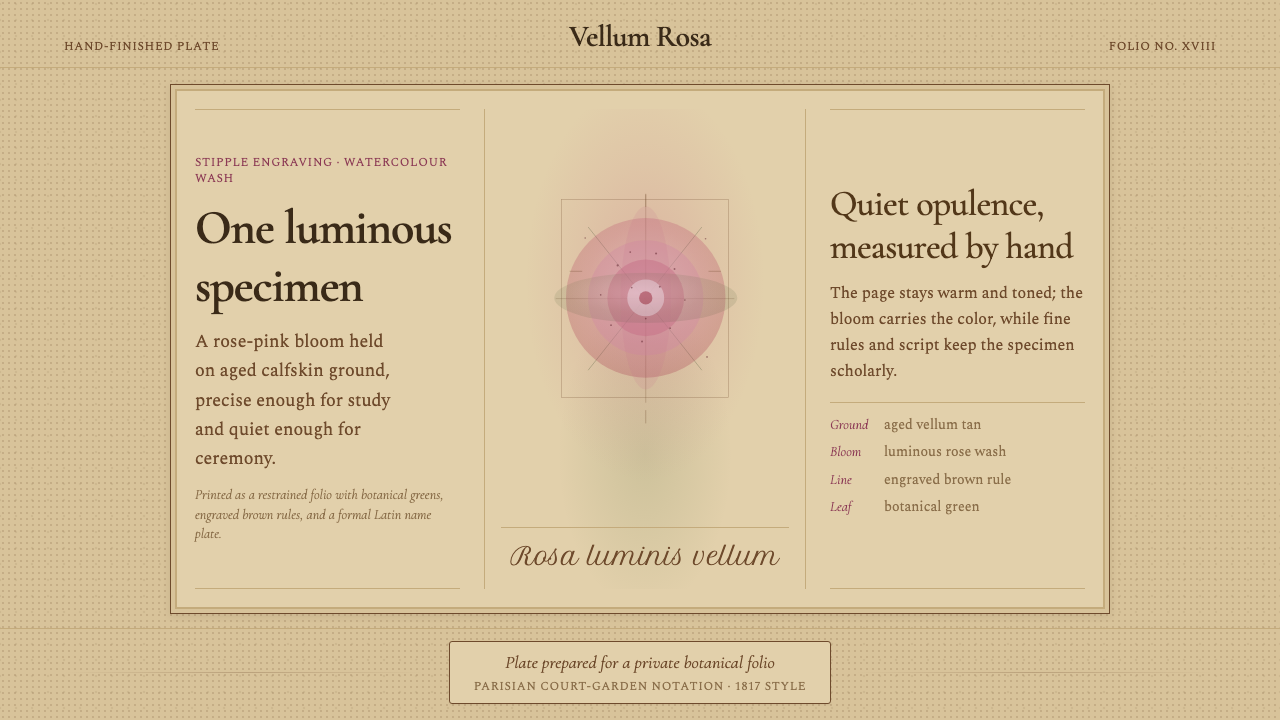 Redouté BotanicalScholarly opulence. Rose wash on aged vellum, framed by engraved brown rules.
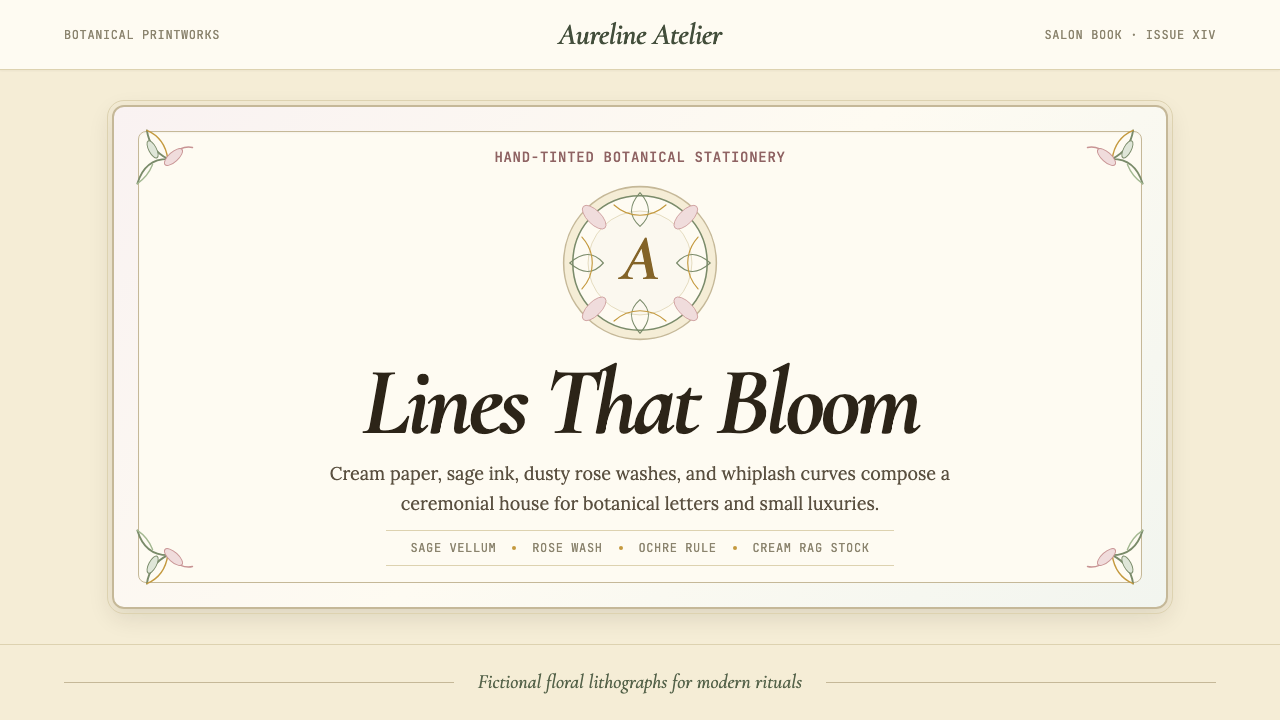 Art Nouveau (Mucha)Mucha's whiplash arabesques. Botanical halos, muted lithograph palette, no ma…
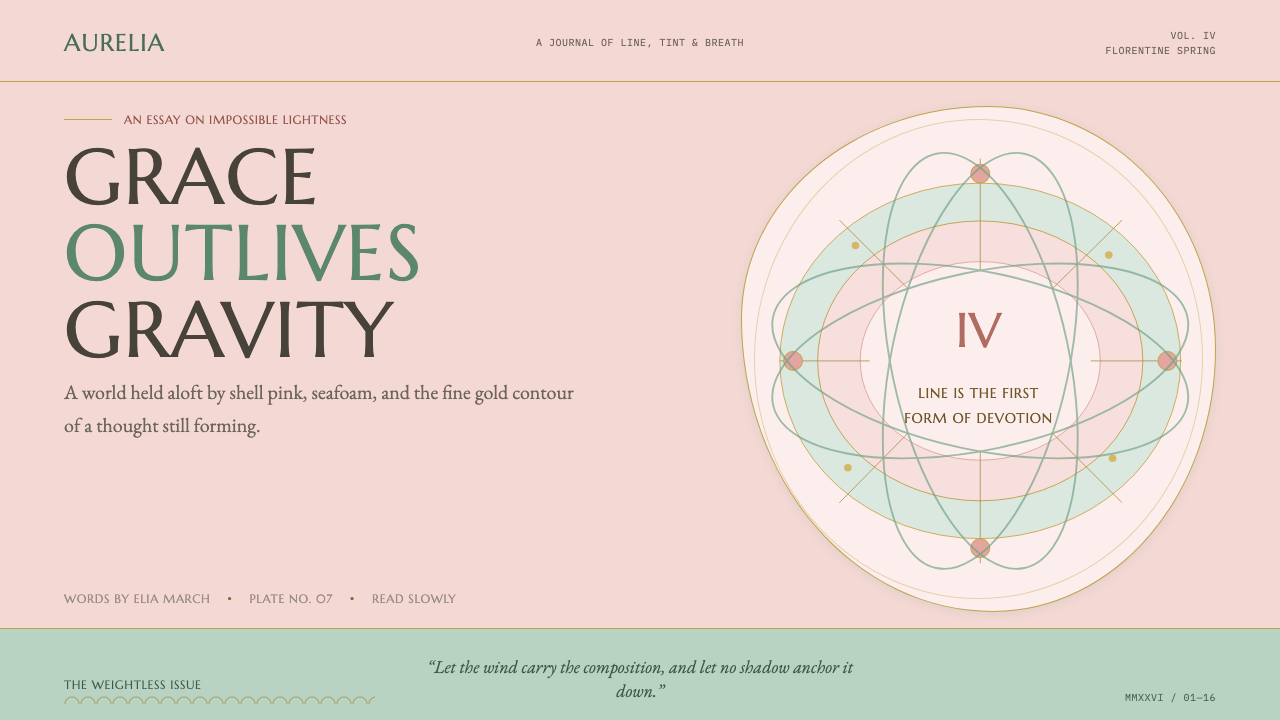 Botticelli Birth of Venus (1486)Grace defeats gravity. Shell pink, seafoam, and fine gilt contours keep every…
 Dior New Look (1947)Couture speaks softly. Cream ground, navy Didot capitals, and gold hairlines…
 Baku Oil Boom MansionsWealth made tactile. Almond limestone, Old Standard TT, and recessed bays car…
 Briar Pipe & TobaccoWarm gloom, precisely aged. Brass rules and Cinzel capitals sit on espresso w…