What is Art Nouveau (Mucha)?
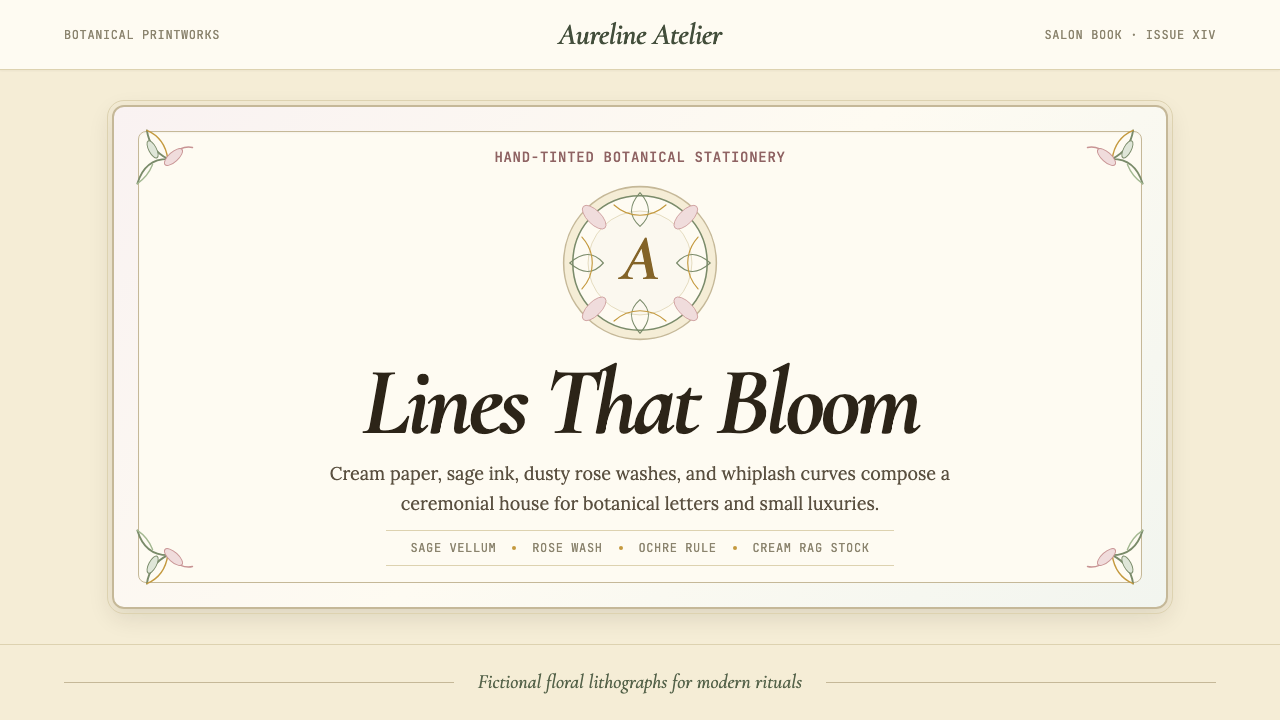
Mucha's whiplash arabesques transformed the theatre poster into a garden of botanical halos, muted lithographic warmth, and sinuous line that made ornament inseparable from meaning.
Art Nouveau (Mucha) in brief
Art Nouveau (Mucha) is the graphic strand of the broader Art Nouveau movement, centred on the poster and decorative print work of the Czech-French artist Alphonse Mucha. Where Art Nouveau's architectural branch expressed itself in ironwork balconies and curved façades, Mucha's graphic language translated the same organic sensibility into a two-dimensional vocabulary of sinuous line, botanical ornament, warm ground tones recalling lithograph paper, and feminine figures encircled by halos of flowers and stylized foliage.
The defining quality of the Mucha aesthetic is the integration of figure and frame. In his celebrated posters for the actress Sarah Bernhardt — beginning with the Gismonda lithograph of 1894 — the border is not a container imposed on an image but an organic extension of the image itself: vines curl into lettering, hair dissolves into petal patterns, and the decorative roundel at the top echoes the form of the figure below. Every element is motivated by the same flowing logic, so that the eye moves through the composition as through a garden rather than as across a grid.
Colour in this tradition is muted and warm — the palette of aged lithograph prints, not fresh paint. Creamy ivory grounds, sage greens, dusty roses, soft ochres, and muted golds dominate. Saturated primaries appear only as small accents; the overall impression is of harmonious, slightly faded richness rather than contrast or drama. This palette was partly a technical consequence of chromolithography's layered ink process and partly a deliberate aesthetic choice that aligned with Art Nouveau's preference for nature over industry.

Where does Art Nouveau (Mucha) come from?
Art Nouveau emerged in the late 1880s and reached its peak between roughly 1890 and 1910, flowering simultaneously across Paris, Brussels, Vienna, Prague, and Glasgow. Its immediate context was a reaction against Victorian historicism — the practice of borrowing Gothic, Renaissance, or classical ornament without organic justification — and against the dehumanizing aesthetics of early industrial production. The movement drew on a diverse set of precedents: Japanese woodblock prints (whose flat colour areas and asymmetric compositions entered Europe through the Japonisme craze of the 1860s and 1870s), the British Arts and Crafts movement's insistence on the unity of fine and applied art, and the Symbolist painters' interest in mood, mythology, and the unconscious.
Alphonse Mucha arrived in Paris from Moravia in 1887, studying painting and struggling for recognition. The turning point came on Christmas Eve 1894, when the printing house Lemercier was urgently seeking an artist to produce a poster for Gismonda, a new play starring Sarah Bernhardt at the Théâtre de la Renaissance. Most staff were on holiday; Mucha, working nearby, accepted the commission and delivered a design unlike anything then current in Parisian print culture. The poster was tall and narrow in a Byzantine format, the figure depicted nearly life-size, the ornament drawn from Byzantine mosaics and Slavic folk patterns, the palette deliberately muted against the city's prevailing taste for loud chromolithographic color. Bernhardt was so pleased she offered Mucha a six-year exclusive contract. He became, almost overnight, the defining visual voice of the Belle Époque.
The broader Art Nouveau movement was simultaneously developing in architecture and decorative arts. In Brussels, Victor Horta was completing the Hôtel Tassel (1893), whose staircase ironwork traced the same whiplash curves that Mucha was drawing on poster paper. In Paris, Hector Guimard was designing the now-iconic Métro entrances — cast iron botanical fantasies that transported daily commuters through a threshold of ornamental growth. In Vienna, the Secession group formed in 1897 around Gustav Klimt, producing work whose gilded flatness and erotic symbolism pushed the movement's decorative ambition toward obsession. In Glasgow, Charles Rennie Mackintosh and the so-called Glasgow Four developed a more rectilinear variant that would later influence Art Deco and even proto-modernism.
The movement's decline was swift and complete. By 1910, avant-garde taste was shifting toward Cubism and early abstraction; the sinuous ornament that had seemed radical in 1895 read, a decade later, as over-ripe and sentimental. The First World War accelerated the change: post-war cultures demanded efficiency, directness, and a break from pre-war luxury. Art Deco, which emerged in the 1920s, retained some of Art Nouveau's love of surface richness but replaced organic curves with streamlined geometry. Art Nouveau was largely dismissed by modernist critics for most of the mid-twentieth century; its rehabilitation came with the countercultural movements of the 1960s, when the psychedelic poster revival found in Mucha's arabesques an ideal visual language for altered perception and organic consciousness.
What defines the Art Nouveau (Mucha) look?
Whiplash Line
The signature mark of the Mucha style is the long, elastic S-curve — called the whiplash line — that appears everywhere from hair and drapery to botanical stems and decorative borders. Unlike the mechanical curve of a compass or the geometric arc of Art Deco, the whiplash line is hand-drawn in quality: it accelerates and tapers, doubles back and intertwines. It suggests growth, movement, and organic energy rather than engineered precision. In layout terms, this means that rigid horizontal or vertical axes are avoided in favor of diagonal flow and interlocking curves that guide the eye continuously through the composition.
Botanical Halo and Frame
Mucha habitually enclosed his central figures within circular or arched halos composed of flowers, leaves, and interlacing stems — a device borrowed from Byzantine icon painting and recast in organic form. The frame is not a neutral boundary but an active element that participates in the composition: vines reach inward, flowers orient toward the figure, and the ornamental roundel at the top of a poster functions as a kind of visual crown. This integration of figure and surround means there is no dead space; every margin is inhabited by purposeful organic form.
Muted Lithographic Palette
The colour palette draws directly from the visual character of chromolithographic printing as practiced in the 1890s: warm ivory grounds, muted sage and moss greens, dusty rose and blush, soft ochres and ambers, and desaturated golds. These are not clean, bright hues but colours that appear to have been filtered through time — slightly aged, slightly powdery, slightly warm. Saturated contrast is used sparingly, typically only to draw attention to a single focal element such as a jewel, a title letterform, or an eye. The overall effect is of unified tonal warmth rather than chromatic drama.
Ornamental Typography
Lettering in the Mucha tradition is itself an ornamental element, designed to coexist with the botanical frame rather than sit apart from it. Letterforms tend toward rounded, flowing serifs or hand-drawn caps in which strokes taper and swell in the same rhythm as the surrounding line work. Text is often arched, curved, or set along a path defined by the composition's organic flow. There is no sharp separation between image and text zones — type grows out of the decorative field the way a flower grows from a stem.
Feminine Figuration
The central figure in most Mucha compositions is a woman in a state of repose or gentle movement, rendered with elongated proportions, flowing drapery, and abundant hair that dissolves into the surrounding ornament. This is not mere convention but a structural choice: the female form provided the long vertical axis that his tall, narrow poster format demanded, and the flowing hair and loose robes gave him the organic line material that the decorative system required. The figure is idealized but not cold — there is a warmth and accessibility to Mucha's figuration that distinguishes it from the more unsettling femmes fatales of other Symbolist artists.
Surface Pattern and Mosaic Detail
Mucha filled the ornamental zones of his compositions with dense, precise patterning derived from Byzantine mosaic, Slavic folk embroidery, and Art Nouveau's general fascination with the decorative surface. Backgrounds are rarely plain; they are filled with low-contrast geometric grids, repeating floral cells, or delicate stippled textures that give depth without competing with the primary figuration. This layered approach to surface — figure over ornamental halo over patterned ground — creates a richness of visual depth that chromolithography could render in multiple ink passes, and that digital work must approach through careful tonal layering.
Integration of Text and Image
One of the most radical aspects of Mucha's poster design — and one of the most instructive for contemporary designers — is the complete refusal to treat text as a separate layer placed over an image. In his work, title lettering, actor's name, venue, and date are integrated into the pictorial structure. Text zones are prepared by the composition itself: an arch of flowers creates a natural space for a title; a band of mosaic pattern forms a legible ground for credits. This integration makes the information hierarchy feel inevitable rather than imposed.

Who shaped Art Nouveau (Mucha)?
Born in Moravia in 1860, Mucha trained as a theatre scene painter before arriving in Paris in 1887. His overnight fame after the Gismonda poster of 1894 led to an extraordinary decade of poster commissions — for Bernhardt's theatrical seasons, for the cigarette paper brand Job, for the biscuit maker Lefèvre-Utile, for champagne houses and travel companies — that defined the visual culture of the Belle Époque. In later life he became deeply committed to Slavic nationalism and devoted two decades to the Slav Epic, a cycle of twenty enormous history paintings celebrating Slavic civilization. He died in Prague in 1939, shortly after the Nazi occupation of Czechoslovakia.
The French architect Guimard is best known for the Paris Métro entrances he designed between 1900 and 1913 — cast-iron structures in the form of giant organic growths, their lamp standards resembling insect antennae, their canopies suggesting botanical forms. These entrances brought Art Nouveau directly into the experience of daily urban life and demonstrated that the movement's ornamental logic was not limited to flat print work but could be realized at architectural scale. Several original Guimard entrances survive in Paris; others were exported to museums in New York and Montreal.
The Viennese painter Klimt was the central figure of the Vienna Secession, a group of artists who broke from the conservative Künstlerhaus in 1897 to pursue a more radical decorative ambition. Klimt's mature work — The Kiss, Portrait of Adele Bloch-Bauer I, the Beethoven Frieze — pushed Art Nouveau's love of surface pattern to an extreme: figures are embedded in fields of gilded geometric ornament so dense that the boundary between person and decoration dissolves. His use of gold leaf, Byzantine mosaic reference, and Symbolist eroticism influenced generations of decorative artists and connects directly to the same sources Mucha was drawing from in Paris.
The English illustrator Beardsley was Art Nouveau's most radical graphic voice in Britain, producing black-and-white ink illustrations of startling psychological intensity for publications including The Yellow Book and Oscar Wilde's Salomé. His work shares with Mucha the organic line, the decorative flatness, and the integration of text and image, but it diverges sharply in mood: where Mucha is warm and accessible, Beardsley is ironic, transgressive, and frequently disturbing. His short career — he died of tuberculosis in 1898 at twenty-five — compressed an enormous influence into a very small body of work.
Though not a visual artist, the French actress Sarah Bernhardt was the human catalyst for Mucha's career and for the Art Nouveau poster as a cultural form. Her requirement that Mucha be given exclusive control over the visual identity of her theatrical seasons meant that Paris was plastered for a decade with a consistent, evolving graphic language centred on his ornamental style. Bernhardt was also an astute businesswoman who understood that the poster was not merely advertising but a cultural artefact that audiences would collect, display, and discuss — a recognition that elevated the graphic poster to the status of art.
How do you use Art Nouveau (Mucha) today?
Art Nouveau (Mucha) is one of the most atmospherically distinctive historical styles available to contemporary designers, but it is also one of the easiest to apply superficially and one of the hardest to apply authentically. The temptation is to add a floral border and call it done. Authentic application requires understanding the system's underlying logic: that figure and frame are not separate layers but a single integrated composition, that the palette is warm and muted rather than bright, and that every ornamental element is motivated by the same organic line rhythm.
For presentation slides, the style is most powerful on cover and section divider pages. A cover benefits from the full Mucha compositional logic: a central illustration or photograph treated with a warm-toned overlay, surrounded by a botanical frame that integrates with the title lettering. Section dividers can use the arched halo motif — a large botanical roundel at the top, text set in a flowing serif below. Content slides should be lighter in ornamental density: a subtle corner flourish, a botanical ruled line, and a warm cream ground are sufficient to maintain stylistic continuity without overwhelming the data. Data slides work best when chart frames echo the organic line of the broader system — soft-edged panels rather than hard rectangular boxes.
For web interfaces, the style suits editorial platforms, cultural institutions, luxury goods, beauty brands, and any product where richness and craftsmanship are core values. A dashboard in this style replaces hard-edged card components with softly bordered panels, uses a warm off-white ground rather than stark white or dark grey, and introduces botanical motif elements as decorative dividers or section markers. Pricing pages can use the botanical halo as a highlight device around a featured tier. Navigation elements benefit from flowing serif typography and subtle ornamental separators between items. The critical discipline is restraint: one or two ornamental moments per screen, not every element decorated.
For editorial and marketing work, Mucha's compositional logic translates directly to high-end magazine layouts, event posters, packaging, and brand identity systems for artisanal or culturally positioned products. An event poster can follow the original Mucha format directly — tall and narrow, central figure, botanical arch, title integrated into the frame. Editorial spreads work well with a warm-toned photographic treatment on one page and a botanical ornamental frame containing the article title and standfirst on the other. Marketing emails and social cards can use a simplified version of the palette — ivory ground, sage green accent, a single ornamental flourish — without attempting the full compositional complexity.
A common mistake when applying this style is treating the palette as an opportunity for colour saturation. The defining quality of the Mucha palette is its restraint: colours are muted, slightly grayed, slightly aged. Introducing bright, clean hues — vivid greens, sharp pinks, bold purples — immediately breaks the lithographic illusion that the palette is designed to evoke. A related mistake is applying ornament indiscriminately: Art Nouveau ornament is not a texture to be tiled but a compositional device that must be motivated by the specific structure of each layout. Borders that do not relate to the central image, botanical motifs scattered at random, and decorative type that conflicts with the figuration are all signs of superficial application. The discipline of the style is integration, not accumulation.

Art Nouveau (Mucha) — FAQ
Is Art Nouveau (Mucha) the same as Art Deco?
They are historically sequential but visually and philosophically opposed. Art Nouveau (roughly 1890–1910) is characterized by organic, sinuous curves derived from natural forms, warm and muted palettes, and the integration of ornament with structure. Art Deco (roughly 1920–1940) is characterized by streamlined geometric forms, high-contrast bold palettes, and the separation of decorative surface from structural logic. Art Deco emerged partly as a reaction against Art Nouveau's perceived excess and sentimentality, replacing biological curves with machine-age geometry. The two styles are occasionally confused because both are richly ornamental and both have strong associations with luxury and the decorative arts — but their underlying visual logic is fundamentally different.
Can Art Nouveau (Mucha) work in digital interfaces, or is it only for print?
The style originated in print and its visual logic — botanical frames, ornamental borders, integrated lettering — is most natural in static compositions. That said, it translates well to digital contexts when applied with appropriate restraint. The key adaptation is density: a Mucha poster can sustain extremely high ornamental density because it is read at length and close range; a web page or app screen is scanned at speed and must preserve large areas of calm ground to remain functional. In practice, this means using botanical ornament as accent rather than as overall texture — a decorative header illustration, a botanical divider, a warm-toned background — while keeping the majority of the interface clean. Motion can be used sparingly: a slow unfurling vine animation on a loading screen, for example, is appropriate; ornament that animates constantly is not.
How does the Mucha palette differ from a generic vintage palette?
Generic vintage palettes tend toward faded, desaturated versions of any hue — a kind of uniform dustiness applied across the board. The Mucha palette is more specific: it is warm-biased (ochres, ambers, ivories, warm greens), lithographic in character (layered and slightly chalky rather than uniformly faded), and organized around tonal harmony rather than contrast. Sage green and dusty rose appear repeatedly because they were favored chromolithographic pigments, not because they represent a generic retro sensibility. The palette also allows for moments of slightly higher saturation — a deeper gold, a richer rose — used to draw attention to specific focal points. The discipline is in keeping these accents warm rather than cool, and muted relative to their surroundings rather than bright.
Is this style appropriate for brands that want to appear modern and forward-looking?
Not straightforwardly. Art Nouveau (Mucha) carries strong historical associations — the Belle Époque, fin-de-siècle Paris, the theatre world of the 1890s — and these associations are part of its appeal in the right contexts: heritage brands, cultural institutions, artisanal producers, luxury goods, and products that want to position themselves as rare and handcrafted. For brands that need to communicate innovation, speed, technological capability, or disruptive modernity, the style is a poor fit. The exception is when a brand deliberately wants to contrast old-world craft against high-tech context — a fine perfume sold through a modern e-commerce platform, for example — in which case the style's nostalgic richness can read as a deliberate statement of values rather than an accident of taste.
What is the biggest technical challenge when reproducing this style digitally?
The hardest thing to reproduce is the layered, slightly imperfect quality of chromolithographic printing — the sense that colours have been built up through successive ink passes, each slightly misregistered, each adding warmth and depth rather than pure additive brightness. Digital rendering defaults to clean, precisely layered colour that reads as bright and synthetic rather than warm and aged. The practical approach is to work with slightly warm-biased colours rather than neutral hues, to avoid pure white grounds in favour of ivory or warm off-white, to introduce very subtle noise or grain to large flat colour areas, and to ensure that greens and roses have enough grey in them to read as muted rather than vivid. The organic line work — the whiplash curves and botanical forms — should feel hand-drawn in character even if executed digitally: variable stroke weight, slight irregularity, and tapering ends contribute more to authenticity than any amount of additional ornamental complexity.
Related design styles
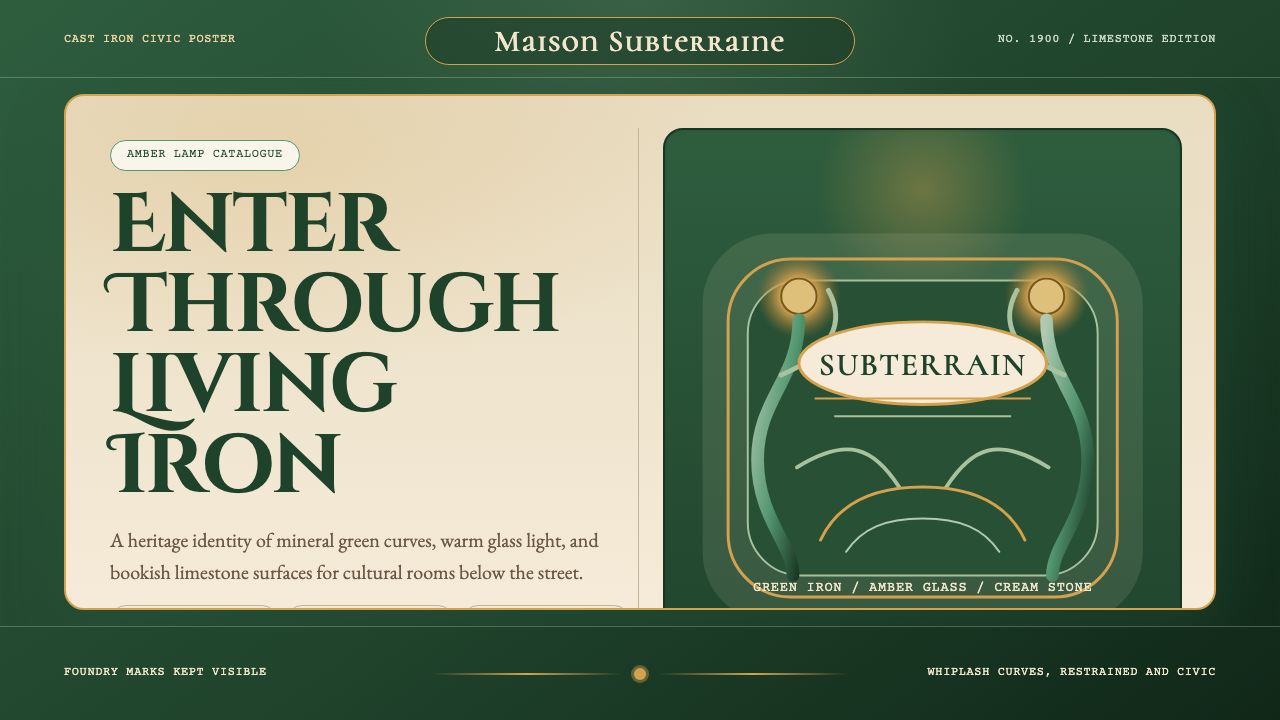 Paris Metro Guimard (1900)Civic sculpture, softly lit. Metro green ironwork frames amber glow and limes…
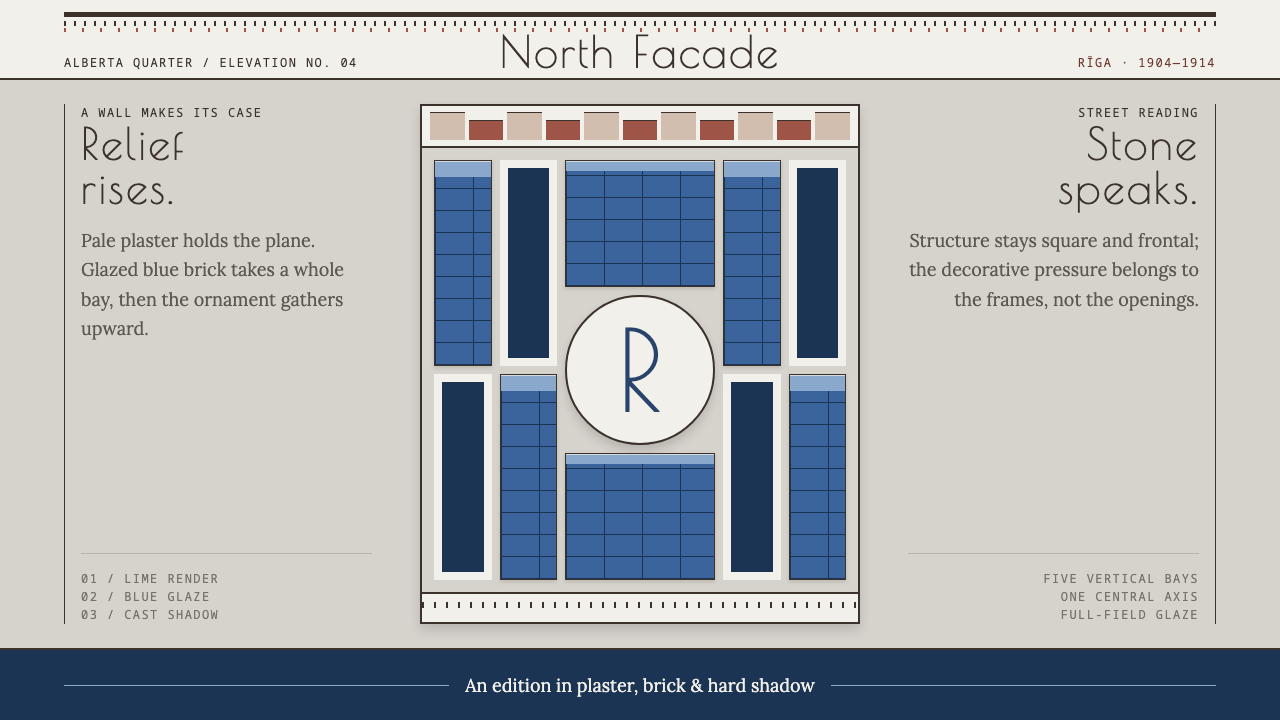 Riga JugendstilA facade that argues in relief. Blue brick fields and pale stucco rise in str…
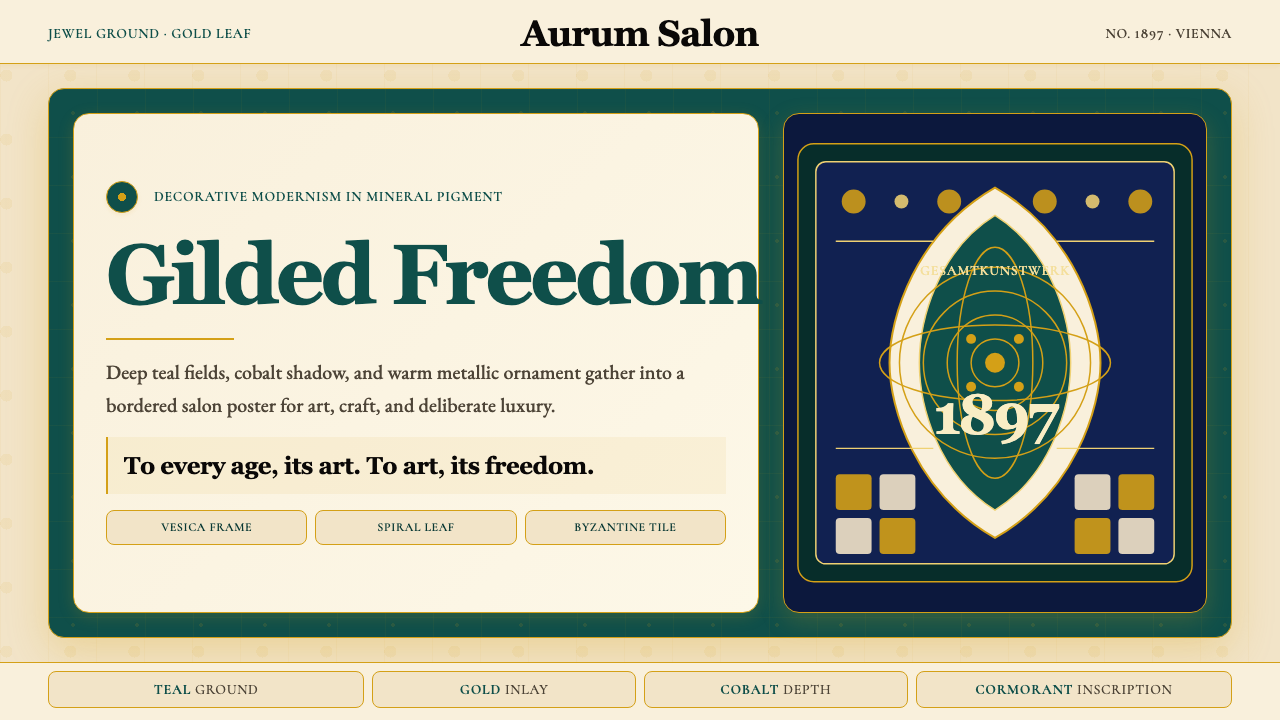 Wiener Secession (Klimt)Opulence made modern. Teal grounds, gold inlay, vesica frames and Cormorant d…
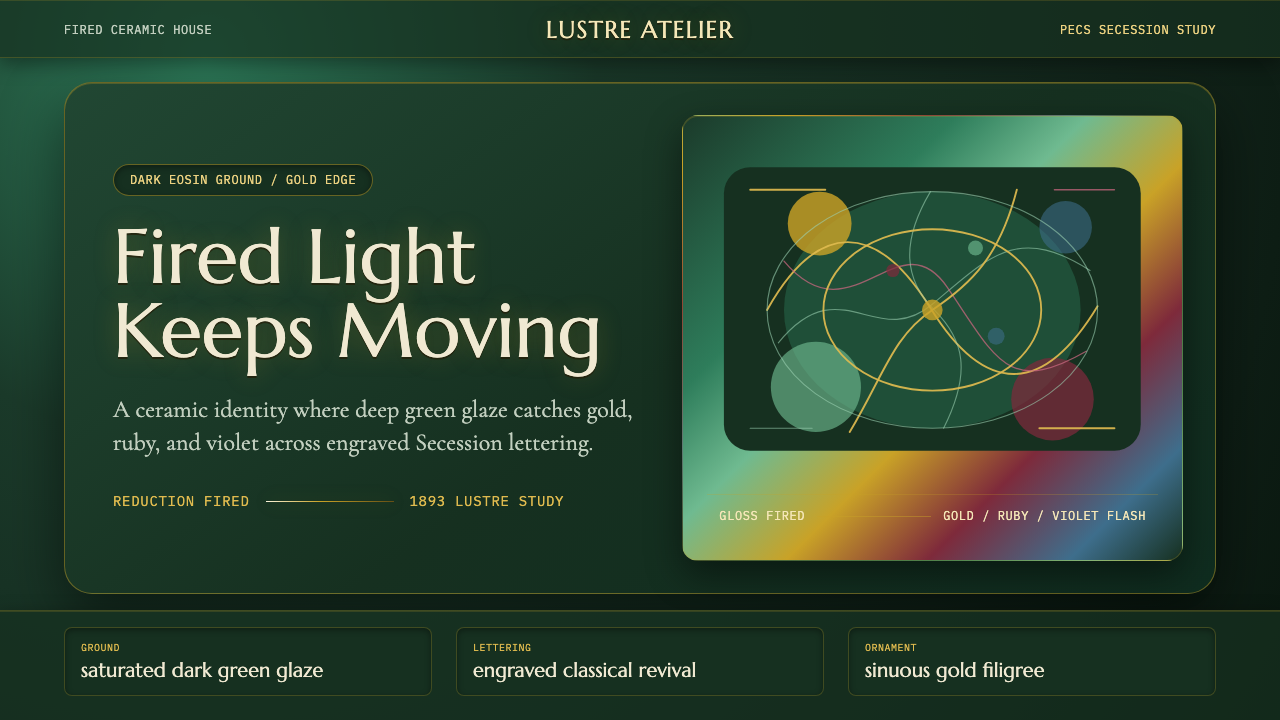 Zsolnay Eosin CeramicsGlaze becomes theater. Dark eosin green flashes gold, ruby, and violet throug…
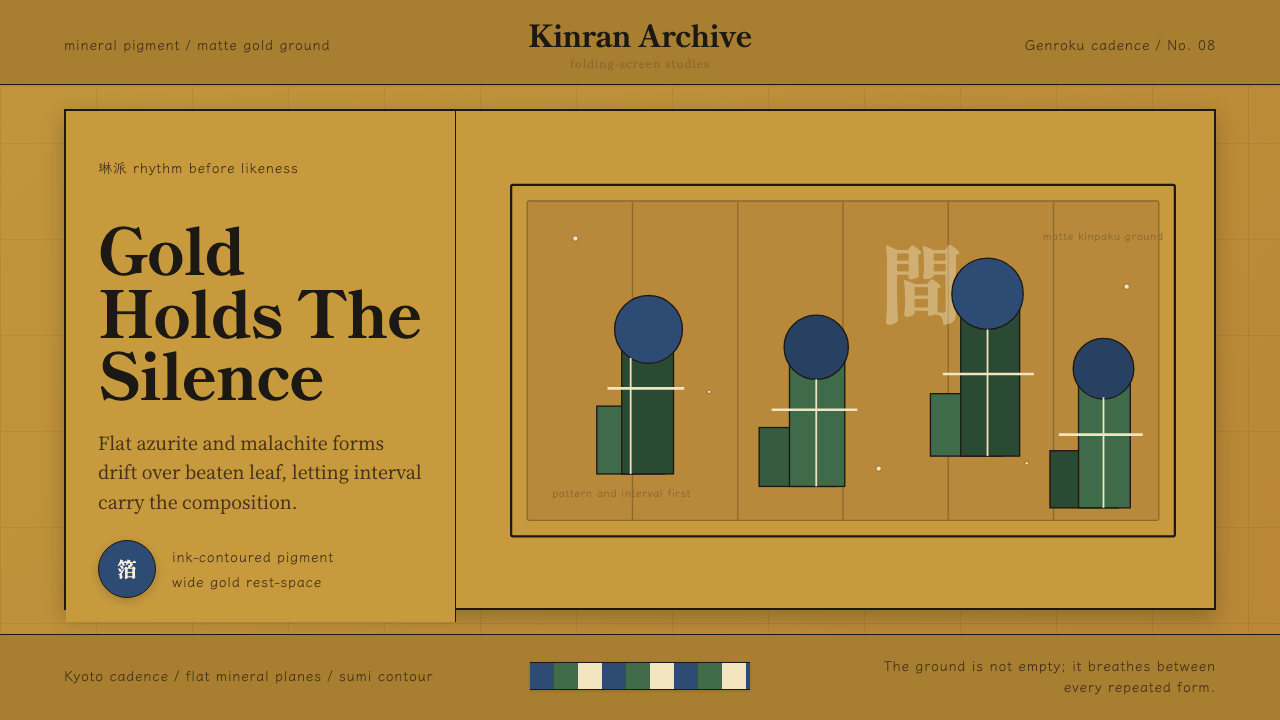 Edo Rinpa (Kōrin)Matte gold breathes. Azurite and malachite repeats float across inked screen…
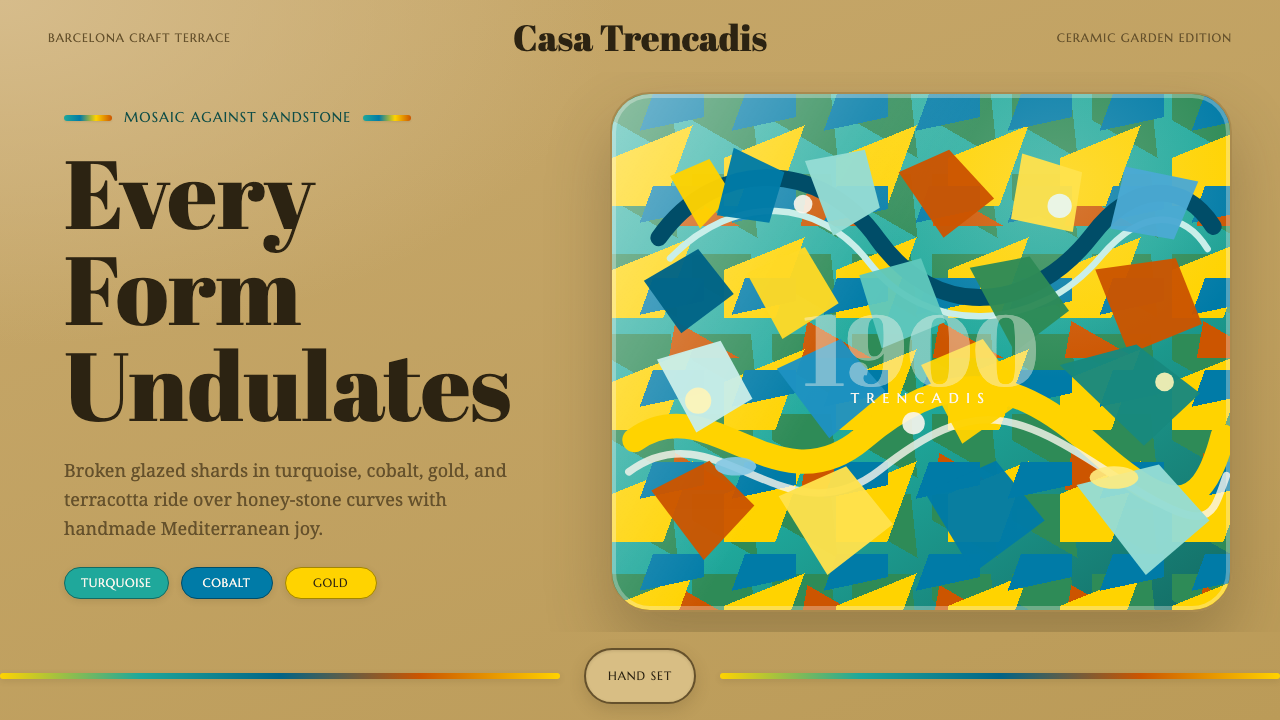 Gaudí ModernismeJoy made in shards. Turquoise, cobalt and gold tessellate over honey-sandston…