What is Paris Metro Guimard (1900)?
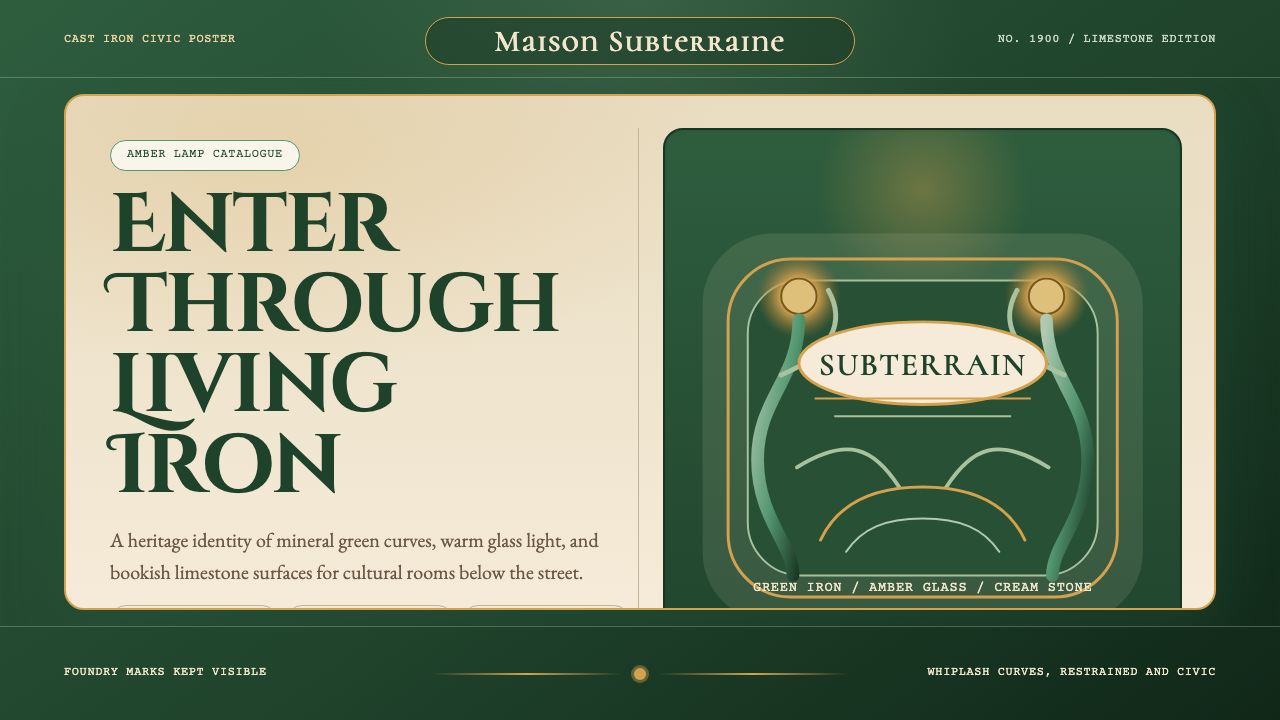
Hector Guimard turned the mouth of the Paris underground into civic sculpture — sinuous iron tendrils, amber lamplight, and the unmistakable green of oxidized metal announcing that utility could be beautiful.
Paris Metro Guimard (1900) in brief
Paris Metro Guimard (1900) is a design language drawn directly from the 167 cast-iron entrance pavilions that architect Hector Guimard created for the Paris Métropolitain between 1900 and 1912. Its palette is anchored in the deep mineral green of patinated ironwork, warmed by amber and honey tones that echo the glass-globe lamps Guimard specified, and grounded in the pale, chalky neutrals of limestone and cream enamel. Against these naturalistic foundations, the style deploys a typography of elongated, organically curved letterforms — serifs that seem to grow rather than be drawn, terminals that taper like leaf tips.
The visual logic of this style is the logic of the living world transposed into engineered material. Where most industrial design of 1900 still aspired to classical symmetry and rectilinear order, Guimard chose the grammar of botany: stems that branch and bifurcate, curves that complete themselves the way a tendril spirals toward light, ornamental details that function as structural elements and structural elements that read as ornament. The result is a system of profound coherence — every component, from the overarching canopy frame down to the smallest finial, speaks the same visual language.
As a digital design system, this aesthetic is best understood as the opposite of modernist reductionism. It does not strip away; it elaborates. It uses richness, organic warmth, and a sense of considered craftsmanship as its primary communicative tools. Projects that need to convey heritage without heaviness, authority without austerity, or warmth without sentimentality will find this vocabulary uniquely suited to those ends.

Where does Paris Metro Guimard (1900) come from?
The Paris Métro story begins in urgency. The city had debated an underground railway for decades; it was the pressure of hosting the 1900 World's Fair — the Exposition Universelle — that finally forced action. Construction began in 1898, and Line 1 opened on July 19, 1900, just in time for the millions of visitors flooding the capital. The project was managed by the Société du Métropolitain de Paris, which commissioned the infrastructure, the rolling stock, and — crucially — the street-level entrance pavilions that would define the public face of the new system.
Hector Guimard received the commission in 1899, when he was already known in Paris for the Castel Béranger apartment building (1898), a work that had earned him both admirers and detractors for its extravagant departure from academic convention. Guimard was deeply aligned with the principles of French Art Nouveau — the movement that sought to dissolve the boundary between fine art and applied craft by borrowing structural and decorative vocabulary from the natural world. He was influenced by the theories of Eugène Viollet-le-Duc, who argued that honest structural logic could be beautiful in itself, and by the Belgian architect Victor Horta, whose Hôtel Tassel (1893) demonstrated that iron and glass could be treated with the same sinuous sensitivity as paint on canvas.
Guimard's Metro entrances were designed as a unified system of prefabricated cast-iron components that could be assembled in different configurations to suit different site conditions. The components — posts, lamps, railings, canopy ribs, signage panels — were manufactured at foundries and then bolted together on site. This modular logic meant that the visual vocabulary was genuinely systematic: the same curved tendrils and tapered terminals appeared at every entrance, whether grand covered pavilion or simple open balustrade. The distinctive lettering — elongated, with slightly swelling strokes and organic flourishes — was integrated into the cast iron itself, appearing on signs, plaques, and the famous green enamel name boards.
The reception was immediate and divided. Admirers called the entrances organic, vital, and perfectly suited to a modern democratic city; critics, including prominent voices in the architectural establishment, dismissed them as monstrous — the nickname 'Style Nouille' (noodle style) was used derisively. The tension between the Guimard entrances and the classical Haussmannian fabric of Paris was deliberate: they announced the underground as something categorically new, a rupture in the city's stone surface. Over time, this rupture became heritage. Of the original 167 Guimard entrances, about 86 remain today; two — at Abbesses and Porte Dauphine — retain their original covered pavilion roofs and are classified historical monuments.
What defines the Paris Metro Guimard (1900) look?
Color Palette
The palette centers on the deep, slightly muted green of oxidized cast iron — not a bright or synthetic green, but the tone of metal weathered outdoors over decades, with quiet blue-gray undertones. Against this structural green, warm amber and golden tones provide luminous contrast, drawn from the glass-globe lamps and the honey-colored enamel inserts. Creamy off-white and pale limestone neutrals serve as background and breathing space, while muted terracotta and warm brown accents anchor the earthier side of the palette. The overall effect is mineral and organic simultaneously — colors that feel dug from the ground rather than mixed from tubes.
Organic Curves and Whiplash Lines
The defining formal quality of this style is the whiplash curve: a line that begins broadly, accelerates through a bend, and tapers to a fine point — the visual motion of a plant stem under stress or a wave breaking. These curves are never arbitrary; they follow the internal logic of growth and tension. In structural elements they suggest forces being elegantly resolved; in decorative elements they echo botanical forms — unfurling fern fronds, lily stems, water reeds. The curves are always fluid and continuous, never jointed or broken, which gives the style its characteristic sense of living momentum.
Organic Letterforms
The typography of the Guimard system is inseparable from its ornamental logic. Letters are elongated and slightly compressed horizontally, with strokes that swell and taper organically rather than following the mechanical uniform-thickness logic of sans-serifs or the mathematical regularity of classical serifs. Terminals — the ends of strokes — are rounded or tapered like plant tips rather than cut flat. The lettering has weight and presence without heaviness; it reads clearly at distance while rewarding close inspection with its surface detail. In digital application, this quality should be sought in typefaces that feel carved or grown rather than drawn or engineered.
Structural Ornament
One of Guimard's most sophisticated achievements was making ornament load-bearing — or at least making it appear so. The branching iron tendrils that form the canopy supports are simultaneously decorative and structural; the posts that anchor the railings are both functional columns and botanical sculptures. In the digital translation of this aesthetic, this principle manifests as decoration that always serves a compositional purpose: a curved divider that also guides reading direction, a flourish at a corner that simultaneously defines and softens the boundary, an ornamental border that clarifies hierarchy. Nothing decorates purely for its own sake; everything earns its presence.
Warm Patina and Surface Texture
The Guimard entrances gain much of their emotional resonance from the quality of their surfaces: cast iron that has been painted and weathered, glass that diffuses rather than transmits light, enamel that has a slight depth and warmth rather than a hard reflective sheen. This is a palette of materials that age well — that look richer and more settled over time rather than worn or shabby. In digital work, this sensibility translates to avoiding perfectly flat, hard-edged surfaces in favor of treatments that suggest slight depth, gentle grain, or the warm diffusion of light through a translucent material. The goal is presence and warmth, not the clinical perfection of pure digital flatness.
Symmetry Softened by Nature
Unlike the strict bilateral symmetry of classical architectural ornament, the Guimard system uses a softer, biological kind of balance: roughly symmetrical overall compositions in which individual elements have the slight asymmetries of natural growth — a tendril that extends a little further on one side, a curve that completes with a slightly different emphasis at each end. This near-symmetry reads as crafted rather than manufactured, alive rather than mechanical. In layout terms, it suggests compositions that are centered or mirrored at the macro level but allow individual elements to breathe and vary slightly rather than snapping to a perfectly rigid grid.
Integration of Text and Image
In the Guimard system, signage is never applied to a surface as an afterthought — it is cast into the material itself, literally part of the structure. Station names appear in the same green iron as the railings and posts; lettering and ornament are compositionally inseparable. In digital translation, this principle argues against treating typography and imagery as separate layers to be stacked. Instead, type should feel embedded in its compositional context: framed by ornament that responds to its weight and rhythm, scaled in relationship to decorative elements rather than independently, placed so that text and surrounding form are in genuine visual dialogue.

Who shaped Paris Metro Guimard (1900)?
Guimard (1867–1942) is the singular creative intelligence behind the Metro entrance system and the defining figure of French Art Nouveau as applied to architecture and public works. Trained at the École des Arts Décoratifs and the École des Beaux-Arts in Paris, he rejected the academic historicism of his training in favor of an architecture shaped by natural forces and structural logic. His Castel Béranger apartment building (1898) scandalized the Paris establishment and won him the commission that would define his legacy. After the peak of his influence in the 1900s, Art Nouveau fell rapidly out of fashion, and Guimard spent his later career increasingly marginalized. He emigrated to the United States in 1938 with his wife, the American painter Adeline Oppenheim, and died in New York in 1942. The postwar rediscovery of his Metro entrances — aided by a Museum of Modern Art exhibition in 1970 — rescued his reputation and established him as a canonical figure in the history of design.
A contemporary and sometime collaborator of Guimard's within the Paris Art Nouveau scene, Henri Sauvage (1873–1932) brought a related but distinct sensibility to the same decorative moment. Where Guimard pushed toward the most sinuous and botanically literal expressions of the style, Sauvage was more interested in the integration of ornament with the social function of buildings — his Villa Majorelle in Nancy (1902) and later his setback residential projects in Paris show an Art Nouveau architect thinking seriously about how decorative ambition and urban housing could coexist. Sauvage's work is a useful reference point for understanding the range of approaches that French Art Nouveau encompassed beyond Guimard's most immediately recognizable vocabulary.
The municipal company that commissioned and oversaw the Metro project was not a passive client; its decisions shaped the Guimard system as much as any individual designer. The company's choice to treat the street-level entrances as a matter of civic identity — rather than merely functional apertures — created the conditions for Guimard's commission. Its requirement that the entrance components be prefabricated and standardized for rapid deployment across the city forced Guimard to develop his design as a true modular system rather than a series of bespoke one-off works. This institutional pressure is partly responsible for the internal coherence that makes the Guimard vocabulary so powerful: the constraints of production systematicity made the design system more rigorous, not less expressive.
Though Belgian rather than French, Victor Horta (1861–1947) is an indispensable reference for understanding where Guimard's formal language came from. Horta's Hôtel Tassel in Brussels (1893) is the work most frequently cited as the founding document of architectural Art Nouveau: a residential interior in which exposed iron structural members were treated not as engineering elements to be hidden but as opportunities for sinuous, whiplash ornament. Guimard visited Brussels and studied Horta's work directly; the influence is traceable in the Metro entrances' treatment of iron as both structural support and decorative surface simultaneously. Horta and Guimard represent the two most sophisticated national expressions of the same fundamental impulse — to make the industrial materials of modernity as beautiful as the natural world they were displacing.
The great nineteenth-century French theorist and restorer Viollet-le-Duc (1814–1879) died two decades before Guimard's Metro commission, yet his intellectual influence runs through the entire project. Viollet-le-Duc argued, most influentially in his Entretiens sur l'Architecture (1858–1872), that beauty in architecture derived not from applied historical ornament but from the honest, visible expression of structural forces and materials. He celebrated Gothic architecture not for its style but for what he saw as its structural rationalism — the way flying buttresses, pointed arches, and ribbed vaults made the logic of load-bearing visible and beautiful. This argument gave Guimard a theoretical justification for his ornamental ironwork: the tendrils and curves were not decoration applied to structure, but structure made ornamental — precisely the fusion Viollet-le-Duc had theorized.
How do you use Paris Metro Guimard (1900) today?
Applying Guimard's vocabulary to contemporary digital work requires understanding what the style is communicating at a deeper level than its surface motifs. The Metro entrances succeeded because they used ornamental richness to signal welcome and civic generosity — the underground, often experienced as threatening or disorienting, was framed as an elaborate gift to the city's inhabitants. In digital work, this translates to using the style's warmth, organic curves, and material richness to communicate trustworthiness, craftsmanship, and considered attention to the user's experience. It is a style for products that want to be memorable and warm, not merely efficient.
For presentation slides, the Guimard palette and vocabulary work exceptionally well for covers and section dividers. A cover slide benefits from a composition in which a central ornamental frame — drawn from the vocabulary of curved iron tendrils and organic letterforms — surrounds or anchors the title, against a deep mineral green or warm cream ground. Section dividers can use a single ornamental element — a whiplash curve, a botanical flourish — as a horizontal punctuation mark. Content slides should be treated with more restraint: the organic aesthetic as a subtle frame or background texture, with body text in a clean, slightly warm neutral, and data visualizations that adopt the palette's greens and ambers without introducing excessive decorative complexity. The goal is atmosphere and heritage, not visual noise.
For web interfaces, this style is most effective in contexts where the user is expected to linger and engage rather than scan and exit: boutique e-commerce, cultural institution sites, premium subscription services, editorial platforms, and hospitality brands. Dashboard and pricing page applications are viable but require care — the ornamental richness must be concentrated in structural framing elements (headers, borders, navigational components) while data display areas are kept relatively clean. Buttons and interactive elements work well when they carry a subtle botanical quality — slightly rounded, with a warm green or amber fill and a letterform that feels chosen rather than defaulted. Ghost buttons and flat minimal components are stylistically inconsistent with this vocabulary and should be avoided.
For editorial and marketing work, the Guimard style supports a particular kind of premium narrative: one that invokes history, craft, and cultural specificity rather than abstraction or novelty. Magazine-format editorial layouts benefit from running ornamental borders along margins, using organic drop capitals to open articles, and selecting photography that has warmth and patina — aged surfaces, natural materials, low-contrast tonal ranges — rather than the high-key, saturated imagery associated with contemporary tech marketing. Marketing pages work well with the style's inherent poster quality: a full-width hero section in deep green with cream typography, a section break announced by an ornamental rule, and feature sections that alternate warm cream with the mineral green in a way that feels considered and rhythmic rather than arbitrary.
The most common mistake when working with this style is reducing it to surface decoration: adding a few botanical motifs to an otherwise unstyled layout and assuming the work is done. The Guimard vocabulary is a coherent system in which color, form, typography, and ornament are mutually reinforcing. Applying the palette without the organic letterforms, or using botanical motifs with a geometric sans-serif typeface, produces a category confusion that reads as costume rather than language. The second common mistake is overloading: the original Metro entrances are densely detailed, but the density is organized by a clear structural hierarchy. In digital work, every ornamental element must earn its place within a composition that has been clearly organized first. Start with structure, add ornament to reinforce it — never the reverse.

Paris Metro Guimard (1900) — FAQ
Is this style only suitable for French or European cultural contexts?
Not at all, though the association is real and should be considered. The Guimard vocabulary's underlying values — warmth, organic form, craft, the celebration of natural forms in engineered contexts — are not culturally specific in the way that, say, a direct quotation of Haussmannian architecture would be. The style has been successfully adapted for hospitality, luxury goods, perfumery, and cultural institution work across very different regional contexts, because what it primarily communicates is premium craftsmanship and considered beauty rather than French national identity. That said, when the brief requires cultural neutrality or a deliberately non-European reference, this style will read with a specific heritage that other palettes would not carry. The question to ask is whether that heritage serves or complicates the project's positioning.
How does this style relate to other Art Nouveau expressions like Jugendstil or Vienna Secession?
All three are branches of the broader Art Nouveau movement that flourished across Europe roughly between 1890 and 1910, and all three reject academic historicism in favor of natural forms and the integration of fine and applied arts. But they are quite distinct in character. Guimard's French style is the most botanically literal — it most directly evokes growing, curving plant life and uses warmth and mineral color as its emotional register. German Jugendstil (as expressed in, for instance, the Munich magazine that named the movement) tends to be flatter, more poster-graphic, with stronger use of outline and silhouette. Vienna Secession, associated with Gustav Klimt, Koloman Moser, and Josef Hoffmann, is more geometric and rectilinear — the Secessionist grid and the black-and-white contrast of the Ver Sacrum magazine are very different from Guimard's fluid ironwork. When working with the Guimard system, it is the organic warmth and mineral palette that are defining, not just the general fact of curving lines.
Can this style work effectively in a dark or night-mode interface?
Yes, with deliberate adaptation. The original Guimard system already contains a night-mode logic of its own: the entrances were lit by amber glass lamps against the deep green of iron and the darkness of the Parisian street at night. A dark-mode translation works best when it anchors the background in a very deep version of the mineral green — almost black but with unmistakable green undertones — and uses the warm amber and honey tones as the primary light-sources of the composition: headlines, active states, key calls to action. The cream and off-white tones shift to a slightly warmer light gray for body text, and ornamental elements are rendered in a tone-on-tone green rather than high-contrast. The risk to avoid is losing the warmth entirely by moving toward a cold near-black background; the style's emotional logic depends on the sense that there is warmth within the darkness.
How should photography be treated when used alongside this aesthetic?
Photography works best in this context when it shares the palette's tonal qualities rather than fighting against them. Images with warm, slightly desaturated color grading — the tones of aged paper, antique brass, stone, and dappled natural light — integrate naturally with the mineral greens and ambers of the Guimard palette. High-key, saturated, or cooled contemporary photography tends to feel dissonant. When using architecture or interior photography, images of spaces that have genuine patina and material warmth — stone walls, aged wood, wrought iron, frosted glass — will always read as more coherent than images of sleek modern interiors. Photographs should be framed within ornamental borders or given a slight warm toning treatment rather than presented as neutral documentary windows. The relationship between the photograph and its decorative frame should feel integrated, not incidental.
Why did Art Nouveau — and the Guimard style specifically — fall out of fashion so quickly after 1910?
The decline was rapid and almost total. By the time of the First World War, Art Nouveau was considered embarrassingly overwrought; the stripped, geometric aesthetic of Art Deco and early modernism replaced it almost overnight in fashionable circles. Several forces drove this. First, the style's ornamental extravagance was expensive to produce — every curving tendril required skilled craftsmanship that the emerging machine-production economy could not cheaply replicate. Second, the cultural mood shifted: the war made organic luxuriance feel inappropriate, even decadent, and there was a widespread appetite for clarity, rationality, and a clean break with pre-war visual culture. Third, and perhaps most importantly, the style had been so quickly popularized and commercialized after 1900 that by 1910 it had accumulated enormous quantities of derivative, low-quality imitation work that discredited the originals by association. The recovery of appreciation for Guimard's work specifically had to wait for the distance that time provides — a reminder that the relationship between a style's historical moment and its later reputation is rarely straightforward.
Related design styles
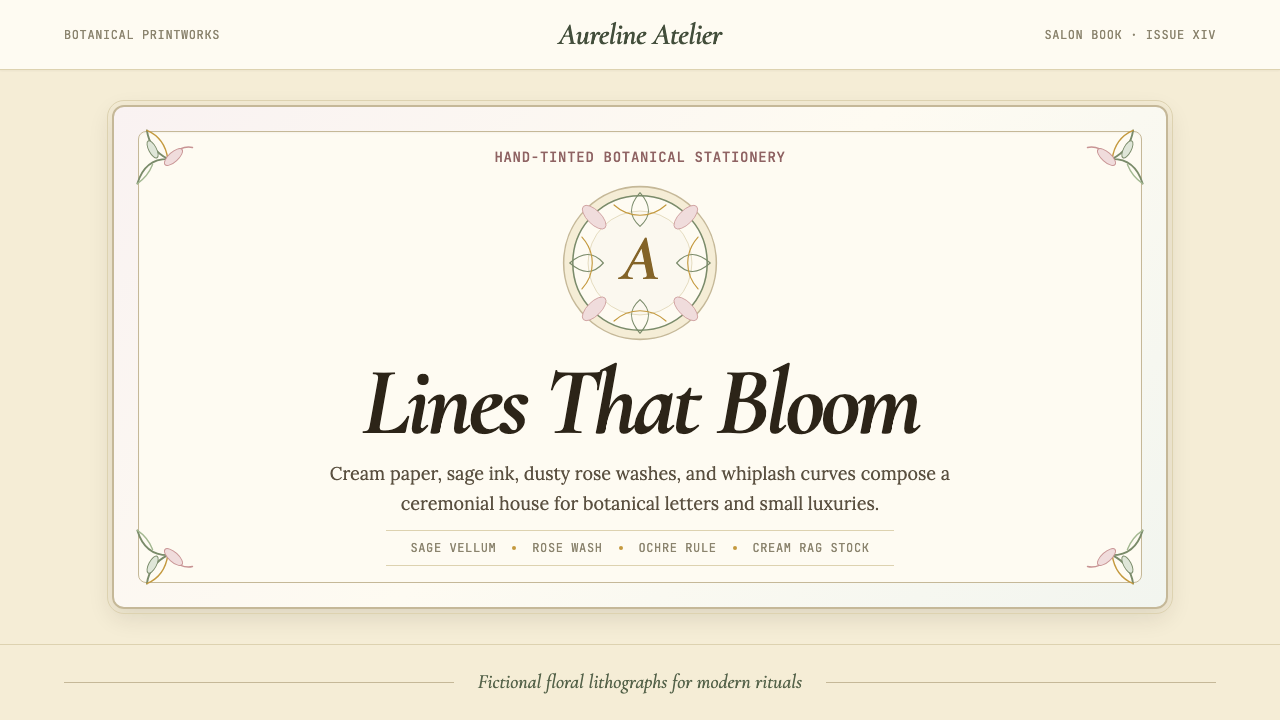 Art Nouveau (Mucha)Mucha's whiplash arabesques. Botanical halos, muted lithograph palette, no ma…
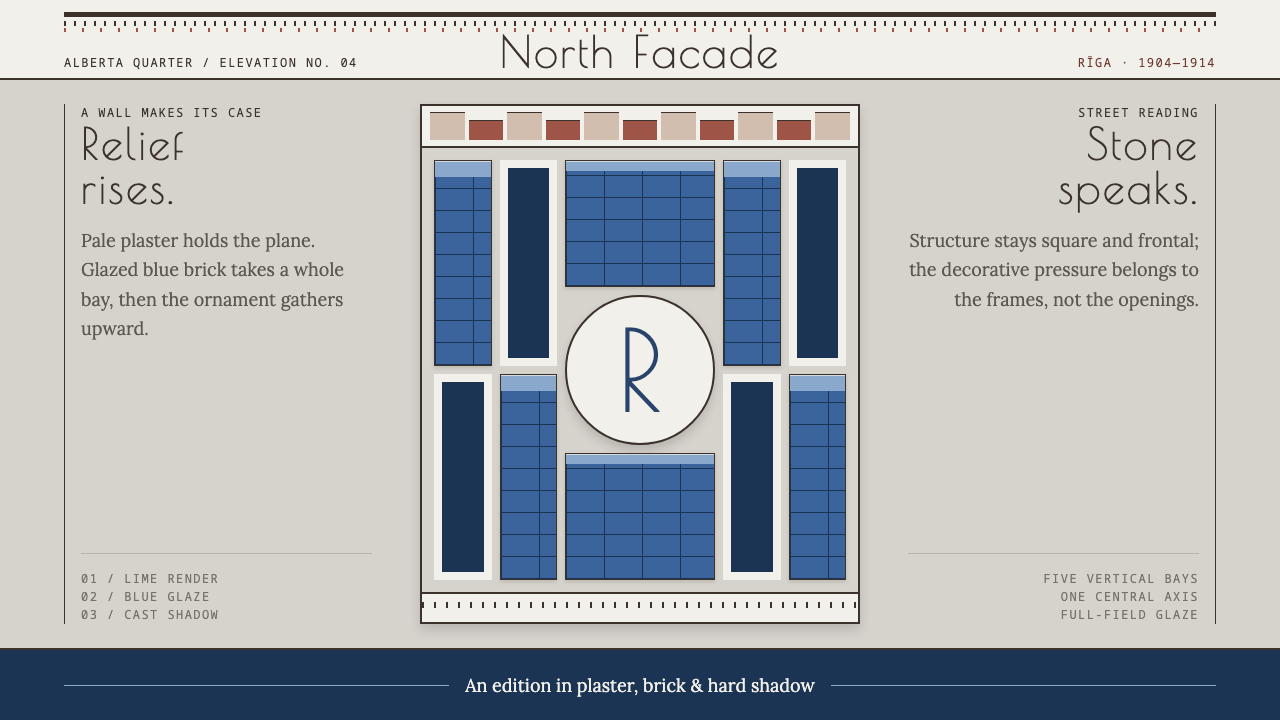 Riga JugendstilA facade that argues in relief. Blue brick fields and pale stucco rise in str…
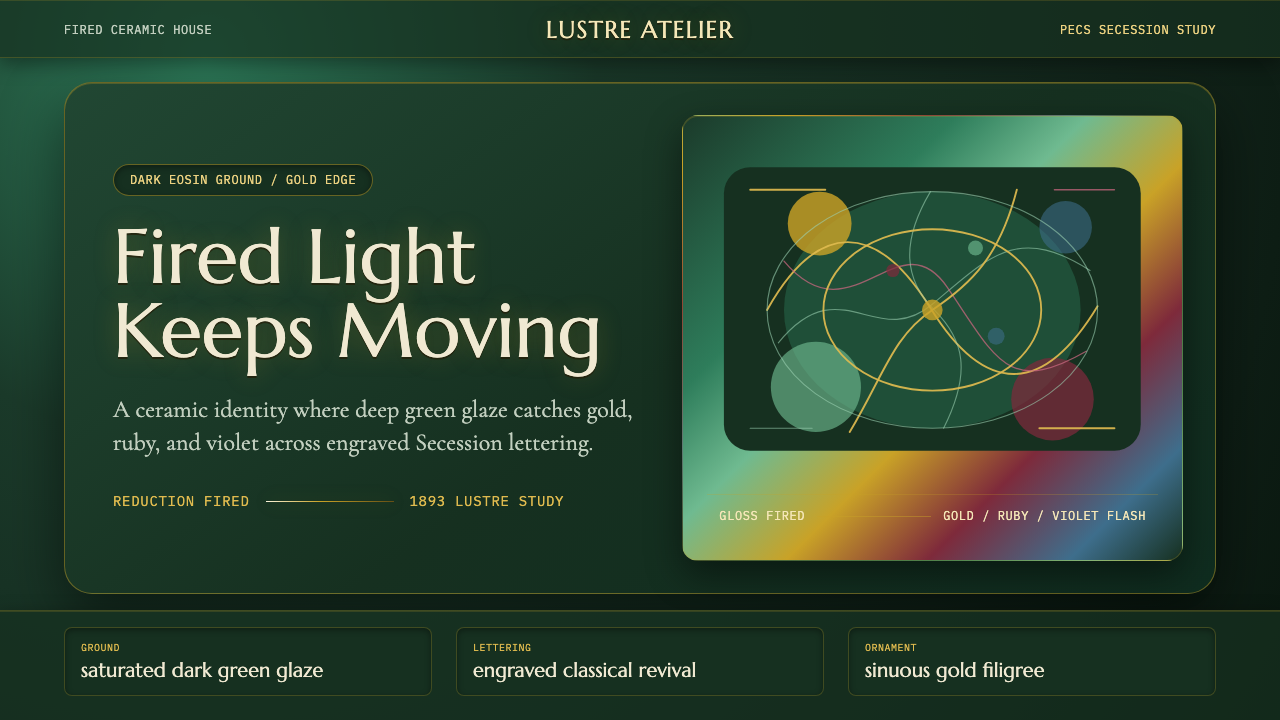 Zsolnay Eosin CeramicsGlaze becomes theater. Dark eosin green flashes gold, ruby, and violet throug…
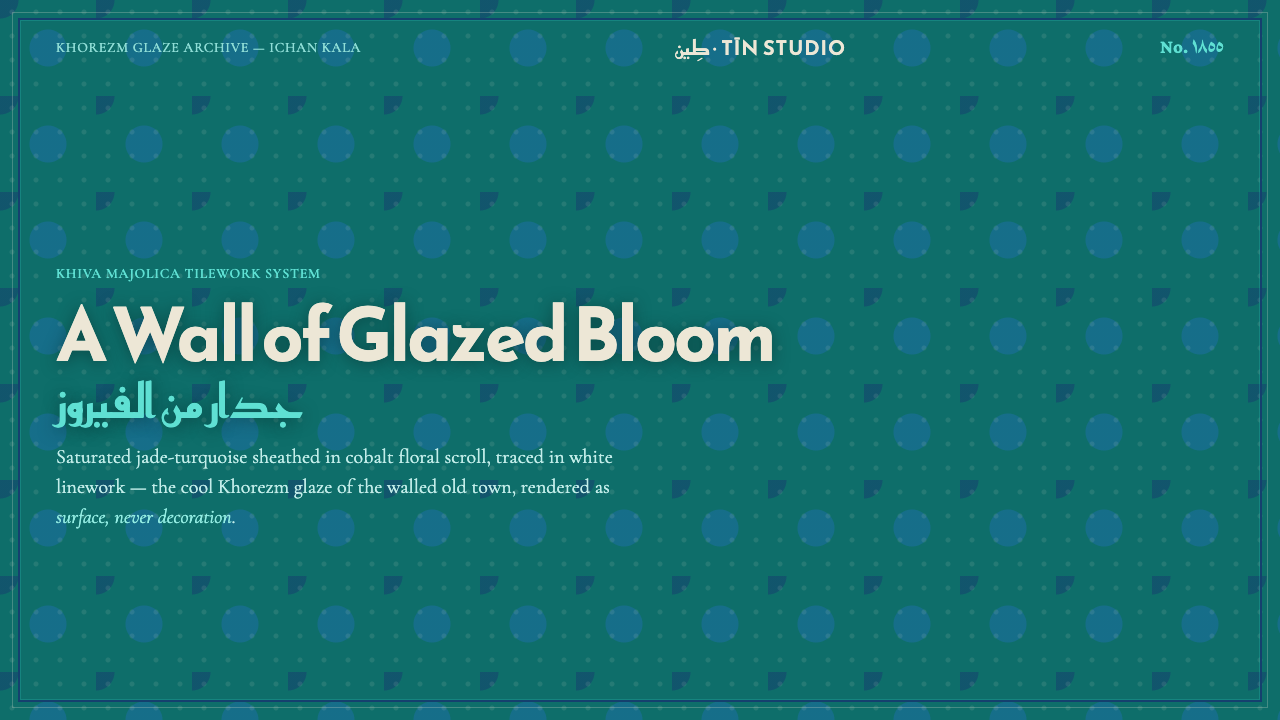 Khiva Ichan-Kala MajolicaJade becomes architecture. Cobalt bands and white tracery lock the surface in…
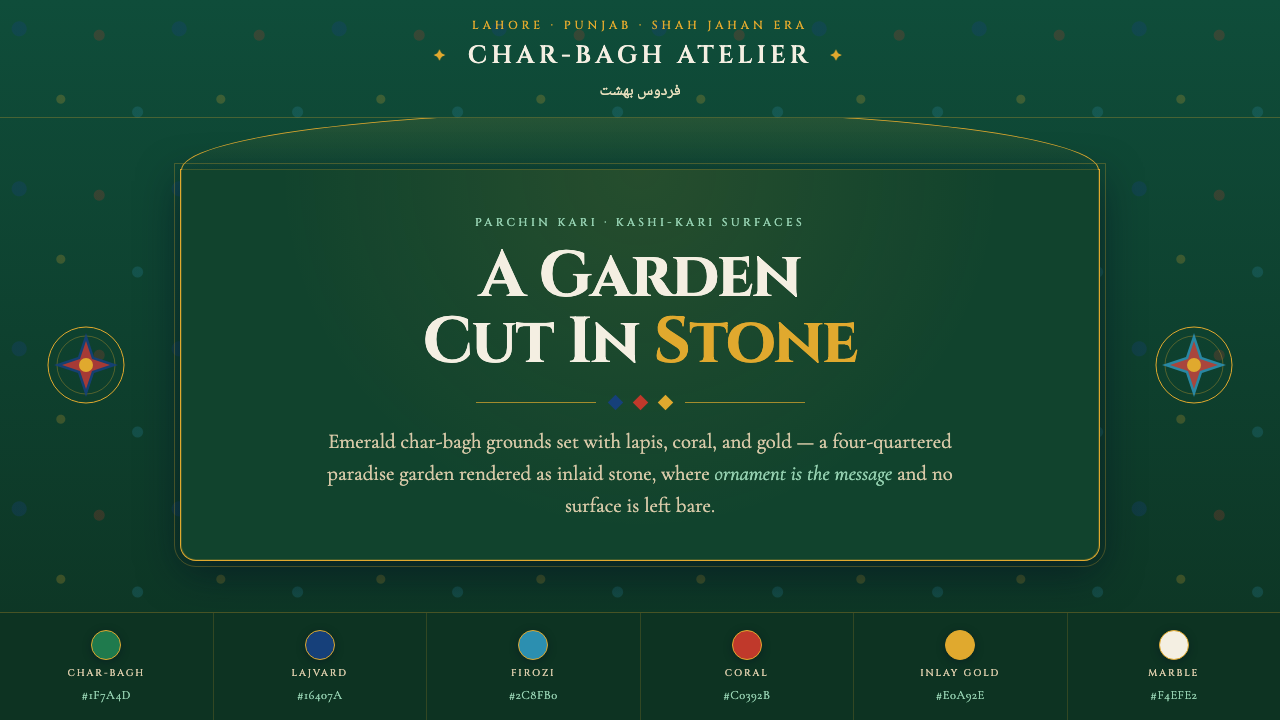 Shalimar Mughal Pietra DuraA paradise garden cut in stone. Emerald char-bagh ground inlaid with lapis, c…
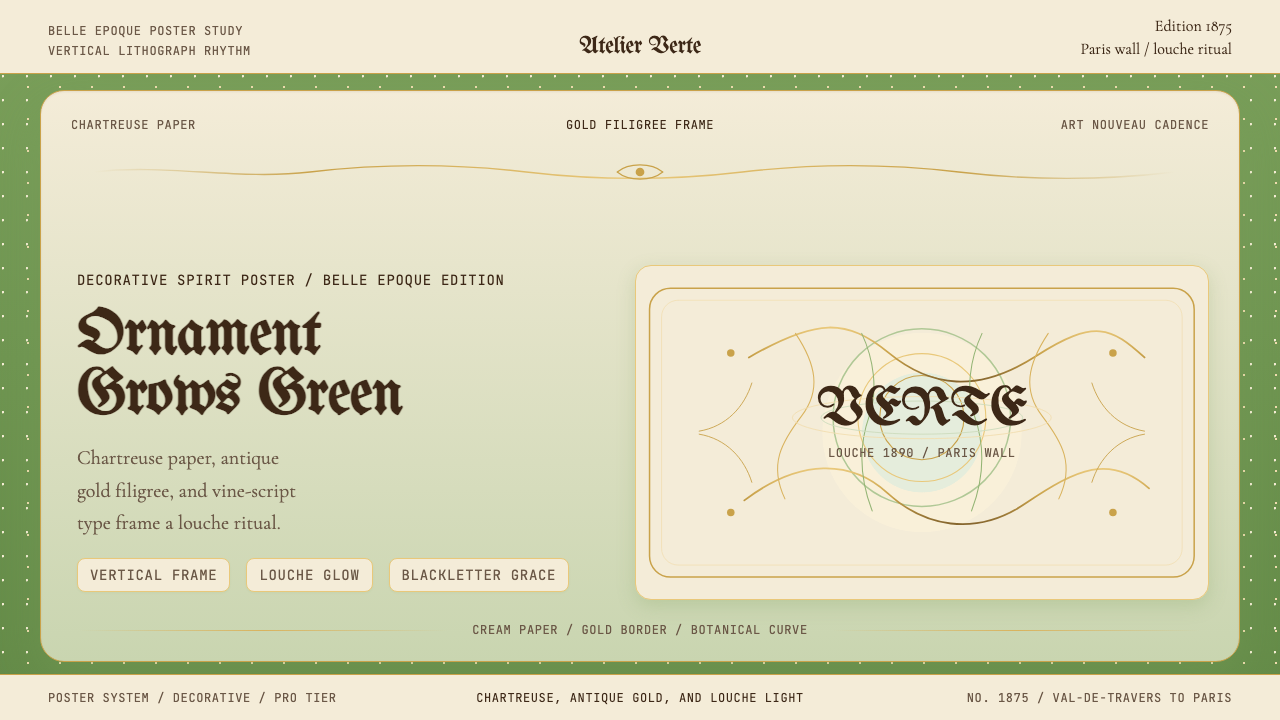 Absinthe Art Nouveau Green (1875)Ornate and verdant. Chartreuse field, gold filigree, vine-script type, and lo…