What is Absinthe Art Nouveau Green (1875)?
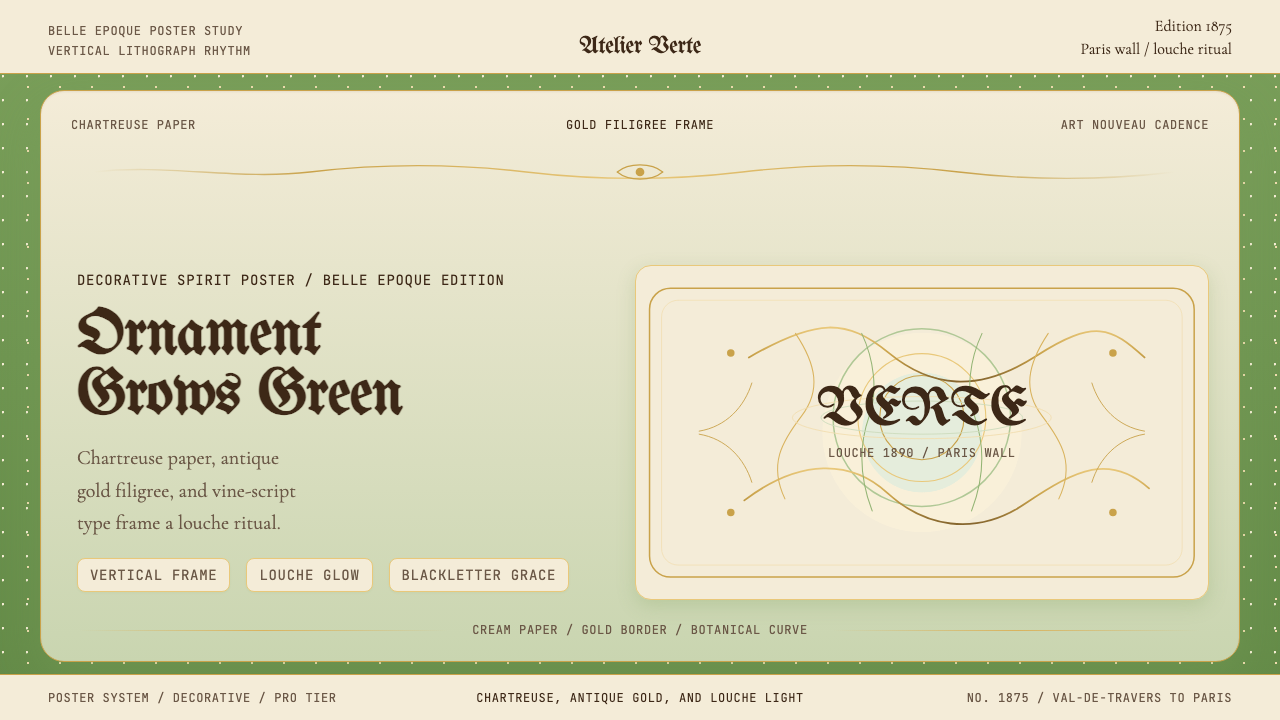
La Fée Verte's world in print — sinuous botanical curves, chartreuse vitality, and antique gold filigree turned every Belle Époque café poster into an intoxicating Art Nouveau altar.
Absinthe Art Nouveau Green (1875) in brief
Absinthe Art Nouveau Green is the visual language born from the commercial poster culture surrounding La Fée Verte — the Green Fairy — the legendary wormwood spirit that dominated European café culture from the 1870s through the first decade of the twentieth century. It is at once a period style and a living design system: chartreuse as a botanical, breathing color anchors every composition, while sinuous curves drawn from vine, tendril, and female silhouette replace straight lines and hard angles entirely.
Where most historical styles organize space through geometry or grid, this system organizes through organic flow. Borders are not ruled lines but winding botanical frames; letterforms are not typeset characters but hand-drawn vines that bloom into serifs. The palette draws on the spirit itself — the luminous, slightly acidic green of absinthe in the glass, the warm amber of aged wood and anise, the creamy opacity of the louche as water meets the spirit, and the cold filigree gold of the distillery label.
The resulting aesthetic is simultaneously opulent and herbaceous: richly detailed in ornament yet rooted in the natural world rather than the imperial or the ecclesiastical. It is a style that perfumes rather than commands, that curves rather than corners, that glows rather than blazes — making it one of the most distinctive and atmospheric design languages the nineteenth century produced.

Where does Absinthe Art Nouveau Green (1875) come from?
Absinthe itself was distilled in the Val-de-Travers region of Switzerland from at least the 1790s, but the spirit's cultural ascendancy began when Pernod Fils established industrial-scale production in Pontarlier, France, around 1805. By mid-century, the five o'clock ritual of l'heure verte — the green hour — had become embedded in Parisian café life from the grands boulevards to the artists' studios of Montmartre. Soldiers returning from Algeria had developed a taste for absinthe issued as a quinine substitute, and a series of vine-killing phylloxera epidemics in the 1860s and 1870s devastated French wine production, pushing consumers toward the affordable, potent spirit. By 1900, France was consuming over thirty-six million liters annually.
This mass market created an extraordinary demand for advertising imagery at precisely the moment when Art Nouveau — the style of the curved line, the organic form, the woman dissolved into flowering plant — was achieving its peak expression in Paris and Brussels. Jules Chéret had already established the large-format color lithographic poster as an art form in its own right during the 1870s and 1880s. When absinthe brands needed to advertise, they commissioned artists working in this fully developed visual idiom. Privat-Livemont, working in Brussels, produced some of the most celebrated absinthe posters of the era, including the 1896 Absinthe Robette, in which a nude female figure holds aloft a glowing glass of absinthe, her body dissolving into decorative smoke. Toulouse-Lautrec and Mucha contributed their own visions of the spirit to the visual culture of the Belle Époque.
The Art Nouveau movement that framed these images was itself a deliberate reaction against both academic historicism and the brutalizing visual effects of industrialization. Its practitioners — working in Paris, Brussels, Vienna, Barcelona, and Glasgow — drew on Japanese woodblock prints for their flat planes of color and elimination of perspective, on the Pre-Raphaelites for their idealized female figures, and on the Arts and Crafts movement for their insistence that applied arts deserved the same creative seriousness as fine art. The result was a style that could be applied to a building facade, a piece of jewelry, a typeface, or a poster with equal conviction.
Absinthe was banned across most of Europe and the United States between 1905 and 1915, as prohibitionist movements successfully linked the spirit to moral degeneracy and working-class disorder. The banning of absinthe coincided almost exactly with Art Nouveau's own decline, displaced by the geometric clarity of Art Deco in the 1910s and 1920s. The two disappearances — one legal, one aesthetic — left the Absinthe Art Nouveau visual system in a kind of suspended preservation, its imagery surviving in museum print collections and vintage poster archives, its vocabulary not widely revisited until late-twentieth-century revival interest in both absinthe (legalized in the European Union from 1988 and the United States from 2007) and fin-de-siècle visual culture brought it back to contemporary consciousness.
What defines the Absinthe Art Nouveau Green (1875) look?
Color
Chartreuse — the living, slightly acidic yellow-green of the distilled spirit — serves as the dominant ground color, carrying associations of botanical life, slight danger, and sensory pleasure simultaneously. Against this field, antique gold establishes the filigree framework of borders, rule lines, and label ornament. Creamy off-white provides mid-tonal breathing space, evoking both the louche opacity of water meeting absinthe and the aged paper of Belle Époque print. Deep forest green appears in shadow areas and secondary botanical elements, ensuring the palette reads as verdant without becoming monochromatic. Touches of warm amber and tawny coral appear in figural elements — skin, glass reflections, flower centers — keeping the composition from reading as purely cold or vegetable.
Line and Curve
The defining mark of this system is the whiplash curve — a line that begins slowly, accelerates through a tight arc, and releases into a trailing tendril. Every structural element, from the border of a frame to the stem of a letterform, employs this organic tension rather than the straight line or right angle. Curves double back on themselves, interlock, and dissolve into botanical silhouettes. The overall effect is one of contained energy: the composition appears to be growing rather than laid out, breathing rather than constructed.
Typography
Type in this system is inseparable from illustration. Letterforms are drawn rather than set: serifs bloom into leaves, ascenders spiral into tendrils, and baseline strokes curl at their terminals like unfurling ferns. Display lettering adopts a deliberately hand-crafted quality, with slight irregularities in stroke weight that emphasize the botanical, living character of the letterform. Where secondary text appears at smaller scale, it typically sits within a cartouche or botanical frame, making even body copy feel curated and precious rather than informational.
Composition and Format
The canonical format is vertical — the tall poster ratio of 1890s Paris café walls, designed to be read at a distance while standing. Within this vertical field, the composition is organized around a central figural element, typically a female form rendered in sinuous profile, surrounded by botanical motifs that frame and echo her silhouette. Text occupies the upper and lower registers, separated from the central figure by ornamental rules or botanical dividers. Negative space is a rarity: every surface area is enriched by pattern, texture, or decorative detail, producing a density of visual information that rewards sustained attention.
Ornament and Filigree
Ornament is not applied to this system — it is structural to it. Gold filigree borders serve the same function as the grid in a modernist layout: they establish the hierarchy of zones, distinguish foreground from background, and provide visual rhythm across the surface. The filigree draws from multiple traditions — Gothic tracery, Japanese decorative metalwork, the engraved label traditions of French wine and spirit bottles — and synthesizes them into a distinctly Belle Époque syntax. Secondary ornamental elements include botanical vignettes, medallion frames, stylized wormwood sprigs, and the absinthe glass itself treated as a decorative motif.
Figuration
The female figure is central to this visual language — not as a portrait subject but as an idealized, partially abstracted form whose body merges with the botanical environment surrounding it. Hair becomes foliage, robes become petals, hands dissolve into tendrils. This figural treatment draws on the Art Nouveau conviction that the boundary between the human and the natural world was a matter of convention rather than fact, and that the role of art was to dissolve that convention. The figure is always shown in a state of reverie or sensory absorption — eyes half-closed, posture inclined — reinforcing the association between the spirit, altered perception, and aesthetic experience.
Texture and Surface
The system employs layered surface effects drawn from both lithographic printing technique and the material culture of the Belle Époque: the slightly rough tooth of quality poster paper, the transparency effects of oil-based lithographic inks layered in multiple passes, the embossed quality of gold label printing. In contemporary application, these translate to subtle paper-texture overlays, warm-tinted vignettes at composition edges, and the suggestion of ink transparency in areas where colors overlap. The result is a surface that feels material and hand-produced rather than digitally flat — a quality that distinguishes authentic application of this system from mere imitation.

Who shaped Absinthe Art Nouveau Green (1875)?
The Belgian artist Henri Privat-Livemont is the most directly associated figure with the Absinthe Art Nouveau visual vocabulary. Working from his studio in Schaerbeek outside Brussels, he produced poster commissions for absinthe brands including Robette and Terminus that became defining examples of the genre. His 1896 Absinthe Robette — depicting a nude female figure dissolving into smoke above a glowing absinthe glass, surrounded by sinuous botanical ornament — is arguably the single most reproduced image of the Belle Époque absinthe poster tradition. Livemont's handling of the female figure, his color mastery in the chartreuse-to-gold range, and his integration of Art Nouveau organic line with commercial lithographic constraints make him the essential reference for this style.
Jules Chéret is the father of the modern poster and the technical and aesthetic foundation upon which the entire Belle Époque absinthe poster tradition rests. Working from his Paris print studio from the 1860s onward, Chéret pioneered the use of large-format three-color lithography for commercial advertising, developing the joyful, whirling female figure — the Chérette — that became the visual emblem of Parisian popular culture. Though Chéret's work predates the full flowering of Art Nouveau, his compositional approach, his mastery of lithographic color, and his establishment of the vertical poster as the dominant commercial format created the platform on which subsequent Art Nouveau absinthe imagery was built.
Though Mucha is most celebrated for his Sarah Bernhardt theatrical posters and his series of decorative panels on the seasons and arts, his visual language is inseparable from the absinthe advertising milieu of Belle Époque Paris. Mucha's characteristic devices — the mandorla halo of botanical ornament surrounding a central female figure, the integration of decorative lettering into the architectural frame of the composition, the translucent layering of warm and cool color — became so influential that they defined the international reception of Art Nouveau as a style. His approach demonstrates that the Absinthe Art Nouveau visual system is not a niche or eccentric variant but the mainstream expression of the movement at its height.
Toulouse-Lautrec occupies a distinctive position in the absinthe poster tradition: where Privat-Livemont and Mucha created idealized, decorative visions of the spirit, Lautrec brought an unflinching documentary eye to the café culture in which absinthe was consumed. His depictions of absinthe drinkers — most famously the 1887 painting A Montrouge: Rosa la Rouge, and his sketches of the habitués of the Moulin Rouge and surrounding cabarets — document the other side of the Green Fairy's world: the solitary drinker, the glazed stare, the absinthe glass as companion to isolation. His poster work for various Paris entertainments brought the same raw energy and psychological acuity to the commercial format, making him an essential foil to the more purely decorative Art Nouveau tradition.
The Swiss-born, Paris-based designer and illustrator Eugène Grasset was instrumental in theorizing and teaching Art Nouveau as a coherent design system rather than merely a decorative fashion. His 1905 treatise La Plante et ses applications ornementales systematically catalogued the transformation of botanical forms — leaves, stems, roots, flowers — into design elements, providing working designers with a grammar for the organic ornament that defines the Absinthe Art Nouveau visual world. Grasset's approach demonstrated that the botanical vocabulary of this style was not arbitrary fantasy but a disciplined language with its own syntactic rules, and his influence extended to a generation of commercial artists working across poster design, book illustration, and decorative arts.
How do you use Absinthe Art Nouveau Green (1875) today?
Absinthe Art Nouveau Green rewards designers who treat it as a complete atmospheric system rather than a palette borrowed from a vintage poster. Applying it well requires committing to the full vocabulary: the sinuous curve, the botanical ornament, the filigree framework, the layered surface texture, and the specific color relationships between chartreuse, antique gold, and creamy off-white. Used selectively — taking only the color, or only the typographic style — the system reads as costume rather than coherent design language.
For presentation slides, this system is most powerful on cover and divider slides where atmospheric impact matters more than information density. A cover built in this idiom uses the full vertical field: a central botanical frame in antique gold on chartreuse occupies most of the slide area, with the presentation title rendered in a drawn, vine-like display treatment inside the central cartouche. Divider slides can use detail crops of botanical ornament — a single unfolding tendril, a medallion border — as background elements. Content slides should pull back from the full ornamental density: a gold rule at top and bottom, a discreet botanical corner ornament, and clean readable type in the body area let the system breathe without losing its character. Data slides work best when charts and graphs are contained within ornamental frames, transforming information displays into the visual equivalent of an illuminated manuscript page.
For web user interfaces, this system suits landing pages, editorial sites, and brand identity pages more than functional dashboards or data-heavy applications. A pricing page in this system uses chartreuse as the hero background for a featured tier, with gold filigree details on card borders and botanical dividers between sections. Navigation can employ the cartouche treatment — each primary navigation item enclosed in a subtle ornamental frame — reinforcing the overall decorative coherence without overwhelming usability. The system struggles in high-information-density contexts: the ornamental richness that makes it beautiful on a poster becomes visual noise when competing with tables, form fields, and notification states.
For editorial and marketing applications, Absinthe Art Nouveau Green excels in contexts where the audience expects sensory richness and historical depth: spirits branding, fine dining, luxury hospitality, beauty and wellness brands, cultural institutions, and any product positioned at the intersection of pleasure and sophistication. Magazine spreads and editorial features benefit from the system's portrait orientation bias — the tall, narrow layout with ornamental top and bottom registers, a central figural or product image, and botanically framed body text creates a reading experience that feels closer to an antique label or a belle époque catalogue page than to a contemporary digital grid.
A common mistake when applying this system is to treat the chartreuse-and-gold combination as sufficient on its own, without committing to the organic line quality that makes the system coherent. Digital applications that use the color palette but employ geometric shapes, rigid grids, and clean sans-serif typography produce a jarring hybrid — the eye recognizes the historical color association but the structural language contradicts it. A second common error is over-saturating the chartreuse: the authentic color is more nuanced and slightly muted than a pure digital yellow-green, carrying a quality of botanical age and patina rather than flat digital brightness. When the color reads as neon rather than herbal, the historical resonance is lost.

Absinthe Art Nouveau Green (1875) — FAQ
How is Absinthe Art Nouveau different from Art Nouveau generally?
Art Nouveau as a movement encompassed a wide range of sub-styles — from the more geometric Viennese Secession to the architecturally integrated Glasgow Style to the fluid, nature-immersed Paris and Brussels variant. Absinthe Art Nouveau Green is specifically the commercial poster variant of the Paris-Brussels tradition: poster-format and color-lithography-constrained, organized around a central female figure immersed in botanical ornament, and calibrated to the specific chartreuse-gold-cream palette associated with the spirit itself. It is more sensory, more figural, and more explicitly connected to pleasure and altered states than the broader Art Nouveau vocabulary, which could also produce the rigorous architectural ornament of Victor Horta or the clean geometric symbolism of Josef Hoffmann.
Can this system work in a light, minimal context, or does it always require ornamental density?
A restrained variant is possible but requires conscious calibration. The system's signature elements — the botanical curve, the gold filigree detail, the chartreuse-and-cream palette — can be used at low density as accent elements within an otherwise clean layout. A product page might use a single gold botanical border around the hero image, chartreuse as the call-to-action color, and a vine-drawn headline typeface, leaving the rest of the page in clean white. This approach reads as Art Nouveau-inflected rather than fully immersive, which suits brands that want historical depth without visual weight. The risk is that at low density, the ornamental elements read as decorative rather than structural, which is precisely the opposite of how they function in the authentic system.
Does the absinthe association limit the system to alcohol brands?
The historical origin is absinthe, but the visual vocabulary has long since escaped that context. What the system carries forward is a set of associations — botanical vitality, sensory richness, fin-de-siècle sophistication, the pleasure of unhurried attention — that apply across many categories: specialty tea and botanical beverage brands, artisan perfumery, luxury hospitality, high-end cosmetics, cultural institutions with a Belle Époque heritage, and literary or artistic publishing. The connection to absinthe can be made explicit or left implicit; in most contemporary applications, audiences read the visual language as generally Art Nouveau and historically sophisticated rather than specifically absinthe-related. The system's dark side — the associations with prohibition, moral panic, and altered consciousness — can itself be a brand asset in categories where transgression and edge are desirable.
How do you apply the louche effect — the opalescent haze — in contemporary design?
The louche — the opalescent cloudiness that forms when water is added to absinthe — is one of the most distinctive atmospheric qualities of this visual system and one of the most misunderstood. It is not a blur, a bokeh, or a soft-focus effect. It is a specific quality of translucent layering: a warm creamy haze that sits between foreground elements and the chartreuse ground, creating a sense of depth without perspective and warmth without softness. In practice, this translates to a mid-toned warm-white layer at reduced opacity overlaying the background color in zones where foreground elements emerge, creating the impression that the illustrated figure or product is materializing from within the color field rather than sitting on top of it. The effect should feel like mist rising from liquid, not like a Gaussian blur applied to an image.
Is it appropriate to mix this system with contemporary sans-serif type for readability?
Mixing is common in contemporary applications and can be done successfully if the hierarchy is clear: drawn or historically-referencing display type for headlines, decorative elements, and brand touchpoints, paired with a clean, neutral typeface for body copy, captions, and interface labels. The key is to treat the drawn display type as the system's voice and the clean body type as its substrate — the illustrated element and the utilitarian element should not compete for the same role. Where the hybrid tends to fail is when the clean type is given decorative treatment (bold weights, tight tracking, unconventional sizing) that makes it compete with the ornamental display elements for visual energy, fragmenting the atmospheric coherence that makes the system effective.
Related design styles
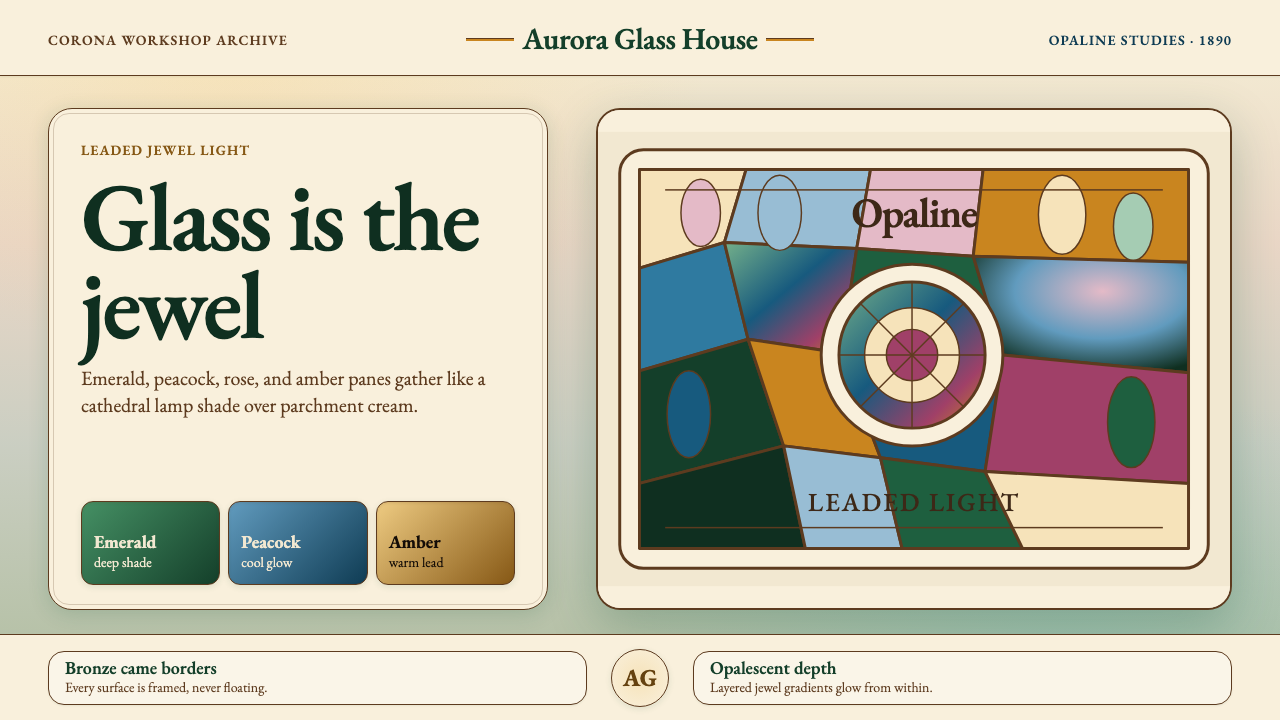 Tiffany Stained GlassJewel light, framed in bronze. Emerald and peacock panes glow on parchment cr…
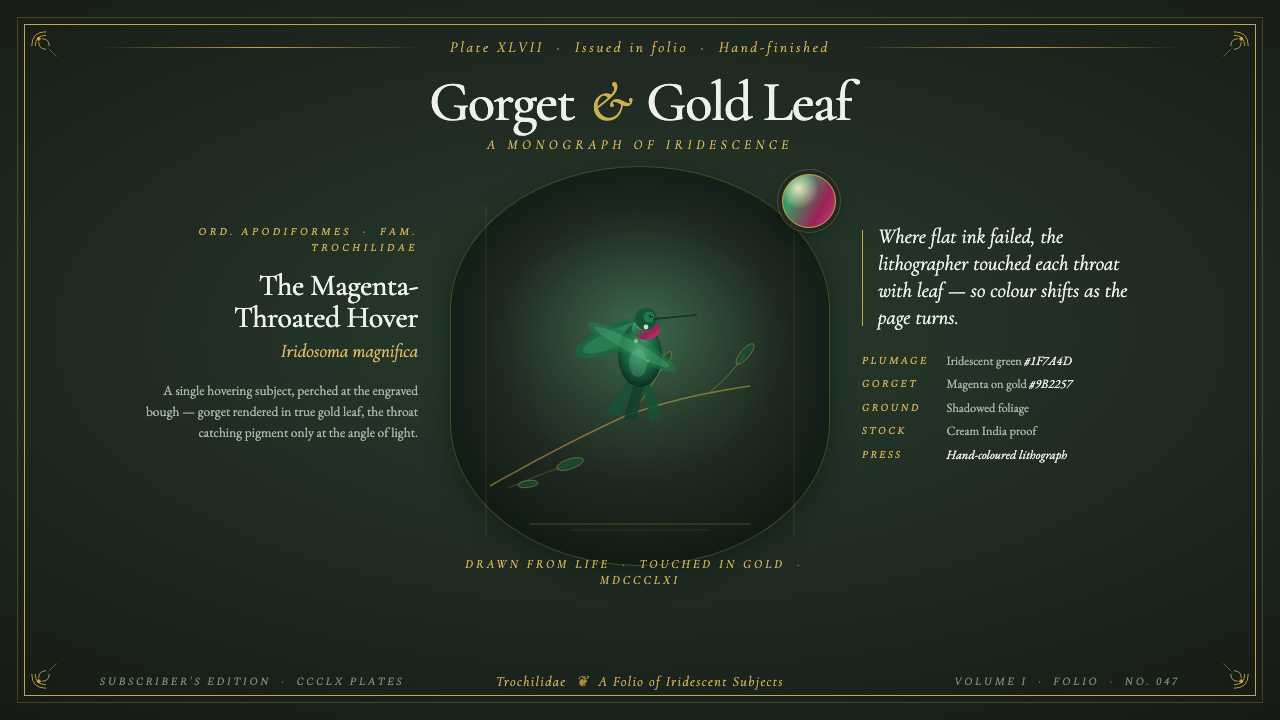 Gould Hummingbird PlateVictorian ornithology, jewel-grade. Green plumage on shadowed foliage, gorget…
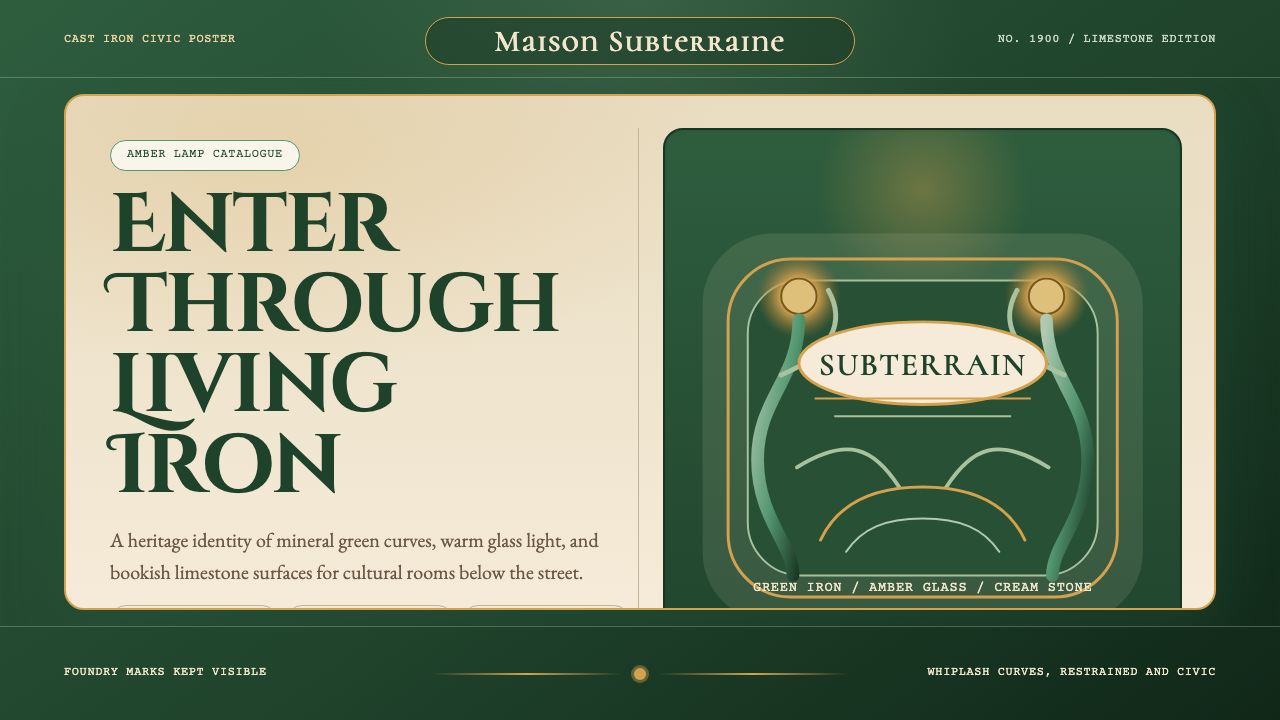 Paris Metro Guimard (1900)Civic sculpture, softly lit. Metro green ironwork frames amber glow and limes…
 Argentine Tango Poster (1940)Nocturnal drama in ink. Oxblood ground, antique gold rules, Bodoni capitals.
 Art Nouveau (Mucha)Mucha's whiplash arabesques. Botanical halos, muted lithograph palette, no ma…
 Danish Skønvirke SilverThe drawing is done in shadow. Amarante on soft silver, with amber held in bi…