What is Eritrean Asmara Art Deco Cinema (1936)?
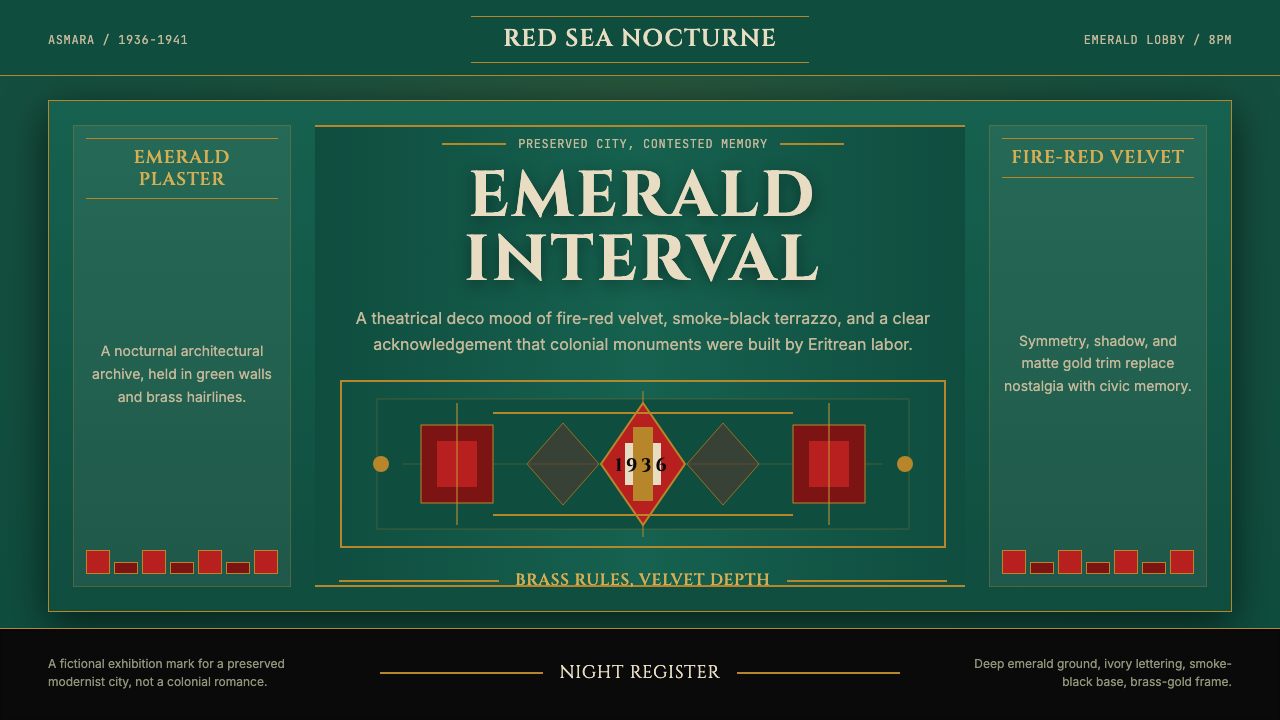
Deep emerald walls, fire-red velvet, and the warm glow of brass sconces — the theater interiors of colonial Asmara turned a moment of political darkness into one of the twentieth century's most vivid and improbable architectural achievements.
Eritrean Asmara Art Deco Cinema (1936) in brief
Eritrean Asmara Art Deco Cinema (1936) is a design system rooted in the nocturnal interior of Cinema Impero — the most celebrated of Asmara's Modernist and Art Deco buildings — as it would have appeared on an evening in the late colonial period. The palette is theatrical and unapologetically rich: deep emerald green surfaces hold the room, fire-red velvet catches the light, smoke-darkened terrazzo grounds the floor, and warm brass fittings offer the only relief from the enclosing darkness. It is a system of controlled drama rather than restraint.
Unlike many historical styles whose visual logic is defined by what is absent — ornament removed, color reduced, decoration stripped away — this system is defined by what is present and precisely where it appears. Color is not sparse; it is dramatically placed. The deep background does not flatten; it recedes and gives depth. The metallic accent does not merely highlight; it organizes the eye through an otherwise dense chromatic field. The result is a visual language of nocturnal authority, equally at home in a film poster and in a luxury landing page.
The system is named for a specific moment and place: the cinema culture that flourished in Asmara between Italian colonial construction in the 1930s and the post-independence preservation of the cityscape through the 1990s and 2000s. It carries the weight of that specific history — buildings erected under a violent colonial program but inhabited, adapted, and preserved by Eritrean communities — and it honors both the architectural achievement and the complex human story beneath it.
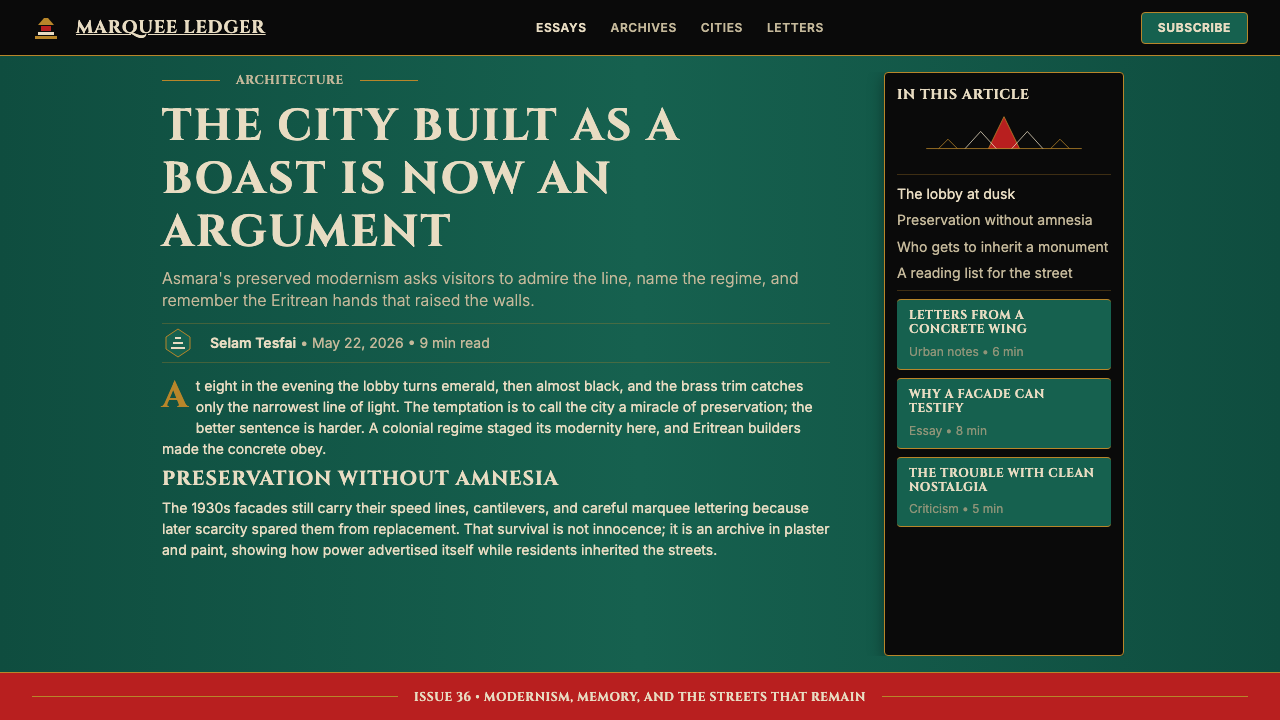
See the Eritrean Asmara Art Deco Cinema (1936) design system
Where does Eritrean Asmara Art Deco Cinema (1936) come from?
In 1935, Benito Mussolini launched the invasion of Ethiopia from Eritrea, and the following year declared the establishment of Italian East Africa (Africa Orientale Italiana). Asmara, which had been the administrative capital of Italian Eritrea since 1900, was rapidly transformed into a showcase city. Between 1936 and 1941, Italian architects — many trained in the Razionalismo tradition that emerged from Italy's engagement with modernist and functionalist ideas — designed and built a concentrated cluster of buildings unlike anything else in East Africa. The goal was propaganda as architecture: a modern colonial capital that would project the power and sophistication of the fascist state.
The buildings they produced were extraordinary on their own terms. Cinema Impero, designed in 1937 by Mario Messina and named for the new empire, became one of the most accomplished Art Deco cinema interiors on the continent. Giuseppe Pettazzi's Fiat Tagliero service station — a cantilevered concrete structure whose wings extend without visible support, legend holding that Pettazzi threatened the construction foreman with a pistol to force removal of the temporary wooden supports — is among the most audacious pieces of modernist engineering anywhere. Bruno Sclafani and Edoardo Cavagnari contributed to the urban fabric of hotels, offices, and commercial buildings whose ground floors opened onto colonnaded sidewalks. The result was a city whose central district was almost entirely constructed within a five-year window, giving it an unusual visual coherence.
What preserved Asmara was, paradoxically, the very isolation that followed Eritrean independence. After the end of Italian rule in 1941, the British administered Eritrea for a decade before federation with Ethiopia. When Eritrea finally achieved full independence in 1993 after a thirty-year armed struggle, the new nation was economically isolated, burdened by debt, and rebuilding from war. There was no capital for large-scale redevelopment. The Art Deco and Modernist buildings that might have been demolished elsewhere were instead left standing — maintained by their inhabitants but not modernized, preserved by circumstance rather than by policy.
International architectural recognition arrived slowly. The preservation movement, led by a combination of Eritrean scholars and international heritage organizations, gradually brought Asmara's unique urban fabric to wider attention. In 2017, UNESCO added Asmara to the World Heritage List, citing the city as an 'exceptional example of early twentieth century modernist urbanism.' The designation formalized what the city's residents had long understood: that the buildings built under colonial coercion had become, through decades of habitation and care, genuinely Eritrean cultural patrimony. The Cinema Impero's red velvet seats, the terrazzo floors worn smooth by generations of filmgoers, the brass fixtures polished by repeated hands — these are no longer Italian export objects but Asmaran objects.
What defines the Eritrean Asmara Art Deco Cinema (1936) look?
Background and Depth
The dominant ground is a deep, saturated emerald — not black, not navy, but the specific green of Cinema Impero's interior walls, which absorbs light rather than reflecting it. Against this ground, other colors appear to advance rather than float. The depth is not achieved through gradients or shadow simulation but through the inherent luminosity contrast between the dark ground and the warmer, lighter elements placed upon it. The system uses darkness as a structural medium, not a neutral backdrop.
Accent and Warmth
Fire red appears as the primary accent — in upholstery, in typographic highlights, in the decorative bands that Art Deco interiors used to define transition zones between architectural surfaces. This red is warm and saturated rather than cold or corporate; it carries the sense of velvet and theatricality rather than urgency or warning. Brass gold provides the secondary accent, used sparingly for sconce light, fixture trim, and structural ornament. Where brass appears, it functions as a light source — a warmth that reads against the emerald and red without competing with either.
Surface and Texture
The system acknowledges texture through the language of specific materials — terrazzo, velvet, brass — without simulating those materials literally. A surface that reads as terrazzo carries the quality of aggregate embedded in a dark matrix: fractured, mineral, intrinsically patterned. A surface that reads as velvet carries directionality and depth without being soft or organic. These material references are invoked through tone and composition rather than through photographic realism or skeuomorphic rendering. The goal is to suggest a physical world without reproducing it.
Art Deco Geometry
The geometric vocabulary is characteristic of late Art Deco rather than the earlier geometric abstraction of Bauhaus or De Stijl. Chevrons, stepped forms, sunburst radiations, and the repeating horizontal banding that defined the transitional ornament of cinema interiors all figure here. These forms are never purely abstract — they carry implied movement, the sense of something accelerating or expanding — and they appear at the junctures of surfaces rather than as full-field patterns. Geometry is used as punctuation rather than as structure.
Light as Element
In Cinema Impero, light was not ambient — it was directed, theatrical, and architectural. Sconces cast warm pools against the emerald walls; projection light cut through the dark. The design system translates this quality into a principle: light is used as a deliberate compositional element rather than a uniform environment. Illuminated areas earn their brightness; dark areas are not failures of illumination but intentional presences. High contrast between lit and unlit zones creates a cinematic reading — the eye moves toward warmth and brightness the way a theater audience turns toward the screen.
Colonial Tension and Eritrean Ownership
The system is not a colonial nostalgia project. It acknowledges that the buildings were constructed using Eritrean labor under a violent imperial program, and that the aesthetic language came from European modernism, not from local tradition. What it honors is the subsequent history: the way Eritrean communities inhabited, maintained, and made these spaces their own over generations of post-colonial use. The richness of the visual language — the velvet, the terrazzo, the brass — belongs as much to the communities that preserved it as to the architects who designed it. This distinction matters for how the style is applied: never as exoticism, always as specific historical place.
Typographic Register
Art Deco type is wide, confident, and geometric — a world away from the ascetic sans-serif of Bauhaus. The appropriate typographic register for this system uses letterforms with strong horizontal emphasis, moderate to generous tracking, and no hairline strokes that would disappear against the dark ground. Display type functions like architectural lettering: large, spaced, assertive. Body text, by contrast, runs light against the deep ground in cream or warm white, creating the layered legibility of a theater program.

See the Eritrean Asmara Art Deco Cinema (1936) design system
Who shaped Eritrean Asmara Art Deco Cinema (1936)?
Messina designed Cinema Impero in 1937, creating what became the defining example of Art Deco cinema architecture in colonial East Africa. Working within the political imperative to project Italian imperial modernity, he produced an interior of genuine theatrical sophistication — the emerald, the red, the brass, the sweeping horizontal ornamental bands that define the space. Messina's other Asmara work contributed to the coherence of the city's built fabric, and Cinema Impero remains the most recognized structure in the UNESCO World Heritage designation.
Pettazzi's Fiat Tagliero service station (1938) is the other iconic building of Asmara's modernist cluster — an aircraft-wing form in reinforced concrete that remains one of the most dramatically engineered buildings of the entire Art Deco period anywhere in the world. It represents the experimental edge of Italian Razionalismo in its colonial context: the ambition to demonstrate engineering mastery in a location that would maximize visibility and symbolic effect. Pettazzi's work anchors the understanding that Asmara's buildings were not merely decorative but structurally audacious.
Sclafani contributed several commercial and civic buildings to Asmara's central district, working in a range of styles from Streamline Moderne to more ornamented Art Deco. His buildings helped define the street-level experience of the city — the colonnaded facades, the recessed ground floors, the rhythm of openings along the main commercial streets. The quotidian urban fabric he helped create is as important as the landmark buildings for understanding why Asmara reads as a coherent whole rather than a collection of individual monuments.
Cavagnari served as the primary planner responsible for Asmara's urban layout during the peak construction period of the late 1930s. His contribution was organizational: the street grid, the zonation of the city that separated the Italian colonial residential areas from the indigenous quarters, and the siting of key civic buildings. The coherence that allowed UNESCO to designate the entire central district as heritage is in part a product of this planning framework. Cavagnari's legacy is therefore inseparable from both the beauty of the built environment and the spatial segregation that accompanied it.
No single name defines the contemporary effort to protect and document Asmara's modernist heritage, but the collective work of Eritrean cultural scholars, international conservation advisors, and local community members over several decades constitutes a kind of institutional figure in the city's story. Beginning in the 1990s, the movement documented the city's buildings systematically, argued for their significance at international heritage bodies, and eventually achieved the 2017 UNESCO inscription. This ongoing institutional effort is as much a part of the heritage system as the original architects — it is the reason the buildings still stand.
How do you use Eritrean Asmara Art Deco Cinema (1936) today?
The Eritrean Asmara Art Deco Cinema system is well-suited to contexts where richness, authority, and a sense of curated history are desired values. It performs best when the dark ground is committed to fully — not as an accent on an otherwise light layout, but as the foundational environment. Presentation covers, hero sections, and feature panels benefit most from this full immersion; mixed-ground layouts where the system appears only in isolated components tend to read as decorative borrowing rather than coherent application.
For presentation slides, this system works best on covers and section dividers rather than content-dense body slides. A cover treatment: the emerald ground fills the frame, a fire-red geometric band occupies the lower third, and the title appears in wide-tracked display type in warm cream or brass tone. Section dividers can carry the full chromatic weight; body slides should step back to a lighter near-white ground with only typographic and accent-color echoes of the full system. Data slides can use the fire-red and brass-gold against a mid-tone ground for bar and line charts, reserving the deep emerald for emphasis states only.
For web interfaces, this system suits landing pages, film or media platforms, hospitality and luxury products, and any context where the product is positioning itself as cultured, considered, and specifically located in time. Navigation and header components take on the qualities of architectural lettering against the deep ground. Card components should use deep shadows and warm accent borders rather than light hairline separators. Interactive states — hover, focus, active — can reveal the fire-red or brass-gold against the emerald, giving the interface a theatrical quality as the user moves through it.
For editorial and marketing contexts, the system supports headline-forward layouts that recall film posters and theater programs. A full-width feature: emerald ground, large cream display type, a fire-red typographic accent on a key phrase, a brass-toned rule separating sections. Inline imagery — where photography appears — works best when treated to high contrast and warm color cast rather than naturalistic rendering. The system does not support casual or playful content well; it is inherently formal and carries the gravity of the historical context from which it draws.
A common error when applying this system is using the emerald as an accent on a light background rather than as the dominant ground. This reversal removes the depth and theatrical quality that define the system and produces something that looks vaguely vintage without the authority of the original. A second common error is over-applying the fire-red — it should appear in discrete, intentional zones, not as a recurring motif throughout a layout. The fire-red earns its power from restraint; when it appears everywhere, it becomes merely a color rather than an accent that commands attention.
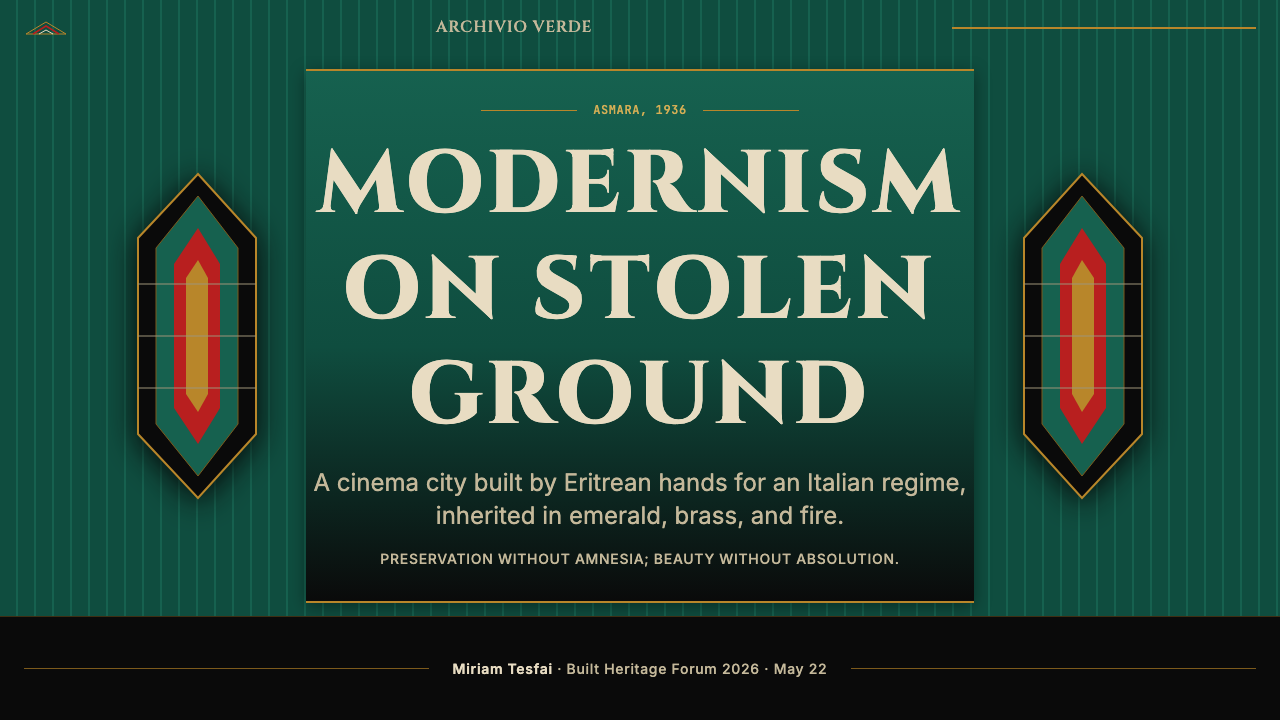
See the Eritrean Asmara Art Deco Cinema (1936) design system
Eritrean Asmara Art Deco Cinema (1936) — FAQ
Is this a colonial aesthetics project, and how should that history inform application?
The style is rooted in buildings constructed through colonial violence, and that history is not incidental to the aesthetic. The right approach is to apply it with specificity rather than abstraction: this is the visual language of a specific place, Cinema Impero in Asmara, not generic 1930s Art Deco. Using it as a platform for celebrating Italian fascist architecture would be a misapplication; using it to evoke the complexity of a place that became genuinely Eritrean despite its origins is the appropriate register. The style works best when applied to contexts that can bear that kind of historical weight — not frivolous products, and not as mere nostalgia.
How does this style differ from mainstream 1930s Art Deco?
Mainstream Art Deco — as practiced in New York, Paris, or London — tends toward cream and gold on light grounds, with abundant gilding, chrome, and surface richness. The Asmara variant is darker and more theatrical: the deep emerald ground is specific to East African colonial cinema interiors and does not appear in the canonical Art Deco references. Additionally, the Asmara buildings combine Italian Razionalismo (a leaner, more functionalist modernism) with Art Deco ornamental vocabulary in a way that produces something more stripped and architectural than typical 1930s theatrical interiors. The result is colder by temperature but warmer by light source — a different kind of luxury than Rockefeller Center or the Palais de Chaillot.
Can this system be used on light backgrounds?
It can, but doing so fundamentally changes the register. On a light or cream ground, the fire-red and brass-gold become the primary accent colors against a neutral field, and the result reads more like conventional 1930s Art Deco than the specific Asmara cinema interior that the system references. The deep emerald becomes a secondary accent rather than the foundational environment, losing the quality of depth and enclosure that characterizes the original. If a light-ground application is necessary for legibility or context reasons, treating it as a simplified variant rather than the full system is the more honest approach.
What kinds of products is this system unsuited for?
The system's formal gravity and historical weight make it unsuitable for products that need to project lightness, approachability, or contemporary neutrality. Children's products, health and wellness applications, casual social platforms, and any context where the user should feel at ease rather than in a specific, serious place are all poor fits. It is also unsuitable for products that need to communicate speed and efficiency above all — the theatrical pacing of the Asmara cinema is deliberate and slow, and that quality transfers to the visual system. A fintech dashboard or a productivity tool would fight against the aesthetic rather than benefit from it.
How does the UNESCO World Heritage designation affect how the style should be treated?
The 2017 designation is significant not as a license but as a responsibility. It confirms that Asmara's buildings are recognized as globally significant heritage — which means they belong to a wider discourse than a simple design style reference. Using this system thoughtfully involves acknowledging that the buildings it references are real, documented, and living heritage sites still inhabited and cared for by Eritrean communities. The designation also reinforces the argument that the style should be applied with specificity: referencing Cinema Impero rather than generic Art Deco positions the work within a real place and its people, which is both more honest and more interesting than abstract period styling.
Related design styles
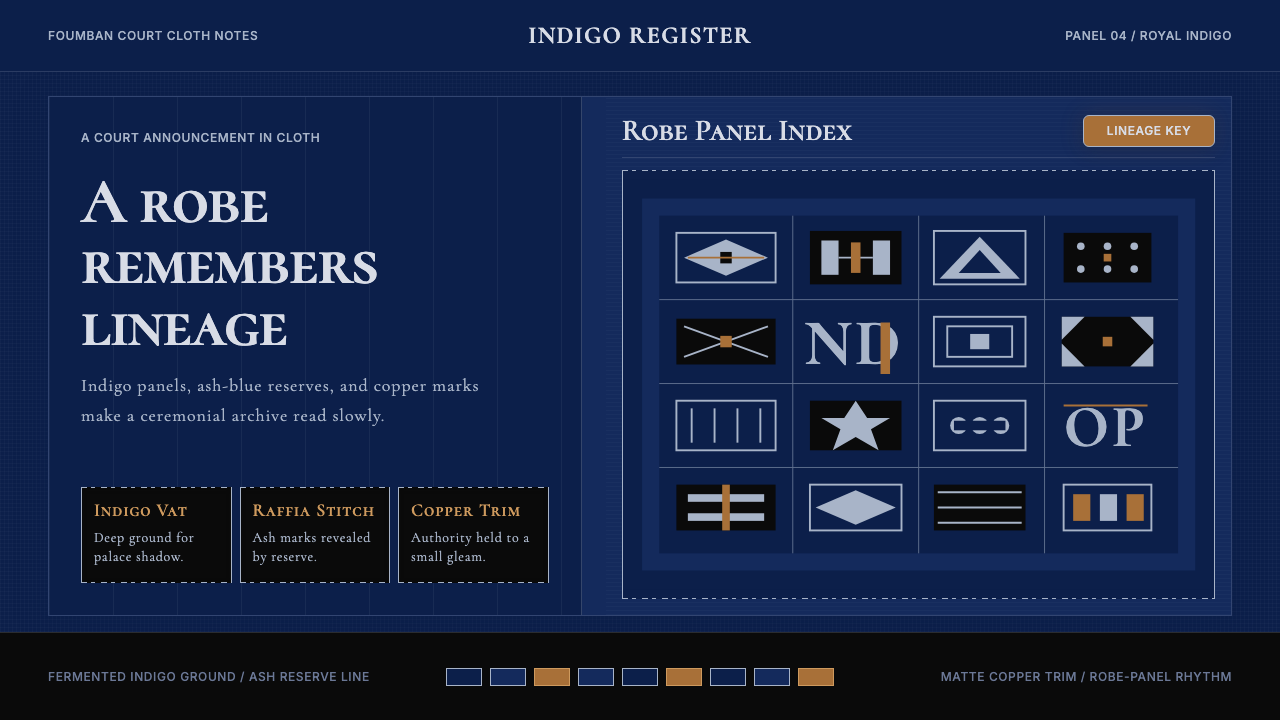 Cameroonian Ndop Royal IndigoReads like court cloth. Indigo panels, ash stitch grids, and matte copper kee…
 Absinthe Art Nouveau Green (1875)Ornate and verdant. Chartreuse field, gold filigree, vine-script type, and lo…
 Argentine Bandoneón 1900 (Tango)Gaslit tango luxury. Midnight velvet, brass fileteado, and pearl-button geome…
 Cairo Downtown Art DecoStone-real glamour. Mauve stucco, dulled gold rules, and verdigris Deco geome…
 Hindu Pantheon Bazaar PrintDevotional calendar art, edge to edge. Gold halos and garland borders on baza…
 Lebanese Art Deco (Beirut)Cosmopolitan warmth. Cormorant friezes, gold hairlines, terracotta-pistachio…