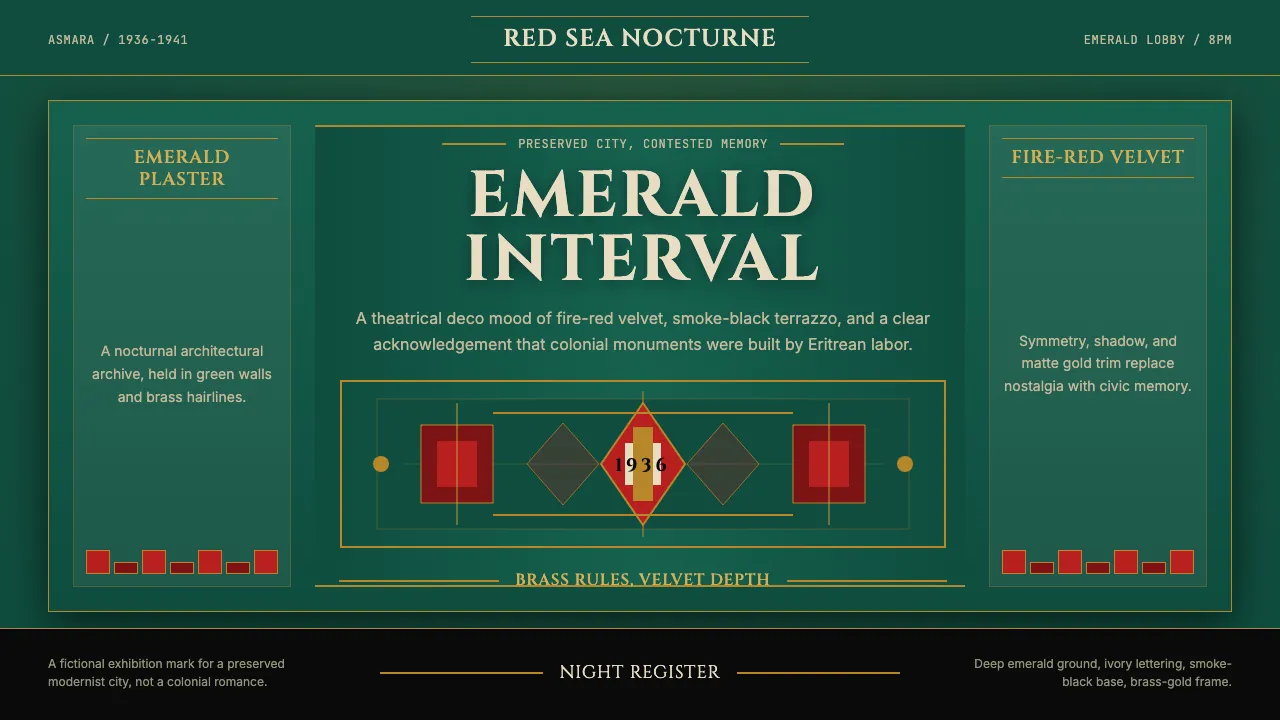
About Eritrean Asmara Art Deco Cinema (1936)
Between 1936 and 1941, Italian architects built a concentrated cluster of Modernist and Art Deco buildings in Asmara — Cinema Impero, Fiat Tagliero, Cinema Roma — creating an unlikely architectural time capsule on colonized land. Post-independence isolation preserved the city almost intact until UNESCO listed it in 2017.
This design system channels the theatrical interior of Cinema Impero at evening: deep emerald walls, fire-red velvet upholstery, smoke-black terrazzo, and brass-gold sconce light. It honors the buildings without romanticizing the regime that commissioned them.
Learn more about the Eritrean Asmara Art Deco Cinema (1936) style
- Origin
- Asmara, Eritrea
- Era
- 1936–1941 Italian colonial construction; UNESCO World Heritage 2017
- Key figures
- Mario Messina · Giuseppe Pettazzi · Bruno Sclafani · Edoardo Cavagnari
- Movements
- Italian Razionalismo · Africa Orientale Italiana architecture · Asmara preservation movement
Eritrean Asmara Art Deco Cinema (1936) design spec
Colors
Typography
The other 11 sections — buttons, cards, spacing, motion, techniques and more — open once you unlock. Download the DESIGN.md or send it to your AI in one click. Unlock once, yours forever.
Sign up nowStyles similar to Eritrean Asmara Art Deco Cinema (1936)
Also inspired by architecture & places, with a close feel.
 Shalimar Mughal Pietra DuraA paradise garden cut in stone. Emerald char-bagh ground inlaid with lapis, coral, and gold.
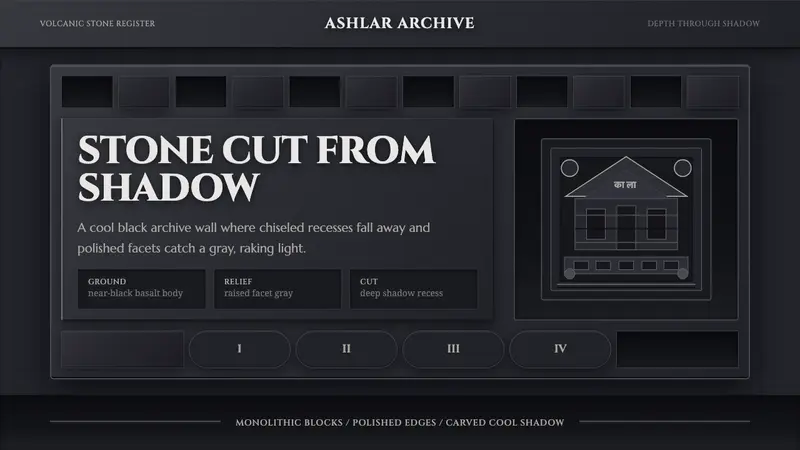 Deccan Basalt TempleMonumental shadow, carved. Near-black basalt, Cinzel capitals, and relief grids catch gray light.
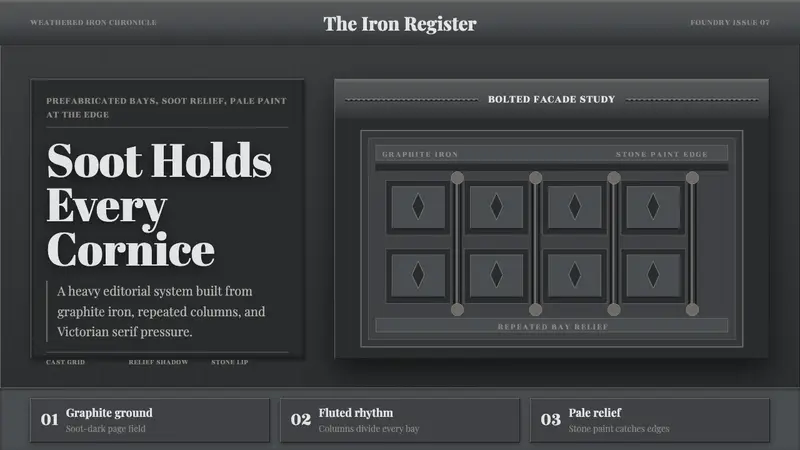 Cast Iron SoHo FacadesIron remembers the city. Graphite bays, Didone type, and pale stone-paint edges cast relief.
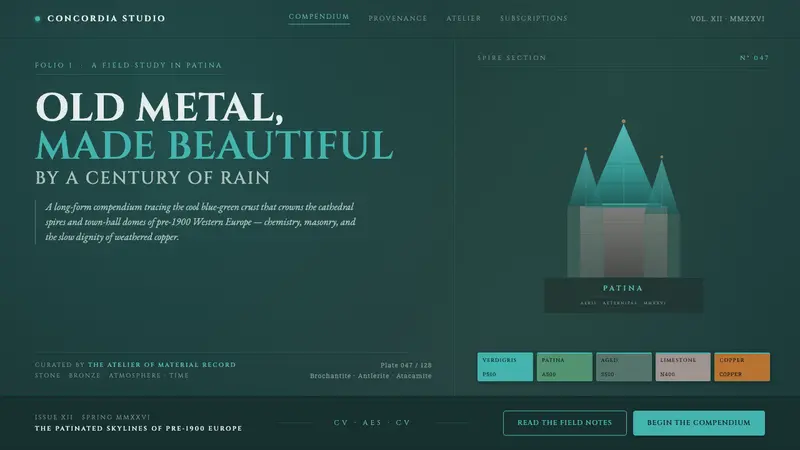 Verdigris Copper RoofOld metal made beautiful by decay. Cool cyan-green patina on dark teal, with Cinzel capitals carved.