What is Tiffany Stained Glass?
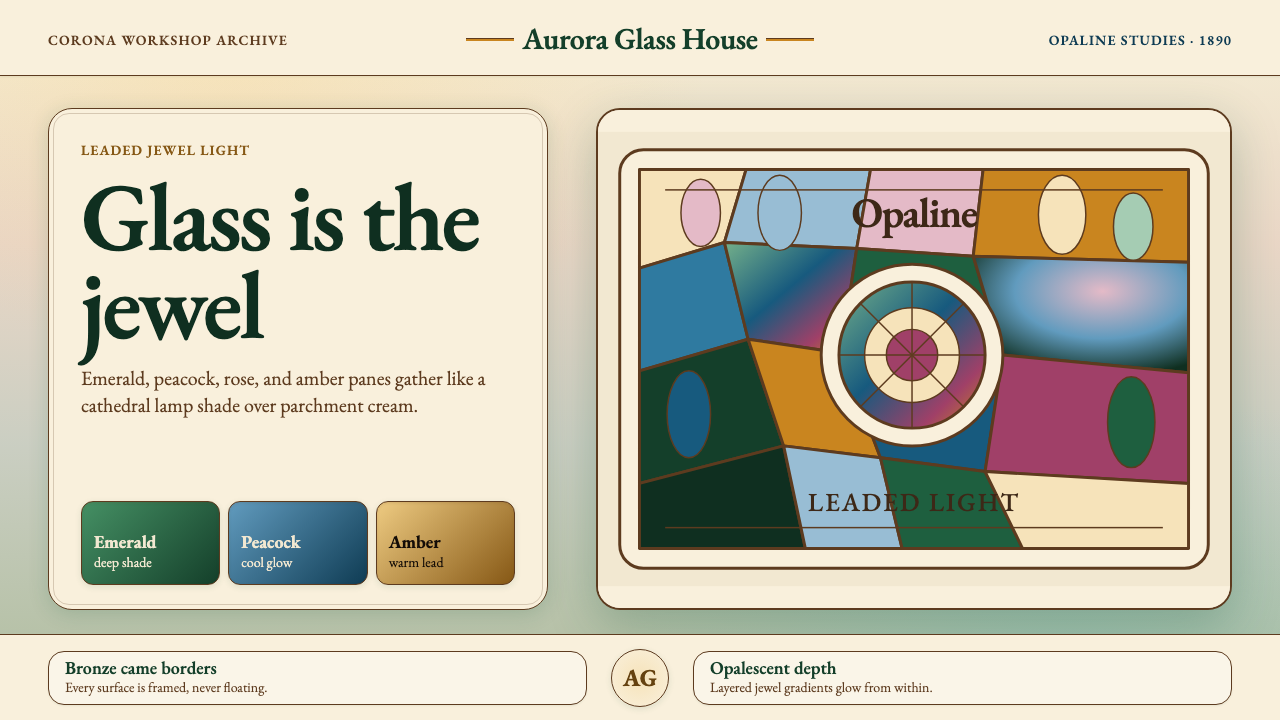
Jewel-saturated glass set in bronze: Tiffany's studios transformed American interiors with color that seems to generate its own light.
Tiffany Stained Glass in brief
Tiffany Stained Glass describes the visual language that emerged from Louis Comfort Tiffany's New York studios between the 1880s and 1920s — a system of jewel-saturated color, sinuous organic line, and iridescent surface that became the definitive American expression of Art Nouveau. The style is immediately recognizable: deep emerald greens, peacock blues, amber golds, and rose-violet tones arranged in irregular, nature-derived compositions framed by delicate bronze lead-came borders, all set against a ground of warm parchment cream.
What makes the style distinctive is not simply its palette but the quality of light it implies. Tiffany's Favrile glass — named from the archaic English word for 'handmade' — was manufactured by introducing metallic oxides directly into molten glass, producing an iridescent, opalescent surface that shifts in response to changing light. In two-dimensional design, this luminous materiality is evoked through layered translucent tones and a sense of color emanating from within rather than sitting on top. The effect is warmth without harshness: rich color that reads as organic, not saturated.
The design vocabulary draws from botanical and entomological observation: wisteria blossoms, dragonfly wings, peacock feathers, lily pads, and peony blooms are recurring motifs, rendered not as literal illustration but as abstracted organic geometry. Outlines are fluid rather than hard, and compositions tend toward radial or bilateral symmetry while retaining a handcrafted irregularity. Together these qualities produce a style that is simultaneously decorative and structural — ornament is not applied to a surface but is inseparable from the object's form.

Where does Tiffany Stained Glass come from?
The story of Tiffany Stained Glass begins not with a single workshop but with a confluence of cultural pressures unique to Gilded Age America. By the 1870s, the newly wealthy merchant and industrial families of New York, Boston, and Chicago were building mansions that needed to communicate status through interior decoration, yet American craft traditions capable of producing the elaborate decorative programs of European aristocratic interiors barely existed. Louis Comfort Tiffany — son of Charles Lewis Tiffany, founder of the eponymous jewelry house — recognized this vacuum. Trained as a painter and deeply influenced by travels in North Africa and Europe, he turned to decorative arts with the conviction that the applied arts could be elevated to the condition of fine art.
Tiffany founded Tiffany Glass and Decorating Company in 1885, consolidating earlier ventures, and established manufacturing operations at Corona, Long Island, where glassblowers and cutters could produce the iridescent Favrile glass that became the studio's signature material. The Corona workshop was staffed largely by immigrant craftspeople whose European guild knowledge of glassmaking was absorbed and redirected toward the studio's aesthetic ambitions. Early commissions included ecclesiastical windows for Episcopal and Presbyterian churches, as well as interior design projects for prominent clients. The 1893 World's Columbian Exposition in Chicago provided a transformative moment of public exposure: Tiffany's Byzantine chapel installation, featuring a complete interior environment of mosaic and leaded glass, was seen by millions and established the studio's international reputation.
Central to the studio's creative identity — though long obscured by the Tiffany name — was Clara Driscoll, who joined as a designer in 1888 and eventually led the women's design department. Driscoll was responsible for many of the studio's most celebrated lamp designs, including the wisteria, dragonfly, peony, and poppy bases. The so-called 'Tiffany Girls' — the female designers and cutters at Corona — brought botanical precision and delicate chromatic judgment to the translation of Louis Tiffany's broader design intentions into executed glass. Letters discovered at the New York Historical Society in the early 2000s confirmed Driscoll's authorship of designs long attributed solely to Louis Tiffany, prompting a significant reassessment of the studio's creative history.
Other significant figures include Frederick Wilson, who designed many of the studio's largest ecclesiastical windows, and Agnes Northrop, a botanist-trained designer whose landscape windows — panoramic compositions of trees, meadows, and skies — were among the most technically demanding works the studio produced. The studio's peak years ran roughly from 1893 to 1920, coinciding with the height of the Aesthetic Movement's influence in America. After the First World War, changing tastes — particularly the rising influence of Art Deco and stripped Modernism — eroded the market for elaborate decorative glass. Tiffany Studios filed for bankruptcy in 1933, and Louis Comfort Tiffany died the same year, closing the original chapter of this visual tradition.
What defines the Tiffany Stained Glass look?
Color and Light
The palette centers on jewel tones that evoke the quality of transmitted rather than reflected light: emerald green, peacock blue, amber gold, rose violet, and deep ruby, all set against a warm parchment cream or ivory ground. These hues are layered and modulated rather than used flat — the visual impression is of color glowing from within, shifting subtly across a composition as light conditions change. Iridescent and opalescent passages recall the lustrous surface of Favrile glass, where metallic shimmer mingles with translucent depth.
Organic Line and Form
Contours in Tiffany-derived work are sinuous and botanically informed rather than geometric or angular. Stems curve and branch, petals overlap in irregular sequences, and wing-veins trace asymmetric paths across panels. The lead-came tradition that physically separates panes of glass in a window becomes, in two-dimensional design, a network of delicate dark outlines that both define and connect individual color areas. These lines are never mechanical — they vary in width and carry the expressive weight of hand-drawing.
Nature Motifs as Structure
Botanical and entomological subjects — wisteria, dragonflies, water lilies, peonies, peacock feathers — are not decorative additions to an otherwise abstract composition but the primary structural vocabulary. Wisteria cascades define a radial grid; dragonfly wings become geometric panels; peacock-tail ocelli serve as focal points. The motifs are abstracted to their essential geometry — a lily pad is a near-circle, a wisteria cluster is a dense vertical mass — without losing their organic identity.
Bronze Lead-Came Borders
One of the most immediately identifiable features of the style is the use of bronze-toned linear borders as both structural and decorative elements. In stained glass, lead came physically holds panes together; in the derived design language, analogous dark metallic lines frame panels, separate content zones, and delineate decorative cartouches. These borders are not uniform rules — they swell at joints, taper along straight runs, and gather into knots at intersections, preserving the hand-worked quality of the original craft.
Layered Translucency
The signature luminosity of Favrile glass — the sense that color inhabits depth rather than coating a surface — is achieved in two-dimensional work through layered, semi-transparent color passages that build gradually toward richer hues. Highlight areas are not simply lighter versions of a base color but carry a distinct warm or cool cast, evoking the way light shifts as it passes through varying glass densities. Shadows within compositions are warm rather than neutral or cold, often tending toward amber or deep violet.
Asymmetric Radial Composition
Tiffany compositions are rarely rigidly symmetrical — even in the large circular lamp shades where radial geometry is inherent, individual panels introduce controlled variation that keeps the overall effect handcrafted rather than mechanical. A wisteria canopy distributes its blossoms unevenly; a dragonfly grouping staggers its figures across a curved field. This productive asymmetry within a broadly symmetric or radial frame is one of the style's most distinctive structural qualities, giving compositions a sense of organic growth rather than manufactured repetition.
Crafted Materiality
The Tiffany visual tradition is grounded in admiration for materials and the marks of their making. Texture is not simulated but suggested: the irregular surface of handblown glass, the grain of patinated bronze, the variation in color saturation across a single pane of glass. In applied design, this translates to a deliberate avoidance of machine-perfect uniformity — slight variations in line weight, tonal passages that shift gradually across a field, and decorative elements that are visibly shaped by hand. The style values warmth, depth, and the evidence of skilled making.

Who shaped Tiffany Stained Glass?
The son of Charles Lewis Tiffany, Louis Comfort Tiffany trained as a painter before turning to the decorative arts in the early 1870s. Travels in Morocco, Egypt, and Venice convinced him that color and materiality were the primary media of artistic experience, and he brought this conviction to his glass work. His most significant technical contribution was the development, with glassblower Arthur Nash, of Favrile glass — iridescent, variegated, and internally colored through metallic oxide fusion. As the studio's creative director and public face, he received the design credits for work that was substantially realized by his team, and his singular artistic vision nonetheless gave the studio a coherent aesthetic identity that made Tiffany synonymous with American decorative luxury.
Clara Driscoll joined Tiffany's design studio in 1888 and served as head of the women's glass-cutting department at Corona. Letters discovered in 2005 at the New York Historical Society established that she was the primary designer behind some of the studio's most celebrated works, including the wisteria lamp, the dragonfly lamp, and the peony lamp. Driscoll worked within a studio system that assigned public credit to Louis Tiffany while her own contributions went largely unattributed during her lifetime. Her botanical precision and sensitivity to color modulation were foundational to the studio's reputation for naturalistic richness, and the reassessment of her role has substantially reshaped how design historians understand the creative process behind Tiffany's glass.
Agnes Northrop was a designer at Tiffany Studios whose training in botany gave her an unusually systematic approach to the depiction of plant forms and natural landscapes. She is best known for the studio's large landscape windows — panoramic compositions of trees, meadows, water, and sky that brought the traditions of Hudson River School painting into the medium of leaded glass. These windows required extraordinary technical control over color gradation and tonal transition across dozens of individual glass panes. Northrop's work represents the studio's highest level of pictorial ambition and demonstrates that the Tiffany visual language extended well beyond the decorative lamp into architectural integration at the scale of ecclesiastical and memorial commissions.
Frederick Wilson served as the principal designer of Tiffany Studios' large ecclesiastical windows throughout the studio's peak period. His commissions included monumental memorial windows for major American churches and universities, works that required integrating figurative subjects — angels, saints, biblical narratives — into the studio's signature jewel-toned glass vocabulary. Wilson's contribution was essentially that of a bridge between traditional European stained-glass iconography and the American Art Nouveau aesthetic that Tiffany had developed: his windows are recognizably Tiffany in their color and materiality while remaining legible as devotional images within established religious traditions.
How do you use Tiffany Stained Glass today?
Tiffany Stained Glass translates most naturally to contexts where richness, warmth, and a sense of careful craftsmanship are primary values — luxury product presentations, cultural institutions, editorial design with a heritage or botanical dimension, and any setting where the audience is expected to dwell on visual detail rather than scan for information rapidly. The style demands slow looking, which makes it poorly suited to high-velocity information environments and well suited to contexts designed for contemplative engagement.
For presentation slides, the style works powerfully as a cover aesthetic: a jewel-toned botanical motif occupying a large portion of the field, a parchment cream ground, and serif type in bronze or deep teal establishes an atmosphere of refined materiality before any content appears. Content slides should exercise restraint relative to the cover — a single tonal accent color, generous spacing, and type set in a classical serif at comfortable sizes. Data visualizations in this style work best when chart elements adopt the jewel-tone palette and are bounded by thin bronze-inflected lines rather than the hard grid rules of more analytical styles. The visual narrative should feel hand-assembled, not templated.
For web interfaces, the Tiffany palette is most at home on pricing pages, feature showcases, or brand landing pages for luxury goods, cultural venues, and artisan products. A useful approach is to use the parchment cream as a dominant background tone, introduce emerald or peacock blue as the primary interactive color, and reserve amber gold for calls to action or premium-tier markers. Navigation and body text should remain in warm near-black rather than pure black, which reads as too stark against the warm background. Card components benefit from thin border treatments rather than shadows; any shadow that does appear should be warm-toned and soft rather than the hard-edged offset shadows of starker styles.
For editorial and marketing work, the style accommodates long-form reading layouts well, since the parchment ground and warm typography create a reading experience that is comfortable over extended periods. Section dividers built from botanical ornament or bronze-ruled lines replace the stark horizontal rules of more geometric styles. Pull quotes and annotations can adopt teal or deep violet as accent colors, reinforcing the jewel-tone range without overwhelming body text. For marketing one-pagers or event programs, full-bleed botanical illustrations at reduced opacity provide rich visual texture as backgrounds without competing with foreground content.
A common mistake when applying this style is treating all jewel tones as equally available throughout a composition. In authentic Tiffany glass, each panel operates within a localized color logic — areas of the composition are cool or warm, luminous or shadowed, but the entire surface does not carry every color simultaneously at full intensity. Applied design should select one or two tones as dominant and use the others as subordinate accents, allowing the composition to breathe and creating the sense of tonal variation that is central to the style's luminous quality. Overloading a layout with multiple saturated jewel tones simultaneously produces visual noise rather than the jeweled glow the style promises.

Tiffany Stained Glass — FAQ
Is Tiffany Stained Glass the same as Art Nouveau?
Tiffany Stained Glass is a specific American expression of Art Nouveau — it shares the movement's commitment to organic form, nature-derived motifs, and the elevation of applied crafts to fine-art status, but it has a distinct material identity rooted in glass, light, and bronze that sets it apart from European Art Nouveau traditions. French Art Nouveau, as practiced by designers like Hector Guimard or Émile Gallé, tends toward more sinuous architectural line and a broader palette of organic materials. Tiffany's version is more luminous, more color-saturated, and more distinctly American in its scale and ambition — the studio produced lamp shades for domestic interiors and monumental windows for cathedrals in the same idiom, a breadth that has no close European parallel.
Can this style work in dark-mode or dark-background layouts?
The canonical Tiffany palette is light-ground — the parchment cream or ivory background is integral to the style's warmth and the illusion of transmitted light. A dark inversion is possible but requires care. Against a very deep background, jewel tones can work as luminous accents rather than dominant fields, and the effect can evoke the way stained glass appears at night when viewed from outside — color as pure light against darkness. However, the bronze lead-came borders and the layered tonal complexity that create the style's characteristic depth tend to collapse in dark-mode rendering, reducing the composition to flatter, higher-contrast color spots. Dark-ground Tiffany-derived work functions best when it treats the style as an illuminated detail rather than a comprehensive environment.
How does Tiffany Stained Glass differ from other Victorian decorative styles?
Victorian decorative styles are broad and varied — they include Gothic Revival, Rococo Revival, Renaissance Revival, the Aesthetic Movement, and many others. Tiffany sits within the Aesthetic Movement strand, which valued art for art's sake and drew heavily from Japanese and Near Eastern design. What distinguishes the Tiffany style specifically is its material particularity: the look is inseparable from glass and its optical properties. Where other Victorian decorative styles used pattern, textile, and surface ornament, Tiffany's language is built on color transmitted through a semi-transparent medium. The result is warmer, more luminous, and less pattern-dependent than most Victorian alternatives. It also lacks the historical-revival character of many Victorian styles — Tiffany was inventing a new visual vocabulary, not restoring a historical one.
What kinds of typography pair well with this style?
The style pairs best with typefaces that carry visible calligraphic heritage — high-contrast serifs where thick and thin strokes alternate fluidly, or display serifs with delicate bracketed feet that echo the tapered quality of the bronze lead lines. Display settings work well when letterforms are set generously, with ample spacing between characters, evoking the unhurried quality of the style's craft origins. Heavy geometric sans-serifs and blunt slab-serifs tend to clash with the organic warmth of the palette and motifs. Script faces can be appropriate for accent use — short titles, pull quotes, event names — but should be used sparingly. Body text is best set in a readable transitional or old-style serif at a warm near-black, maintaining legibility without competing with the decorative richness of surrounding visual elements.
Is this style appropriate for digital products, or is it primarily suited to print?
The style is fully applicable to digital contexts, though it requires different calibration than it does in print. On screen, the parchment cream background may need to be slightly lighter to compensate for the additive nature of screen illumination — what reads as warm and creamy on a backlit display would appear yellowed in print. The jewel tones, which are rich but not maximally saturated in print, may benefit from slight desaturation on high-gamut displays to preserve the sense of depth and warmth rather than reading as garish. Interactive states — hover, active, focus — can be expressed through subtle luminance shifts rather than high-contrast color changes, preserving the style's atmosphere. The style is particularly well suited to editorial web experiences, cultural institution sites, and luxury brand digital touchpoints where dwell time is high and visual richness is a virtue rather than a liability.
Related design styles
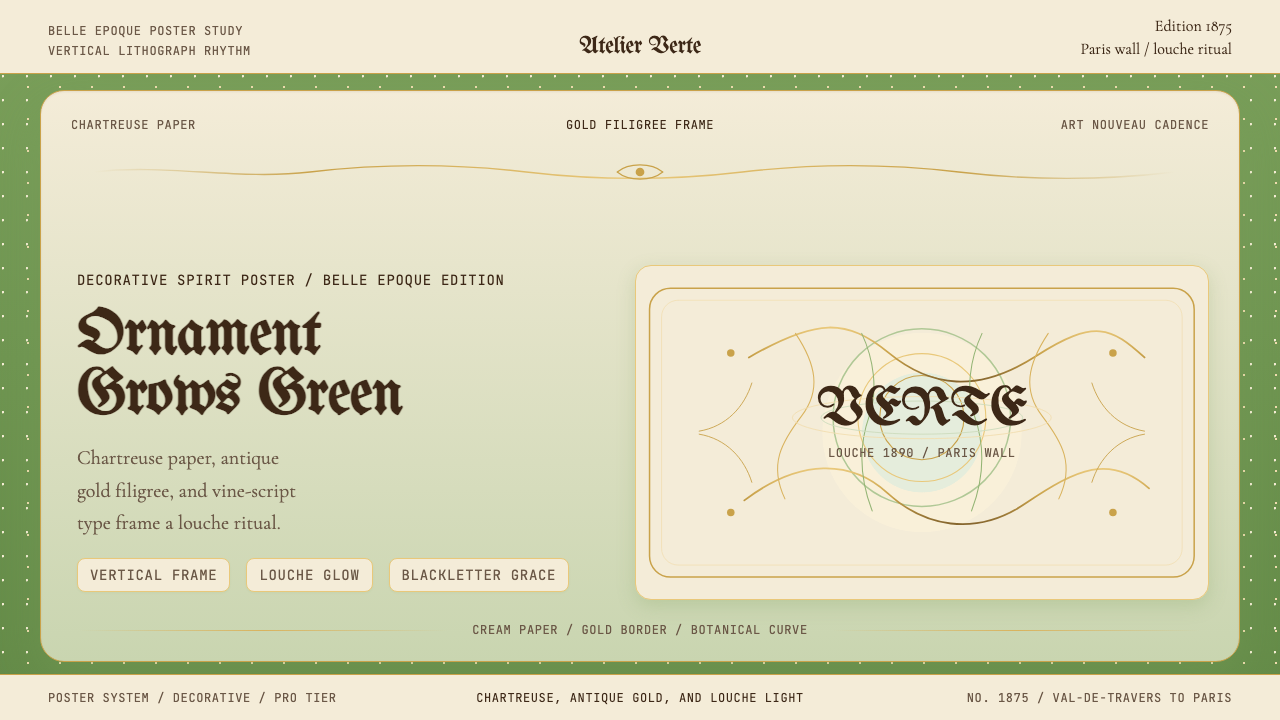 Absinthe Art Nouveau Green (1875)Ornate and verdant. Chartreuse field, gold filigree, vine-script type, and lo…
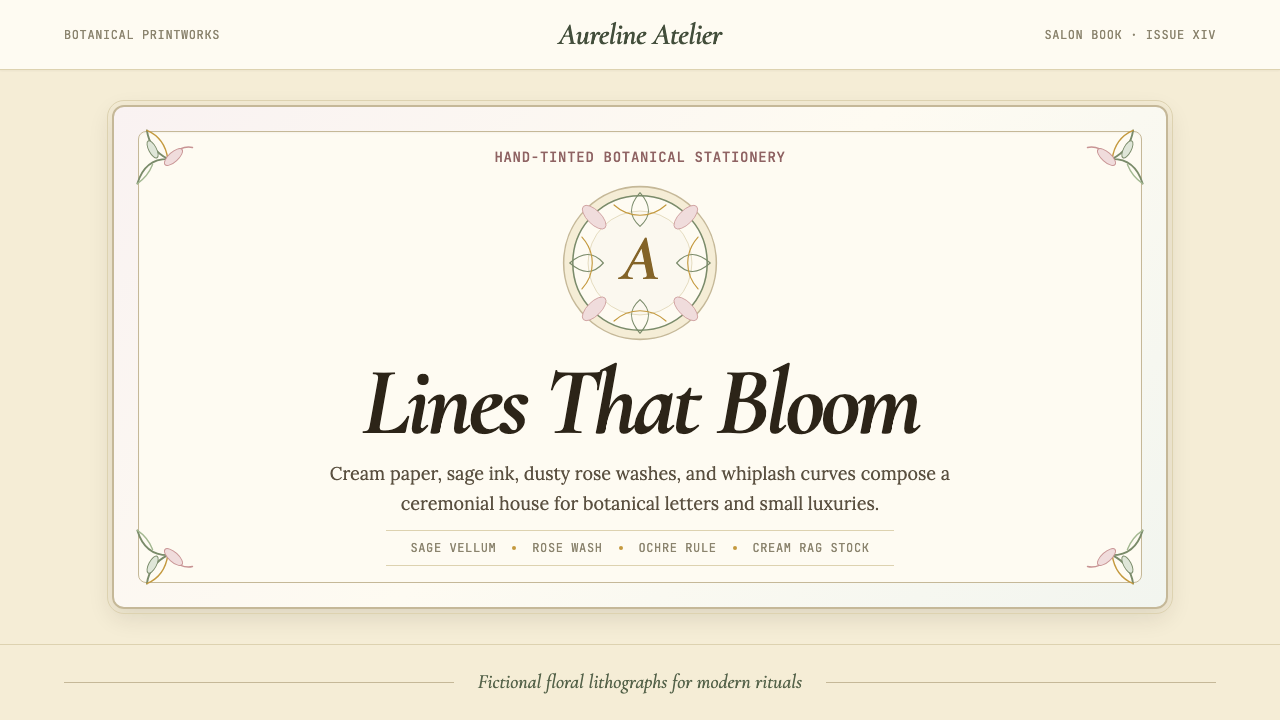 Art Nouveau (Mucha)Mucha's whiplash arabesques. Botanical halos, muted lithograph palette, no ma…
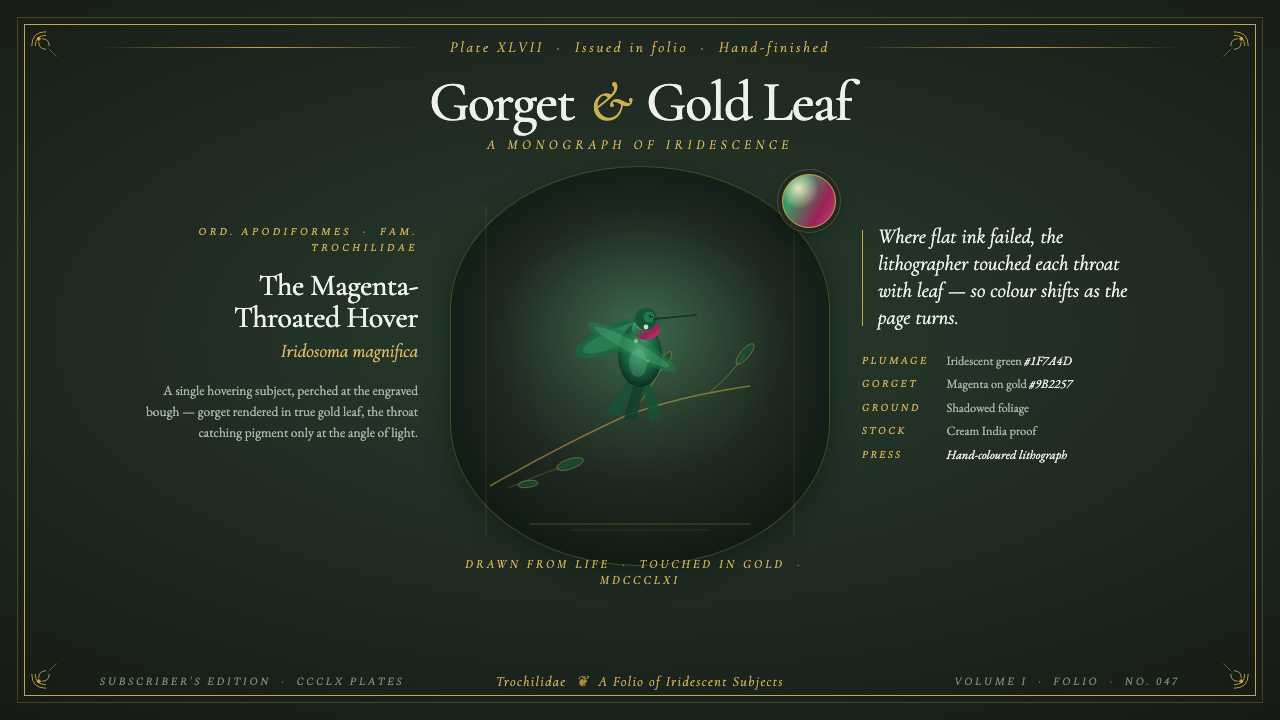 Gould Hummingbird PlateVictorian ornithology, jewel-grade. Green plumage on shadowed foliage, gorget…
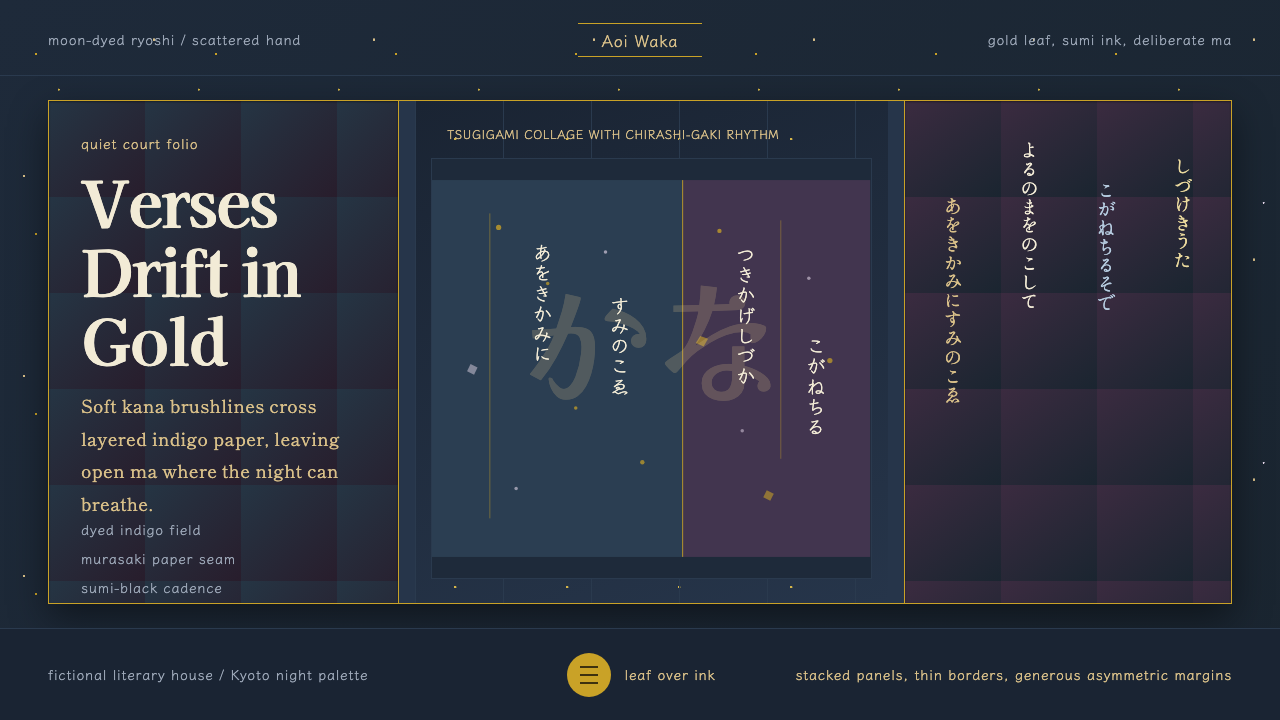 Kana Waka CalligraphyQuiet luxury in ink. Indigo ryoshi, Kaisei serif, scattered kana, and gold fl…
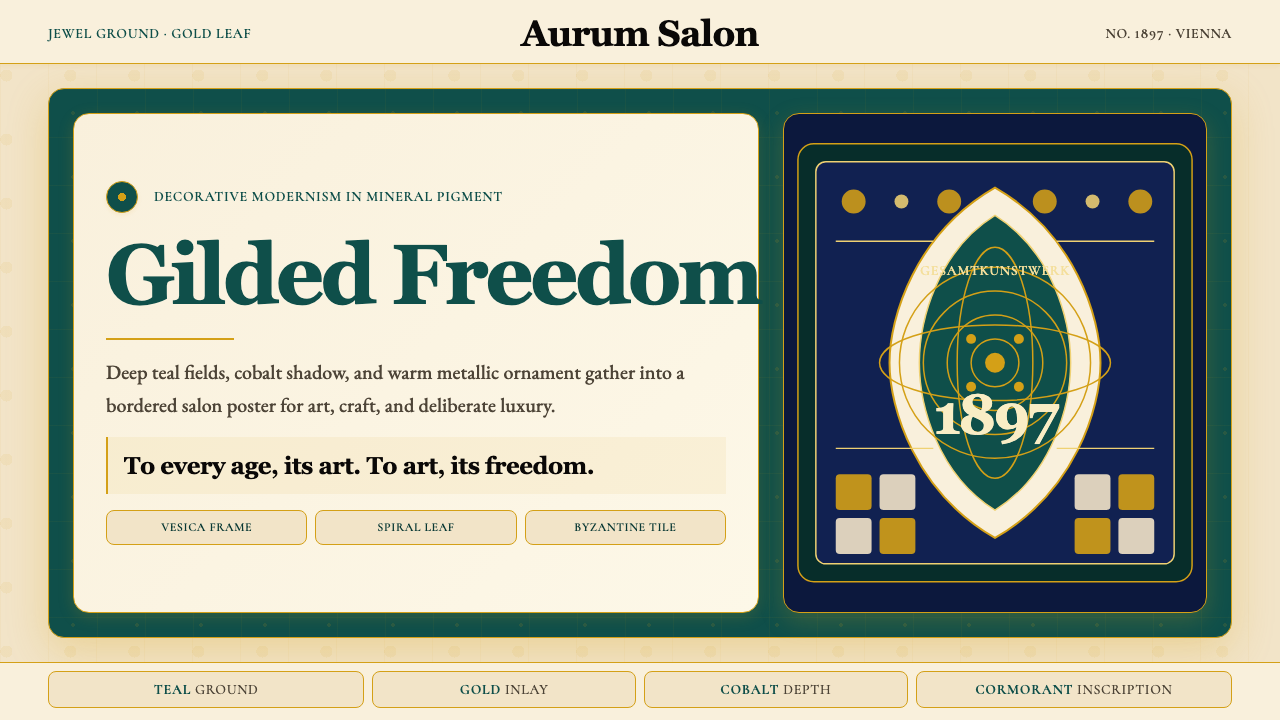 Wiener Secession (Klimt)Opulence made modern. Teal grounds, gold inlay, vesica frames and Cormorant d…
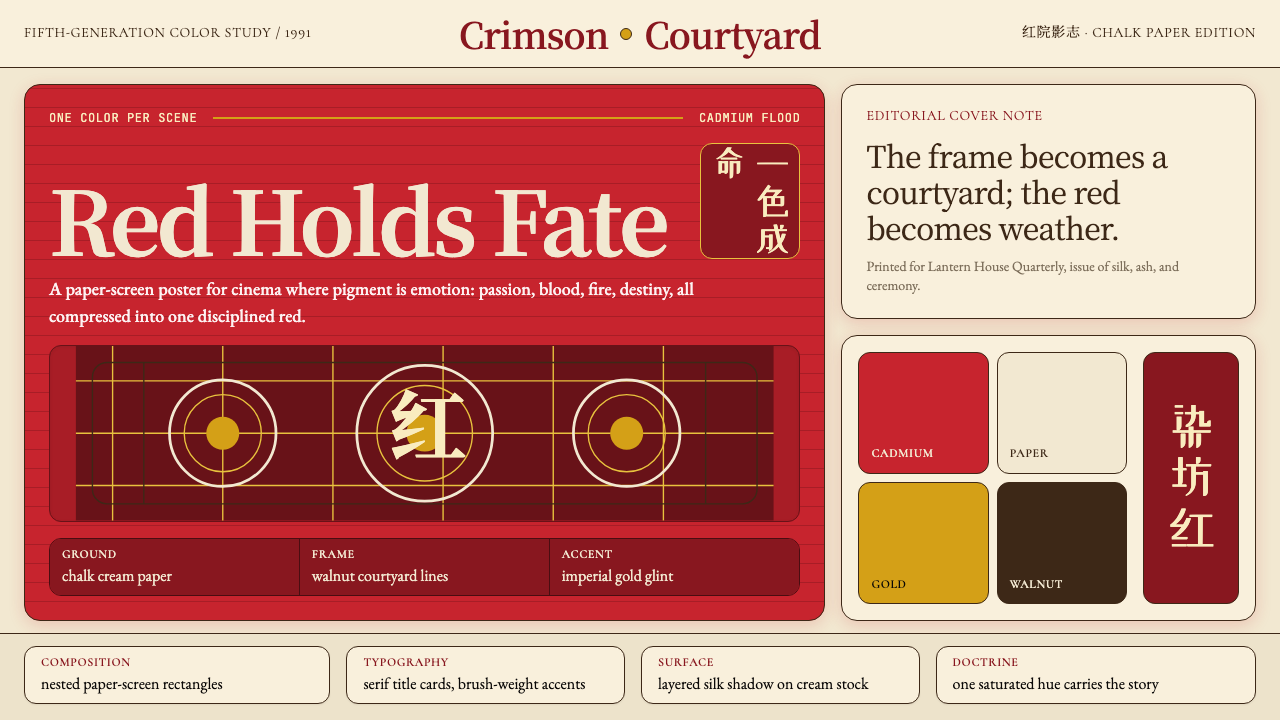 Zhang Yimou Cinema RedRed carries fate. Cadmium flood, chalk paper, walnut grids make cinema feel c…