What is Zhang Yimou Cinema Red?
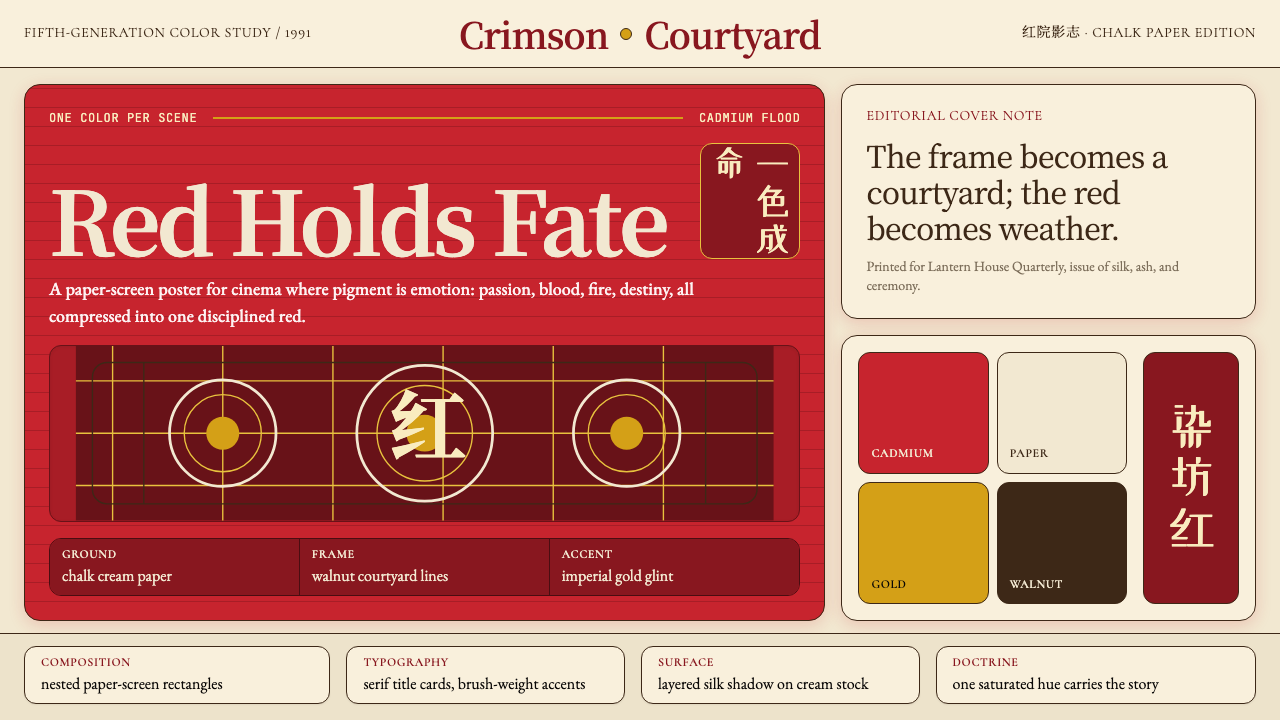
Zhang Yimou turned a single red into an entire emotional language — passion, fate, and political destiny compressed into one saturated hue that floods every frame like dye poured into still water.
Zhang Yimou Cinema Red in brief
Zhang Yimou Cinema Red is a design aesthetic derived from the chromatic discipline of China's Fifth Generation cinema — the extraordinary burst of filmmaking that emerged from the Beijing Film Academy class of 1982, whose graduates had survived the Cultural Revolution and returned to the countryside as sent-down youth before returning to study. Zhang Yimou, who served as cinematographer on early Fifth Generation films before directing his own, developed an unmistakable visual grammar built on a dominant, ceremonial red set against warm parchment grounds, deep walnut-brown architectural frames, and restrained imperial gold accents.
The aesthetic is not about abundance of color. It is about the intensity of one. Where most visual systems balance multiple hues across a composition, Cinema Red concentrates its emotional charge into a single oversaturated field — a courtyard hung with vermilion lanterns, a vat of scarlet dye, a bridal sedan chair lacquered to a blinding sheen. Everything else in the frame — cream paper walls, dark timber lattice, raked earth — exists to make that red feel inevitable. The design system translates this cinematic discipline into interface and layout work: a chalk-cream or warm parchment ground, structural frames in deep walnut brown, one dominant red that commands the primary visual weight of any composition.
What distinguishes this system from generic 'red-and-gold' oriental pastiche is its emotional logic. The red in Zhang Yimou's films is never decorative. It is fate made visible — it signals desire, danger, ritual, and the crushing weight of social expectation. Applied faithfully, Cinema Red produces compositions that feel ceremonial and weighty rather than festive or merely colorful. The atmosphere is closer to incense smoke and lacquered wood than to celebration banners.

Where does Zhang Yimou Cinema Red come from?
The Fifth Generation of Chinese filmmakers emerged from an almost impossible set of historical circumstances. The Beijing Film Academy, closed during the Cultural Revolution (1966–1976), reopened in 1978 and admitted its first post-revolutionary class — a cohort of students already in their mid-to-late twenties, shaped by years of rural labor, political upheaval, and a hunger for visual art they had been denied. Zhang Yimou, born in 1950 in Xi'an, Shaanxi province, had worked in a cotton mill and later as a farm laborer before gaining admission. He would go on to study cinematography, not directing — and his later films bear the mark of a director who thinks first in images.
The visual revolution these filmmakers launched was inseparable from the literature they adapted. Zhang Yimou's early films drew on the work of Chinese writers exploring rural life, social tradition, and the weight of history: Mo Yan's novel provided the source for Red Sorghum (1987), Su Tong's novella for Raise the Red Lantern (1991), and Yu Hua's fiction for To Live (1994). These were stories set in village courtyards, dye works, and opera houses — environments saturated with the material culture of pre-modern China. The visual palette was already embedded in the source material; Zhang Yimou and his collaborators made it overwhelming.
Red Sorghum (1987) established the template. Cinematographer Gu Changwei and Zhang Yimou flooded the frame with a red that felt biological — the crimson of sorghum wine, of blood spilled in Japanese occupation, of bridal processions crossing open fields. The color was not realistic in the photographic sense; it was heightened, pushed toward the mythological. Ju Dou (1990) transferred this intensity to the interior of a dye works — bolts of crimson-dyed cloth hanging in columns, the dye vat itself a turbulent red field from which characters emerged stained. Raise the Red Lantern (1991) refined the palette toward ritual: lanterns of a specific, repeated red punctuating the grey-blue architecture of a Shanxi merchant compound, their lighting and extinguishing the only event that matters in the lives of the women inside.
The international reception of these films in the early 1990s — including Oscar nominations, Venice and Berlin festival prizes — brought global attention to their visual style at the exact moment that digital design tools were first enabling designers outside film to work at similar scales of color saturation and compositional control. The aesthetic entered design consciousness as a named reference point: rich, ceremonial, emotionally loaded, and specifically Chinese in its material vocabulary — lacquer, paper, timber, dye — without being stereotypically decorative. Zhang Yimou's later work, including Hero (2002) and House of Flying Daggers (2004), extended the system into wuxia spectacle with even greater chromatic ambition, confirming the style's range and establishing its continued relevance into the early twenty-first century.
What defines the Zhang Yimou Cinema Red look?
Dominant Red Field
The defining move of this system is the use of a single, deeply saturated red as the primary organizational weight in a composition. This is not a red used in balance with other colors; it is a red that floods — covering large surface areas, commanding attention before any other element registers. The specific quality of the red is warm and slightly orange-shifted, closer to vermilion or lacquer than to crimson or rose. It reads as physical, material, even ceremonial — the color of dye-vats and lantern silk rather than of alert badges or notification dots.
Chalk-Cream and Parchment Ground
The ground against which Cinema Red operates is never pure white. It is a warm, slightly muted cream — the color of unsized paper, of whitewashed courtyard walls under afternoon light, of handmade cloth before dyeing. This warmth in the background is essential: it gives the dominant red a surface to push against that does not fight it with equal brightness, allowing the red to read as luminous rather than garish. Cool white or grey grounds would undermine the temperature logic entirely.
Walnut-Brown Structural Frame
The architectural elements in Zhang Yimou's visual world — courtyard gates, lattice screens, timber beams, carved doorframes — are consistently rendered in a deep, warm brown that reads as walnut, aged teak, or lacquered rosewood. In design application, this tone functions as the structural skeleton: navigation bars, dividers, border elements, and framing devices. It is dark enough to establish hierarchy over the parchment ground but warm enough not to create the cold authority of pure black. The grain and texture of wood are implied, not simulated — the tone carries the reference without requiring a photographic surface.
Imperial Gold as Accent
Gold in this system is deployed with extreme restraint — a hairline border on a ceremonial element, a single character rendered in gilt, the edge of a lantern frame. It never competes with the dominant red for visual weight; its role is to elevate and formalize. The quality of the gold is warm, slightly muted, and matte rather than metallic-bright — closer to gilt paper or lacquered gold leaf than to polished brass or chrome. When gold appears, it signals that something in the composition is being treated as precious, rare, or ritually significant.
Symmetry and Ceremonial Composition
Unlike the asymmetric dynamism of Bauhaus or Swiss International Style, Cinema Red leans into bilateral symmetry as a deliberate compositional choice. Symmetry in Chinese courtyard architecture is not neutral — it is a marker of order, ritual, and hierarchy. A centered composition with a dominant red element at the axis reads as a formal declaration. This does not mean all layouts must be rigidly symmetrical; but when Cinema Red is applied authentically, the organizing logic tends toward centeredness, balance, and the kind of weight that makes a viewer pause rather than scan.
Texture Through Restraint
The textures that matter in this system are not added — they are implied. The warmth of the ground suggests paper or plaster; the depth of the walnut brown suggests grain; the richness of the red suggests dye that has penetrated a surface rather than been painted over it. In practice, this means avoiding high-gloss, high-contrast, or digitally generated texture effects. Surfaces should read as aged and material without requiring photographic rendering. A slight warmth in tonal values, a slight desaturation in supporting tones, does more to evoke the physical world of Zhang Yimou's cinema than any applied texture overlay.
Emotional Gravity Over Decoration
The hardest principle to articulate and the easiest to violate: Cinema Red is an emotionally serious aesthetic. Every element in a composition should feel like it carries weight — purpose, history, or consequence. Decorative flourishes, playful micro-animations, gradient washes, or ironic visual references all break the system. This is an aesthetic that takes its own emotional register seriously. A layout built on Cinema Red principles should feel like it is making a statement, not performing one. The test is whether removing an element would leave the composition feeling incomplete, or merely lighter. If lighter, remove it.

Who shaped Zhang Yimou Cinema Red?
Born in Xi'an in 1950, Zhang Yimou trained as a cinematographer at the Beijing Film Academy — a background that made him one of the most visually deliberate directors of his generation. His first film as director, Red Sorghum (1987), won the Golden Bear at Berlin and announced his chromatic ambitions immediately. Over the following two decades he produced a string of films — Ju Dou, Raise the Red Lantern, The Story of Qiu Ju, To Live, Shanghai Triad, Hero, House of Flying Daggers — that systematically explored what saturated color, architectural space, and ritual could do as a formal vocabulary. He directed the opening and closing ceremonies of the 2008 Beijing Olympics, bringing the same ceremonial color logic to an audience of billions.
Gong Li became the central human presence in Zhang Yimou's chromatic world, appearing in Red Sorghum, Ju Dou, Raise the Red Lantern, The Story of Qiu Ju, To Live, and Shanghai Triad. Her roles consistently placed her in the tension between individual desire and social constraint — the same tension the red-and-parchment palette makes visible at a compositional level. She is not simply an actress associated with the style; her physical presence in the frame shaped decisions about color proportion, light temperature, and compositional weight in ways that influenced how the visual system was developed across multiple productions.
Mo Yan — born Guan Moye in 1955 in Shandong province, winner of the Nobel Prize in Literature in 2012 — provided Zhang Yimou with the source material for Red Sorghum through his 1986 novel Red Sorghum Clan. Mo Yan's prose is itself deeply chromatic: red appears throughout his Gaomi County fiction as the color of vitality, violence, and historical memory. The novel's sensory density — sorghum wine, blood, red earth, bridal procession — gave Zhang Yimou a literary mandate for the chromatic extremity of the film. Mo Yan's influence on the aesthetic is therefore not merely biographical but structural: the literary source established that red could carry narrative weight across an entire work.
Su Tong's 1990 novella Wives and Concubines provided the literary source for Raise the Red Lantern, the film in which Zhang Yimou's color system reached its most refined and architecturally integrated expression. Su Tong's story of the rituals of a 1920s merchant household — the lighting of lanterns to signal which concubine would receive the master that evening — gave the visual system its central organizing metaphor: red as the unit of power distribution, red as reward and deprivation, red as the only warmth available in an otherwise grey and cold world. The Shanxi merchant compound setting that director Zhang Yimou selected for the film (the Qiao Family Compound in Qi County) amplified Su Tong's architectural symbolism into something almost diagrammatic.
Gu Changwei served as director of photography on Red Sorghum (1987) and Ju Dou (1990), and it is largely his eye that translated Zhang Yimou's color intentions into the specific photographic language that defined the aesthetic's early years. Gu later went on to a distinguished directing career of his own (Peacock, 2005; Blind Mountain, 2007). His collaboration with Zhang Yimou in the late 1980s established the precise quality of light — warm, raking, from low angles — that gives the red in these films its material weight. The red in a Gu Changwei-lit frame looks like something you could touch.
How do you use Zhang Yimou Cinema Red today?
Cinema Red is one of the most emotionally charged design systems available — which means it is also one of the easiest to misapply. The discipline required is essentially about restraint: letting a single, dominant red carry the full weight of the composition while every other element serves a supporting role. Before applying this system, establish clearly what the red will mean in the context of the product. If the red is going to appear on interactive elements, alerts, and decorative accents simultaneously, the system will collapse into visual noise. Choose one register — ceremonial, structural, or hierarchical — and commit to it throughout.
For presentation slides, Cinema Red operates most powerfully when the cover slide is treated as a poster rather than a title card. A large field of the dominant red — occupying more than half the slide area — with a centered title in warm white or parchment, and the thinnest possible gold rule beneath it, creates the declarative quality that the system demands. Content slides should return to the parchment ground with walnut-brown structural elements — section headers, dividers, column rules — and reserve the dominant red for a single focal element per slide: a key statistic, a call-out quote, or a primary chart element. Data visualization in this system works best when the primary data series is rendered in the dominant red and all supporting series in deeply muted earth tones — the data hierarchy becomes legible through the same color logic that structures the rest of the composition.
For web interfaces, the system is best suited to contexts that benefit from weight and formality: premium product landing pages, cultural institution websites, high-end editorial platforms, and brand identity pages where the product aspires to a sense of history or ceremony. Dashboard and analytical tools can use Cinema Red, but should restrict the dominant red to a single tier of information — the most critical metric, the primary status indicator — rather than using it across multiple data dimensions. Navigation elements work well in deep walnut brown against parchment, with the dominant red reserved for the active state. Pricing pages can use the full red for a featured or recommended tier, creating the same logic of distinction that lantern lighting created in Raise the Red Lantern.
For editorial and marketing applications, Cinema Red's poster-like visual gravity makes it especially effective in contexts where a single, strong impression is more valuable than comprehensive information density. A campaign image with a dominant red field and minimal type — a date, a name, a single line — conveys the weight of an announcement rather than the busyness of advertising. Long-form editorial layouts can use the system more subtly: parchment grounds for body text columns, walnut-brown pull-quote borders, and a dominant red reserved for section openers or key featured images. Marketing materials that need to communicate prestige, heritage, or cultural authority will find that Cinema Red does the semantic work of those associations more efficiently than explicit claims in copy.
The most common mistake when applying Cinema Red is treating it as a 'red-and-gold' oriental decoration scheme and adding pattern, ornament, or figurative illustration derived from traditional Chinese visual culture — cloud motifs, dragon scales, lattice patterns used as backgrounds. Zhang Yimou's films contain these architectural elements, but they are always subordinated to the color logic, never equal participants in it. The second most common mistake is using too much gold — allowing gold to become a co-equal accent to red rather than a rare, elevating touch. When red and gold compete at similar visual weights, the result looks festive and commercial rather than ceremonial and weighty. A third mistake is failing to commit to the warmth of the ground: using a cool or neutral white instead of the warm parchment destroys the temperature relationships that make the dominant red feel luminous.

Zhang Yimou Cinema Red — FAQ
How is Cinema Red different from generic Chinese red or festive red palettes?
Generic Chinese red or festive red palettes typically pair red with bright gold, white, and black in roughly equal proportions, producing a result that reads as celebratory, auspicious, or commercial — New Year cards, restaurant branding, holiday packaging. Cinema Red is emotionally different: the red is dominant to the point of flooding, the gold is a rare and restrained accent rather than an equal partner, the ground is warm parchment rather than white or black, and the overall emotional register is grave and ceremonial rather than joyful. The reference is not festivals or celebrations; it is the slow, fateful rituals of courtyard life — lanterns being lit and extinguished, dye vats turning cloth a permanent color, processions crossing open fields. The weight of history, not the brightness of celebration, is what Cinema Red is designed to communicate.
Can Cinema Red work in a dark or night-mode interface?
A dark-mode variant is possible but requires fundamental restructuring rather than a simple color inversion. The warmth that is essential to Cinema Red — the relationship between the dominant red and the warm parchment ground — does not survive a flip to black backgrounds. On a near-black ground, the same red reads as aggressive and alert-like rather than ceremonial and weighty. The most successful dark-mode adaptation treats the background as a very deep, warm near-black with subtle brown undertones — the color of aged lacquer in shadow — rather than pure black or cool charcoal. Against this warm-dark ground, the dominant red can retain some of its material quality, and walnut-brown elements can be lightened slightly to maintain structural legibility. Gold accents read well against dark grounds and can be allowed slightly more presence than in the light-mode version.
Does the symmetry principle mean every layout must be centered and formal?
Not rigidly. The principle is that Cinema Red compositions should feel balanced and intentional rather than dynamically asymmetric. A layout that places a dominant red element to one side and balances it with substantial negative space on the other side can work within the system — the key is that the balance feels deliberate and weighty, not casual or reactive. What the system resists is the kind of diagonal, energetic, off-center composition that characterizes more kinetic design languages like Bauhaus or Swiss Style. The test is atmospheric: a Cinema Red layout should feel like you are looking at something that has been arranged, not designed for maximum eye movement. Ceremonial stillness is the goal.
What kinds of products or brands should avoid Cinema Red?
Cinema Red struggles wherever the product needs to communicate lightness, playfulness, warmth-in-the-approachable sense, or consumer friendliness. Children's products, food and beverage brands (unless positioned at the very highest luxury tier), fitness and wellness applications, social platforms oriented toward casual connection, and any product that needs to feel low-barrier and accessible will find that Cinema Red's gravity works against them. The system also struggles in contexts where the color red already carries a specific functional meaning — error states, alerts, financial losses — as the dominant use of red for structural and aesthetic purposes will create semantic confusion. Finally, brands that aspire to freshness, novelty, or technological leading-edge positioning will find that Cinema Red's historical weight reads as conservative rather than forward-looking.
How should Cinema Red handle photography and illustration?
Photography in this system works best when it follows the same color logic as the rest of the composition — images with warm, raking light, substantial areas of shadow, and a dominant warm or red tone in the primary subject. Full-color photography that introduces cool tones, high-key brightness, or chromatic variety will fight the palette rather than support it. The most effective approach is to treat photography as a chromatic element: select or grade images so that they read as extensions of the parchment-red-walnut system rather than interruptions of it. High-contrast, single-color silhouettes against the dominant red can be particularly powerful. Illustration works similarly: flat, warm-toned, with minimal line complexity. Detailed, multi-color illustration — especially anything that introduces greens, blues, or purples — should be avoided. When in doubt, reduce the illustration to its simplest silhouette form and render it in walnut brown or warm near-black against the parchment ground.
Related design styles
 Kana Waka CalligraphyQuiet luxury in ink. Indigo ryoshi, Kaisei serif, scattered kana, and gold fl…
 Gould Hummingbird PlateVictorian ornithology, jewel-grade. Green plumage on shadowed foliage, gorget…
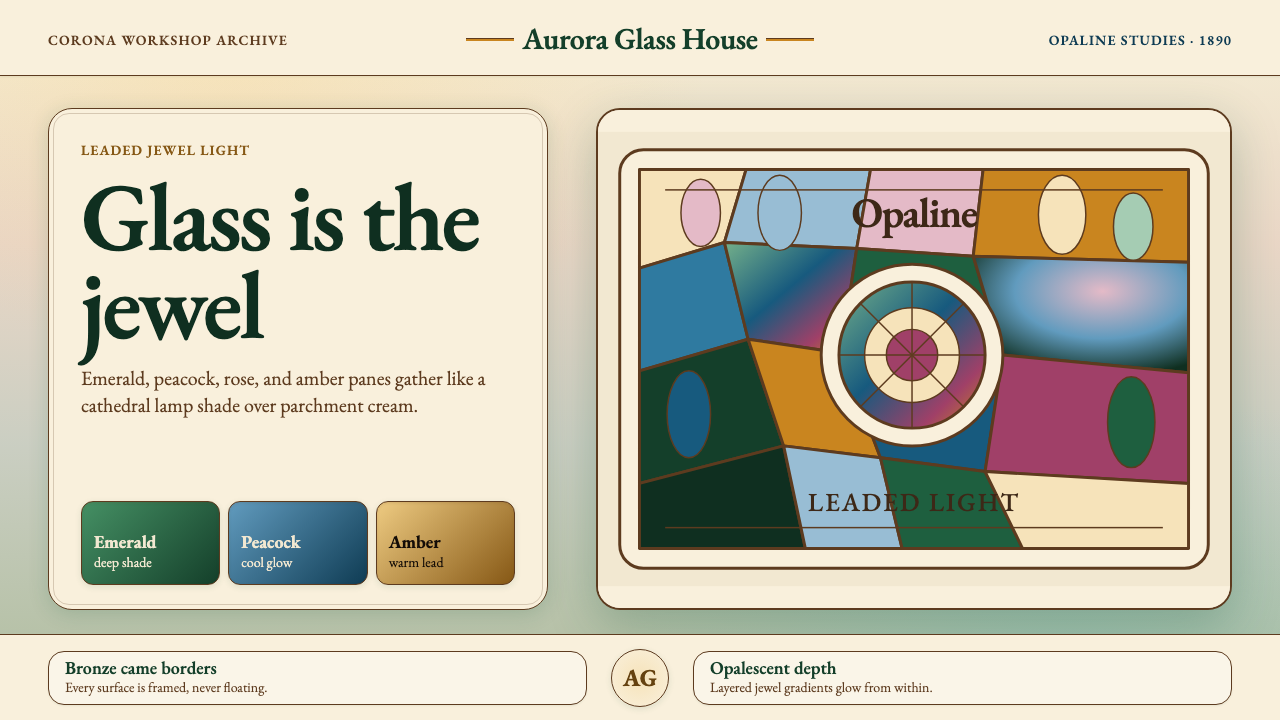 Tiffany Stained GlassJewel light, framed in bronze. Emerald and peacock panes glow on parchment cr…
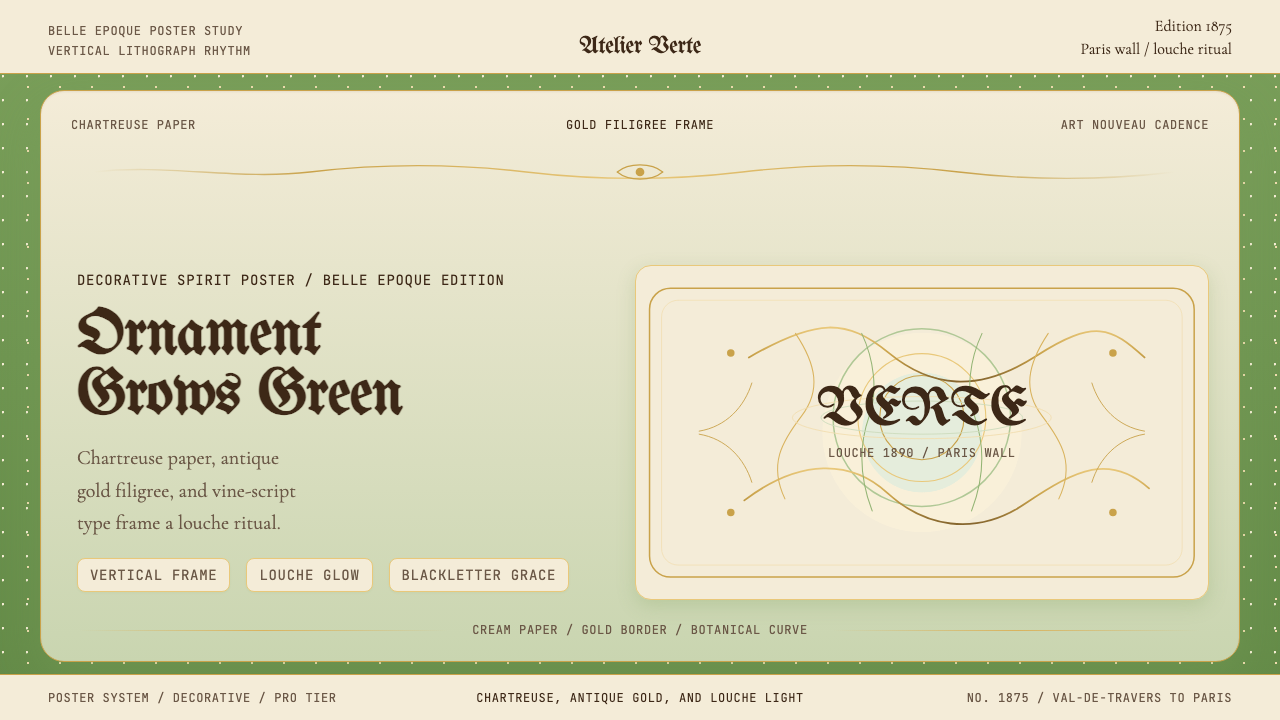 Absinthe Art Nouveau Green (1875)Ornate and verdant. Chartreuse field, gold filigree, vine-script type, and lo…
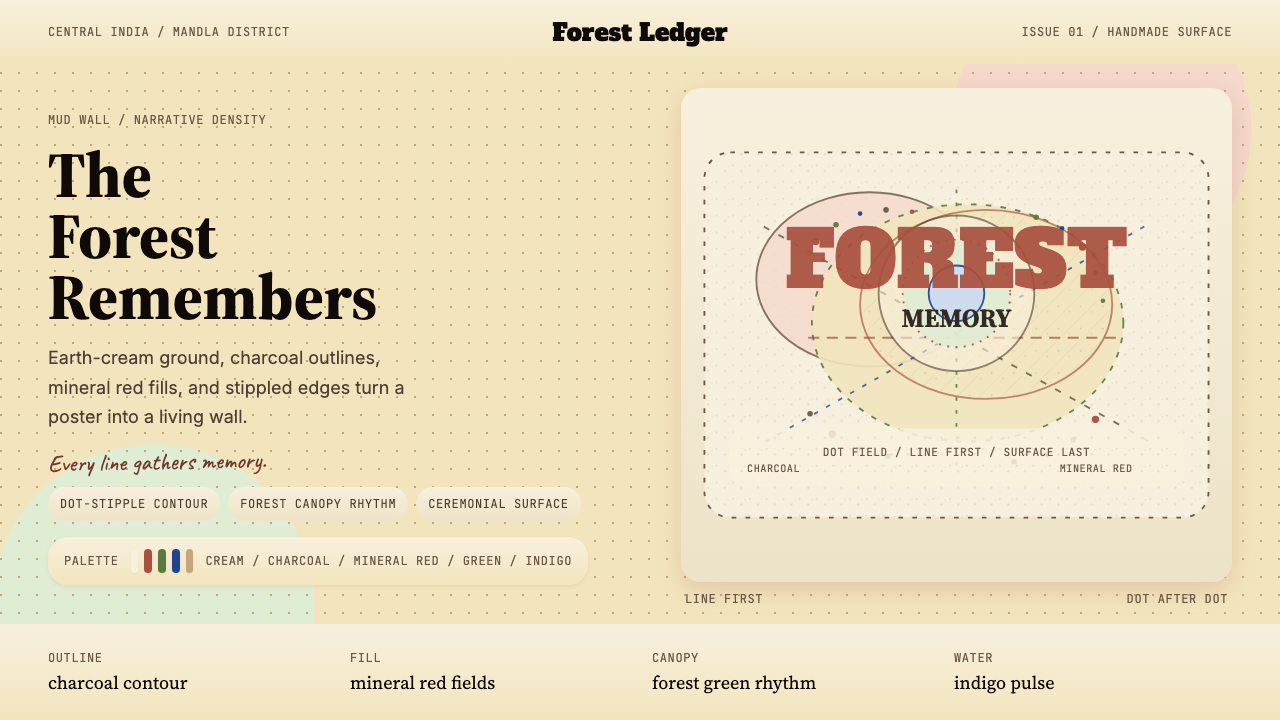 Gond Tribal Art (Madhya Pradesh)The wall becomes a forest. Earth-cream, charcoal, and stippled red make it ce…
 Mongolian Nomadic SteppeSteppe memory in jewel tones. Blood-red felt, saffron, indigo, and bordered u…