What is Gond Tribal Art (Madhya Pradesh)?
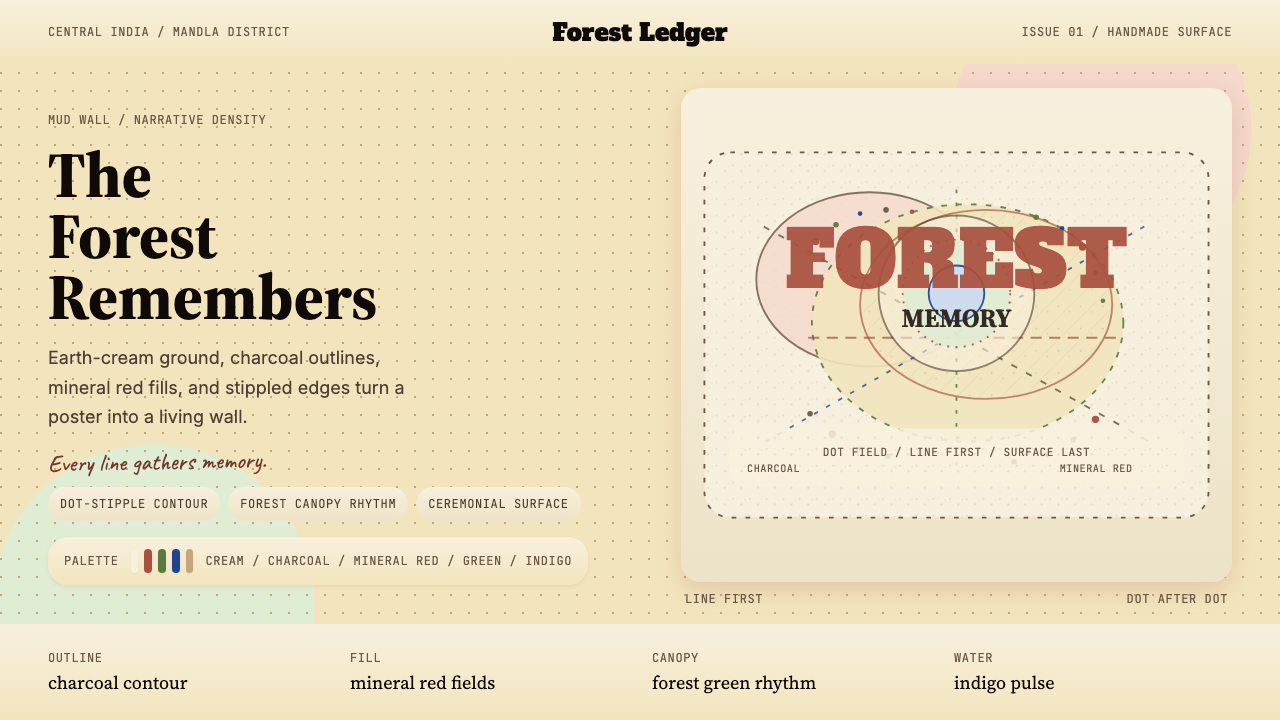
Every surface is alive — Gond art fills the world with stippled dots and spiraling lines, turning walls, paper, and screens into ceremonial forests where animals, trees, and deities pulse with equal breath.
Gond Tribal Art (Madhya Pradesh) in brief
Gond art is the visual tradition of the Gond Adivasi (indigenous) communities of central India, centered in Madhya Pradesh's Mandla district and the village of Patangarh. It is a ceremonial and narrative art form: images are not decorative in the Western sense but cosmologically purposeful, recording the relationships between humans, animals, trees, water, sky, and the spirit world in a single densely layered surface.
The defining visual grammar of Gond art is pattern-as-life: every silhouette — whether a tiger, a tree, a fish, or a deity — is filled from edge to edge with repeating dots, dashes, lines, and chevrons. No form is left solid or empty. The filling patterns are not merely decorative infill; they are understood within Gond cosmology as the living texture of each being, the visual equivalent of breath or energy moving through matter.
The contemporary form of Gond art emerged from centuries of wall-painting practice. Traditionally, Gond women painted the interior and exterior walls of homes with earth-mineral pigments — charcoal black, mineral red, forest green, indigo, and warm cream from lime-washed mud — on auspicious occasions. When painter Jangarh Singh Shyam began working on paper and canvas in the 1980s under the mentorship of artist J. Swaminathan at Bhopal's Bharat Bhavan arts center, he transposed this wall-painting vocabulary onto a portable medium and gave it a contemporary artistic presence that brought Gond imagery international recognition.

Where does Gond Tribal Art (Madhya Pradesh) come from?
The Gond people are one of the largest Adivasi (indigenous) groups in India, with a presence in Madhya Pradesh, Chhattisgarh, Telangana, Maharashtra, and Odisha. Their wall-painting tradition is centuries old, rooted in the practice of adorning homes before festivals, weddings, and seasonal ceremonies with images that invite beneficial spirits and honor the natural world. The pigments were made from materials immediately at hand: charcoal from the fire, red from iron-bearing earth, green from plants, white from lime-washed clay. The act of painting was understood as a ritual gesture — a form of prayer enacted through the hand.
The transformation of Gond art into a recognized contemporary art form is inseparable from the story of Jangarh Singh Shyam, born in Patangarh in 1962. In 1981, painter and critic J. Swaminathan — himself a central figure in India's post-independence engagement with folk and tribal art as modernism — invited Jangarh to Bhopal's newly established Bharat Bhavan cultural complex. There, Jangarh began painting on paper using synthetic pigments and acrylic, transposing the visual logic of wall painting — dense stippling, organic silhouettes, layered texture — into a format that could travel, be exhibited, and enter the art market. The body of work he produced in the 1980s and 1990s established what is now recognized as the modern Gond painting style.
Jangarh Singh Shyam's significance cannot be overstated. He invented a new vocabulary by staying faithful to an old one: the animals, birds, trees, and spirit figures of Gond cosmology, rendered with the same textural density as the ancestral wall murals but on a scale and in a format appropriate to gallery walls and printed pages. His work attracted international collectors and led directly to the careers of the next generation of Gond painters, including Bhajju Shyam — his nephew — and Durga Bai Vyam, whose own practice expanded the tradition's reach into children's book illustration, public murals, and large-format print.
The broader movement context situates Gond art within a post-independence Indian cultural project that sought to revalue tribal and folk art not as ethnographic curiosity but as sophisticated visual culture worthy of the same attention as academic or modernist painting. Swaminathan's work at Bharat Bhavan was part of this project; so were the activities of the Crafts Council of India, the regional arts academies, and later the Adivasi Lok Kala Parishad. Gond art today occupies a layered position: it is simultaneously a living community practice in Patangarh, a recognized genre in the international contemporary art market, a source for commercial design adaptation, and an educational subject in Indian schools.
What defines the Gond Tribal Art (Madhya Pradesh) look?
Dense Stippling and Line-Fill
The signature mark of Gond art is the complete filling of every silhouetted form with repeating micro-patterns: rows of dots, parallel dash clusters, chevron bands, concentric arcs, and hatched grids. No area within a form's outline is left plain or solid. The patterns vary between forms — a fish may carry concentric scale-rings while the tree behind it uses vertical dash-columns — giving each subject its own visual texture and rhythm. This stippling tradition derives directly from the wall-painting practice where textured surfaces were built up slowly with fingertip and twig.
Organic Silhouette and Fluid Outline
Gond forms are never rigid or mechanical. Animals, trees, humans, and deities are drawn with a flowing, slightly irregular outline that gives each figure a sense of movement and organic growth. Bodies curve and stretch; branches reach in multiple directions; figures overlap and interlock. The outline itself is typically a confident single stroke, neither sketchy nor labored, carrying the assurance of a mark-making tradition practiced across generations. Within this fluid outer boundary, the dense interior patterning creates a vibrating contrast between edge and fill.
Earth-Mineral Color Palette
The traditional Gond palette is drawn from earth and forest: a warm cream or ochre ground, charcoal black for outlines and dominant fills, mineral red for warmth and ceremony, forest green for foliage and water, and indigo for depth and shadow. These are not bright synthetic colors but muted, warm, organic tones that read as aged, handmade, and rooted in the natural world. Contemporary Gond painters often extend the palette with additional earthy tones — deep mustard, terracotta, burnt sienna — while preserving the overall character of earth-warmth against a light ground.
Narrative Simultaneity
Gond compositions do not follow a single linear narrative or a fixed pictorial hierarchy. Multiple stories, creatures, and symbolic figures coexist in the same frame without a clear foreground or background. A peacock perches in the branches of a tree whose roots contain a serpent while a sun figure occupies the upper field and human figures appear at the margin — all rendered at similar scale and given equal pictorial weight. This simultaneity reflects a cosmological worldview in which all living beings exist in interdependent relation, none more primary than another.
Ceremonial Density
Gond art is visually full to the point of overflowing — there is no white space, no rest, no area of visual quiet. This density is deliberate and culturally meaningful. The wall-painting tradition from which contemporary Gond art descends was never about decoration; it was about inviting auspiciousness, marking sacred occasions, and creating a visually charged environment that was understood as spiritually active. A Gond image that contains empty space would be cosmologically incomplete. In design application, this quality of generous, layered, ceremonial fullness distinguishes Gond style most sharply from minimalist or modernist aesthetics.
Animal and Tree as Primary Subject
Gond art draws its subject matter from the forest world and from Gond cosmology, where animals, birds, and trees are not background scenery but primary agents with spiritual significance. The peacock, tiger, fish, elephant, serpent, deer, and various birds appear repeatedly as central figures, each carrying specific symbolic meaning within Gond oral and visual tradition. Trees are depicted as living architectures — their branches become worlds unto themselves, populated with birds and figures. The forest is not landscape; it is community.
Two-Dimensional Flatness with Layered Depth
Gond art is entirely flat — there is no perspective, no cast shadow, no modeling of light across surfaces. Yet the paintings do not read as empty or simple, because the layered interior patterning creates an optical depth that is visual rather than spatial. Forms placed behind other forms are not diminished in scale or lightened in tone; they simply occupy a different zone of the composition. This flatness is not a technical limitation but a formal choice inherited from the wall-painting tradition, where the painted surface is understood as a single sacred plane rather than a window into illusory space.

Who shaped Gond Tribal Art (Madhya Pradesh)?
Born in Patangarh in 1962, Jangarh Singh Shyam is the founding figure of contemporary Gond painting. His invitation to Bharat Bhavan in Bhopal in 1981 by J. Swaminathan marked the moment when the Gond wall-painting tradition was transposed onto paper and canvas and introduced to the broader art world. Working prolifically through the 1980s and 1990s, Jangarh developed the visual vocabulary — dense stippling, fluid animal and tree silhouettes, layered cosmological compositions — that defines the style recognized internationally today. His sudden death in 2001 in Japan, where he was on an artist residency, ended a career of extraordinary originality. He is credited with inventing the term 'Jangarh kalam' (Jangarh's pen or style), which has become a general term for contemporary Gond painting.
Jagdish Swaminathan (1928–1994) was a painter, poet, and critic who served as the founding director of the visual arts program at Bharat Bhavan in Bhopal from its establishment in 1981. His theoretical conviction — that Indian tribal and folk art represented a sophisticated and unbroken visual intelligence that mainstream Indian modernism had systematically undervalued — drove his decision to invite Gond, Saura, and other Adivasi artists to Bharat Bhavan. His mentorship of Jangarh Singh Shyam was decisive for the emergence of contemporary Gond art. Swaminathan is a central figure in the story of how post-independence India revalued its own folk and tribal visual traditions.
Bhajju Shyam is Jangarh Singh Shyam's nephew and one of the most internationally recognized contemporary Gond painters. He came to wide public attention through the book 'The London Jungle Book' (2004), in which he reinterpreted his experience of visiting London for the first time through Gond visual vocabulary — the London Underground became a serpent, Big Ben a peacock, the city's pigeons forest birds. The book demonstrated the tradition's capacity for wit, cultural commentary, and adaptive narrative while remaining visually faithful to Gond stippling and earth-tone conventions. Bhajju Shyam has since illustrated numerous books and exhibited internationally, becoming a leading voice for the tradition's contemporary relevance.
Durga Bai Vyam is one of the most prominent women artists to have emerged from the Gond tradition, originally trained in the related Pardhan Gond art practice of Madhya Pradesh. Working with her husband Subhash Vyam, she co-created 'Bhimayana' (2011), a graphic narrative about the life of B.R. Ambedkar told entirely through Gond visual conventions — a landmark work that demonstrated how Gond stippling and animal-world imagery could carry the weight of serious political and historical content. Her work has been exhibited in India and internationally, and she has contributed to educational materials, public murals, and children's publishing, expanding the reach of the tradition beyond the gallery context.
Nankusia Shyam, Jangarh Singh Shyam's wife, continued creating Gond paintings after her husband's death and became an important figure in the tradition's continuity within Patangarh. Her work, often centered on domestic and forest scenes rendered with the same layered stippling and fluid outlines of the broader tradition, represents the practice as it exists within community life rather than solely within the gallery-facing contemporary art world. Her career illustrates that contemporary Gond art is not a single authored movement but a living community practice with multiple practitioners contributing across generations and contexts.
How do you use Gond Tribal Art (Madhya Pradesh) today?
Applying Gond art in design work requires understanding what the style is actually doing: it is not pattern for pattern's sake, but pattern as the visual language of living presence. Every surface is filled because every surface is understood as alive. When this principle is respected — when the density feels purposeful rather than decorative, when animal and tree forms carry recognizable Gond silhouettes, when the earth-toned palette remains warm and mineral rather than bright and synthetic — the style communicates something genuinely different from other illustrated or patterned aesthetics.
For presentation slides, Gond art works most powerfully on cover pages and section dividers where full-surface illustration is appropriate. A cover built around a large Gond-style composition — a central animal or tree form filled with stippled texture on a warm cream ground, with charcoal outlines and accents of mineral red or forest green — creates immediate visual impact and cultural distinction. Content slides should use Gond elements sparingly: a stippled border, a small animal motif at a corner, or a textured background panel that sits behind clean type. Data slides pair well with a single Gond illustration used as a full-bleed background at reduced opacity, allowing charts and numbers to remain readable while the textural warmth of the style frames the content.
For web interfaces and digital dashboards, Gond art functions best as a pattern layer or illustrative accent rather than a structural system. The style does not lend itself to button states, form inputs, or navigation hierarchies — those should remain typographically clean and functionally clear. Instead, Gond motifs serve hero sections, empty states, loading illustrations, and branded decorative panels. A pricing page, for example, might use a full-width Gond tree-and-bird illustration as a section header, with functional UI elements in clean type below. The key is treating Gond as the illustrative layer that gives a product emotional warmth and cultural character, not as the organizational system.
For editorial and marketing work, Gond art offers exceptional richness for feature articles, cultural publications, festival campaigns, and brand communications that seek to signal handcrafted authenticity, Indian cultural identity, or a relationship with nature and community. Full-page illustrated spreads using Gond motifs work well in magazine formats; stippled border treatments bring warmth to editorial columns; spot illustrations of animals or trees can anchor section headings. Marketing campaigns for food, wellness, travel, and sustainability brands find natural alignment with the style's forest world imagery and ceremonially generous visual character. The earth palette reads particularly well in print, where the warmth of cream stock and the depth of charcoal ink reinforce the hand-mineral quality of the source tradition.
A common mistake when adapting Gond art is reducing it to generic pattern or surface texture while losing its specific visual logic. Authentic Gond style requires that patterns be applied within clearly defined organic silhouettes — not as flat repeating tiles across a neutral ground. Another frequent error is substituting bright, fully saturated colors for the earth-mineral palette: replacing warm ochre with vivid orange, or mineral red with hot pink, produces something that reads as generic 'tribal' decoration rather than as the specific and culturally grounded visual tradition that Gond art actually is. A third mistake is using Gond elements without acknowledgment of their origin — the tradition has living practitioners and a specific community identity, and design work that engages with it responsibly should credit the Gond Adivasi tradition and, where possible, commission or license work from Gond artists directly.

Gond Tribal Art (Madhya Pradesh) — FAQ
Is Gond art the same as other Indian tribal art forms, like Warli or Madhubani?
No — they are distinct traditions from different communities and regions, with different visual vocabularies and different cosmological contexts. Warli art, from Maharashtra's Warli Adivasi community, uses a spare geometric language of triangles, circles, and lines on a mud-red ground, depicting human figures in community scenes and rituals. Madhubani (also called Mithila) art, from Bihar's Mithila region, uses intricate floral and figurative line work with bright colors to depict Hindu mythology and daily life. Gond art is distinguished by its dense stippling and line-fill within fluid animal and tree silhouettes, its specific earth-mineral palette, and its cosmological emphasis on the forest world and the interdependence of all living beings. These traditions share the quality of being living community practices rather than historical styles, but they should not be conflated.
Can Gond art work in a digital dark-mode interface?
Yes, but with important adjustments. The traditional Gond palette is light-ground — warm cream or ochre backgrounds with charcoal black outlines are canonical. A dark inversion is possible and can be striking: deep indigo or near-black grounds with cream, gold, and mineral red stippling can evoke a night-forest quality that carries its own ceremonial resonance. The critical requirement is that the earth-toned, organic character of the palette be preserved — bright neon fills placed over a dark ground will lose the warmth and material specificity that distinguishes Gond style from generic decorative pattern. The stippling and line-fill patterns read well at reduced opacity over dark backgrounds, allowing textural depth without overwhelming other interface elements.
How do you distinguish authentic Gond visual logic from generic 'tribal pattern' imitation?
Several markers distinguish authentic Gond-derived work. First, the patterns are applied within clearly defined organic silhouettes — a tiger or a tree — rather than spread as a flat repeating tile across a neutral ground. Second, the palette is warm and earth-mineral in character: charcoal black, warm cream, mineral red, forest green, indigo — not bright primaries or synthetic neons. Third, the composition shows narrative simultaneity: multiple creatures, trees, and figures coexist at similar scale without a strict foreground-background hierarchy. Fourth, forms are fluid and slightly irregular rather than mechanically precise — the outline carries the mark of a hand. Work that borrows only the stippling pattern and applies it to geometric or corporate forms without the organic silhouettes, specific palette, or cosmological density will read as surface appropriation rather than genuine stylistic engagement.
Is it appropriate to use Gond art commercially without involving Gond artists?
This is a live and contested question in Indian design and cultural policy. Gond art is not in the public domain in the sense that it is a living, practiced tradition with identifiable community authorship and specific artist practitioners who depend on the tradition for their livelihood. Using Gond visual conventions without acknowledgment, without commissioning Gond artists, or without fair compensation is widely regarded as appropriative and harmful to the community. Best practice is to commission work directly from Gond artists or studios, to license imagery through organizations that work with and fairly compensate Gond practitioners, to clearly credit the Gond Adivasi tradition in any published work, and to avoid reproducing the work of specific named artists without explicit permission. Stylistic inspiration is different from direct reproduction, but even stylistic adoption carries responsibility to acknowledge source and to support the living tradition.
What kinds of products and brands align most naturally with Gond art?
Gond art aligns most naturally with brands and products that seek to communicate a genuine relationship with Indian cultural identity, handcrafted authenticity, ecological values, or community. It is particularly well-suited for cultural institutions, arts organizations, food and beverage brands with Indian origins, sustainable goods companies, travel and hospitality in the Indian subcontinent, children's educational products, and wellness or natural health brands. It is less suited — and risks appearing superficial or appropriative — when used by brands with no cultural or thematic connection to the values the tradition embodies, or when deployed purely for decorative novelty without respect for the style's depth and living context. The question to ask is not just whether Gond art will make the product look distinctive, but whether the product's values and purpose are genuinely in conversation with what the tradition represents.
Related design styles
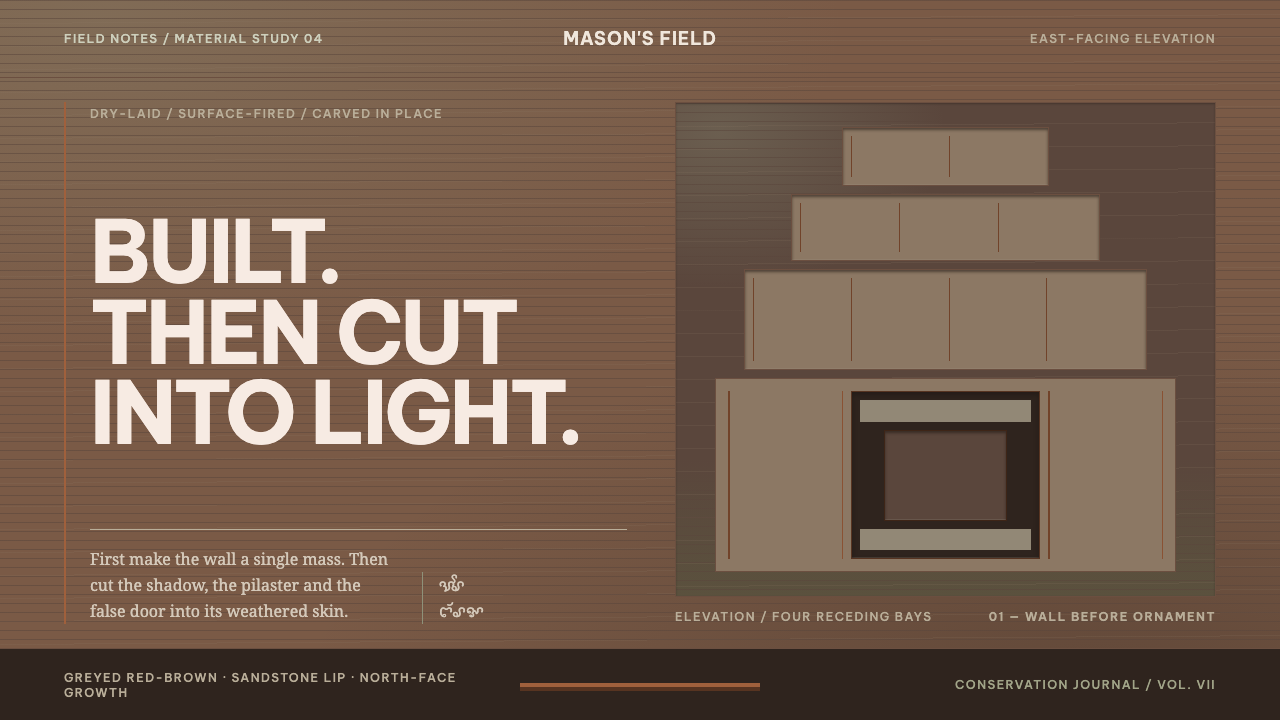 Cham My Son TowersWall before ornament. Greyed brick bays recede around cut shadows and sandsto…
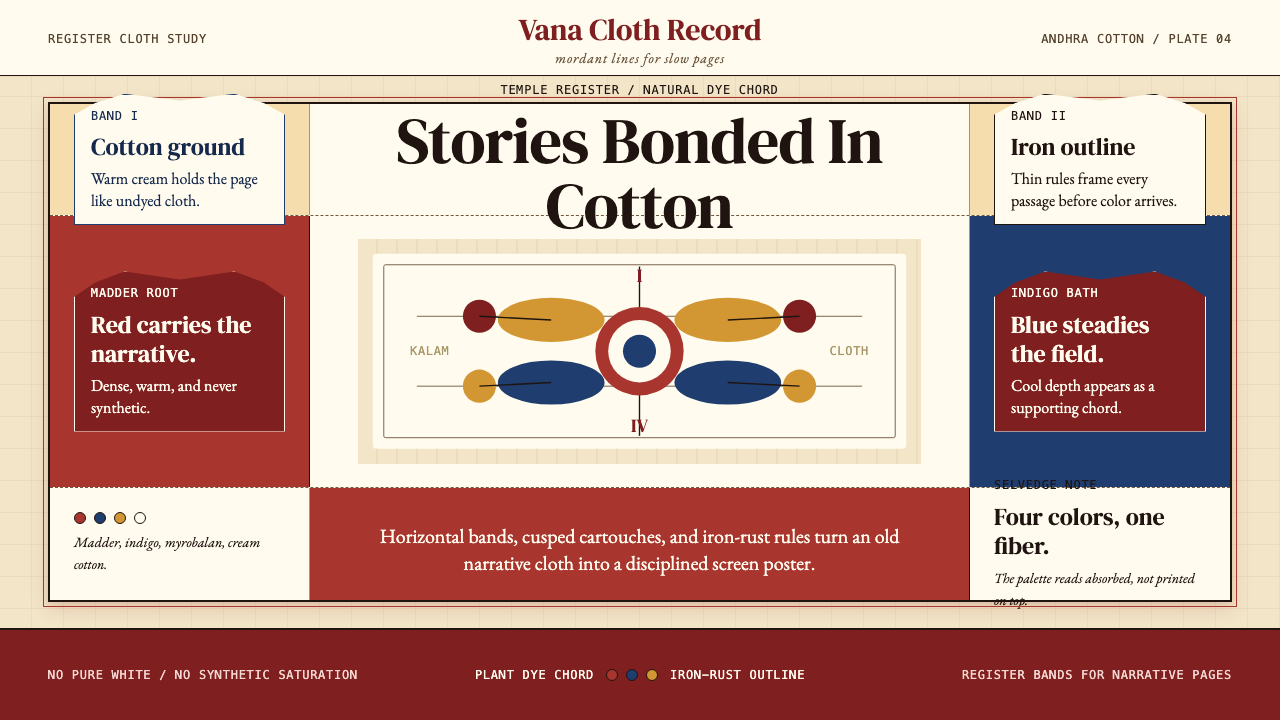 Kalamkari (Andhra Pradesh)Cloth becomes narrative. Madder bands, indigo panels, and iron rules stack li…
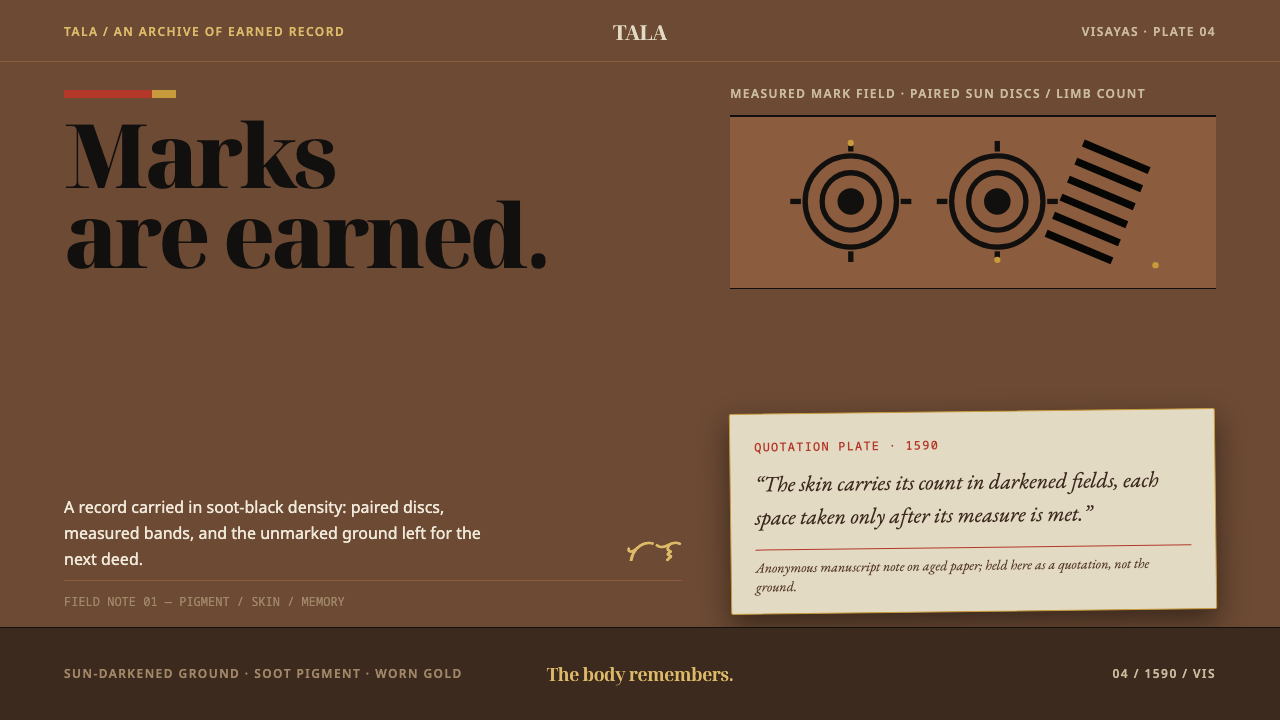 Visayan PintadosA record worn, not displayed. Soot-black marks accrete across sun-darkened sk…
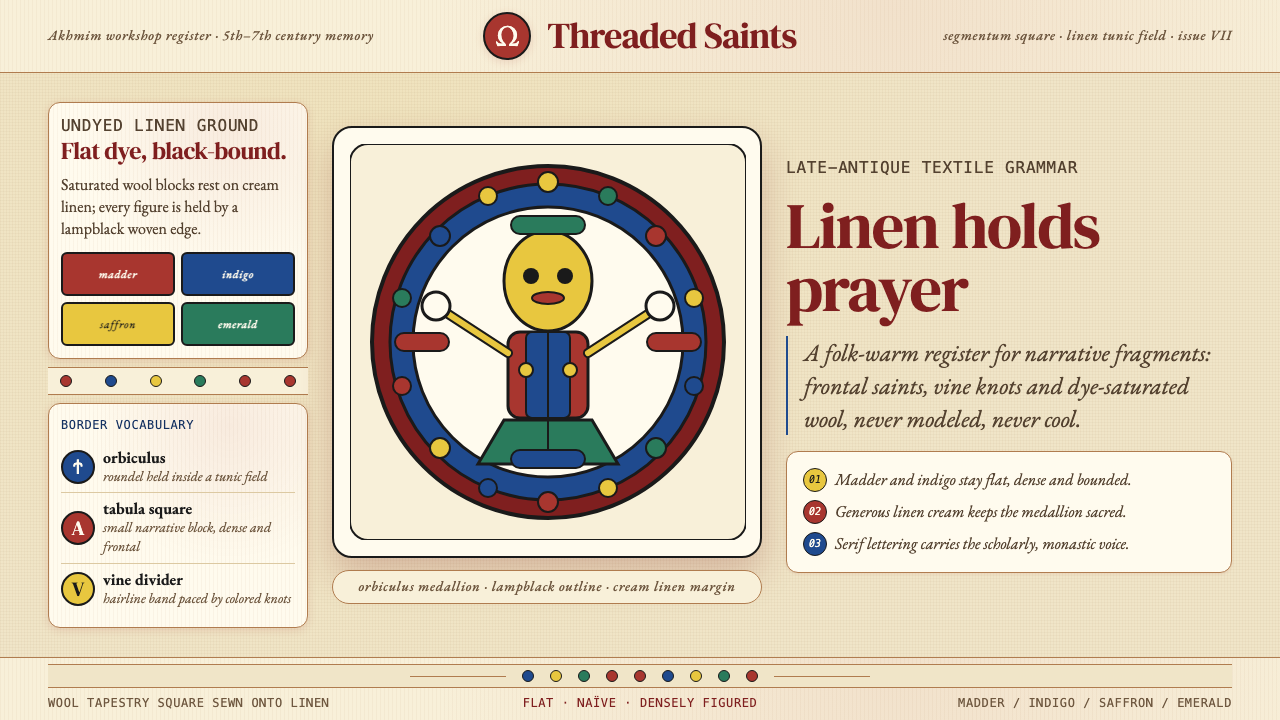 Egyptian Coptic TextileWarmth woven flat. Madder, indigo and saffron medallions sit on linen cream.
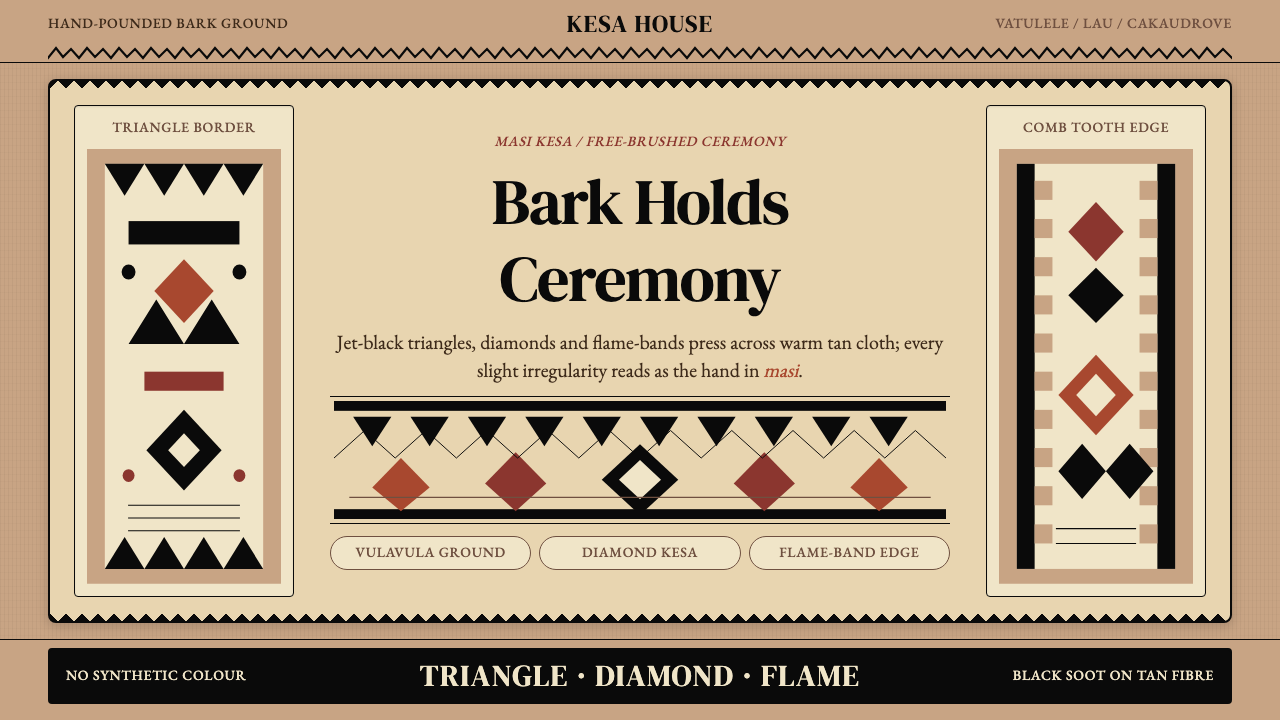 Fijian Masi (Tapa Cloth)Ceremony hits in black. Tan bark ground carries diamonds, zigzags and flame-b…
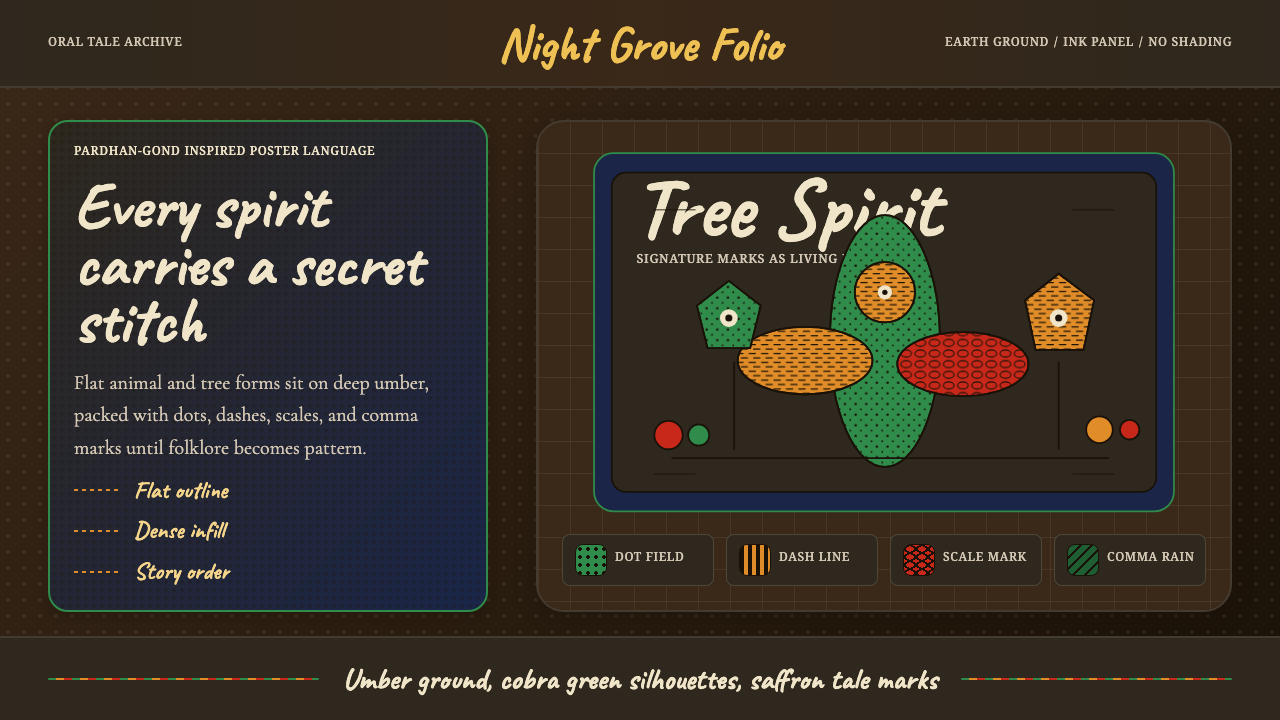 Gond Pardhan (Tree Spirit Painting)Story breathes in pattern. Cobra green forms on umber ground, filled with dot…