What is Egyptian Coptic Textile?
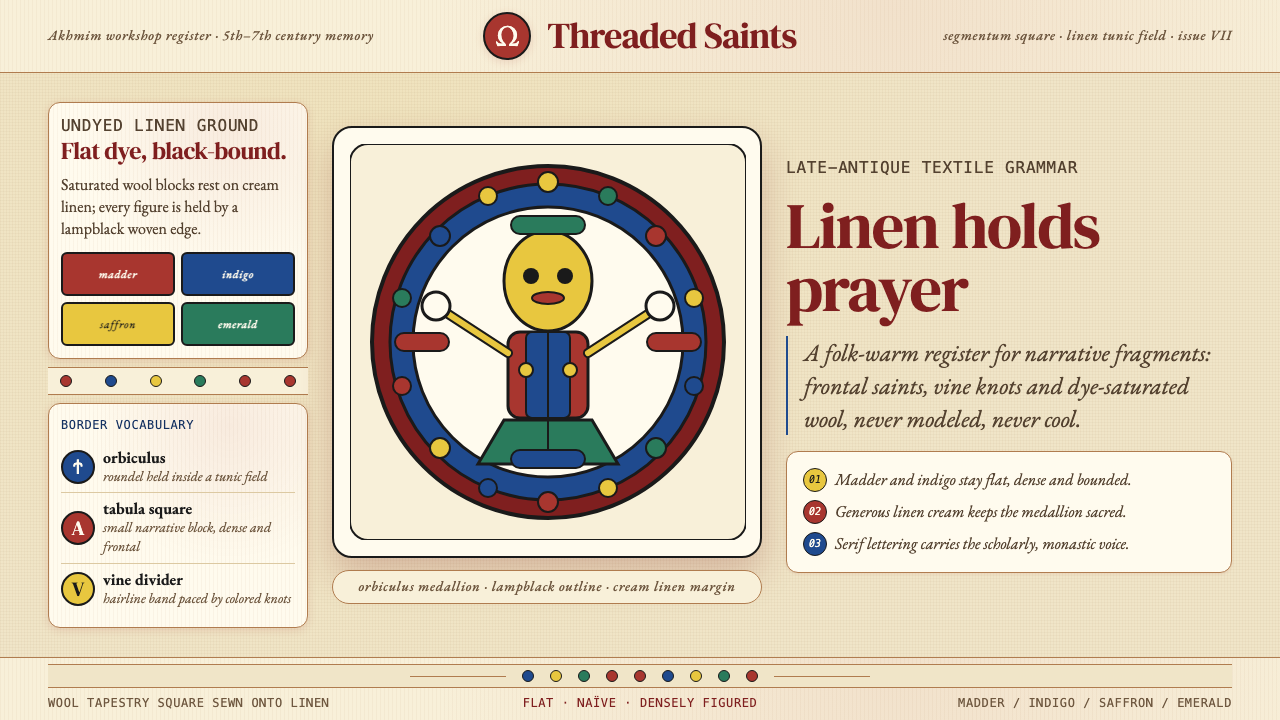
Wool and linen bound together in saturated warmth — Coptic tapestry squares carried Christian Egypt's visual memory across a thousand years of daily wear.
Egyptian Coptic Textile in brief
Egyptian Coptic Textile is the weaving tradition of Christian Egypt spanning the 4th through 8th centuries CE. Weavers worked wool tapestry-squares — called tabulae or clavi — directly onto undyed linen tunics, filling them with figures bounded by a heavy lampblack outline. The resulting palette is immediately recognizable: saturated madder-red, deep indigo, saffron yellow, and emerald green sit against the warm cream of undyed linen, creating a color language that feels simultaneously ancient and vivid.
The iconographic vocabulary is richly layered. Praying figures called orants — wide-eyed, frontal, arms raised — share space with dancing maenads carried over from pagan Dionysiac memory, with peacocks spreading jeweled tails, with vine tendrils curling into inhabited roundels, and with lion-and-hunter scenes rooted in the heroic tradition. This mixing of Christian devotion and inherited Greco-Roman motif was not contradiction but continuity — the same weavers and the same families who had once honored Dionysus now honored Christ, and they brought their entire visual repertoire with them.
The style is neither Greco-Roman naturalism nor Byzantine formality. It is its own register: flat, naïve in the best sense, densely figured, and profoundly warm. Figures are rendered with large expressive eyes and stylized bodies; backgrounds are filled rather than opened; borders are thick and active rather than merely framing. This density and warmth, combined with the tactile reality of wool on linen, gives Coptic textile a folk directness that no courtly or ecclesiastical style ever quite matched.

Where does Egyptian Coptic Textile come from?
The Coptic textile tradition grew from the convergence of three distinct weaving cultures in Roman Egypt. Greek settlers had brought Mediterranean loom techniques; Pharaonic Egypt contributed a millennia-old tradition of fine linen production; and the eastern trade routes introduced Iranian and Syrian pattern vocabularies — the hunting roundel, the pearl border, the confronted-animal motif. When Christianity became the religion of Roman Egypt from the 4th century onward, weavers adapted these combined inheritances to serve a new devotional context without abandoning a single thread of what had come before.
The primary production centers were concentrated in Middle and Upper Egypt. Akhmim (ancient Panopolis) on the Upper Nile was the dominant weaving city, with a long history as a center of linen and wool production stretching back into the Pharaonic period. Antinoöpolis, founded by Emperor Hadrian in 130 CE, became another significant site. The Fayum oasis, Bawit with its important monastery, and the Saqqara complex near Memphis all yielded important textile finds. These were not luxury goods alone — Coptic tunics were everyday garments, worn by people of modest means and wealthy patrons alike, and the tapestry inserts varied from modest repeating geometric borders to elaborate figural medallions on fine wool.
The rediscovery of Coptic textiles began in the 1880s through large-scale tomb excavations, particularly at Akhmim, where the dry desert conditions had preserved cloth intact for fifteen centuries. The French archaeologist Albert Gayet led major excavations at Antinoöpolis beginning in 1895, recovering thousands of fragments and complete garments. The Austrian dealer Theodor Graf had earlier brought the first significant group of Akhmim textiles to European attention. These excavation campaigns — conducted with methods that would be considered destructive by modern standards — dispersed material across the museums of Europe and North America, with major collections now held at the Victoria and Albert Museum in London, the Metropolitan Museum of Art in New York, the Louvre in Paris, and the Abegg-Stiftung in Riggisberg, Switzerland.
Scholarly understanding deepened significantly through the 20th century. Art historians including Anna Gonosová and textile scholars such as Cäcilia Fluck established systematic catalogues and attribution frameworks, connecting individual fragments to their production regions and periods. Contemporary scholarship has moved beyond simple stylistic classification to examine the social and economic contexts of production — who wore these garments, who made them, and how workshops transmitted designs across generations. The field now recognizes that what was once called a single Coptic style encompasses significant regional variation and a centuries-long evolution from relatively naturalistic late-antique figure work toward the increasingly schematic, flat, and powerfully abstracted imagery of the 7th and 8th centuries.
What defines the Egyptian Coptic Textile look?
Color Palette
The Coptic palette centers on four saturated plant and mineral dyes applied to natural wool: madder-red (the dominant warm anchor), indigo (the principal cool contrast), saffron yellow (used for highlight and secondary figures), and weld or verdigris for the rarer emerald-green accents. These colors sit against undyed linen, whose warm cream acts as both ground and breathing space. Lampblack outline is the fifth essential element — every figure, every leaf, every border is bounded by a firm dark contour that holds the saturated fills in check and gives the entire composition its characteristic graphic legibility.
Figure Style
Coptic figures are frontal, flat, and intentionally un-naturalistic. Eyes are disproportionately large — sometimes nearly circular — and carry enormous expressive weight; they are the focal point of every face and the primary vehicle of devotional intensity. Bodies are schematic rather than anatomically observed: limbs are tubular, drapery is rendered as stacked parallel lines rather than observed cloth, and proportion is governed by hierarchy and emphasis rather than realism. This naïve directness is not failure but choice — it was the visual grammar of a tradition that valued spiritual presence over physical illusion.
Compositional Density
Unlike classical Mediterranean styles that valued negative space, Coptic textile composition fills every available area with figure, motif, or pattern. Borders are not merely framing devices — they are inhabited by running animals, vine tendrils, and geometric interlace. Roundels and squares are packed with layered figures, often with secondary elements wedged into corners or framing bands. This density reflects both a horror vacui — a discomfort with empty space — and the practical reality of weaving, where every thread represents labor and leaving areas blank would be waste. The result is a richly legible surface that rewards close looking.
Outline and Flatness
The lampblack contour line is the structural backbone of Coptic visual language. It is never tentative — it is bold, consistent, and drawn with the confidence of a tradition that had been using outline as the primary organizational device since the time of the pharaohs. Within the outline, color is applied as flat, unmodulated fill: there is no shading, no modeling toward volume, no attempt to suggest three-dimensional form through tonal variation. Light does not exist in Coptic textile as a spatial force; objects are not lit, they are identified. This radical flatness, combined with saturated color, produces images of extraordinary visual strength.
Syncretic Iconography
Coptic textile iconography freely combines Christian, late-antique pagan, and Pharaonic visual elements without apparent tension. A single tunic might carry an orant (Christian prayer figure), a Dionysiac maenad (pagan inheritance), a Nilotic water scene with crocodiles (Pharaonic landscape), and a pearl-border roundel of Iranian derivation. This syncretism is not eclecticism for its own sake — it reflects the actual lived experience of Coptic Egyptians, who inhabited a cultural landscape shaped by millennia of overlapping traditions. For contemporary designers, it models a way of drawing from multiple visual sources that achieves coherence through shared graphic language rather than thematic purity.
Border and Frame Language
The borders of Coptic tapestry inserts are as significant as their central fields. Standard border types include running wave and vine-tendril patterns, geometric guilloche and interlace, rows of facing buds or palmettes, and the pearl-border (a row of small circles) of Iranian and Central Asian derivation. These borders are not passive containment — they are active visual elements that define scale, establish rhythm, and signal the register of what they enclose. A coarser geometric border signals a humble everyday garment; an intricate figural border with inhabited vine-scroll signals wealth and commemorative intention.
Warmth as System
If a single quality distinguishes Coptic textile from every other late-antique visual tradition, it is warmth — not as a sentimentality but as a structural property of the color system. The undyed linen ground is warm cream, not cold white. Madder-red is the dominant hue, warming the entire palette. Even the indigo, a cool color in isolation, is deepened by its proximity to the red and gold tones surrounding it, taking on a purple resonance rather than a purely cool blue note. This warmth is not accidental — it is the cumulative effect of using natural, undyed fibers as ground and warm-shifted natural dyes as figure. Every contemporary application of this aesthetic should begin with this warming of the ground, because the palette rests on it.

Who shaped Egyptian Coptic Textile?
The French Egyptologist Albert Gayet conducted the most extensive systematic excavations of Coptic textiles, leading missions to Antinoöpolis from 1895 through the early 1900s. His campaigns recovered thousands of complete and fragmentary garments, many of which entered French museum collections. Though his methods lacked the stratigraphic rigor of modern archaeology, his detailed documentation and the sheer volume of material he recovered established the foundation for all subsequent Coptic textile scholarship. His work brought the aesthetic of Coptic weaving to broad public attention in France and beyond.
The Viennese antique dealer Theodor Graf was instrumental in bringing Coptic textiles to European collectors and museums in the 1880s and 1890s. His acquisition and sale of the first major groups of Akhmim textiles — through exhibitions in Vienna, Berlin, and Paris — introduced the aesthetic to Western audiences who had never seen such material. Graf's commercial instincts drove the early market for Coptic works, accelerating both scholarly interest and the problematic dispersal of material across private collections. His role illustrates how the rediscovery of Coptic textile was shaped as much by art market dynamics as by academic archaeology.
Cäcilia Fluck, a German textile historian based at the Museum of Islamic Art in Berlin, has become one of the leading contemporary scholars of Coptic textiles. Her systematic cataloguing work, collaborative excavations at sites including Antinoöpolis, and contributions to the comprehensive Textiles from the Nile Valley publication series have significantly advanced the field's understanding of workshop practices, regional distinctions, and dating methods. Fluck's scholarship represents the shift in Coptic textile studies from aesthetic appreciation to rigorous contextual analysis — understanding not just what these objects look like, but who made them, how they were made, and what they meant to their wearers.
The art historian Anna Gonosová made significant contributions to understanding the iconographic sources and stylistic development of Coptic textile motifs. Her close analysis of individual tapestry panels — tracing how specific compositional formats, figure types, and border patterns were transmitted, adapted, and transformed across workshops and across generations — helped establish the intellectual framework for understanding Coptic weaving not as a single static style but as an evolving tradition with deep roots in the late-antique visual koine of the eastern Mediterranean.
How do you use Egyptian Coptic Textile today?
Egyptian Coptic Textile as a design reference requires understanding its internal logic rather than merely borrowing its surface appearance. The system's power comes from three structural decisions: a warm-ground palette built on undyed cream rather than white; heavy contour lines that define every element before color fills it; and a compositional density that treats empty space as a resource to be used, not preserved. Applied correctly, the aesthetic produces work that feels simultaneously archaic and urgent — a quality that distinguishes it from the many historical styles that read as merely decorative.
For presentation slides, this style suits cover pages and section dividers more naturally than data-heavy content slides. A cover in the Coptic mode works with a warm cream or aged-linen ground, strong geometric or medallion framing for the title block, and a limited palette of saturated warm colors for decorative elements. Section-opener slides benefit from the style's border language — a thick ornamental frame or a vine-tendril divider signals a shift in register without requiring a change in typeface. Data slides are harder to execute authentically: the density principle can quickly overwhelm numerical content. The best approach is to use the palette and framing language for structural elements while keeping the data visualization itself relatively open.
For web interfaces, the Coptic aesthetic is most naturally suited to editorial-style pages, cultural heritage contexts, and brands positioning themselves around craft, heritage, or artisanal production. Dashboard and functional interfaces are more challenging — the style's density and warmth work against the scannability that utility interfaces require. Where the style is applied to web, keep backgrounds in the warm cream or warm off-white range, use the saturated colors sparingly as accent against that ground, and rely on bordered components rather than shadow-based depth. Navigation and UI controls should be treated with restraint, borrowing the palette without imposing the figural density.
For editorial and marketing work, the style's strongest application is in contexts that celebrate cultural depth, craft lineage, or warm human storytelling. A brand identity drawing on Coptic textile would use the medallion format as a recurring framing device, the warm-ground palette as its color foundation, and the heavy-outline treatment as a graphic signature for illustration or iconography. Marketing pages work well with the style's border-and-frame vocabulary for section structure, using ornamental dividers instead of ruled lines and keeping body text on warm cream grounds. Editorial layouts in long-form journalism or cultural publishing can use the palette and framing language to create visual chapters, with each section announced by a border element.
A common mistake when applying this style is flattening its warmth into generic earth tones or boho-neutral palettes. Coptic color is not muted — it is saturated warmth, which is different. Madder-red is deep and rich, not dusty rose; indigo is full and dense, not faded denim; saffron is vivid, not mustard. A second common error is using the iconographic vocabulary — orants, peacocks, vine tendrils — as literal decorative motifs without absorbing the underlying graphic principles of flatness, heavy outline, and warm ground. Borrowing the motifs without the structure produces pastiche. The style is better learned from its palette and compositional logic than from its recognizable imagery.
A third pitfall is treating the style as appropriate only for brands with an explicit historical or archaeological identity. Coptic textile's folk directness, warm palette, and human-centered iconography make it surprisingly applicable to contemporary brands in food, craft beverage, artisanal goods, and values-led consumer products — anywhere that warmth, authenticity, and visual richness are genuine brand values. The key is extraction of principle rather than literal quotation of ancient imagery.

Egyptian Coptic Textile — FAQ
How is Coptic textile different from Byzantine art?
Byzantine art and Coptic textile share a late-antique Christian context and a general tendency toward frontality and flatness, but they operate in very different registers. Byzantine art is courtly and hierarchical — it was produced for imperial and ecclesiastical patrons and aimed to project divine authority through gold, formal symmetry, and controlled grandeur. Coptic textile is folk and warm — it was produced for everyday garments worn by ordinary Egyptians and aimed to surround the body with devotional imagery through saturated color, dense pattern, and accessible iconography. Byzantium uses gold ground to suggest transcendence; Coptic weaving uses undyed linen cream to suggest continuity with everyday warmth. Where Byzantine figures are remote and austerely beautiful, Coptic figures are direct, large-eyed, and humanly immediate.
Can this style work for dark-background designs?
The Coptic palette is fundamentally a warm-ground system — its warmth and legibility depend on the undyed linen cream acting as the passive ground against which saturated colors register. A dark inversion is possible but requires significant adaptation. On a deep ground, the pale linen tone shifts to a highlight or text color rather than a ground, and the primary palette must be adjusted so that madder-red and saffron carry the warmth rather than the ground itself. The heavy lampblack outline — which is invisible on the historic linen ground — becomes irrelevant on a dark background; it must be replaced with a warm light outline or abandoned in favor of color contrast alone. Dark Coptic-derived palettes can work for theatrical, luxury, or festival contexts, but they lose the essential folk warmth that makes the style distinctive.
Is the syncretic iconography — mixing Christian, pagan, and Pharaonic imagery — appropriate to reference in contemporary design?
The syncretic quality of Coptic iconography is one of its most intellectually interesting features, but contemporary designers should engage with it carefully. Lifting specific religious imagery — orants, crosses, or specific biblical scenes — from a devotional context into commercial design risks disrespect to communities for whom these images carry living religious meaning. The safer and more productive approach is to engage with the Coptic style at the level of graphic principle: its palette, its compositional density, its outline language, its border vocabulary, and its medallion framing — all of which are culturally rich without being specifically sacred. The peacock, the vine tendril, and the geometric interlace are all available without reservation; the devotional figure at prayer is more delicate territory.
What contemporary design contexts is this style least suited to?
The Coptic style struggles most in contexts that require visual lightness, openness, and calm. High-volume information interfaces — complex dashboards, data-dense analytical tools, or multi-step forms — are difficult to execute well because the style's density principle works against the breathing room these interfaces need. Minimalist or luxury-minimalist brand contexts are also poor fits: the warmth and fullness of the Coptic visual vocabulary conflicts with the deliberate restraint that luxury minimalism depends on. Corporate and financial contexts, which typically signal authority through restraint and precision, similarly find the style too warm, too figured, and too folk-inflected. The style is best reserved for brands and contexts where richness, warmth, depth, and a sense of deep cultural rootedness are genuine values.
How can I distinguish authentic Coptic textile-derived design from surface imitation?
Authentic Coptic-derived design is structured from the inside out: it begins with the warm undyed-linen ground, builds saturated color on top of that warmth, and uses heavy outline to define every element before filling with color. Surface imitation typically reverses this logic — it borrows the recognizable motifs (vine tendrils, roundels, geometric borders) and applies them to a white or neutral ground, producing results that look like decorative appliqué rather than an integrated visual system. The test is whether the warmth is structural or cosmetic: if removing the earth tones would reveal an essentially cold, white-ground layout with ornamentation on top, the design has borrowed surface without absorbing system. Genuine application feels warm, dense, and bounded — not decorated.
Related design styles
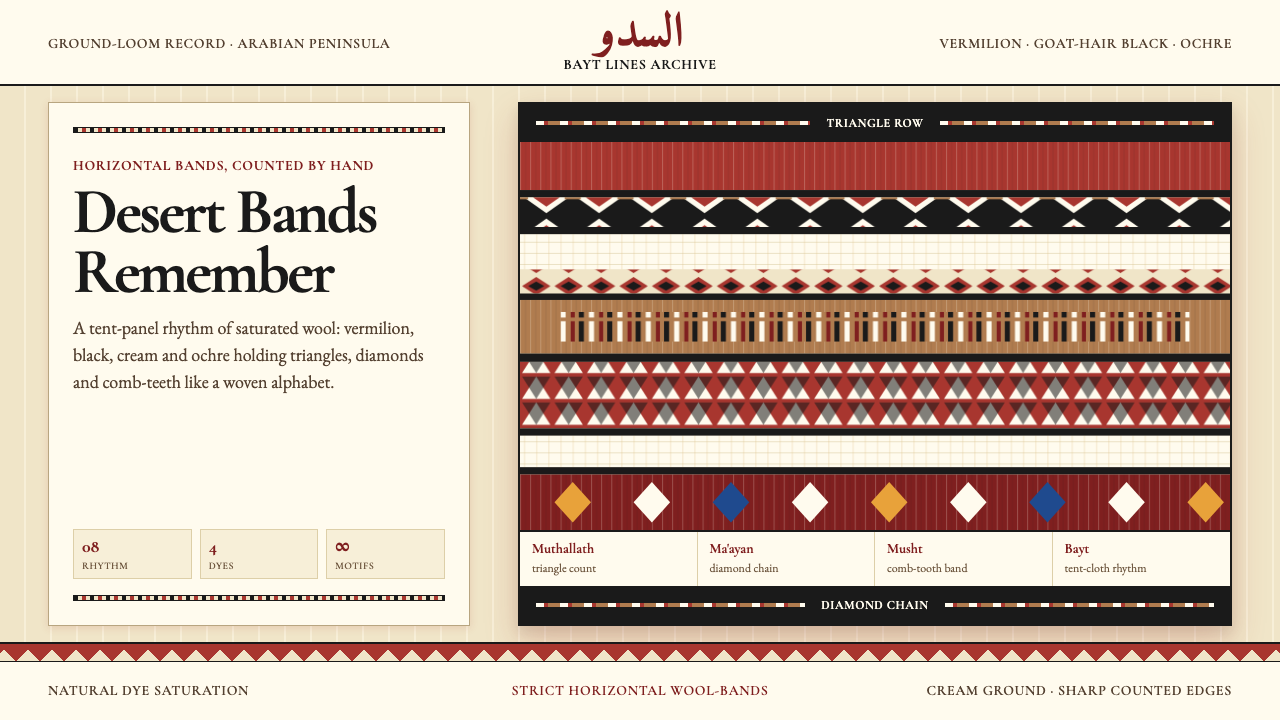 Bedouin Desert Textile (Sadu)Woven memory, not ornament. Vermilion-black bands count triangles and diamond…
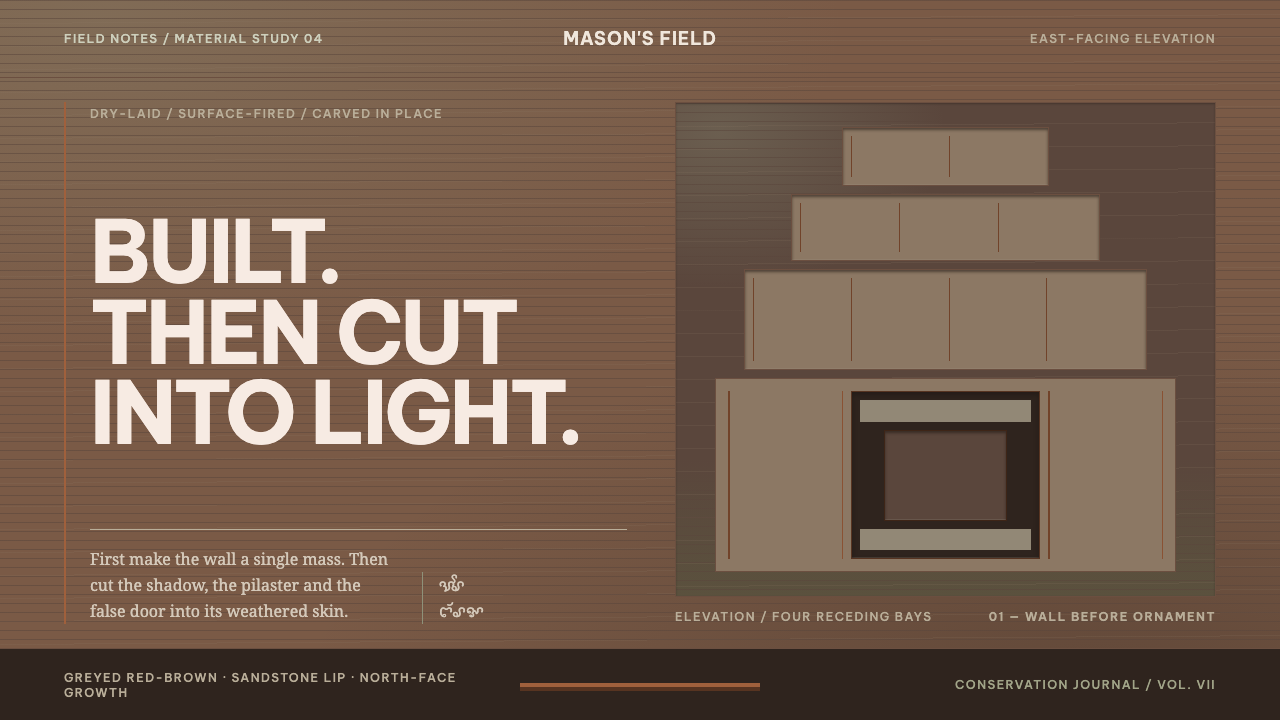 Cham My Son TowersWall before ornament. Greyed brick bays recede around cut shadows and sandsto…
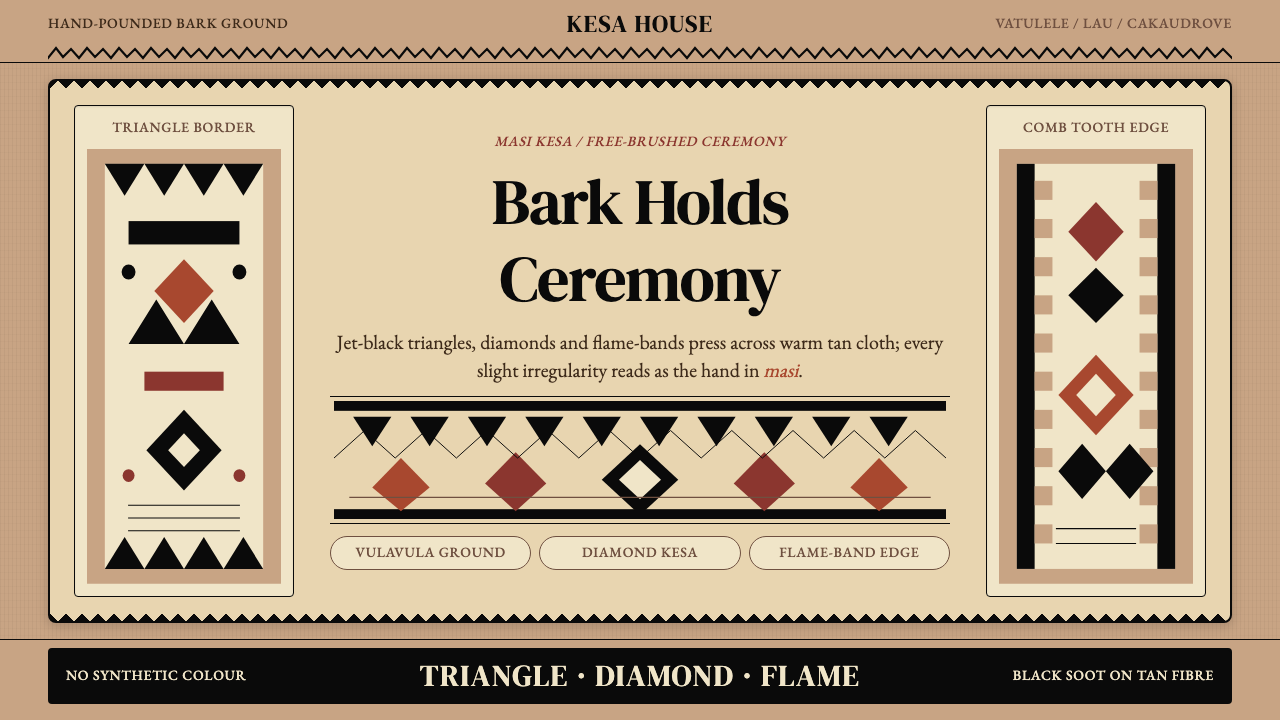 Fijian Masi (Tapa Cloth)Ceremony hits in black. Tan bark ground carries diamonds, zigzags and flame-b…
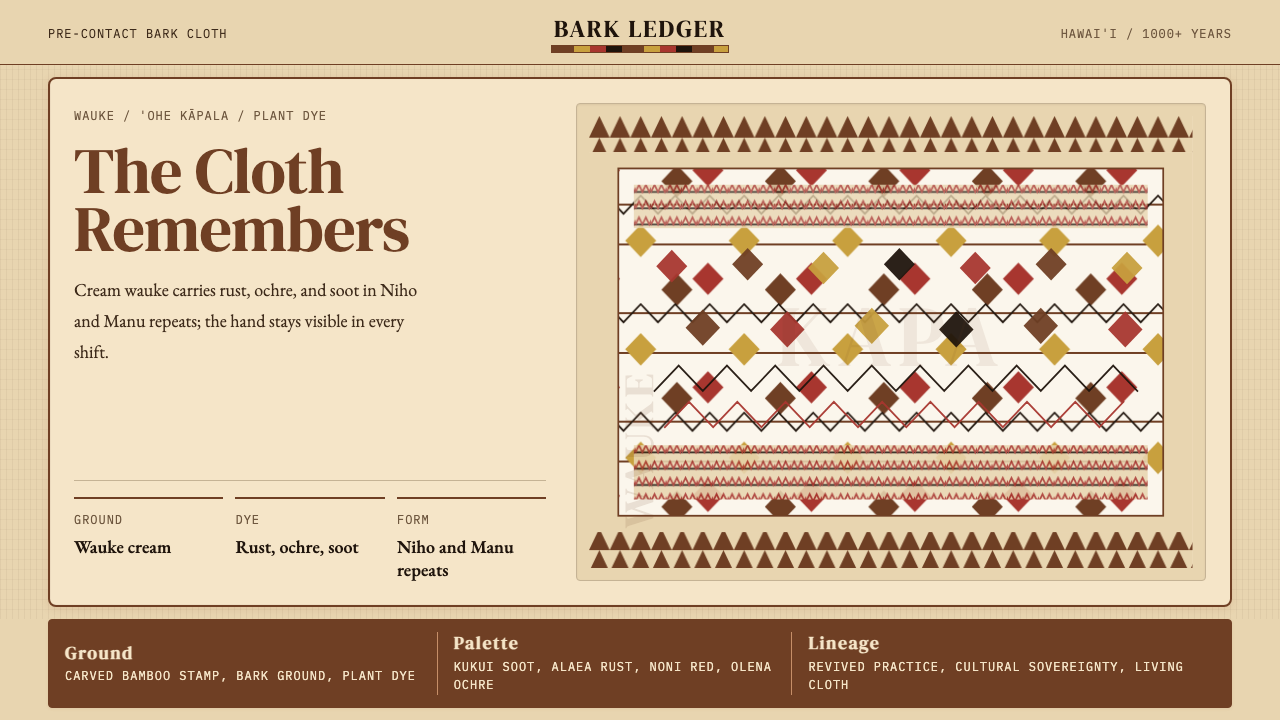 Hawaiian Kapa (Bark Cloth)Ceremonial geometry. Cream wauke, rust, ochre, and soot stamped in repeat.
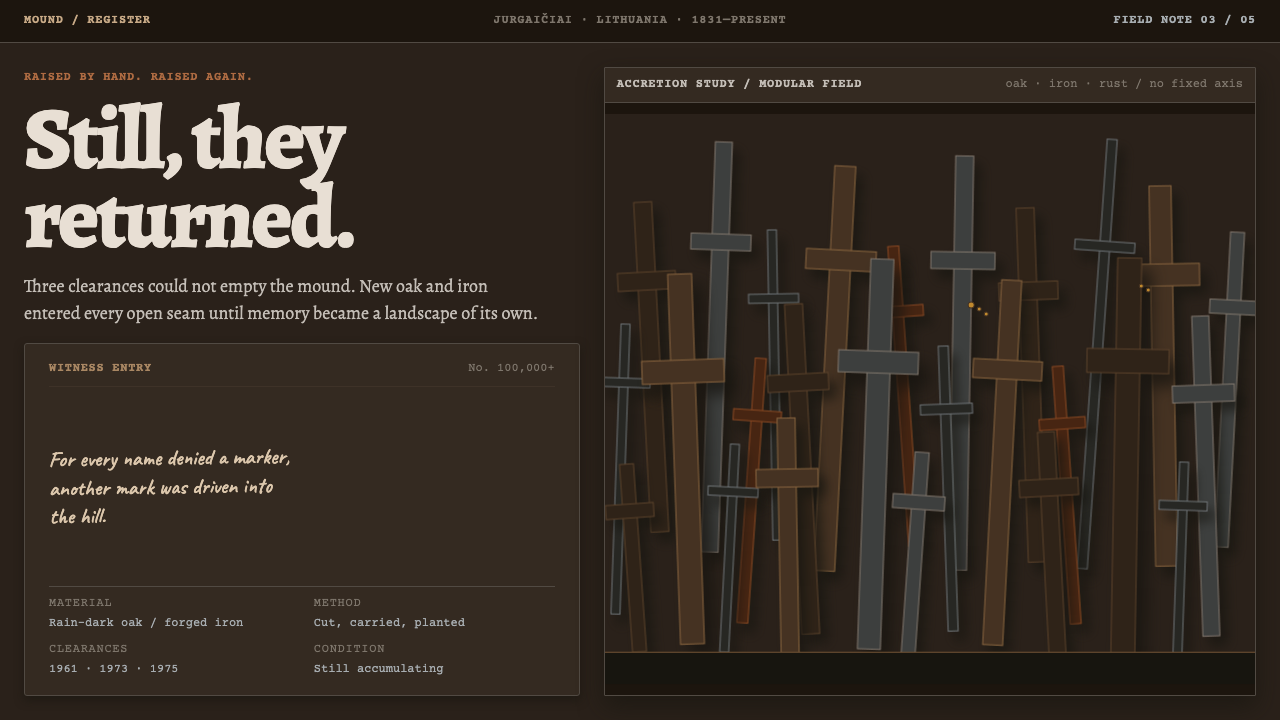 Hill of CrossesMemory returns by hand. Rain-black oak and rusted iron overlap until density…
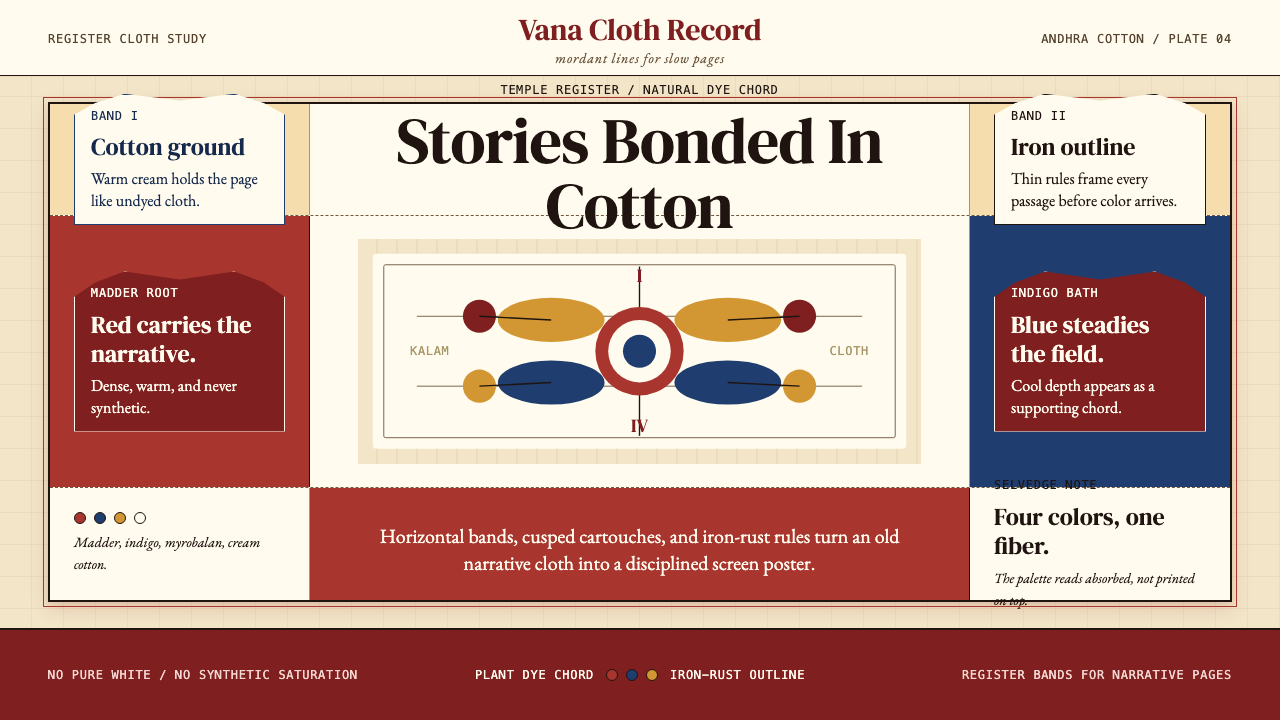 Kalamkari (Andhra Pradesh)Cloth becomes narrative. Madder bands, indigo panels, and iron rules stack li…