What is Mali Bògòlanfini (Bambara Mud-Cloth)?
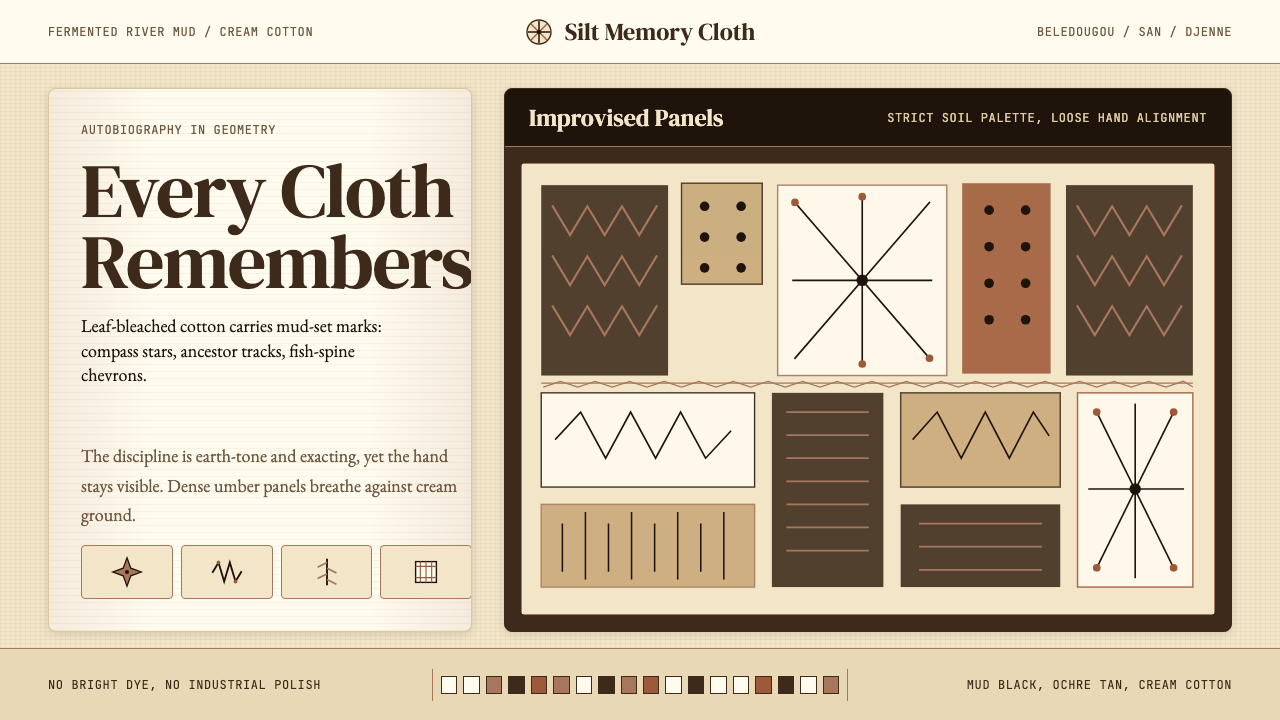
Born from Niger River mud and centuries of Bambara women's hands, bògòlanfini turns earth itself into a geometric autobiography.
Mali Bògòlanfini (Bambara Mud-Cloth) in brief
Bògòlanfini — literally 'mud cloth' in Bambara — is a centuries-old textile tradition from southern Mali in which hand-woven cotton strips are joined, treated with leaf-tea mordants, and then hand-painted with iron-rich fermented riverbed mud that binds permanently to the fiber. The result is a cloth whose deep umber-brown and warm ochre-tan figures sit against an undyed cream ground, creating a visual language of profound restraint — only the colors the earth itself provides, never anything brighter or more synthetic.
The visual grammar of bògòlanfini is entirely geometric and entirely improvisational within that constraint. Compass-star rosettes, ancestor-track chevrons, fish-spine zigzags, comb-tooth grids, and lightning-bolt diagonals accumulate across the cloth surface without fixed repeat or symmetrical mirroring. Each cloth is the painter's individual statement: the composition is hers alone, built up through alternating applications of mud and bleaching agent until the negative cream space and the positive dark figure achieve the density she intends. This interplay of figure and ground — dark motif on light field, occasionally reversed with dark ground and bleached figures — is the fundamental visual tension the style explores.
Despite its ancient roots, bògòlanfini became an international design reference in the 1980s when Malian fashion designer Chris Seydou introduced mud-cloth panels into tailored garments shown in Paris. From there it entered the broader vocabulary of Pan-African identity and diaspora design, appearing on everything from album covers to interior textiles to digital pattern libraries. The aesthetic carries with it the silt of the Niger River — not as metaphor but as literal material — and that material origin gives it a warmth, irregularity, and depth that no synthetic imitation fully reproduces.

Where does Mali Bògòlanfini (Bambara Mud-Cloth) come from?
The practice of bògòlanfini is rooted in the Bambara (also called Bamanana) people of southern Mali, primarily in three regions: Beledougou, San, and Djenné. Within Bambara culture, the craft was traditionally the province of women, passed from mother to daughter over generations. The knowledge encoded in bògòlanfini is not merely decorative: specific geometric configurations carry social meaning, marking stages of life passage — the transition from girlhood to womanhood, the status of a hunter, the identity of a particular village or lineage. A cloth was not simply patterned; it was read.
The technical process has remained largely consistent across centuries. Strips of hand-woven cotton — typically narrow, produced on horizontal looms — are sewn together into larger cloths. The cloth is then soaked in a solution of pounded and boiled leaves, often from the n'gallama or wolo trees, which coat the fiber with tannins that allow the mud to bind. The painter then applies iron-rich mud from the Niger riverbed, harvested and fermented in clay pots for up to a year, directly onto the cloth using a metal blade, a carved wooden tool, or her fingers. The mud oxidizes with the tannins in the fiber, fixing the dark mark permanently. Sections of the cloth that should remain light are treated with a caustic bleaching solution — traditionally a millet-flour-and-water paste, later sometimes a soap or chemical bleach — that removes the leaf-tea ground and returns those areas to near-white. The process alternates, building figure and ground through successive applications.
Western documentation of bògòlanfini as a distinct cultural artifact began in earnest in the nineteenth century, when French colonial administrators and ethnographers in West Africa noted the distinctive cloths. The first systematic scholarly treatment came in the mid-twentieth century through the work of Pascal James Imperato, an American physician and anthropologist who documented the tradition during his years in Mali in the 1960s and published detailed accounts of its iconography and social function. Imperato's documentation established the vocabulary of motif names and their social meanings that subsequent researchers and designers have drawn upon.
The pivotal moment of international exposure came in the 1980s through Chris Seydou, a Malian designer who had trained in Paris and was working across both Malian and French fashion contexts. Seydou cut mud-cloth panels and integrated them into structured tailored silhouettes — combining a textile with deep local roots with a design language legible to international fashion audiences. His work was shown in Paris and attracted significant attention, and from that exposure bògòlanfini entered the international design and fashion conversation. Seydou died in 1994, but his role in bringing the textile to global recognition is foundational. The subsequent decades saw bògòlanfini adopted across the African diaspora as a symbol of Pan-African cultural identity, a process accelerated by its appearance in American popular culture — on stage costumes, in film, and in editorial photography — through the 1990s and into the twenty-first century.
What defines the Mali Bògòlanfini (Bambara Mud-Cloth) look?
Earth-Tone Monochrome Palette
The color range of authentic bògòlanfini is entirely determined by its materials: the deep umber-brown and near-black of fermented Niger River mud, the warm ochre-tan of partially oxidized mud or diluted applications, and the cream of undyed cotton. No chromatic color — no red, green, blue, or purple — appears in the traditional system. The palette's warmth and depth come from the iron content of the mud and the tannin content of the mordant; the variation between cloths comes from differences in soil source, fermentation time, and the number of mud applications layered before bleaching. This material constraint is also the style's visual identity: the warmth of the tones against the cream ground is immediately recognizable and non-reproducible by synthetic means without losing its quality.
Geometric Motif Vocabulary
The visual language of bògòlanfini is built from a repertoire of recurring geometric units: compass-star rosettes formed by intersecting diagonal lines, chevrons and V-tracks that read as ancestor footprints, fish-spine arrangements of alternating diagonals, comb-tooth borders, grid and lattice patterns, and bold zigzag lightning forms. These units are not combined according to a fixed grammar — the painter assembles them according to her own knowledge, the message she intends the cloth to carry, and the compositional instinct developed through years of practice. The result is never the same twice: each cloth is an improvisation on a shared geometric language, analogous to a jazz musician playing within a harmonic tradition without reproducing an exact melody.
Figure-Ground Tension
The most distinctive compositional quality of bògòlanfini is the active relationship between its dark motifs and its light ground. The cream negative space is not passive background — it is a designed element of equal weight to the painted figure. Experienced painters control the density and distribution of motifs so that the eye moves between figure and ground in a rhythm: dense motif areas create visual weight, open cream areas provide release. Some cloths reverse the standard arrangement entirely, using a dark mud ground with bleached-out figures — a technique that produces a photographic-negative quality and shifts the visual temperature of the cloth from warm to cool.
Hand-Made Irregularity
Because every line, every motif unit, and every boundary in a bògòlanfini cloth is applied freehand using a tool held in the painter's hand, the work carries an inherent irregularity that is inseparable from its aesthetic identity. Lines waver slightly. Repeated motif units vary subtly in size. The boundary between a mud-painted area and the cream ground is not a crisp vector edge but a slightly absorbed, slightly feathered boundary where the mud has spread into the woven textile. This quality is not a defect to be corrected in applications of the style; it is the primary carrier of the cloth's warmth and humanity. Digital or printed interpretations that remove this irregularity and substitute mechanically perfect repetition lose the essential quality of the aesthetic.
Asymmetric Density Rhythm
Bògòlanfini compositions are rarely symmetrical in the bilateral sense that Western decorative traditions favor. Instead, they achieve balance through the distribution of visual density: a heavily patterned section on one side of a cloth is balanced by a different but equally active section elsewhere, not by its mirror image. This asymmetric rhythm is partly a consequence of the improvisational compositional method and partly a reflection of the Bambara aesthetic value for dynamic rather than static balance. The eye is invited to travel across the cloth surface reading the sequence of motifs, not to rest in a single centered focal point.
Negative Space as Active Element
In bògòlanfini, the untreated cream cotton ground functions as a fully intentional design element rather than mere absence of pattern. The painter's control over the cloth lies as much in what she leaves uncoated as in what she paints. Narrow cream bands between motif units create visual breathing room that prevents the composition from collapsing into undifferentiated darkness. Wide cream passages serve as compositional rests — moments where the eye can pause before encountering the next motif zone. This disciplined use of negative space is one of the qualities that makes bògòlanfini aesthetically compatible with modern design sensibilities despite its ancient origins.
Cultural Encoding and Social Function
Unlike purely decorative textiles, bògòlanfini carries encoded social meaning in its motif choices. Individual geometric configurations bear names — the name of a specific lineage, the name of a historical event, the name of an animal or tool with ceremonial significance — and the combination of named motifs on a single cloth makes an argument or tells a story legible to those with the cultural knowledge to read it. Cloths were traditionally made to mark specific life events and worn by their recipients as a form of identity statement. This communicative dimension is what distinguishes bògòlanfini from other geometric textile traditions and gives it the quality that designers sometimes describe as the cloth feeling like it means something, even when the viewer cannot read its specific vocabulary.

Who shaped Mali Bògòlanfini (Bambara Mud-Cloth)?
Chris Seydou (1949–1994) was a Malian fashion designer who trained in Paris and worked across Malian and French fashion contexts before establishing his atelier in Bamako. His pivotal contribution was the recognition that bògòlanfini — a textile with deep roots in Bambara village craft — could be cut, seamed, and structured into garments that spoke to an international fashion audience without abandoning the textile's visual identity. His Paris showings in the 1980s were the first sustained international exposure bògòlanfini received as a design material rather than an ethnographic artifact, and his work framed the textile as a modern design resource rather than a folkloric curiosity. His early death in 1994 cut short a career that had been foundational to the internationalization of West African fashion.
Aminata Dramane Traoré served as Mali's Minister of Culture from 1997 to 2000 and was a consistent advocate for the recognition and support of Malian cultural production, including traditional textile practices. Her writing and public work positioned bògòlanfini and other Malian crafts not as relics to be preserved in museums but as living cultural resources with present-tense relevance to African identity and economic development. Her advocacy helped establish institutional frameworks within Mali for the support of traditional craft industries at a period when globalization was threatening to displace them.
Pascal James Imperato, an American physician and anthropologist, lived and worked in Mali during the 1960s and produced the first systematic scholarly documentation of bògòlanfini's iconography and social function. His research established the foundational catalogue of named motifs and their meanings — the vocabulary that subsequent designers, researchers, and cultural advocates have drawn upon. Without his documentation work, much of the specific cultural encoding of bògòlanfini's geometric vocabulary might have remained accessible only to practitioners within the tradition, making it impossible for the broader design world to engage with the textile's meaning rather than merely its appearance.
Boubacar Doumbia is among the contemporary Malian artists who have worked to develop bògòlanfini as a fine art medium beyond its traditional textile context, producing large-format works on cloth that engage with the tradition's geometric vocabulary while expanding its scale and compositional ambition. His work represents one direction in which the tradition has evolved in the post-Seydou period: toward an art practice that treats the cloth and its mud-painting process as tools for individual artistic expression alongside — rather than in place of — its cultural function.
How do you use Mali Bògòlanfini (Bambara Mud-Cloth) today?
Bògòlanfini is among the most distinctive of the historical textile aesthetics available to contemporary designers, and its qualities — warm earth tones, bold hand-drawn geometry, active negative space, and inherent textural irregularity — translate well to digital applications when handled with understanding of what makes the original compelling. The most important principle for application is that the style's power comes from restraint and material honesty: the palette is exactly what iron mud on cream cotton looks like, and any attempt to expand it into brighter or more saturated territory abandons the core visual logic.
For presentation slides, bògòlanfini works most effectively as a cover or section-divider aesthetic rather than a data-dense content style. A cover using this aesthetic benefits from a cream or warm off-white field with a single large geometric motif — a compass-star or a bold zigzag — rendered in deep brown on the dominant proportion of the surface, with the title set in a clean, neutral typeface at high contrast against the field. Content slides should carry the aesthetic through texture references and color choice rather than attempting to reproduce mud-cloth geometry on every page; a consistent warm cream background with deep brown type and subtle geometric border elements is more sustainable and more readable than a motif-heavy approach. Data visualizations in this palette use the deep brown and the warmer ochre tones to differentiate series, treating chart elements as geometric forms in the same spirit as the textile's own forms.
For web interfaces, the aesthetic is particularly well-suited to landing pages, editorial headers, and cultural or identity-focused brands where warmth, distinctiveness, and a sense of craft are desired values. A dashboard or product interface in this style should use the cream as the dominant background, reserve the deep earth-brown for navigation elements, headings, and primary interactive states, and deploy the lighter ochre tones as accent or secondary states. Texture can be introduced subtly through background treatments — a slight grain or weave-like pattern — without importing an actual photograph of mud cloth, which risks looking literal rather than inspired. Card components should use warm borders rather than soft shadows; the aesthetic is not one of floating, luminous surfaces but of grounded, material presence.
For editorial and marketing contexts, bògòlanfini's bold geometry and high contrast between dark figure and light ground make it a strong framework for feature headers, section breaks, and promotional materials where visual impact at a distance is needed. A full-width editorial header using a large geometric motif in deep umber against a cream field reads immediately and memorably. Marketing materials benefit from the style's warmth: where a cooler, more minimal aesthetic might feel sterile, the earth tones convey trustworthiness, depth, and cultural seriousness. The style is particularly effective for brands operating in fashion, craft, music, cultural institutions, and any context where African or African-diaspora identity is part of the visual proposition.
The most common mistake when applying this aesthetic is treating it as a pattern library rather than a visual philosophy. Designers who lift mud-cloth motifs and apply them at high saturation in synthetic colors, on dark backgrounds, or at mechanical repeat-pattern precision miss the essential qualities: the warmth of the palette, the humanity of the hand-drawn line, the breathing quality of negative space, and the cultural weight of the geometric vocabulary. A second common error is using the motifs decoratively without any understanding of their scale relationships — cramming compass-stars and chevrons into a small icon or favicon produces visual noise rather than the bold legibility the aesthetic achieves at appropriate scale. Use fewer motif types, give each more room, and trust the negative space to do compositional work.

Mali Bògòlanfini (Bambara Mud-Cloth) — FAQ
Is bògòlanfini always dark motifs on a light ground, or can the palette be varied?
The traditional base case is dark motifs — deep umber-brown to near-black — on an undyed cream cotton ground. However, the tradition itself includes a reversal technique in which the mud is applied across the entire surface as a ground, and then selective areas are bleached out to create lighter figures against the dark field. This produces a visually cooler, more graphic quality — closer to a photographic negative — compared to the warmth of the standard version. In contemporary design applications, the palette can be extended by using the ochre-tan range of partially oxidized mud tones as a mid-value accent, creating a three-value system of cream ground, ochre mid-tone, and deep umber. What should be avoided is introducing unrelated hues: the visual logic of the style depends entirely on the restricted earth-tone range, and importing a color that has no analog in the natural mud-and-cotton process breaks the aesthetic coherence.
How do you introduce the hand-made quality of mud cloth in a digital or printed context?
The most effective approach is to work at the level of the motif construction rather than applying a photographic texture overlay. When drawing geometric forms in a vector environment, introduce deliberate slight variation in line weight and subtle imperfection at corners and endpoints rather than using the software's perfect geometric tools. A compass-star constructed with slightly uneven arm lengths reads as hand-drawn; the same form constructed with perfectly equal arms reads as mechanical and loses the essential quality. Alternatively, scan hand-drawn motifs and clean them up minimally — preserving the slight wavering of lines and the absorbed edge quality — rather than re-drawing them at vector precision. For backgrounds, a subtle paper or woven textile grain applied at low opacity conveys material warmth without literally reproducing a mud-cloth photograph.
What is the cultural protocol around using bògòlanfini motifs in commercial design?
Bògòlanfini exists in a complex position: it is both a living craft tradition with active practitioners and community owners, and a widely adopted design reference with decades of international circulation. The general principle for respectful engagement is attribution and context: acknowledging the Bambara and broader Malian origin of the aesthetic rather than presenting it as a generic 'African pattern' or a purely personal design invention. The specific motif names and their social meanings carry cultural weight; using motifs whose specific meanings are known without acknowledging those meanings reduces the tradition to surface pattern. For commercial applications, sourcing actual bògòlanfini textiles from Malian producers, or licensing patterns from contemporary Malian artists who work within the tradition, is both more ethically grounded and likely to produce more authentic visual results than constructing the aesthetic from scratch.
Does bògòlanfini work in minimalist or sparse compositions, or does it require visual density to read correctly?
The aesthetic actually accommodates both extremes, but through different mechanisms. Traditional bògòlanfini cloths range from very dense compositions — where motifs cover eighty or ninety percent of the surface and the cream ground appears only in narrow interstices — to relatively spare arrangements where a single large motif floats in a generous cream field. In design applications, a single bold geometric motif at large scale on a cream field is a completely valid and often more contemporary-feeling approach than a density-maximizing pattern treatment. The key is that whichever density approach is taken, the motif itself should be rendered with enough scale and line weight to carry visual authority: a mud-cloth geometric at very small size loses its character and reads as generic geometry rather than bògòlanfini.
How does bògòlanfini differ from other African geometric textile traditions like kente or adinkra?
The differences are substantial and matter for design application. Kente, from the Akan and Ewe peoples of Ghana and Togo, is a woven textile whose geometric patterns are created by the structure of the weave itself — the color and pattern are inseparable from the cloth construction, and its palette is traditionally bright and multi-chromatic, including gold, green, red, and black. Adinkra, also from Ghana, is a stamped textile tradition using carved calabash stamps to print symbolic motifs in black on colored cloth grounds; its motifs are discrete symbols with specific named meanings, typically arranged in a grid. Bògòlanfini differs from both in its monochromatic earth-tone palette, its hand-painted rather than woven or stamped application method, its improvisational compositional approach, and its active use of negative cream space as a design element. Each tradition has its own visual logic and cultural context; treating them as interchangeable 'African patterns' erases the distinct aesthetic and cultural specificity of each.
Related design styles
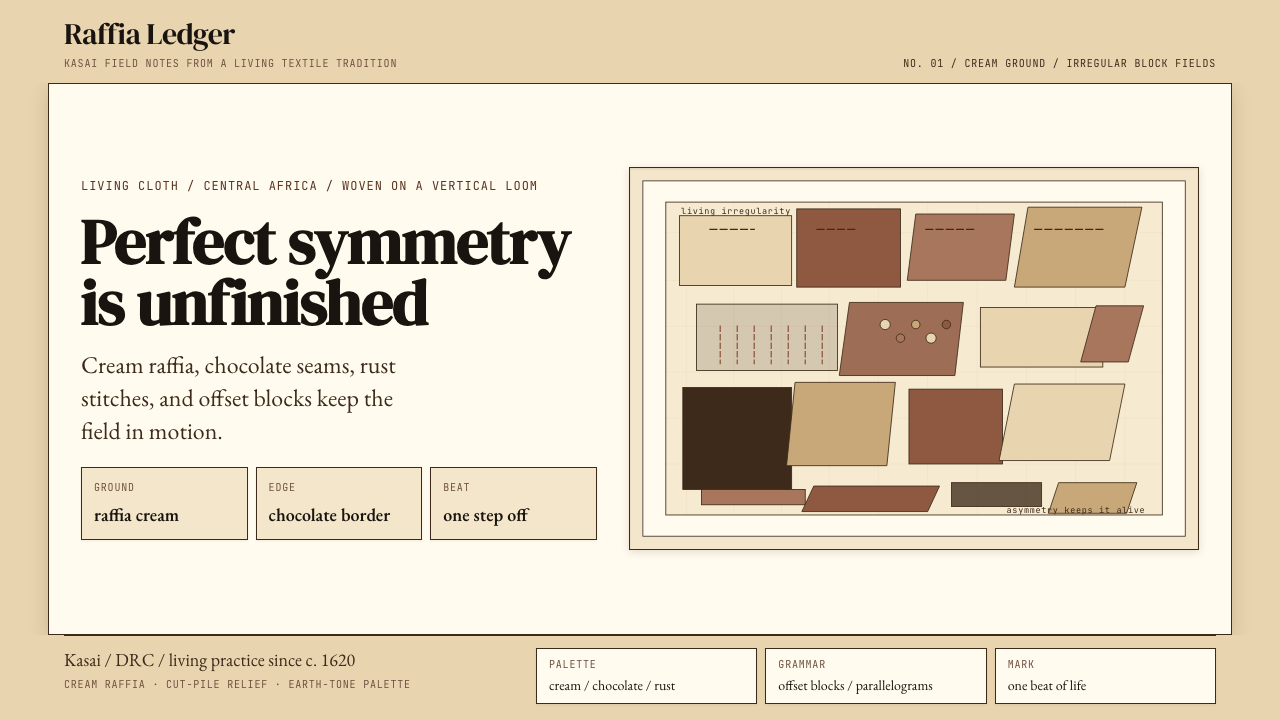 Kuba Raffia Cloth (Congo)Deliberate asymmetry lives. Cream raffia, chocolate seams, and rust blocks.
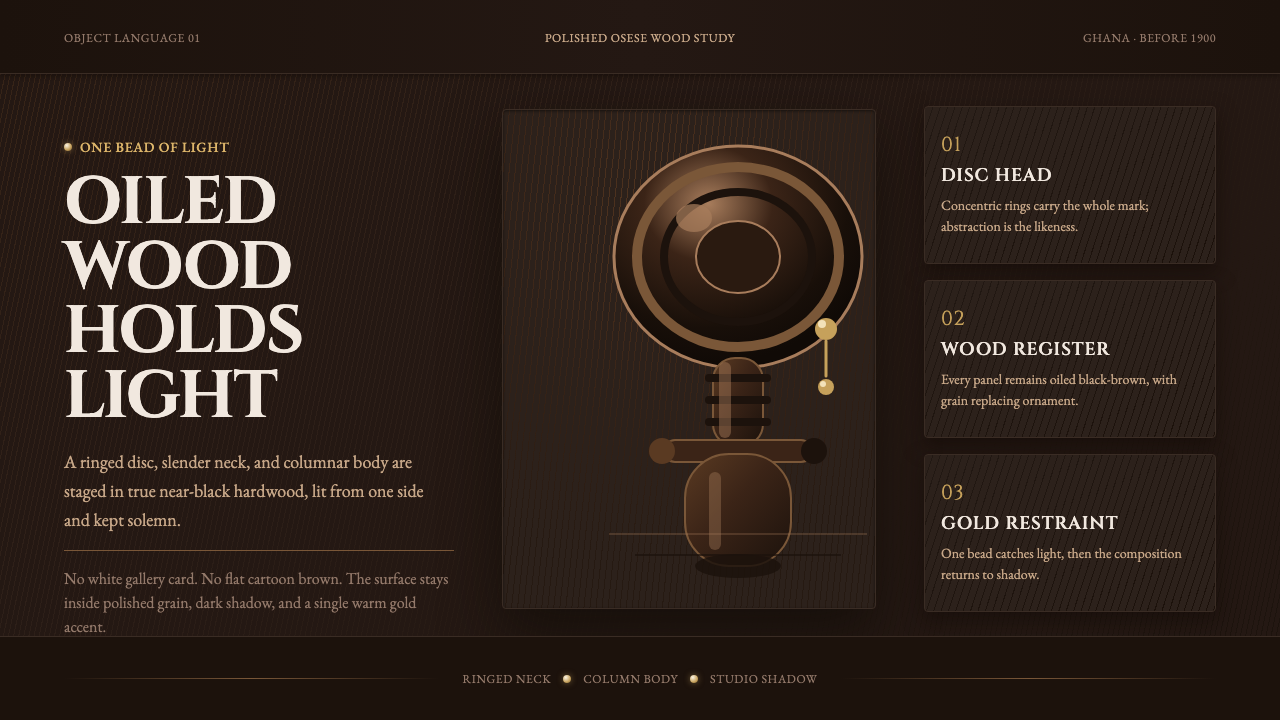 Akuaba Akan Fertility DollDarkness becomes sculpture. Near-black wood, ringed geometry, and one gold be…
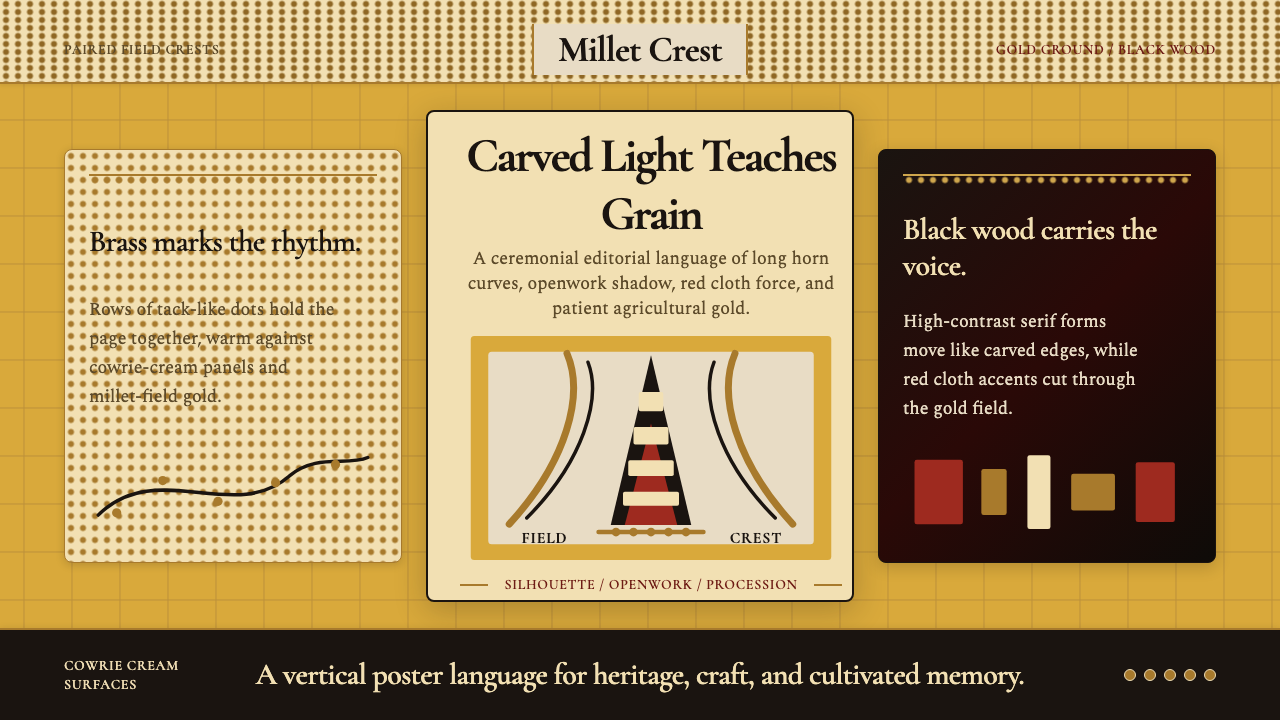 Bambara Chi Wara AntelopeCarved memory in gold. Black serif silhouettes and brass-dot borders carry th…
 Cham My Son TowersWall before ornament. Greyed brick bays recede around cut shadows and sandsto…
 Dogon Bandiagara Cliff MaskHand-hewn gravity. Charred wood, kaolin type, and sandstone geometry stack li…
 Egyptian Coptic TextileWarmth woven flat. Madder, indigo and saffron medallions sit on linen cream.