What is Fijian Masi (Tapa Cloth)?
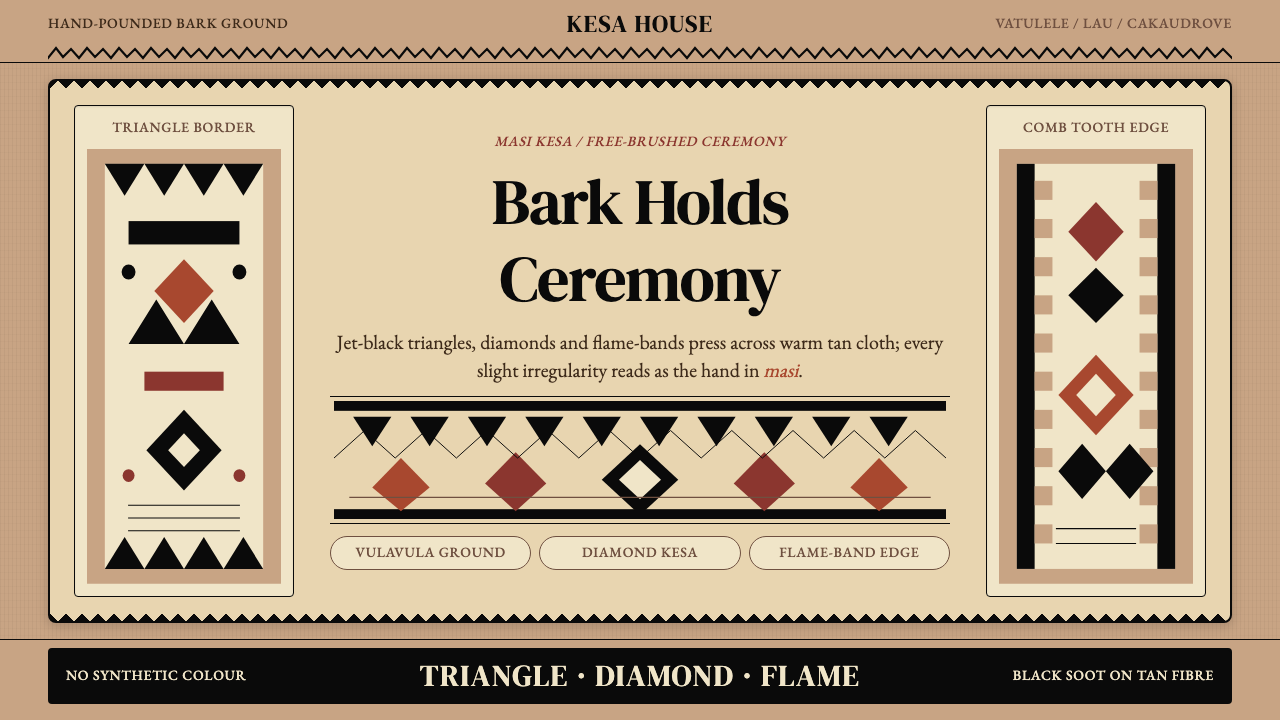
Masi is Fiji's bark-cloth tradition — jet-black geometric painting on warm tan tapa that has marked weddings, funerals, and chiefly ceremonies for more than a thousand years.
Fijian Masi (Tapa Cloth) in brief
Fijian masi is the Pacific's most graphically forceful bark-cloth tradition. Women pound paper-mulberry bark into wide, supple sheets of tapa, then hand-paint triangles, diamonds, zigzags, and flame-bands in free improvisational composition using jet-black carbon pigment against the warm tan of the bare bark. The result is a two-tone visual language of almost absolute contrast — uncompromising black geometry on a ground of warm earth — that reads as both ancient and strikingly contemporary.
What distinguishes masi from other Pacific bark-cloth traditions is its scale, its freedom, and the weight of its black marks. Hawaiian kapa tends toward finer stamped grids; Tongan ngatu uses repeated stencil motifs over larger registers. Masi is looser and bolder, allowing each maker's hand to improvise within inherited compositional conventions. Slight irregularities in the brush stroke are not defects — they are the signature of human craft pressed into fibrous bark, and experienced viewers read them as evidence of authenticity.
The aesthetic rests on a disciplined restraint that is easy to underestimate. The palette never leaves the range of warm earth tones and bleached ivory, punctuated by pure black. There is no color for decoration's sake, no gradient, no shading. The graphic punch comes entirely from the placement and proportion of black shapes against the ground — a visual logic that aligns masi, across a great distance of culture and time, with the most rigorous traditions of geometric abstraction worldwide.

Where does Fijian Masi (Tapa Cloth) come from?
The production of bark cloth in Fiji reaches back well over a thousand years, connected to the broader Austronesian expansion across the Pacific that carried the paper-mulberry plant — the raw material of tapa — from Southeast Asia to the remotest island groups. Within Fiji, distinct regional traditions emerged across the archipelago: Vatulele Island became particularly renowned for the quality of its masi kesa, the painted variety, while Cakaudrove, Kabara, and the Lau group each developed characteristic motif vocabularies that trained observers can identify by pattern family and regional idiom.
Bark cloth in Fiji has always carried ceremonial weight that distinguishes it from ordinary textile production. Chiefs received masi at installations; the dead were wrapped in it at funerals; brides and their families exchanged great lengths of it at weddings. The cloth was — and in living practice remains — a medium of social transaction as much as a material object. A single ceremonial presentation might involve strips ten meters long, displayed and then gifted in rituals that encode genealogy, alliance, and rank. This ceremonial centrality meant that the visual conventions of masi were not decorative whims but a shared symbolic language maintained across generations of makers.
The making of masi is women's work, transmitted matrilineally through communities of practice. The process begins with harvesting paper-mulberry shoots, stripping and soaking the bark, then beating it with grooved mallets on wooden anvils — a process that both thins and felts the fiber into cloth. Multiple strips are then laminated with arrowroot starch into wider sheets. Painting follows using a range of traditional pigments: carbon black derived from charred candlenut (lama) provides the dominant graphic mark, while a reddish-brown derived from mangrove bark and other natural materials gives the rust accents seen in some regional traditions. The painting itself is performed freehand, with makers working from internalized compositional knowledge rather than drawn guidelines.
Contact with European traders, missionaries, and colonial administrators from the early nineteenth century onward placed masi in a paradoxical position: it gained visibility outside Fiji precisely as the social structures that had sustained its ceremonial use came under pressure. By the late twentieth century, Fijian cultural renaissance movements — working alongside scholars including Rod Ewins, whose typological studies of masi motifs documented the regional diversity of the tradition, and Fergus Clunie, who examined its material and ceremonial dimensions — had established masi as a central symbol of Fijian cultural identity. Today, masi production continues as a living practice, spanning ceremonial use, tourist-market adaptation, and a growing field of contemporary artists and designers who apply its visual logic to new contexts.
What defines the Fijian Masi (Tapa Cloth) look?
Two-Tone Palette
The masi palette is built on an almost absolute opposition: jet-black painted marks against the warm, undyed tan of beaten bark. No third color mediates the contrast. The ground is not white but a living, organic beige — warm where candlenut oil has been applied, lighter where the bark fiber remains bare. This warmth is structural; it softens the severity of the black without compromising the graphic intensity. Some regional traditions introduce a rust or reddish-brown as a secondary accent, but the dominant logic is always black on earth.
Bold Geometric Motifs
The motif vocabulary of masi centers on triangles, diamonds, zigzags, stepped forms, and what are traditionally described as flame-bands — interlocking wedge shapes that create dynamic directional movement across the cloth. These forms are not abstract in the Western modernist sense; they carry names and associations within Fijian culture, encoding place, rank, and genealogy. Visually, however, they operate as pure geometry: flat, unshaded, drawn at a scale that reads across distance. The marks are large enough to be legible from ten paces — a practical requirement for cloth displayed at ceremony.
Freehand Improvisation
Unlike Pacific bark-cloth traditions that rely on stencils or stamps to achieve regularity, masi painting is executed freehand by makers who have internalized the compositional grammar through years of practice. This produces a characteristic quality of controlled variation: the overall pattern is coherent and recognizable, but individual marks carry the idiosyncratic energy of a human hand. Lines are not ruler-straight; diamonds are not perfectly symmetrical. This slight irregularity is a defining quality, not a deficiency. It is what distinguishes handmade masi from reproduction and what gives each cloth a living, breathing presence.
Scale and Rhythm
Masi compositions are organized through rhythm rather than symmetry. Motif bands repeat across the cloth with variations in weight and spacing that create visual breathing — areas of dense marking alternate with broader, quieter intervals of bare ground. This rhythmic alternation prevents visual fatigue across large-format pieces and mirrors the kind of pattern logic found in musical call-and-response structures. The largest ceremonial masi pieces operate as total environments: displayed in full, they surround the viewer with an insistent geometric pulse that is simultaneously orderly and alive.
Material Warmth
The bark cloth ground itself is never neutral. Beaten paper-mulberry has a slight translucency, a soft surface texture, and an organic warmth that no printed reproduction fully captures. Where candlenut oil has been rubbed in as a preservative and softener, the cloth takes on a depth that reads as amber against strong light. This material warmth is an intrinsic part of the aesthetic — it prevents masi from reading as cold or clinical despite the severity of its black geometric marks. Contemporary designers working with masi-derived visual language can approximate this warmth through off-white and warm beige grounds rather than pure white.
Regional Distinctiveness
Masi is not a single uniform tradition but a family of related regional practices, each with characteristic motif preferences, compositional tendencies, and production techniques. Vatulele Island masi is recognized for particularly fine execution and a rich carbon black that stands out from the cloth with striking density. Lau group traditions tend toward tighter interlocked geometric patterns. Kabara and Cakaudrove work develops its own signature arrangements. This regional variation means that masi carries embedded geographic information — an experienced eye can often identify provenance from the pattern family and painterly manner, much as scholars identify regional schools in European painting.
Ceremonial Gravity
The visual character of masi cannot be fully separated from its ceremonial function. The cloth is made with intent, displayed with purpose, and given with consequence — at chiefly installations, funerals, and weddings where the exchange of masi enacts social relationships and communicates rank. This purposefulness is legible in the visual manner: masi does not entertain or decorate in a frivolous sense. Its graphic marks are direct, its scale assertive, its color uncompromising. Designing with masi-derived aesthetics means accepting this gravity — the style does not lend itself to lightness or irony.

Who shaped Fijian Masi (Tapa Cloth)?
The tradition of masi painting on Vatulele Island has been sustained across generations by communities of women working within matrilineal lines of transmission. These unnamed practitioners represent the core of the tradition — its living knowledge base, its aesthetic standards, and its ceremonial memory. Their work has been collected by major museums worldwide, including the British Museum and the Fiji Museum, and scholarly documentation repeatedly identifies Vatulele as the site of the highest-quality surviving masi kesa production. The tradition persists as a communal rather than individual practice, which is itself a formal statement: the cloth belongs to the group, not the maker.
Rod Ewins is a scholar whose typological studies of Fijian masi motifs established the foundational academic record of the tradition's regional diversity and compositional grammar. His documentation work — classifying motif families, regional variants, and naming conventions — provided the comparative framework that subsequent researchers, designers, and cultural institutions have used to understand masi as a coherent tradition with internal differentiation rather than a single undifferentiated style. His research is among the primary scholarly references for the symbolic meanings and geographic distribution of specific masi pattern types.
Fergus Clunie worked as a curator and researcher at the Fiji Museum, where he produced significant scholarship on Fijian material culture, including the ceremonial and material dimensions of masi. His work examined the cloth not only as a visual artifact but as an object embedded in social and political practice — the protocols of its production, exchange, and display. This contextual scholarship is important for designers working with masi aesthetics because it makes visible the ceremonial logic that shaped the visual conventions, helping practitioners distinguish between authentic formal principles and superficial pattern borrowing.
Lucia Latukefu represents the contemporary generation of Pacific cultural practitioners who have worked to position traditional bark-cloth aesthetics within international design and art discourse. Her practice and writing have contributed to the conversation about how masi and related Pacific textile traditions can be engaged respectfully and creatively by contemporary designers — addressing questions of cultural protocol, attribution, and the difference between homage and appropriation. This work is particularly relevant as masi-derived visual motifs have gained broader international visibility in graphic design, fashion, and branding contexts.
How do you use Fijian Masi (Tapa Cloth) today?
Masi is a high-contrast, ceremony-anchored graphic tradition, and its visual logic transfers most effectively to contexts that benefit from assertiveness, cultural warmth, and geometric clarity. Understanding the style means working with its fundamental dual structure — a warm organic ground punctuated by bold black geometry — rather than simply borrowing its surface pattern vocabulary. The graphic intensity of masi does not scale down gracefully to delicate or fussy contexts; it is inherently large-scale and direct.
For presentation slides, masi works powerfully on cover pages where its bold compositional language commands attention. A cover built on this aesthetic uses a warm off-white or aged-parchment field as the primary ground, with one or two large black geometric shapes — a diamond band across the lower third, a zigzag column on one side — anchoring the composition. The title sits in high-contrast type against the warm ground, with generous negative space. Content slides are best kept quieter: use the warm ground color throughout, with black for body text and occasional geometric dividers drawn from the masi motif vocabulary to mark section breaks. Data slides benefit from chart bars and segment shapes rendered in black on the warm ground, possibly with a rust or amber accent for a secondary data series — keeping strictly to two tones and an accent, never introducing arbitrary color.
For web interfaces and dashboards, the masi aesthetic supports platforms that want to project confidence, cultural specificity, and handcrafted authenticity alongside analytical clarity. The approach treats the background as a warm tone rather than pure white, uses black for all primary text and structural elements, and introduces geometric border patterns drawn from masi motif families as visual separators between interface sections. Pricing pages work well with this vocabulary: tier cards can be outlined with geometric border treatments, with the highest tier reversed to a black ground with warm text. Navigation elements should be clean and typographic — the pattern vocabulary belongs at the structural level, not scattered as decorative fill. Avoid applying masi-derived patterns as repeating tile backgrounds, which flattens their visual weight and strips the ceremonial context.
For editorial design and marketing materials, masi's poster-quality graphic power suits bold feature announcements, cultural program materials, and brand identity systems for organizations that want to signal Pacific heritage, artisanal production, or a values-led aesthetic. A marketing page built on this tradition alternates full-width blocks between a warm ground with black typography and a black ground with warm or rust-toned typography, with geometric band motifs used as section transitions rather than ornamental afterthoughts. Print applications — event posters, packaging, certificates — are where the style is most naturally at home, because the physicality of the material logic (warm paper, black ink, no gradients) can be honored directly.
A common mistake when applying masi aesthetics is treating the geometric motifs as a pattern library to be applied decoratively across any layout regardless of structural logic. In authentic masi, every mark occupies space purposefully — the rhythm of filled and unfilled areas is compositionally considered, not randomly distributed. Designers who apply masi-derived zigzags and diamonds as decorative borders on otherwise unrelated layouts often produce results that feel culturally costumed rather than structurally informed. The more effective approach is to let the masi formal logic — the two-tone discipline, the rhythm of mark and ground, the scale of the geometric shapes — govern the entire composition, rather than adding pattern elements to a layout that was conceived in a different visual register.

Fijian Masi (Tapa Cloth) — FAQ
Is masi the same as tapa cloth?
Tapa is a generic term for bark cloth made across the Pacific — from Hawaii to Tonga to Samoa to Fiji. Masi is the Fijian name for their specific tradition of bark-cloth production and decoration. What distinguishes Fijian masi within the broader tapa family is the characteristic hand-painted black geometric decoration, the scale of the marks, and the ceremonial weight the cloth carries in Fijian social life. Hawaiian kapa, Tongan ngatu, and Samoan siapo are related traditions with their own distinct visual languages and production methods. Using the terms interchangeably flattens important distinctions in technique, visual character, and cultural meaning.
How does masi differ visually from other Pacific bark-cloth traditions?
The most immediate visual difference is the scale and weight of the black marks. Masi painting is bold and freehand — large geometric shapes applied with a confident, improvisational hand — whereas Tongan ngatu, for example, often uses repeated stenciled motifs in a more regular, dense grid, and Hawaiian kapa achieves pattern through fine stamped impressions at a smaller scale. Masi also maintains a starker two-tone contrast: the warm bark ground versus pure black, with minimal use of additional colors. Samoan siapo similarly uses geometric motifs but tends toward finer linework and a greater variety of brown tones. The Fijian tradition is the most graphically confrontational of the group.
Can masi motifs be used freely in commercial design?
This is a live and contested question. Masi motifs are not trademarked, but they emerge from a living cultural tradition in which specific patterns carry community ownership, ceremonial meaning, and genealogical significance that intellectual property frameworks were not designed to address. The distinction between visual inspiration and cultural appropriation depends on factors including attribution, the nature of the commercial context, whether Fijian makers and communities benefit, and whether the most sacred or rank-specific patterns are being used without permission. Working with masi aesthetics at the level of formal principles — two-tone palette, bold geometry, rhythmic composition — carries different implications than directly reproducing specific named motifs in a commercial product without consultation or credit.
What colors can be introduced without breaking the masi aesthetic?
The core masi palette — warm bark tan and jet black — is the system, not a starting point to be expanded. That said, some regional traditions incorporate a rust or reddish-brown derived from natural pigments as a secondary accent, and this is consistent with the tradition's own internal range. If a contemporary application requires a third tone, a warm rust or ochre sits within the tradition's logic; a cool gray or a saturated modern hue does not. The key discipline is maintaining the warm ground as dominant, using black as the primary graphic element, and treating any accent color as genuinely secondary — present for structure or emphasis, not for decoration or variety. Introducing multiple accent colors destroys the two-tone logic that gives masi its visual authority.
Does masi work in digital dark-mode interfaces?
A direct inversion — white geometric marks on a black ground — loses the warmth that is structurally essential to the masi aesthetic. The warm bark-tan ground is not incidental; it is what prevents the black geometry from reading as cold or aggressive. A more considered dark-mode adaptation would use a very dark warm brown or deep charcoal as the ground rather than pure black, and then render geometric motifs in a warm cream or aged ivory rather than pure white. This preserves the two-tone contrast and the warmth-plus-graphic-punch combination that defines the tradition. Pure black backgrounds with white geometric marks reference the formal logic of masi but lose its material and cultural warmth — the result reads as an abstracted variant rather than an authentic application.
Related design styles
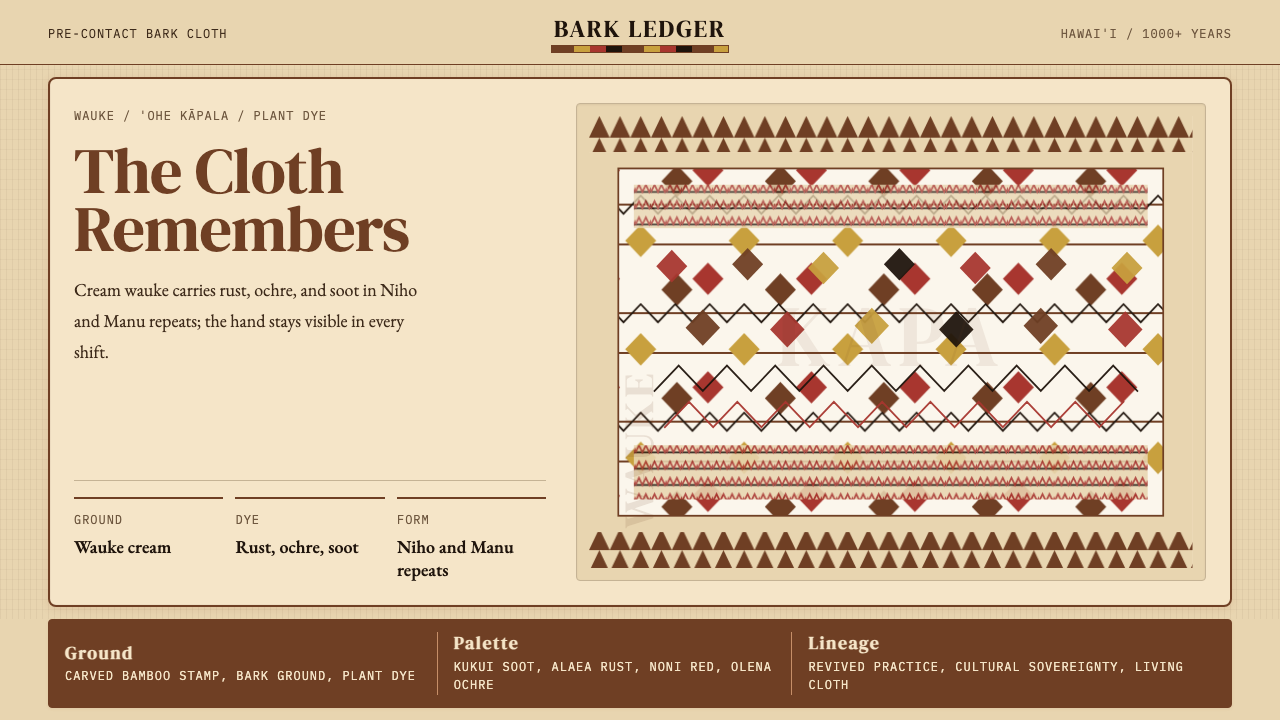 Hawaiian Kapa (Bark Cloth)Ceremonial geometry. Cream wauke, rust, ochre, and soot stamped in repeat.
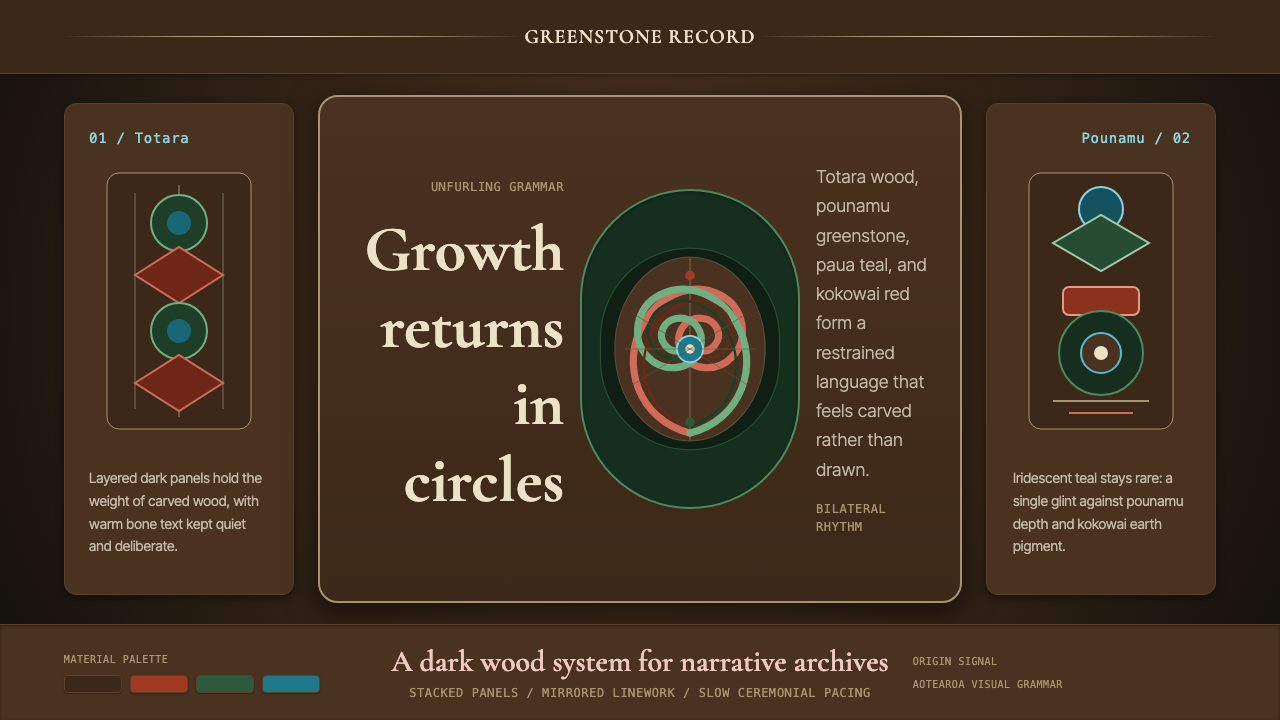 Māori Koru Spiral (Aotearoa)Carved, not drawn. Totara brown, pounamu green, and mirrored koru geometry ca…
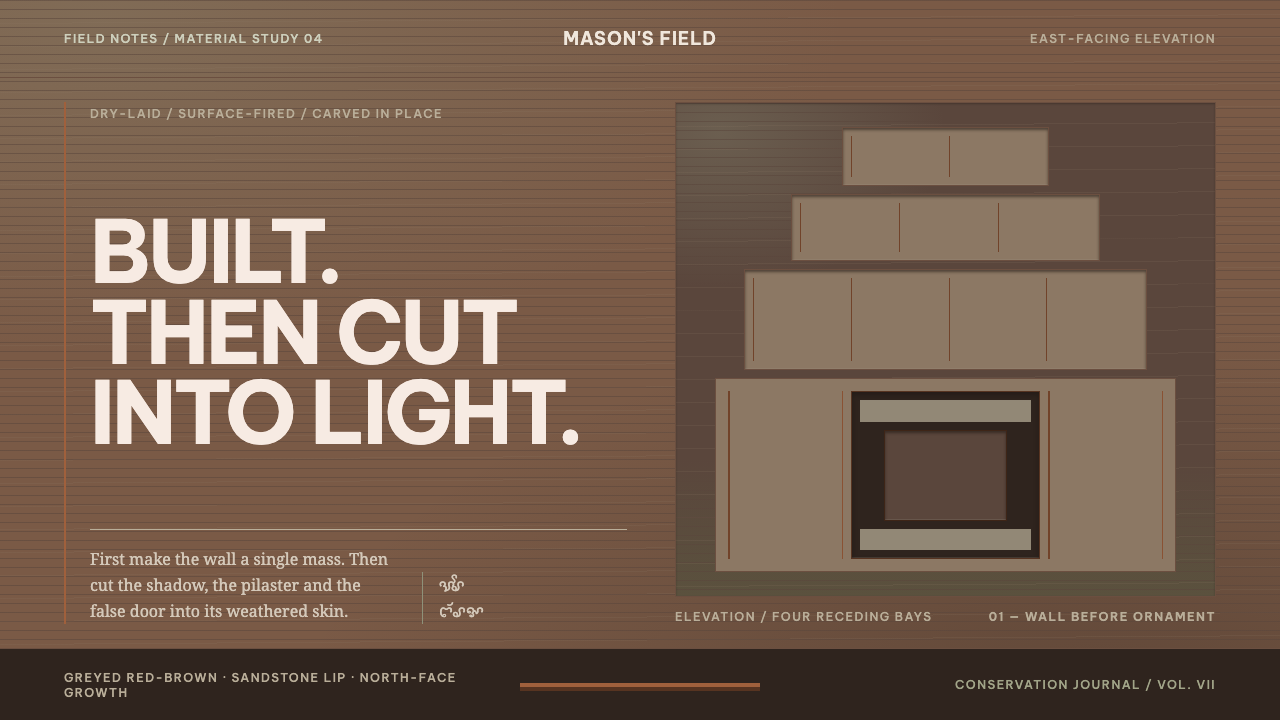 Cham My Son TowersWall before ornament. Greyed brick bays recede around cut shadows and sandsto…
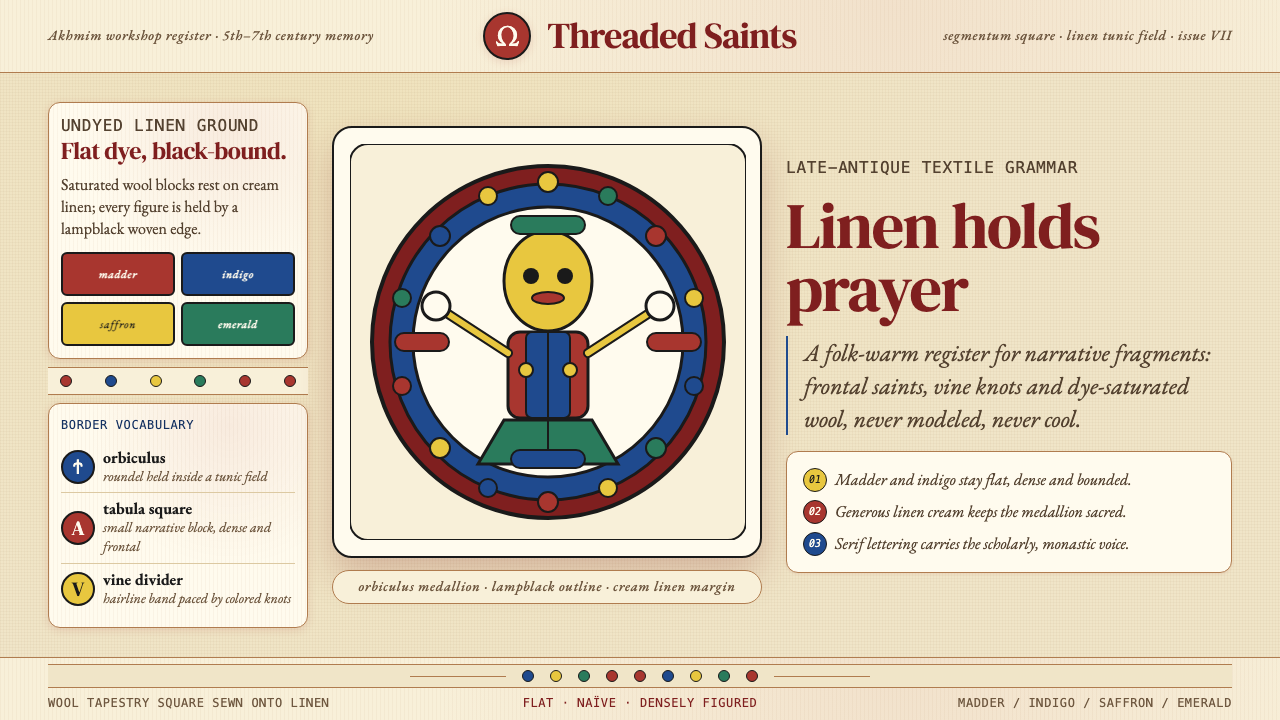 Egyptian Coptic TextileWarmth woven flat. Madder, indigo and saffron medallions sit on linen cream.
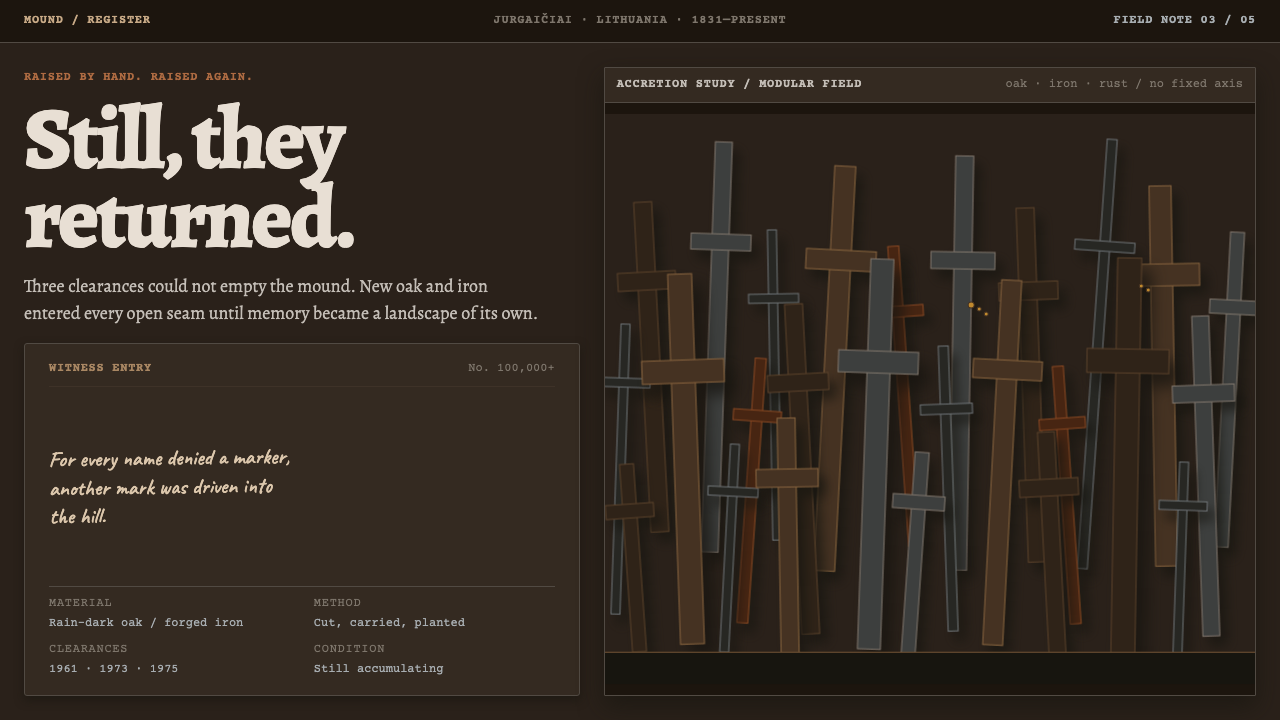 Hill of CrossesMemory returns by hand. Rain-black oak and rusted iron overlap until density…
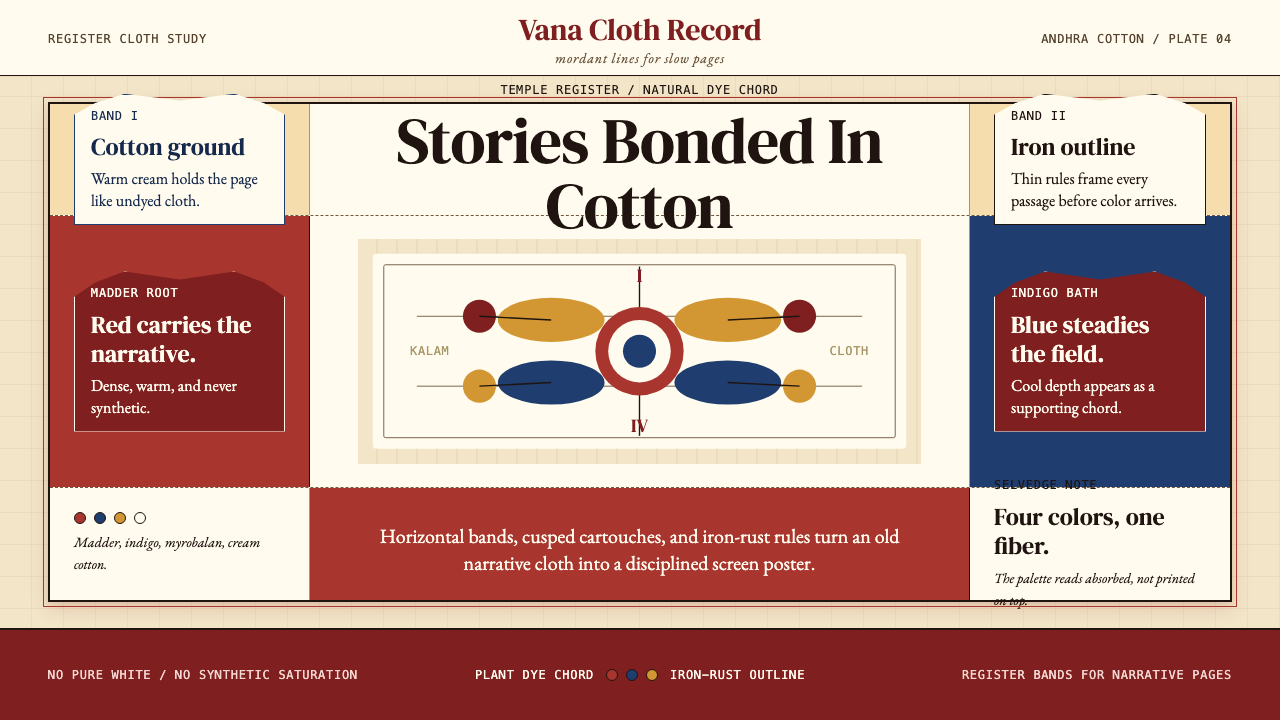 Kalamkari (Andhra Pradesh)Cloth becomes narrative. Madder bands, indigo panels, and iron rules stack li…