What is Kalamkari (Andhra Pradesh)?
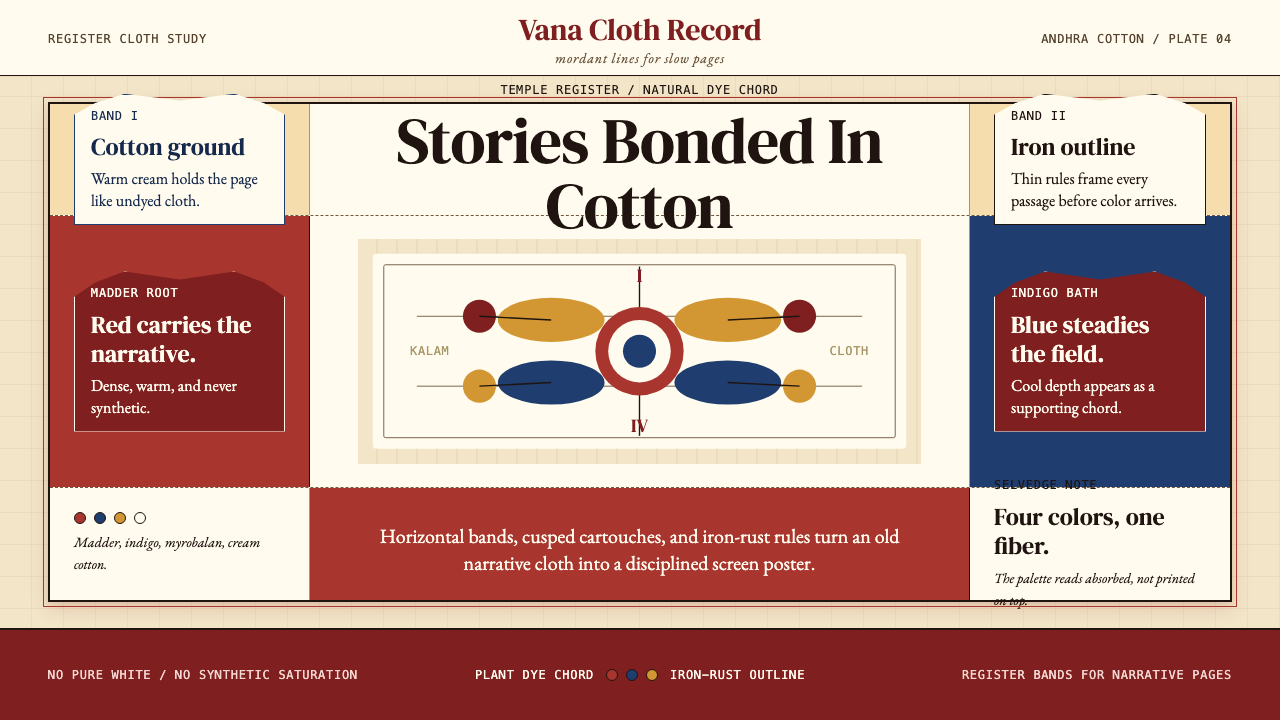
Eight hundred years of South Indian hand-drawn cloth — tamarind-twig kalam, plant-dye palette, and temple registers stacked like sacred narrative — translated into a living design system.
Kalamkari (Andhra Pradesh) in brief
Kalamkari is an 800-year-old South Indian craft of drawing directly on cotton cloth using a tamarind-twig stylus called a kalam. Artisans apply mordants and plant-based dyes — madder red, iron-rust black, indigo blue, myrobalan yellow, pomegranate pink — that bond permanently into the fiber through a sequence of soaking, drying, and fixing stages. The result is color that does not read synthetic: it is warm, slightly varied, and organically settled into the weave. Two historic schools coexist under the same name. Srikalahasti, inland on the banks of the Swarnamukhi River, practices purely freehand work: the kalam traces mythological narratives, deities, and flora directly onto cloth without any printed guide. Machilipatnam, on the Coromandel Coast, combines woodblock printing for ground patterns with kalam detailing for outlines and fine interior work — a hybrid suited to larger-scale decorative and export production.
As a design system, Kalamkari translates that woven cloth into screen and print. The ground is cream or unbleached natural cotton — never synthetic white and never cool gray. Content is organized in horizontal register bands, each carrying a distinct narrative or data layer, in the same way temple cloths divide cosmic stories into sequential rows. Iron-rust outlines unify every element: they are firm, hand-drawn rather than mechanical in character, and they give the system its defining warmth. A central vertical axis — the tree of life, or kalpa vriksha — provides structural symmetry, around which asymmetric organic detail can radiate freely. Color is governed by the natural-dye chord: warm madder reds, deep indigo blues, earthy ochres and mustard yellows, muted pomegranate pinks, and occasionally a mineral green derived from the interaction of iron and myrobalan. Nothing in this palette reads electric or industrial.
The style occupies a distinctive position in the landscape of historical design systems. Unlike systems that derive their authority from reduction and abstraction — Bauhaus geometry, Swiss typography — Kalamkari derives its authority from density, narrative, and craft specificity. Every mark carries memory of the maker's hand. Applied thoughtfully, this makes it one of the richest visual languages available for brands, editorial contexts, or digital interfaces that want to communicate heritage, artisanal authenticity, warmth, and cultural depth without resorting to cliché.

Where does Kalamkari (Andhra Pradesh) come from?
The earliest documented Kalamkari cloths were produced as temple hanging narratives — long vertical and horizontal panels narrating episodes from the Ramayana, Mahabharata, and Puranas. These cloths were not decorative in the domestic sense; they were devotional objects, hung in temples as visual scripture for worshippers who could not read Sanskrit texts. The craft likely developed alongside South Indian temple culture from at least the twelfth century, though earlier antecedents exist in the broader tradition of cloth-painting across the subcontinent. The name itself is Persian in origin — kalam means pen or reed, kari means craft or work — a linguistic trace of the Mughal and Sultanate patronage that would later transform the tradition.
Between approximately 1500 and 1700, Mughal and Deccani Sultanate patronage fundamentally reshaped Kalamkari production at Machilipatnam. Patrons required large decorative panels for palace interiors: tent linings, floor spreads, and chamber dividers. This demand introduced Persian and Mughal aesthetic sensibilities — arabesque floral scrolls, structured geometric borders, the cypress tree and garden motifs of Persian carpet design — into what had been a primarily Hindu narrative tradition. The Machilipatnam school absorbed these forms while retaining its plant-dye palette and resist-printing techniques, producing a hybrid visual language that was simultaneously South Indian in color and Indo-Persian in compositional structure.
From the seventeenth century onward, the Coromandel Coast became a significant node in the global textile trade. Dutch and English East India Company agents stationed at Masulipatnam (the colonial name for Machilipatnam) commissioned Kalamkari cloths in large quantities for European markets. European consumers called these fabrics chintz — from the Hindi chint, meaning variegated or spotted — and they became enormously fashionable in Dutch, English, and French interiors by the late seventeenth century. To meet European demand, Machilipatnam workshops adapted their compositions: borders became more regularized, grounds lighter, and floral motifs larger and more isolated. This export phase introduced new levels of standardization, but it also spread awareness of the craft across two continents and helped finance continued production through the eighteenth century.
The nineteenth century brought considerable disruption. British colonial economic policies and the flooding of Indian markets with industrially produced Manchester cotton cloth devastated hand-production across the subcontinent. Kalamkari production contracted sharply, particularly at Machilipatnam, where block-printing workshops could not compete with machine-printed fabric on price. The craft survived mainly in Srikalahasti, where the temple-cloth tradition maintained a degree of ritual patronage, and in small family workshops carrying hereditary knowledge. The twentieth-century revival came in stages: the All India Handicrafts Board supported documentation and artisan training from the 1950s, Kalamkari received a Geographical Indication tag recognizing its regional authenticity, and contemporary designers including Sabyasachi Mukherjee brought the aesthetic into high-fashion contexts, reintroducing the visual language to global audiences. Today both schools remain active, with a new generation of practitioners working across traditional cloth, paper, and digital applications.
What defines the Kalamkari (Andhra Pradesh) look?
Color Palette
The palette is bounded by the chemistry of plant dyes. Madder root yields the warm, slightly brownish reds — never the electric crimson of synthetic dye. Indigo provides the only true blue, ranging from pale woad-shadow to deep midnight depending on the number of dye baths. Iron-rust mixed with myrobalan mordant produces the characteristic charcoal-black outline color. Myrobalan alone yields amber and ochre; pomegranate rind gives soft pinks. The palette thus has internal coherence: every color is warm-toned, slightly earthed, and optically compatible with every other color in the system. Cool tones and desaturated neutrals are absent; pure white is absent; the ground itself is warm cream.
Register Band Structure
Content is organized in horizontal bands called registers, stacked vertically to narrate a sequence of events, hierarchies, or categories. Each register is bounded top and bottom by a continuous border line, often decorated with a repeating small motif — a lotus bud chain, a geometric step pattern, or a scrolling vine. This register logic mirrors the organization of South Indian temple sculpture, where narrative friezes wrap around a sanctum at different heights, each telling a different story. On screen or on the slide, registers become the primary layout unit: a title register, a content register, a data register, and a footer register each occupy their horizontal band without bleeding into the others.
Iron-Rust Outline
The defining mark in Kalamkari is the iron-rust black outline — drawn with the kalam in a single continuous gesture when the craft is at its finest. This line is not perfectly mechanical: it swells slightly at curves, tapers at stroke endings, and carries visible directionality. In a design system, this translates to borders, dividers, and decorative frames that are firm and warm in character rather than cold and precise. The outline unifies every element on the ground — illustrations, text containers, data frames, decorative borders — the same way the kalam line unifies figure, ground, and ornament on the cloth.
Tree of Life Axis
The kalpa vriksha — the wish-fulfilling tree of Indian cosmology — appears as a central vertical spine in both Srikalahasti and Machilipatnam work. Its trunk is the axis of symmetry; its branches carry flowers, birds, and narrative figures that radiate left and right in near-mirror arrangements. In design application, the tree-of-life logic provides the structural center of complex compositions: a central headline, data visualization, or hero illustration is flanked by symmetrically weighted content blocks or decorative columns. The surrounding detail is never perfectly mirrored — organic variation is essential to the aesthetic — but the bilateral logic is always present.
Botanical and Figural Density
Kalamkari grounds are never empty. Between primary figures and narrative scenes, every available surface is filled with lotus scrolls, peacock feathers, stylized mango forms, creeper tendrils, and fish scales. This infill is not filler in the pejorative sense — it is load-bearing decoration that unifies the composition and signals craft mastery. A design system derived from Kalamkari embraces this density selectively: illustration frames carry decorative infill borders, section dividers incorporate repeating botanical elements, and empty grounds are understood as unusual rather than the default. This makes the system distinctly different from minimal aesthetics where whitespace is the primary value.
Warm Ground
The ground in Kalamkari is always the color of prepared cotton: a warm, slightly yellowish cream produced by treating the cloth in a bath of myrobalan and buffalo milk before any pigment is applied. This ground is the single most important differentiator of the style. It prevents any color in the palette from reading cold or clinical. Madder red on cream is richer than madder red on white; indigo on cream is warmer and less harsh than indigo on white. In screen applications, the ground should read as natural material rather than digital neutral — warm without being yellow, substantial without being dark.
Hand-Drawn Character
The most difficult aspect of Kalamkari to transfer into digital or print work is its hand-drawn quality — the evidence of the maker's hand visible in every line and fill. Mechanical perfection is the enemy of this aesthetic. In practical application, this means preferring slightly irregular border patterns over machine-perfect rules, hand-rendered illustrations over photographic imagery, and letterforms with calligraphic ancestry over purely geometric sans-serifs. It does not mean deliberately introducing errors; it means choosing visual elements whose character carries warmth and specificity rather than neutrality and precision.

Who shaped Kalamkari (Andhra Pradesh)?
A master Kalamkari artist from Srikalahasti who has dedicated his practice to preserving and transmitting the freehand temple-narrative tradition. Niranjan's work demonstrates the full range of the Srikalahasti kalam's expressive capacity, from the finest hair-thin outlining of facial features to the bold compositional structures of multi-figure mythological panels. He has been recognized by Indian craft bodies for his role in training the next generation of practitioners and for maintaining the ritual and devotional dimensions of the craft alongside its increasing visibility in the contemporary design market.
A leading figure in the Machilipatnam tradition, Lakshman Rao is known for his mastery of the combined block-print and kalam method that defines the coastal school. His contribution has been particularly significant in documenting and codifying the woodblock vocabulary — the precise carved motifs used to lay down the structural ground of a Machilipatnam piece — at a moment when many hereditary block-carvers have left the profession. His workshops have helped sustain the ecosystem of complementary skills on which the school depends.
A Srikalahasti master who has pursued an experimental path within the tradition, applying Kalamkari technique to new formats — large wall installations, contemporary art contexts, and collaborations with architects and interior designers. Srinivas's practice demonstrates that the Kalamkari visual language is not frozen in its historic forms: the kalam's logic of line, register, and botanical density can expand to address contemporary spatial scales without losing its essential character. His work has been exhibited internationally and contributed to repositioning the craft as a living tradition rather than a museum artifact.
The Kolkata-born fashion designer who, from the early 2000s onward, became the most internationally prominent voice for Indian handcraft textiles including Kalamkari. Mukherjee's collections have consistently incorporated Kalamkari panels, borders, and motifs — bringing them into luxury fashion contexts alongside his signature blend of historical Indian textiles. His work is significant not because it is documentary or preservationist, but because it recontextualized Kalamkari within global luxury aesthetics, demonstrating that the visual language could carry authority in contemporary fashion and design without being domesticated or diluted. The renewed commercial interest in Kalamkari production that followed his collections has had direct impact on artisan livelihoods in both Srikalahasti and Machilipatnam.
The seventeenth and eighteenth-century European East India Company agents — Dutch, English, and French — who commissioned and exported Kalamkari cloths from the Coromandel Coast were not artists, but their curatorial and commercial decisions fundamentally shaped the tradition. By specifying lighter grounds, larger floral motifs, and more regularized border systems, they introduced a standardization that pushed Machilipatnam toward a broader compositional language. The chintz trade created the first significant global audience for Kalamkari aesthetics, and the stylistic adaptations made for European markets left permanent traces in the Machilipatnam school's vocabulary that persist in the tradition today.
How do you use Kalamkari (Andhra Pradesh) today?
Applying Kalamkari to contemporary design work requires understanding what the system is actually doing structurally, not merely borrowing its surface visual markers. The style's core logic is: warm ground, horizontal register organization, iron-rust outline discipline, botanical infill density, and a natural-dye color chord. When all five are present and working together, the result reads as Kalamkari-derived; when only the color palette is borrowed and applied to a modern minimal layout, the result is decorative pastiche. The distinction matters because Kalamkari's authority comes from system coherence, not from ornamental elements applied individually.
For presentation slides, Kalamkari works most powerfully on cover slides where the full visual vocabulary can be deployed without information-density constraints. A strong Kalamkari cover uses a warm cream ground, a central composition anchored by a tree-of-life or large botanical illustration treated as a hero element, a title set in a typeface with calligraphic warmth placed within a clearly bounded register band, and a border system that frames all four edges with repeating botanical motifs. Content slides should simplify significantly: retain the cream ground and iron-rust border discipline, use register bands to separate sections, and introduce the color palette sparingly through data visualization elements, category labels, or accent rules. Data slides benefit from the register logic directly — each data category occupies its own horizontal band, with plant-dye colors assigning meaning to series without competing with each other.
For web interfaces and dashboards, Kalamkari suits platforms where warmth, craft heritage, and cultural specificity are intended brand values — artisanal e-commerce, cultural institutions, travel and hospitality, food and beverage with regional provenance emphasis, and wellness brands rooted in traditional practice. The approach: set a warm cream background throughout, use bordered card components with a firm warm outline rather than soft shadow, employ a botanical border pattern as a recurring motif in navigation headers and section dividers, and restrict the full color palette to illustrative or accent elements. Pricing pages work well when each tier is housed in a register band with its own botanical border treatment, and calls to action are colored in madder red or indigo rather than generic blue or green.
For editorial and marketing work, Kalamkari provides an exceptionally rich language for print and digital content that aims to communicate craft, provenance, and depth. A Kalamkari-derived editorial layout uses a warm cream paper ground, a botanical drop-cap or initial illustration to open each major section, register bands to organize pull quotes or sidebars, and iron-rust rules rather than gray lines to separate content zones. Marketing pages benefit from the style's poster-like compositional density: full-width panels carry large botanical or figural illustrations with text overlay in a clearly bounded register, alternating between cream-ground and deep-indigo-ground sections to create rhythm without introducing new colors. Brand identity systems derived from Kalamkari should anchor on a single dominant motif — a specific flower, bird, or tree form — rather than attempting to reference the full visual vocabulary simultaneously.
A common mistake when applying Kalamkari is treating the botanical ornamentation as optional decoration that can be added or removed without changing the system's character. In authentic Kalamkari, the infill density is structural — it is what creates the sense of a fully inhabited visual world. Stripping it out in favor of modern whitespace principles produces something that looks like Indian-themed decoration rather than a Kalamkari-derived design system. The correct approach when simplifying for digital contexts is to concentrate the botanical density at borders, frames, and accent elements rather than eliminating it entirely, preserving the system's essential character while adapting its density to screen legibility requirements.

Kalamkari (Andhra Pradesh) — FAQ
What is the difference between Srikalahasti and Machilipatnam Kalamkari?
The two schools share a name, a plant-dye palette, and a warm-ground aesthetic, but differ fundamentally in technique and historical orientation. Srikalahasti Kalamkari is purely freehand — the kalam draws every line directly on cloth without any printed guide. It is the older devotional tradition, historically producing temple narratives and religious cloths. Machilipatnam Kalamkari combines woodblock printing for the structural ground pattern with kalam work for outlines and fine detail. It evolved as a more commercially oriented school, producing decorative panels and, from the seventeenth century onward, export goods for European markets. In design application, Srikalahasti-influenced work tends toward more fluid, less regularized compositions; Machilipatnam-influenced work tends toward more structured, repeating-pattern systems.
Can Kalamkari work in a dark-background layout?
A dark inversion is possible but requires significant compositional adjustment. The warm cream ground is so central to the aesthetic that replacing it with a dark background fundamentally changes the character of the system. The most successful dark-ground Kalamkari-derived treatments use deep indigo as the background — not neutral black or charcoal — because indigo is native to the palette and maintains the system's color relationships. On an indigo ground, madder red and myrobalan gold read as warm highlights rather than structure colors, and the botanical infill reads as gold or cream line-work against the dark field. The iron-rust outline color typically inverts to a pale warm tone. This approach works well for evening event materials, luxury packaging, or inverted hero panels within an otherwise cream-ground layout.
How does Kalamkari differ from other South and Southeast Asian botanical textile traditions?
Several South and Southeast Asian textile traditions share botanical motifs and plant-dye palettes with Kalamkari, but each has distinct formal properties. Batik — practiced across Java, Malaysia, and parts of India — uses wax-resist rather than kalam drawing, producing outlines that are slightly irregular and soft-edged where the wax cracked. Ikat — practiced widely across Indonesia, Central Asia, and India — achieves its patterns through thread dyeing before weaving, producing characteristically blurred, feathered edges that Kalamkari does not share. Block-printed Indian textiles from Rajasthan and Gujarat use flat repeat patterns with less figural and narrative content than Kalamkari typically employs. The distinguishing properties of Kalamkari are: the kalam's drawn line giving it a calligraphic character, the narrative register structure organizing content sequentially, and the specific natural-dye chord — madder, indigo, myrobalan, iron — that is tied to Andhra Pradesh's specific material history.
Is the Kalamkari palette compatible with accessibility standards for digital use?
The natural-dye palette of Kalamkari presents specific accessibility considerations for digital application. The warm cream ground has lower contrast against pale yellow and light ochre than a pure white ground would, so body text should always be set in the iron-rust black or a deep indigo — never in a mid-tone plant-dye color — to maintain readable contrast ratios. Madder red used as a background color needs dark text overlay, not cream text, to achieve sufficient contrast. Indigo backgrounds accept both cream and gold text at adequate contrast levels. The most common accessibility failure in Kalamkari-derived digital work is using plant-dye colors — particularly ochre, pomegranate pink, and pale indigo — at medium saturation as text or interactive label colors against cream; these combinations reliably fail contrast requirements and should be reserved for purely decorative or illustrative elements.
What kinds of products or brands are a poor fit for Kalamkari?
Kalamkari carries specific cultural and aesthetic associations that make it unsuitable for certain product categories. It reads as warm, narrative, craft-rooted, and South Asian in cultural register — which is a powerful fit for brands that share those values but can be incongruous or appropriative in others. Technology products positioning for precision and rational efficiency struggle against the style's organic density and warm tones. Financial products requiring strict neutrality and authority may find the ornamental richness undercuts the expected register. Children's educational products and playful consumer applications need lighter, more primary palettes than Kalamkari's earth-toned natural-dye system provides. Most critically: brands with no genuine connection to South Asian craft heritage should exercise considerable care before adopting the aesthetic wholesale, since the style carries cultural meaning that is not simply decorative. A thoughtful selective reference — botanical register logic, warm ground, outline discipline — is more defensible than a wholesale visual adoption.
Related design styles
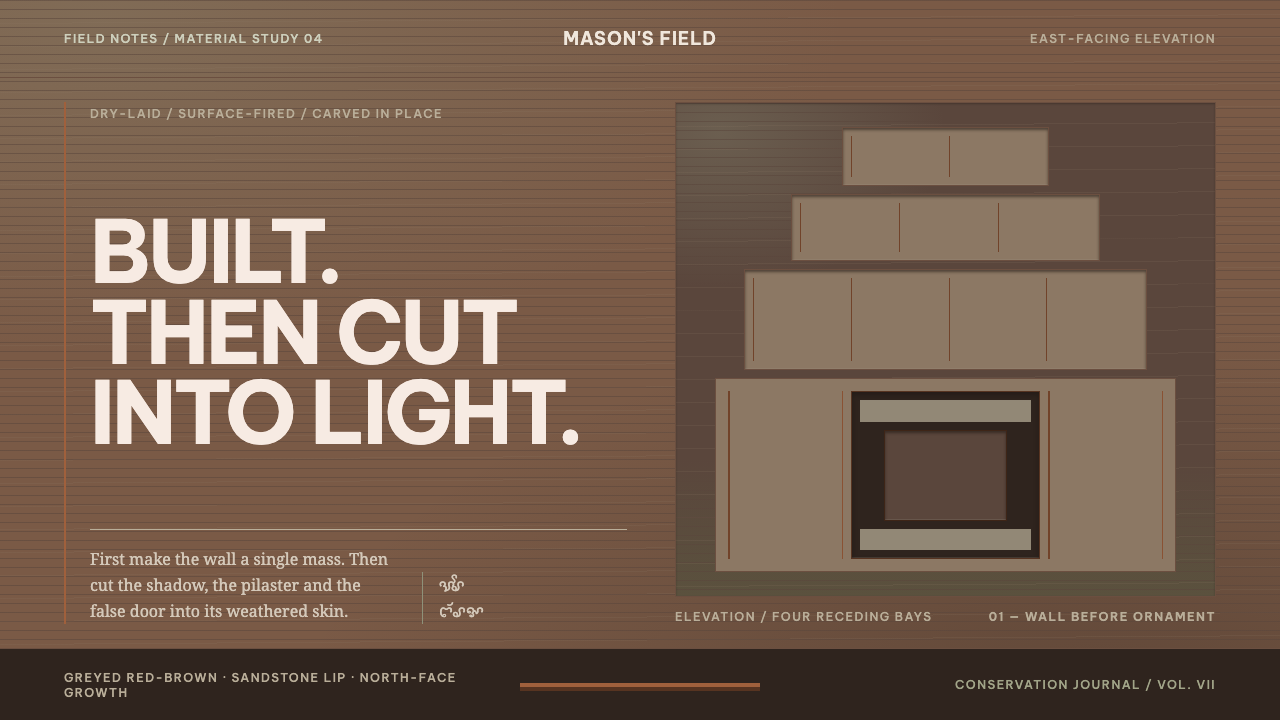 Cham My Son TowersWall before ornament. Greyed brick bays recede around cut shadows and sandsto…
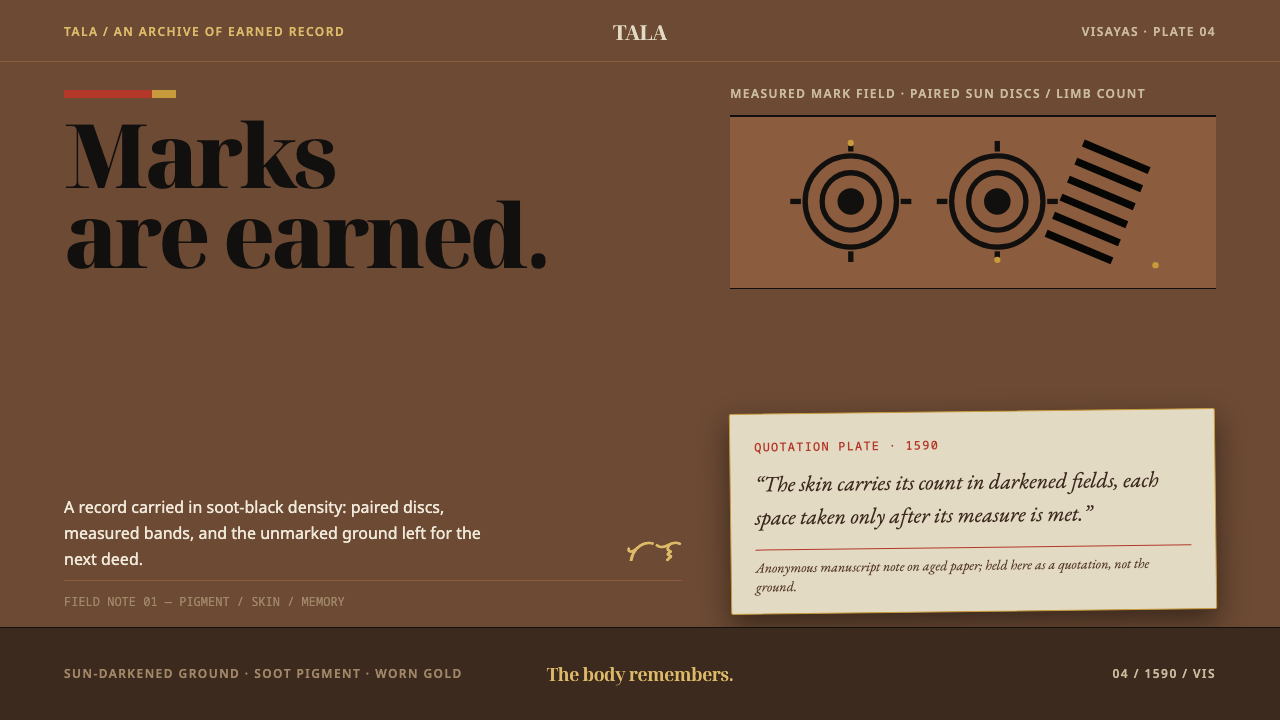 Visayan PintadosA record worn, not displayed. Soot-black marks accrete across sun-darkened sk…
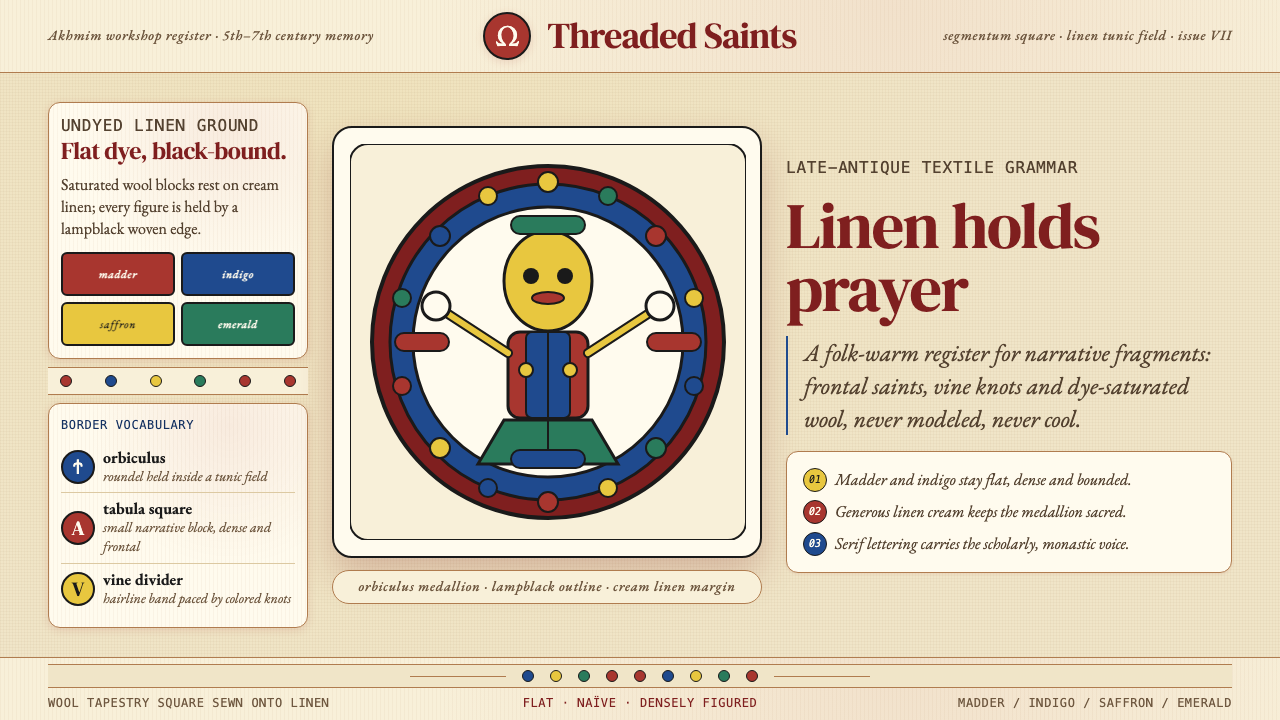 Egyptian Coptic TextileWarmth woven flat. Madder, indigo and saffron medallions sit on linen cream.
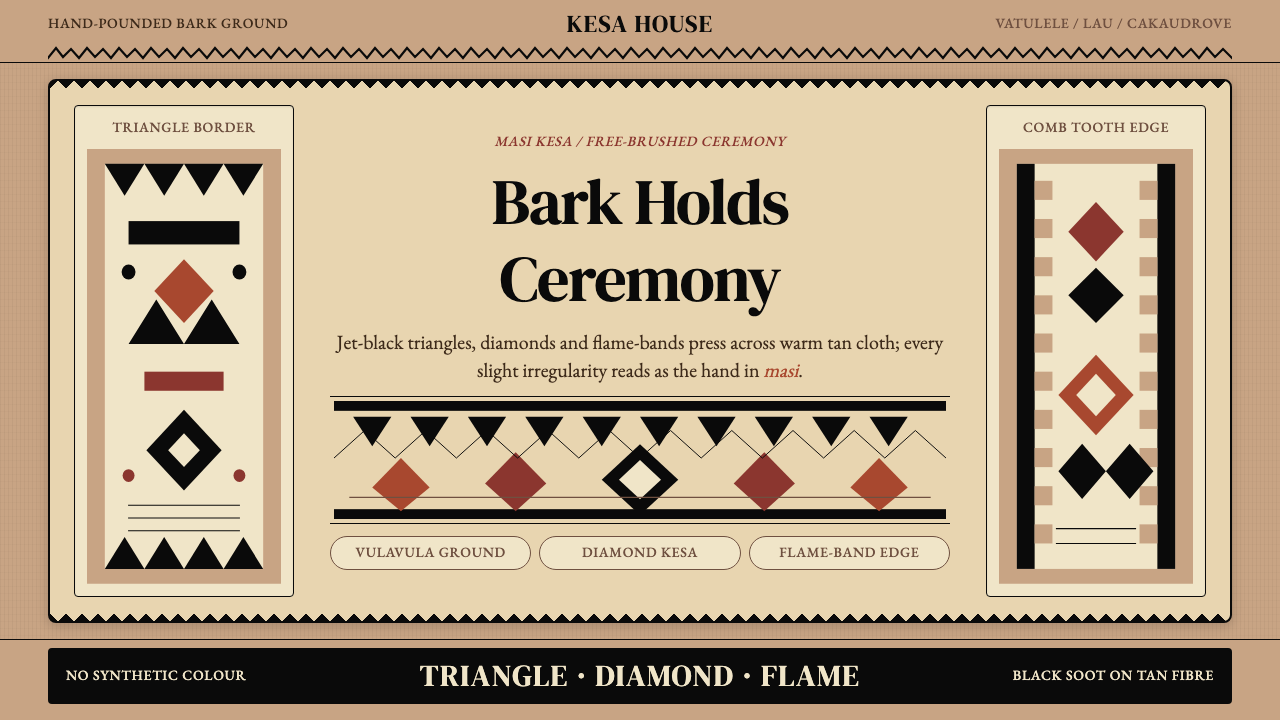 Fijian Masi (Tapa Cloth)Ceremony hits in black. Tan bark ground carries diamonds, zigzags and flame-b…
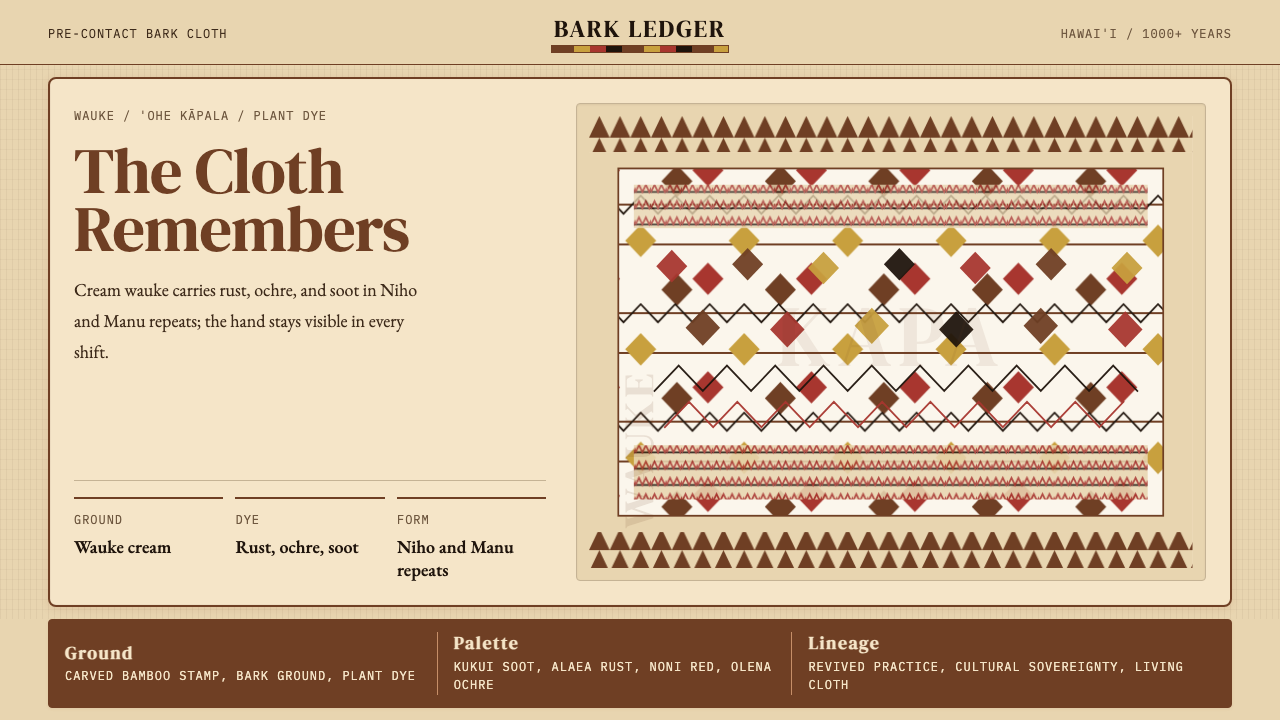 Hawaiian Kapa (Bark Cloth)Ceremonial geometry. Cream wauke, rust, ochre, and soot stamped in repeat.
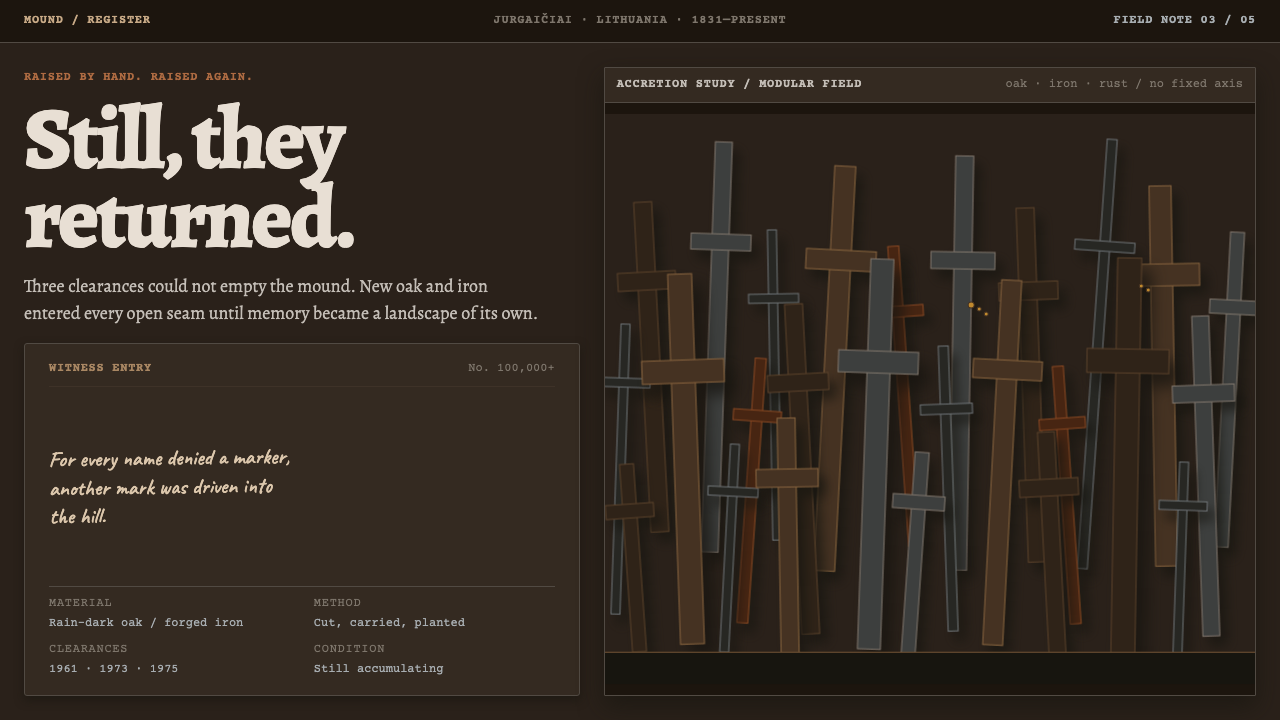 Hill of CrossesMemory returns by hand. Rain-black oak and rusted iron overlap until density…