What is Madhubani (Mithila Folk Painting)?
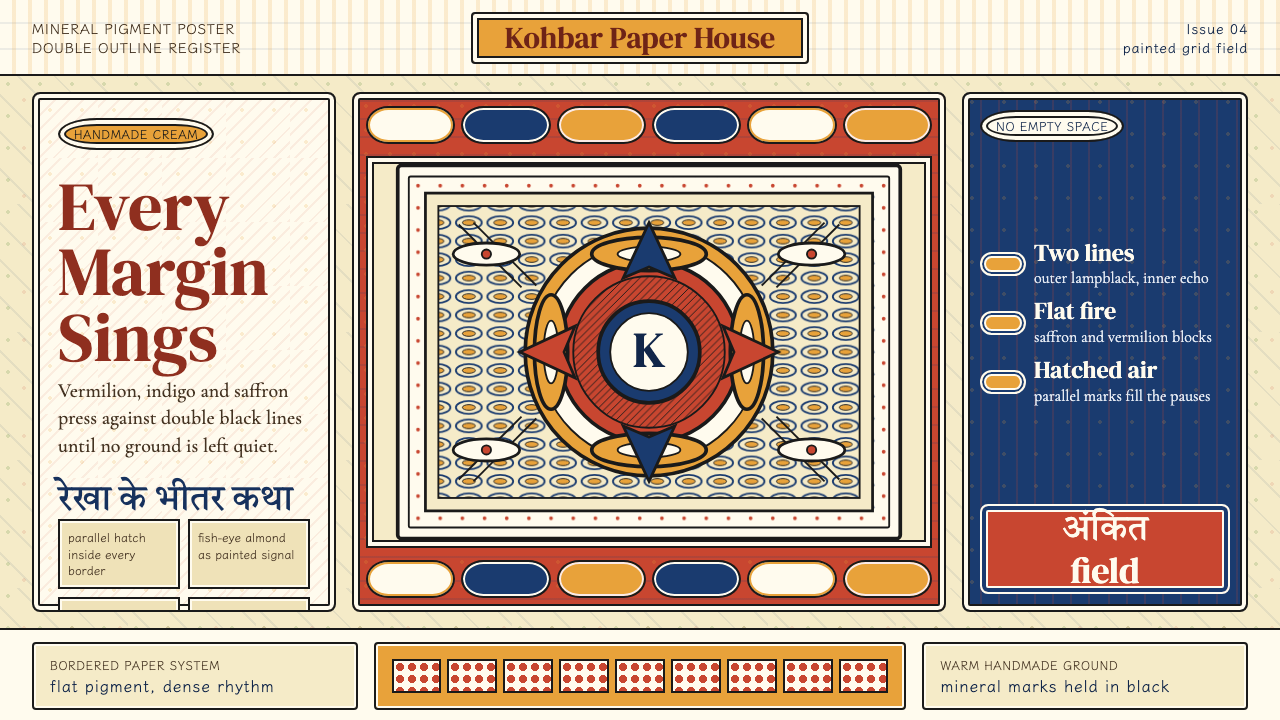
Madhubani leaves no ground untouched — every surface swells with double-outlined deities, lotus fields, and obsessively hatched geometry in saturated mineral color.
Madhubani (Mithila Folk Painting) in brief
Madhubani — also called Mithila Painting — is a centuries-old folk-painting tradition from the Mithila region of northern Bihar, India. Its visual logic is unlike almost any other historical style: there is no background, no empty ground, no atmospheric depth. Every square unit of surface is occupied by figure, motif, or hatch-filled field. Color is applied as flat, opaque mineral blocks — vermilion, indigo, saffron, lampblack — and never blended, graduated, or allowed to fade toward an edge.
The style's most distinctive technical feature is the double outline. Every figure and every major motif is drawn twice: a first contour establishes the form, and a second contour runs closely parallel to the first, creating a bold linear border that vibrates against the dense interior patterning. Within those outlines, space is filled with parallel hatching, crosshatch grids, fish-scale tessellations, bamboo-leaf chains, or vine scrolls — never solid color blocks alone. The result is a visual density that reads simultaneously as joyous ornament and as rigorous compositional discipline.
Subject matter is drawn almost entirely from Hindu cosmology and life-cycle ritual: Shiva and Parvati, Rama and Sita, the sun and moon as paired divine faces, peacocks as tokens of divine love, fish and lotus as symbols of fertility and prosperity. The tradition was historically practiced by women of the Brahmin and Kayastha castes of Mithila, who painted walls and floors for weddings, harvests, and religious festivals. This context — the art as a woman's sacred household labor — shapes the style's density: leaving ground unpainted was considered inauspicious, an invitation to emptiness where good fortune should be.

Where does Madhubani (Mithila Folk Painting) come from?
The oral tradition surrounding Madhubani traces its origins to the Ramayana itself — Janaka, the king of Mithila and father of Sita, is said to have commissioned paintings on the walls of his palace to celebrate his daughter's wedding to Rama. Whether or not this story is historical, it captures something true: the style is inseparable from the wedding ritual. For as far back as living memory and written record extend, Mithila women painted the kohbar ghar — the nuptial chamber — with imagery of fertility and divine union before each marriage. The tradition was passed down entirely through female lineage, mother to daughter, within specific castes and villages.
For centuries Madhubani existed only on impermanent surfaces: mud-plastered walls, freshly prepared earthen floors, strips of cloth. Each season's paintings were whitewashed over, and the cycle began again. The art was not collected, not sold, not signed — it was used. This changed abruptly in 1966–1967 when a severe drought devastated northern Bihar. The All India Handicrafts Board, responding to the economic emergency, dispatched the artist and art administrator Pupul Jayakar and the artist Bhaskar Kulkarni to Mithila to encourage women to transfer their wall designs to paper. The intention was to generate cash income through craft sales. The experiment produced unexpected results: paintings by Sita Devi and Ganga Devi entered international collections almost immediately, and within a decade Madhubani paper paintings were being exhibited in galleries in Tokyo, New York, and Paris.
The transition to paper forced decisions that had never been necessary before. On a wall, scale and composition could be improvised continuously; on a fixed paper sheet, the artist had to plan the total surface from the beginning. This constraint, paradoxically, sharpened the tradition's compositional logic. The characteristic all-over fill and the hierarchical arrangement of central deity surrounded by subsidiary motifs became more explicit and more refined as artists adapted to the new support.
In 1970, Sita Devi became the first Madhubani artist to receive the national Padma Shri award. Further awards followed for Ganga Devi, Mahasundari Devi, and Baua Devi across the subsequent decades, bringing institutional recognition that transformed the tradition's social status within India. What had been unpaid domestic labor — sacred but invisible — became a named and documented art form with identifiable masters. Today the style is practiced across a broad community of artists in Madhubani district and beyond, with the tradition continuing to evolve while its core visual grammar — double outline, total fill, flat mineral color, mythological subject — remains recognizable and intact.
What defines the Madhubani (Mithila Folk Painting) look?
Double Outline
Every figure and major motif in Madhubani is contoured twice. The inner line follows the form precisely; the outer line runs closely parallel, producing a bold border of consistent width. This double stroke — not a single thick line but two distinct lines with a narrow gap — is the style's most immediately recognizable signature. It gives figures a simultaneous sense of solidity and vibration, and it creates a clear visual boundary between densely patterned interior fills and the equally dense surrounding field.
Total Surface Fill
Empty ground is structurally forbidden. Every area not occupied by a primary figure is filled with subsidiary motifs — lotus buds, fish, peacock feathers, vine tendrils, bamboo fronds, or geometric grids. Where figures end, decorative fields begin without interruption. This horror vacui is not merely decorative preference but carries ritual significance: an undecorated surface was considered inauspicious in the domestic and ceremonial contexts where Madhubani originated. The compositional effect is one of teeming, abundant vitality with no hierarchy between center and edge.
Flat Mineral Color
The palette is built from a small set of saturated, opaque mineral and earth pigments: vermilion (a warm, vivid red), indigo (a deep, absorbing blue), saffron-yellow (an intense warm gold), lampblack, and occasionally turmeric-derived yellow or the bright green of crushed leaves. Each color is applied as an even, opaque field within defined boundaries — never as a wash, never gradated, never mixed to create intermediate hues. The visual effect is of color-as-substance: dense, weighty, and specific. Against a warm handmade-paper ground, the saturated blocks read as simultaneously ancient and bold.
Parallel Hatching as Interior Fill
Within the double-outlined boundaries of figures and motifs, Madhubani rarely uses solid color alone. Instead, interiors are filled with closely spaced parallel lines, diagonal grids, crosshatching, or combinations thereof. These hatch patterns function simultaneously as texture, as color-mixing (two overlapping hatch directions in different colors produce a visual blend), and as a kind of meditative discipline — the repetitive fine-line work that defines the tradition's characteristic intensity. Different sub-styles within Madhubani employ hatching differently: Bharni style uses bold solid fills, while Kachni style relies almost entirely on fine-line hatching in black or red.
Mythological Iconography
Madhubani's subject matter is drawn from a specific and consistent iconographic repertoire. Shiva and Parvati appear as a central divine couple; Rama and Sita are depicted in scenes from the Ramayana; Vishnu reclines on the serpent Shesha; Krishna plays his flute among gopas. The sun and moon appear as facing frontal faces, often paired. Fish represent fertility and good fortune; the lotus connects the earthly and divine; the peacock signals love and beauty. Specific scenes correspond to specific ritual contexts — the kohbar (wedding chamber) painting uses a distinct set of fertility symbols that would not appear in a Dussehra painting. This iconographic precision is part of the style's ritual grammar, not merely decoration.
Border and Panel Structure
Madhubani compositions are typically framed by multiple concentric borders — two, three, or four nested rectangular bands — that are themselves densely patterned with geometric micro-motifs. These borders serve to contain the composition visually and to provide a transitional zone between the painting and the physical surface it occupies. Within the main field, the composition is sometimes divided into narrative panels arranged in registers (horizontal rows), particularly for Ramayana or Mahabharata storytelling paintings, while ritual and devotional paintings tend toward a single hierarchical field with the primary deity occupying the center.
Line as Primary Medium
In Madhubani, the line is not a boundary drawn around color — it is the work itself. Traditional practitioners drew with twigs, matchsticks, or fingers dipped in pigment, producing lines of varying pressure and slight irregularity that give the style its hand-made warmth. The line defines form, texture, spatial relationship, and decorative fill simultaneously. Color is applied afterward, within and sometimes across the line work. This primacy of line means that a strong Madhubani composition retains its power and clarity even when seen in black-and-white reproduction — the hatch work, the double outline, and the figure-field relationships all survive the removal of color.

Who shaped Madhubani (Mithila Folk Painting)?
Sita Devi of Jitwarpur village is widely regarded as the single most influential figure in the transition of Madhubani from wall painting to internationally recognized fine art. She began painting on paper at the direct request of Bhaskar Kulkarni following the 1966 drought initiative, and her command of the Bharni sub-style — characterized by bold, filled color areas and a sophisticated handling of the central deity figure — made her work immediately comprehensible and compelling to outside viewers. In 1970 she received the Padma Shri, the first Madhubani artist to be so recognized by the Indian state. Her long career, which continued into the early 2000s, established the standard of compositional ambition and technical density against which subsequent generations measured themselves.
Ganga Devi of Ranti village developed a form of Madhubani painting unusual for its autobiographical scope. After being diagnosed with cancer in the 1980s, she embarked on a cycle of paintings documenting her journey to the United States for treatment — an extraordinary instance of the tradition's conventions being bent to record contemporary personal experience. Her 'Cancer Series' depicts American hospitals, aircraft, and city streets rendered in the unmistakable Madhubani visual grammar: double-outlined figures, total fill, flat mineral color. She received the Padma Shri in 1975 and her work entered the collection of the Smithsonian Institution. She died in 1991, but the 'Cancer Series' remains one of the most discussed expansions of the tradition's thematic range.
Mahasundari Devi was the preeminent practitioner of the Kachni sub-style, in which fine-line hatching in red or black replaces filled color as the primary means of surface articulation. Where Bharni style is immediately striking in its color saturation, Kachni demands a slower reading: the composition reveals itself through the varying direction and density of thousands of fine strokes. Mahasundari Devi's Kachni work is characterized by unusually complex compositional arrangements and a precision of line that was widely attributed to her extensive practice within the ritual context — she had been painting kohbar and other ceremonial walls since childhood. She received the Padma Shri in 1981.
Baua Devi, still active into the 2010s, is known for the compositional ambition and thematic breadth of her large-format paper paintings. She was among the first Madhubani artists to work at scales comparable to Western oil paintings, and she extended the tradition's iconographic range to include scenes from the Mahabharata and from village life alongside the more conventional Ramayana and ritual imagery. She received the Padma Shri in 1983. Her work is represented in major museum collections in India, Japan, and the United States, and she has been instrumental in training subsequent generations of artists in the Jitwarpur tradition.
Bharti Dayal represents the tradition's contemporary generation — artists working within the inherited visual grammar while consciously addressing international audiences and contemporary themes. Trained in the Kachni tradition, she has received multiple national awards and has exhibited widely in Europe and North America. Her work is notable for its compositional clarity and for the care with which it balances traditional iconography against the demands of a viewer who may have no prior knowledge of Hindu mythology. She has also contributed significantly to documentation of the tradition's iconographic vocabulary, an important form of preservation work as the ritual contexts in which many motifs originally carried meaning continue to change.
How do you use Madhubani (Mithila Folk Painting) today?
Applying Madhubani to contemporary design work requires understanding what the style actually prioritizes: total surface engagement, rhythmic repetition of motif, strong linear boundary, and saturated flat color that never blends. This is not a style for spare layouts or negative-space compositions. It works best when the brief calls for richness, festivity, cultural specificity, or a deliberate visual intensity that commands sustained attention. Used carelessly, the style's density can overwhelm; used with discipline, it creates work that reads as both decorative and meaningful.
For presentation slides, Madhubani logic works most powerfully on cover pages and chapter dividers rather than data-heavy content slides. A cover built in this tradition takes one primary motif — a lotus arrangement, a peacock, a paired sun-and-moon face — fills the entire slide field with that motif and its subsidiary hatch-filled surround, and places the title text inside a border panel that mimics the painting's nested frame structure. The type should be bold, high-contrast, and limited in quantity: the image carries the visual weight, the text provides only the essential identifier. Section dividers can use a narrower horizontal band of Madhubani-style border patterning to signal transitions without overwhelming the content pages they introduce.
For web interfaces and dashboards, Madhubani is best used as accent and boundary language rather than as the dominant surface treatment. Applied at full density across a dashboard UI, the style destroys scannability — the very quality dashboards depend on. Used selectively, it is powerful: a Madhubani-patterned header band, a border treatment around a hero section, iconography derived from the tradition's fish-lotus-peacock vocabulary used as category identifiers or illustration elements. Pricing pages can use a Madhubani-derived decorative panel as a visual separator between tiers, with the tier cards themselves kept clean and typographic. The key is containment: treat the Madhubani elements as architectural ornament within a mostly clean layout.
For editorial and marketing work — brand identity for textile, beauty, food, or travel companies with South Asian positioning; festival invitations; cultural event programs; packaging for artisan products — Madhubani is a primary rather than supporting treatment. Here, the style's density is an asset rather than a challenge. A marketing poster can use the full all-over composition approach: primary figure in the center field, subsidiary motifs filling every surrounding area, double-outlined border, flat saturated color. For editorial spreads, a half-page Madhubani illustration alongside clean body text creates the necessary breathing room while using the style's richness as the dominant visual statement. The tradition's specific color range — warm red, deep indigo, saffron, black on cream — should be maintained rather than recolored into a contemporary palette; the color is inseparable from the style's authority.
A common mistake when applying Madhubani influence is partial application: borrowing the double-outline motif or the fish-and-lotus imagery while leaving large areas of empty background untreated. The result is neither Madhubani nor a clean modern design — it is an incoherent hybrid. The style's logic demands commitment to total fill; anything short of that reads as incompleteness. A second common mistake is recoloring the palette into softer, more contemporary tones — muted sage, blush, slate — which destroys the style's visual authority without replacing it with anything coherent. If the full saturated palette is unsuitable for the context, it is better to use a single Madhubani-derived element at full intensity as an accent than to dilute the whole vocabulary.
Madhubani is not appropriate for contexts that require clinical clarity, strict minimalism, or neutral cultural positioning. It carries strong associations with Indian folk tradition and Hindu religious iconography. Used in a medical, financial, or enterprise software context without deliberate cultural framing, these associations can confuse brand positioning. Similarly, the style's historical identity as women's sacred labor in a specific regional and caste context is not merely decorative backstory — designers applying the style have a responsibility to represent its origins accurately rather than treating it as generic South Asian pattern.

Madhubani (Mithila Folk Painting) — FAQ
What is the difference between Bharni and Kachni sub-styles?
Bharni and Kachni are the two principal technical sub-styles within Madhubani, distinguished primarily by how they handle interior fill. Bharni style — associated with the Brahmin community of Jitwarpur — fills figure interiors with flat, bold color: the skin of a deity is a single saturated block, a sari a solid plane of red or gold. The effect is vivid and immediately readable from a distance. Kachni style — associated with the Kayastha community of Ranti — uses fine parallel hatching in black or red ink as the primary articulation method, with color playing a secondary or absent role. Kachni compositions require close viewing to fully appreciate; their power comes from the accumulation of thousands of fine, precise strokes. Contemporary artists sometimes combine both approaches within a single work.
Can Madhubani be applied to dark backgrounds?
Historically, Madhubani was painted on the warm cream of handmade paper or the natural off-white of freshly plastered mud walls — never on dark grounds. The traditional palette depends on the warm neutral ground to provide visual breathing room between the dense motifs; without it, the saturated colors and dense hatching risk becoming illegible rather than rich. A dark-background inversion is possible in contemporary applications, but it requires significant adjustment. On a dark ground, the double outline — traditionally drawn in black — becomes invisible, requiring a shift to an ivory or warm-neutral line. The saturated mineral colors need to be rendered lighter in value to maintain their distinction. The result can be striking, but it is a significant departure from the tradition's grammar rather than a natural extension of it.
Is Madhubani appropriate for non-Indian brands or contexts without South Asian cultural connection?
Madhubani carries specific cultural and religious associations that are inseparable from its visual grammar: the iconography is Hindu, the tradition is regionally specific to Mithila, and its historical practice was embedded in women's sacred labor and caste social structure. Using the style without any of this context — as generic 'exotic pattern' — is both aesthetically incoherent (the motifs lose their iconographic logic) and ethically problematic (it effaces the tradition's specific human origins). Brands and designers outside the cultural context can engage with Madhubani responsibly by commissioning work from practitioners of the tradition directly, by clearly attributing the style's origins in their communications, and by using it in contexts where the cultural reference adds meaning rather than serving merely as visual novelty.
How does Madhubani handle text and lettering within compositions?
Traditional Madhubani compositions contain no text. The tradition is pre-literate in its functional origins — the paintings were made for and by communities where visual symbol carried the communicative work that writing does in literate cultures. Contemporary Madhubani practitioners sometimes incorporate Devanagari script as a decorative element, treating letter forms as graphic motifs consistent with the surrounding visual grammar: outlined, hatch-filled, integrated into the border structure. For contemporary designers incorporating Madhubani-derived aesthetics, text should be treated as a separate formal layer — typically in a clean, high-contrast type — held apart from the Madhubani illustration field rather than embedded within it. Attempting to integrate Latin type directly into a Madhubani composition typically produces visual incoherence, as the letter forms and the painting's visual grammar operate at incompatible scales and densities.
What makes Madhubani immediately distinguishable from other South Asian folk-painting traditions?
Three features set Madhubani apart from related traditions like Warli, Pattachitra, and Gond painting. First, the double outline: Madhubani is the only major Indian folk tradition in which every figure is systematically contoured twice as a core compositional rule, not as an occasional decorative choice. Second, total fill with hatch patterning: Madhubani's interior articulation through fine parallel lines is technically distinct from Pattachitra's solid fills or Gond's dot-and-dash line-work. Third, the specific iconographic repertoire: Madhubani's visual vocabulary is drawn from a particular stratum of North Indian Shaivite and Vaishnavite iconography combined with local Maithili folk symbols — the combination of the kohbar fertility symbols (fish, bamboo, lotus, the eight-petaled flower) with classical Hindu narrative is unique to the Mithila tradition.
Related design styles
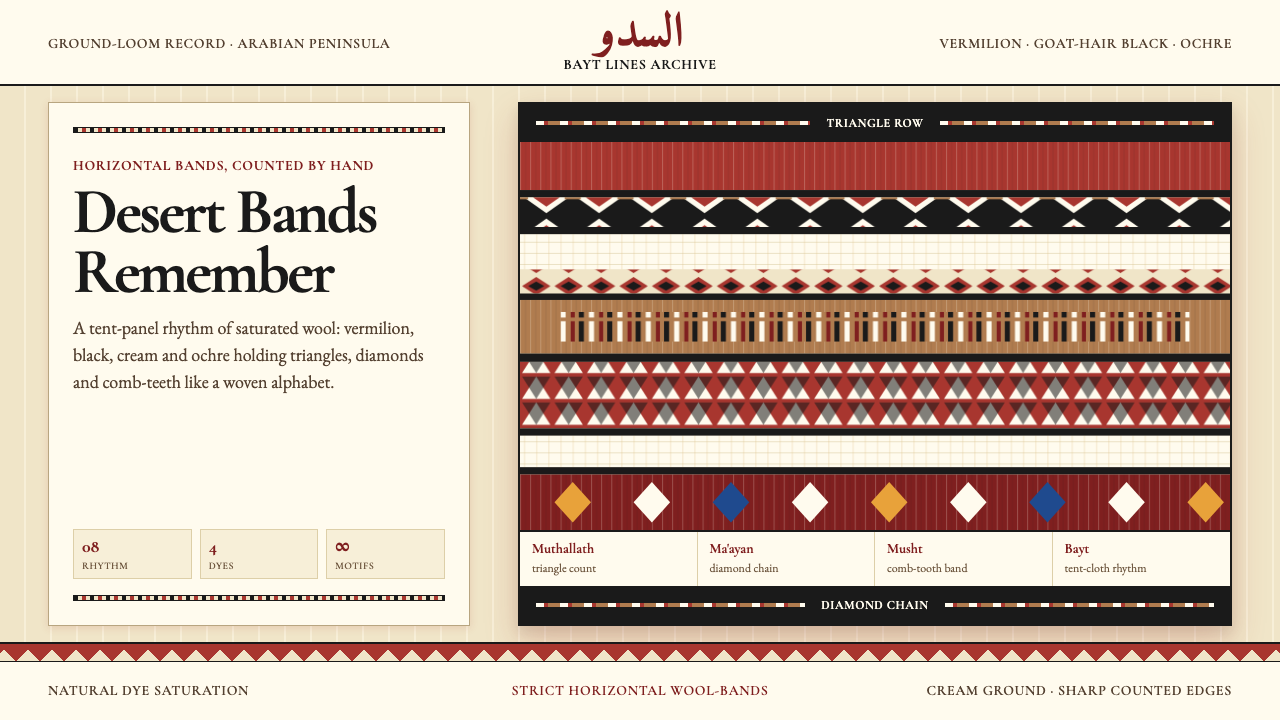 Bedouin Desert Textile (Sadu)Woven memory, not ornament. Vermilion-black bands count triangles and diamond…
 Cham My Son TowersWall before ornament. Greyed brick bays recede around cut shadows and sandsto…
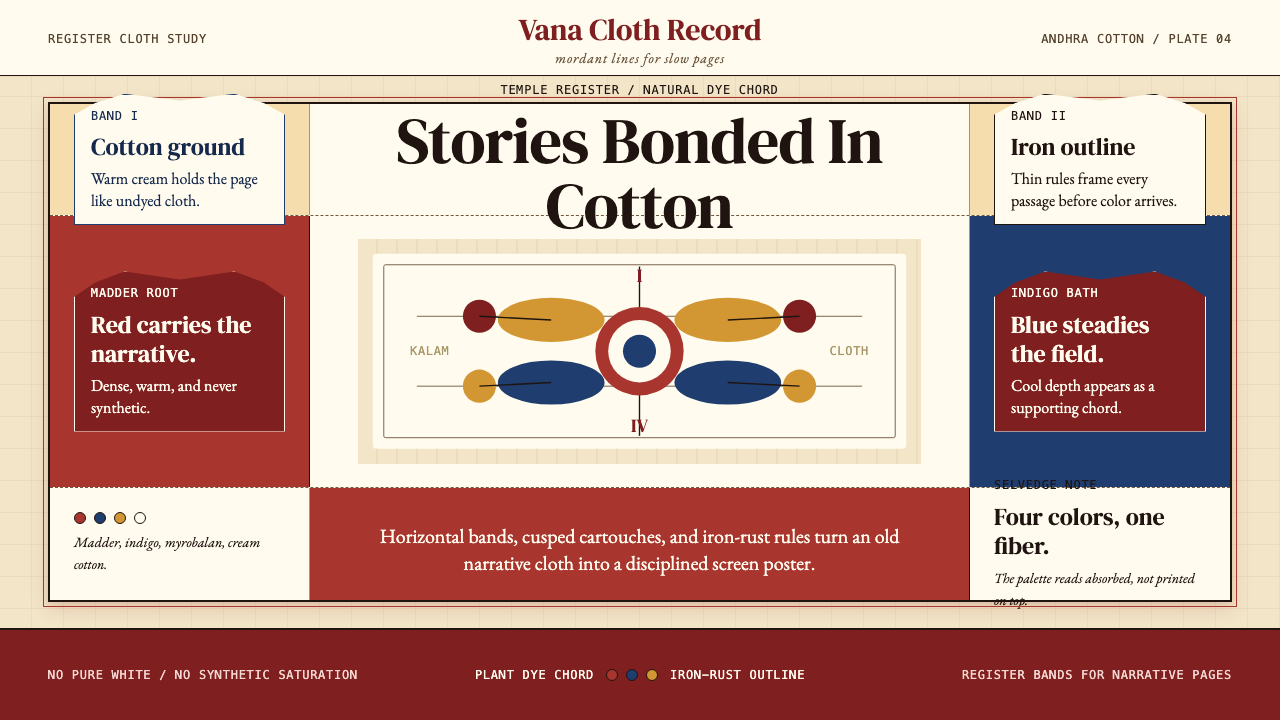 Kalamkari (Andhra Pradesh)Cloth becomes narrative. Madder bands, indigo panels, and iron rules stack li…
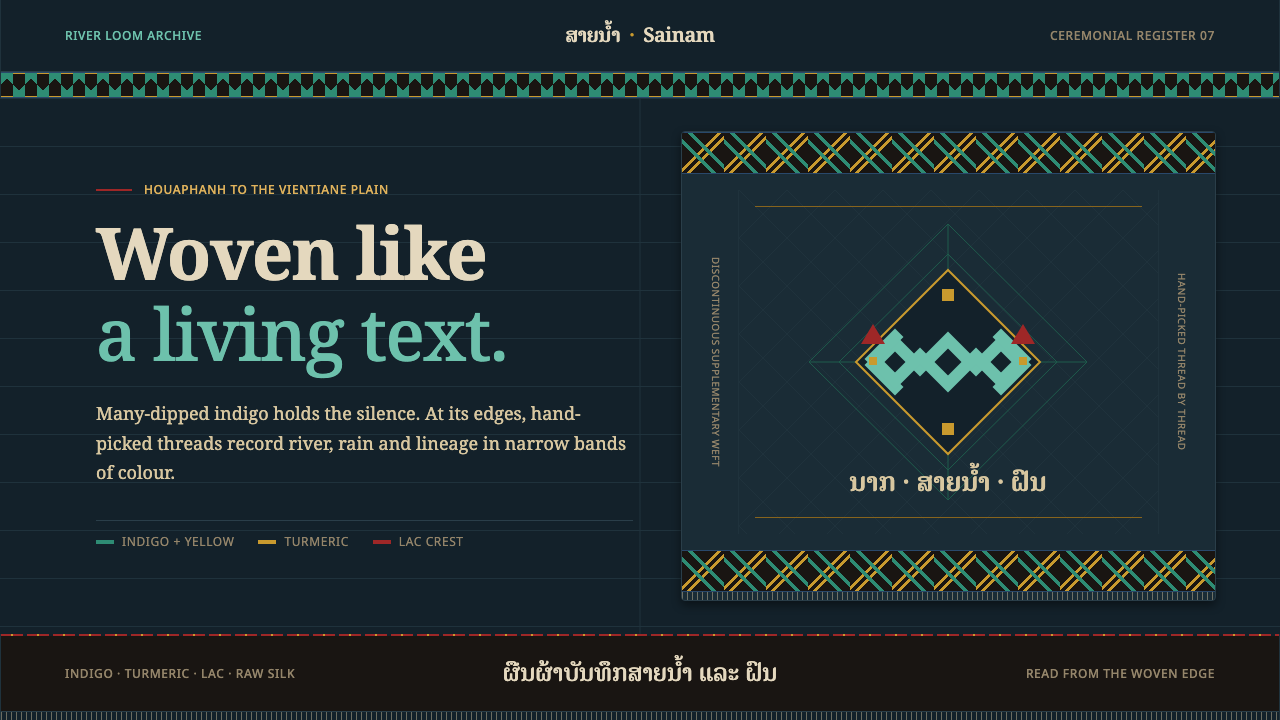 Lao Naga TextileDarkness becomes woven memory. Turquoise and turmeric bands speak across many…
 Madagascan Lamba SilkAncestry is woven flat. Crimson, indigo, cream and gold run in strict silk ba…
 Okinawan Bingata Resist DyeOrnate without clutter. Persimmon ground, vermilion type, emerald-cobalt sten…