What is Madagascan Lamba Silk?
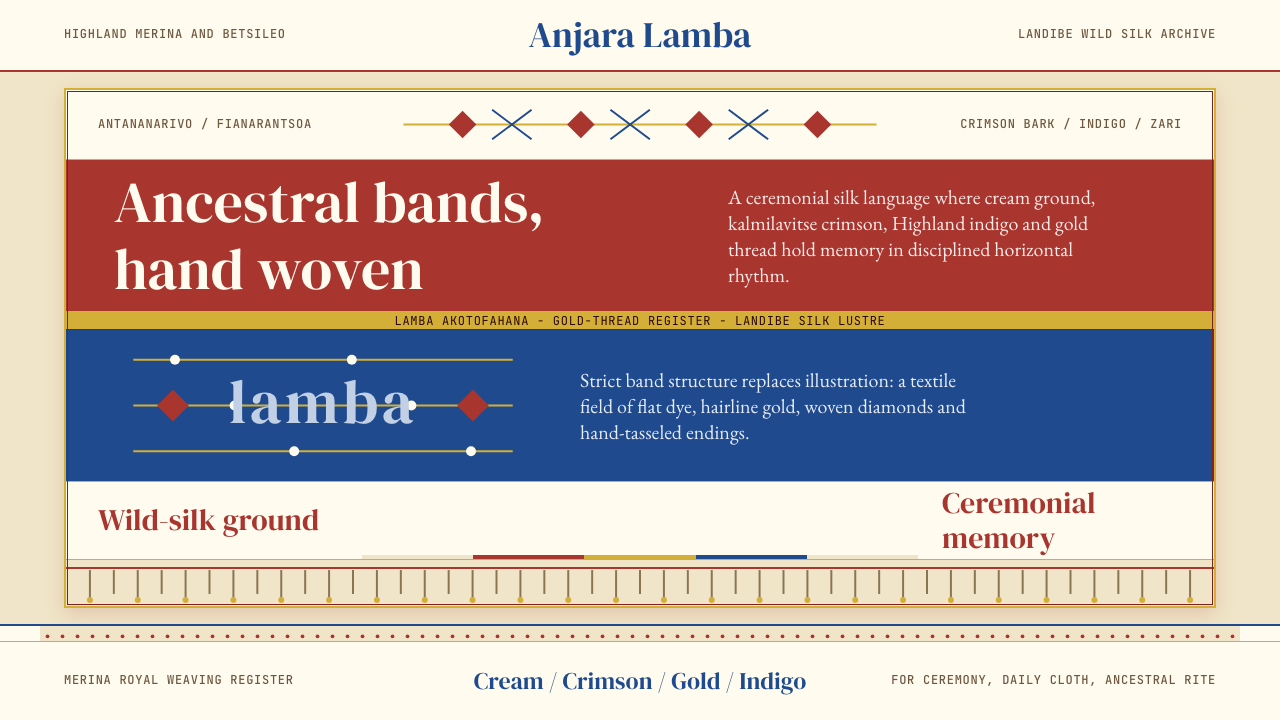
Woven by Highland women across centuries, Madagascan lamba silk turns a strict horizontal stripe into a language of ancestral memory, ceremony, and national identity.
Madagascan Lamba Silk in brief
Madagascan lamba silk is the hand-woven wild-silk shawl produced by Merina and Betsileo weavers in the Central Highland regions of Madagascar. It is simultaneously a daily garment, a ceremonial textile, and the country's most enduring national symbol — worn draped over the shoulders, wrapped around the body, or spread across the deceased during the famadihana ancestral reburial rite. The word lamba simply means cloth in Malagasy, but in common usage it refers specifically to the large woven shawl that has defined Highland dress for centuries.
The visual system of lamba silk is built on horizontal bands of saturated color running the full width of the cloth. Undyed wild silk — with its warm, creamy natural tone — forms the ground. Against this base, bold bands of Madagascar-crimson, deep indigo, soft gold, ochre, and pomegranate alternate in rhythms that vary by weaver, region, and occasion. Zari gold-thread accents catch the light along stripe edges, and the cloth finishes at each end with hand-tasseled fringe. The lustre of landibe silk — the local wild silkworm species — gives the finished textile a soft sheen that distinguishes it from both cotton equivalents and cultivated Bombyx mori silk.
What makes lamba silk visually compelling as a design reference is its combination of structural discipline and chromatic warmth. The stripe is the only compositional device: there are no figurative motifs, no woven pictograms, no central medallions. All meaning is carried by color sequence, band width, and proportion. This is a visual language reduced to its most essential elements, yet capable of extraordinary expressive range — from the muted, undyed cloth of everyday use to the richly banded ceremonial lamba that signals royal or ancestral significance.

Where does Madagascan Lamba Silk come from?
The lamba textile tradition traces its earliest documented origins to the Merina kingdom of the Central Highlands, with scholarly consensus placing the formal establishment of royal weaving workshops in the sixteenth and seventeenth centuries. The Merina court at Antananarivo elevated lamba production to a state enterprise: weavers operated under royal patronage, and the finest silk lambas were reserved for the sovereign, the nobility, and sacred ancestral purposes. The Highland wild silkworm, landibe, was already endemic to Madagascar's eastern forests, providing a local raw material distinct from anything available in continental Africa or mainland Asia. This ecological specificity — silk produced from a species found nowhere else — gave Malagasy textile culture its particular material identity from the outset.
The royal-court peak of lamba production ran from the late eighteenth century through to 1896, when French colonial annexation dissolved the Merina monarchy. During the reign of Queen Ranavalona I, who ruled from 1828 to 1861 and pursued a policy of cultural and economic resistance to European influence, lamba production was actively protected and promoted as an expression of Malagasy sovereignty. Ranavalona's court maintained strict weaving traditions and resisted the importation of European cloth. Her reign represents the high-water mark of lamba as political and cultural symbol — a textile that signified not merely status but deliberate national self-definition.
French colonization (1896–1960) disrupted but did not destroy the tradition. Imported European textiles competed with hand-woven lambas in local markets, and certain dyeing traditions were altered by the introduction of synthetic colorants. However, the famadihana ritual — in which families periodically exhume, rewrap, and rebury their ancestors in fresh lamba cloth — maintained a constant ceremonial demand that kept the weaving tradition economically viable throughout the colonial period. The lamba's status as sacred cloth, irreplaceable by industrial substitute in its ritual function, insulated it from the full force of colonial commercial displacement.
After Malagasy independence in 1960, lamba silk underwent a deliberate cultural revival as part of national identity reconstruction. The textile was adopted as a marker of Malagasy heritage across ethnic and regional lines — previously the lamba had been primarily a Highland Merina and Betsileo tradition, but independence-era nationalism broadened its symbolic reach. Contemporary production is concentrated in cooperatives and family workshops around Antananarivo, Fianarantsoa, and the craft town of Ambositra. In the twenty-first century, designers including Eric Raisina have worked to bring lamba silk techniques into contemporary fashion and textile art, creating an international profile for the tradition while sustaining the technical and chromatic conventions that define it. Scholars such as Sarah Fee and Christine Mullen Kreamer have produced foundational academic work documenting the textile's social, ritual, and visual history.
What defines the Madagascan Lamba Silk look?
Horizontal Stripe Structure
The defining compositional principle of lamba silk is the horizontal band — a stripe that runs without interruption across the entire width of the cloth. There are no diagonal lines, no medallions, no vertical elements. The stripe is the grammar and the content simultaneously. Band widths vary from broad anchoring fields to narrow accent lines, and their sequencing — which colors appear in what order, which widths are wide versus narrow — is the primary means through which weavers encode regional identity, occasion, and personal signature.
Saturated Natural Palette
The lamba color range is warm, rich, and entirely derived from natural sources: plant dyes, bark extracts, and mineral pigments available to Highland Malagasy weavers over centuries. The signature crimson comes from the kalmilavitse tree bark; indigo arrives through both locally gathered and traded plant sources; gold tones emerge from saffron and related dye materials; ochre and pomegranate complete the warm register. The undyed wild silk ground is not white but a living, slightly varied cream that shifts subtly in different light conditions — a warmth no synthetic can precisely replicate.
Wild Silk Luminosity
Landibe silk — the fiber produced by Madagascar's endemic wild silkworm — has a distinctive optical quality that differs from cultivated silk in important ways. It is slightly coarser in texture, producing a surface that diffuses light softly rather than reflecting it sharply. Colors applied to landibe silk appear slightly muted compared to the same dyes on cultivated silk, but they achieve a depth and warmth that more polished fibers cannot match. This natural luminosity — a soft, living sheen rather than a high gloss — is central to the lamba's visual identity.
Zari Gold Accent
Many ceremonial and prestige lambas incorporate zari — metallic gold thread woven along stripe borders or as a narrow accent band within the composition. The zari element entered lamba weaving through Indian Ocean trade networks, connecting Madagascar to South Asian textile traditions. In use, zari catches directional light in ways that the surrounding silk does not, creating a subtle but perceptible shimmer along stripe edges. This accent is calibrated with restraint: a lamba with heavy zari coverage reads as gaudy; one with a single narrow gold band reads as dignified and ceremonially appropriate.
Hand-Tasseled Fringe
At each short end of the lamba, the warp threads are gathered and knotted into tasseled fringe — a hand-finishing element that is both structural and decorative. The fringe signals that the cloth is hand-woven: machine-loomed textiles cannot replicate the slight variation in tassel length and density that comes from hand-finishing. In the design vocabulary of lamba silk, the fringe also functions as a transitional element, allowing the bold horizontal stripes to dissolve gradually into open thread rather than terminating abruptly against a cut edge.
Color Sequence as Meaning
Because the stripe is the sole compositional device, the exact sequence of colors across a lamba's width carries the full burden of visual differentiation and cultural communication. Weavers, regions, and weaving families develop signature sequences — the order in which crimson, indigo, gold, and cream bands appear. These sequences are not random and not merely aesthetic: certain color arrangements are associated with specific ceremonies, with mourning versus celebration, with royal lineage versus commoner use. Reading a lamba is, in a precise sense, reading a sentence written in saturated color.
Ritual and Ceremonial Function
Lamba silk is not primarily a fashion textile — it is a sacred one. The famadihana reburial ceremony, in which Malagasy families exhume the remains of ancestors, wrap them in fresh lamba cloth, and celebrate their continued presence among the living, creates a sustained ritual demand for new lamba production in each generation. The cloth used in famadihana is selected with care: its color sequence, quality, and the quality of its weave all carry meaning about the family's relationship to the ancestor being honored. This ritual context gives lamba silk an authority that purely decorative textiles rarely achieve.

Who shaped Madagascan Lamba Silk?
Ranavalona I ruled the Merina kingdom from 1828 to 1861, a reign defined by fierce resistance to European economic and cultural penetration. She actively protected and promoted lamba weaving as an expression of Malagasy sovereignty, restricting the importation of European cloth and maintaining royal weaving workshops at the Antananarivo court. Under her patronage, lamba silk production reached a zenith of technical refinement and symbolic authority. Her reign represents the clearest historical moment in which lamba was explicitly understood as a national and political textile, not merely a cultural artifact.
Sarah Fee is a textile anthropologist whose scholarly work has been foundational to the academic documentation of Malagasy cloth traditions, including lamba silk. Her research explores the relationship between textile production, ritual life, and social identity in Madagascar, situating lamba within the broader context of Indian Ocean exchange networks and indigenous material culture. Fee's work has made the social and visual logic of lamba accessible to an international academic audience and provided the scholarly framework within which contemporary design interest in the textile can be properly contextualized.
Eric Raisina is a Malagasy-born couturier who has worked between Madagascar and Paris, becoming the most internationally recognized designer to build a body of work around Malagasy textile traditions, including lamba silk. His approach treats the horizontal stripe structure and saturated natural palette of lamba not as ethnographic material to be preserved unchanged but as a living visual vocabulary to be applied to contemporary silhouettes and contexts. Raisina's work demonstrates that lamba's formal principles — strict horizontal banding, warm saturated naturals, luminous wild silk — are capable of operating effectively in international fashion and design contexts without losing their cultural specificity.
Christine Mullen Kreamer is a curator and scholar of African art and material culture whose work has brought Malagasy textile traditions, including lamba silk, to museum and curatorial audiences. Her scholarship addresses the ways in which cloth functions as a carrier of social memory, ancestral relationship, and political identity in Madagascar, connecting the ritual use of lamba to broader questions about how material objects participate in the construction and maintenance of community. Kreamer's institutional work has been instrumental in establishing lamba silk as a subject of serious art-historical and anthropological attention outside Madagascar.
How do you use Madagascan Lamba Silk today?
Lamba silk's visual language — warm saturated horizontals, creamy natural grounds, luminous wild-silk texture, and gold accent — is among the richest historical textile traditions available to contemporary designers working on presentations, web interfaces, and editorial materials. Applying it correctly requires understanding its structural logic: the horizontal band is not decorative trim applied to an otherwise conventional layout, but the organizing principle of the entire composition. Color sequences carry meaning; proportion between bands establishes hierarchy; nothing is arbitrary.
For presentation slides, lamba silk works with particular power on cover and section-divider pages. A cover conceived in this language might establish a warm cream or undyed-silk ground across the full slide, then introduce two or three bold horizontal bands — one deep crimson, one indigo, one gold — stacked at varying widths toward the lower third, with the title set in clean, weight-contrasting type in the upper field. Content slides should preserve the horizontal orientation: thin ruling lines dividing sections, body text aligned to a clear horizontal baseline, and data visualizations — bar charts especially — treated as additional bands of color running across the composition rather than floating isolated objects.
For web interfaces, the lamba palette adapts naturally to dashboards, analytics views, and pricing or comparison pages where category differentiation is key. The approach: establish a warm off-white or cream background as the primary surface, use the deep crimson-to-indigo spectrum for primary action states and tier indicators, and reserve gold accents for the highest-value tier or most important call to action. Horizontal dividers replace vertical separators; content sections stack as horizontal bands rather than columnar cards. The overall effect is warm, authoritative, and structurally clear — well-suited to platforms that want to combine data density with cultural richness.
For editorial and marketing work, lamba silk supports a bold, layered approach to typographic hierarchy and section design. A long-form article or report laid out in this system might use wide-margin horizontal color bands as section breaks — a full-width band of deep crimson introducing a major section, a narrower gold rule marking a subsection. Marketing landing pages work well with alternating full-width content blocks in cream and warm near-black, with the horizontal band logic governing where primary colors appear as accents. The fringe motif — rows of fine vertical threads dissolving from a horizontal boundary — can be abstracted into a typographic or illustrative detail that references the textile's finishing convention without literal representation.
A common mistake when working with this palette is treating the crimson, indigo, and gold as equivalent partners to be distributed evenly. In an authentic lamba composition, one color dominates — typically the warm cream ground — and the others are used in calibrated amounts, with the most accent-weight color (gold) appearing least frequently and only where emphasis is required. Applying all three saturated colors at equal weight simultaneously produces visual noise rather than the rhythmic, measured quality that makes the original textile compelling. Similarly, pairing this palette with hard-edged, high-contrast graphic elements undermines the warmth that defines it: lamba silk asks for softness at the edges, slight tonal variation within color fields, and a general sense that the composition breathes rather than snaps.

Madagascan Lamba Silk — FAQ
Is lamba silk appropriate for dark or night-mode interfaces?
The canonical lamba palette is warm-ground: undyed cream silk as the primary surface, with saturated color bands applied above it. A dark inversion is possible but requires deliberate adaptation. On a deep warm-charcoal or dark brown ground — rather than pure black — the crimson, indigo, and gold bands retain their warmth and remain readable without producing the harshness that a cold black background would introduce. Avoid pure black as the ground color: the natural palette was developed against warm organic surfaces, and the perceptual relationship between its hues depends on that warmth. A dark lamba-inspired layout works best when the background itself has a visible warmth — close to aged wood or deep earth rather than digital black.
How does lamba silk differ from other stripe-based textile aesthetics like Andean or West African weaving?
The horizontal stripe appears in textile cultures across the world, but lamba silk is distinguished by several specific qualities. First, its palette is governed by the warm naturals of wild silk — a ground color that is not white but a living cream — combined with dyes derived from Madagascar-specific botanical sources, particularly the characteristic crimson that comes from kalmilavitse bark. Second, lamba stripes are always horizontal and never broken by figurative motifs, keeping the composition purely abstract. Andean textiles often use diagonal and stepped elements; West African kente introduces vertical stripe elements and geometric interlocking. Lamba's specific grammar — horizontal only, no figurative interruption, warm naturals throughout — gives it a particular visual temperature that is distinct from both.
Can this palette work for tech or SaaS products, or does it read as too artisanal?
The artisanal quality is real and can be either an asset or a liability depending on the product context. For SaaS products where warmth, cultural authenticity, and differentiation from the typical blue-gray tech palette are desired values — sustainability platforms, cultural tools, creative-industry software, hospitality or travel technology — the lamba palette reads as sophisticated and deliberately distinctive. The key is treating the horizontal band structure as a rigorous organizing system rather than a decorative reference: structured, proportioned, systematic application communicates rationality even when the palette itself is warm and organic. For products where trust is built through cold precision — fintech, security tools, enterprise data infrastructure — the palette is likely a poor fit, and a different style would serve better.
How should texture be handled when referencing lamba silk in digital design?
The textile's organic texture — the slight irregularity of hand-spun wild silk, the subtle variation within color fields caused by natural dye uptake — is one of its most distinctive qualities, but it should be evoked rather than literally simulated in digital applications. Avoid overlaying fabric scan textures on interface elements; this reads as skeuomorphic pastiche rather than genuine aesthetic translation. Instead, introduce tonal variation within color fields by using slight gradients between two close values of the same hue — the effect suggests the depth of dyed cloth without simulating its surface. Where the design calls for a more explicit textile reference, a carefully scaled abstract pattern derived from the warp-and-weft grid structure can function as a background field without competing with content.
What is the famadihana, and why does it matter for understanding lamba silk?
Famadihana — sometimes translated as 'the turning of the bones' — is an ancestral reburial ceremony practiced by Malagasy Highland communities, particularly among the Merina and Betsileo. Families periodically exhume the remains of deceased relatives, wrap them in new lamba cloth, carry them in procession accompanied by music and celebration, and then return them to the family tomb. The ceremony maintains the relational bond between the living and the dead and is central to Malagasy spiritual life. Its relevance to lamba silk is direct: famadihana creates sustained, generational demand for new lamba production, since the cloth must be freshly woven for each ceremony. This ritual function explains why lamba silk production remained economically viable through colonial disruption and industrial competition — it could not be replaced by imported cloth because its ritual authenticity required hand-weaving by communities with the appropriate ancestral knowledge. Understanding famadihana is understanding why lamba silk has survived as a living tradition rather than becoming a museum artifact.
Related design styles
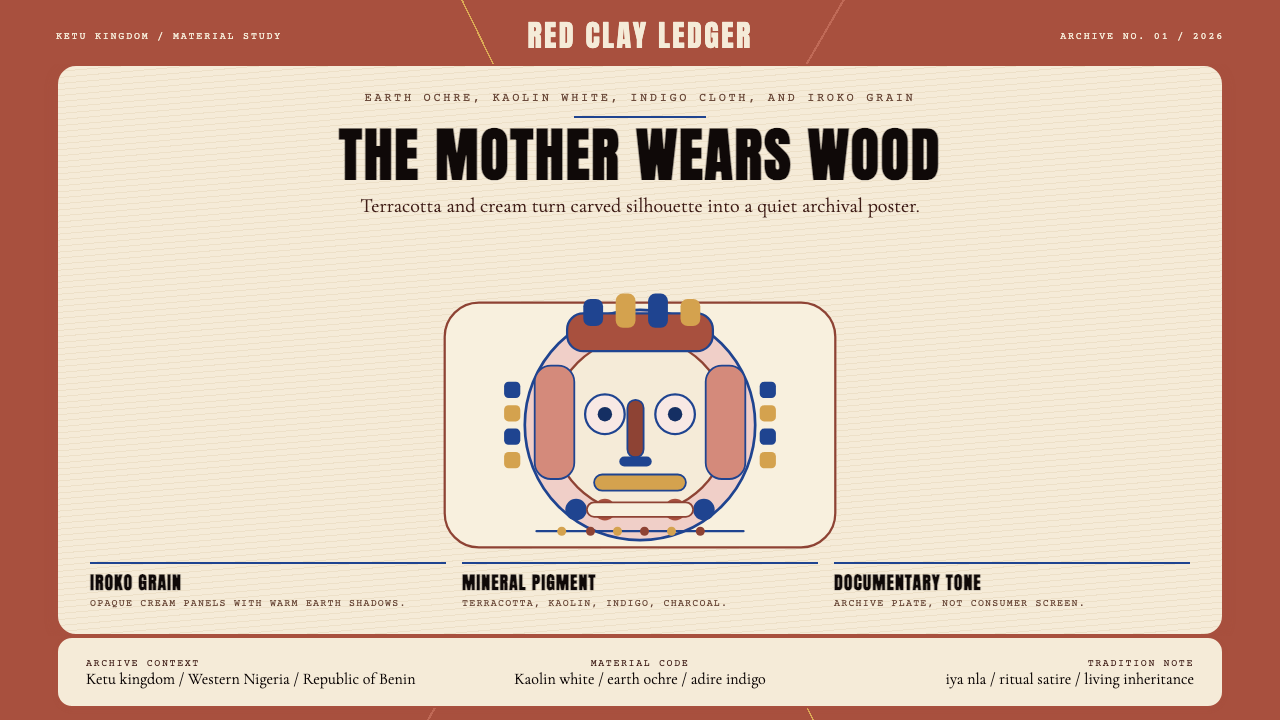 Yoruba Gelede MaskRitual weight, not spectacle. Terracotta, kaolin, and indigo frame a carved-m…
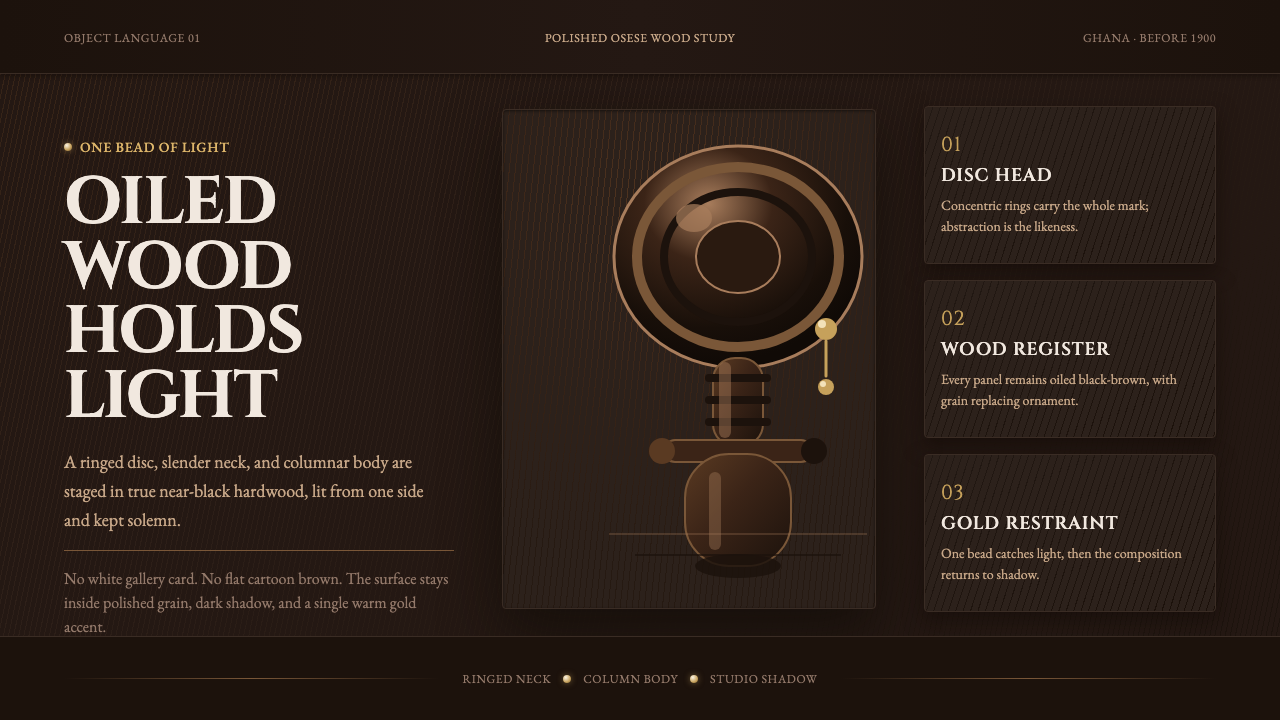 Akuaba Akan Fertility DollDarkness becomes sculpture. Near-black wood, ringed geometry, and one gold be…
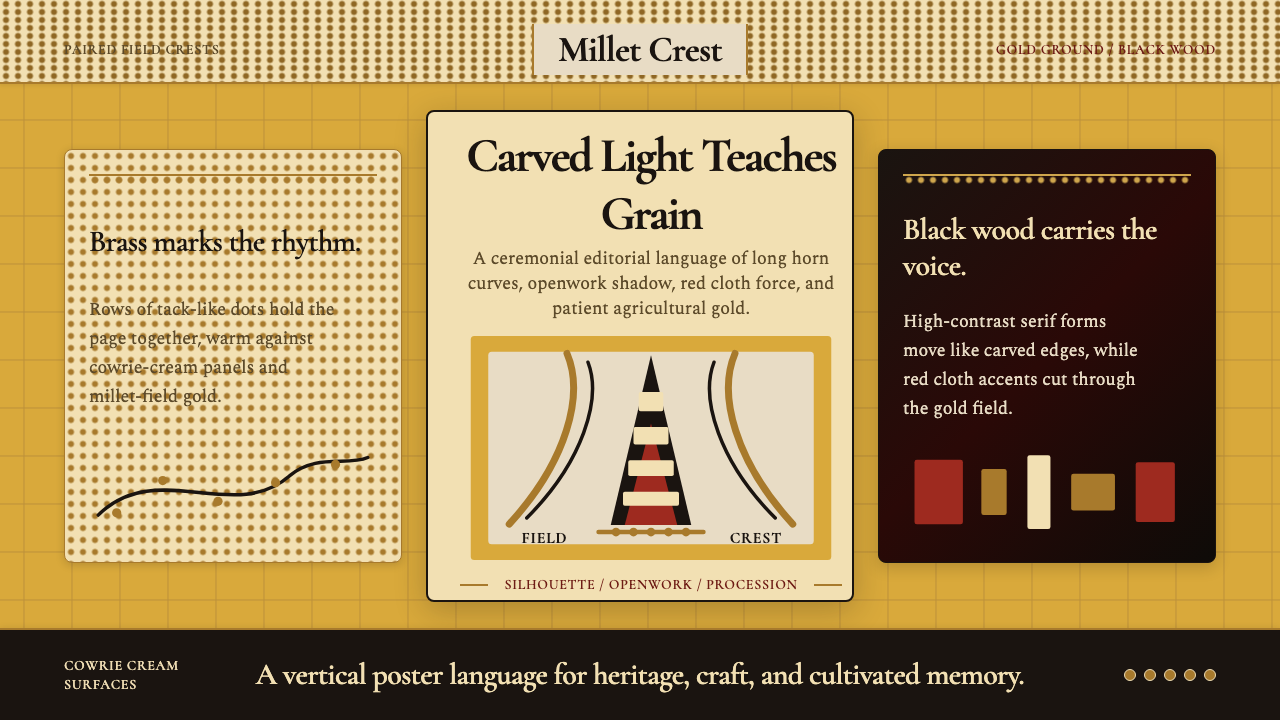 Bambara Chi Wara AntelopeCarved memory in gold. Black serif silhouettes and brass-dot borders carry th…
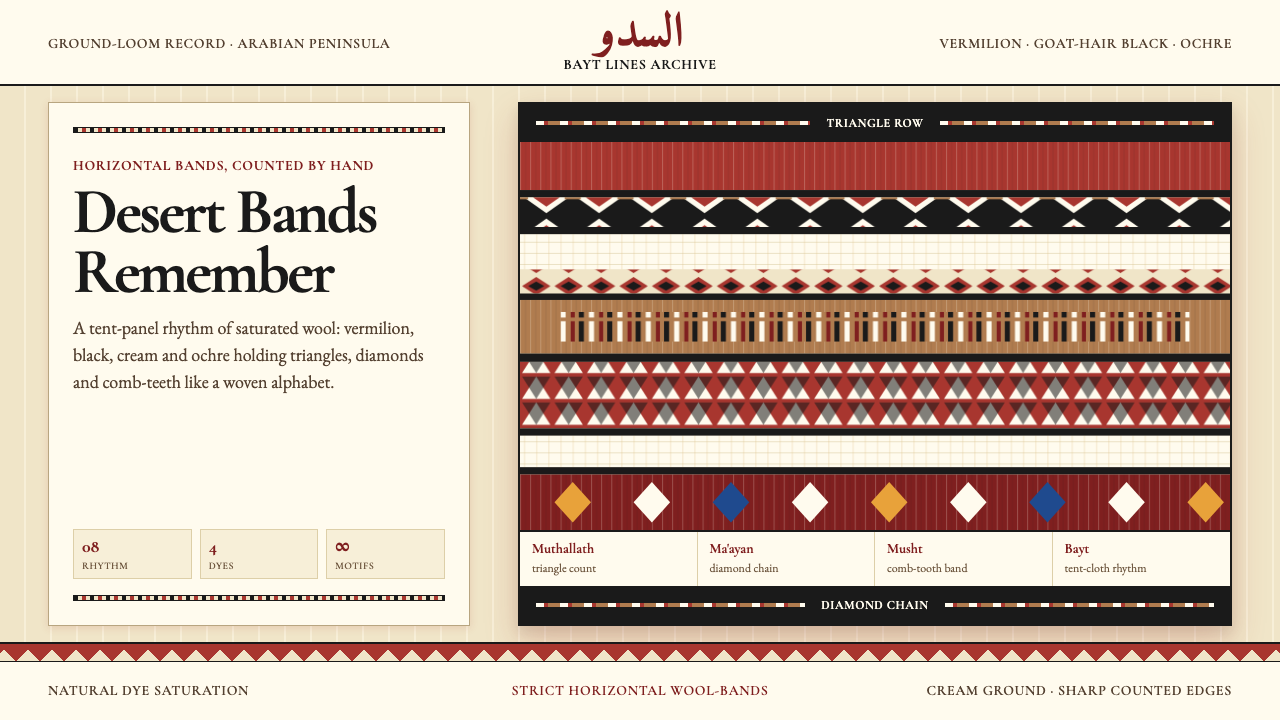 Bedouin Desert Textile (Sadu)Woven memory, not ornament. Vermilion-black bands count triangles and diamond…
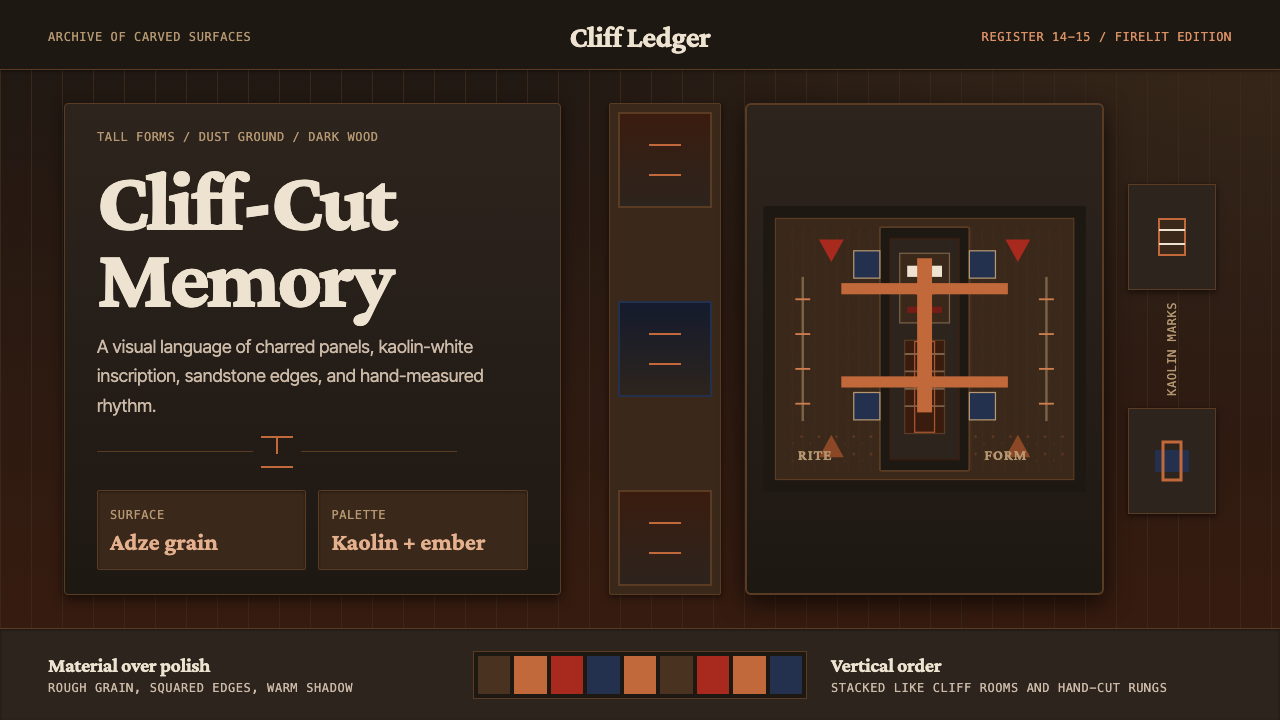 Dogon Bandiagara Cliff MaskHand-hewn gravity. Charred wood, kaolin type, and sandstone geometry stack li…
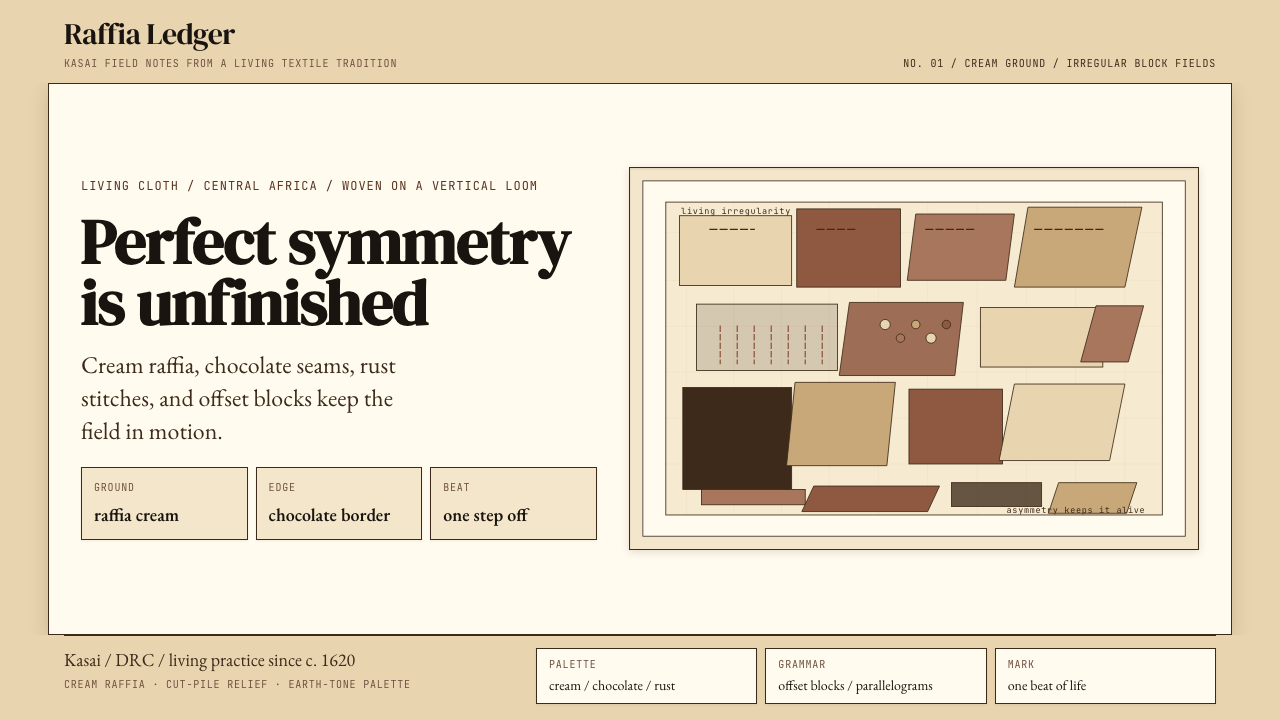 Kuba Raffia Cloth (Congo)Deliberate asymmetry lives. Cream raffia, chocolate seams, and rust blocks.