What is Bedouin Desert Textile (Sadu)?
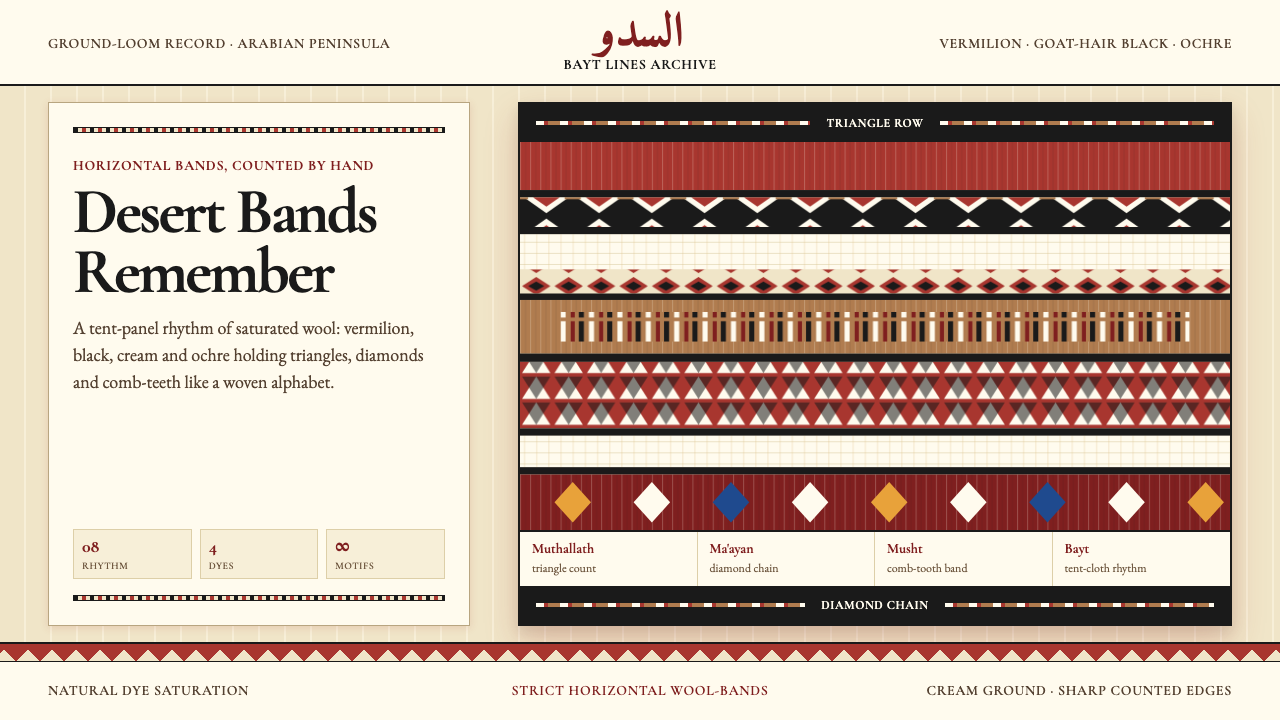
Sadu is the woven language of the Arabian desert — horizontal bands of vermilion, black, and cream that carry geometry as meaning, identity, and memory.
Bedouin Desert Textile (Sadu) in brief
Sadu (السدو) is the ground-loom weaving tradition of Bedouin women across the Arabian peninsula. Practiced for millennia in the tents and encampments of nomadic communities spanning Saudi Arabia, Kuwait, the UAE, Bahrain, Qatar, Jordan, and the Sinai, it is one of the most visually disciplined textile arts in the world. Every piece — whether a black tent panel, a floor carpet, a camel-saddle blanket, or an animal trapping — is governed by the same strict organizing principle: saturated horizontal bands, each one carrying a sequence of geometric motifs counted thread by thread on the loom.
The palette is narrow and intensely saturated: vermilion red, deep black, undyed cream wool, and ochre yellow form the backbone of nearly every composition. Within each band, weavers embed triangle, diamond, comb-tooth, cross, protective-eye, scorpion, and camel-silhouette motifs as a kind of personal and tribal vocabulary. These patterns are not merely decorative — they identify the maker's community, record genealogical information, and communicate social status in a culture where literacy was historically oral and material rather than textual.
Recognized by UNESCO as Intangible Cultural Heritage in 2011 under a joint inscription by Saudi Arabia and Kuwait, Sadu remains a living craft. Institutions such as Sadu House Kuwait and the Saudi Heritage Commission actively maintain training programs and master-apprentice relationships. The visual system it represents — strict horizontal structure, natural-dye saturation, coarse warm fiber grain — is as coherent and transferable as any canonical design movement, with the additional resonance of being encoded with genuine cultural information rather than invented for purely aesthetic ends.

Where does Bedouin Desert Textile (Sadu) come from?
The origins of Sadu weaving are inseparable from the ecology of the Arabian peninsula and the social structure of Bedouin life. Nomadic pastoralism — the seasonal movement of families and their herds across vast desert landscapes — created the conditions for a textile tradition oriented entirely toward functional necessity. Black tents woven from goat hair provided shelter; carpets and saddle blankets managed temperature and protected livestock; woven trappings marked the identity and prestige of a household in motion. Everything that Sadu produced was made to be packed, moved, used in the sun and sand, and unpacked again.
Weaving in this context was exclusively the domain of women and was transmitted matrilineally. A girl learned from her mother and grandmother, absorbing not just the mechanical technique but the inherited vocabulary of motifs specific to her tribe and region. There was no pattern book, no written specification — the vocabulary lived in memory and in the hands. Different tribal groups across the peninsula developed recognizably distinct regional dialects of the Sadu visual language: the compositions of the Najd region in central Saudi Arabia differ in proportion and motif density from those of Kuwait or the UAE, and a practiced eye can read tribal affiliation in the arrangement of a band.
The materials were dictated by what the desert provided. Sheep wool formed the foundation — warm, absorbent, and available from the herds that Bedouin families kept. Goat hair, darker and coarser, was used for tent panels where structural durability under sun and wind was essential. Natural dyes — madder root for the characteristic vermilion reds, indigo for deep blue-black, plant-based tannins for ochre and brown — produced the saturated palette that distinguishes authentic Sadu from synthetic imitations. The undyed cream of natural wool became the luminous ground against which all other colors registered.
The UNESCO recognition in 2011 marked a formal acknowledgment of Sadu's endangered status as well as its cultural significance. By the mid-twentieth century, shifts toward settled urban life, the availability of machine-woven textiles, and the decline of nomadic pastoral economies had dramatically reduced the number of practicing weavers. The response from institutions in Kuwait and Saudi Arabia has been systematic: Sadu House Kuwait, established in 1969, was among the earliest dedicated centers for preserving, documenting, and teaching the craft. Today, the tension between preservation and living practice — between Sadu as museum object and Sadu as genuinely used material culture — remains a productive creative challenge for contemporary practitioners who work within its visual grammar.
What defines the Bedouin Desert Textile (Sadu) look?
Horizontal Band Structure
Every Sadu composition is organized as a sequence of horizontal bands running the full width of the woven panel. Each band is a self-contained register with its own color and motif sequence, and the rhythm of bands — wide alternating with narrow, saturated alternating with neutral — creates the composition's overall visual architecture. This strict horizontal orientation is not merely aesthetic; it is a consequence of the ground loom's mechanics, in which the warp runs horizontally and each pass of the weft builds the design row by row.
Saturated Natural-Dye Palette
The Sadu palette is simultaneously restricted and intensely chromatic. Vermilion red, derived from madder root, is the most visually dominant hue and typically occupies the widest bands. Deep black, from tannin and iron mordants, provides structural contrast and outlines. Undyed cream or off-white wool serves as the luminous ground. Ochre yellow and occasional deep blue-black complete the vocabulary. Natural dyeing produces a quality of saturation distinct from synthetic colorants — warm, slightly uneven, and highly resonant against the cream ground.
Counted Geometric Motifs
Within each band, Sadu weavers construct geometric figures by counting individual warp and weft threads — a technique that produces forms with characteristic stepped or jagged edges rather than the smooth curves of drawn art. Triangles, diamonds, comb-tooth borders, crosses, lozenges, and stylized figurative forms (the protective eye, the scorpion, the camel) are built thread by thread from memory. The stepped quality of these forms is not a limitation but a signature: it gives Sadu its unmistakable pixelated precision, where every angle is determined by the grid of the loom.
Tribal Motif Vocabulary
Sadu is not a single unified pattern system but a family of regional dialects united by shared structural principles. Each tribal group maintained its own inventory of motifs, and the arrangement, proportion, and density of patterns within a piece communicated information about the maker's lineage and community. This embedded information function distinguishes Sadu from purely decorative textile traditions — the patterns carry semantic weight, functioning more like a written script than an ornamental surface.
Fiber Texture and Material Warmth
The physical character of Sadu — the slight roughness of hand-spun wool, the subtle luster variation across the surface, the structural firmness of tight weaving — contributes as much to its aesthetic identity as its color and pattern. In digital or print applications, evoking Sadu's material warmth requires deliberate attention to texture: a faint grain or fiber quality in backgrounds and fields, rather than the smooth flatness of a purely digital surface. This material resonance is what separates Sadu-inspired work from simple geometric pattern.
Strict Symmetry Within Bands
While the composition of a full Sadu piece involves rhythm and variation across bands, the motifs within each individual band are typically rendered with rigorous bilateral symmetry. A diamond is perfectly mirrored on both axes; a comb-tooth border repeats at precise intervals. This internal discipline — symmetry within the band, variation between bands — produces a visual experience that is simultaneously orderly and richly complex, structured enough to read as a system yet varied enough to reward close attention.
Negative Space as Active Element
In Sadu compositions, the undyed cream ground is not a passive background but an active visual element. Weavers exploit the interplay between filled and unfilled areas within a band to create secondary pattern effects — the cream between two rows of triangles reads as its own zigzag. This figure-ground oscillation, familiar from optical geometry, is built into the counting technique itself: the negative space is as precisely determined as the motif it surrounds.

Who shaped Bedouin Desert Textile (Sadu)?
A Kuwaiti royal patron and advocate whose support was instrumental in the founding and sustained operation of Sadu House Kuwait. Her backing helped transform an informal preservation effort into an institutional center with facilities for teaching, archiving, and exhibiting Sadu weaving. The elevation of Sadu from craft practice to recognized cultural heritage owes much to patronage networks she helped cultivate, and her advocacy contributed to the conditions that led to the UNESCO inscription in 2011.
An American textile scholar who produced the most comprehensive English-language documentation of Bedouin weaving traditions in the Arabian peninsula. Her research — conducted through fieldwork, interviews with practicing weavers, and analysis of museum collections — established a rigorous visual taxonomy of Sadu motifs, regional variations, and material techniques. Her publications remain the primary scholarly reference for researchers, designers, and institutions working to understand Sadu's visual grammar with academic precision.
A Kuwaiti weaver and educator who worked closely with Sadu House Kuwait to transmit the craft to younger generations. As a practicing master weaver, she represents the living continuity of the tradition — the embodied knowledge of motif counting, loom setup, and natural dyeing that cannot be fully captured in documentation alone. Her role in teaching demonstrates how Sadu preservation functions not as archival work but as active cultural reproduction through direct person-to-person transmission.
A designer and cultural practitioner who has worked on translating the visual grammar of Sadu into contemporary contexts — including brand identity, exhibition design, and graphic applications — without flattening its cultural specificity. His work represents one model for how a living heritage aesthetic can be engaged with seriously in modern design practice: studying the motif vocabulary deeply, understanding the structural logic of the band system, and applying those principles with full awareness of their origin and meaning.
How do you use Bedouin Desert Textile (Sadu) today?
Sadu's visual grammar is unusually transferable to contemporary design precisely because its underlying logic is structural rather than superficially decorative. Applying it well requires understanding what the system is actually doing: creating hierarchy through band width and saturation, creating pattern through counted geometric repetition, and creating warmth through the interplay of dense color and luminous cream ground. Designers who treat it as a palette plus some triangles will produce pastiche; those who internalize the band structure as an organizing principle will produce work that carries the tradition's genuine authority.
For presentation slides, the Sadu approach works powerfully on both cover and content pages. A cover benefits from a bold horizontal band composition: a wide vermilion or black band spanning the lower or upper third of the slide anchors the title, while a narrow band of geometric repeat motifs provides a visual signature element. Content slides should apply the band logic structurally — section dividers rendered as narrow geometric-motif strips, body text set against the cream ground, and data visualizations that use the palette's restricted but saturated hues to distinguish categories. The result reads as authoritative, culturally grounded, and visually distinctive without relying on generic illustration.
For web interfaces, Sadu is exceptionally well suited to dashboards, editorial platforms, and cultural or heritage-adjacent products where warmth and depth are desired alongside clear information hierarchy. The approach: use the cream or warm off-white as the dominant background, reserve the vermilion and deep black for primary navigation, calls to action, and section headers, and apply geometric border elements derived from comb-tooth or diamond motifs as structural dividers. Texture in the background — a subtle fiber or weave grain — reinforces the material resonance without impeding readability. Card components and data panels can use narrow band headers in the Sadu palette to create visual anchors.
For editorial and marketing work, the style supports rich, layered compositions that reward slow reading. A Sadu-inflected article layout uses horizontal band breaks to separate sections — each break a narrow strip of geometric repeat rather than a plain rule — with body text set on the warm cream ground. Marketing pages work well with the style's poster-like structural boldness: full-width feature bands alternate between deep black grounds with cream type and vermilion grounds with black type, creating the rhythmic alternation that is the hallmark of the woven original. Motif elements used as marginal marks, section labels, or decorative initials add cultural specificity without overwhelming the informational content.
A common mistake when applying Sadu is treating the geometric motifs as interchangeable surface decoration — scattering triangles and diamonds across a layout without the band structure that gives them meaning. In authentic Sadu, every motif exists within a counted sequence inside a defined horizontal register; isolated floating geometry loses both the visual discipline and the cultural logic. Similarly, expanding the palette beyond the natural-dye core vocabulary — introducing bright synthetic turquoise, lime green, or purple — breaks the warmth and saturation quality that distinguishes Sadu from generic tribal-print aesthetics. Restraint in color and structural commitment to the horizontal register are what make the difference.

Bedouin Desert Textile (Sadu) — FAQ
Is Sadu the same as other Middle Eastern geometric textile traditions?
Sadu is specifically the ground-loom weaving tradition of Bedouin women on the Arabian peninsula — it should not be conflated with the broader category of Islamic geometric pattern, with Persian carpet weaving, or with North African Berber textile traditions, all of which share geometric vocabulary but differ fundamentally in structure, material, context, and cultural meaning. Sadu's defining characteristics — the strict horizontal band orientation, the limited natural-dye palette, the counted motif technique, and its specific tribal information-encoding function — make it a distinct visual system, even within the larger family of southwestern Asian textile arts.
Can Sadu aesthetics work in a digital dark-mode interface?
The canonical Sadu palette is light-ground — the luminous cream of undyed wool is structurally central to how the saturated colors register. A dark inversion is possible but requires careful recalibration. On a deep dark background, the vermilion reads as intensely warm and forward, which can work for hero elements but becomes aggressive if overused. The cream tones, when used as foreground type or motif color on a dark ground, provide the same warmth they deliver in the original context. A dark Sadu variant works best when it anchors to the deep black already present in the tradition and uses the vermilion and cream sparingly as accent and typography rather than as field colors.
How should Sadu motifs be scaled — large and bold, or small and dense?
In the original tradition, motif scale is proportional to the band width — wider bands carry larger, more complex motif sequences; narrow bands carry simple, tightly repeated border elements. This proportional logic translates directly to design applications. When using Sadu-derived geometry as a primary graphic element — a hero illustration, a cover graphic — scale it up so the stepped edges and counting structure are visible and legible. When using it as a supporting texture or border — a section divider, a card header — keep it tight and repetitive, letting the rhythm of repetition carry the weight rather than individual motif complexity. Avoid the middle ground where motifs are large enough to read as ornament but too small to appreciate as structure.
Is it appropriate for non-Arabian brands to use Sadu aesthetics?
This is a genuine question worth taking seriously rather than dismissing in either direction. Sadu is a UNESCO-recognized living heritage practice, not an expired historical style, which means engagement with it carries ethical weight. The critical distinction is between studied engagement and extraction: work that cites the tradition, understands its visual grammar at depth, applies its structural logic rather than just its surface appearance, and ideally involves practitioners from the tradition itself occupies ethically different ground from work that lifts Bedouin triangle patterns as exotic decoration without attribution or understanding. For international brands, the safest and most honest approach is to treat Sadu as a design reference with acknowledged origins — using it as a structural inspiration, citing it clearly, and considering collaboration with regional designers who work within the tradition.
What makes Sadu different from generic tribal or ethnic pattern?
The category of 'tribal pattern' in commercial design typically refers to a visual style assembled from geometric motifs loosely associated with indigenous or non-Western cultures, stripped of specific cultural context and recombined for visual effect. Sadu is not this. It is a precisely documented tradition with specific regional variants, a named motif vocabulary with identifiable tribal meanings, a defined material and technical system, and living practitioners who maintain its transmission. Engaging with Sadu means engaging with something specific — particular motifs from particular communities, woven on a ground loom with natural-dyed wool, organized into horizontal band registers. That specificity is both its cultural integrity and its design strength. Generic tribal pattern has no such integrity to draw from.
Related design styles
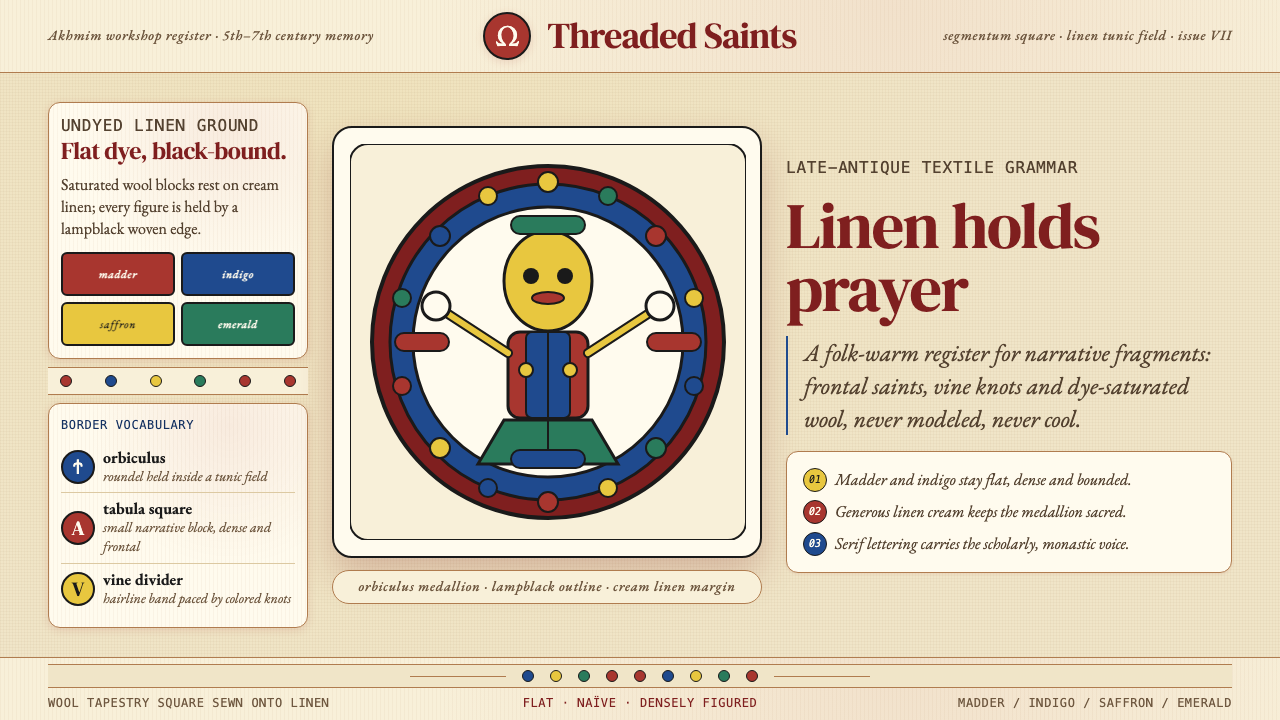 Egyptian Coptic TextileWarmth woven flat. Madder, indigo and saffron medallions sit on linen cream.
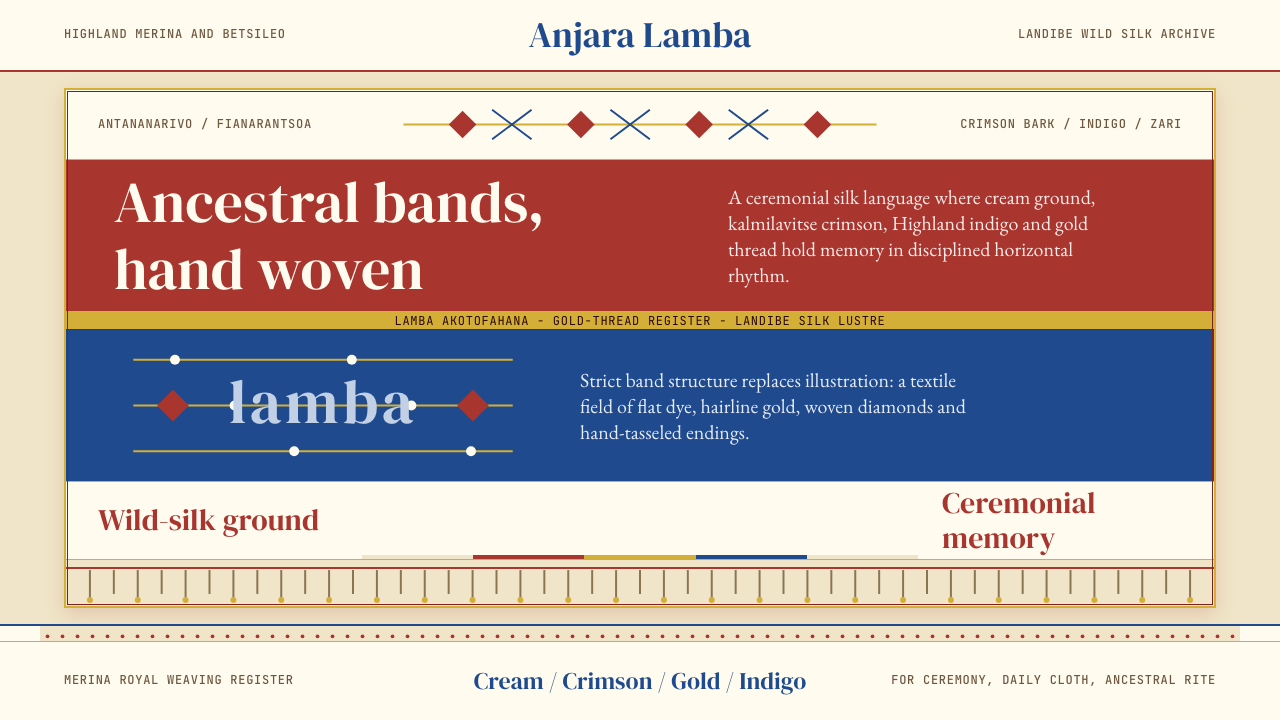 Madagascan Lamba SilkAncestry is woven flat. Crimson, indigo, cream and gold run in strict silk ba…
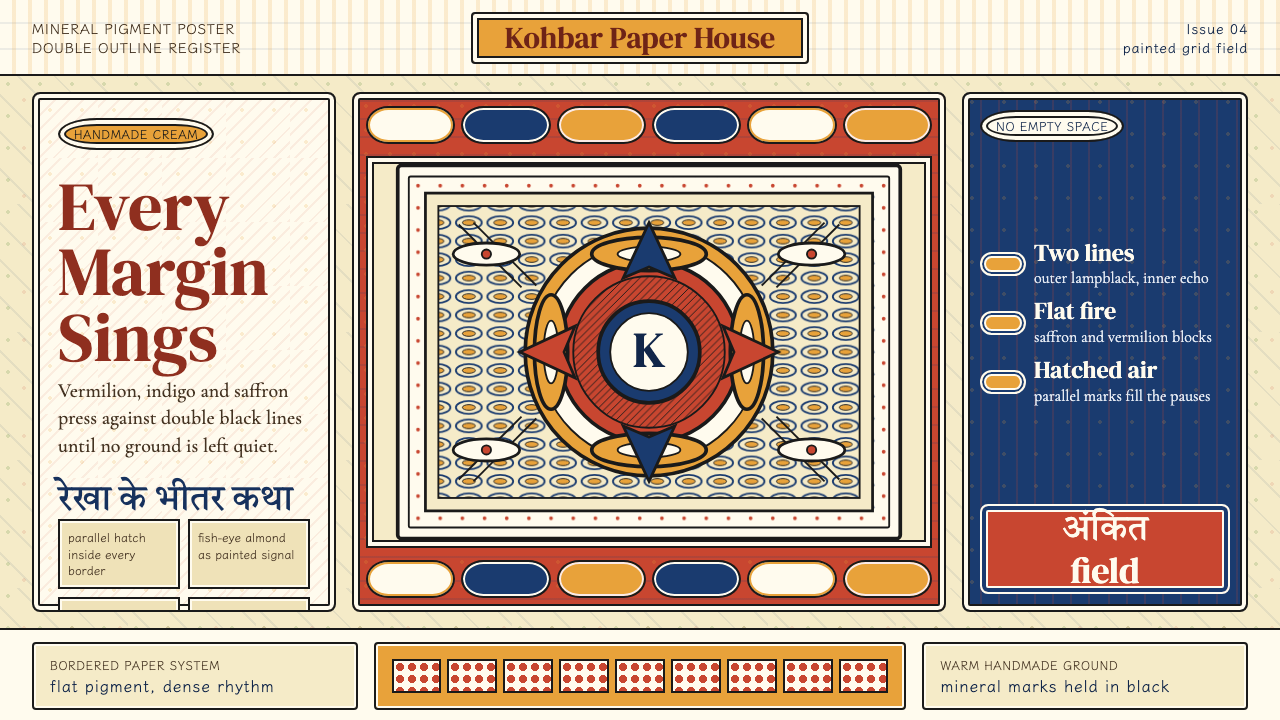 Madhubani (Mithila Folk Painting)No empty ground. Vermilion, indigo and saffron pack double-outlined panels wi…
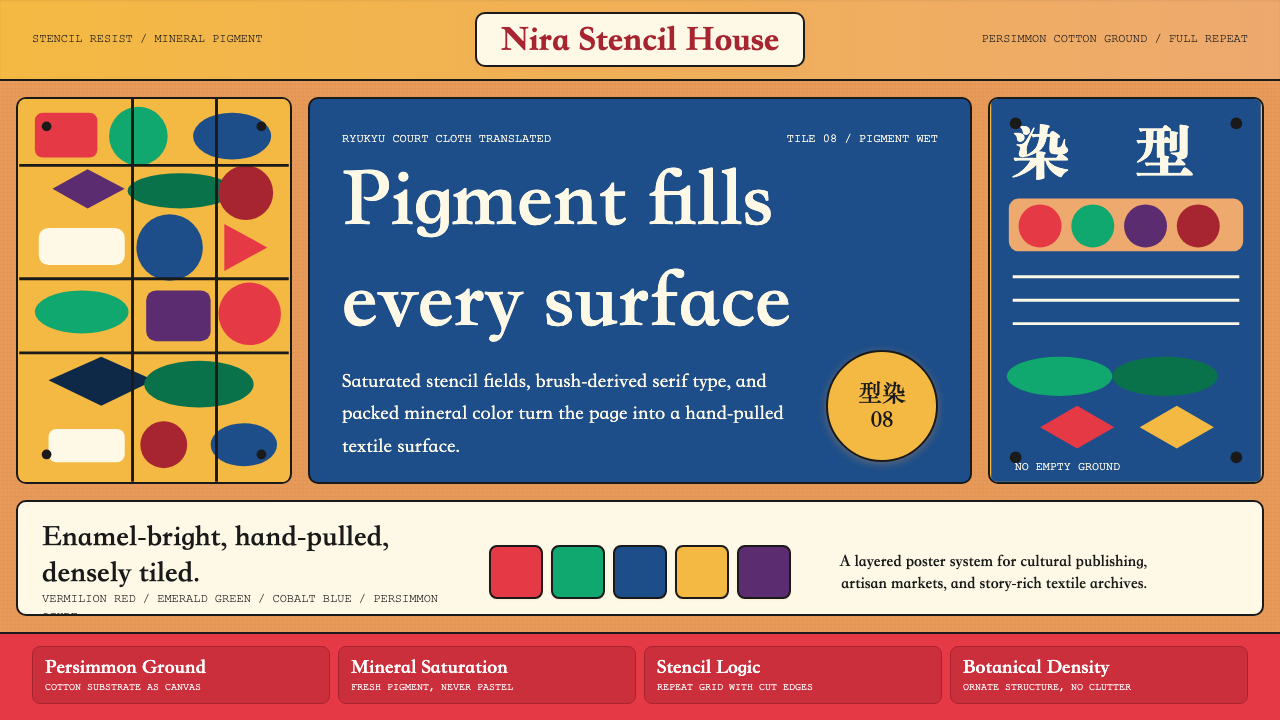 Okinawan Bingata Resist DyeOrnate without clutter. Persimmon ground, vermilion type, emerald-cobalt sten…
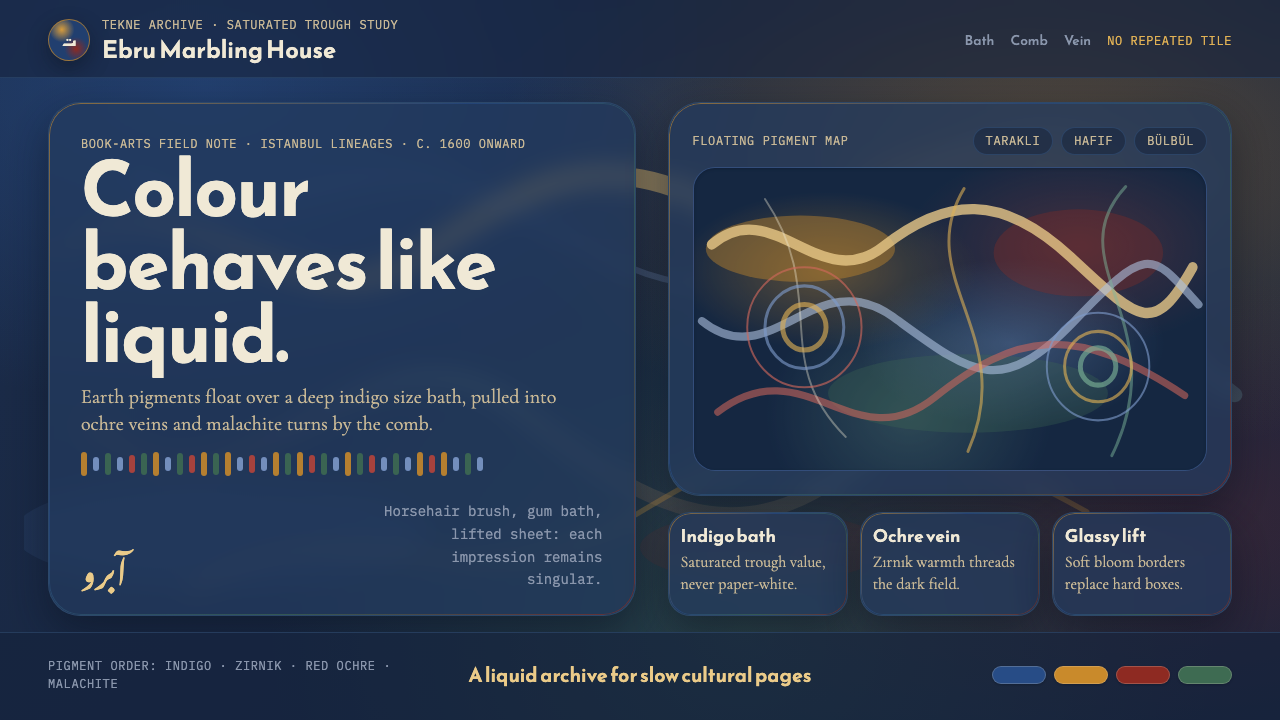 Ottoman Ebru MarblingLiquid, never tiled. Indigo bath, ochre veins, and glassy bloom edges carry t…
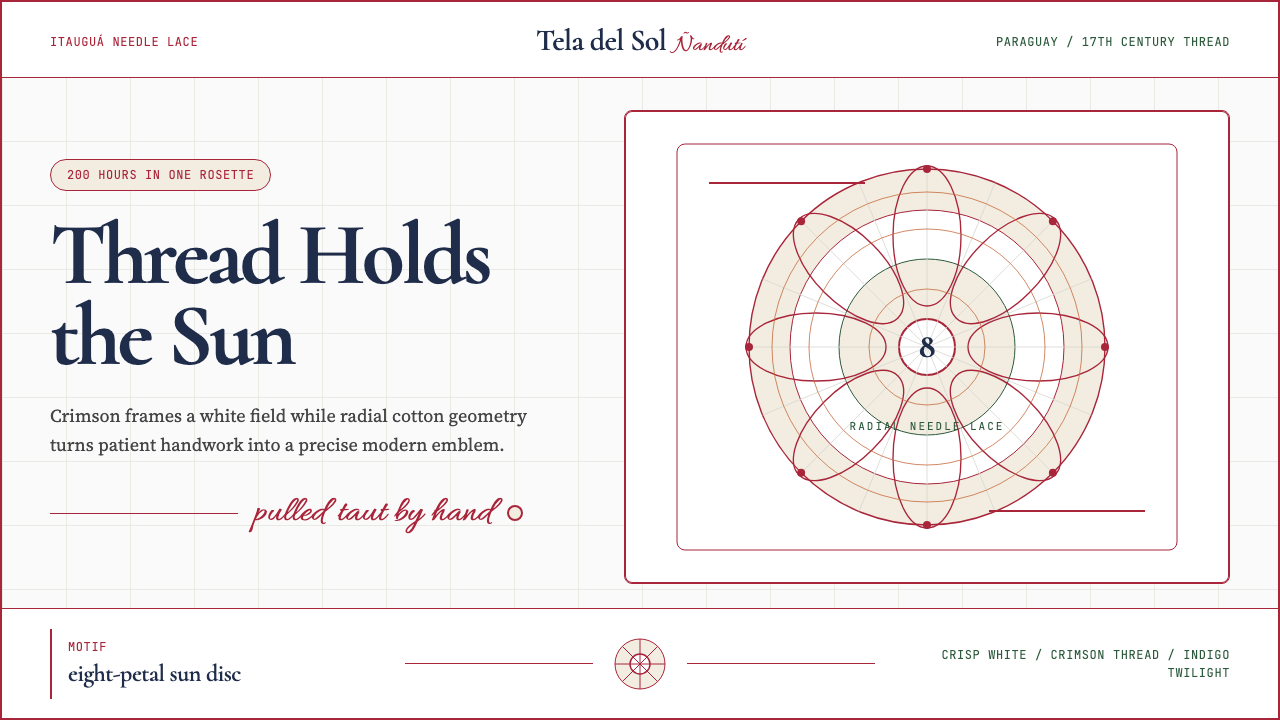 Paraguayan Ñandutí LacePatient craft, modern frame. Crimson lines pin radial lace on crisp white.