What is Paraguayan Ñandutí Lace?
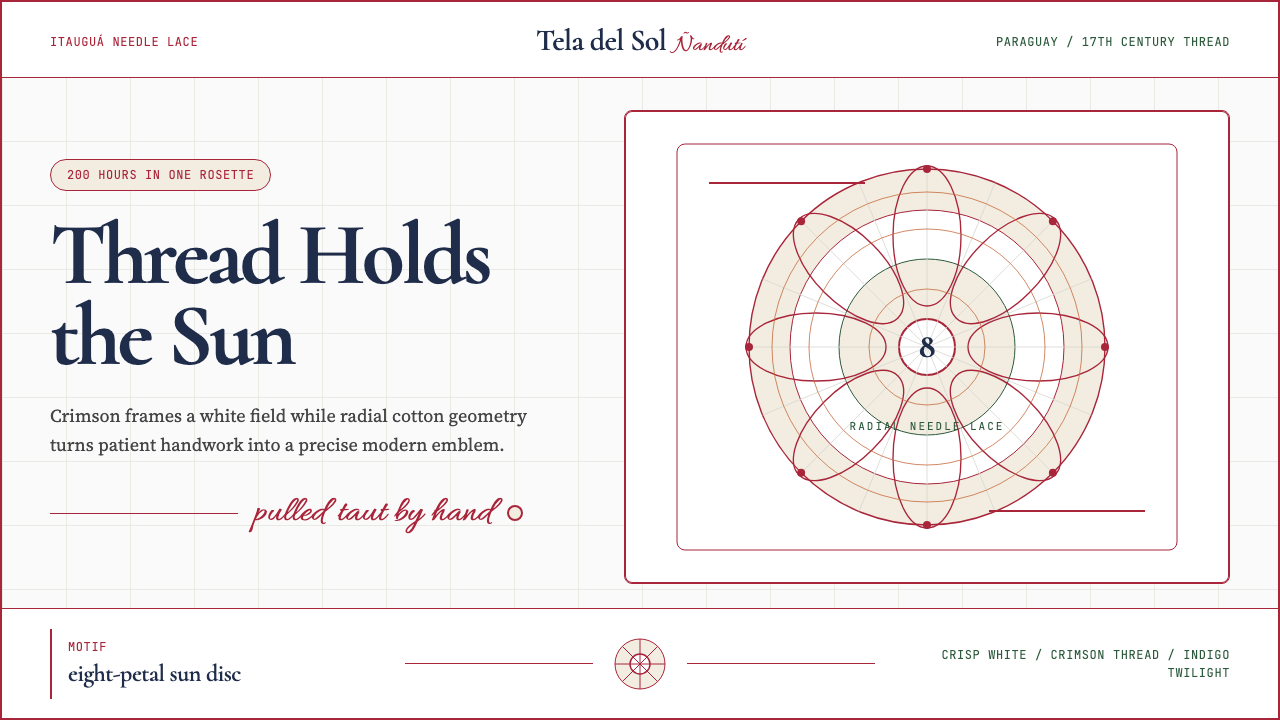
Ñandutí — the spider-web lace of Paraguay — translates three centuries of radial needle-craft into a design language of deep crimson, cream white, and the patient geometry of the sun disc.
Paraguayan Ñandutí Lace in brief
Paraguayan Ñandutí Lace is a design system rooted in the radial needle-lace tradition of Itauguá, a small town southeast of Asunción where women artisans have spent more than three centuries tatting cotton thread into eight-petal rosettes, sun discs, and spider-web mandalas. The name itself — drawn from the Guaraní word for spider web — signals the defining characteristic of the work: every composition radiates outward from a central point, governed by the same rotational logic that nature uses in webs, flowers, and shells.
As a visual system, Ñandutí Lace is built on two contrasting registers. The background is near-white or cream — the color of unbleached cotton laid on a wooden frame — and against this ground, deep crimson threads draw the radiating lines, arcs, and petal-forms that define the lace pattern. The contrast is stark and deliberate: warmth against warmth, organic geometry against organic texture. Nothing in the palette is cold or synthetic.
The system is not merely decorative. The radial structure carries symbolic weight drawn from both Guaraní pre-Columbian mythology and Spanish Catholic imagery. The spider-web form references the sacred weaving of the cosmos; the sun disc echoes the agricultural reverence for light and growing seasons. This dual heritage — Indigenous and colonial, fused over centuries of craft practice — gives the visual language a cultural depth that purely formal systems cannot replicate.
Where does Paraguayan Ñandutí Lace come from?
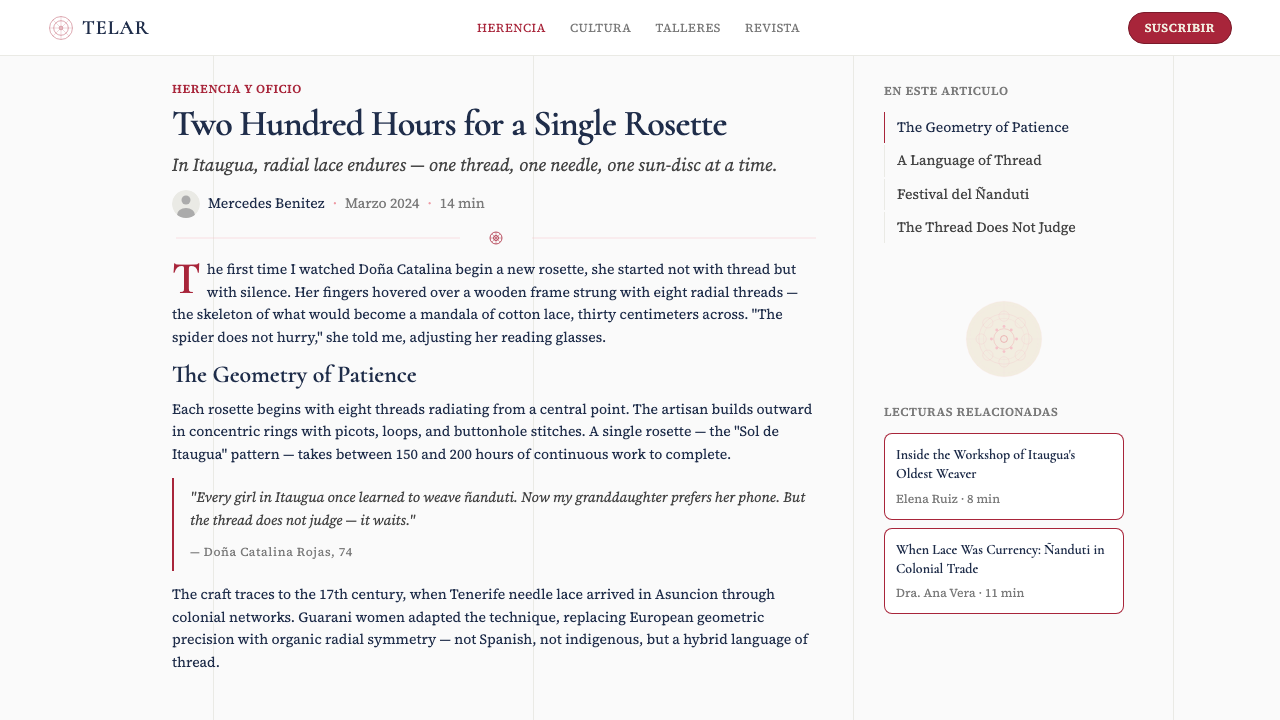
The technique arrived in Paraguay in the seventeenth century via Spanish colonial contact, most likely carried by women from Tenerife in the Canary Islands, where a similar radial needle-lace called Tenerife lace had been practiced for generations. Spanish missionaries and settlers brought the craft as part of their domestic material culture, and the women of the Guaraní communities around Itauguá — already skilled in textile weaving — absorbed the technique and began reinventing it through their own visual vocabulary, symbol systems, and cosmological references.
The crucial transformation happened at the meeting point of two craft traditions. Spanish Tenerife lace was already radial and sun-like, using a cushion pinned with threads radiating from a center point. Guaraní women recognized in this structure something familiar — the web of Ñandú, the sacred spider of creation mythology — and layered their own symbolic forms onto the Spanish armature. The eight-petal rosette, the layered sun disc, and the web-like interstices between petals all carry this syncretic charge. By the eighteenth century, Ñandutí had become a distinctly Paraguayan art form rather than a colonial import.
Itauguá became the center of production by the nineteenth century, when artisans in the town organized informally around the craft as a livelihood. The work was sold at markets in Asunción, and the annual Festival del Ñandutí — still held in Itauguá — developed into a major regional event celebrating both the craft and the broader mestizo cultural identity of Paraguay. Figures such as Josefina Plá, the Spanish-born Paraguayan poet, critic, and cultural historian, wrote extensively about the Ñandutí tradition as a paradigmatic example of how Guaraní and Hispanic cultures had fused into something entirely new rather than simply one absorbing the other.
In the twenty-first century, the craft-cooperative movement brought a new phase of formalization. Women's cooperatives in Itauguá, Yaguarón, and Asunción began working with cultural preservation organizations to document patterns, codify teaching methods, and explore how the visual language of Ñandutí might translate into contemporary applied design. Artists and designers associated with Paraguay's visual arts scene — including those working in the tradition of Carlos Colombino and Olga Blinder, who had spent decades arguing for the legitimacy of Paraguayan vernacular forms as sources for contemporary practice — contributed to this modernization. The result is a design system that is simultaneously ancient in its sources and contemporary in its applications.
What defines the Paraguayan Ñandutí Lace look?
Radial Geometry
Every compositional element in Ñandutí Lace emanates from a central point, organized along axes that divide the field into equal radial segments. This is not merely a stylistic choice but a structural imperative inherited from the needle-lace technique itself: the artisan's thread always returns to the center before moving outward again. In design applications, this radial logic functions as the primary organizing principle — backgrounds, textures, focal elements, and decorative frames all carry the suggestion of rotation and symmetry around a fixed core.
Crimson and Cream Palette
The dominant palette pairs deep, saturated crimson against cream or off-white grounds. The crimson is not an aggressive primary red but a warmer, deeper tone with associations of dried flowers, aged textiles, and the handmade. Against the cream ground, it reads as both festive and intimate — the color of a celebration held in a domestic courtyard rather than a public square. Accent colors, when they appear, are similarly warm: dusty gold, terracotta, and muted ochre are consistent with the tradition's material roots in plant-dyed thread.
Petal and Web Motifs
The visual vocabulary centers on two repeating forms: the multi-petal rosette, which typically presents four, six, or eight identical petals arranged symmetrically around a center; and the web-like lattice of threads connecting petal tips and filling the spaces between rosettes. These are not rigid geometric abstractions but slightly organic forms — each petal has a gentle curve, each lattice thread a subtle variation in tension — giving the overall composition a quality that distinguishes it clearly from purely mechanical geometry. The forms are simultaneously floral, celestial, and architectural.
Fine Linear Detail
The texture of Ñandutí Lace is inherently linear — the lace is made of thread, and thread reads as line. Even in large compositional fields, the viewer is aware of individual lines making their way across the surface, crossing, knotting, and looping. In design translation, this linear quality manifests as an insistence on visible structure: the grid lines of a composition remain perceptible, type has a slight thread-like delicacy rather than bold weight, and decorative elements are built from strokes rather than solid fills.
Symmetry as Warmth
Unlike the deliberate asymmetry of many modernist design systems, Ñandutí Lace embraces bilateral and rotational symmetry as an aesthetic value rather than a constraint. The symmetry is not stiff or institutional — it is the symmetry of a flower or a snowflake, felt as natural rather than imposed. This gives compositions derived from the tradition a quality of completeness and repose that suits ceremonial or celebratory contexts. The balanced structure signals care, patience, and the passage of time spent in making.
Organic Craft Texture
The lace tradition assumes that slight irregularity is not a defect but a marker of the handmade. No two rosettes in a Ñandutí piece are exactly identical; no line is perfectly straight. In a design system context, this principle pushes against sterile digital perfection. Surfaces may carry a faint grain or weave texture; edges may have a fractionally imprecise quality; layouts may allow breathing room that a purely mechanical grid would not. This is restraint expressed through permissive imperfection rather than through minimalism.
Ceremonial Weight
Ñandutí pieces were traditionally made for weddings, festivals, and religious occasions — contexts where the visual object needed to signal that something special was being marked. This ceremonial gravity is baked into the visual system: the density of detail, the richness of the crimson-cream contrast, and the patience implied by radial patterning all communicate that this is not everyday visual noise but a considered, occasion-worthy presentation. Design work drawing on this tradition carries that same signal of intentionality and occasion.

Who shaped Paraguayan Ñandutí Lace?
The anonymous collective of women artisans who have practiced and transmitted Ñandutí across generations in Itauguá represents the core of the tradition. Operating first as informal family workshops and later as formal cooperatives, these artisans developed the vocabulary of rosette forms, codified teaching methods for passing the craft to younger generations, and navigated the commercialization of the work without sacrificing its symbolic integrity. Their collective authorship is the defining feature of Ñandutí as a cultural form: no single designer invented it; it accumulated.
Born in the Canary Islands and naturalized Paraguayan, Josefina Plá (1903–1999) was a poet, playwright, ceramicist, and cultural critic who spent decades arguing for the artistic legitimacy of Paraguayan popular and vernacular traditions. Her critical writing on Ñandutí positioned the craft not as folk curiosity but as a significant achievement of syncretic cultural creativity — a form where Guaraní and Hispanic elements had genuinely fused rather than merely coexisting. Her advocacy helped establish the intellectual framework through which later designers would approach the tradition as a serious design source.
Carlos Colombino (1937–2019) was Paraguay's most internationally recognized visual artist of the twentieth century, known for his woodblock relief works and his role in establishing contemporary Paraguayan art as a serious field. While not a Ñandutí practitioner himself, Colombino spent decades arguing in critical writing and institutional work that Paraguayan material culture — including vernacular craft traditions — deserved to be engaged seriously by contemporary artists rather than preserved in ethnographic amber. His influence helped legitimize the idea that Ñandutí's visual logic could be source material for designed work.
Olga Blinder (1921–2008) was a Paraguayan painter, printmaker, and art educator who played a foundational role in building Paraguay's contemporary art infrastructure. Co-founder of the Arte Nuevo group in 1954, Blinder consistently pushed for Paraguayan artists to engage with their own cultural heritage — including indigenous and popular forms — as a source of contemporary visual thinking rather than as something to be bypassed in pursuit of international modernism. Her pedagogical work across decades trained generations of Paraguayan visual artists to see vernacular forms like Ñandutí as serious design references.
How do you use Paraguayan Ñandutí Lace today?
Ñandutí Lace is a style that rewards restraint in application. Its power comes from the density and intricacy of a single radial motif allowed to breathe against a spacious ground — not from tiling the motif repeatedly until the surface is overwhelmed. The central design decision when working with this system is always the same: choose your center, build the radial structure outward, and protect the surrounding space. The lace pattern works best as a focal element or structural frame, not as background fill.
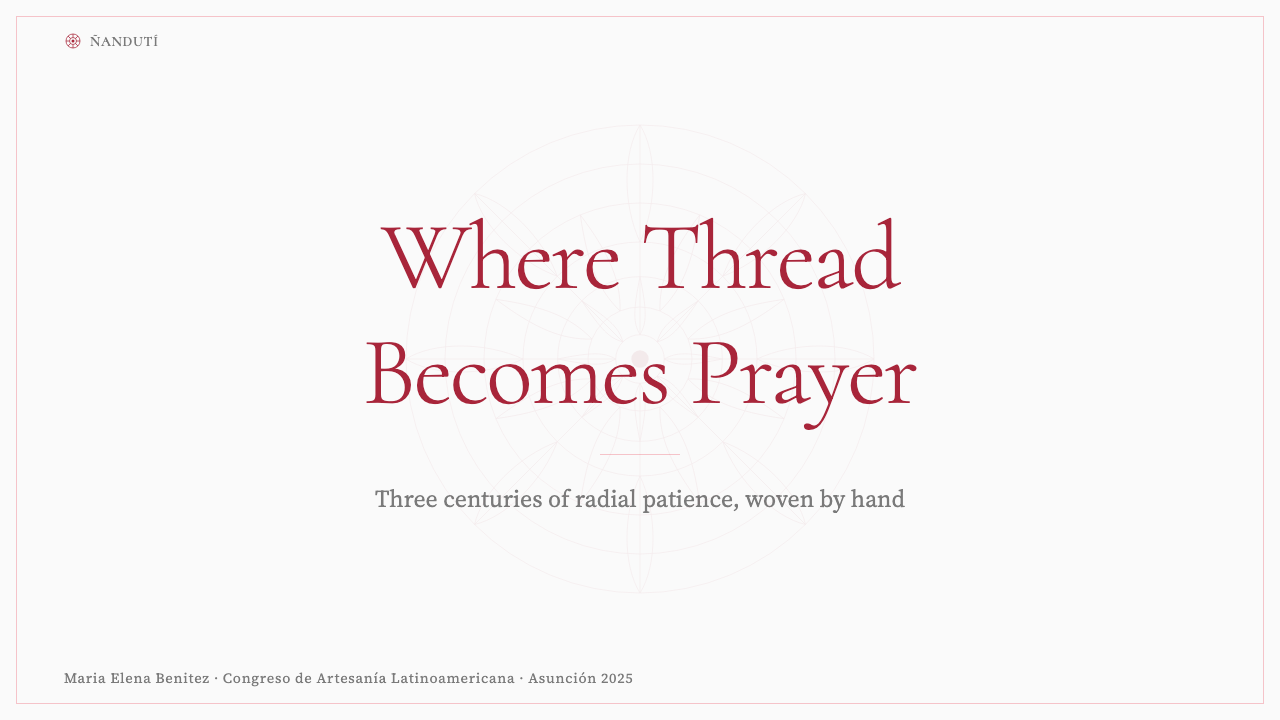
For presentation slides, the style performs best on ceremonial or occasion-specific decks: opening slides for conferences, covers for annual reports, title pages for cultural or heritage content. A single large sun-disc rosette occupying a generous portion of the cover slide, set in deep crimson against cream, immediately signals that what follows has been prepared with care and carries cultural weight. Content slides within the same deck can step back significantly — a cream ground with crimson ruled lines, a radial detail in a corner, and generous white space — preserving the ceremonial register without overwhelming every page with pattern density.
For web interfaces, the style aligns well with artisan marketplace pages, cultural heritage portals, festival landing pages, and editorial contexts where organic warmth and cultural specificity are values. Structural application works better than decorative: use the radial geometry to organize a feature-highlight section, a pricing tier comparison with a circular focal point, or a hero section where a large rosette frames a central message. The palette — cream grounds, deep crimson accents, warm neutrals — translates cleanly into a web context without requiring literal lace textures. Hard-edged crimson lines and circular frame elements carry the style's logic at much lower visual weight than full pattern reproduction.
For editorial and marketing work, Ñandutí Lace offers a visual identity with genuine cultural specificity — useful for any brand or project seeking to signal Latin American heritage, artisan quality, or patient craft. Editorial layouts benefit from the style's linear density used as ornamental section breaks: a band of radial pattern at the top and bottom of a page, with clean cream-and-crimson typography in the body. Marketing materials for artisan goods, cultural tourism, or heritage events can use larger pattern elements more freely, since the audience in those contexts is already primed to receive visual richness as quality signal rather than noise.
A common mistake when applying this style is treating the deep crimson as interchangeable with any saturated red. The specific warmth of traditional Ñandutí crimson — closer to the color of aged madder or garnet than a primary red — is essential to the style's intimacy and organic quality. Replacing it with a bright, cold red shifts the register from handmade warmth to graphic assertiveness and loses the connection to the craft tradition. Similarly, introducing cool or desaturated colors into the palette — grey grounds, slate accents, navy blue — dilutes the style's essential warmth and reads as an unresolved hybrid rather than a coherent application.
Paraguayan Ñandutí Lace — FAQ
What makes Ñandutí Lace different from other radial or mandala-based design systems?
Most radial design systems derive from architectural, sacred geometry, or East Asian traditions that treat symmetry as a vehicle for universal or cosmic abstraction. Ñandutí is different because its radial logic is rooted in a specific material practice — the needle-lace technique — and carries the cultural specificity of a particular community in a particular place. The imperfect organicism of the forms, the warm palette of natural dyes, and the symbolic layer drawn from Guaraní mythology all make this a culturally located system rather than a universalizing one. It does not aspire to the impersonal sublime; it celebrates the particular and handmade.
Can this style work for digital products, or is it limited to print and marketing?
Ñandutí Lace translates well into digital contexts when its visual logic — radial structure, warm palette, organic linearity — is applied architecturally rather than literally. A web dashboard styled entirely with full lace pattern would be visually overwhelming and cognitively distracting. But a dashboard that uses the radial structure to organize data visualizations, employs crimson and cream as its primary color system, and allows generous spacing to function as the equivalent of the lace's open-weave ground works very well. The key is translating the underlying principles rather than importing the surface texture.
How should the style handle dark backgrounds?
The historical palette of Ñandutí Lace is firmly light-ground: cream or white backgrounds are the canonical context, and the crimson thread reads as a rich dark accent against that ground. A dark inversion is possible but requires substantial adjustment. On a very dark or near-black ground, the crimson becomes a glowing accent rather than a structural line — increasing its visual weight dramatically. The cream elements should shift toward a warm off-white or ivory rather than a blue-tinted white, to maintain the palette's warmth. A fully inverted dark version of this system works best for evening events, luxury contexts, or digital applications in low-light environments where the original light-ground palette would feel too bright.
Is Ñandutí Lace appropriate for brands outside Latin America?
The style is appropriate for any context where its values — patient craftsmanship, cultural rootedness, organic warmth, celebratory occasion — align with what the brand or project needs to communicate. This does not require the brand to be Paraguayan or Latin American. An artisan food brand, a heritage travel company, a handmade goods marketplace, or a cultural festival outside the region could all draw on this visual system authentically if those underlying values are genuinely present in the product. The risk to avoid is using the specific symbols and palette decoratively as exotic surface dressing without any connection to the underlying values the tradition carries. That produces pastiche rather than authentic style application.
How does this style relate to other Latin American textile-based design traditions?
Ñandutí Lace sits within a broader family of Latin American textile and craft-based visual traditions — Guatemalan huipil weaving, Mexican talavera pottery, Peruvian tapestry, Colombian mola appliqué — that share certain structural commitments: geometric patterning, bold color contrast, radial or grid-based organization, and a direct connection between visual form and cultural meaning. What distinguishes Ñandutí within this family is its specific combination of Spanish lace technique with Guaraní symbolic vocabulary, and its unusually restrained palette — where many neighboring traditions embrace polychrome intensity, Ñandutí typically works within a two-color or three-color range. This restraint makes it among the most adaptable of the Latin American craft traditions for contemporary design application.
Related design styles
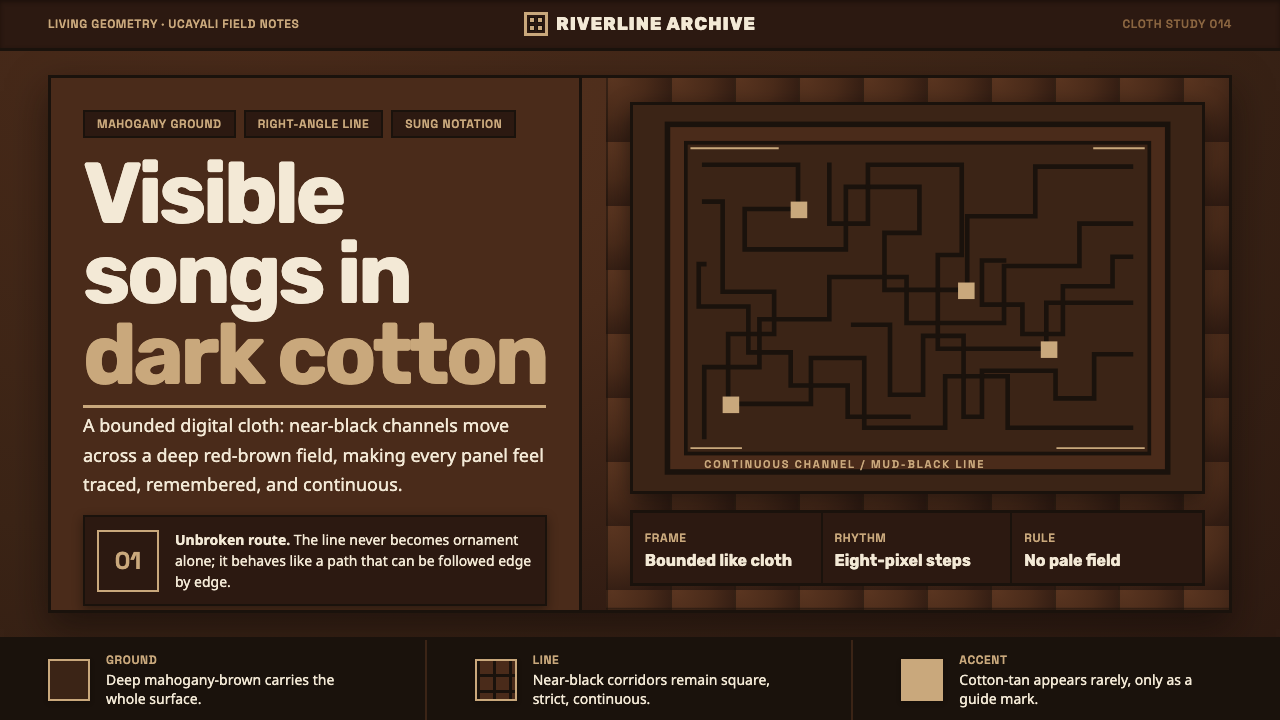 Shipibo Kené PatternSacred geometry sings. Mahogany cotton carries near-black right-angle paths.
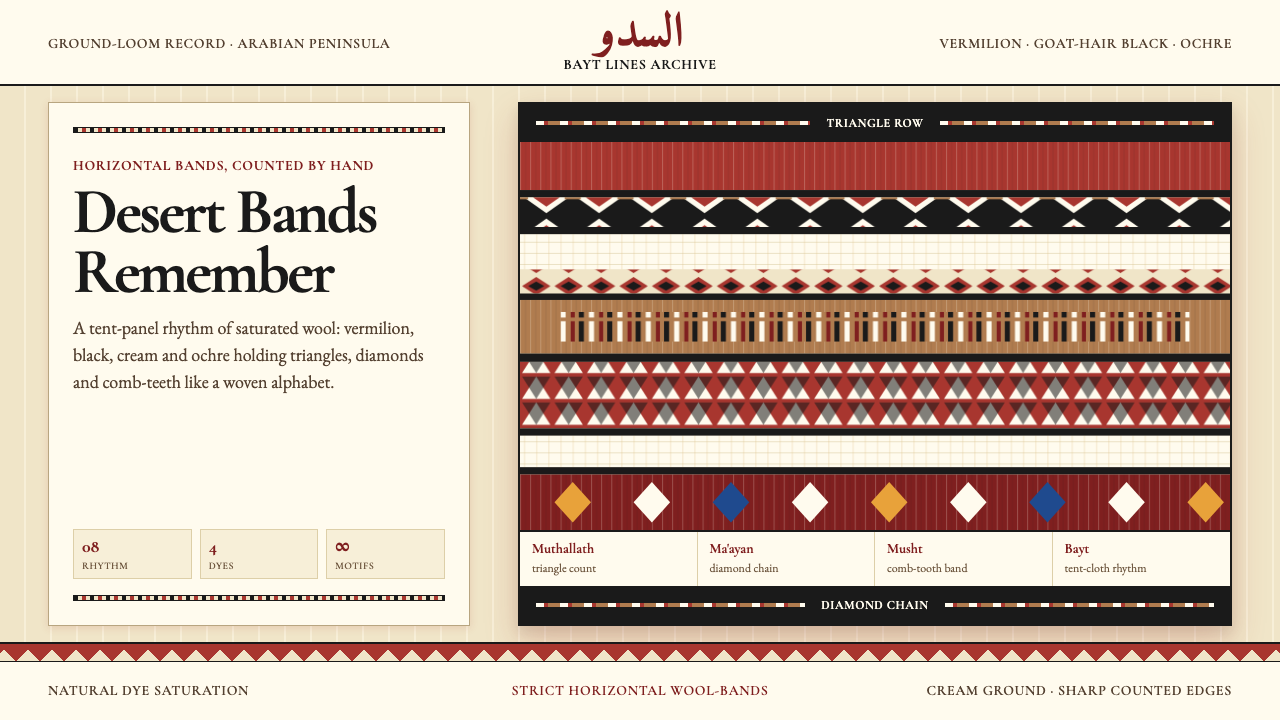 Bedouin Desert Textile (Sadu)Woven memory, not ornament. Vermilion-black bands count triangles and diamond…
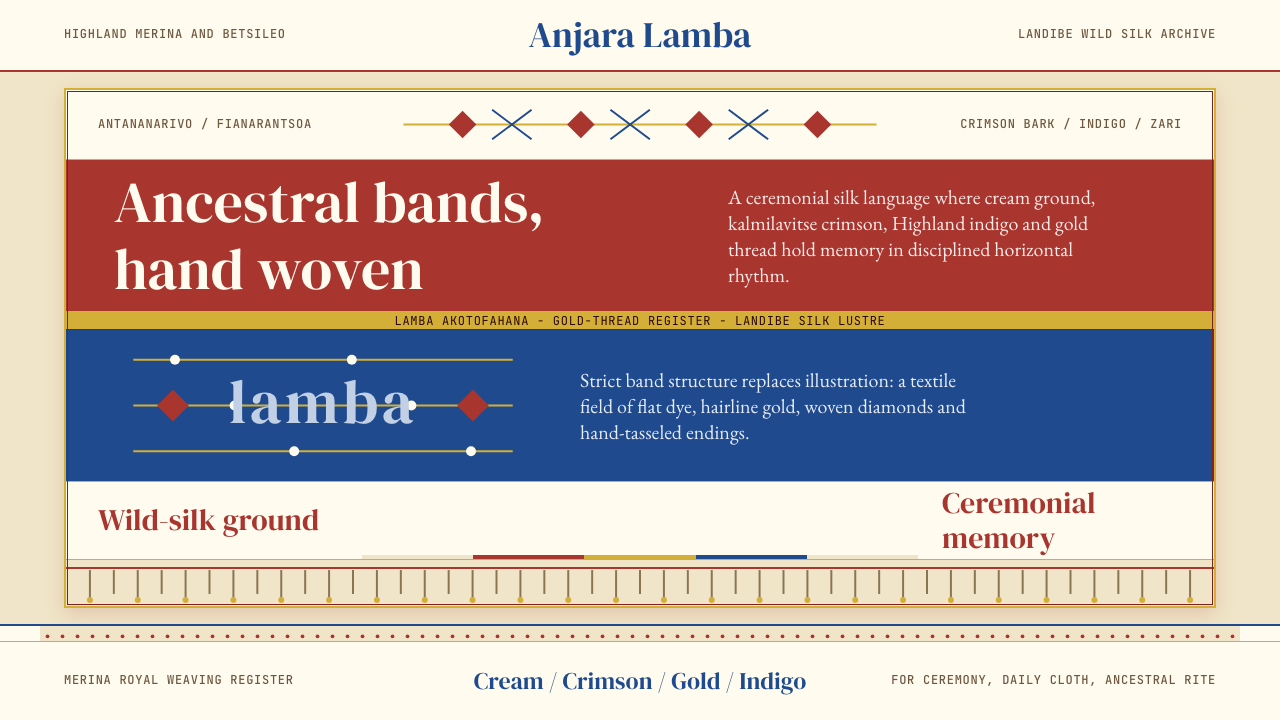 Madagascan Lamba SilkAncestry is woven flat. Crimson, indigo, cream and gold run in strict silk ba…
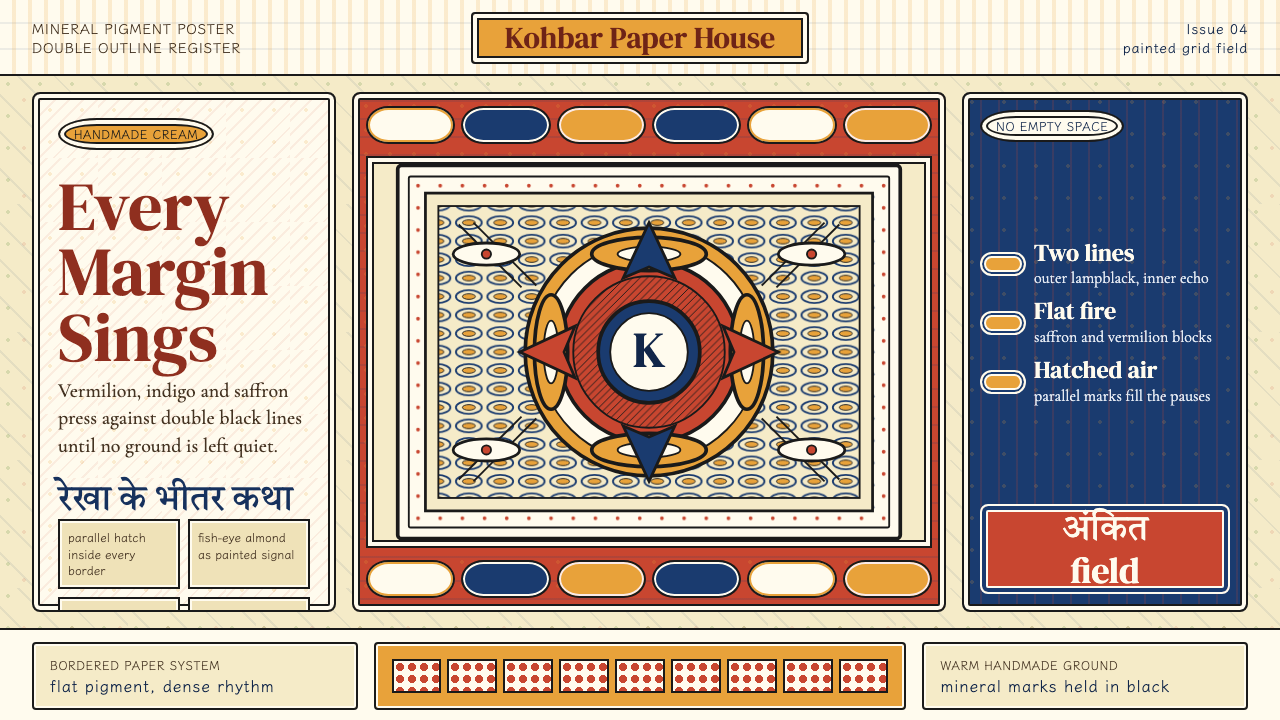 Madhubani (Mithila Folk Painting)No empty ground. Vermilion, indigo and saffron pack double-outlined panels wi…
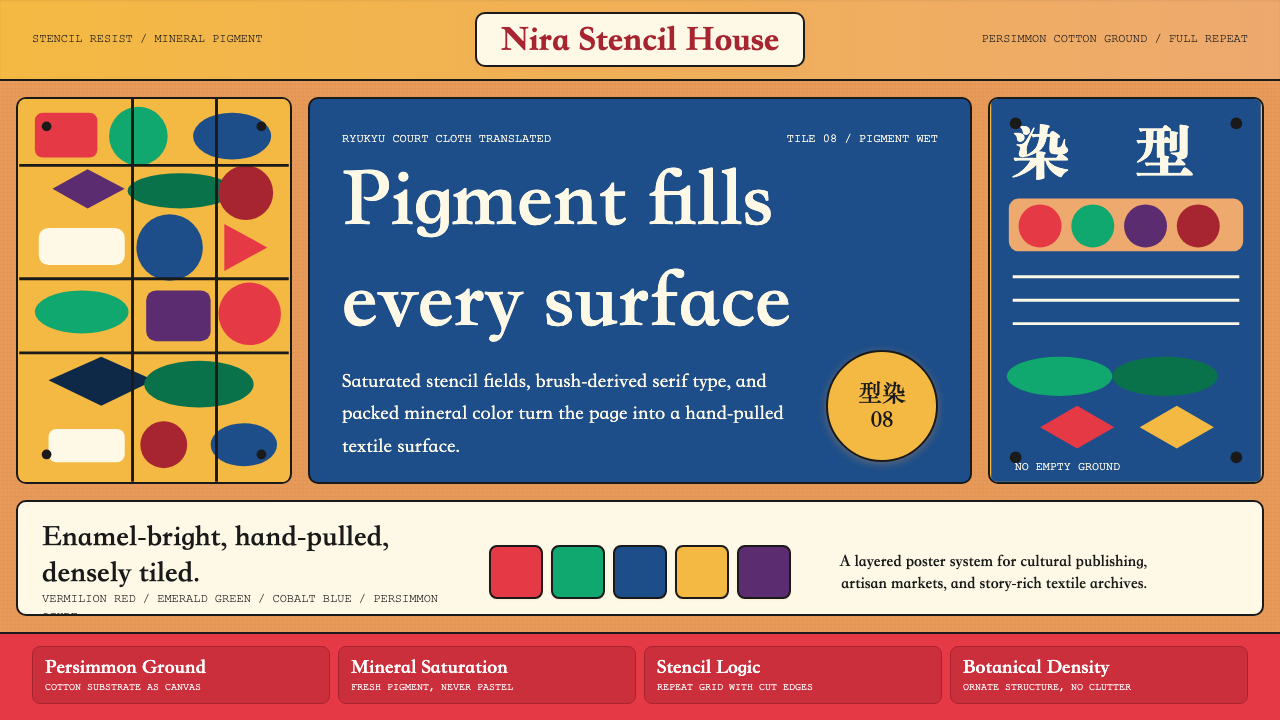 Okinawan Bingata Resist DyeOrnate without clutter. Persimmon ground, vermilion type, emerald-cobalt sten…
 Yoruba Gelede MaskRitual weight, not spectacle. Terracotta, kaolin, and indigo frame a carved-m…