What is Yoruba Gelede Mask?
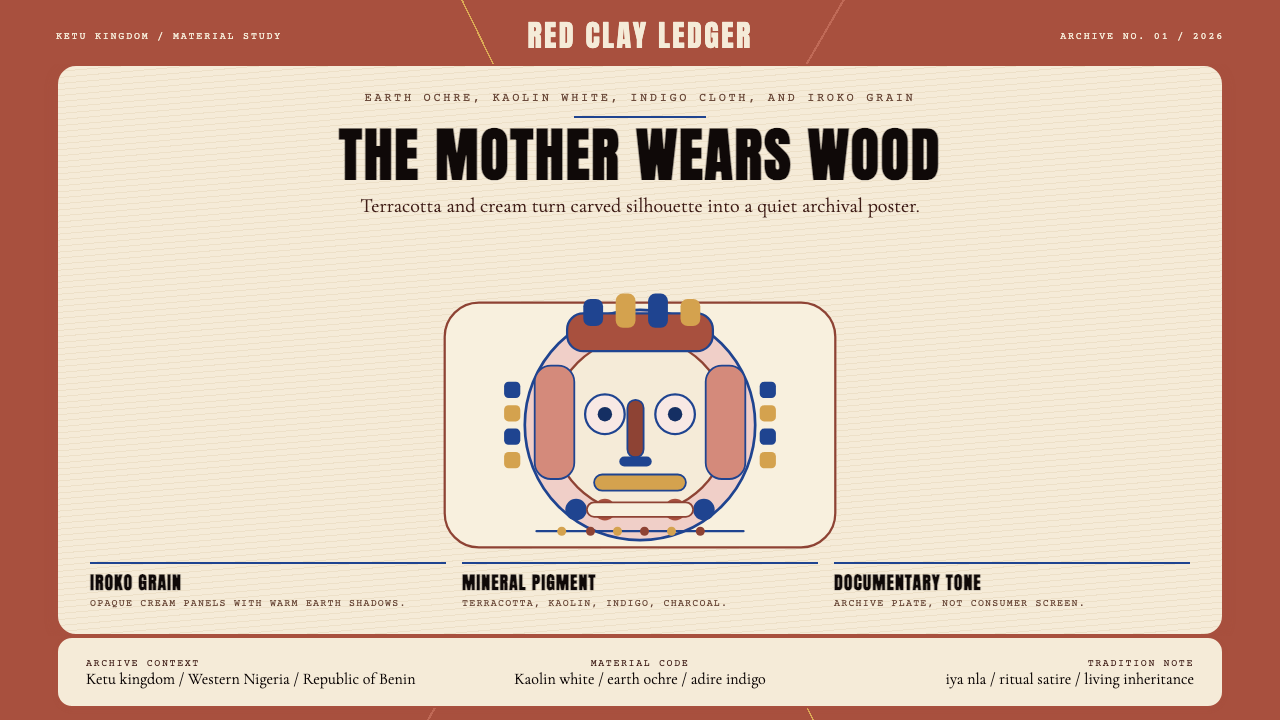
Carved from a single block of iroko wood and painted in mineral earth, Gelede translates a living West African masquerade tradition into a design language of ceremonial weight, terracotta warmth, and documentary gravity.
Yoruba Gelede Mask in brief
The Yoruba Gelede Mask design system takes its visual logic from the Gelede masquerade of the Yoruba people of West Africa — a living ritual tradition in which elaborately carved and painted wooden headdresses are worn during festival ceremonies to honor iya nla, the great mothers, and to appease the spiritual powers held by elder women in the community. The aesthetic vocabulary is grounded in material fact: terracotta ochre grounds derived from fired earth, kaolin-white surfaces echoing the mineral clay applied to ceremonial objects, indigo cloth accents drawn from hand-dyed West African textile traditions, and warm condensed type that recalls the weight and gravity of carved-wood poster vernacular.
What makes this design language distinct is that it carries documentary seriousness rather than decorative exoticism. Every color, every textural suggestion, every typographic choice is traceable to a specific material or cultural practice. Terracotta is not merely warm; it is the specific warm of fired Yoruba clay vessels and earthen pigments. The white is not sterile modernist white but the chalky, mineral quality of kaolin used in ritual body marking and object preparation. The system does not borrow surface appearances — it translates a coherent cultural material vocabulary into a digital design register.
The result is a palette and compositional logic suited to work that needs to feel grounded, authoritative, and culturally specific rather than universally abstract. It lends itself naturally to contexts where gravity matters: cultural documentation, editorial journalism, institutional identity for museums and heritage organizations, and any design work that must communicate seriousness without resorting to conventional corporate severity.

Where does Yoruba Gelede Mask come from?
The Gelede masquerade originated among the Yoruba and Egun peoples of the Ketu kingdom, centered in what is now the Republic of Benin, with the tradition spreading westward into southwestern Nigeria and Togo. Its documented roots reach at least to the eighteenth century, though oral histories suggest a much older genesis tied to the founding mythologies of Ketu lineage groups. Gelede is not a singular performance but a complex annual festival cycle in which masks are commissioned from specialist carvers, consecrated through ritual, and performed by initiated male dancers whose identities are concealed beneath the headdresses.
The central purpose of Gelede is to acknowledge and manage the spiritual power attributed to elderly women — mothers, grandmothers, and female ancestors — within Yoruba cosmology. This power, known as ase, is regarded as ambivalent: enormously constructive when honored and properly appeased, potentially destructive when neglected or antagonized. Gelede performances are therefore simultaneously theatrical entertainment and serious spiritual negotiation — a communal act of recognition directed at iya nla, the great mother principle that underlies Yoruba understanding of cosmic order. The carved headdresses that sit atop the dancers' heads are vehicles for this spiritual address, and their imagery — figures, animals, narrative scenes — is carefully chosen to flatter, honor, and engage the mothers' attention.
The carving tradition is highly specialized. Master carvers, working primarily in iroko wood (chosen for its density, stability, and spiritual associations), produce headdresses whose upper registers become stages for elaborate sculptural scenes: hunters, priests, market women, colonial officers, musicians, and animals appear in arrangements that comment on Yoruba social life. The faces of the masks are painted in earth-derived mineral pigments — ochres, kaolins, iron oxides — that weather and change across the performance season, accumulating a patina that signals accumulated ritual use. Indigo-dyed cotton cloth completes the costume, connecting the dancer to the broader visual language of Yoruba ceremonial dress.
In 2001, UNESCO inscribed the Gelede masquerade on its list of Intangible Cultural Heritage of Humanity, recognizing it as a living tradition of global significance. The inscription marked an important moment in the broader recognition of West African masquerade traditions as sophisticated art and cultural systems rather than ethnographic curiosities. Scholars including Babatunde Lawal, Henry John Drewal, and Margaret Thompson Drewal produced foundational documentary and analytical work on Gelede through the latter decades of the twentieth century, establishing the academic record that supports the tradition's continued visibility and the international understanding of its aesthetic and social logic.
What defines the Yoruba Gelede Mask look?
Color Palette
The palette draws directly from the mineral pigments used in Gelede carving and ritual practice: terracotta ochre as the dominant ground, warm and earthy in the manner of fired clay; kaolin white as a secondary surface tone, chalky and slightly textured rather than brilliant or sterile; indigo as the primary accent, deep and saturated in the manner of hand-dyed West African cloth. Black appears as a structural tone — for type, outlines, and architectural shadow. Together these four tones create a palette that feels simultaneously ancient and warm, ceremonially serious without being cold.
Typography
Type choices in this system echo the weight and presence of carved-wood vernacular — thick strokes, condensed proportions, and a visual density that holds its own against heavily textured grounds. Display type should feel monumental: wide at the top of the hierarchy, set with confident leading, printed in deep terracotta or black against the kaolin ground. Body text is quieter but maintains substance — no hairline weights, no airy spacing. The typographic logic is that of a notice or proclamation, not a whisper.
Texture and Surface
Unlike design systems that flatten everything to pristine digital smoothness, this palette implies surface. The terracotta ground carries the subtle grain of fired earth; the kaolin white reads as slightly absorbent, like prepared canvas or gesso; indigo accents suggest the weft and weight of woven or dyed fabric. These textural qualities should be invoked through tonal variation and edge treatment rather than literal photographic texture overlays — the goal is the feeling of material presence, not its simulation.
Composition and Weight
Gelede headdresses are read from a distance in outdoor festival settings — they must be legible, bold, and composed with strong vertical presence. This compositional logic translates into design work that favors centered or near-centered primary elements, strong vertical axes, and a sense that each element occupies its space with intention. Margins are generous; breathing room is treated as respect rather than waste. The composition never feels crowded or hustling — it has the stillness and deliberateness of ceremonial arrangement.
Narrative Imagery
Gelede headdresses are explicitly narrative — their upper registers depict scenes from Yoruba social life that comment, celebrate, or caution. This narrative sensibility should inform how imagery is selected and used within the design system: photographs and illustrations carry documentary weight rather than decorative function, and they depict specific people, places, or practices rather than abstract gestures toward culture. Imagery is evidence, not atmosphere.
Ceremonial Hierarchy
Yoruba ceremonial contexts maintain clear hierarchies — between elders and initiates, between the sacred and the profane, between the performance and the audience. The design system translates this into explicit, unambiguous visual hierarchy. Primary content is primary: large, weighted, positioned prominently. Secondary content supports without competing. There is no design anxiety about making hierarchy visible — clarity of rank is a form of respect in this visual tradition.
Restraint in Accent
Indigo appears in authentic Gelede costume as a specific accent — the deep-dyed cloth of the dancer's costume provides a foil to the carved and painted wood of the headdress, but it does not overwhelm. In the design system, indigo functions similarly: it is a powerful accent that should be used for a single tier of emphasis — a key statistic, a call to action, a title bar — rather than distributed broadly across the layout. When indigo appears everywhere, its ceremonial force dissipates. Used once or twice, it reads as intentional weight.

Who shaped Yoruba Gelede Mask?
Babatunde Lawal is among the most important scholars of Gelede, producing foundational texts on the masquerade's visual culture, symbolic program, and relationship to Yoruba spiritual cosmology. His analytical framework established how the carved upper register of Gelede headdresses functions as a social commentary system — the depicted figures and scenes are not merely decorative but constitute a form of communal discourse about Yoruba values, anxieties, and social order. His work provided the rigorous academic grounding that supports broader international understanding and recognition of Gelede as a sophisticated art tradition.
Henry John Drewal conducted pioneering fieldwork among Gelede communities in the Republic of Benin and Nigeria from the 1970s onward, producing detailed documentary records of the carvers, the festival calendar, the ritual protocols, and the social contexts in which Gelede operates. Co-authoring with Margaret Thompson Drewal, he helped bring Gelede into sustained academic and curatorial visibility in North American and European institutions. His documentation established the photographic and ethnographic record that underpins contemporary design engagements with the tradition's visual vocabulary.
Margaret Thompson Drewal brought a performance studies perspective to the analysis of Gelede, emphasizing the masquerade not only as a visual art form but as a form of embodied, time-based ritual performance in which movement, music, and mask operate together as an integrated system. Her work on the relationship between Yoruba performance aesthetics and the broader structure of Gelede ceremony deepened understanding of why the visual forms take the shapes they do — the headdress is never a static object but always a component of a dynamic live event, which is why its visual language is bold, legible from a distance, and compositionally centered rather than subtle or intimate.
The Gelede carving tradition is maintained by specialist carvers whose knowledge is transmitted through apprenticeship lineages rather than formal institutional education. Within Gelede communities, master carvers hold social authority commensurate with their craft skill — they are not anonymous craftsmen but named practitioners whose stylistic signatures are recognized by knowledgeable viewers. The tradition of recognizing individual carver style within a collectively maintained visual vocabulary is itself instructive for design thinking: the system provides a shared framework while individual execution within that framework can be distinctively authored.
How do you use Yoruba Gelede Mask today?
The Yoruba Gelede Mask design system is not a universal style — it carries a specific cultural gravity that must be matched by the seriousness of the work it frames. It performs best in contexts where documentation, heritage, or the communication of cultural depth are core values: museum and gallery exhibition materials, editorial journalism covering African culture or global heritage, academic and institutional publications, and cultural organizations that need to signal authority and rootedness rather than novelty or disruption. Using this system casually or ironically would represent a significant category error.
For presentation slides, the system works best as a cover-and-section-structure language rather than a universal content style. A cover built on terracotta ground with a bold centered title in kaolin white, a strong documentary photograph treated with high contrast, and an indigo accent line creates immediate visual authority. Section dividers should maintain this ceremonial seriousness — large type, minimal supporting elements, confident spatial decisions. Data slides within this system should be restrained and clear: bar charts and figures in black on a near-white ground, with indigo used sparingly to highlight the single most important value. Avoid decorative chart frames or embellishments — the dignity of the system lies in its restraint.
For web interfaces, this system suits editorial-driven platforms, digital archives, museum collection browsers, and any interface whose primary function is to present and contextualize cultural content rather than to convert or transact. A dashboard or pricing page can use it effectively if the product itself is positioned around cultural authority — a heritage organization membership portal, an academic database subscription interface, or an institutional grants application system. The approach: a near-white or kaolin ground for the main content area, terracotta as the primary navigation and header surface, indigo for active states and critical calls to action, black for all body text and iconography. Card components should have clear visible borders rather than soft shadows — the system does not blur edges.
For editorial and marketing work, Gelede offers a strong visual register for feature journalism, documentary book covers, cultural magazine spreads, and institutional annual reports. A full-bleed terracotta background with a richly documented black-and-white or naturally colored photograph, kaolin-white headline type at large scale, and a single indigo pull-quote creates a spread that reads as both visually compelling and editorially serious. Marketing pages for cultural institutions or heritage tourism — where communicating depth and authenticity is more important than energy or excitement — benefit from the system's measured pacing: wide margins, generous vertical spacing, and type hierarchies that give readers time to settle into the content.
A common mistake when applying this system is treating the terracotta, kaolin, and indigo palette as interchangeable warm-tone ingredients to be balanced decoratively across a layout. The palette has a specific hierarchy: terracotta grounds, kaolin surfaces, indigo punctuates. Using all three at equal weight simultaneously collapses the system's logic and produces work that feels muddy rather than ceremonially weighted. A related error is introducing additional warm accent colors — brick red, golden yellow, warm coral — in an attempt to increase visual richness. The system's richness comes from its restraint and the depth of its specific tones, not from multiplication of hues. Adding colors dilutes the palette's connection to its material sources and tips the aesthetic toward generic warm ethnographic pastiche rather than authentic documentary gravity.

Yoruba Gelede Mask — FAQ
Is it appropriate to use this design system for non-African or non-cultural contexts?
The system can be applied outside strictly African cultural contexts — it is a design language, not an exclusive cultural property — but it carries weight and associations that must be handled honestly. Using it for a fintech startup or a consumer app would create a tonal mismatch: the palette and compositional logic signal seriousness, rootedness, and cultural depth, which will clash with contexts that need to feel agile, contemporary, or frictionless. The system is well-suited to any context where the product's values align with its aesthetic values: gravity, documentation, heritage, authority. Where those values are absent or secondary, a different system will serve better.
How does this palette work in dark-background layouts?
The historic Gelede palette — terracotta, kaolin, indigo — is fundamentally a warm-ground system, and its natural register is light rather than dark. A dark inversion is possible but requires significant rebalancing. On a dark or near-black ground, indigo loses much of its distinctiveness against a dark surround; terracotta can feel aggressive and high-saturation rather than warm and earthy; kaolin white will function effectively as primary text and light accent. A workable dark variant uses a very deep warm-brown or near-black as the ground, kaolin as primary type, terracotta as a single strong accent, and reserves indigo for borders or structural lines rather than fills. This produces a somber, ceremonially weighted result — appropriate for contexts like digital memorial experiences or archival interfaces where gravity is intentional.
How should photography be handled within this design system?
Photography should function as documentary evidence rather than decorative atmosphere. The selection criterion is specificity: images of actual Gelede performances, Yoruba craftspeople, festival settings, or West African material culture carry the appropriate weight. Generic stock imagery of African subjects treated as atmospheric backdrop undermines the system's documentary integrity. In terms of treatment, photographs look best when reproduced with full tonal richness — neither bleached nor artificially warmed to match the terracotta palette. The palette already provides the warmth; let the photograph speak on its own terms. Hard crops and confident scale decisions serve the system better than soft vignettes or decorative masking.
What is the difference between Gelede and other West African masquerade traditions?
West African masquerade traditions are enormously diverse — the Egungun masquerade of the Yoruba, the Poro society masquerades of the Mende and Temne in Sierra Leone, the Gelede of the Ketu Yoruba, and the Eguae of the Edo are all distinct traditions with different cosmological purposes, visual vocabularies, and social functions. Gelede is distinguished by its explicit focus on honoring the spiritual power of women — this is unusual among masquerade traditions, which more commonly center male initiation or ancestral propitiation. The Gelede headdress is also distinctive in its narrative upper register, which turns the top of the mask into a staged tableau. Design systems derived from different masquerade traditions would feel quite different from each other: Egungun, for example, emphasizes layered textile panels and motion over carved form, producing a very different visual logic.
Can this system be used for digital products aimed at West African audiences?
It can, but with important nuance. Contemporary digital audiences in Nigeria, Benin, and the broader West African region are not a monolith — they span users who engage deeply with traditional culture, users for whom this palette will read as specifically local and heritage-inflected, and users who interact primarily with global digital product norms and may find this aesthetic unexpected or formal. For a heritage museum app, a cultural documentation platform, or a festivals and events portal, the system is highly appropriate and will likely resonate strongly. For a payments app or a social platform, a contemporary Nigerian design sensibility — which often engages vibrantly with color and energy — will be more fitting than a palette rooted in ceremonial restraint.
Related design styles
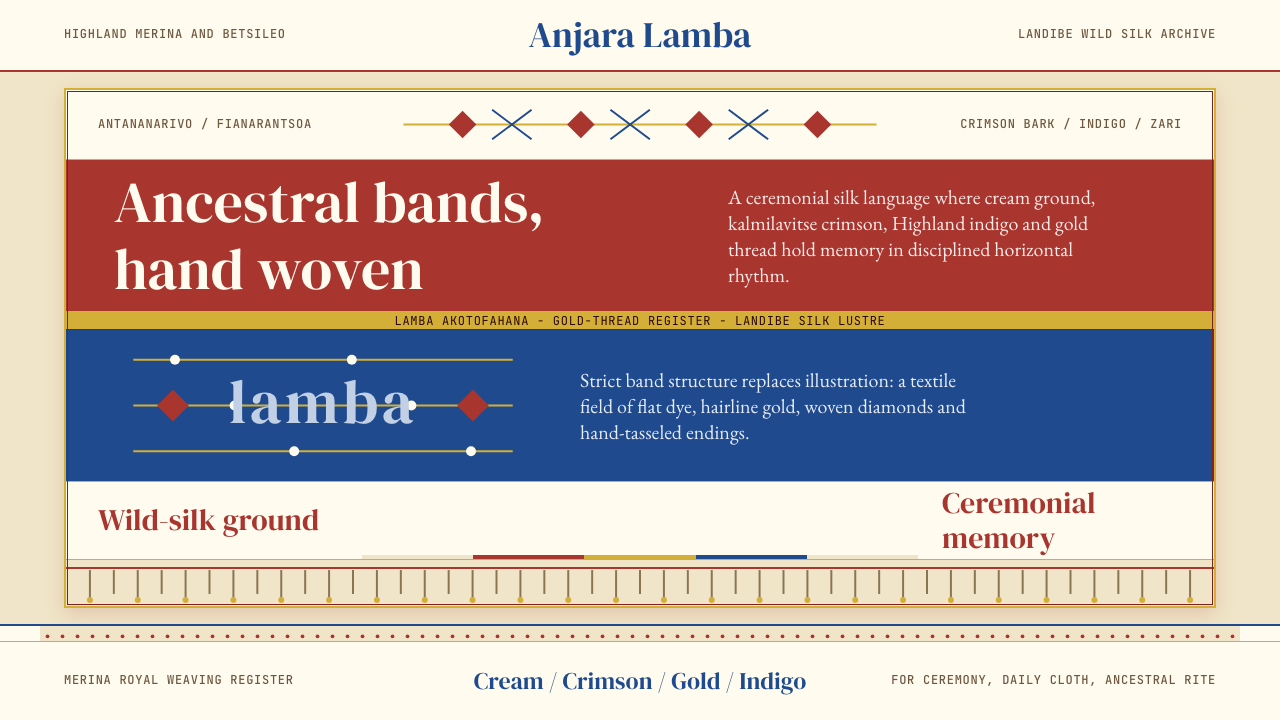 Madagascan Lamba SilkAncestry is woven flat. Crimson, indigo, cream and gold run in strict silk ba…
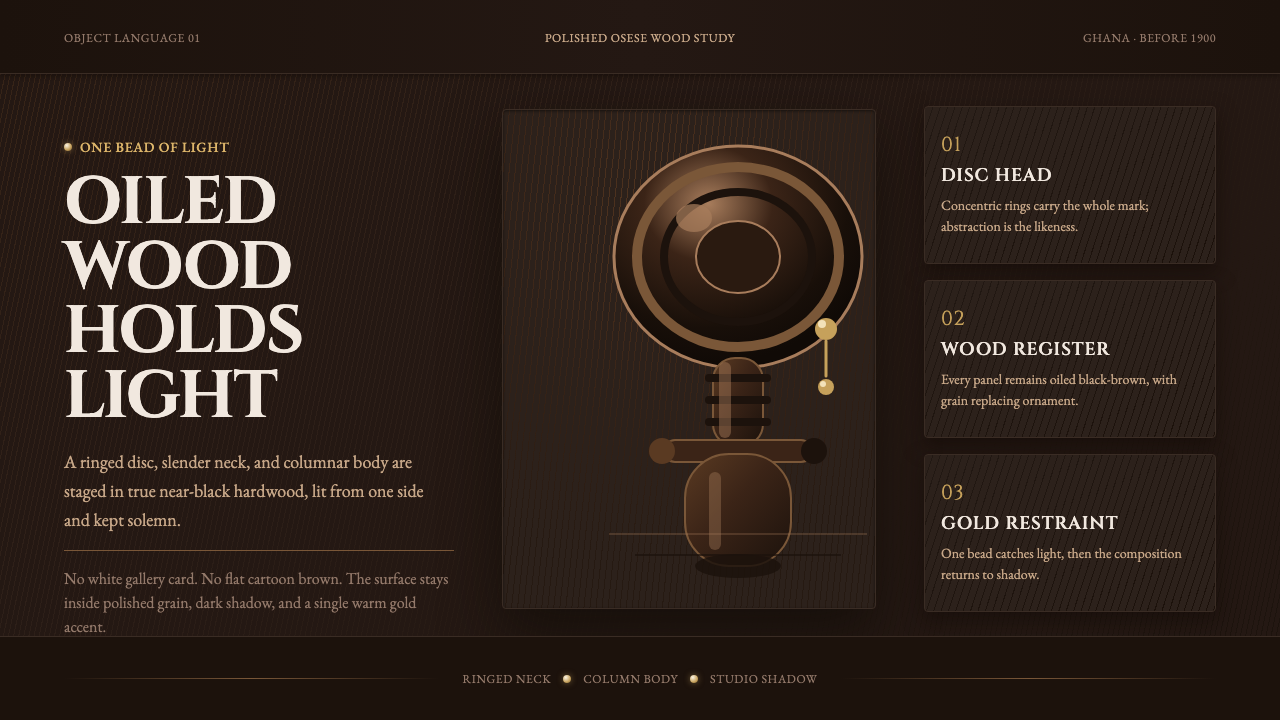 Akuaba Akan Fertility DollDarkness becomes sculpture. Near-black wood, ringed geometry, and one gold be…
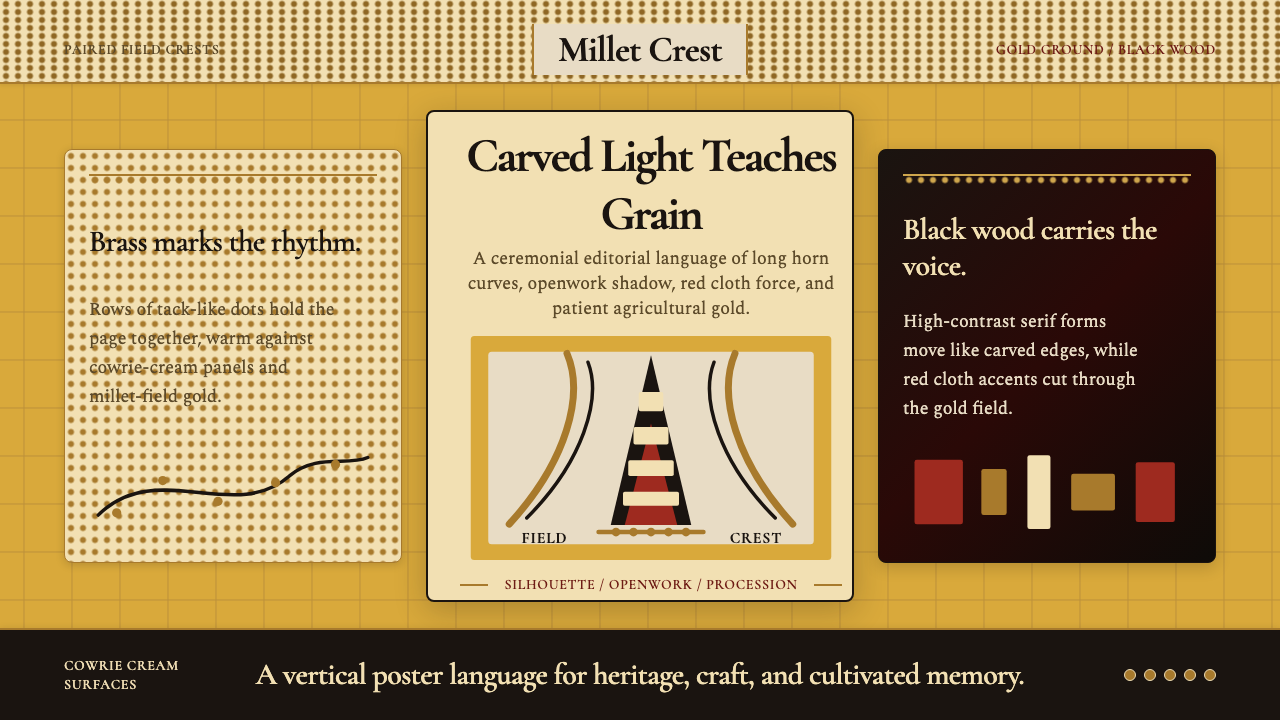 Bambara Chi Wara AntelopeCarved memory in gold. Black serif silhouettes and brass-dot borders carry th…
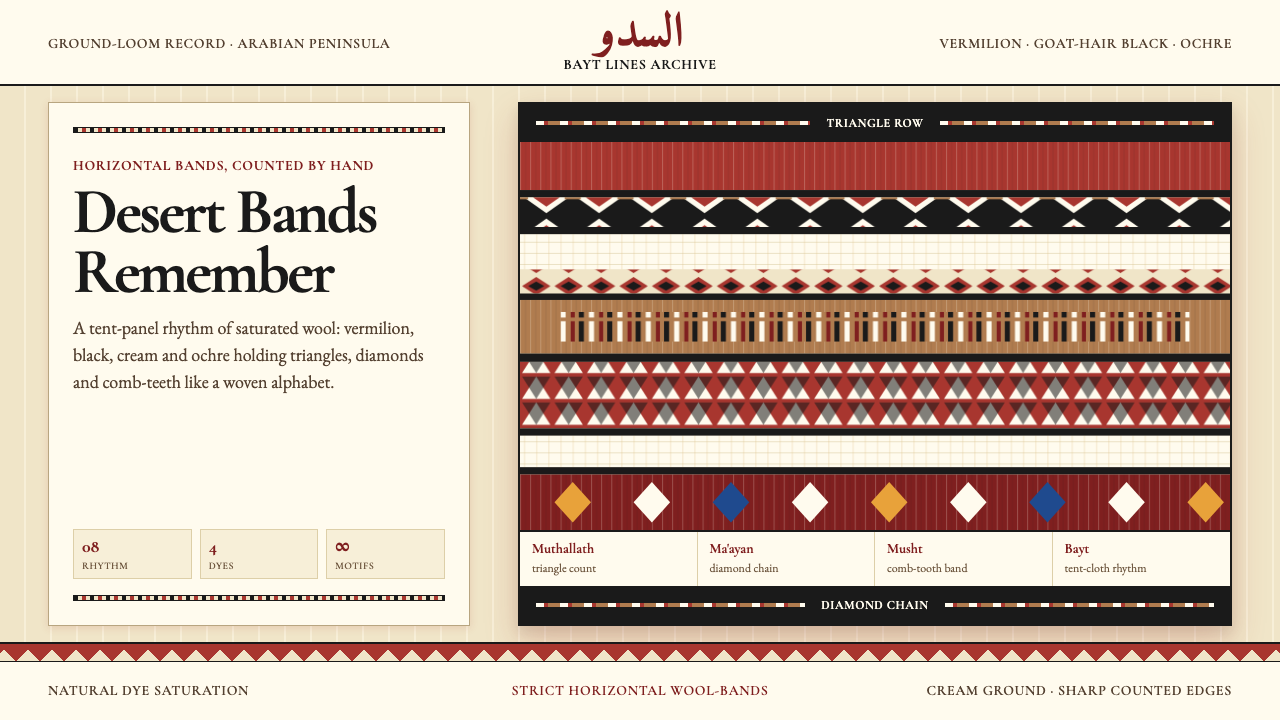 Bedouin Desert Textile (Sadu)Woven memory, not ornament. Vermilion-black bands count triangles and diamond…
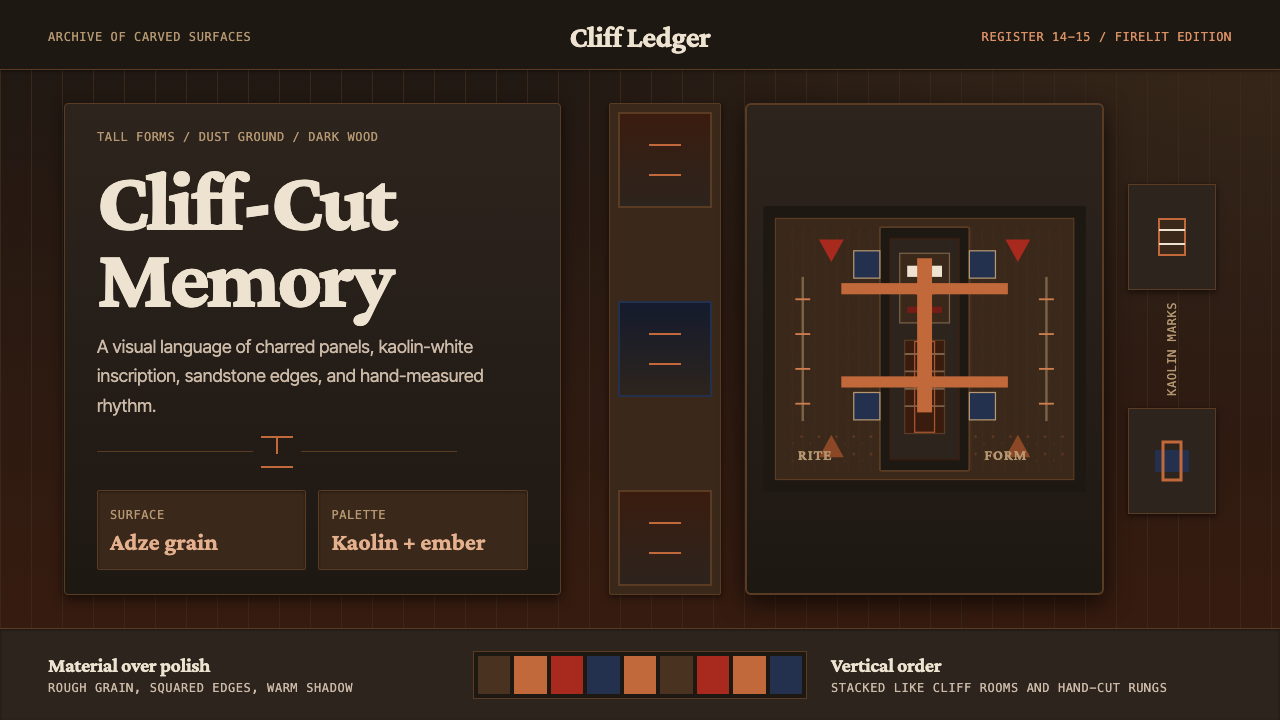 Dogon Bandiagara Cliff MaskHand-hewn gravity. Charred wood, kaolin type, and sandstone geometry stack li…
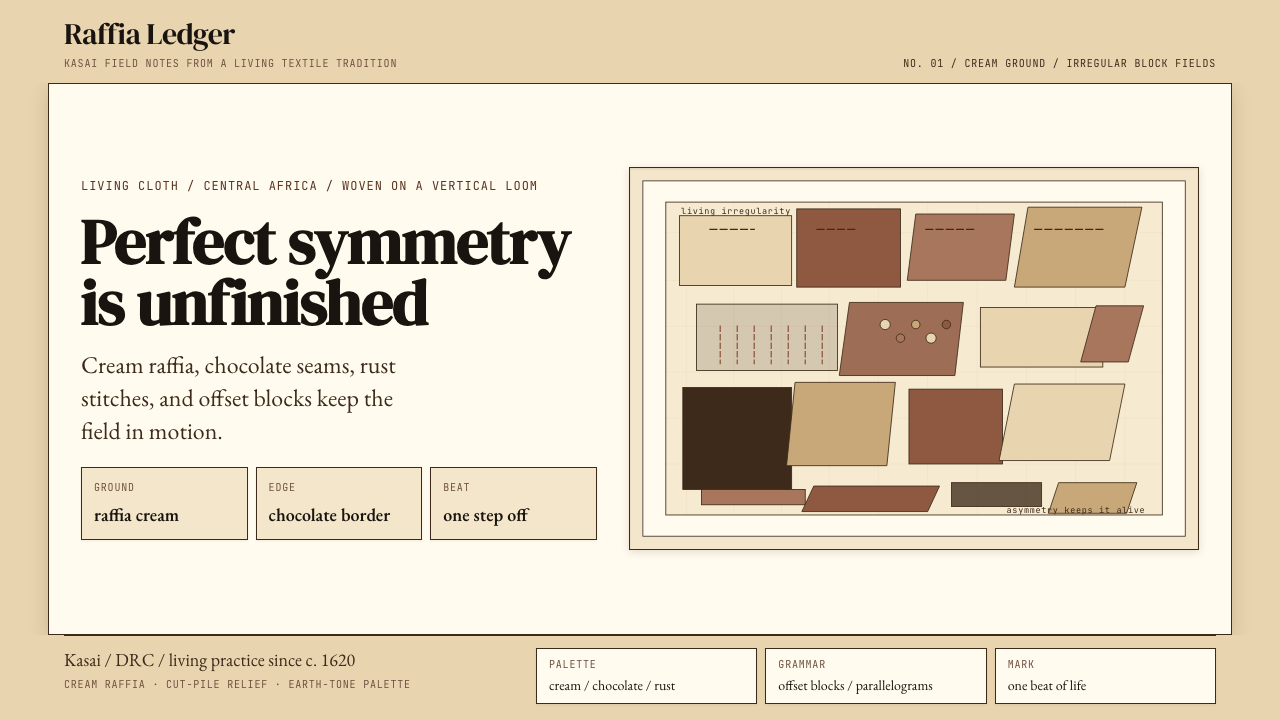 Kuba Raffia Cloth (Congo)Deliberate asymmetry lives. Cream raffia, chocolate seams, and rust blocks.