What is Dogon Bandiagara Cliff Mask?
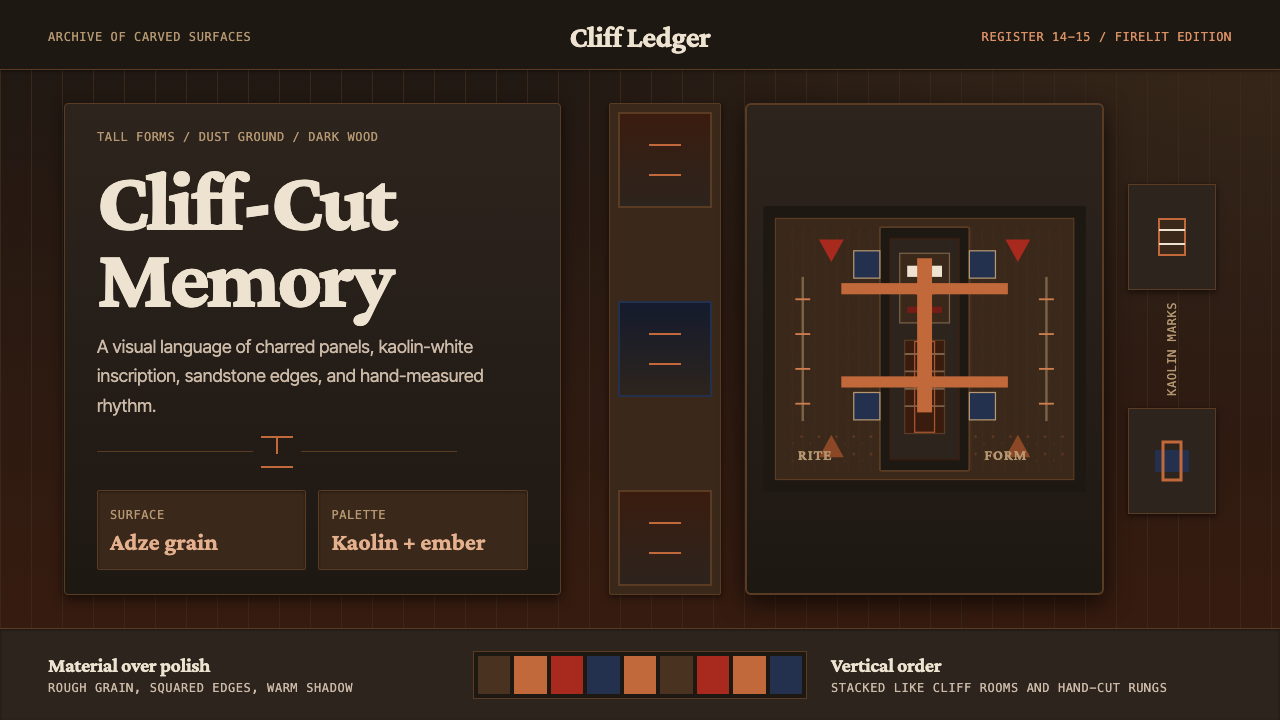
From the vertical sandstone face of Mali's Bandiagara Escarpment comes a design language as ancient and as deliberate as the cliff itself — rough-hewn rectangles, ritual cross motifs, and a palette scraped from the earth.
Dogon Bandiagara Cliff Mask in brief
Dogon Bandiagara Cliff Mask is a design style rooted in the visual and spiritual culture of the Dogon people, who have inhabited the Bandiagara Escarpment in central Mali for more than five centuries. The style channels the forms, textures, and sacred symbolism of Dogon wood-carving — particularly the masks used in Dama funerary ceremonies — into a coherent visual system: tall, compressed rectangular forms; rough surfaces that read as hand-worked rather than machine-finished; a muted palette drawn from cliff minerals, kaolin pigment, charred wood, and indigo-dyed textiles; and the Kanaga cross motif, a cruciform sign representing the cosmic order that links sky, earth, and ancestor.
What distinguishes this style from generic 'African-inspired' design is its specificity. It is not an abstraction of a continent but a distillation of one community's highly particular material and ritual tradition. Every element carries documentary weight: the adze-textured surface recalls the blacksmith-sculptor lineages whose authority over iron and carved wood is both practical and cosmological; the compressed verticals echo the cliff-side granaries and toguna meeting houses that Dogon builders have constructed from sandstone blocks and millet-straw thatch for generations; the Kanaga geometry is not decorative but theological.
Visually, the style occupies a space between monument and artifact. It is not sleek. It does not reward speed. Its power accumulates in stillness — a deep, dusty gravity that rewards sustained attention. On a screen or on paper, it reads as something that was dug out of the earth rather than composed on a grid.
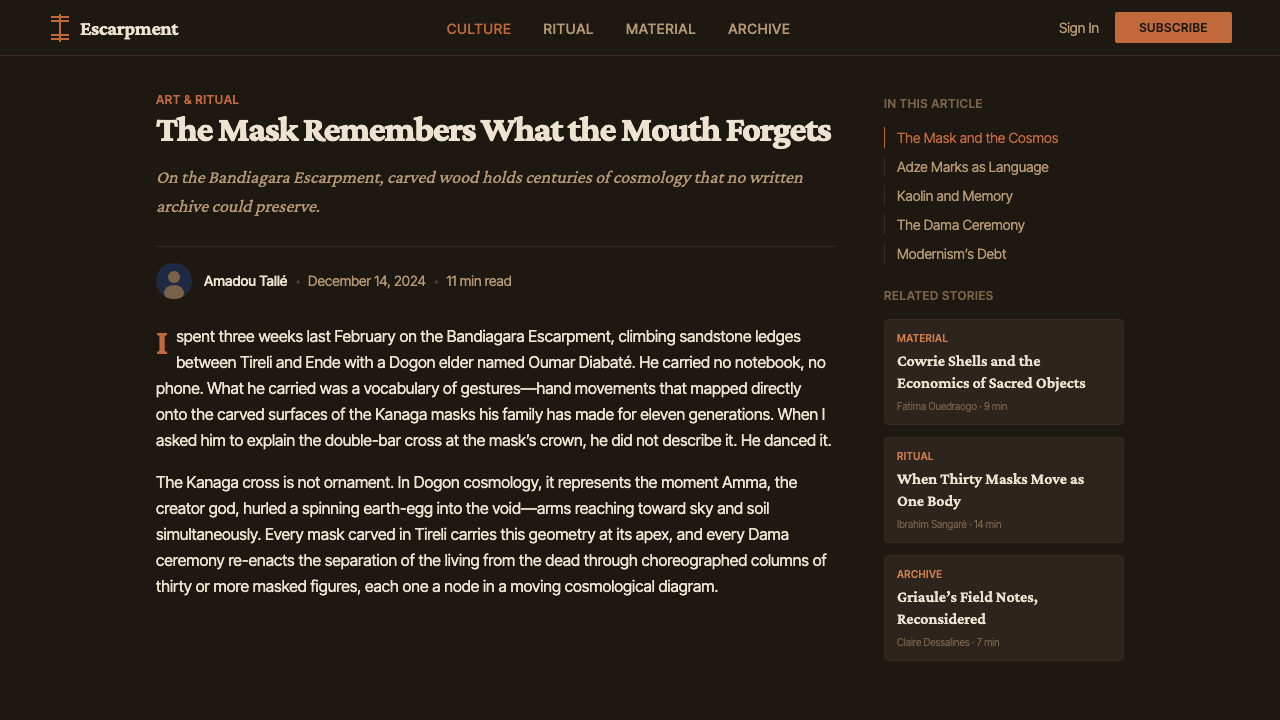
Where does Dogon Bandiagara Cliff Mask come from?
The Dogon people are believed to have settled the Bandiagara Escarpment — a dramatic sandstone cliff face stretching roughly one hundred and fifty kilometers in the Mopti region of Mali — between the fourteenth and fifteenth centuries, possibly fleeing the expansion of the Mandé empire. The cliff itself became both fortress and canvas. Dogon builders cut granaries and dwelling rooms directly into the rock face and constructed villages from the same amber sandstone on the plateau above. The geography shaped a culture oriented toward verticality, compression, and the deep logic of layered stone.
Dogon mask-making sits at the intersection of craft, cosmology, and social authority. Masks are not decorative objects; they are instruments for managing the relationship between the living and the dead. Dama, the principal funeral cycle, can last several years and culminates in a series of masked dances performed on the dust-orange plazas of clifftop villages. The masks — tall, some exceeding two meters in height — are carved by men of the Awa society from the wood of specific tree species. Their forms are strictly codified: the Kanaga, the Sirige, the Great Mask. Each corresponds to a narrative within Dogon cosmology, and the visual vocabulary of each — cross, chevron, column, face — encodes a specific relationship between human society and the order of the cosmos.
The Kanaga mask is the most widely recognized form and the visual anchor of this design system. Its superstructure is a double-barred cross: a vertical column from which two horizontal bars extend, each bar terminated with a short perpendicular stroke. The form has been interpreted variously as a stylized bird, a creator god, and a diagram of the cosmos itself — sky above, earth below, linked by the axis of human existence. Marcel Griaule's 1931 Dakar-Djibouti Mission, which spent fourteen months documenting Dogon culture, brought this visual language to international attention. His subsequent collaboration with elder Ogotemmêli, recorded in Dieu d'Eau (Conversations with Ogotemmêli, 1948), provided the first extensive account of Dogon cosmological thought in a European language.
Western exposure to Dogon aesthetics coincided with the rise of European modernism, and the influence was not one-directional. Cubist painters and constructivist sculptors of the early twentieth century engaged with African mask forms — though often without acknowledging specific sources — and Dogon work in particular, with its severe geometry and compressed frontality, resonated with the reductive ambitions of European avant-garde art. By the mid-twentieth century, Dogon masks had entered museum collections across Europe and North America, and the visual grammar of the Bandiagara tradition — rectangular compression, rough surface, cross geometry — had become legible as a coherent aesthetic mode in its own right, one that designers and artists outside Mali could study and interpret.
What defines the Dogon Bandiagara Cliff Mask look?
Form: Tall Rectangles and Compressed Frontality
The governing shape of Dogon mask design is the elongated rectangle — a tall vertical panel that rises from a narrow base and maintains strict bilateral symmetry around a central axis. This verticality is not decorative; it echoes the architectural logic of cliff-face granaries, the stacked stone of Dogon dwellings, and the physical height of the masks themselves, some of which tower above their wearers. Compositions built on this logic feel compressed and load-bearing, as though weight presses downward through every element.
Color: Earth Minerals and Ritual Pigments
The palette is narrow and mineral in character: a deep, sandy terracotta that recalls the iron-oxide hue of the Bandiagara sandstone; dense, warm black derived from charred wood and manganese; a chalky, near-white kaolin that Dogon artists apply to masks in broad flat areas; an ochre-tinged intermediate tone; and a deep indigo associated with cowrie-bead textiles. These colors do not blend or graduate — they are applied as discrete, flat fields, adjacent but not mixed. The overall temperature is warm and dusty, never cool or luminous.
Texture: The Hand-Hewn Surface
Where most contemporary digital aesthetics tend toward smoothness, this style insists on the memory of tool marks. Surfaces carry the visual implication of the adze — the curved blade that Dogon carvers drag across wood grain to produce shallow, irregular facets that catch and diffuse light rather than reflecting it cleanly. In digital application this quality is achieved through the deliberate introduction of irregularity: edges that are almost but not perfectly straight, fills that carry a slight granularity, type that sits slightly unevenly on its baseline. The effect reads as made rather than generated.
Symbol: The Kanaga Cross
The Kanaga cross is the style's primary geometric motif and its most charged element. Its structure — a vertical bar crossed twice by horizontals, with each horizontal arm terminated by a short perpendicular — is precise enough to be reproduced consistently but open enough in meaning to function as pure geometry when context requires it. Used as a primary structural element rather than a surface decoration, it anchors compositions and signals depth of cultural reference. Used carelessly or too frequently, it tips into pastiche.
Composition: Layered Panels, Not Open Fields
Dogon visual culture does not organize space around a single focal point surrounded by breathing room. It stacks: granaries sit above granaries; carved panels sit above carved panels; register upon register of symbol accumulates from base to apex. This stacking logic produces compositions that feel dense and archaeological — as though meaning accumulates with height. Contemporary applications of this style work best when they embrace the same layered panel structure: horizontal bands of content stacked vertically, each band complete in itself, the whole read from bottom to top as much as top to bottom.
Darkness as Presence, Not Absence
This is an inherently dark-mode style. The charred-wood black is not a neutral void or a recessive background — it is a positive material presence, the way the interior of a carved mask reads as depth rather than emptiness. Against this ground, kaolin white and terracotta orange carry enormous visual weight even in small quantities. The darkness is the substance; the lighter elements are what has been revealed within it. Inverting the style to a light background fundamentally changes its character, producing something legible but significantly less weighty.
Typography: Weight and Silence
There is no indigenous Dogon typographic tradition in the Latin or digital sense — the style's typography must be borrowed and calibrated to feel consonant with its visual weight. The governing principle is mass over refinement: letterforms should feel carved rather than drawn, substantial rather than elegant. Headline type works best when it is wide-set, generously spaced, and rendered in a weight that matches the density of the surrounding carved surfaces. Body text should be spare — this is a style in which long columns of fine type feel incongruous. Silence and spacing carry as much meaning as the words themselves.

Who shaped Dogon Bandiagara Cliff Mask?
Ogotemmêli was a Dogon elder and hunter who, having lost his sight in an accident, became one of the most celebrated repositories of Dogon cosmological knowledge in the twentieth century. Over thirty-three days in 1946, he delivered to the French ethnographer Marcel Griaule a comprehensive account of Dogon origin myth, cosmology, and symbolic system — material later published as Conversations with Ogotemmêli. His testimony remains the primary textual source for understanding the symbolic weight carried by Dogon visual forms, including the Kanaga cross motif and the relationships encoded in mask carving.
Marcel Griaule was a French anthropologist and aviator who led the Dakar-Djibouti Mission of 1931 — the first major French ethnographic expedition across sub-Saharan Africa. His fieldwork among the Dogon, sustained over decades, produced the most extensive Western record of Dogon material culture and cosmology. Griaule's documentation of mask ceremonies, architectural forms, and symbolic systems effectively established the Dogon as one of the most studied communities in African ethnography and, indirectly, gave Dogon visual culture its international currency. His methods and interpretations have been subject to scholarly revision, but his role in transmitting this visual tradition to a global audience is undeniable.
Germaine Dieterlen was a French ethnologist and longtime collaborator of Marcel Griaule who spent decades conducting her own fieldwork among the Dogon and related Sahelian cultures. Her contributions to documenting the Sigui ceremony — a ritual cycle that occurs only once every sixty years and involves the renewal of the Great Mask — provided material unavailable from any other source. After Griaule's death in 1956, Dieterlen continued the research program and co-authored with him the posthumously published The Pale Fox, a comprehensive account of Dogon cosmology that remains a foundational reference for understanding the symbolic framework underlying the visual tradition.
The Awa is the men's society responsible for the production and ritual use of Dogon masks. Membership is obligatory for initiated Dogon men, and the society governs both the technical process of mask carving and the ceremonial protocol of their use. Masks are carved in secret, stored in sacred spaces, and deployed only during specific ritual occasions — most prominently Dama, the cycle of funerary rites that releases the souls of the recently dead. The Awa's collective authority over mask production means that the visual vocabulary of Dogon carving is not the individual expression of named artists but the accumulated inheritance of a community aesthetic maintained across generations.
Unlike fine-art traditions organized around individual named masters, Dogon mask carving is sustained by blacksmith lineages — families for whom ironwork and woodcarving are hereditary specializations. The village of Sangha, on the Bandiagara plateau, has historically been one of the principal centers of this production. Contemporary artisan families in Sangha and surrounding villages continue to carve masks for active ceremonial use as well as for cultural exchange. Their work represents the living transmission of the visual tradition — adaptive to new materials and changing ritual contexts, but maintaining the core formal vocabulary of compressed rectangles, cross geometry, and hand-textured surface.
How do you use Dogon Bandiagara Cliff Mask today?
Dogon Bandiagara Cliff Mask is a high-commitment style — it does not sit lightly on a design. Its authority comes from density, from texture, from the feeling that every element has been placed with the gravity of ritual rather than the speed of production. Applied without that commitment, it quickly reads as costume: some clay-toned colors and a cross shape on an otherwise ordinary layout. Applied with full conviction, it creates something genuinely unlike most digital design — monumental, still, and weighted with cultural memory.
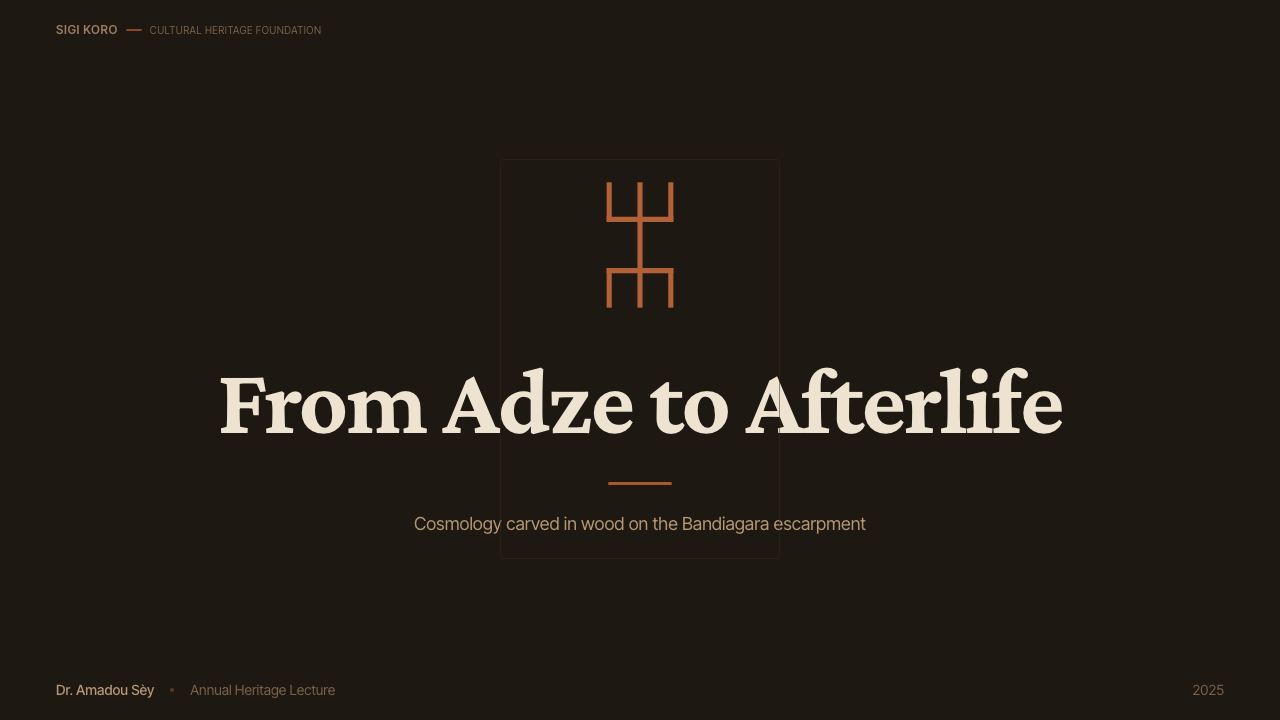
For presentation slides, this style works most powerfully as a cover treatment and as section dividers. A cover built on this vocabulary should commit fully: a deep charred background, a single large Kanaga or rectangular form in terracotta or kaolin, and a headline set in a wide, heavy weight with generous character spacing. Resist the urge to add refinement — no subtle gradients, no light drop shadows, no decorative secondary elements. Content slides are harder to execute at full intensity; the most practical approach is to carry the palette and the compressed rectangular logic into simple content frames, treating the dark background as a constant and the lighter elements as revealed text and data.
For web interfaces, the style suits landing pages, brand introductions, and cultural or editorial contexts more readily than functional dashboards. A header built on Dogon principles — deep dark background, terracotta or kaolin accent, monumental spaced type — creates an immediate and distinctive impression. Navigation elements should be stripped to essentials: type only, maximum contrast, no soft states. For UI contexts requiring conventional interactivity — forms, filtering, data tables — the full style intensity should be modulated: carry the color story and the typographic weight, but use a lighter variation of the ground tone and reduce the surface texture to preserve legibility at small sizes.
For editorial and marketing design — book covers, poster campaigns, cultural institution identities — the style reaches its fullest expression. The stacking panel structure translates naturally to a vertical poster format; the Kanaga cross works as a primary graphic element at large scale; the mineral palette holds well in print reproduction. A common application is the section-head treatment in a long-form editorial: deep band, single large geometric form or cross motif, overprinted in white kaolin type — the reader registers a shift in register without losing the thread of the content.
The most common mistake in applying this style is treating the Kanaga cross as decoration rather than structure. The cross should appear once, prominently, or not at all — using it as a repeating wallpaper pattern or a background texture element strips it of visual authority and tips the design into superficial cultural referencing. The second common mistake is softening the palette: introducing warm beiges, muted earth tones, or desaturated terracottas in an effort to make the style more approachable. The style's power depends on the tension between its deep, dense darks and its sharp, chalky lights — dilute either pole and the whole system loses its gravity.
Dogon Bandiagara Cliff Mask — FAQ
Is this style appropriate for non-African cultural contexts, or does using it risk cultural appropriation?
This is a serious and legitimate concern. The Dogon mask tradition is a living ritual practice, not a historical archive, and the Kanaga cross carries active cosmological meaning for communities who still perform Dama. Designers working with this vocabulary should be transparent about the source, avoid rendering the cross as empty decoration, and engage with the tradition's documented meaning rather than its surface geometry alone. The style is most ethically used in contexts with explicit cultural connection — institutions engaged in African art and history, projects in dialogue with Dogon or broader Sahelian cultural communities, or design briefs that foreground the origin rather than obscuring it. Using it as a 'tribal-primitive' style signal for generic earthiness or 'authenticity' is both historically inaccurate and disrespectful to a specific and still-living tradition.
How does this style differ from other West African design traditions?
West Africa contains remarkable stylistic diversity, and Dogon visual culture is distinct from neighboring traditions in several respects. The compressed vertical rectangular form is specifically Dogon — compare it with the curvilinear, zoomorphic vocabulary of Bamana sculpture or the openwork geometric patterning of Fulani textile arts. The Kanaga cross has no equivalent in nearby traditions. The palette — terracotta, kaolin, charred black, indigo — is similarly specific, tied to the mineral environment of the Bandiagara Escarpment rather than to a broader regional convention. The style should be understood as the product of a specific geography, a specific ritual system, and a specific carving lineage, not as a general representation of West African aesthetics.
Can this style work in a light or white background layout?
It can function, but it loses much of its essential character. The style's power depends on the deep charred-black ground acting as a positive material presence — the same way the dark interior of a carved mask is its depth, not its absence. On a white or cream ground, the terracotta and kaolin elements lose their luminous contrast, the Kanaga cross reads as a flat illustration rather than a carved revelation, and the overall composition becomes illustrative rather than monumental. If a light-ground application is required, the most effective approach is to treat it as a reduced reference: maintain the compressed rectangular structure, use the terracotta palette as the primary positive color against near-white, and introduce the cross motif sparingly. The result will be more approachable but considerably less powerful.
How should typography be chosen to work with this style?
The guiding principle is mass over refinement. Typefaces that feel geometrically constructed but carry perceptible weight — substantial letterforms with a slight irregularity or optical compensation that recalls hand-cutting — read most consonantly with the carved surface aesthetic. Condensed or compressed type settings align with the style's vertical rectangle logic. Avoid typefaces with high stroke contrast (the thick-thin variation characteristic of classical serifs), which introduce a refinement the style actively resists. Similarly avoid ultra-thin weights — they read as foreign to the material density of the system. The approach to spacing should be generous at the headline level and spare at the body level: the style does not reward dense text columns.
What makes this style appropriate for a dark-mode context specifically?
Unlike most dark-mode styles, which are adaptations of light-mode systems — essentially the same design with inverted contrast — the Dogon Bandiagara Cliff Mask style is natively dark. The charred-wood black is not a background color choice; it is a material. The style developed from a tradition in which darkness is not absence but substance: the interior of a carved mask, the smoke-blackened surface of a ritual object, the night sky above a cliff-top village during Dama dances. Applying it in a dark-mode context is therefore not an inversion or an adaptation but a direct expression of the style's fundamental logic. It is one of the few design vocabularies in which the dark background actively contributes meaning rather than simply providing contrast.
Related design styles
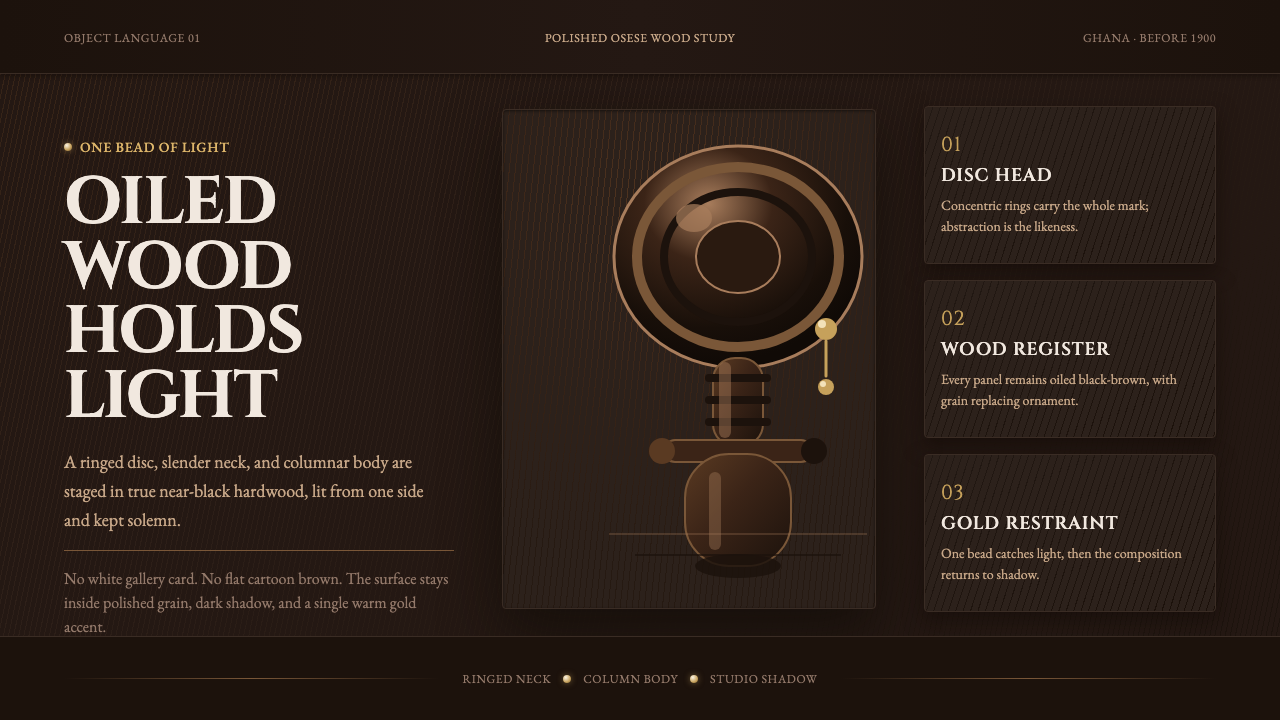 Akuaba Akan Fertility DollDarkness becomes sculpture. Near-black wood, ringed geometry, and one gold be…
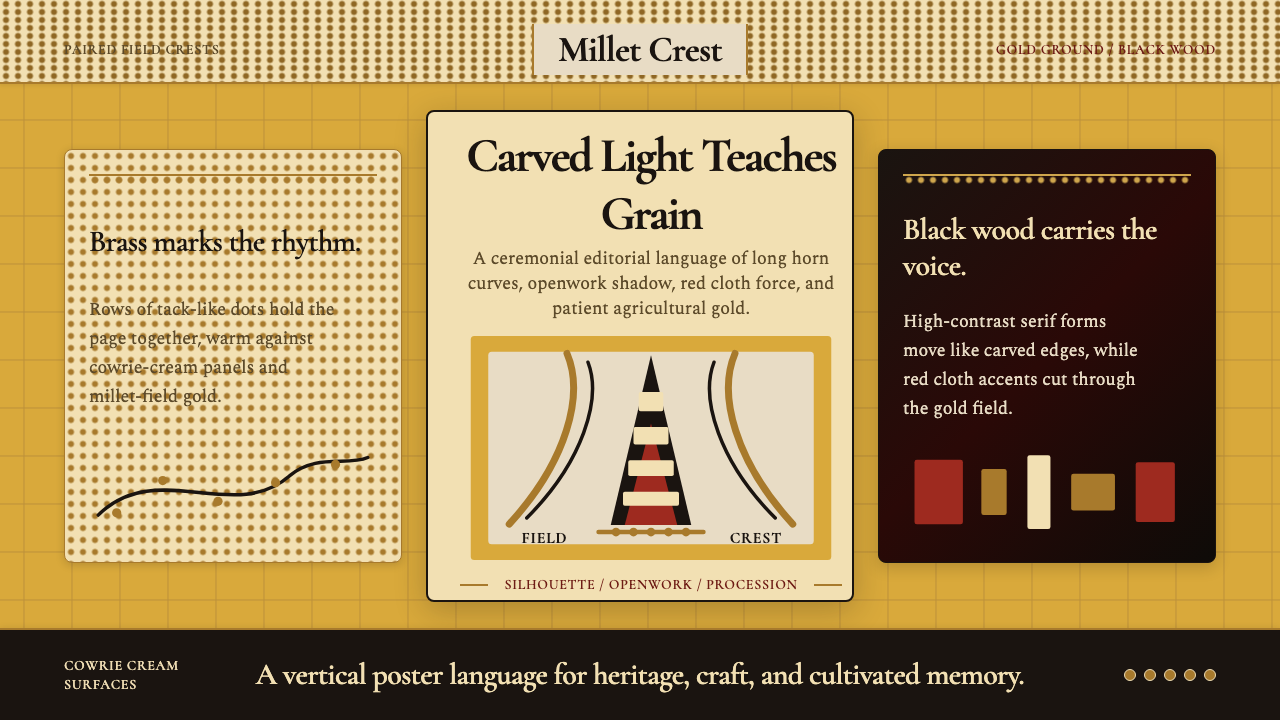 Bambara Chi Wara AntelopeCarved memory in gold. Black serif silhouettes and brass-dot borders carry th…
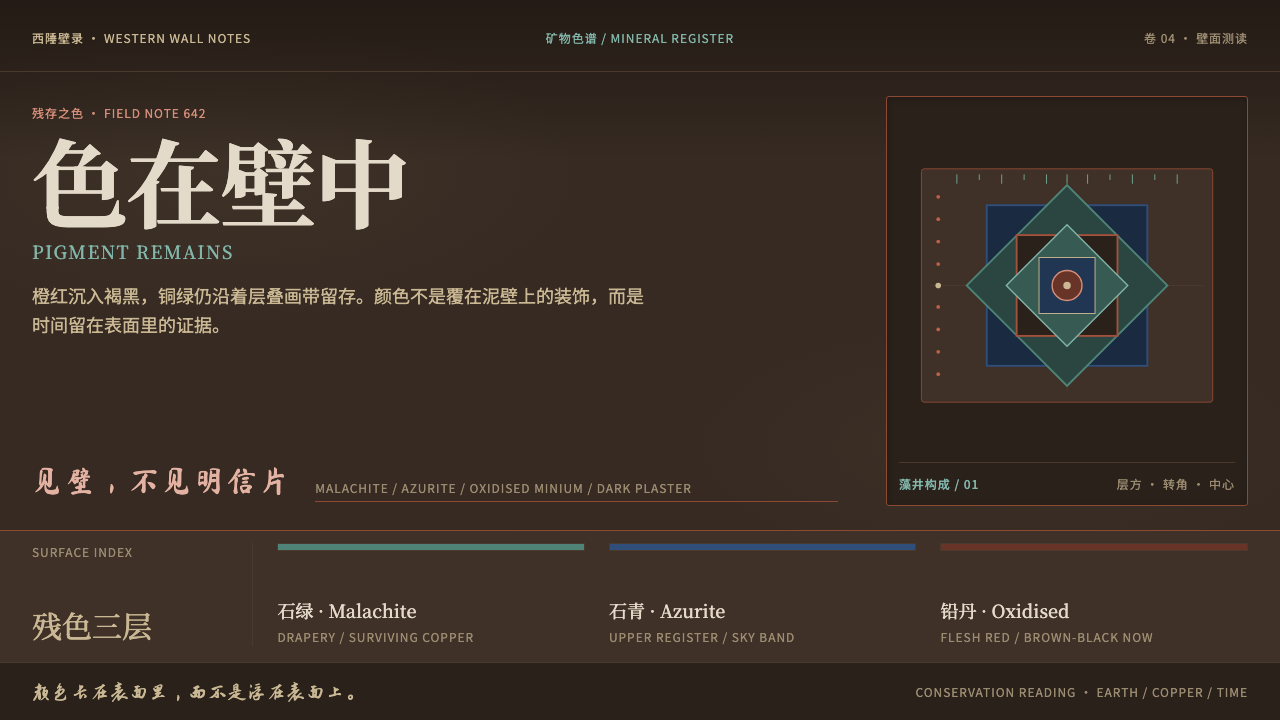 Dunhuang Mogao MuralsTime lives in the wall. Mineral green and azurite endure on oxidised brown pl…
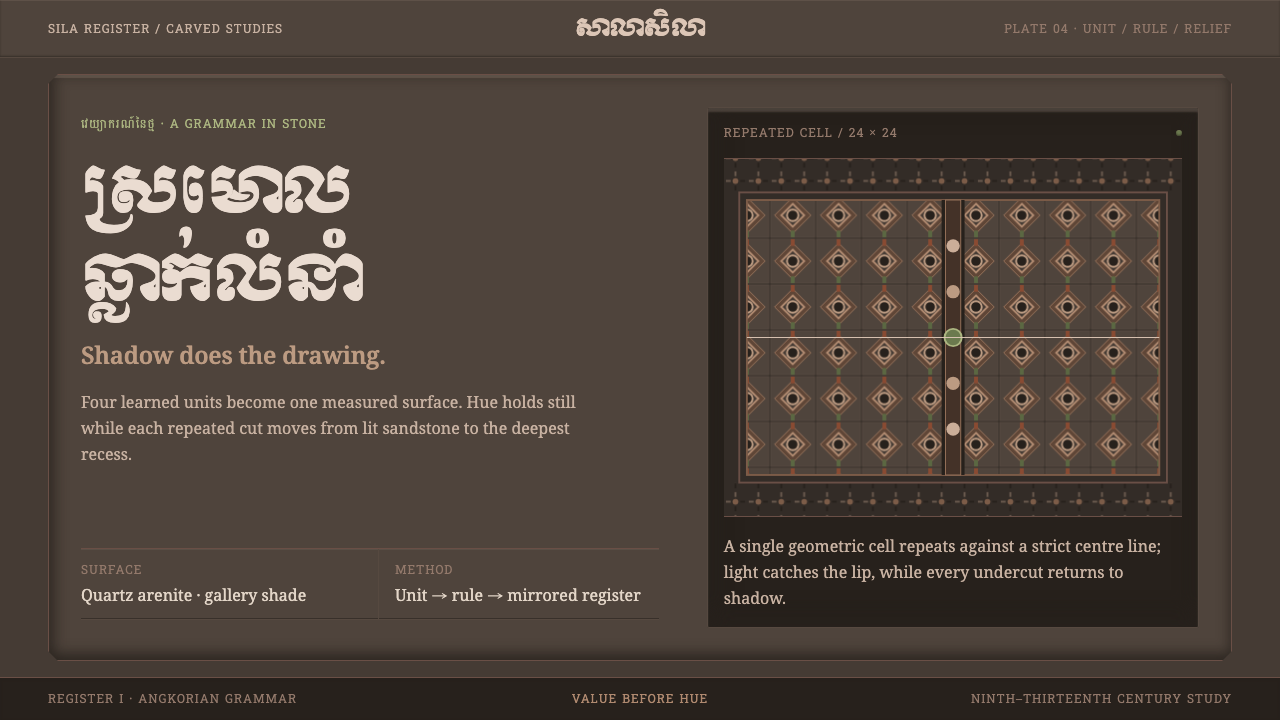 Khmer Kbach MotifShadow carves the grammar. Repeated stone cells turn a narrow sandstone palet…
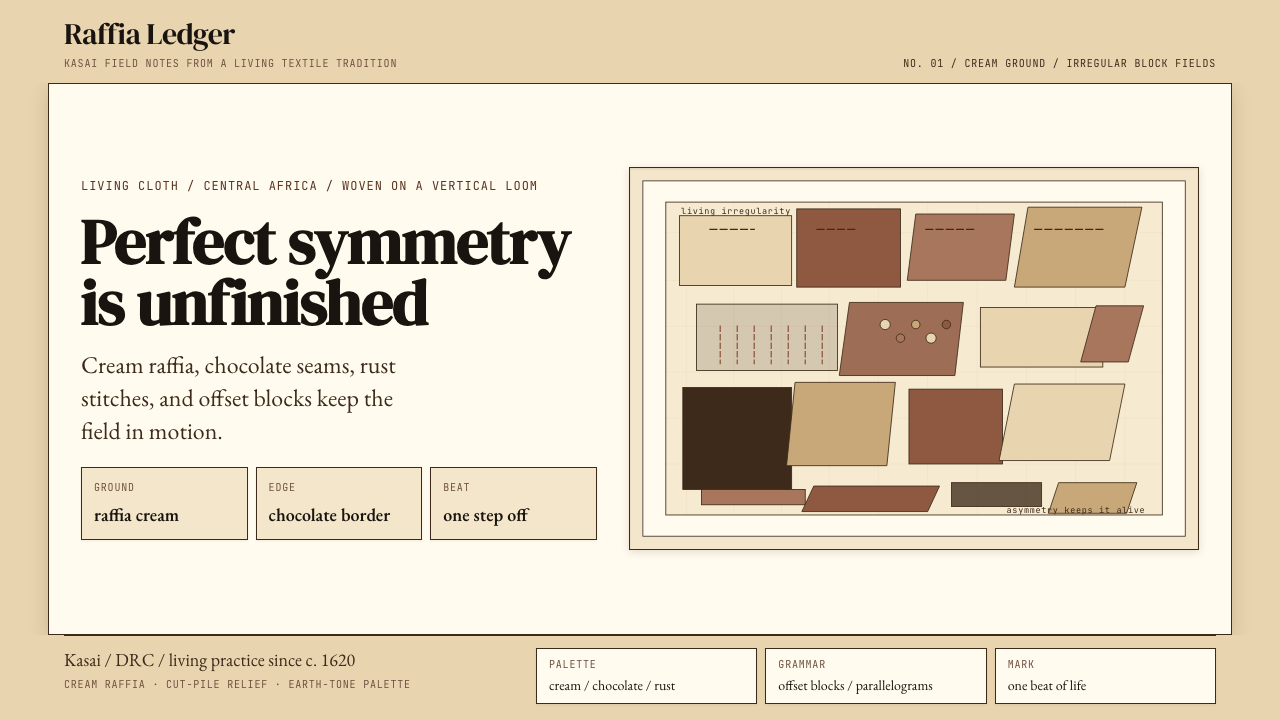 Kuba Raffia Cloth (Congo)Deliberate asymmetry lives. Cream raffia, chocolate seams, and rust blocks.
 Lithuanian Amber (Baltic Pagan)Ancient amber glows. Honey resin on smoked oak, framed by saulė geometry.