What is Kuba Raffia Cloth (Congo)?
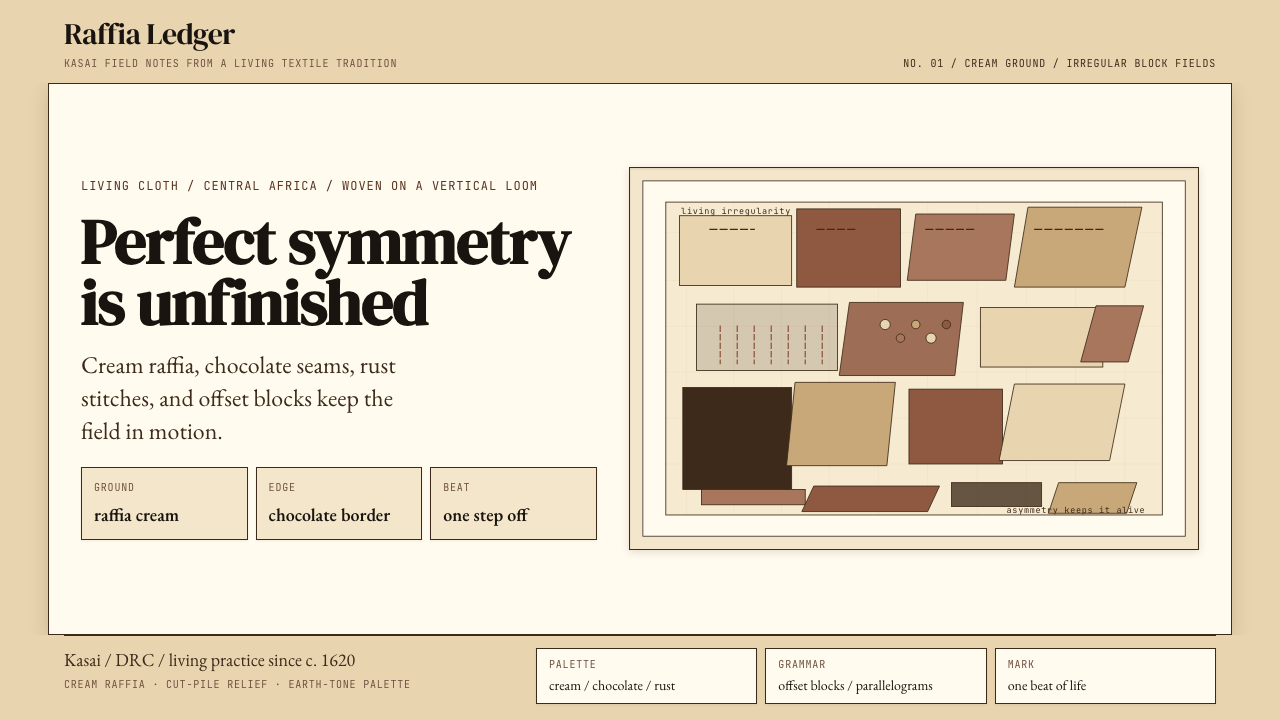
From the Kuba Kingdom's looms comes central Africa's most geometrically daring textile — a language of deliberate asymmetry, earth-tone geometry, and the conviction that one small irregularity is the mark of life.
Kuba Raffia Cloth (Congo) in brief
Kuba raffia cloth is the signature textile tradition of the Kuba Kingdom, located in the Kasai region of what is today the Democratic Republic of Congo. It is woven on vertical looms from fibers stripped from raffia palm leaves, then embellished through three distinct embroidery techniques — cut-pile work that raises a dense velvet-like plush, flat surface embroidery in interlocking geometric lines, and appliqué panels that layer contrasting shapes across the cloth. The result is a surface that is simultaneously textile, relief sculpture, and abstract painting.
The visual grammar of Kuba cloth is built entirely from non-representational geometry: squares, parallelograms, diagonal bands, chevrons, interlocking T-shapes, herringbone fields, and meanders. These motifs are combined and varied across the cloth's surface in ways that approach but never achieve perfect symmetry. The asymmetry is not accidental — it is the tradition's most essential aesthetic principle. A perfectly symmetrical cloth would be considered incomplete, even lifeless. The small rhythmic displacement within each repeated module is what animates the whole.
The palette of Kuba raffia cloth is anchored entirely in earth tones drawn from the materials themselves and from natural dyes: the warm cream of undyed raffia fiber, the deep chocolate brown of woven weft threads, rust and terracotta from iron-rich pigments, ochre and umber from clay-based dyes, and occasional near-black from charred materials. This is not a palette of limitation but of discipline — five tones that generate extraordinary visual complexity through geometry alone, without ever reaching for contrast that the natural world did not provide.

Where does Kuba Raffia Cloth (Congo) come from?
The Kuba Kingdom was founded in the Kasai basin of central Africa around the early seventeenth century, when a confederation of Bantu-speaking peoples united under a royal lineage centered at the capital Mushenge (also called Nsheng). The kingdom reached its fullest political and artistic development over the following two centuries, establishing a court culture of remarkable sophistication in woodcarving, ceremonial dress, and above all textiles. Raffia cloth was not merely a trade good or a bodily covering — it was the material language of royal authority, ritual obligation, and social identity.
The pivotal figure in the formalization of Kuba textile culture was King Shyaam aMbul aNgoong, who came to power around 1620. According to royal oral tradition, Shyaam introduced or systematized a number of design motifs after extensive travels, and his reign is credited with organizing the court's ceremonial and artistic practices into the codified forms that subsequent generations would elaborate upon. Whether as historical figure or dynastic legend, Shyaam represents the moment when Kuba cloth became a named, catalogued tradition — one in which specific geometric patterns were assigned specific names and ritual associations, and in which innovation was governed by the continuity of a recognized vocabulary.
Kuba cloth entered the consciousness of Western scholarship and art through two very different channels. The Belgian ethnographer Emil Torday conducted field research in the Kasai region beginning in 1907, collecting textiles and artifacts that entered the collections of the British Museum and brought Kuba material culture to European scholarly attention. Simultaneously, the American missionary William Sheppard had been documenting and collecting Kuba objects since the 1890s, and his accounts introduced Kuba design to American audiences. By the early twentieth century, Kuba cloth had reached European museum collections at a moment when artists across the continent were reconsidering the nature of visual representation — and its geometric abstraction spoke directly to what Picasso, Braque, Matisse, Paul Klee, and the teachers of the Bauhaus were working through independently.
The connection to European modernism was not one of influence in the traditional sense — the Kuba weavers and European cubists were not in dialogue. Rather, the encounter was one of recognition: artists working toward geometric abstraction from within Western tradition encountered a non-Western tradition that had already arrived at a remarkably similar formal vocabulary through entirely different means and motivations. Scholars including Joseph Cornet, Monni Adams, and Patricia Darish subsequently deepened the academic understanding of Kuba textile traditions, establishing that the corpus of named patterns ran to hundreds of distinct motifs, each with its own history of variation and elaboration across generations of weavers. Today, Kuba raffia cloth remains an active living tradition, with weavers continuing to produce cloth for ceremonial use, royal gifts, and an international craft market that has brought sustained attention to the Kasai region's artistic heritage.
What defines the Kuba Raffia Cloth (Congo) look?
Deliberate Asymmetry
The governing aesthetic principle of Kuba cloth is that perfect symmetry represents incompleteness. Each design field approaches regularity through repeated geometric modules, then breaks that regularity at deliberate points — a color block shifts slightly, a line terminates one unit early, a diagonal reverses direction unexpectedly. This intentional disruption is not a flaw but the tradition's highest achievement: the moment where the cloth breathes and asserts that it was made by a living hand.
Earth-Tone Palette
Kuba cloth works within a strictly natural, earth-derived palette: the warm cream of undyed raffia fiber, deep chocolate brown from woven weft threads, rust and terracotta from iron-rich natural pigments, ochre from clay-based dyes, and near-black from charred materials. These four or five tones are never supplemented with brighter or more saturated hues — the visual drama comes entirely from geometric arrangement rather than chromatic contrast. The palette reads as both ancient and immediately contemporary.
Geometric Vocabulary
The design vocabulary of Kuba cloth draws on a named canon of hundreds of distinct geometric motifs — interlocking squares, diagonal parallelograms, herringbone fields, chevrons, meanders, and T-shapes — each with its own history within the tradition. These motifs are combined, scaled, rotated, and layered within a single cloth to create visual complexity that rewards sustained attention. The corpus of named patterns was large enough that royal weavers maintained oral and visual catalogs to track variations.
Layered Surface Techniques
Kuba cloth employs three distinct embellishment techniques, often combined within a single piece. Cut-pile embroidery loops thread through the woven ground and then trims it flush to create a dense raised velvet surface that catches light directionally. Flat-stitch embroidery traces geometric outlines across the surface in contrasting thread. Appliqué panels attach separately worked geometric shapes over the main ground, creating a third dimension of pattern on top of pattern. The interplay of matte and plush, flat and raised, gives the cloth a tactile and optical richness that reproduction rarely captures.
Ritual and Social Function
Kuba cloth was never purely decorative. Different types of cloth — distinguished by their technique, scale, pattern density, and the identity of the maker — were associated with different ceremonial contexts: royal burial preparations, initiation rites, bride-wealth payments, and court display. The most elaborately worked pieces were produced by or for the king and senior titleholders, and owning or wearing a particular type of cloth signaled precise social position. This functional weight means Kuba design is never casual — every formal choice carries the seriousness of a tradition in which cloth and identity are inseparable.
Named Pattern Continuity
A distinctive feature of Kuba textile culture is that design motifs carry individual names that persist across generations. Weavers learn not only the visual forms but the names and associations of each pattern, and innovation within the tradition has historically proceeded by variation and recombination of named elements rather than invention from scratch. This named continuity gives the tradition a kind of visual language structure — one in which fluent speakers can read the choices made in a cloth as both formal and historical statements.
Tension Between Repetition and Variation
Kuba cloth achieves its visual energy through the interplay of repetition and deliberate variation. A design field will establish a strong repeating unit — a square subdivided by diagonal lines, for instance — and then modulate that unit across the cloth's surface by shifting scale, rotating direction, substituting one of the earth tones for another, or allowing one instance to be slightly larger or denser than its neighbors. The eye is drawn in by the pattern and held by the variation. This oscillation between the expected and the surprising is the mechanism by which Kuba cloth sustains attention across a large surface.

Who shaped Kuba Raffia Cloth (Congo)?
The nineteenth ndop (king) of the Kuba Kingdom, Shyaam aMbul aNgoong came to power around 1620 and is credited in royal oral tradition with a transformative reorganization of Kuba court culture. He is said to have introduced or formalized numerous geometric design motifs — reportedly after observing patterns on his travels — and his reign is considered the founding moment of Kuba textile culture as a codified system with named patterns and associated ritual meanings. Whether as literal historical figure or dynastic charter myth, Shyaam represents the tradition's claim that design is not arbitrary decoration but a structured inheritance.
A Belgian-born ethnographer working for the British Museum, Emil Torday conducted fieldwork in the Kasai region between 1907 and 1909, collecting an extensive range of Kuba textiles, sculptures, and ceremonial objects. His meticulous documentation — including descriptions of weaving techniques, pattern names, and the social contexts of cloth use — provided the first systematic account of Kuba material culture for Western scholarship. The objects he collected remain among the most significant holdings of Kuba material in any museum collection worldwide, and his field notes established much of the foundational vocabulary through which the tradition has been subsequently studied.
An African-American Presbyterian missionary who worked in the Congo from 1890 to 1910, William Sheppard was among the first outsiders to gain sustained access to the Kuba Kingdom and to document its culture with sympathetic depth. His accounts of Kuba life — including detailed descriptions of textile production, ceremonial use, and the social meanings of cloth — introduced Kuba design to American readers at a time when African art was rarely discussed outside an anthropological frame. Sheppard was also a forthright critic of Belgian colonial brutality in the Congo, and his moral witness gave his documentation of Kuba culture an urgency that went beyond ethnographic curiosity.
A Belgian art historian who spent decades working in the Democratic Republic of Congo, Joseph Cornet produced the most comprehensive scholarly account of Kuba art in the twentieth century. His detailed cataloguing of named Kuba textile patterns — tracing each motif across historical examples and documenting its variations — established the scholarly foundation for understanding Kuba cloth as a structured design tradition with its own internal grammar. Cornet's work demonstrated that the corpus of Kuba patterns was far larger and more systematically organized than earlier observers had recognized, and his documentation remains an essential reference for anyone studying the tradition seriously.
An American art historian specializing in African textiles, Monni Adams contributed important comparative and contextual analysis of Kuba cloth within the broader landscape of central African textile traditions. Her research examined how Kuba geometric patterns relate to wider regional design vocabularies, and her writing helped distinguish what was specific to Kuba practice from what reflected broader shared traditions across the Kasai region. Adams's work was part of a broader scholarly movement in the latter half of the twentieth century that insisted on treating African textile traditions as sophisticated design systems deserving rigorous formal analysis rather than as mere ethnographic curiosities.
How do you use Kuba Raffia Cloth (Congo) today?
Applying Kuba raffia cloth as a design reference requires understanding its two governing principles before touching any visual tool. First: the palette is earth-toned and strictly bounded — cream, chocolate brown, rust, ochre, and near-black — and all visual complexity must be generated through geometry and surface variation within those tones, never through the addition of brighter or more saturated color. Second: deliberate imperfection is a feature, not a failure. Any layout that achieves too-perfect symmetry has misread the source material. The goal is patterned regularity with breathing room built in.
For presentation slides, Kuba is most effective when used to frame content rather than to illustrate it. A cover slide might use a geometric border built from interlocking angular shapes in the earth-tone palette — cream ground with chocolate and rust patterning along the lower third — while the title sits clean and undecorated above. Content slides work best with a strongly textured decorative margin or header band drawing on Kuba geometric motifs, with the body area kept open and relatively spare. Data slides can adopt the visual logic of Kuba pattern-fields for infographics: a series of geometric units that vary slightly in density or tone to encode quantity, rather than using conventional bar charts in primary colors.
For web interfaces — particularly dashboards, editorial pages, and premium or heritage-brand product pages — Kuba's earth palette and geometric density work well when applied to structural elements like navigation bars, section dividers, header bands, and card borders rather than used as a full-page background. A pricing or feature page can use a Kuba-derived decorative band to separate tiers, with the product photography or iconography set against a clean cream or warm white field. The imperfection principle translates well to subtle variation in spacing or weight between repeated UI components — enough regularity to feel systematic, enough variation to feel handmade.
For editorial and marketing design, Kuba's textile character makes it particularly well-suited to print and print-adjacent applications: book covers, magazine editorial spreads, packaging for artisan or heritage goods, and cultural institution materials. The pattern vocabulary works as a full-bleed texture at reduced opacity behind large type, as a framing device for pull-quotes or section headers, or as a richly patterned element that anchors an otherwise minimal composition. In digital marketing, Kuba geometry translates well to social card graphics and event posters — contexts where a single strong geometric field at earth-tone scale reads immediately and distinctively across different screen sizes.
The most common mistake when working with Kuba reference material is adding color outside the earth-tone range in the belief that the palette needs brightening or modernizing. This always works against the system. Kuba's visual authority comes precisely from the discipline of staying within its natural tones — the moment a bright teal, cobalt, or saturated orange is introduced, the geometry loses the contrast-through-pattern logic it depends on, and the work begins to read as generic global-craft pastiche rather than as a coherent design language. A second common error is pursuing perfect symmetry out of an instinct for tidiness: any Kuba-derived layout that mirrors left to right and top to bottom has lost the tradition's animating principle.

Kuba Raffia Cloth (Congo) — FAQ
Is Kuba cloth purely decorative, or does the geometry carry meaning?
The geometry carries meaning on multiple levels. Individual named patterns are associated with specific ritual contexts, social ranks, and historical moments within the Kuba tradition. A cloth's pattern choices signal who made it, who should wear it, and under what circumstances — royal burial preparations call for different pattern combinations than bride-wealth payments or initiation rites. Beyond these specific associations, the tradition also embeds a general philosophical claim in the asymmetry principle itself: the choice to preserve a small irregularity is an argument about the relationship between perfection, completeness, and life. The geometry is never merely decorative in the sense of being arbitrary — it is always making a statement, even when the statement is primarily formal.
Why did Picasso and the Cubists find Kuba cloth significant?
The encounter was one of formal recognition rather than direct influence. European modernists working in the 1900s and 1910s were independently dismantling naturalistic representation in favor of geometric abstraction — breaking objects into facets, eliminating perspective depth, treating the picture surface as a flat field of shapes rather than a window onto a scene. When artists like Picasso and Matisse encountered Kuba cloth in museum collections, they found a tradition that had arrived at sophisticated geometric abstraction through entirely independent means and had sustained it across generations as a living practice rather than a radical rupture. This recognition that abstraction was not a European invention but a universal formal possibility was significant both artistically and philosophically, though the deeper meanings of Kuba patterns within their own tradition remained largely unexamined by these early encounters.
How should the asymmetry principle be applied in digital design without looking like a mistake?
The key is that Kuba-style asymmetry is patterned asymmetry, not random asymmetry. A geometric field establishes a strong regular unit first — the viewer needs to understand the underlying grid before the variation registers as intentional. Once regularity is established, variation is introduced at a consistent and limited scale: a module that is ten percent larger than its neighbors, a row that terminates one unit short, a color substitution that occurs every seventh repeat rather than every fifth. The variation should feel like a rule within a rule — a secondary rhythm that runs against the primary one — rather than a one-off deviation. In practical terms, this means maintaining strict grid alignment while allowing deliberate exceptions that recur with their own regularity.
Can Kuba-derived design work in a contemporary digital product without looking ethnographic or pastiche?
Yes, but it requires working from principles rather than copying motifs. A design that lifts specific Kuba pattern shapes and applies them as surface decoration on an otherwise generic interface will read as pastiche — it treats the visual tradition as costume rather than logic. A design that genuinely adopts Kuba principles — earth-tone palette discipline, geometric complexity generated through variation on a grid, deliberate asymmetry within a regular field — will feel contemporary and coherent even if no individual element is recognizably 'African' in a surface-pattern sense. The difference is between borrowing appearances and inheriting a method. The former always risks being read as culturally reductive; the latter is the basis of how all design traditions have cross-pollinated throughout history.
Is Kuba cloth still being produced today, or is it primarily a historical artifact?
Kuba raffia cloth remains an active living tradition. Weavers in the Kasai region of the Democratic Republic of Congo continue to produce cloth using the traditional vertical loom, raffia fiber, and embroidery techniques, both for ceremonial use within the community — royal gift-giving, initiation ceremonies, funerary preparations — and for sale through international craft markets and cultural institutions. The tradition has faced significant pressures over the twentieth and twenty-first centuries, including the disruption of Belgian colonialism, repeated political instability in the DRC, and the displacement of traditional textile production by imported synthetic fabrics. Nevertheless, sustained international interest from collectors, museums, and the contemporary craft market has helped support the continuation of active weaving practice. The cloth produced today sits in direct continuity with the historical tradition, not as a revival but as an unbroken — if interrupted — line of practice.
Related design styles
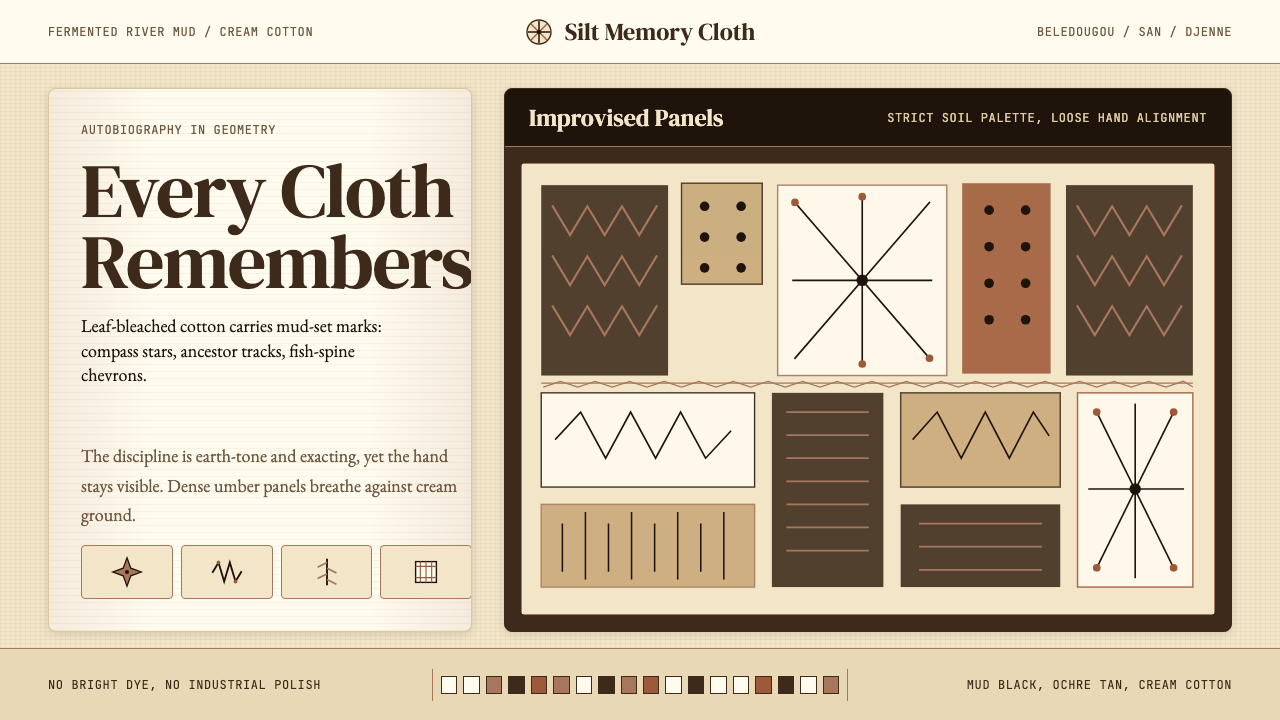 Mali Bògòlanfini (Bambara Mud-Cloth)Autobiography in geometry. Deep umber motifs breathe across cream cotton.
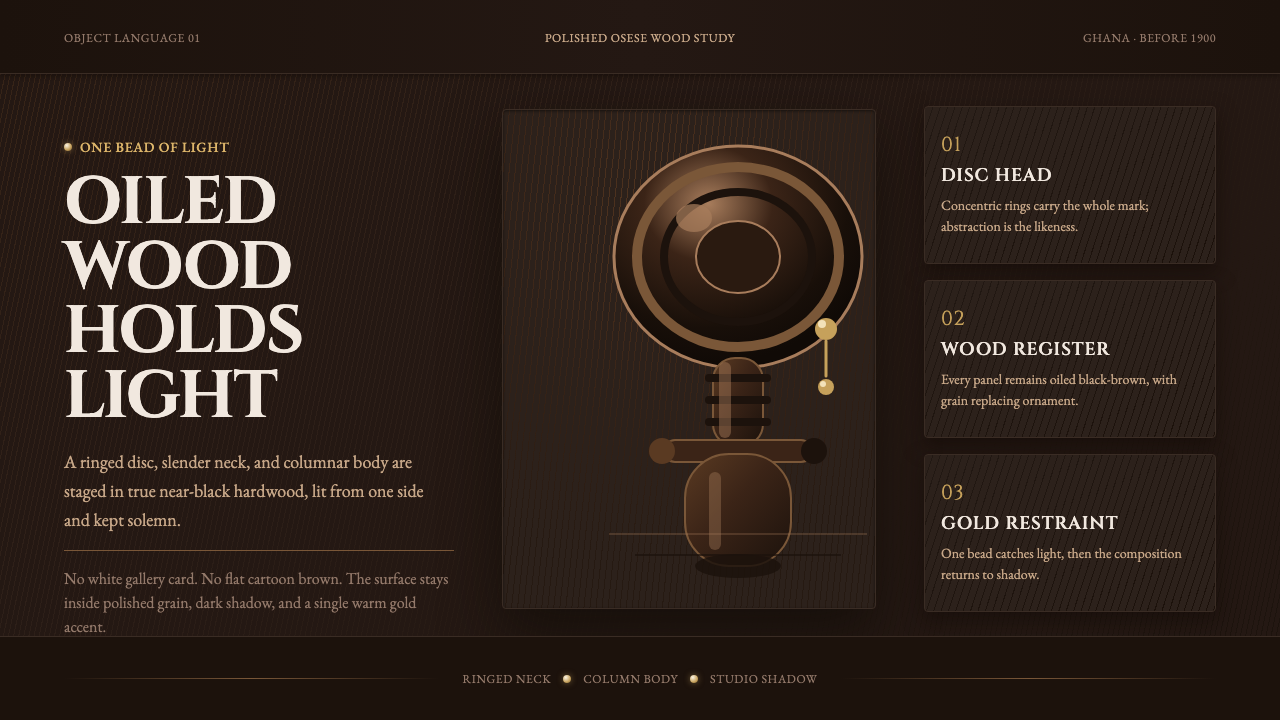 Akuaba Akan Fertility DollDarkness becomes sculpture. Near-black wood, ringed geometry, and one gold be…
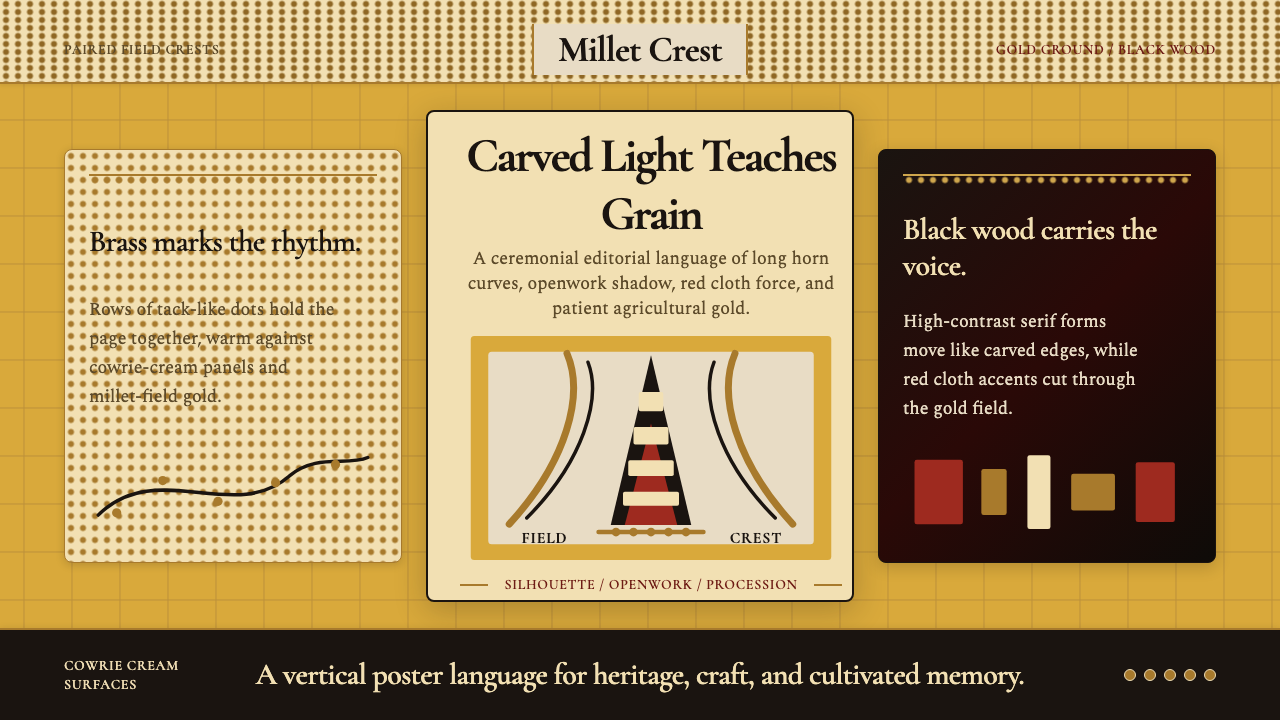 Bambara Chi Wara AntelopeCarved memory in gold. Black serif silhouettes and brass-dot borders carry th…
 Cham My Son TowersWall before ornament. Greyed brick bays recede around cut shadows and sandsto…
 Dogon Bandiagara Cliff MaskHand-hewn gravity. Charred wood, kaolin type, and sandstone geometry stack li…
 Egyptian Coptic TextileWarmth woven flat. Madder, indigo and saffron medallions sit on linen cream.