What is Hawaiian Kapa (Bark Cloth)?
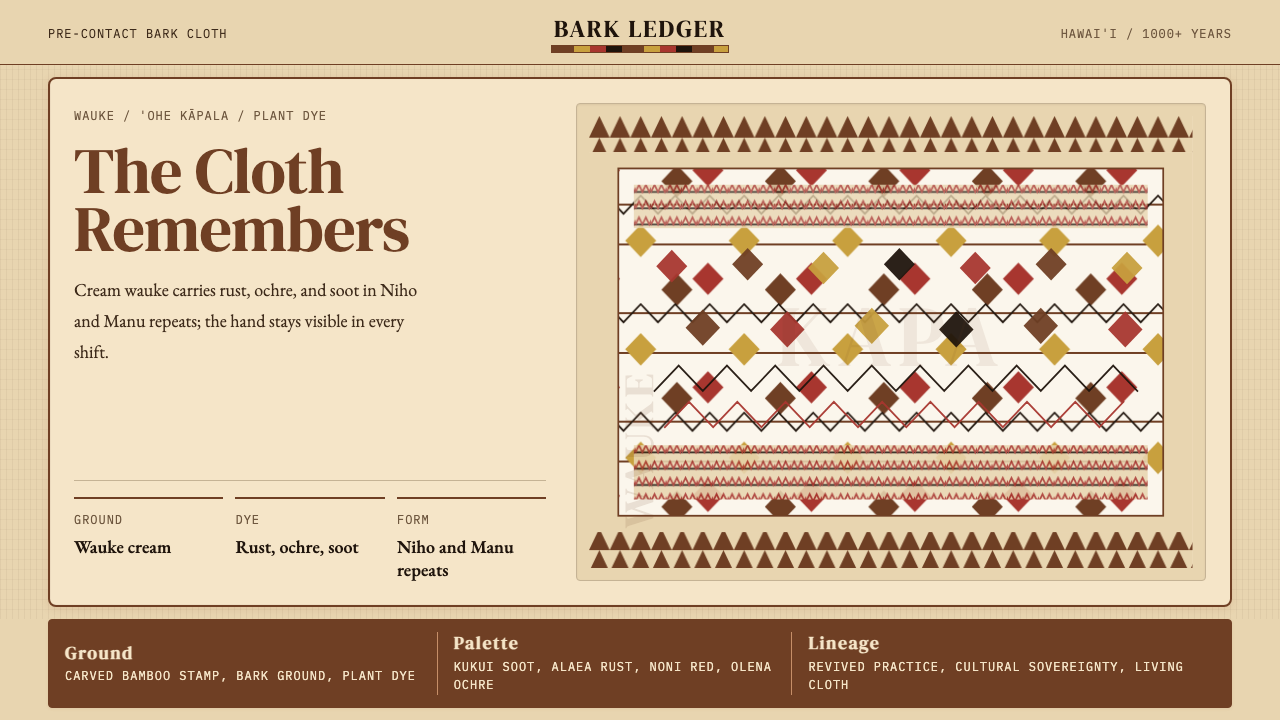
Hawaiian kapa turns pounded bark into ceremony — earth tones, stamped geometry, and a living tradition that nearly vanished and came back.
Hawaiian Kapa (Bark Cloth) in brief
Hawaiian kapa is the bark-cloth tradition of pre-contact Hawai'i, produced by pounding the inner bark of the wauke (paper mulberry) plant into a thin, textile-like sheet, then decorating it with stamped geometric patterns using hand-carved bamboo tools called 'ohe kāpala. The result is not weaving — it is a form of felting-by-percussion, in which the cellulose fibers bond under repeated beating until the material achieves a smooth, papery surface capable of holding dye and fine detail.
The aesthetic identity of kapa is anchored in its materials. The ground cloth carries the natural cream-to-tan color of processed wauke bark — warm, slightly uneven, never a flat white. Over this ground, artisans stamped repeating motifs using plant-based dyes: kukui-nut soot for deep charcoal-black, noni fruit for reddish-brown, 'olena (Hawaiian turmeric) for warm yellow, and 'alaea red earth for a brick-rust tone. The resulting palette is strictly a warm earth register, with no cool hues, no bright saturated colors, and no metallic effects.
The patterns themselves are geometric and rule-governed. Common motifs include the Niho (tooth or comb-tooth zigzag), the Manu (bird-vector diagonal), paired triangle rows, diamond grids, and border bands of repeating lines. These are not random ornament — each maker, each ahupua'a (land division), and each intended use produced its own recognized pattern vocabulary. The finest kapa, reserved for chiefly garments and ritual objects, displayed the densest patterning with the sharpest registration. Everyday kapa used simpler repeats. The hand-stamping process, for all its control, leaves traces of slight misalignment and tonal variation that are intrinsic to the material's character.

Where does Hawaiian Kapa (Bark Cloth) come from?
Kapa production arrived in Hawai'i with the Polynesian voyagers who settled the islands roughly a thousand years ago, carrying with them the bark-cloth traditions common across the Pacific — from Tonga and Samoa to Tahiti and the Marquesas. What developed in Hawai'i, however, diverged substantially from related tapa traditions elsewhere. Hawaiian kapa makers achieved a fineness of material and a density of patterning unmatched anywhere in the Pacific, in part because of the particular qualities of Hawaiian wauke, in part because of the distinctive grooved-surface carving of Hawaiian ie kuku beaters, which imparted a watermark-like texture to the cloth during beating.
The technical peak of kapa production came during the 1700s and into the early 1800s, coinciding with the consolidation of the Hawaiian kingdom under Kamehameha I. At this period, kapa was not merely cloth — it was a primary medium of cultural expression, social rank, and spiritual life. High-ranking ali'i (chiefs) wore kapa garments of extraordinary refinement; kapa was used in burial wrappings, temple offerings, and as gifts marking alliances between chiefdoms. Specialist kapa beaters, often women, maintained skills passed down within family lineages, and the finest practitioners were known and respected across islands.
The arrival of Western traders and missionaries after the 1778 contact with Captain James Cook initiated a rapid disruption of the tradition. Western cloth — cotton, wool, printed calico — was cheaper, faster to acquire, and carried the cultural prestige of the foreign. Missionary influence discouraged or directly suppressed many of the ritual and ceremonial contexts in which kapa held meaning. By the mid-1800s, kapa production had declined sharply; by 1900, the knowledge of how to beat, watermark, and pattern kapa at a high level was held by only a small number of elderly practitioners, and was in real danger of total loss.
The revival began in earnest during the 1970s Hawaiian cultural renaissance — a broad, politically charged resurgence of Native Hawaiian language, arts, navigation, and cultural practice. Researchers like Edith McKinzie documented surviving kapa knowledge from elderly practitioners and archival sources. Practitioners including Pua Van Dorpe and Marie McDonald began the painstaking work of re-learning the full process — not from imported Samoan or Tongan tapa traditions, but from Hawaiian-specific techniques recovered through research, surviving objects in museum collections, and oral history. Roen Hufford's subsequent contributions extended the revival's reach and deepened its technical grounding. Today, Hawaiian kapa is an active contemporary practice, produced by a community of dedicated makers who regard it not as a craft revival but as cultural sovereignty in material form.
What defines the Hawaiian Kapa (Bark Cloth) look?
Ground Color
The defining ground of kapa is the natural color of processed wauke bark — a warm cream-to-tan that varies slightly from piece to piece, carrying the memory of the living plant. This ground is not a neutral canvas in the modern sense; it is the first design decision, establishing a warmth that ties every stamped color to the earth. Attempting to replicate kapa aesthetics on a cold white or gray-tinted ground fundamentally alters the system's character.
Earth-Tone Palette
The stamped colors are drawn entirely from plant and mineral dyes available in the Hawaiian environment: deep charcoal-black from kukui-nut soot, warm reddish-brown from noni fruit, a soft yellow-ochre from 'olena turmeric, and a brick-rust red from 'alaea volcanic earth. No cool colors, no bright blues or greens, no synthetic brightness enter the system. The palette reads as warm, weighted, and ancient — every hue is slightly desaturated by its organic origin, never sharp or jarring against its neighbors.
Stamped Geometric Motifs
Decoration is applied exclusively through repetitive stamping with 'ohe kāpala — bamboo tools hand-carved with a single motif that the maker presses in measured sequence across the cloth surface. The vocabulary is geometric: zigzag rows, comb-tooth bands (Niho), diagonal bird-vector lines (Manu), paired triangles, diamond grids, and concentric border strips. Each stamp impression is discrete; pattern emerges from the discipline of repetition rather than from continuous drawn lines. This gives kapa its characteristic quality of controlled rhythm.
Intentional Imperfection
The hand-stamping process, however skilled the maker, produces slight variations in alignment, ink saturation, and impression depth across a piece. These variations are not errors to be corrected — they are the evidence of making, the human trace embedded in the cloth. A kapa surface read up close reveals this rhythm of near-repetition: motifs that are almost but not quite identical, color densities that shift as the dye on the stamp depletes and is re-applied. This textural aliveness is a core part of the aesthetic and should not be smoothed out in contemporary interpretations.
Border and Field Structure
Kapa design typically organizes the cloth surface into a central field of repeating pattern enclosed by one or more border bands of a different but related motif. The borders function as frames — they mark the edge of the design field and establish the overall proportions of the piece. This field-and-border structure is an organizing logic shared with many textile traditions, but in kapa it has particular significance: border patterns often carried meaning related to the rank of the intended wearer or the ritual purpose of the object.
Tactile Surface Memory
The ie kuku beaters used to process wauke bark were carved with fine parallel grooves on their striking faces. These grooves leave a subtle grid-like watermark on the cloth surface — a texture visible when the kapa is held at an angle to light. This watermark is not a decorative addition; it is a structural byproduct of the beating process that became an aesthetic marker of quality. In two-dimensional design work inspired by kapa, this quality translates to a preference for surfaces that carry slight texture rather than perfectly smooth or glossy finishes.
Rhythm over Composition
Unlike Western textile design traditions that often emphasize a central focal point or an asymmetric hero element, kapa aesthetics are organized by rhythm — the measured repetition of a unit across a field. There is no hierarchy of attention, no single element that demands the eye before others. Every stamped impression is equal in status; the whole emerges from their accumulation. This all-over, rhythm-first logic is the underlying principle that distinguishes authentic kapa-inspired work from work that merely borrows earth tones and geometric shapes.

Who shaped Hawaiian Kapa (Bark Cloth)?
Pua Van Dorpe is one of the principal figures of the post-1970s kapa revival, recognized for her commitment to recovering specifically Hawaiian techniques rather than borrowing from other Pacific tapa traditions. Her work involved research into archival sources, study of museum collections of historic kapa, and the re-development of processes for watermarking, beating, and natural dyeing that had nearly been lost. She has taught extensively, making her one of the central nodes through whom the recovered knowledge has been transmitted to subsequent generations of kapa makers.
Marie McDonald's contributions to the kapa revival span both practice and scholarship. Her research into the botanical sources of Hawaiian kapa dyes and the regional variation of pattern vocabularies across the Hawaiian islands helped establish a rigorous, evidence-based foundation for the revival — distinguishing what was authentically Hawaiian kapa from what was generalized Pacific tapa. Her documentation work ensured that the revival was grounded in specificity rather than romantic generalization.
Roen Hufford represents a later generation of the kapa revival, one that has both deepened the technical mastery of the tradition and extended its reach through teaching and public demonstration. Her work reflects the maturation of the revival from an urgent salvage effort into a stable, transmissible practice. Hufford's kapa demonstrates how the tradition can be practiced at a high technical level by a new generation while remaining anchored to the specific materials, processes, and aesthetic values that define Hawaiian kapa as distinct from other bark-cloth traditions.
Edith McKinzie was a researcher and cultural preservationist whose documentation work in the years before and during the 1970s renaissance helped prevent the complete loss of kapa knowledge. By recording techniques from elderly practitioners who still held living memory of pre-decline kapa production, McKinzie created a textual and archival record that practitioners like Van Dorpe and McDonald could draw on in reconstructing the tradition. Her work exemplifies the role that systematic documentation plays in the survival of endangered material cultures.
How do you use Hawaiian Kapa (Bark Cloth) today?
Applying kapa as a design reference requires understanding what makes the aesthetic system coherent rather than simply borrowing its most visible surface features. The system's coherence comes from three interlocking commitments: a warm, restricted earth-tone palette drawn entirely from organic sources; all-over rhythmic pattern built from the disciplined repetition of a finite geometric vocabulary; and a ground material whose natural color and slight texture are active design ingredients, not neutral backdrop. Work that borrows individual kapa motifs without honoring these structural commitments will read as surface appropriation rather than genuine stylistic engagement.
For presentation slides, the kapa aesthetic works most effectively on cover pages and section dividers where visual impact matters more than information density. A cover built in this spirit uses the natural warm ground color as the slide background, applies a single repeating geometric motif — Niho zigzag, Manu diagonal, or a triangle row — as a stamp-like texture pattern across one portion of the field, and keeps title type in a deep charcoal or near-black. Section dividers can use border-band logic: a horizontal strip of one earth-tone color crossing the full width of the slide, with the section title sitting within or adjacent to it. Content slides should be restrained — the palette and texture are strong enough that any attempt to apply kapa pattern to information-dense pages will overwhelm rather than support the content.
For web interfaces, kapa translates most naturally to surfaces where warmth, cultural richness, and unhurried attention are desired values — editorial platforms, cultural institution websites, artisan marketplaces, and heritage-focused brand pages. A kapa-informed dashboard or pricing page uses the warm cream-tan as the primary background, charcoal-black for body text and structural lines, and one or two earth tones (rust-red or warm ochre) for interactive states and call-to-action elements. Pattern application should be used sparingly and at low visual intensity — as a subtle watermark-like border on a card component, or a stamp-motif divider between page sections. Attempting to tile a full kapa pattern behind functional interface content will create visual noise.
For editorial and marketing work, kapa's most natural register is cultural storytelling, heritage brand identity, and editorial contexts that benefit from a sense of craft, place, and time depth. A magazine spread or feature article might use the warm ground tone as a tinted page background, with an 'ohe kāpala-inspired geometric border framing a pull quote or image. Marketing materials for a product positioned around natural materials, Hawaiian identity, or artisan craft can carry kapa-pattern elements as secondary texture — on a product tag, packaging band, or email header — without overwhelming the primary commercial message. The palette's warmth also makes it effective for social media graphics in editorial contexts, where earth-tone backgrounds stand out from the blue-dominant feeds typical of most platforms.
The most common mistake when working with kapa as a design reference is treating it as a purely decorative surface pattern — selecting an individual motif, digitalizing it, and applying it at high contrast over unrelated color fields. This misunderstands both the source and the system. The motifs only make sense in relation to the warm ground they sit on, the earth tones they are stamped in, and the all-over rhythm of their repetition. A second common error is mixing kapa motifs with visual languages from other Pacific tapa traditions — Samoan siapo, Tongan ngatu, or Fijian masi — as if they were interchangeable. They are not. Each tradition has a distinct formal vocabulary, a distinct color relationship, and a distinct cultural meaning. Hawaiian kapa is a specific practice with specific characteristics, and conflating it with a generic 'Pacific tapa aesthetic' is both visually incoherent and culturally reductive.

Hawaiian Kapa (Bark Cloth) — FAQ
Is kapa the same as tapa?
Kapa is the Hawaiian word for what English speakers broadly call tapa — bark cloth made by pounding plant fiber into a sheet. The same word root appears across Polynesian languages: kapa in Hawaiian, tapa in Tongan and Samoan. However, Hawaiian kapa is not the same as Tongan ngatu, Samoan siapo, or Fijian masi — each is a distinct tradition with different plant sources, different beating tools, different pattern vocabularies, and different aesthetic character. Hawaiian kapa is distinguished by the particular fineness of its material, the use of watermarked surface texture from grooved beaters, and a geometric pattern vocabulary specific to Hawai'i. Using 'tapa' as a generic term for all bark cloth is technically correct but obscures these meaningful differences.
What plant materials are used to make and dye kapa?
The primary fiber source for Hawaiian kapa is wauke (Broussonetia papyrifera, paper mulberry), though māmaki (Pipturus albidus) was also used, producing a coarser cloth. Wauke bark is harvested, stripped, soaked, and then beaten extensively with grooved stone or wooden ie kuku beaters until the fibers bond into a coherent sheet. Natural dyes come from kukui (candlenut) soot for black, noni (Morinda citrifolia) root and fruit for reddish-brown tones, 'olena (Curcuma longa, turmeric) for yellow, and 'alaea volcanic red earth for rust-red. Each dye source produces a characteristic hue range with slight variation depending on preparation and concentration — this natural variation is part of the visual character of authentic kapa.
How should kapa-inspired pattern be used in digital design without looking like a costume or parody?
The risk of parody comes from selecting the most visually dramatic elements of a tradition — usually the boldest motifs at maximum contrast — and applying them without the underlying structural logic that gives them meaning. Kapa-inspired digital work reads as respectful and coherent when it honors three things: the warm ground color as the primary field (not white or black), the earth-tone palette without additions, and the all-over rhythm of repetition rather than a single hero motif used decoratively. Restraint is also essential — kapa pattern is most effective as a supporting texture at medium-to-low visual weight, framing or grounding other content, rather than as the loudest element in the composition. Understanding the tradition's context and origin is as important as the formal decisions.
Can this design style work in a modern, minimal product context?
Yes, but the adaptation requires discipline about what to keep and what to leave behind. The aspects of kapa that translate well into modern minimal contexts are its color logic (the warm restricted palette works beautifully as a neutral alternative to the grey-and-white palettes dominant in contemporary minimal design), its all-over rhythm principle (which can inspire subtle surface texture on cards, backgrounds, or dividers), and its earth-tone hierarchy (using one color as ground, one as primary pattern, and one as accent). What does not translate directly is the density and cultural specificity of traditional motifs — in a minimal context, these should be distilled to their most geometric essence and used at low opacity or reduced scale. The goal is to carry the spirit of the aesthetic — warmth, rhythm, groundedness — without reproducing specific traditional patterns out of context.
Where can kapa be seen today?
Historic kapa from before the tradition's decline is held in major museum collections including the Bishop Museum in Honolulu (which has one of the world's most significant holdings), the Peabody Essex Museum, the British Museum, and various European collections assembled during the Cook and subsequent expeditions. Contemporary kapa made by revival-era and current practitioners can be seen at cultural events in Hawai'i, through the work of organizations supporting Native Hawaiian arts, and occasionally at exhibitions featuring Pacific or Indigenous material culture. The Hawaiian quilting tradition, which post-dates kapa but retains some of its pattern logic in a different medium, is more widely accessible and offers a related visual reference point for those unable to access kapa directly.
Related design styles
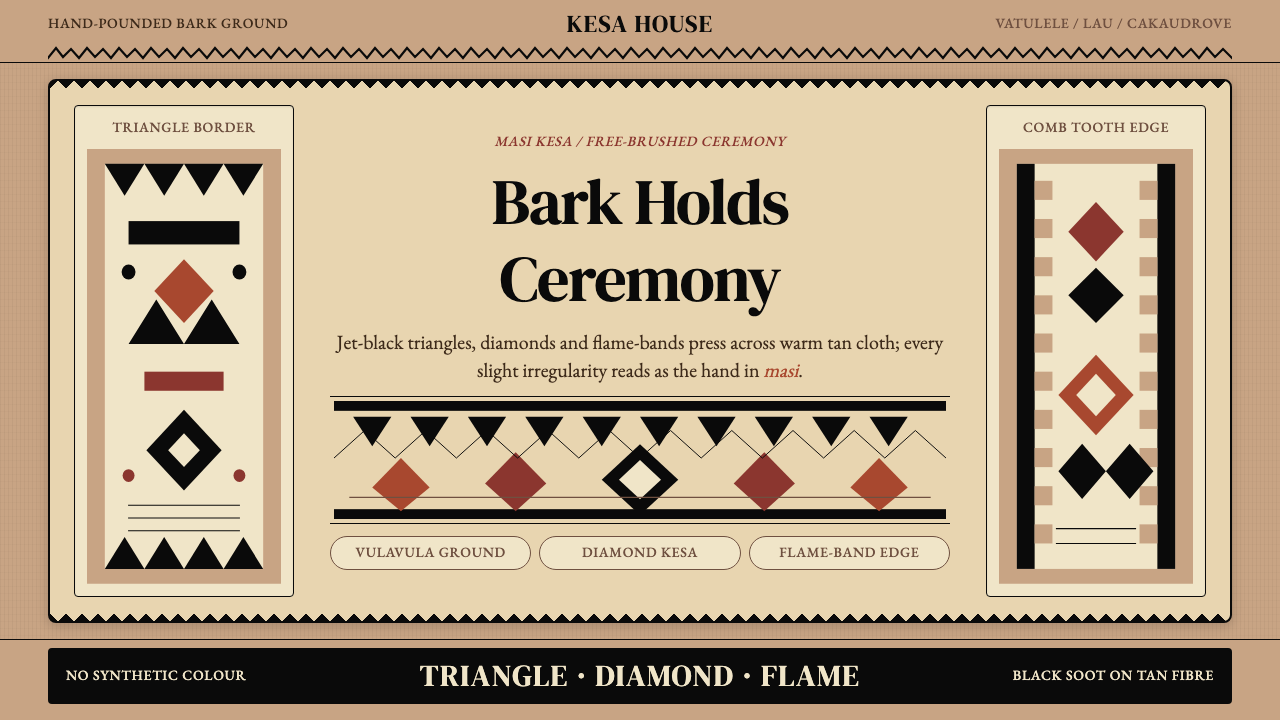 Fijian Masi (Tapa Cloth)Ceremony hits in black. Tan bark ground carries diamonds, zigzags and flame-b…
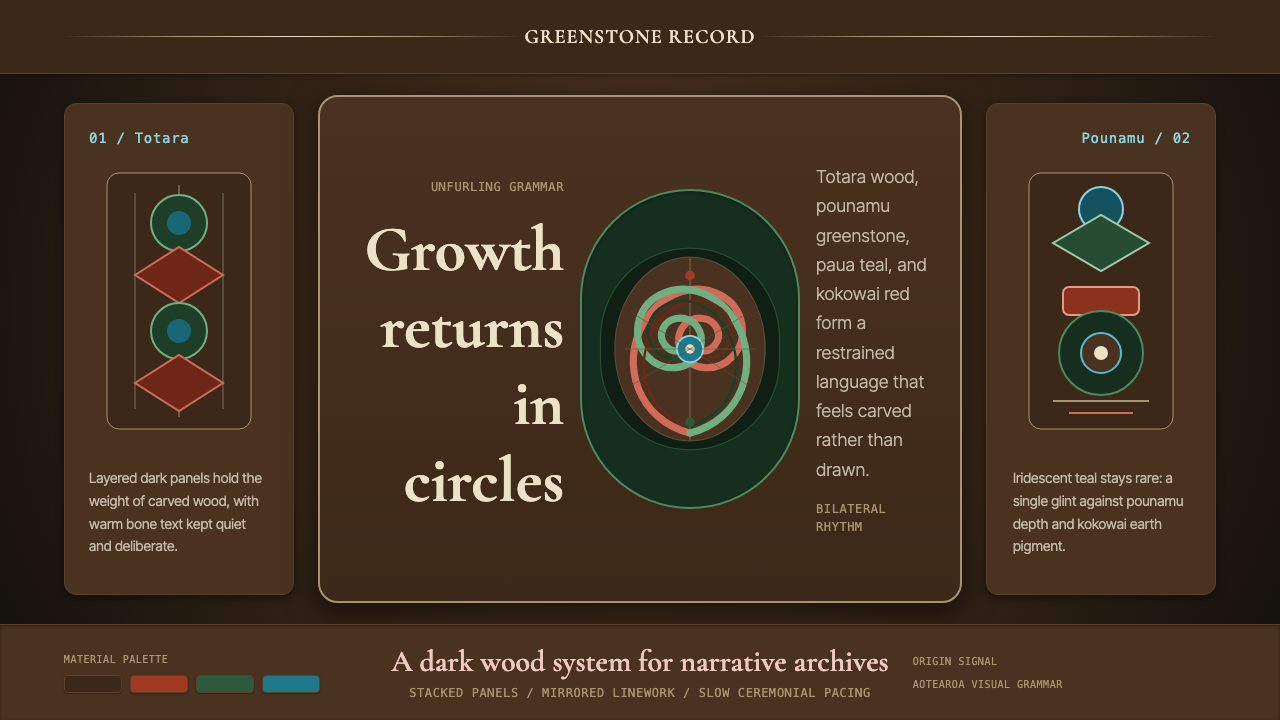 Māori Koru Spiral (Aotearoa)Carved, not drawn. Totara brown, pounamu green, and mirrored koru geometry ca…
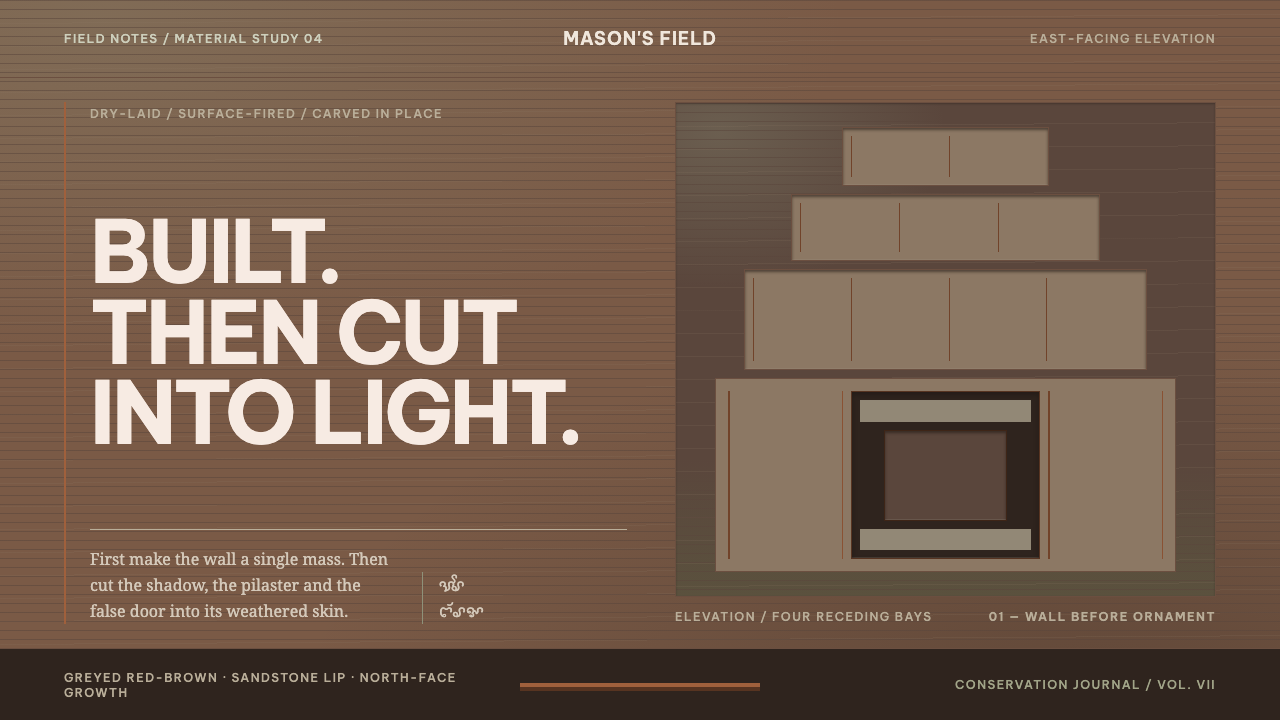 Cham My Son TowersWall before ornament. Greyed brick bays recede around cut shadows and sandsto…
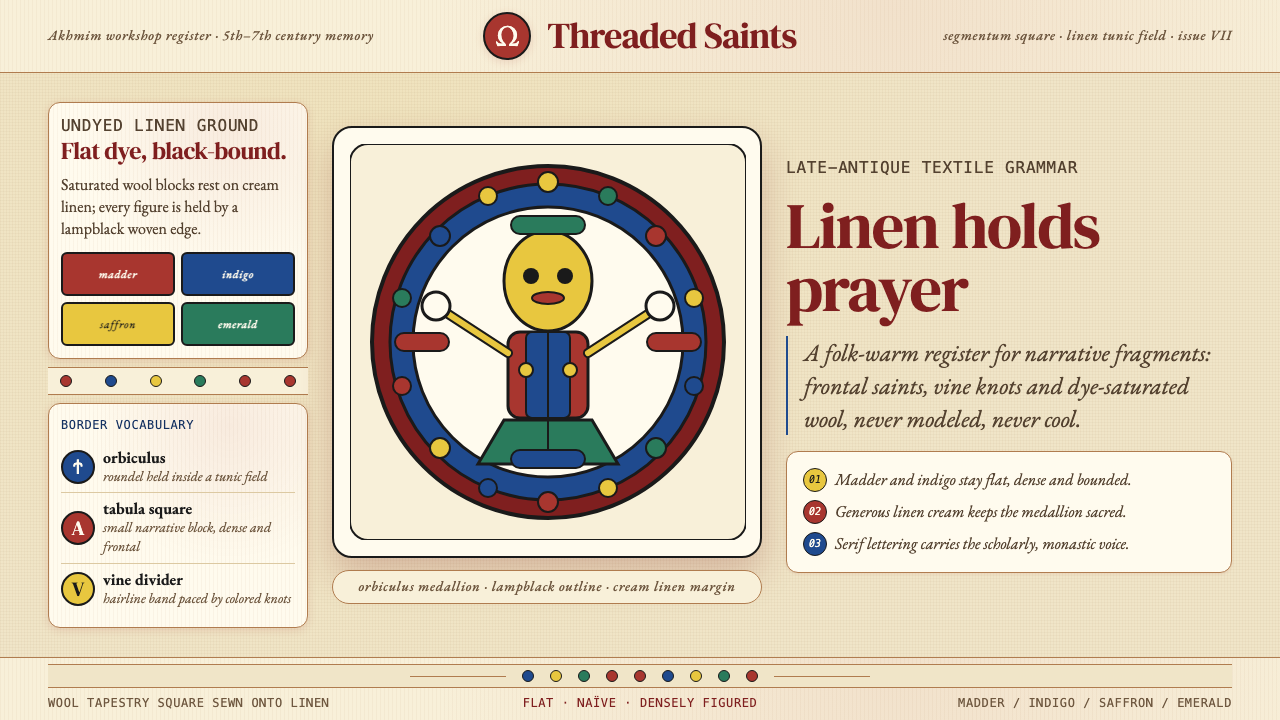 Egyptian Coptic TextileWarmth woven flat. Madder, indigo and saffron medallions sit on linen cream.
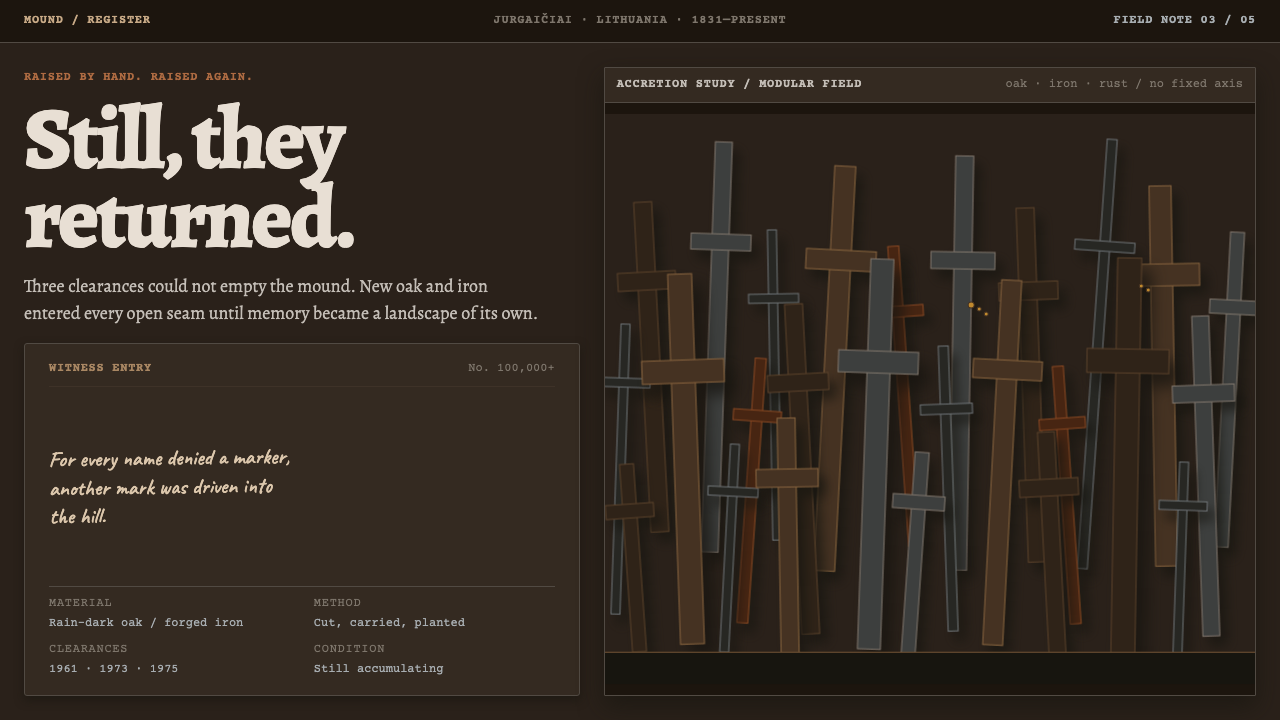 Hill of CrossesMemory returns by hand. Rain-black oak and rusted iron overlap until density…
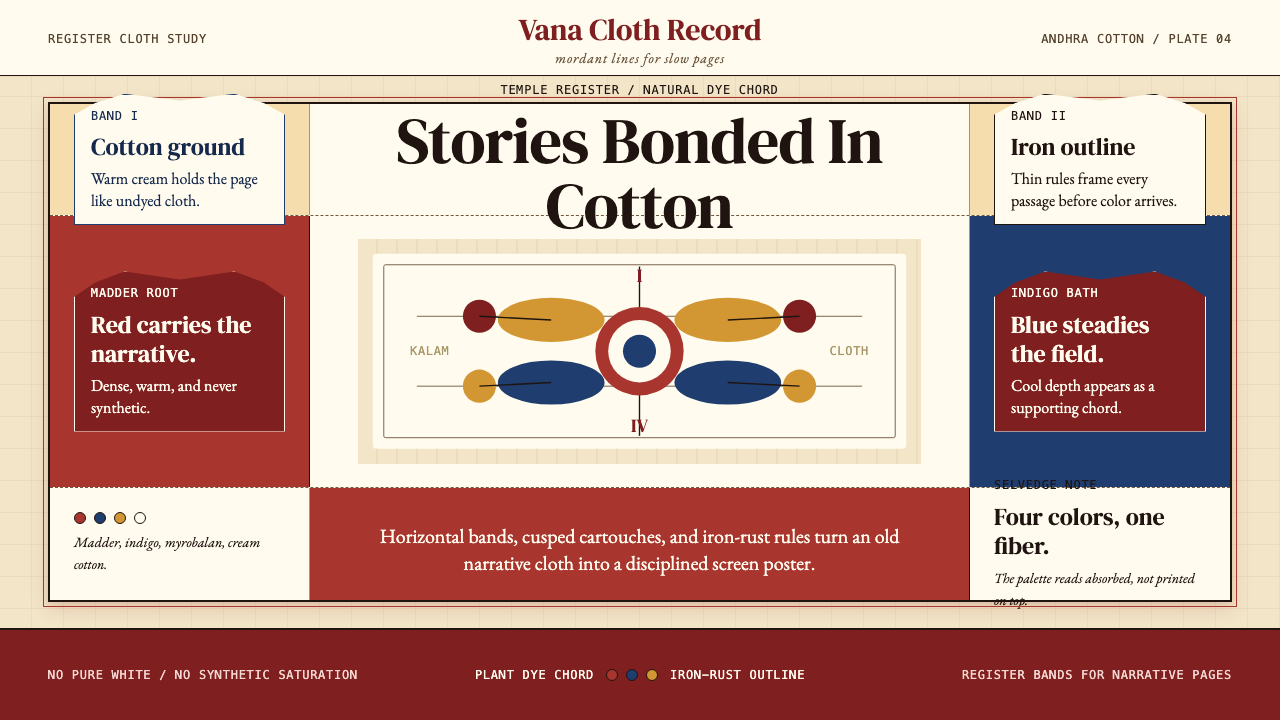 Kalamkari (Andhra Pradesh)Cloth becomes narrative. Madder bands, indigo panels, and iron rules stack li…