What is Māori Koru Spiral (Aotearoa)?
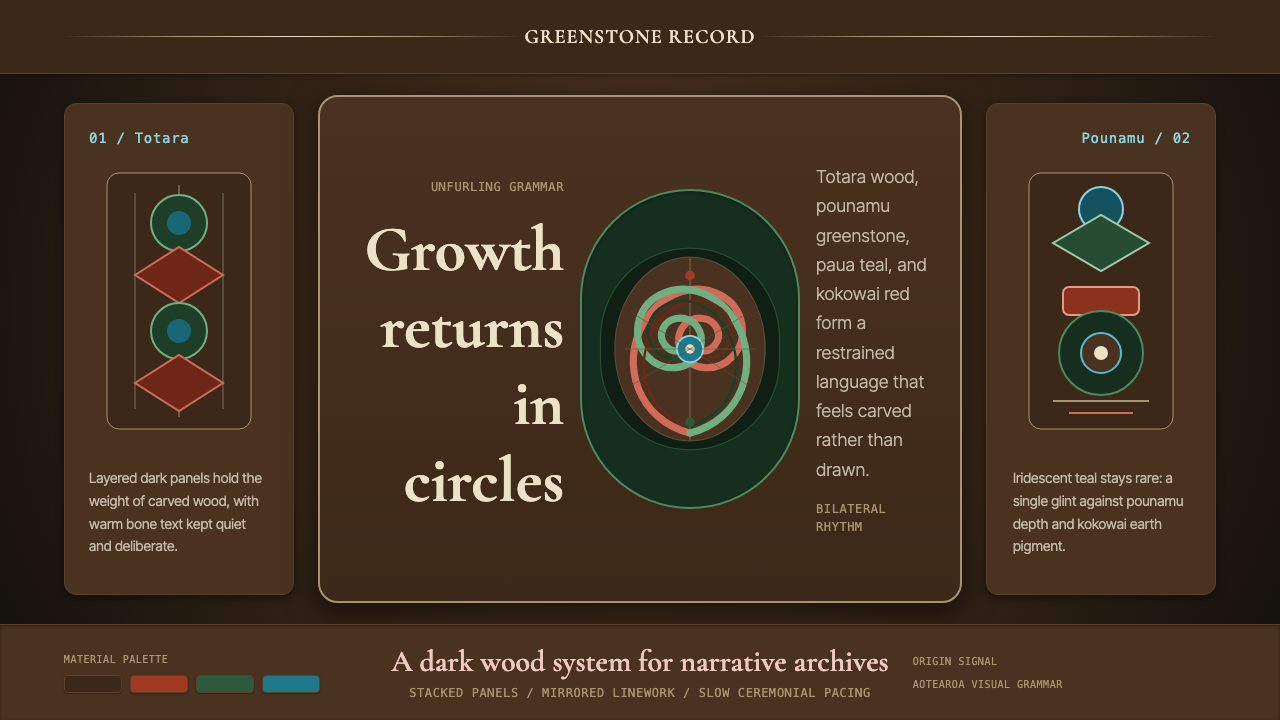
Carved from the deep grain of totara wood and the iridescent shimmer of pounamu stone, the Māori koru transforms an unfurling silver-fern frond into a visual language of perpetual renewal.
Māori Koru Spiral (Aotearoa) in brief
The Māori koru design system is rooted in the visual vocabulary of whakairo — the traditional Māori practice of wood and stone carving — translated into a contemporary digital interface language. Its defining motif, the koru, is a spiral that mirrors the curling tip of a young silver-fern frond at the moment of unfurling. In Māori cosmology, this form carries layered meaning: new life beginning, cyclical growth continuing, and the enduring connection between past, present, and future.
The palette draws directly from materials found in the natural and cultural world of Aotearoa New Zealand. Deep totara-wood brown forms the foundational ground — dark, warm, and dense with implied texture. Against it, pounamu (greenstone or nephrite jade) green provides the primary accent: a color that in traditional culture signified prestige, spiritual protection, and ancestral connection. Paua-shell iridescence — the shifting blue-green that lines the inner surface of the abalone shell — adds luminous depth to secondary elements, suggesting light caught beneath a surface rather than cast upon it. Kokowai, a red ochre pigment used in traditional ceremony and carving, supplies a warm, earthy emphasis that grounds the darker values.
What makes this system distinctive is its fundamental visual logic: everything is felt as carved rather than drawn. Forms have weight and implied depth, as though they have been worked out of a resistant material. Bilateral symmetry — the mirrored geometry of kowhaiwhai rafter painting in the wharenui meeting house — organizes composition at every scale. Nothing floats arbitrarily; each element is placed with the deliberateness of a carver making an irreversible mark.
Where does Māori Koru Spiral (Aotearoa) come from?
Māori ancestors arrived in Aotearoa from eastern Polynesia in successive voyages beginning around 1300 CE, bringing with them the navigational, agricultural, and artistic traditions of the wider Pacific. The environments they encountered — vast kauri and totara forests, coastlines rich in pounamu and paua, an ecology unlike anything in the tropical islands they had left — rapidly shaped new aesthetic responses. By the fifteenth and sixteenth centuries, a distinctive regional carving tradition had developed, rooted in ancestral Polynesian forms but transformed by the density of available hardwoods and the particular spiritual needs of the new land.
Whakairo — formal wood carving — became the primary architectural and ceremonial art form. The wharenui meeting house, with its carved ancestral figures (poupou), kowhaiwhai rafter patterns, and tukutuku woven wall panels, was both a genealogical library and a cosmological diagram. Each carved element had specific narrative and spiritual meaning: the koru spiral represented new growth and the cycle of life; the manaia (a profile figure with a bird or reptilian beak) represented guardianship; interlocking spirals on faces and garments (tā moko, or facial tattooing) inscribed genealogical identity directly onto the body. This was never decorative art in the Western sense — every mark carried precise cultural information.
The period from roughly 1500 to 1840 represented the classic flowering of these traditions. Contact with European explorers and settlers from the late eighteenth century onward brought both disruption and new materials. The musket wars of the early nineteenth century, followed by land confiscation and colonization, severely damaged the social structures within which whakairo and related arts had flourished. By the late nineteenth century, Gottfried Lindauer — a Czech-born painter who worked extensively in New Zealand from 1874 — produced a body of portraiture that documented Māori subjects and their traditional dress and moko with unusual care, providing a crucial visual archive of forms that were under pressure.
The Māori renaissance of the 1960s and the broader political and cultural resurgence that followed transformed this relationship. Artists such as Cliff Whiting and Pakariki Harrison reasserted traditional carving forms not as museum artifacts but as living artistic traditions capable of engaging with contemporary materials and contexts. Scholar and activist Ngahuia Te Awekotuku provided critical intellectual frameworks for understanding Māori art on its own terms rather than through colonial categories. By the 1990s and into the twenty-first century, koru and kowhaiwhai forms had entered the broader design vocabulary of Aotearoa — appearing in national logos, airline branding, and architectural ornament — while simultaneously being reclaimed by Māori artists insisting on the depth and specificity of the tradition those surface applications drew upon.
What defines the Māori Koru Spiral (Aotearoa) look?
Palette
The palette is organized around four culturally specific values: totara-wood brown (a deep, warm, reddish-dark ground), pounamu green (a mid-to-deep green with cool, mineral clarity), paua-shell iridescence (a luminous blue-green used for subtle shimmer effects), and kokowai red ochre (a warm, earthy accent). Against the dark ground, these colors function as carved surfaces do — they catch light at different angles, suggesting relief rather than flat application. The overall effect is rich and restrained, never garish, always implying depth within darkness.
The Koru Spiral
The koru — an expanding logarithmic spiral that closes back into itself at the center — is the system's primary formal unit. It appears at every scale, from large structural motifs to micro-details at component edges. The spiral is never used as pure decoration; it carries directional energy, suggesting emergence and return in the same gesture. When two koru face each other in bilateral symmetry, they form the kowhaiwhai pattern that governed the rhythmic ornament of the meeting house. Proportions follow the natural geometry of the fern frond itself, not an arbitrary geometric formula.
Bilateral Symmetry
Unlike Bauhaus asymmetry or Swiss rationalist grids, this system is built on bilateral mirroring derived from the kowhaiwhai tradition. Layouts, patterns, and components tend to fold along a central axis, with each element having a mirror counterpart. This symmetry is not mechanical or cold — small variations in carved-surface texture and color depth prevent it from feeling rigid. The effect is closer to the breathing symmetry of a living form than to the imposed symmetry of classical architecture.
Carved Surface Quality
Elements feel worked from material rather than printed onto a surface. This is achieved through subtle layering of slightly different tonal values within the dark ground — suggesting the faceted planes of a carved form catching light from different angles — rather than through any literal texture simulation. Edges have weight; they do not feel like strokes on paper but like the boundaries of a form that has been cut away. Even flat fields in the UI carry this sense of material presence.
Iridescence and Luminosity
Paua-shell iridescence — that characteristic shift between blue, green, and purple depending on angle of view — provides the system's most distinctive visual effect. Used sparingly on interactive states, hover effects, or focal highlights, it creates a sense of depth and aliveness that the matte totara ground cannot. The luminosity is never ambient or diffuse; it is specific and located, like light caught in a facet of polished stone. Overuse flattens the effect; restraint is essential.
Tā Moko Line Work
Tā moko — traditional Māori facial tattooing — informs the system's approach to fine line work and detailing. Lines are not merely outlines; they are active, curvilinear, interlocking elements that carry meaning through their configuration and direction. Within UI components, this principle appears as intricate border treatments, divider ornaments, and decorative rule patterns that echo the genealogical specificity of tā moko without directly reproducing sacred motifs. The line work is always purposeful and densely organized, never casual or decorative in isolation.
Structural Restraint
Despite the richness of the palette and the intricacy of the spiral vocabulary, the system is governed by deep restraint. Each element earns its place through cultural reference or structural function. Random ornamentation — spiral patterns added purely for visual filling, kokowai red deployed without relational purpose — immediately reads as pastiche. The restraint is not minimalism (the system is visually dense when used fully) but discipline: everything present should belong there, and belong for a reason.
Who shaped Māori Koru Spiral (Aotearoa)?
Cliff Whiting was a leading figure in the Māori arts renaissance of the late twentieth century, known for large-scale paintings, carvings, and installations that brought traditional koru and kowhaiwhai forms into dialogue with contemporary art contexts. His mural work — most prominently in public institutions across Aotearoa — demonstrated that the visual logic of whakairo could speak with full authority in modern architectural settings, without requiring translation into a Western visual idiom. Whiting's approach insisted on cultural continuity rather than cultural nostalgia.
Pakariki Harrison was one of the foremost master carvers of the twentieth century, trained in traditional whakairo and responsible for major carvings in meeting houses and public buildings throughout New Zealand. His work maintained rigorous fidelity to the formal principles and cultural protocols of traditional carving while adapting to new scales and materials. Harrison also played a central role in transmitting carving knowledge to younger generations, ensuring the craft's continuity at a time when the social structures that had previously transmitted it were under severe pressure.
Gottfried Lindauer was a Czech-born painter who immigrated to New Zealand in 1874 and devoted much of his career to portraiture of Māori subjects. Working at a time of significant cultural disruption, Lindauer produced hundreds of paintings documenting traditional dress, tā moko facial patterns, and ancestral objects with a degree of visual precision unusual for the period. His work — controversial in some respects, because of the colonial context in which it was produced — nonetheless constitutes an important visual archive of koru and moko forms as they existed in the nineteenth century, before many of the objects and practices he depicted were lost or suppressed.
Ngahuia Te Awekotuku is a scholar, writer, and activist whose intellectual work has been fundamental to establishing Māori art as a subject of serious critical inquiry on its own terms. Her research challenged colonial frameworks that had categorized Māori visual culture as craft or ethnographic artifact rather than art, and provided rigorous analysis of tā moko, whakairo, and related practices as sophisticated aesthetic and cultural systems. Her work created intellectual space for contemporary designers and artists to engage with these traditions with both depth and accountability.
How do you use Māori Koru Spiral (Aotearoa) today?
Applying the Māori koru system to contemporary design work requires understanding what the visual language is doing at its deepest level: creating a sense of carved presence, cultural depth, and cyclical meaning rather than simply borrowing aesthetic surface features. Used thoughtfully, it is one of the most distinctive and emotionally resonant design languages available for projects rooted in Aotearoa New Zealand, Pacific identity, environmental stewardship, or cultural heritage.
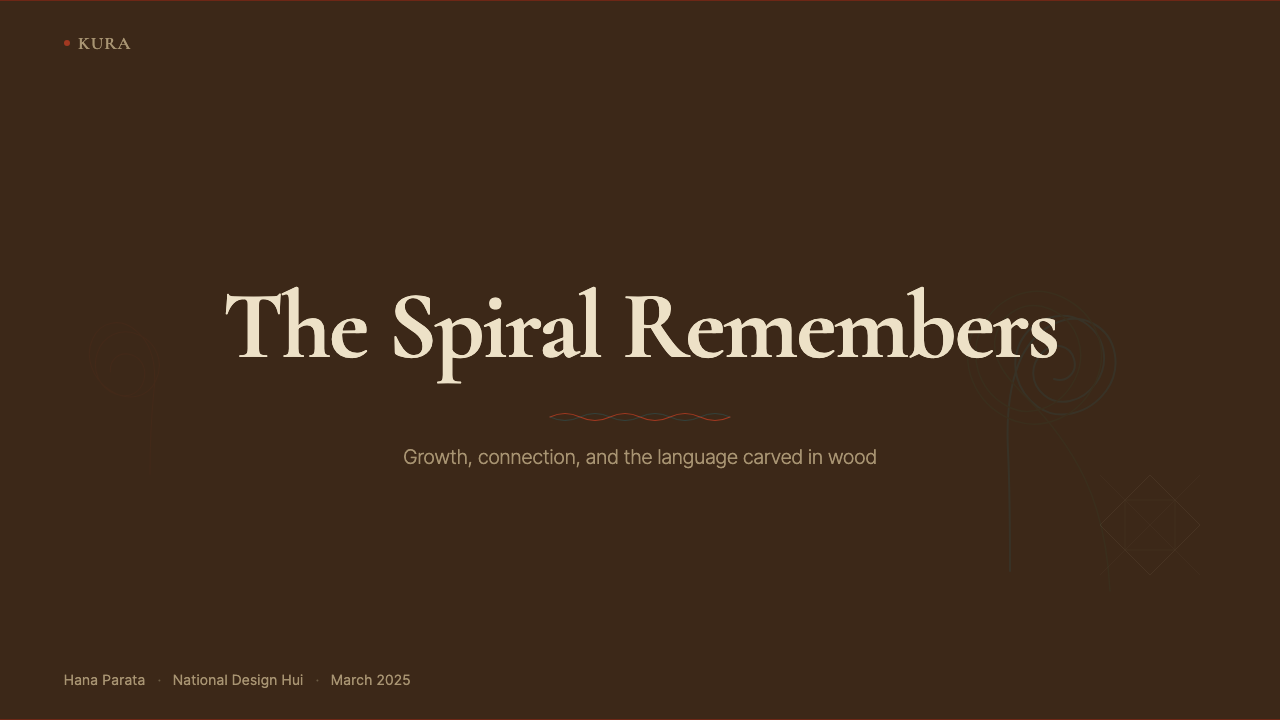
For presentation slides, the system works most powerfully at the structural level. A cover slide benefits from a single large koru spiral set against the deep totara-ground dark, with the title in a clean, generous weight letterform that does not compete with the spiral's complexity. Content slides should use the dark ground consistently, with pounamu green reserved for active elements — headers, key data points, navigational cues — and kokowai red used sparingly for critical emphasis. Data slides take on a ceremonial quality when bar charts and timeline elements are organized along the bilateral symmetry axis, as though data itself has been made to participate in the kowhaiwhai rhythm.
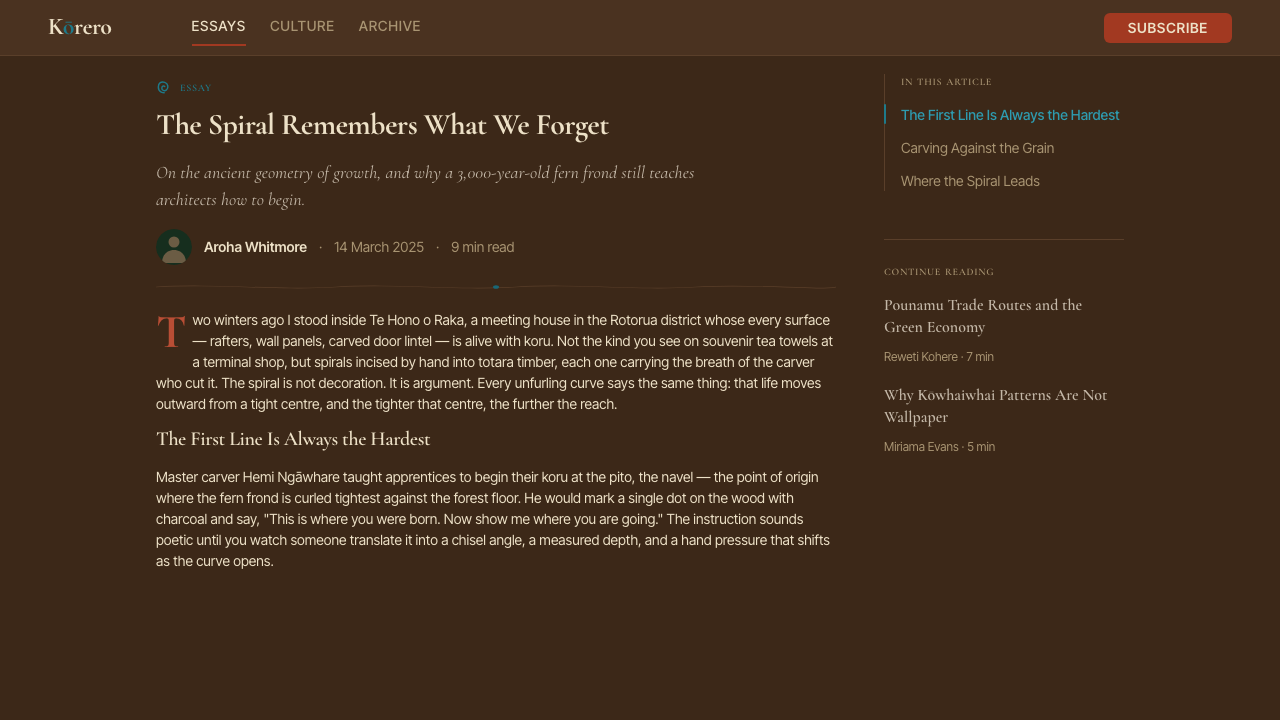
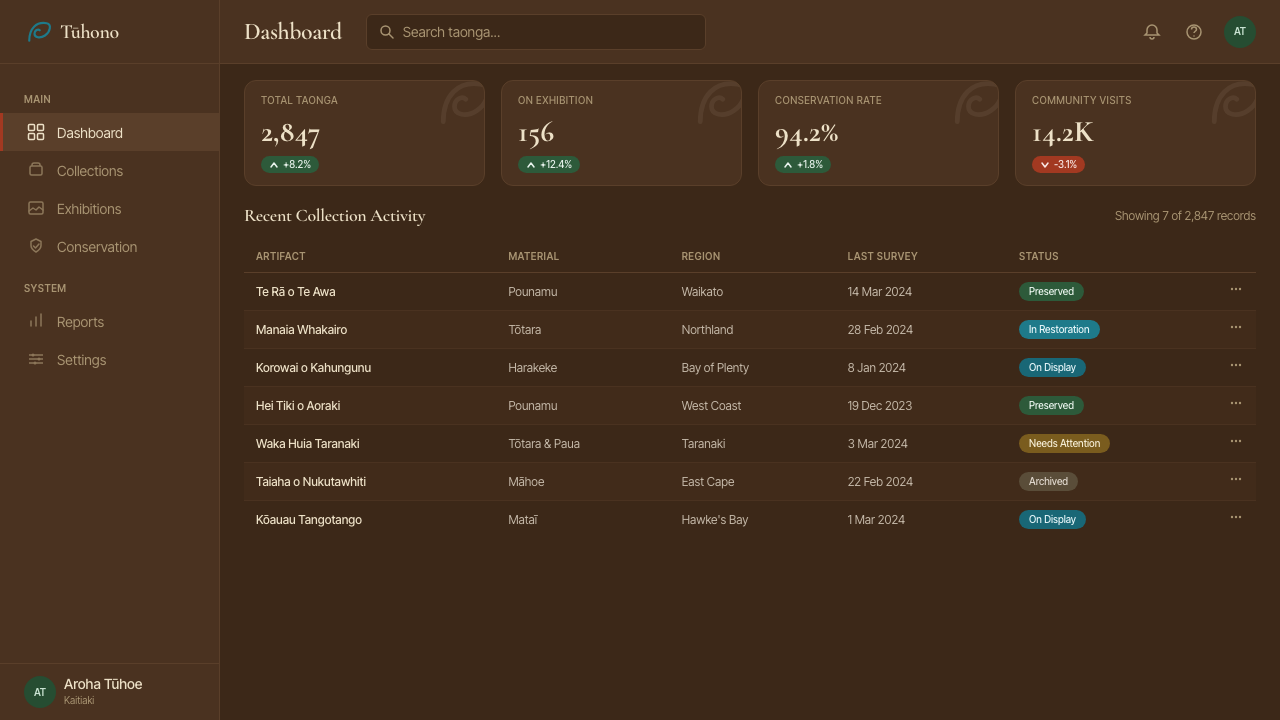
For web interfaces and dashboards, the dark background and luminous accent colors suit environments where concentration and authority matter: cultural institution portals, government heritage platforms, environmental monitoring dashboards, or any product positioning itself within Aotearoa's indigenous identity space. Navigation should feel weighty and deliberate — generous spacing, strong typographic hierarchy, paua iridescence reserved for hover and active states only. Cards should carry implied depth through layered tonal variation rather than drop shadows; the goal is to suggest carved planes, not floating paper.
For editorial and marketing work, the style supports storytelling with deep historical texture. Feature spreads can use full-bleed dark grounds with kowhaiwhai-derived border treatments framing the central content area. Pull quotes and section breaks benefit from a single koru spiral as ornamental anchor rather than generic typographic rules. In marketing materials, the kokowai red accent serves well as the primary call-to-action color — warm, urgent, culturally specific — while the pounamu green carries informational hierarchy.
A common mistake is reducing the system to its most obvious surface feature — the koru spiral — and tiling it decoratively across backgrounds or using it as a generic logo device without cultural grounding. This produces what Māori artists and scholars have called a surface application that strips the form of its meaning. A more disciplined approach uses the spiral sparingly, at deliberate scale, in positions that echo its traditional structural role. Similarly, the palette is often misapplied by adding bright contemporary hues alongside the totara-pounamu-paua range; this immediately breaks the system's coherence, because those additional colors carry no referential weight within the cultural logic the system is built upon.
Māori Koru Spiral (Aotearoa) — FAQ
Is it appropriate to use koru and kowhaiwhai forms in commercial design?
This is a question that Māori communities, artists, and scholars actively debate, and there is no single consensus answer. The broad principles that have emerged from those conversations are: attribution and context matter enormously; using these forms for products or organizations with a genuine connection to Aotearoa or Māori culture is different from using them as generic exotica; direct reproduction of specific sacred motifs (particularly tā moko designs) is widely considered inappropriate without direct iwi or whānau authorization; and commercially viable work should ideally involve Māori cultural consultation or co-authorship. The safest approach is to work with a designer who has deep cultural knowledge of the tradition, rather than applying the visual system from the outside.
How does this system differ from generic Pacific or Polynesian design?
The Māori koru system is specific to the artistic traditions of Aotearoa New Zealand, shaped by the particular hardwoods, stones, and shell materials available there, and by the cosmological and genealogical frameworks of Māori culture. It should not be conflated with Hawaiian, Samoan, Tongan, or other Pacific visual traditions, which have their own distinct formal vocabularies and cultural protocols. What they share is a Polynesian ancestry, but the centuries of development in their respective environments have produced systems that are genuinely different. Using Māori koru forms as a stand-in for generic Pacific identity is a flattening that disrespects the specificity of all the traditions involved.
Can this system work in a light-background version?
A light inversion is possible, but it fundamentally changes the system's character. The dark totara-ground is not simply a color choice — it reflects the material reality of carved wood, where the depth of the material is what you see, and light catches the raised forms from above. On a light background, the pounamu green and kokowai red remain culturally specific, but the sense of carved depth disappears. The result can still be visually coherent and culturally referenced, but it will read differently — lighter, more decorative, less immersive. For applications where the full carved-material quality is important, the dark ground is strongly preferable.
How should typography be chosen to work with this system?
Typography for this system should feel substantial rather than delicate — letterforms with clear structure and generous weight sit better against the carved-material quality of the visual ground. Typefaces that evoke hand-made quality or calligraphic influence can work well, while ultra-thin or highly geometric typefaces tend to feel at odds with the system's material warmth. Whatever typeface is chosen, a strong scale contrast between headline and body sizes amplifies the system's sense of hierarchy and ceremony. For Chinese text, a typeface with clear, confident strokes — rather than a compressed or overly mechanized face — maintains the right register.
What kinds of projects are a poor fit for this system?
The Māori koru system is not appropriate for projects seeking lightness, playfulness, or generic universality. Products targeting children, casual consumer markets, or contexts where cultural specificity would feel imposed rather than earned will not benefit from this system. It is also poorly suited to high-speed transactional interfaces — e-commerce checkout flows, quick-service utilities — where the visual weight and ceremonial quality of the system slow the user's reading rather than aiding it. The system rewards contexts where depth, cultural resonance, and considered presence are values the product genuinely holds, not borrowed atmosphere.
Related design styles
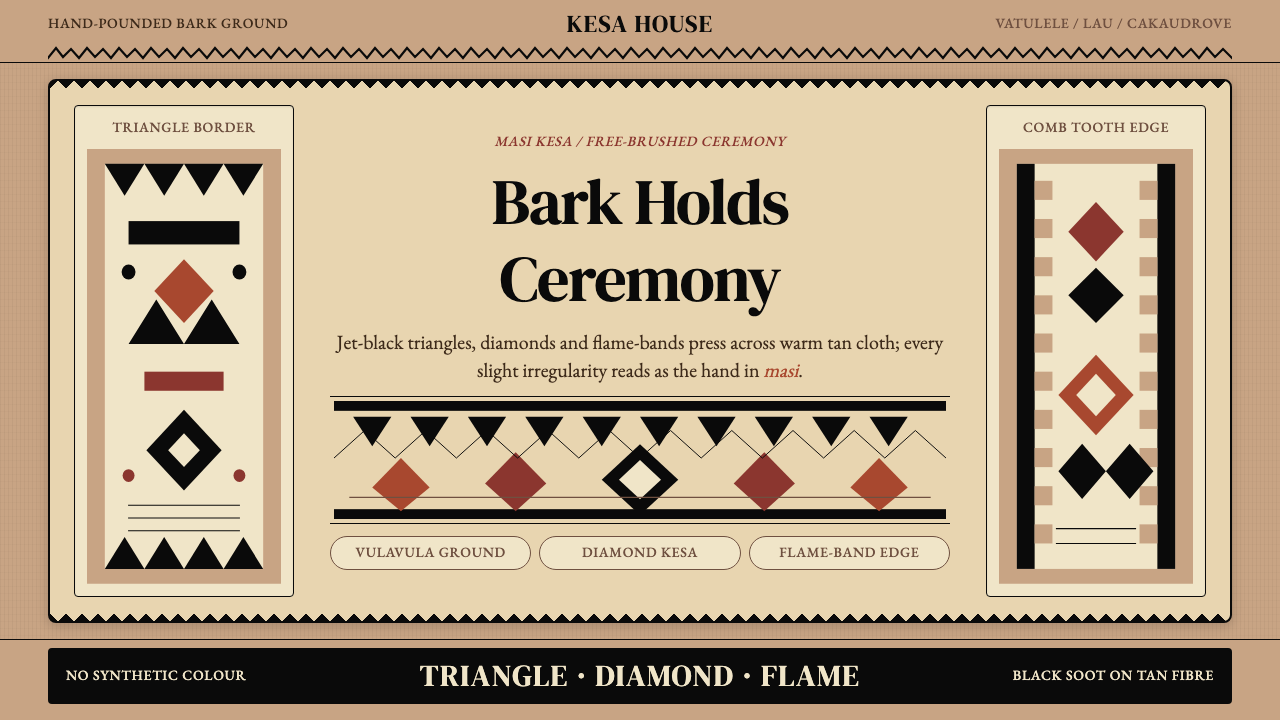 Fijian Masi (Tapa Cloth)Ceremony hits in black. Tan bark ground carries diamonds, zigzags and flame-b…
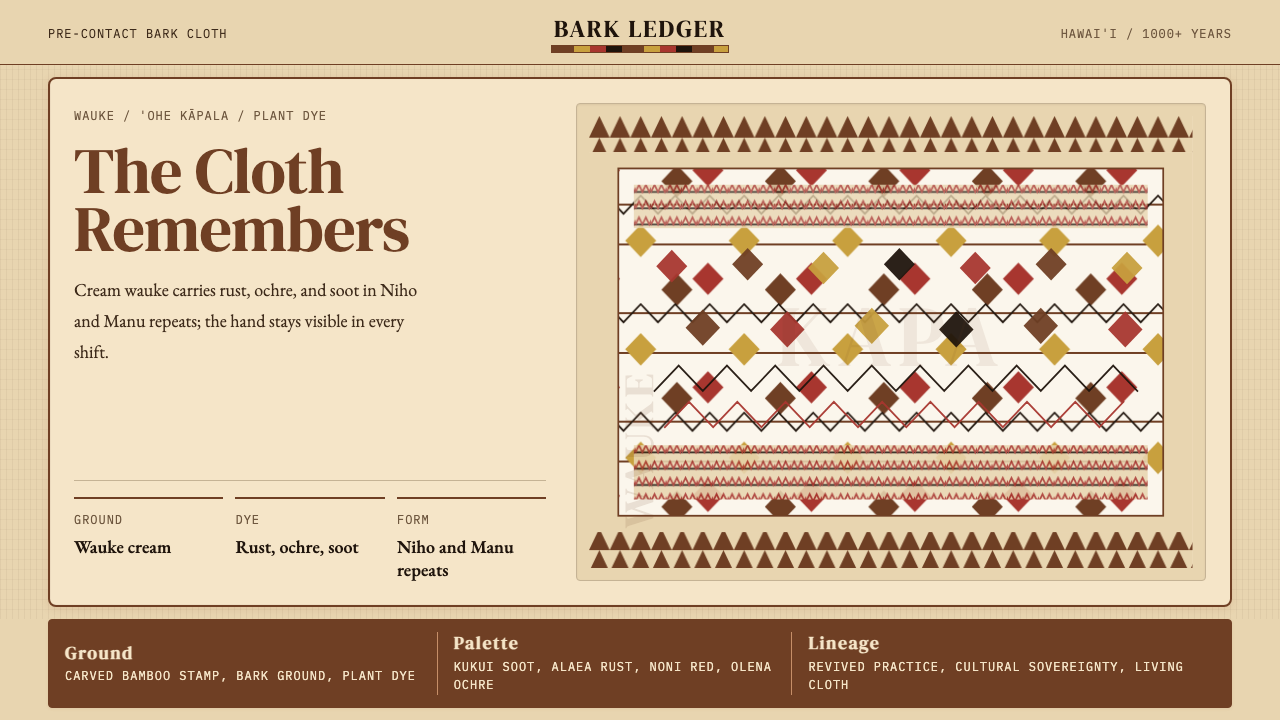 Hawaiian Kapa (Bark Cloth)Ceremonial geometry. Cream wauke, rust, ochre, and soot stamped in repeat.
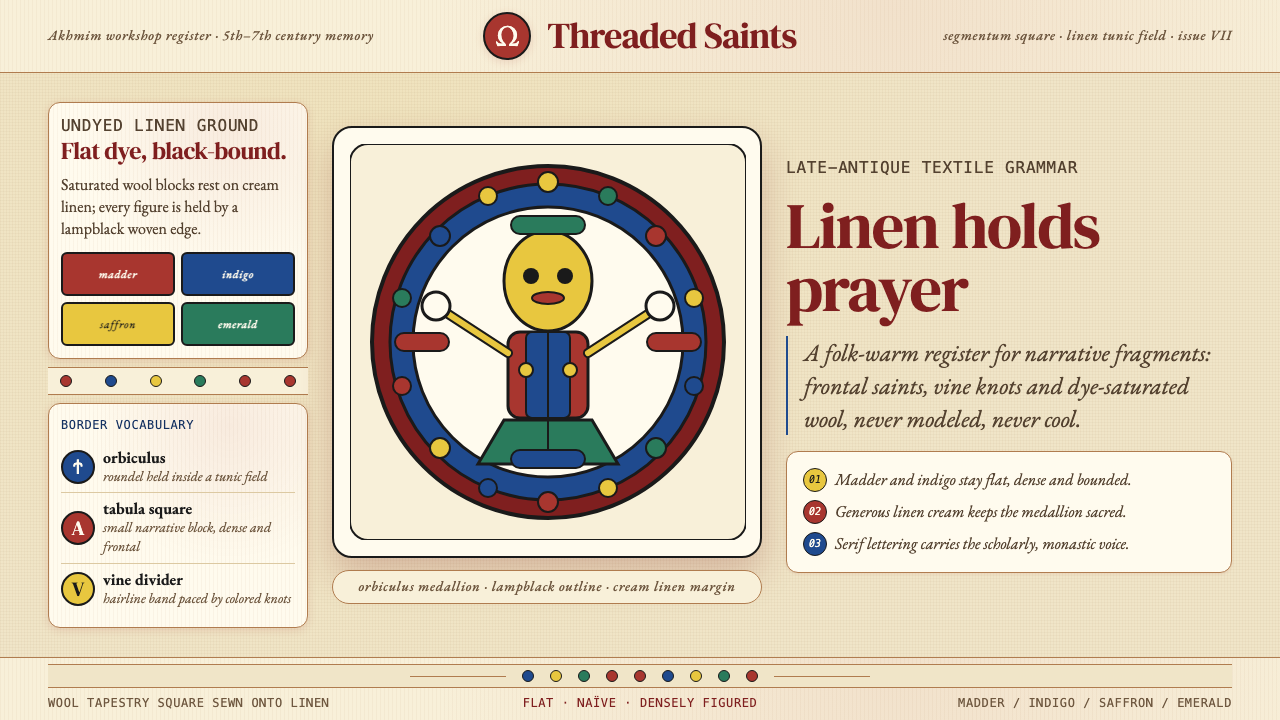 Egyptian Coptic TextileWarmth woven flat. Madder, indigo and saffron medallions sit on linen cream.
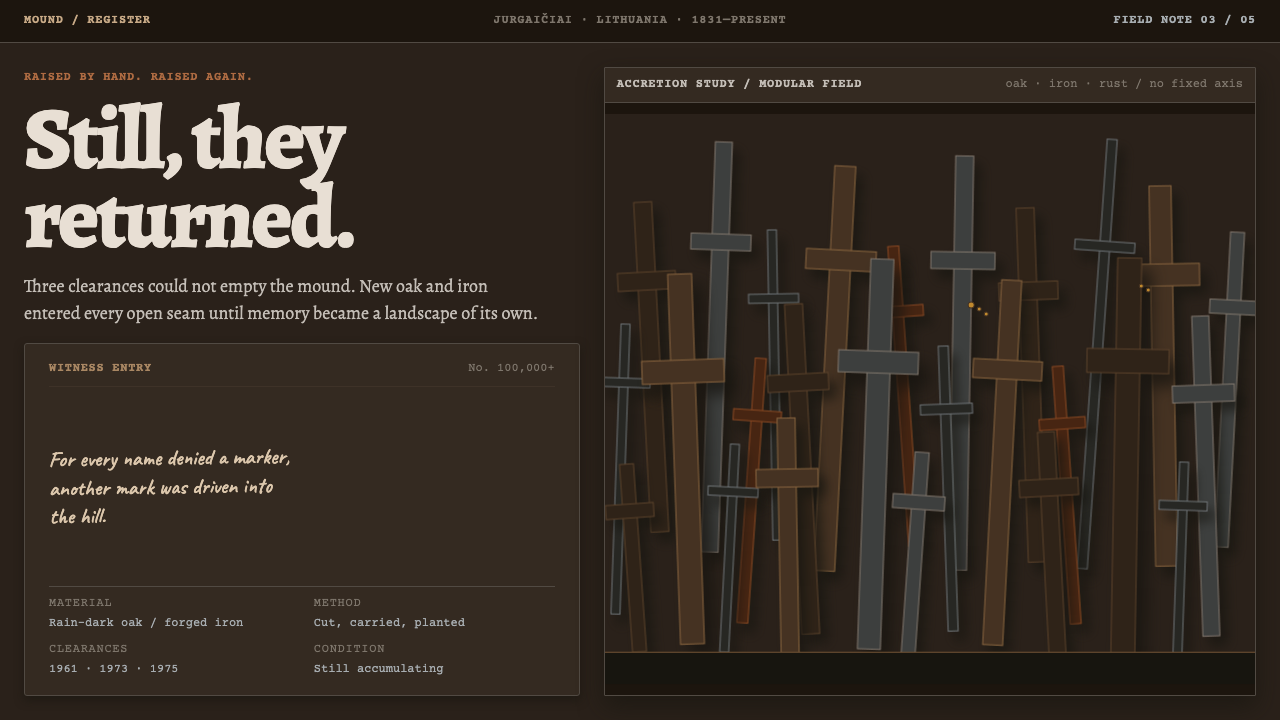 Hill of CrossesMemory returns by hand. Rain-black oak and rusted iron overlap until density…
 Kalamkari (Andhra Pradesh)Cloth becomes narrative. Madder bands, indigo panels, and iron rules stack li…
 Kuba Raffia Cloth (Congo)Deliberate asymmetry lives. Cream raffia, chocolate seams, and rust blocks.