What is Chinese Jianzhi Paper-Cutting?
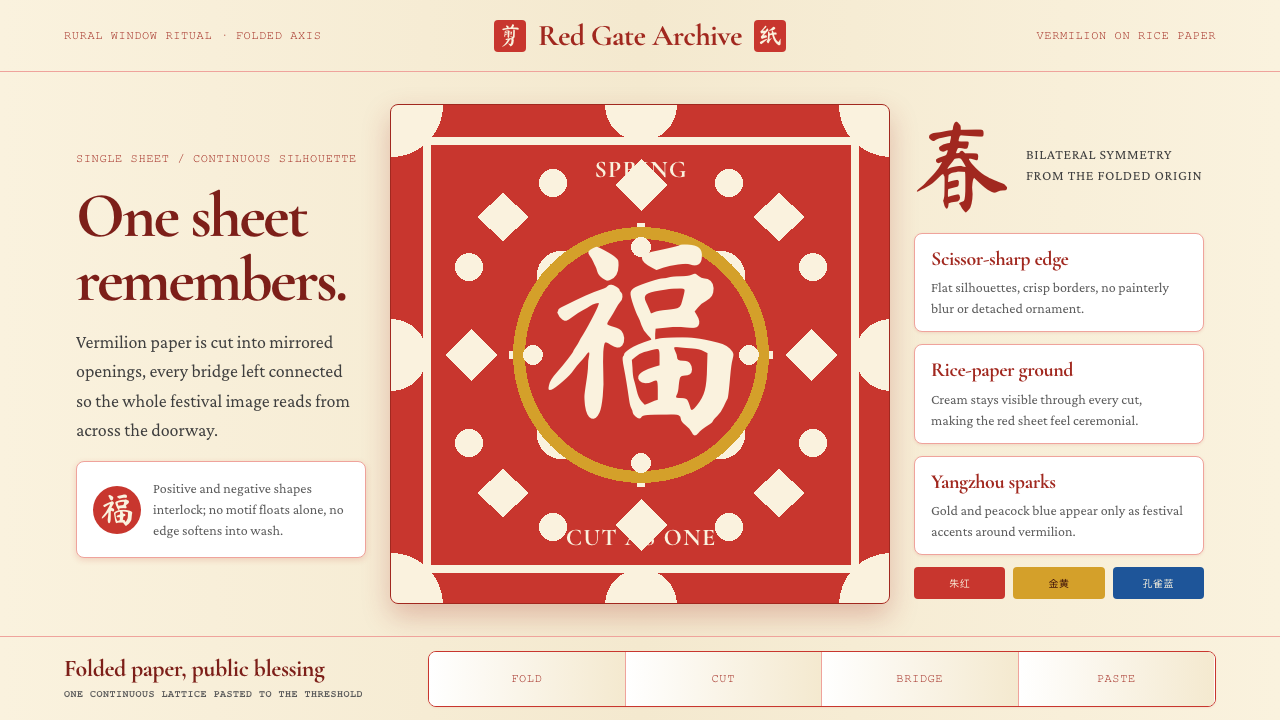
Jianzhi reduces a single sheet of red paper to an intricate lacework silhouette — a visual language forged from the fold, the scissor edge, and twelve hundred years of Spring Festival ritual.
Chinese Jianzhi Paper-Cutting in brief
Chinese jianzhi (剪纸, literally 'cut paper') is one of the world's oldest and most concentrated single-color graphic systems. A practitioner folds a sheet of red paper along a central axis, cuts negative space through multiple layers simultaneously, and unfolds the result to reveal a bilaterally symmetrical lacework of fish, lotus, opera characters, or good-fortune ideographs. The entire image is structurally continuous — every petal and tendril physically connected to every other — because any isolated island of paper would fall away from the scissors.
The aesthetic is defined by extreme economy of means. Vermilion or blood-red paper against a rice-paper cream or whitewashed wall surface is the canonical color pairing, carrying ceremonial weight accumulated over centuries of Spring Festival doorway decoration, wedding and funeral ritual, and embroidery-pattern transfer. The Yangzhou school and several Fujian traditions introduce imperial yellow, peacock blue, and jade green in layered multi-color compositions, but even these polychrome variants retain the core logic: positive silhouette and negative void locked into mutual dependency, every edge the trace of a scissor blade, nothing softened or blurred.
In 2009 UNESCO inscribed jianzhi on the Representative List of the Intangible Cultural Heritage of Humanity, recognizing both its unbroken rural transmission and the precariousness of that transmission as village craft economies changed. The designation accelerated interest from contemporary designers and educators, who recognized in jianzhi a fully articulated visual grammar — symmetry, positive-negative interlock, connective bridging, knife-sharp silhouette — that translates with remarkable fidelity from paper to screen.

Where does Chinese Jianzhi Paper-Cutting come from?
The material prehistory of jianzhi extends back before paper itself. Archaeological evidence and literary sources record the practice of cutting decorative silhouettes from thin metal foil — particularly gold and silver leaf — during the Han dynasty (roughly 200 BC to 200 AD), when such objects were placed in tombs as symbolic substitutes for precious goods. The invention of paper, traditionally dated to Cai Lun's refinement of the process around 105 AD, made the medium cheap enough for widespread domestic use, and by the fifth and sixth centuries there are records of cut-paper figures being burned at funerals and displayed at seasonal festivals across northern China.
The craft reached its first period of sophisticated regional differentiation during the Tang dynasty (618–907 AD), when trade routes, imperial patronage, and the movement of skilled craftswomen between regional courts spread specific motif vocabularies — the fish-in-lotus, the magpie-on-plum, the paired phoenix — from one provincial tradition to another. Song dynasty (960–1279 AD) commercial cities saw the emergence of professional paper-cutters who sold their work at festival markets, producing a split between the vernacular household tradition and a more refined commercial practice that would characterize jianzhi through its peak period.
The great age of village jianzhi ran roughly from the mid-Ming dynasty through the end of the Qing, spanning the years 1500 to 1900. During this period the craft was primarily transmitted by women: girls learned from mothers and grandmothers, accumulating a personal repertoire of templates folded into small packets and stored in wooden boxes. The motif vocabulary encoded popular Buddhist imagery, Daoist symbols of longevity, Confucian family values, and the practical needs of wedding decoration — the double happiness character, the mandarin duck pair, the pomegranate heavy with seeds. Regional styles crystallized during this period: Shaanxi and Shanxi paper-cutting from the Loess Plateau tended toward bold, rough-edged figures with strong symbolic weight; Hebei and Shandong work was finer and more intricate; Yangzhou developed its distinctive layered multi-color technique; Fujian incorporated imagery from maritime trade and overseas Chinese communities.
The twentieth century brought disruption and revival in alternating waves. Republican-era (1912–1949) folklorists, including scholars associated with the Yanjing University folklore movement, began systematic documentation of regional styles, rescuing templates and recording the biographies of master practitioners. The People's Republic period produced a complex dynamic: during the early 1950s, paper-cutting was celebrated as a people's art and given institutional support through cultural centers and arts-and-crafts cooperatives; the Cultural Revolution (1966–1976) suppressed many traditional motifs as feudal remnants while directing the medium toward political imagery; the reform era from 1978 onward brought renewed academic interest, museum collection, and eventually the UNESCO recognition of 2009. Today the practice exists across a wide spectrum, from village grandmothers maintaining purely oral-transmission traditions to urban contemporary artists and designers using laser cutting and digital fabrication to explore the grammar of the form.
What defines the Chinese Jianzhi Paper-Cutting look?
Vermilion-on-Cream Color Logic
The canonical jianzhi palette is a single saturated red — ranging from the warm blood-red of festival paper to the cooler vermilion of lacquerware — against a rice-paper cream or whitewashed surface. This is not minimalism by design philosophy but by material necessity: a single sheet of paper is either cut away (void) or left standing (form), and the ground shows through wherever the scissors have passed. The red carries concentrated ceremonial meaning accumulated over centuries: it is the color of good fortune, of vital energy, of the threshold between inside and outside. The Yangzhou and Fujian polychrome traditions introduce additional hues — imperial yellow, peacock blue, jade green — layered in separate cut sheets, but these always retain the same logic of saturated flat color with no gradient and no tonal modulation.
Positive-Negative Interlock
The defining structural principle of jianzhi is the inseparability of positive form and negative void. Unlike painting or printing, where marks are added to a surface, paper-cutting is entirely subtractive: the image is what remains after material is removed. Every shape is defined by the shape of the space surrounding it, and skilled practitioners design both simultaneously. The result is a visual system in which figure and ground are in constant dialogue — a fish shape reads because the water around it has been articulated, a lotus petal exists because the air between petals has been cut. This mutual dependency gives jianzhi compositions their characteristic density and visual tension.
Bilateral Symmetry from the Fold
Most jianzhi is cut from folded paper, which means bilateral symmetry is not a stylistic choice but a structural consequence of the process. The fold is the axis; whatever is cut on one half is automatically mirrored on the other. Experienced practitioners work with this constraint productively, designing compositions that use the axis as a formal device — a central character flanked by identical floral borders, paired animals facing each other across an implied center line, or repeated geometric units that tile outward from the fold. The symmetry gives jianzhi its iconic quality of completeness: the image feels resolved, contained, ceremonially balanced.
Connective Bridging
Because an isolated fragment of cut paper has no support and will fall, every element within a jianzhi composition must be physically connected to every other element by at least one bridge of uncut paper. This connective constraint drives one of the medium's most distinctive formal inventions: the leaf-vein and tendril network that ties fish to lotus, birds to branches, and characters to their decorative borders. These bridges are not decorative additions — they are structural requirements that practitioners have refined into an expressive convention. The thinness of a bridge signals the confidence of the cutter; the patterning of the network reveals the compositional intelligence of the designer.
Scissor-Sharp Edge Quality
Every edge in a traditional jianzhi is the exact trace of a scissor or knife blade: crisp, decisive, zero-tolerance for ambiguity. There is no anti-aliasing, no feathering, no soft transition between positive and negative. The edge is either cut or not cut. This quality of absolute binary decision at every boundary gives jianzhi its characteristic graphic impact from a distance — the image reads as a bold silhouette before it resolves into detail — and its intimacy up close, where the precision of thousands of individual cuts becomes visible. The sharpness is also culturally coded: the scissor's clean cut is associated with clarity of intention, the ceremonial preparation of the space for good fortune.
Motif Vocabulary and Symbolic Density
Jianzhi maintains a rich and highly codified iconographic vocabulary in which every element carries layered meaning. Fish (鱼, yú) pun on abundance (余, yú); lotus (莲, lián) on continuous succession (连, lián); the magpie (喜鹊) announces good news; the bat (蝠, fú) sounds like good fortune (福, fú); the pomegranate (石榴) signals many children; the phoenix and dragon pair represent conjugal union. Practitioners learn these associations as part of their training, and literate viewers decode them as readily as text. This symbolic density means that a jianzhi is never purely formal — it is always also a statement, a wish, or a prayer folded into the structure of the cut.
Flatness and Material Honesty
Jianzhi is an entirely flat medium: there is no illusion of depth, no perspective recession, no shading that simulates three-dimensional form. What exists is a single plane of paper with areas present or absent. This flatness is not a limitation to be overcome but the medium's essential character, and skilled practitioners exploit it fully. Overlapping silhouettes suggest spatial relationships without violating the flat plane; scale relationships between figures convey narrative hierarchy without recession into depth. The result anticipates many of the principles that twentieth-century graphic designers would discover independently: the power of flat color, the legibility of silhouette, the compositional force of the unmodulated plane.

Who shaped Chinese Jianzhi Paper-Cutting?
Ku Shulan (1920–2004) of Pucheng County, Shaanxi Province, is among the most celebrated jianzhi artists of the twentieth century and the one most responsible for bringing the northern tradition to international attention. Working from her farmhouse, she developed an exuberant multi-color style — large-scale compositions covering entire walls, combining goddess figures, flowers, animals, and geometric borders in compositions of astonishing chromatic richness. She was designated a National Folk Art Master (中国民间工艺美术大师) and her work entered major museum collections in China and abroad. Ku Shulan's achievement demonstrated that jianzhi was not merely a minor craft tradition but a fully elaborated artistic medium capable of monumental scale and complex iconographic programs.
Gao Fenglian (born 1935) of Ansai County, Shaanxi Province, represents the Loess Plateau tradition at its most powerfully archaic. Her work draws on pre-Buddhist imagery — fertility goddesses, animist spirit forms, the frog and fish symbols associated with ancient Yellow River valley cultures — rendered in a bold, roughened style that preserves the gestural vitality of improvised cutting. Gao has been a central figure in academic and curatorial efforts to document Shaanxi jianzhi, and her collaboration with scholars in the 1980s and 1990s helped establish the interpretive framework through which contemporary audiences understand the deep symbolic strata of northern Chinese paper-cutting.
Wang Laoshang (1890–1951) of Wuqiang County, Hebei Province, was the preeminent master of the Hebei woodblock-print and paper-cut tradition and a figure whose influence on subsequent generations of northern Chinese folk artists was comparable to that of a classical calligrapher on later scripts. His compositions — New Year prints, paper-cut designs for embroidery patterns, and standalone pictorial works — were characterized by a refined integration of line and silhouette, drawing on opera costume and theatrical convention to produce figures of extraordinary elegance within the formal constraints of the medium. Wuqiang County today remains one of the most important centers of folk print and paper-cut production in China, and Wang's legacy shapes the aesthetic standard against which local work is still measured.
Bai Fengying (1933–2018) of Inner Mongolia represented a tradition of paper-cutting that blended the Han Chinese ceremonial vocabulary with visual elements derived from Mongolian textile and felt-craft patterns, producing compositions with a distinctive geometric boldness unusual within the jianzhi canon. Her work demonstrates the degree to which jianzhi is not a monolithic tradition but a family of regional practices that has absorbed influences from neighboring craft cultures throughout its history. Bai was among the practitioners whose documentation in the 1980s reform-era folk arts revival helped establish the breadth and diversity of the jianzhi tradition as a national cultural asset.
How do you use Chinese Jianzhi Paper-Cutting today?
Jianzhi is a highly transferable visual system for contemporary design precisely because its grammar is structural rather than ornamental: symmetry, positive-negative interlock, flat saturated color, scissor-sharp edges, and connective bridging are formal principles that operate just as powerfully on screen as on paper. Applying the style correctly requires internalizing what the visual system is actually doing — not layering red and folk motifs over an existing layout, but rebuilding the compositional logic from the principles outward.
For presentation slides, the jianzhi sensibility works most powerfully on cover and section-divider pages. A cover built on the style uses a single high-saturation red field as the ground, with white or cream silhouette forms — cut-paper figures, floral lattices, or bold ideographic shapes — occupying the center. The bilateral symmetry principle argues for centered, axially organized compositions rather than the asymmetric layouts of Western modernism. Content slides should restrain the palette to the canonical two-tone: red carries structural weight and accent function, cream or white holds body text and supporting information, with negative space doing heavy organizational work. Data visualizations take on a diagrammatic, pattern-like quality when rendered in the flat saturated palette, with chart elements treated as positive silhouette shapes against a light ground.
For web user interfaces, jianzhi is best suited to contexts where ceremonial weight, cultural specificity, or festive energy are intended values: landing pages for Spring Festival campaigns, cultural heritage platforms, luxury goods with an Asian market orientation, or any context where the designer wishes to signal both tradition and visual sophistication. Dashboard and functional interfaces can incorporate the language more sparingly — a border motif drawn from jianzhi lattice patterns, a navigation element with a symmetrical cut-paper silhouette, an alert or badge component in the canonical red. Pricing pages work well when tier differentiation is signaled through the color logic: one tier in the full ceremonial red, others in the neutral cream or a muted secondary hue.
For editorial and marketing work, the style's most direct application is in campaign identities for Chinese cultural events, festivals, or brands with a heritage positioning. A Jianzhi-derived editorial layout uses the positive-negative principle to treat images as silhouettes: photographs are vignetted to hard-edged shapes, illustrations are rendered as cut-paper forms, and text blocks are treated as positive elements within a lattice of negative space. Marketing materials benefit from the style's inherent boldness — a single full-bleed vermilion field with a centered white silhouette reads from distance as confidently as a traditional doorway paper-cut, and carries the same sense of deliberate ceremonial preparation.
A common mistake when applying jianzhi aesthetics is treating the red as merely a brand color and adding folk motifs as surface decoration while leaving the underlying composition logic unchanged. Authentic application requires adopting the structural principles: bilateral symmetry or strong axial organization, positive-negative reciprocity between figure and ground, connective continuity rather than isolated floating elements, and the absolute flatness of the cut-paper surface with no gradients, soft shadows, or simulated depth. A second frequent error is importing too much polychrome complexity — the multi-color Yangzhou tradition requires the same connective and symmetrical logic as the single-color northern tradition, and applying multiple saturated hues without that structural discipline produces visual chaos rather than jianzhi's characteristic ceremonial density.

Chinese Jianzhi Paper-Cutting — FAQ
Is jianzhi always red, or can other colors be used?
The single-color red-on-cream pairing is the canonical and most historically widespread form, but jianzhi encompasses a broad range of color traditions. The Yangzhou school has practiced layered multi-color paper-cutting for centuries, building compositions from separately cut sheets of imperial yellow, peacock blue, jade green, and red. Fujian coastal traditions use a brighter, more varied palette influenced by maritime trade aesthetics. In contemporary and design-oriented applications, the jianzhi grammar — symmetry, positive-negative interlock, flat silhouette, connective bridging — can be expressed in any color palette, including monochromatic black-on-white or white-on-dark schemes. The red carries cultural specificity and ceremonial connotation; when those associations are desired, the canonical palette is irreplaceable. When the formal grammar alone is the goal, the color is a variable.
How does jianzhi differ from other Asian paper-cutting traditions such as Japanese kirigami or Polish wycinanki?
Jianzhi, kirigami, and wycinanki share the fundamental premise of cutting paper to create decorative forms, but they differ substantially in visual logic and cultural function. Japanese kirigami — used in origami-adjacent paper-folding craft — tends toward geometric snowflake and radial symmetry patterns, with a lighter, more openly lacy structure and little symbolic iconographic content. Polish wycinanki from the Łowicz region uses bold, saturated multi-color layered compositions with folk floral and bird motifs, with a visual richness and chromatic density comparable to Yangzhou jianzhi but within a completely different iconographic vocabulary. Jianzhi is distinguished by the depth and specificity of its symbolic coding, the structural requirement of total connectivity, and its deep integration with Chinese ceremonial life across a continuous tradition spanning over a millennium.
Can the jianzhi style work for digital interfaces that need to feel modern rather than traditionally cultural?
Yes, with calibration. The jianzhi visual system is modular enough that its formal principles can be separated from its most overtly folkloric motif vocabulary. A digital interface can adopt bilateral symmetry, hard-edged flat silhouettes, the positive-negative interlock principle, and a restrained two-tone palette without incorporating fish, lotus, or traditional ideographic forms. The resulting aesthetic reads as structured, considered, and culturally grounded rather than as costume. Contemporary Chinese technology and luxury brands have successfully used this approach — extracting the grammar while updating the motif vocabulary to geometric abstractions or contemporary iconography. The risk is that excessive abstraction loses the cultural signal entirely and produces a generic flat-design system. The balance point is usually found in the structural principles — symmetry, connectivity, flat color — applied to contemporary content rather than in the traditional iconographic vocabulary.
What is the most common mistake designers make when applying jianzhi aesthetics?
The most pervasive mistake is treating jianzhi as a surface-level motif library rather than a structural grammar. Designers take a lotus border, a fish silhouette, or a double-happiness character and overlay these elements on a layout that retains the underlying logic of Western modernism — asymmetric grids, multiple type hierarchies, photographic imagery, soft shadows, gradient backgrounds. The result is a layout that says 'Chinese folk art' as decoration while the actual compositional intelligence of jianzhi — the connective bridging, the positive-negative reciprocity, the axial symmetry — is absent. A related error is using the red at low saturation or mixing it with multiple other hues without the structural discipline that jianzhi's flat-color logic requires. Authentic application means adopting the grammar first and letting the motifs follow naturally from that structural commitment.
Is jianzhi appropriate for non-Chinese-cultural contexts, or does it carry too much cultural specificity?
Jianzhi sits at the intersection of a universal formal principle — symmetry, flat silhouette, positive-negative interlock — and a highly specific cultural iconography. The formal principles are genuinely universal and have been independently discovered by paper-cutting traditions worldwide. The iconographic vocabulary — fish, lotus, opera figures, ideographic forms — carries specific cultural coding that, applied in non-Chinese contexts, requires careful consideration of whether the cultural signal is appropriate, desired, and respectful. The safest approach in non-Chinese cultural contexts is to engage with the formal grammar rather than the specific motif vocabulary: use the structural principles of symmetry, flat color, and connective bridging with locally relevant or abstract content. This produces work that is structurally sophisticated without making a claim to cultural identity it does not authentically hold.
Related design styles
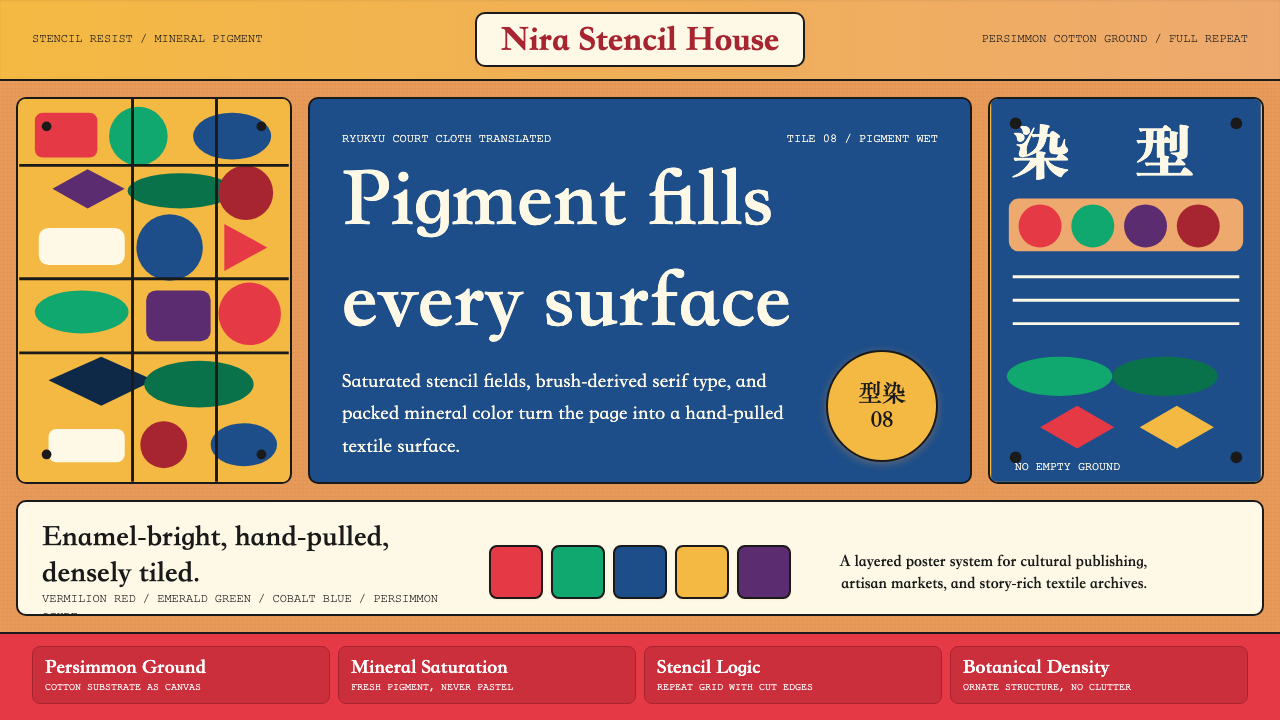 Okinawan Bingata Resist DyeOrnate without clutter. Persimmon ground, vermilion type, emerald-cobalt sten…
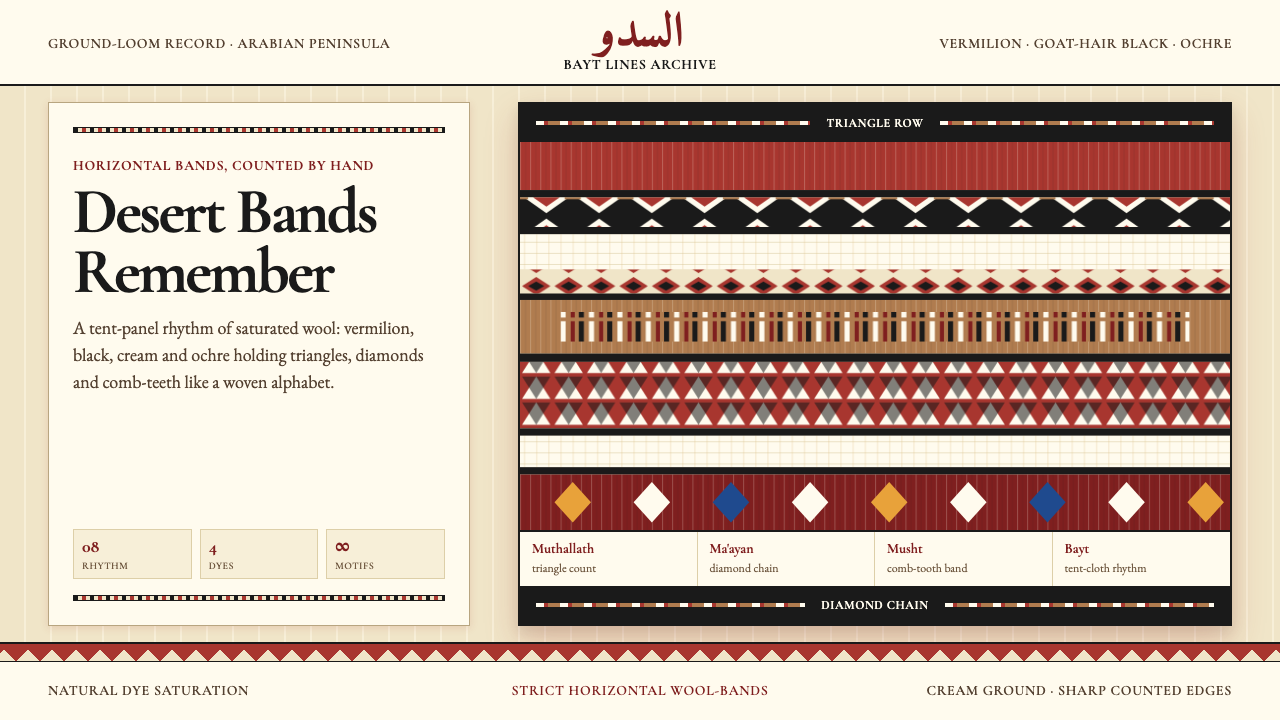 Bedouin Desert Textile (Sadu)Woven memory, not ornament. Vermilion-black bands count triangles and diamond…
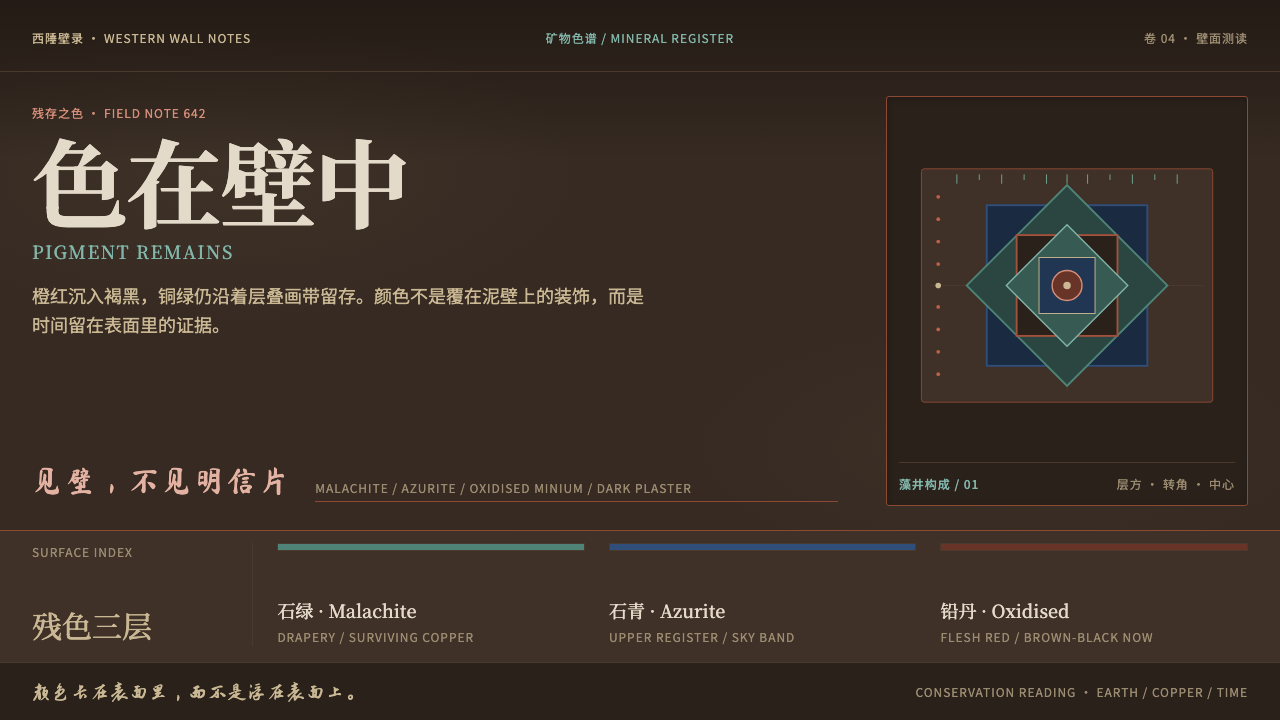 Dunhuang Mogao MuralsTime lives in the wall. Mineral green and azurite endure on oxidised brown pl…
 Khmer Kbach MotifShadow carves the grammar. Repeated stone cells turn a narrow sandstone palet…
 Madagascan Lamba SilkAncestry is woven flat. Crimson, indigo, cream and gold run in strict silk ba…
 Madhubani (Mithila Folk Painting)No empty ground. Vermilion, indigo and saffron pack double-outlined panels wi…