What is Okinawan Bingata Resist Dye?
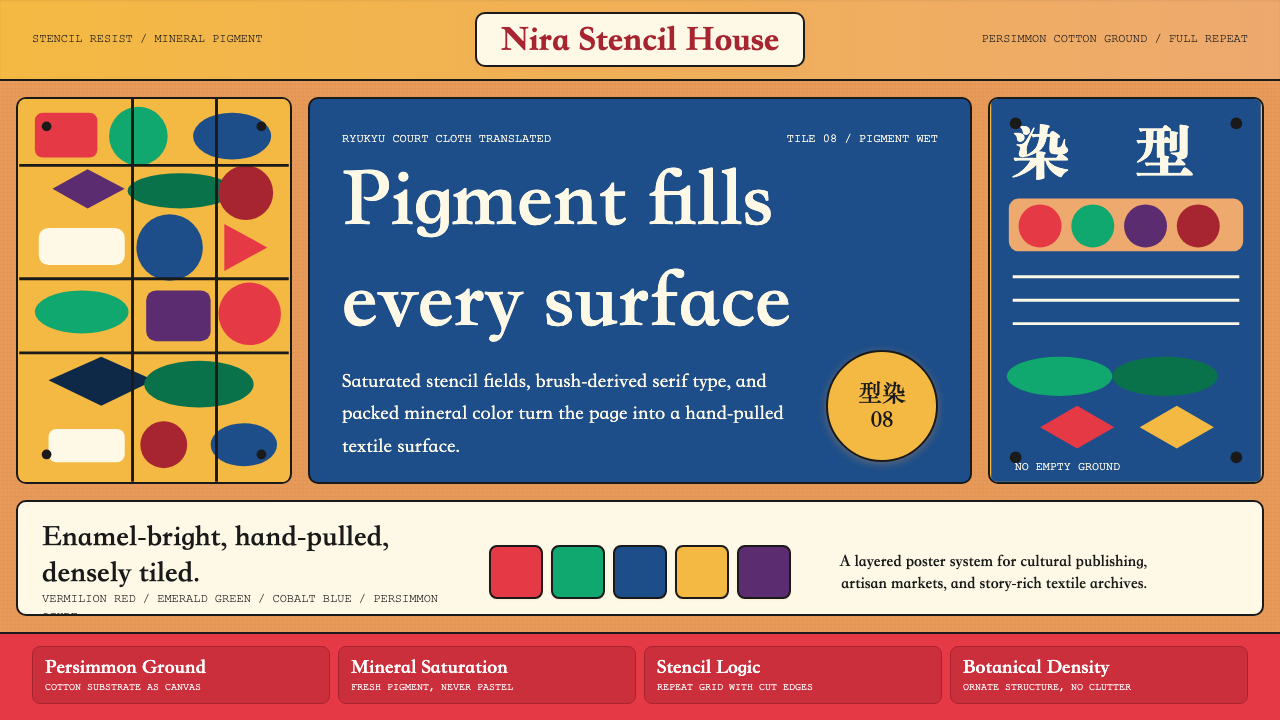
Bingata is the stencil-resist dyeing tradition of the Ryukyu Kingdom — saturated, botanical, horror vacui — and its visual logic translates into digital interfaces with surprising directness.
Okinawan Bingata Resist Dye in brief
Bingata — the name combines the Okinawan words for 'color' (bin) and 'pattern' (gata) — is a stencil-resist textile dyeing tradition native to the Ryukyu Kingdom, a sovereign archipelago state that flourished between the fifteenth and nineteenth centuries before its annexation into Japan. The technique involves cutting intricate patterns into washi paper or shark skin, applying pigment paste through the stencil, and then selectively removing resist to reveal the ground. Successive layers build a composition of botanical density that fills every square inch of the cloth.
What makes bingata visually distinctive is the relationship between its palette and its composition. The pigments — traditionally ground from mineral sources including malachite, azurite, cinnabar, and iron oxide — produce colors that sit at a particular register: deeply saturated but not garish, warm but never muddy. Against a persimmon-tanned cotton ground, vermilion fish and cobalt waves read as enamel-bright, as though the design were fired rather than dyed. The composition enforces horror vacui: fish, banana leaves, peonies, cranes, and wave forms interlock without gap or hierarchy, every element of equal visual weight.
As a design system, bingata offers a vocabulary that is simultaneously ornate and disciplined. It is not maximalism in the contemporary sense — it is a specific tropical court aesthetic governed by strict conventions about motif selection, color register, and compositional density. The distinction matters for application: bingata-derived work succeeds when it honors those conventions rather than simply reproducing surface busyness.
Where does Okinawan Bingata Resist Dye come from?
The Ryukyu Kingdom occupied a strategic position in the maritime trade networks of the fifteenth and sixteenth centuries, serving as an intermediary between China, Japan, Korea, and the island nations of Southeast Asia. This commercial centrality brought both wealth and aesthetic influence. Chinese court textile traditions — particularly the use of mineral pigments and stencil methods — arrived through tribute relationships and merchant contact; they were absorbed and transformed into something distinctly Okinawan over the course of several generations.
Bingata emerged as a court textile, produced in Shuri — the royal capital on the western side of the Okinawa main island — primarily for the Ryukyuan aristocracy. The most elaborate robes, with their densest patterns and most vivid colorwork, were restricted to members of the royal family; the colors themselves served as a rank indicator, with particular hues and color combinations reserved by sumptuary law for specific social tiers. This hierarchical function shaped the vocabulary: the most saturated, most complex designs were not aesthetic experiments but social documents.
The craft's transmission was disrupted twice by political catastrophe. The first disruption came with the Satsuma Domain's invasion of the Ryukyu Kingdom in 1609, which imposed Japanese feudal authority over the islands while preserving the formal structure of the Ryukyuan court — a political arrangement that ironically helped preserve bingata production, since the court's ceremonial functions continued to demand court textiles. The second and more severe rupture came with the Meiji annexation of 1879 and the abolition of the Ryukyuan royal court. Without royal patronage, the workshops that had produced bingata for generations lost their primary clients and much of their institutional knowledge.
The twentieth-century revival of bingata is closely linked to the broader Japanese folk craft (mingei) movement championed by Yanagi Soetsu in the 1920s and 1930s, which drew renewed scholarly and commercial attention to regional craft traditions across Japan, including Okinawa. After the devastation of the Second World War — Okinawa suffered among the heaviest civilian casualties of any theater — the island's reversion to Japanese administration in 1972 triggered a self-conscious effort to recover and document Okinawan cultural heritage, including bingata. Contemporary studios in Shuri, Naha, and Yomitan continue production, adapting traditional stencil vocabularies to new garment forms and, increasingly, to surface design applications well beyond textile.
What defines the Okinawan Bingata Resist Dye look?
Color Palette
The bingata palette reads as mineral-saturated and tropically warm: persimmon orange grounds, vermilion reds, cobalt and turquoise blues, leaf greens ranging from pale celadon to deep malachite, and accents of egg-yolk yellow. These are not pastel colors, nor are they the flat primaries of Western modernism — they sit at a point of maximum pigment depth while retaining warmth. The ground color itself carries tonal weight, appearing as a fifth element in the composition rather than a neutral support.
Horror Vacui Composition
Bingata composition leaves no negative space. Motifs interlock like puzzle pieces — a fish's tail curves into a wave form, which gives way to a banana leaf, which overlaps a peony, which borders a crane's wing. This total surface coverage is not random accumulation but a structured system in which each element is assigned a specific scale relationship to its neighbors. The result is a composition that reads as dense but never chaotic: every corner is resolved, every transition deliberate.
Motif Vocabulary
The bingata repertoire draws on a specific set of motifs with fixed cultural meanings: fish and sea waves (abundance and connection), banana leaves and peonies (tropical vitality), cranes (longevity and nobility), chrysanthemums (royalty, borrowed from Chinese and Japanese court traditions), and geometric lattices used as compositional anchors. Each motif class has an associated scale range and color assignment. Mixing motifs from outside this vocabulary — or deploying canonical motifs at the wrong scale — is the primary error in bingata-derived work.
Layered Pigment Depth
Bingata achieves its characteristic luminosity not from any single vivid pigment but from the layering process: a base resist, a mid-layer pigment application, selective removal, and often a final outlines pass that both defines forms and unifies the surface. In digital application, this translates into a compositional approach where forms are understood as stacked layers of color with distinct outlines rather than flat silhouettes. Shadows within individual motifs are handled with a darker version of the same hue — internal modeling — rather than a neutral gray overlay.
Stencil Geometry
Beneath the botanical imagery, bingata composition is organized by an underlying geometric grid derived from the repeat structure of the stencil. This grid is rarely visible as a line but is felt as a rhythm: the motifs rotate, tile, and mirror in patterns that betray the repeat unit. In some bingata designs, particularly those using geometric ground patterns as fillers between organic motifs, the grid becomes explicit — a lattice of diamonds, hexagons, or wave-scale forms (uroko) that gives the surface a crystalline underlying structure.
Outline and Contour
Every motif in bingata is bounded by a fine outline — drawn in a dark version of the form's own color or in black — that both separates adjacent forms and gives the composition legibility at a distance. This outline is not merely a border; it is the structure that holds the composition together across multiple colors applied at high saturation. In digital work, preserving this outlined quality distinguishes bingata-derived design from flat vector illustration: the line is a distinct layer, not an artifact of shape edges.
Warmth Over Coolness
Despite the presence of cobalt blues and deep greens in the palette, bingata compositions read as warm overall. This is a function of the persimmon ground, the prevalence of vermilion and orange-red in the primary motifs, and the way the mineral pigments interact — blues appear more turquoise than icy, greens more emerald than slate. Any digital interpretation that privileges cool neutrals in the base or background will drift away from the tradition's fundamental warmth, producing something that looks generically tropical rather than specifically bingata.
Who shaped Okinawan Bingata Resist Dye?
Shiroma Eiki is one of the most prominent bingata practitioners of the modern era, recognized by the Japanese government as a holder of an important intangible cultural property for his work in maintaining and transmitting the classical Shuri bingata tradition. His studio practice has concentrated on preserving the historical stencil vocabulary and pigment methods of the royal court period while producing works that function as contemporary surface design rather than purely archival reproduction. His approach represents the mainstream of postwar bingata: rigorous traditional technique applied to living craft production.
Tamanaha Sachiko is among the practitioners who have worked to introduce bingata stencil techniques and palette vocabularies into contemporary fashion and interior textile design, expanding the tradition beyond its original ceremonial context. Her contribution lies not in historical reconstruction but in demonstrating that bingata's compositional and chromatic logic can produce compelling results when applied to new garment forms and surface contexts — a practice that has influenced how younger Okinawan craft designers understand the tradition's transferability.
Chinen Sachiko has been associated with efforts to document and teach bingata technique during the critical postwar revival period, when the transmission of historical knowledge was particularly vulnerable to disruption. Her pedagogical work helped ensure that the technical specifics of pigment preparation, stencil cutting, and resist application were systematically recorded and passed to new generations of practitioners — a contribution whose significance lies less in visible artworks than in the survival of the craft's underlying methodology.
Sho En — a member of the Ryukyuan royal family — is credited as an important early patron and practitioner in the formalization of bingata as a royal court textile. The tradition places him in the fifteenth to sixteenth century period when bingata developed its canonical vocabulary of motifs and its associated sumptuary conventions. Whether or not the attributions are historically precise, his name represents the broader entanglement of bingata production with royal patronage that shaped the tradition's fundamental character.
Yanagi Soetsu, the philosopher and critic who founded the Japanese folk craft (mingei) movement in the 1920s, did not practice bingata himself but was instrumental in directing national and international attention toward Okinawan craft traditions at a moment when they were in genuine danger of disappearing. His aesthetic framework — which valued craft objects made by anonymous artisans for everyday use over objects made by named artists for elite consumption — was somewhat at odds with bingata's aristocratic origins, but his advocacy helped secure both scholarly documentation and commercial revival for the tradition during a critical period.
How do you use Okinawan Bingata Resist Dye today?
Bingata is one of the richer historical design languages to apply to contemporary digital work, precisely because its logic is compositional and chromatic rather than purely ornamental. Applying it well means understanding what it is actually doing: managing maximum visual density without chaos, using a warm mineral palette as structural signal rather than decoration, and treating every motif as part of an interlocking system rather than a standalone element. Surface borrowing — a fish here, a wave there, against a white background — will produce something that reads as generic tropical illustration, not bingata.
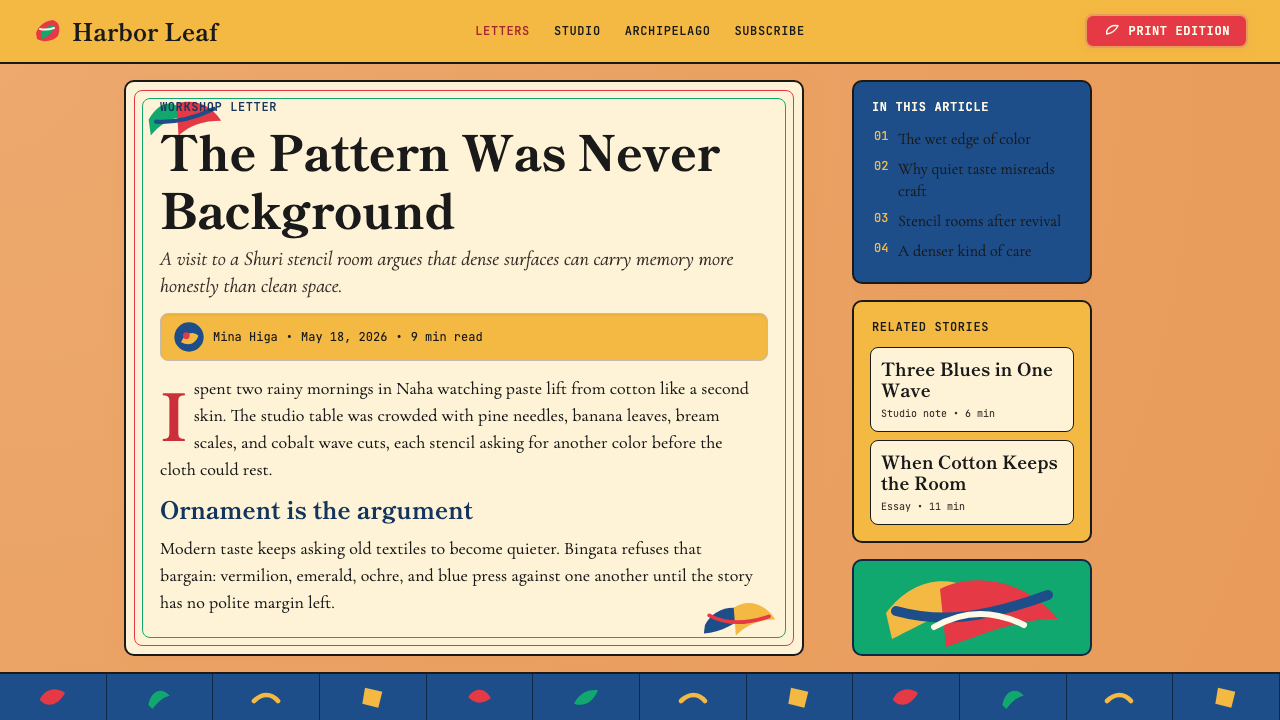
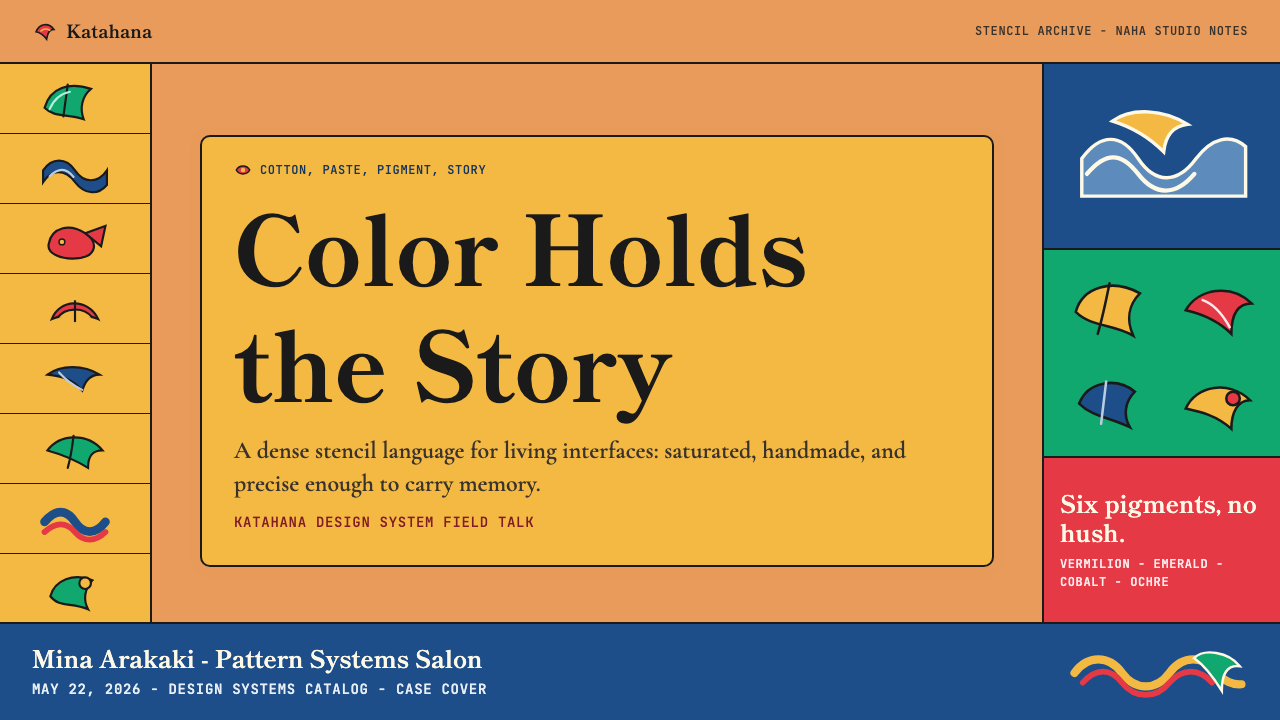
For presentation slides, bingata works most naturally on cover and section-break pages where the full compositional density can be deployed without competing with content. A cover slide using a full-coverage bingata pattern as background — tiled or cropped — with a white or cream text block applied over it achieves a strong identity statement. The key is contrast: the pattern must be rich enough to register as a field, not a distraction. For content slides, a restrained approach works better: pull the palette rather than the pattern density. Use the persimmon-to-vermilion warmth as the primary color family for headers and data highlights, with cobalt accents for secondary elements, and keep the body of the slide white or near-white so the content reads cleanly.
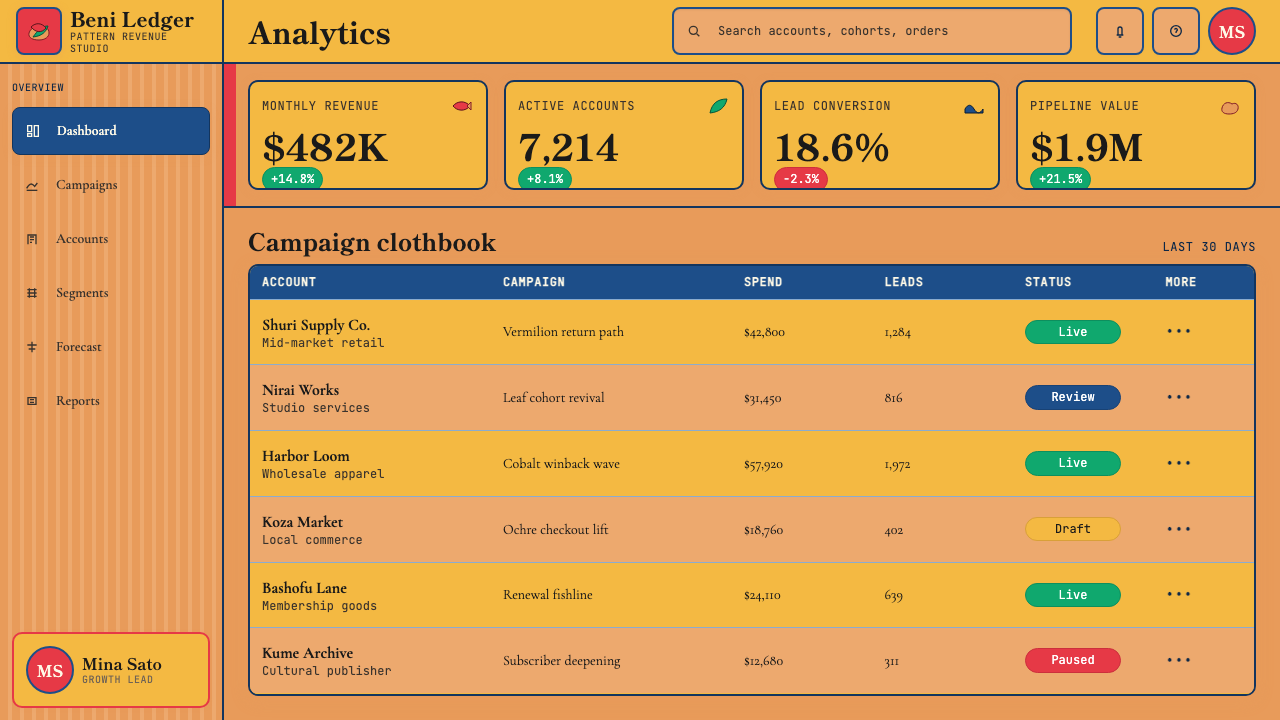
For web interfaces, bingata is best deployed as a surface accent language rather than a structural system. Dashboards benefit from the palette applied to data visualization elements — charts and indicators in the bingata warm spectrum read as confident and culturally specific without the coldness of typical corporate data palettes. Pricing pages can use bingata-pattern backgrounds on feature highlight cards or tier headers, contained within a clean typographic grid that handles the functional hierarchy. The pattern should never compete with interactive controls; reserve it for decorative bands, hero areas, and illustration regions.
For editorial and marketing contexts, bingata is particularly strong in materials where cultural authority and visual richness both matter: travel and hospitality content, cultural institution communications, fashion lookbooks, and premium consumer brand work. The composition's density makes it well suited to hero images and full-bleed spreads, where the pattern becomes environment rather than motif. For marketing materials that need both cultural specificity and functional clarity, the most effective approach is to pair a bingata-pattern zone with generous white space elsewhere — the two regions in contrast, each making the other read more strongly.
A common mistake when applying bingata is treating the palette as a pastel tropical colorway — reducing the saturated mineral pigments to lighter, lower-saturation tints that read as beach resort rather than royal court. A second frequent error is applying the motifs at too large a scale, so that individual fish or leaves become legible as isolated images rather than elements of an interlocking field. Bingata reads correctly when the individual motifs are small enough relative to the total composition that the eye reads the surface texture first and the individual motifs second. If you can immediately name every element without scanning the piece as a whole, the motifs are too large.
Okinawan Bingata Resist Dye — FAQ
What is the difference between bingata and other Japanese stencil dyeing traditions like katazome?
Katazome is a stencil dyeing technique practiced across Japan that typically uses a paste-resist method to produce one or two-color repeat patterns on cotton or linen — the ground color and one dyed color. Bingata is distinguished by its use of multiple layered mineral pigments (rather than fiber-reactive dyes), its tropical palette that reflects Ryukyuan rather than Japanese mainland aesthetic conventions, and its horror vacui compositional approach. A katazome cloth often has a clear, airy relationship between motif and ground; a bingata cloth fills every surface. The two traditions share technical method but serve entirely different aesthetic ends and cultural contexts.
Can bingata be applied effectively to dark-background interfaces?
A dark inversion of bingata is possible but requires careful adjustment. The tradition's canonical form is a warm-toned light ground — persimmon, cream, or pale gold — with darker motifs applied on top. On a dark background, the color relationships reverse: the motifs must become the lighter elements, which tends to push the palette toward tones it does not naturally inhabit. The most successful dark adaptations preserve the warmth of the palette — keeping the blues turquoise rather than navy, the reds vermilion rather than burgundy — and use a very dark warm brown or deep persimmon as the background rather than neutral black. Cold dark backgrounds drain the palette of its distinctive warmth and produce something that reads as generic ornamental rather than bingata.
How do I use bingata motifs without the design feeling culturally appropriative?
The question of cultural appropriation in design is complex, but there are practical principles that separate thoughtful use from exploitation. First, specificity matters: understanding that bingata is distinctly Okinawan — not generically Japanese, Southeast Asian, or tropical — and signaling that specificity in how you attribute and describe the work is a meaningful act of respect. Second, the tradition has living practitioners who make work and teach; licensing designs from or crediting contemporary bingata artists is more grounded than lifting historical motifs from archives. Third, consider whether the visual system is being engaged at the level of surface pattern (weaker) or compositional and chromatic logic (stronger) — the latter requires deeper understanding and produces work that honors the tradition more substantively than surface quotation.
What modern design contexts have borrowed from bingata, and what went wrong?
Bingata has appeared in contemporary fashion — most visibly in resort and swimwear collections — and in packaging and branding for Japanese cultural tourism. The most common failure mode is reduction to palette and approximate motif without the compositional logic: designers pick the warm oranges and aquas, place a few fish or leaves at large scale on a white ground, and call the result bingata-inspired. The outcome reads as generic tropical print. The second failure mode is mixing bingata motifs with East Asian visual vocabularies from outside the Ryukyuan tradition — pairing bingata fish with Japanese mon crests or Chinese phoenix forms — which produces a conflationary aesthetic that erases the tradition's cultural specificity. Success cases tend to be those where designers engaged with the compositional density as the primary challenge, treating the full-field, horror vacui approach as the defining design problem to solve.
Is bingata the right choice for a product that needs to communicate warmth and handcraft?
Bingata communicates warmth in a specific register: tropical, court, mineral, ornate. It is warm in the sense of saturated color temperature and the human evidence of the hand-pulled stencil, but it is not cozy or rustic — those qualities belong to other traditions. A product that needs warmth in the sense of approachability, softness, or informal intimacy would be better served by textile traditions with airier compositions and less saturated palettes. Bingata is better suited to products that want to communicate richness, ceremony, cultural authority, and tropical vitality — a premium gift brand, a cultural institution, a hospitality property with a specific sense of place. If the warmth needed is hearth-and-home, bingata will likely overshoot.
Related design styles
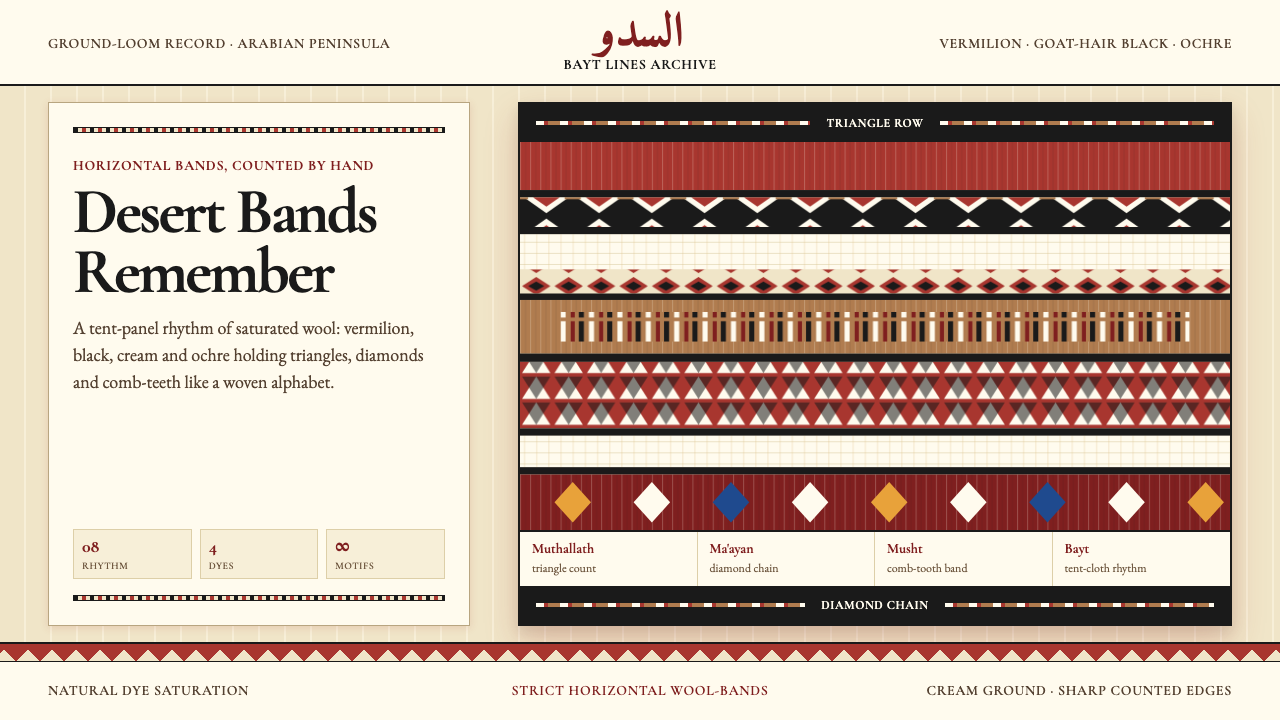 Bedouin Desert Textile (Sadu)Woven memory, not ornament. Vermilion-black bands count triangles and diamond…
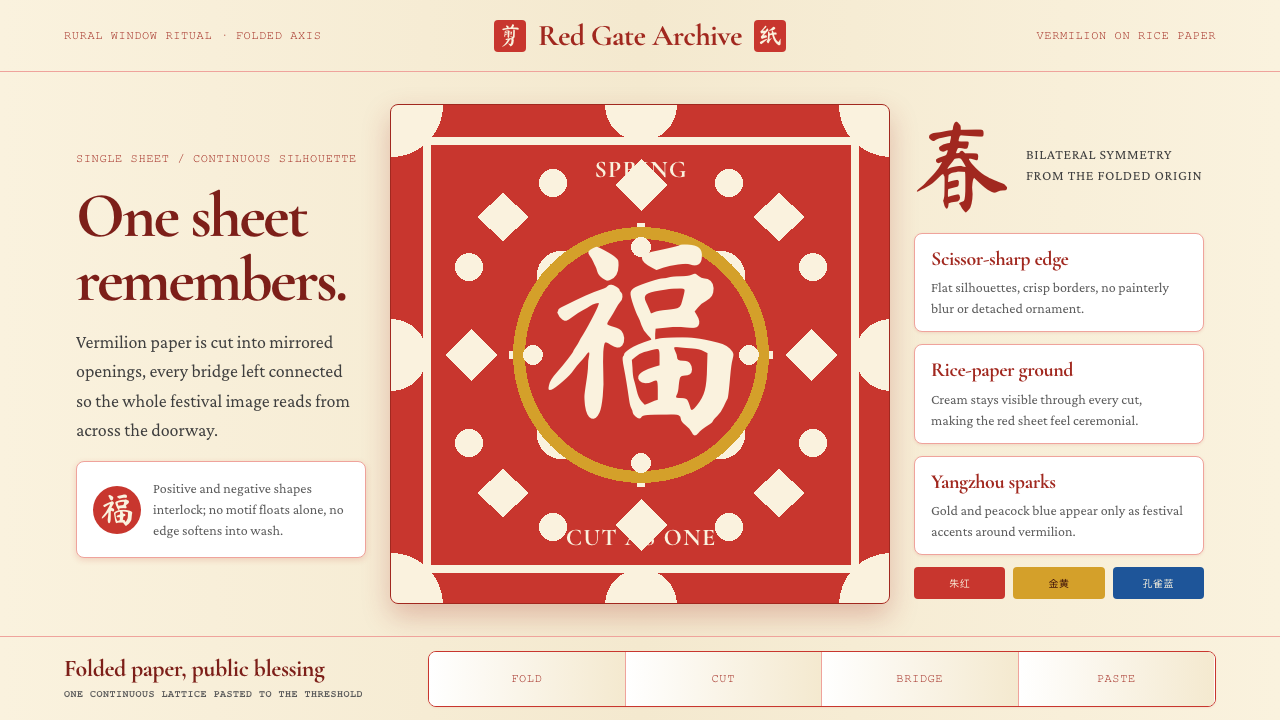 Chinese Jianzhi Paper-CuttingRitual red, cut as one. Vermilion lacework on rice-paper cream locks every sh…
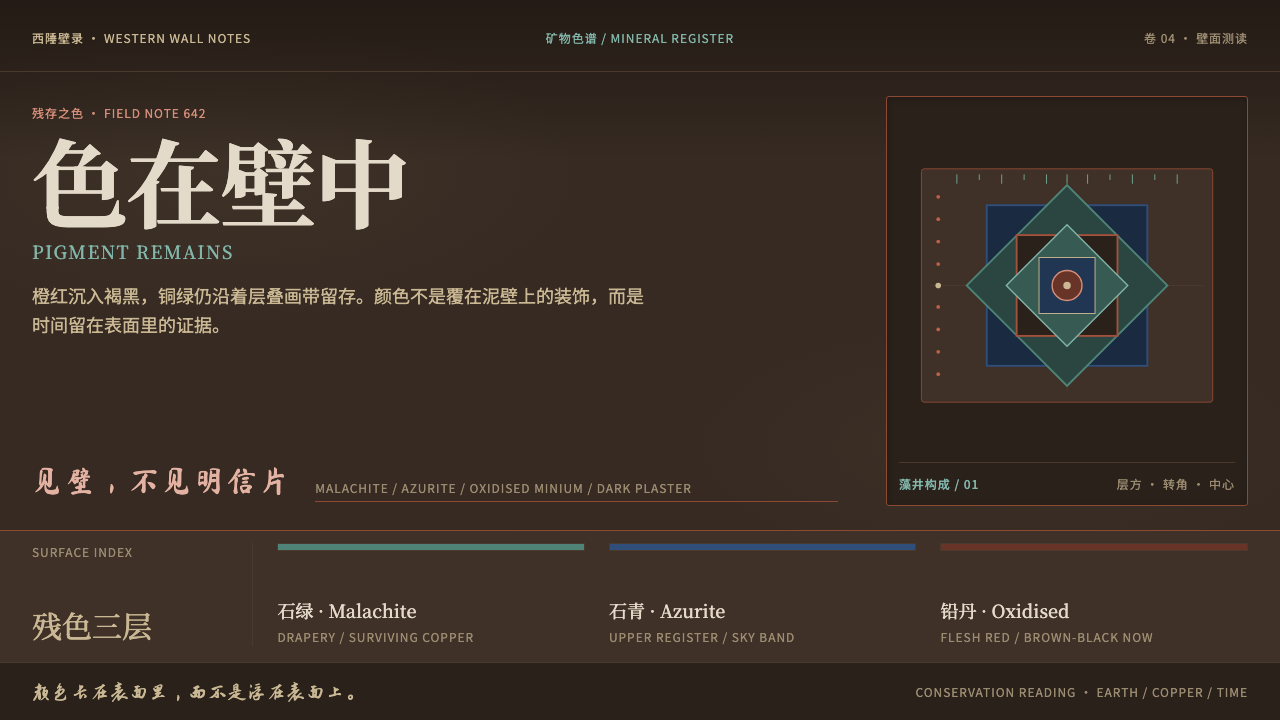 Dunhuang Mogao MuralsTime lives in the wall. Mineral green and azurite endure on oxidised brown pl…
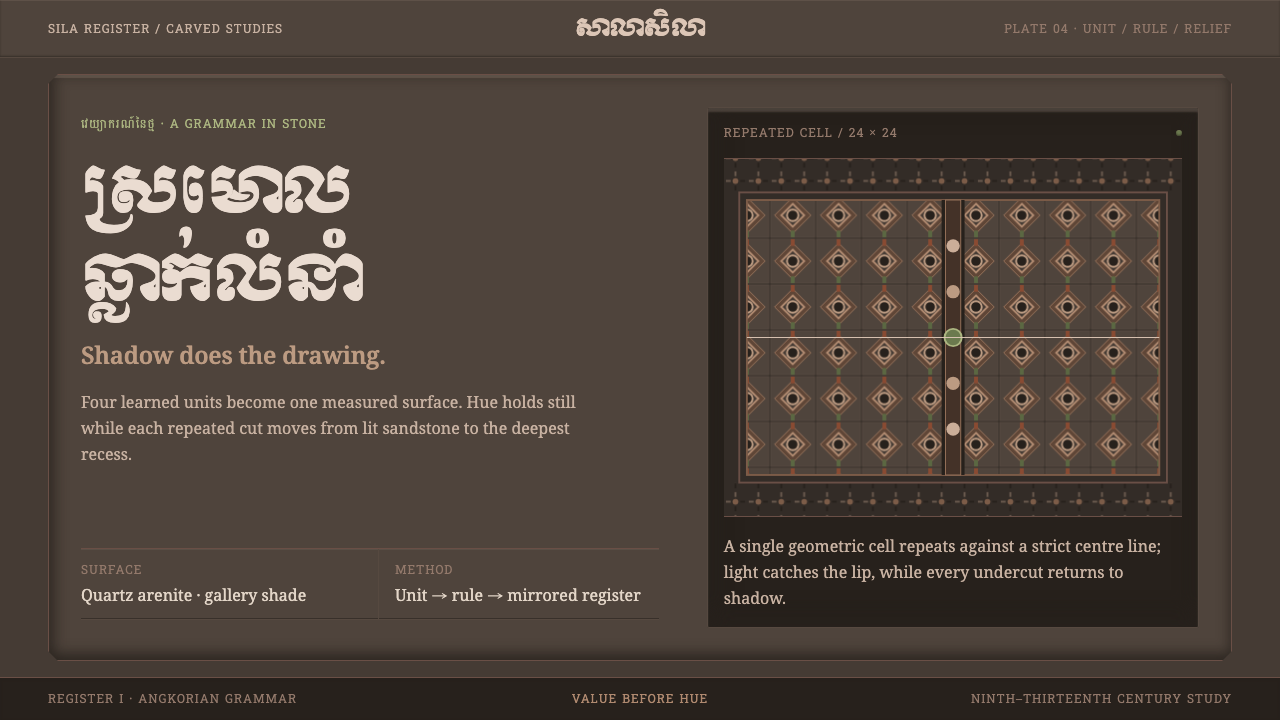 Khmer Kbach MotifShadow carves the grammar. Repeated stone cells turn a narrow sandstone palet…
 Madagascan Lamba SilkAncestry is woven flat. Crimson, indigo, cream and gold run in strict silk ba…
 Madhubani (Mithila Folk Painting)No empty ground. Vermilion, indigo and saffron pack double-outlined panels wi…