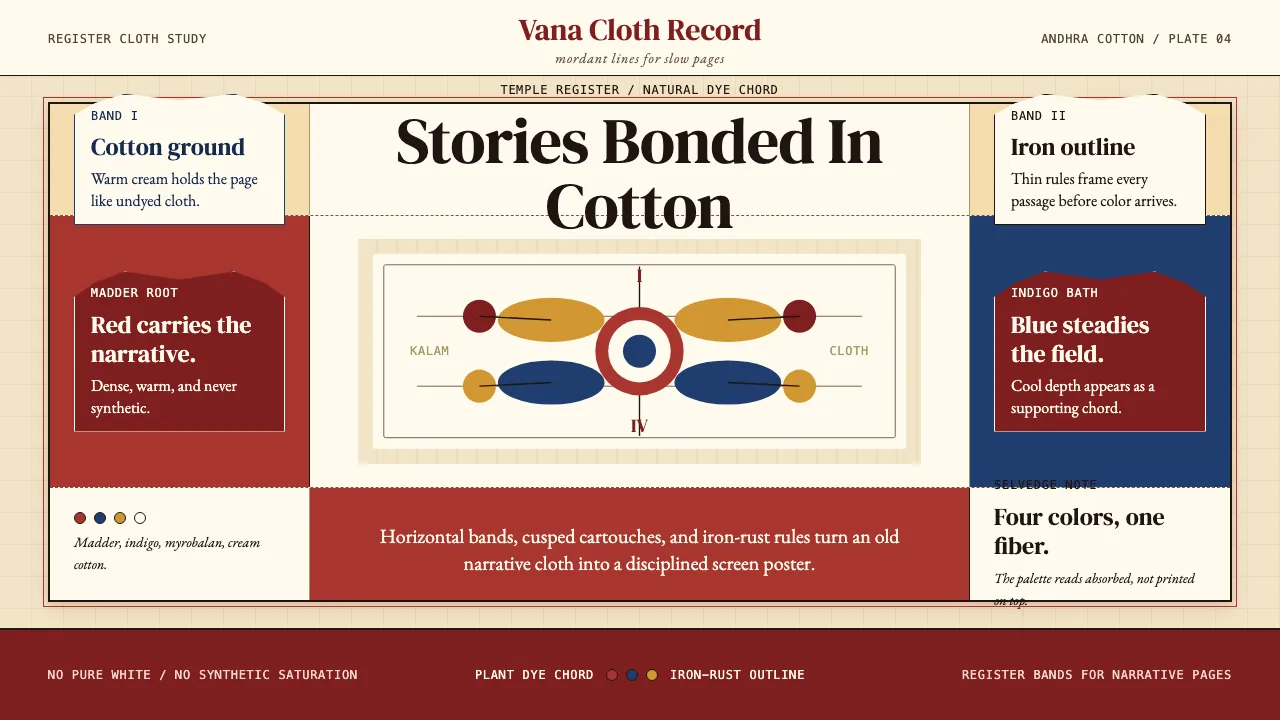
About Kalamkari (Andhra Pradesh)
Kalamkari is the 800-year-old South Indian craft of drawing on cotton with a tamarind-twig kalam, using mordants and plant dyes — madder red, iron-rust black, indigo blue, myrobalan yellow — bonded permanently into the fiber. Two schools coexist: Srikalahasti's purely hand-drawn temple narratives, and Machilipatnam's block-printed, kalam-detailed export work.
As a design system, Kalamkari translates that cloth into screen: cream cotton grounds, horizontal register bands carrying narrative content, iron-rust outlines, tree-of-life spines, and a chord of warm natural-dye color that never reads synthetic.
- Origin
- Andhra Pradesh, India — Srikalahasti and Machilipatnam, Coromandel Coast
- Era
- 800+ years; temple-cloth roots, Mughal-Persian patronage 1500–1700, European chintz trade 1600s–1700s, modern GI-tag revival
- Key figures
- J. Niranjan · Lakshman Rao · Pitchuka Srinivas · Sabyasachi Mukherjee
- Movements
- South Indian temple cloth-painting · Coromandel Coast chintz · Indo-Persian floral lineage
Kalamkari (Andhra Pradesh) design spec
Colors
Typography
The other 11 sections — buttons, cards, spacing, motion, techniques and more — open once you unlock. Download the DESIGN.md or send it to your AI in one click. Unlock once, yours forever.
Sign up nowStyles similar to Kalamkari (Andhra Pradesh)
Also inspired by crafts & folk art, with a close feel.
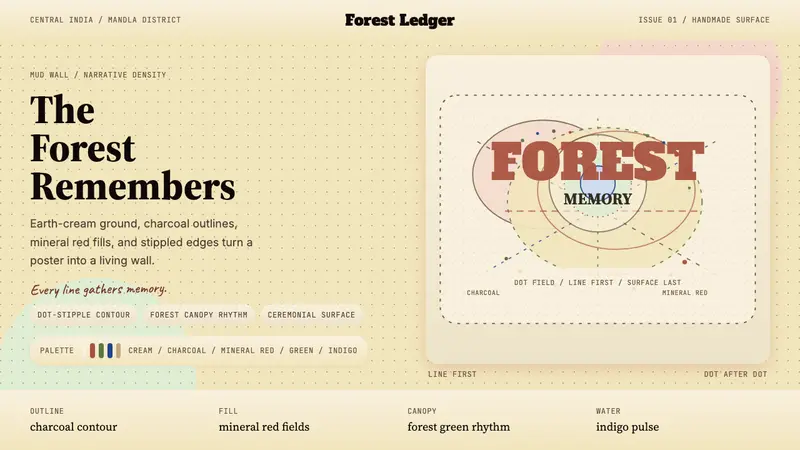 Gond Tribal Art (Madhya Pradesh)The wall becomes a forest. Earth-cream, charcoal, and stippled red make it ceremonial.
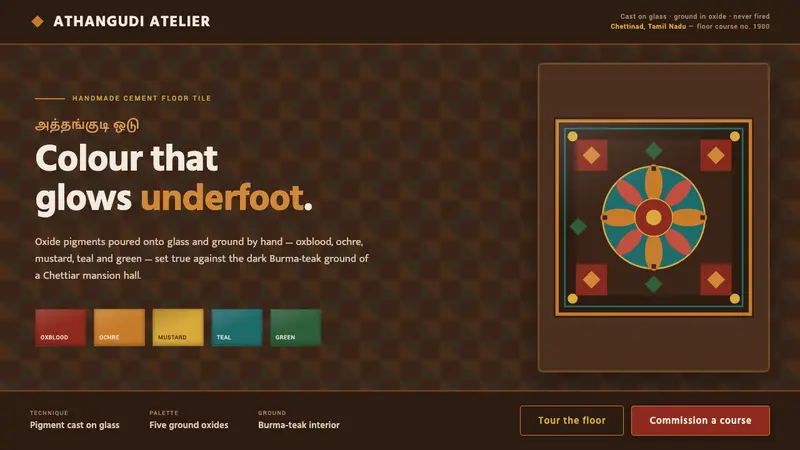 Chettinad Athangudi TilesColour that glows underfoot. Five ground-oxide tones on dark teak in bordered tile-grid medallions.
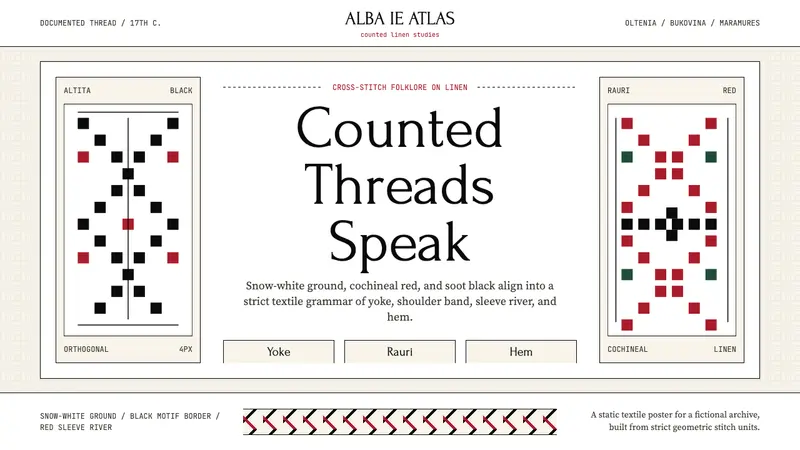 Romanian Ie (folk embroidered blouse)Folklore becomes grid. Cochineal red and soot black stitch strict bands on linen white.
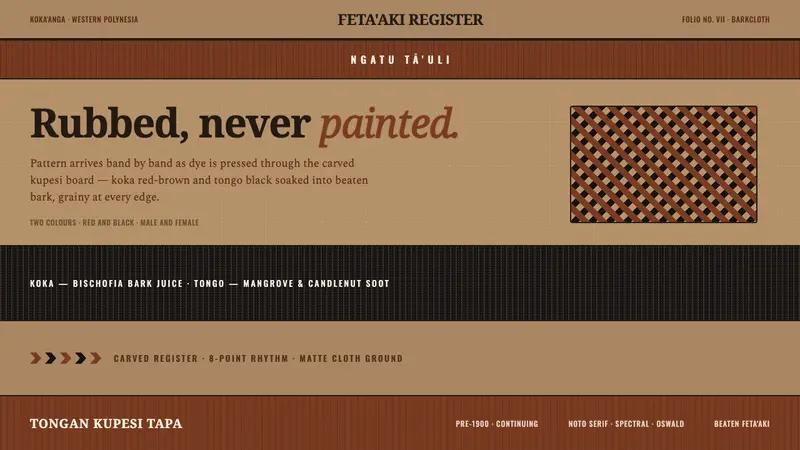 Tongan Kupesi TapaRubbed, never painted. Koka red and tongo black soak into beaten tan bark as stacked grainy bands.