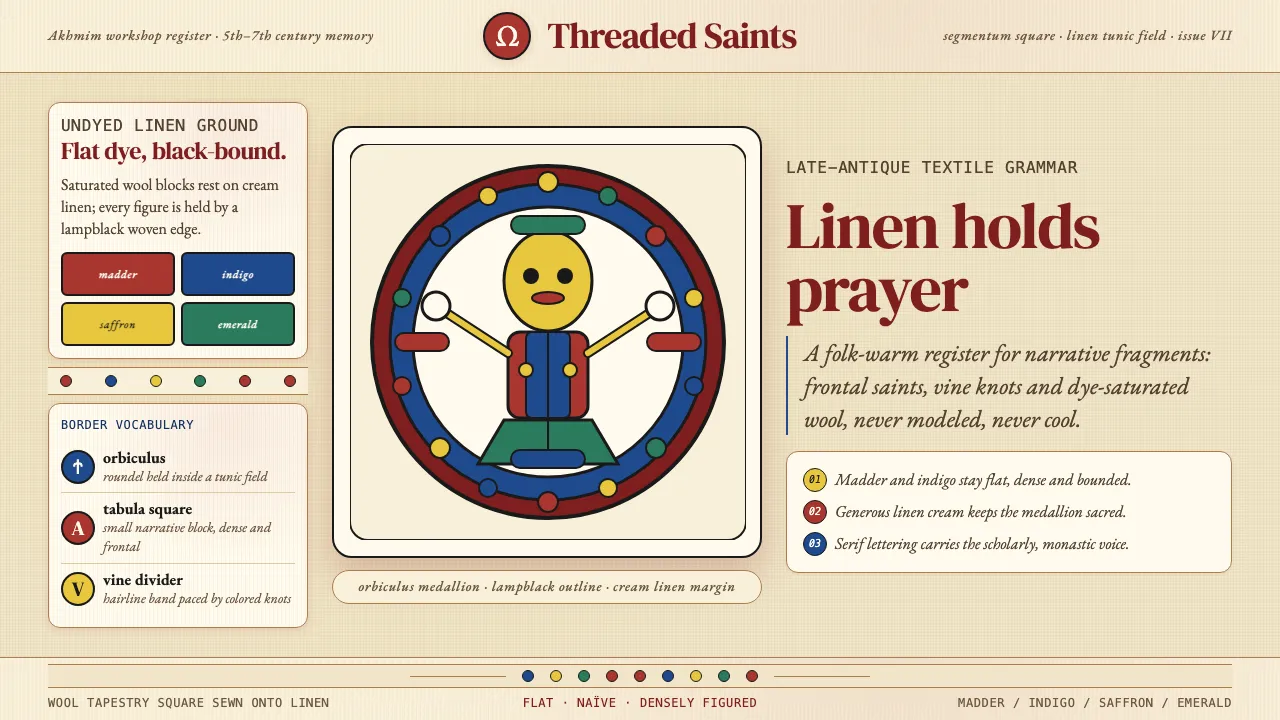
About Egyptian Coptic Textile
Egyptian Coptic Textile is the 4th–8th century weaving tradition of Christian Egypt — wool tapestry-squares sewn onto undyed-linen tunics, with saturated madder-red, indigo, saffron, and emerald figures bounded by lampblack outline. The vocabulary is folk-warm and unmistakable: big-eyed praying orants, dancing maenads carried over from pagan memory, peacocks and vine-tendrils, lion-and-hunter scenes.
Neither Greco-Roman nor Byzantine, this is its own register — flat, naïve, densely figured, profoundly warm. Rediscovered in the 1880s through tomb excavations at Akhmim and Antinoöpolis, the surviving fragments at the V&A, Met, Louvre, and Abegg-Stiftung anchor every detail of this system.
- Origin
- Coptic Egypt (Akhmim · Antinoöpolis · Fayum · Bawit · Saqqara)
- Era
- 4th–8th century CE; peak 5th–7th c; rediscovered 1880s onward
- Key figures
- Albert Gayet · Theodor Graf · Anna Gonosová · Cäcilia Fluck
- Movements
- Late-Antique Mediterranean Christian art · Pharaonic visual-memory survival · Coptic Orthodox cultural revival
Egyptian Coptic Textile design spec
Colors
Typography
The other 11 sections — buttons, cards, spacing, motion, techniques and more — open once you unlock. Download the DESIGN.md or send it to your AI in one click. Unlock once, yours forever.
Sign up nowStyles similar to Egyptian Coptic Textile
Also inspired by crafts & folk art, with a close feel.
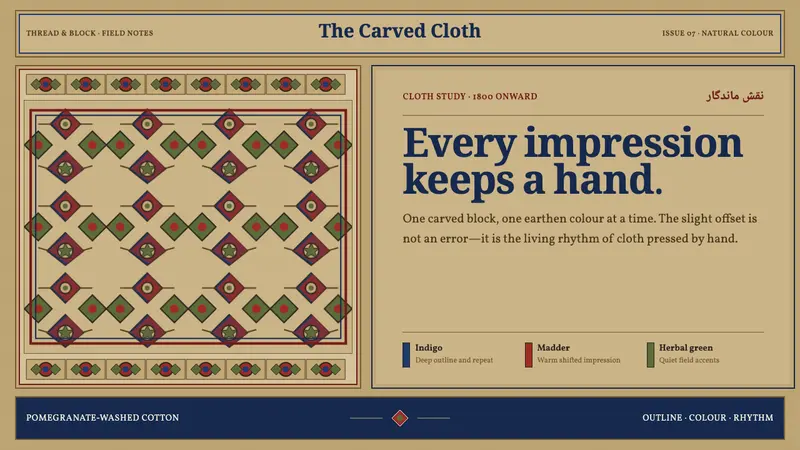 Isfahan Qalamkar PrintEvery impression keeps a hand. Indigo and madder repeats shift softly across pomegranate-tan cloth.
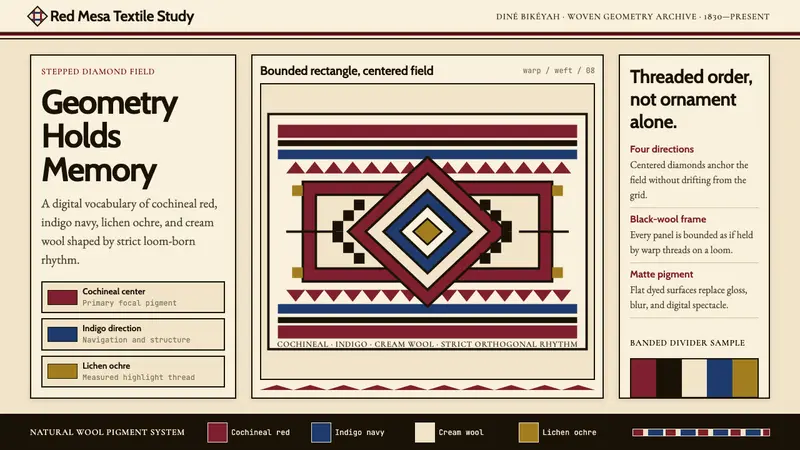 Navajo BlanketGeometry carries memory. Cochineal, indigo, and cream wool form strict stepped diamonds.
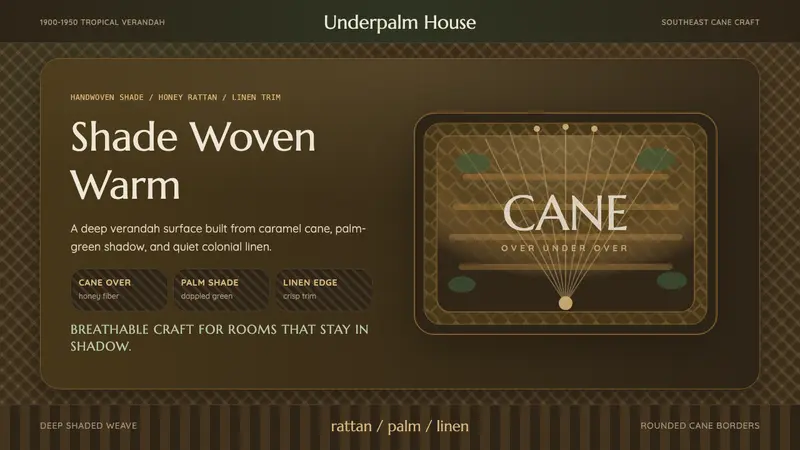 Rattan & WickerWarm shade has texture. Honey cane and palm green weave across a dark verandah ground.
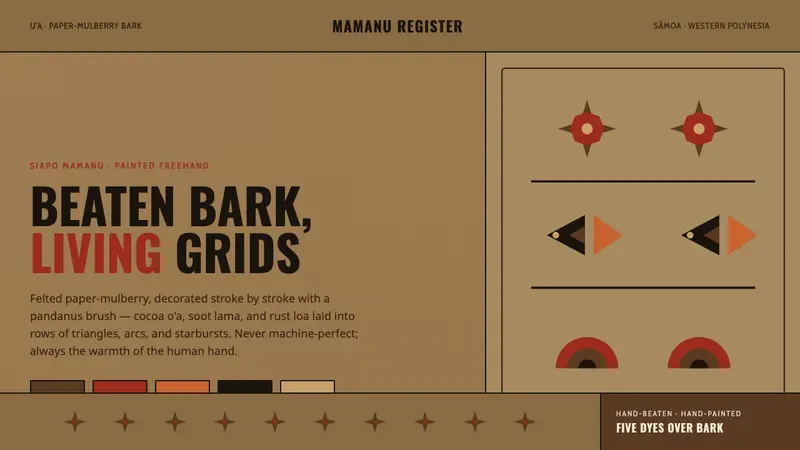 Samoan Siapo MamanuBeaten bark, never white. Five natural dyes paint freehand grids of fish, shells, starbursts.